Proceedings of NAACL-HLT 2018, pages 1024–1034
Learning Word Embeddings for Low-resource Languages by PU Learning
Chao Jiang
University of Virginia [email protected]
Cho-Jui Hsieh
University of California Davis [email protected]
Hsiang-Fu Yu
Amazon
Kai-Wei Chang
University of California Los Angeles [email protected]
Abstract
Word embedding is a key component in many downstream applications in processing natu-ral languages. Existing approaches often as-sume the existence of a large collection of text for learning effective word embedding. However, such a corpus may not be avail-able for some low-resource languages. In this paper, we study how to effectively learn a word embedding model on a corpus with only a few million tokens. In such a situa-tion, the co-occurrence matrix is sparse as the co-occurrences of many word pairs are unob-served. In contrast to existing approaches of-ten only sample a few unobserved word pairs as negative samples, we argue that the zero entries in the co-occurrence matrix also pro-vide valuable information. We then design a Positive-Unlabeled Learning (PU-Learning) approach to factorize the co-occurrence matrix and validate the proposed approaches in four different languages.
1 Introduction
Learning word representations has become a fundamental problem in processing natural lan-guages. These semantic representations, which map a word into a point in a linear space, have been widely applied in downstream applications, including named entity recognition (Guo et al., 2014), document ranking (Nalisnick et al.,2016), sentiment analysis (Irsoy and Cardie,2014), ques-tion answering (Antol et al.,2015), and image cap-tioning (Karpathy and Fei-Fei,2015).
Over the past few years, various approaches have been proposed to learn word vectors (e.g., (Pennington et al., 2014; Mikolov et al., 2013a; Levy and Goldberg,2014b;Ji et al.,2015)) based on co-occurrence information between words ob-served on the training corpus. The intuition behind this is to represent words with similar vectors if
they have similar contexts. To learn a good word embedding, most approaches assume a large col-lection of text is freely available, such that the es-timation of word co-occurrences is accurate. For example, the Google Word2Vec model (Mikolov et al., 2013a) is trained on the Google News dataset, which contains around 100 billion to-kens, and the GloVe embedding (Pennington et al., 2014) is trained on a crawled corpus that contains 840 billion tokens in total. However, such an as-sumption may not hold for low-resource languages such as Inuit or Sindhi, which are not spoken by many people or have not been put into a digital format. For those languages, usually, only a lim-ited size corpus is available. Training word vectors under such a setting is a challenging problem.
One key restriction of the existing approaches is that they often mainly rely on the word pairs that are observed to co-occur on the training data. When the size of the text corpus is small, most word pairs are unobserved, resulting in an ex-tremely sparse co-occurrence matrix (i.e., most en-tries are zero)1. For example, the text82 corpus
has about 17,000,000 tokens and 71,000 distinct words. The corresponding co-occurrence matrix has more than five billion entries, but only about 45,000,000 are non-zeros (observed on the train-ing corpus). Most existtrain-ing approaches, such as Glove and Skip-gram, cannot handle a vast num-ber of zero terms in the co-occurrence matrix; therefore, they only sub-sample a small subset of zero entries during the training.
In contrast, we argue that theunobservedword pairs can provide valuable information for train-ing a word embeddtrain-ing model, especially when the co-occurrence matrix is very sparse. Inspired
1Note that the zero term can mean either the pairs of
words cannot co-occur or the co-occurrence is not observed in the training corpus.
2http://mattmahoney.net/dc/text8.zip
by the success of Positive-Unlabeled Learning (PU-Learning) in collaborative filtering applica-tions (Pan et al., 2008; Hu et al., 2008; Pan and Scholz,2009;Qin et al.,2010;Paquet and Koenig-stein,2013;Hsieh et al.,2015), we design an algo-rithm to effectively learn word embeddings from both positive (observed terms) and unlabeled (un-observed/zero terms) examples. Essentially, by using the square loss to model the unobserved terms and designing an efficient update rule based on linear algebra operations, the proposed PU-Learning framework can be trained efficiently and effectively.
We evaluate the performance of the proposed approach in English3 and other three
resource-scarce languages. We collected unlabeled lan-guage corpora from Wikipedia and compared the proposed approach with popular approaches, the Glove and the Skip-gram models, for training word embeddings. The experimental results show that our approach significantly outperforms the baseline models, especially when the size of the training corpus is small.
Our key contributions are summarized below.
• We propose a PU-Learning framework for learning word embedding.
• We tailor the coordinate descent algo-rithm (Yu et al., 2017b) for solving the cor-responding optimization problem.
• Our experimental results show that PU-Learning improves the word embedding training in the low-resource setting.
2 Related work
Learning word vectors. The idea of learning word representations can be traced back to La-tent Semantic Analysis (LSA) (Deerwester et al., 1990) and Hyperspace Analogue to Language (HAL) (Lund and Burgess, 1996), where word vectors are generated by factorizing a word-document and word-word co-occurrence matrix, respectively. Similar approaches can also be ex-tended to learn other types of relations between words (Yih et al.,2012;Chang et al.,2013) or enti-ties (Chang et al.,2014). However, due to the lim-itation of the use of principal component analysis,
3Although English is not a resource-scarce language, we
simulate the low-resource setting in an English corpus. In this way, we leverage the existing evaluation methods to evaluate the proposed approach.
these approaches are often less flexible. Besides, directly factorizing the co-occurrence matrix may cause the frequent words dominating the training objective.
In the past decade, various approaches have been proposed to improve the training of word em-beddings. For example, instead of factorizing the co-occurrence count matrix, Bullinaria and Levy (2007); Levy and Goldberg (2014b) proposed to factorizepoint-wise mutual information(PMI) and positive PMI (PPMI) matrices as these metrics scale the co-occurrence counts (Bullinaria and Levy, 2007; Levy and Goldberg, 2014b). Skip-gram model with negative-sampling (SGNS) and Continuous Bag-of-Words models (Mikolov et al., 2013b) were proposed for training word vectors on a large scale without consuming a large amount of memory. GloVe (Pennington et al., 2014) is pro-posed as an alternative to decompose a weighted log co-occurrence matrix with a bias term added to each word. Very recently, WordRank model (Ji et al., 2015) has been proposed to minimize a ranking loss which naturally fits the tasks re-quiring ranking based evaluation metrics. Stratos et al. (2015) also proposed CCA (canonical cor-relation analysis)-based word embedding which shows competitive performance. All these ap-proaches focus on the situations where a large text corpus is available.
Positive and Unlabeled (PU) Learning: Pos-itive and Unlabeled (PU) learning (Li and Liu, 2005) is proposed for training a model when the positive instances are partially labeled and the un-labeled instances are mostly negative. Recently, PU learning has been used in many classification and collaborative filtering applications due to the nature of “implicit feedback” in many recommen-dation systems—users usually only provide posi-tive feedback (e.g., purchases, clicks) and it is very hard to collect negative feedback.
W,C vocabulary of central and context words m, n vocabulary sizes
k dimension of word vectors W, H m×kandn×klatent matrices Cij weight for the (i, j) entry
Aij value of the PPMI matrix
Qij value of the co-occurrence matrix
wi,hj i-th row ofW andj-th row ofH
b,ˆb bias term
λi, λj regularization parameters | · | the size of a set
Ω Set of possible word-context pairs Ω+ Set of observed word-context pairs Ω− Set of unobserved word-context pairs
Table 1: Notations.
design a new approach for training word vectors by leveraging the PU-Learning framework and ex-isting word embedding techniques. To the best of our knowledge, this is the first work to train word embedding models using the PU-learning frame-work.
3 PU-Learning for Word Embedding
Similar to GloVe and other word embedding learn-ing algorithms, the proposed approach consists of three steps. The first step is to construct a co-occurrence matrix. Follow the literature (Levy and Goldberg,2014a), we use the PPMI metric to mea-sure the co-occurrence between words. Then, in the second step, a PU-Learning approach is ap-plied to factorize the co-occurrence matrix and generate word vectors and context vectors. Fi-nally, a post-processing step generates the final embedding vector for each word by combining the word vector and the context vector.
We summarize the notations used in this paper in Table1and describe the details of each step in the remainder of this section.
3.1 Building the Co-Occurrence Matrix
Various metrics can be used for estimating the co-occurrence between words in a corpus. PPMI metric stems frompoint-wise mutual information (PMI) which has been widely used as a mea-sure of word association in NLP for various tasks (Church and Hanks,1990). In our case, each entry P M I(w, c) represents the relevant measure be-tween a word w and a context word c by calcu-lating the ratio between their joint probability (the
chance they appear together in a local context win-dow) and their marginal probabilities (the chance they appear independently) (Levy and Goldberg, 2014b). More specifically, each entry of PMI ma-trix can be defined by
P M I(w, c) = log Pˆ(w, c) ˆ
P(w)·P(c)ˆ , (1)
where Pˆ(w),Pˆ(c) and Pˆ(w, c) are the the fre-quency of wordw, wordc, and word pairs(w, c), respectively. The PMI matrix can be computed based on the co-occurrence counts of word pairs, and it is an information-theoretic association mea-sure which effectively eliminates the big differ-ences in magnitude among entries in the co-occurrence matrix.
Extending from the PMI metric, the PPMI met-ric replaces all the negative entries in PMI matrix by 0:
P P M I(w, c) = max(P M I(w, c),0). (2)
The intuition behind this is that people usually perceive positive associations between words (e.g. “ice” and “snow”). In contrast, the negative as-sociation is hard to define (Levy and Goldberg, 2014b). Therefore, it is reasonable to replace the negative entries in the PMI matrix by 0, such that the negative association is treated as “uninforma-tive”. Empirically, several existing works (Levy et al., 2015; Bullinaria and Levy, 2007) showed that the PPMI metric achieves good performance on various semantic similarity tasks.
In practice, we follow the pipeline described in Levy et al.(2015) to build the PPMI matrix and apply several useful tricks to improve its quality. First, we apply a context distribution smoothing mechanism to enlarge the probability of sampling a rare context. In particular, all context counts are scaled to the power ofα.4:
P P M Iα(w, c) = max log ˆ P(w, c) ˆ
P(w) ˆPα(c),0
!
ˆ
Pα(c) = #(c) α
P ¯
c#(¯c)α ,
where#(w)denotes the number of times wordw appears. This smoothing mechanism effectively
alleviates PPMI’s bias towards rare words (Levy et al.,2015).
Next, previous studies show that words that oc-cur too frequent often dominate the training ob-jective (Levy et al., 2015) and degrade the per-formance of word embedding. To avoid this is-sue, we follow Levy et al. (2015) to sub-sample words with frequency more than a thresholdtwith a probabilitypdefined as:
p= 1−
s
t ˆ P(w).
3.2 PU-Learning for Matrix Factorization
We proposed a matrix factorization based word embedding model which aims to minimize the re-construction error on the PPMI matrix. The low-rank embeddings are obtained by solving the fol-lowing optimization problem:
min W,H
X
i,j∈Ω
Cij(Aij−wiThj −bi−ˆbj)2
+X i
λikwik2+
X
j
λjkhjk2, (3)
whereW andHare m×kandn×klatent ma-trices, representing words and context words, re-spectively. The first term in Eq. (3) aims for min-imizing reconstruction error, and the second and third terms are regularization terms.λiandλjare weights of regularization term. They are hyper-parameters that need to be tuned.
The zero entries in co-occurrence matrix denote that two words never appear together in the cur-rent corpus, which also refers to unobserved terms. The unobserved term can be either real zero (two words shouldn’t be co-occurred even when we use very large corpus) or just missing in the small cor-pus. In contrast to SGNS sub-sampling a small set of zero entries as negative samples, our model will try to use the information from all zeros.
The set Ωincludes all the|W| × |C|entries— both positive and zero entries:
Ω = Ω+∪Ω−. (4)
Note that we define the positive samplesΩ+to be
all the (w, c) pairs that appear at least one time in the corpus, and negative samplesΩ− are word pairs that never appear in the corpus.
Weighting function. Eq (3) is very similar to the one used in previous matrix factorization ap-proaches such as GloVe, but we propose a new way to set the weights Cij. If we set equal weights for all the entries, then Cij = constant, and the model is very similar to conducting SVD for the PPMI matrix. Previous work has shown that this approach often suffers from poor per-formance (Pennington et al., 2014). More ad-vanced methods, such as GloVe, set non-uniform weights for observed entries to reflect their con-fidence. However, the time complexity of their algorithm is proportional to number of nonzero weights (|(i, j) | Cij 6= 0|), thus they have to set zero weights for all the unobserved entries (Cij = 0 for Ω−), or try to incorporate a small set of unobserved entries by negative sampling.
We propose to set the weights for Ω+ andΩ− differently using the following scheme:
Cij =
(Qij/xmax)α, ifQij ≤xmax, and(i, j)∈Ω+ 1, ifQij > xmax, and(i, j)∈Ω+ ρ, (i, j)∈Ω−
(5)
Herexmaxandαare re-weighting parameters, and ρis the unified weight for unobserved terms. We will discuss them later.
For entries in Ω+, we set the non-uniform weights as in GloVe (Pennington et al., 2014), which assigns larger weights to context word that appears more often with the given word, but also avoids overwhelming the other terms. For entries inΩ−, instead of setting their weights to be 0, we assign a small constant weightρ. The main idea is from the literature of PU-learning (Hu et al.,2008; Hsieh et al., 2015): although missing entries are highly uncertain, they are still likely to be true 0, so we should incorporate them in the learning pro-cess but multiplying with a smaller weight accord-ing to the uncertainty. Therefore,ρ in (5) reflects how confident we are to the zero entries.
In our experiments, we set xmax = 10, α = 3/4according to (Pennington et al.,2014), and let ρ be a parameter to tune. Experiments show that adding weighting function obviously improves the performance especially on analogy tasks.
vectors. Instead of directly usingw>i hjto approx-imateAij, we use
Aij ≈w>i hj+bi+ ˆbj.
Yu et al. (2017b) design an efficient column-wise coordinate descent algorithm for solving the PU matrix factorization problem; however, they do not consider the bias term in their implementa-tions. To incorporate the bias term in (3), we pro-pose the following training algorithm based on the coordinate descent approach. Our algorithm does not introduce much overhead compared to that in (Yu et al.,2017b).
We augment eachwi,hj ∈Rkinto the follow-ing(k+ 2)dimensional vectors:
wi0 =
wi1
... wik 1 bi
h0j =
hj1
... hjk ˆ bj 1
Therefore, for each word and context vector, we have the following equality
hwi0,h0ji=hwi,hji+bi+ ˆbj,
which means the loss function in (3) can be written as
X
i,j∈Ω
Cij(Aij −w0>i h0j)2.
Also, we denote W0 = [w01,w02, . . . ,w0n]> and H0 = [h01,h02, . . . ,h0n]>. In the column-wise co-ordinate descent method, at each iteration we pick at∈ {1, . . . ,(k+ 2)}, and update thet-th column ofW0andH0. The updates can be derived for the following two cases:
a. When t ≤ k, the elements in the t-th col-umn isw1t, . . . , wntand we can directly use the update rule derived inYu et al.(2017b) to update them.
b. Whent = k+ 1, we do not update the cor-responding column ofW0since the elements are all 1, and we use the similar coordinate descent update to update thek+ 1-th column ofH0 (corresponding toˆb1, . . . ,ˆbn). When t=k+2, we do not update the corresponding column ofH0 (they are all 1) and we update thek+ 2-th column ofW0 (corresponding to b1, . . . , bn) using coordinate descent.
With some further derivations, we can show that the algorithm only requiresO(nnz(A) +nk)time to update each column,5so the overall complexity
is O(nnz(A)k +nk2) time per epoch, which is
only proportional to number of nonzero terms in A. Therefore, with the same time complexity as GloVe, we can utilize the information from all the zero entries in A instead of only sub-sampling a small set of zero entries.
3.3 Interpretation of Parameters
In the PU-Learning formulation, ρ represents the unified weight that assigned to the unobserved terms. Intuitively,ρreflects the confidence on un-observed entries—largerρmeans that we are quite certain about the zeroes, while small ρ indicates the many of unobserved pairs are not truly zero. Whenρ = 0, the PU-Learning approach reduces to a model similar to GloVe, which discards all the unobserved terms. In practice, ρ is an important parameter to tune, and we find that ρ = 0.0625 achieves the best results in general. Regarding the other parameter, λ is the regularization term for preventing the embedding model from over-fitting. In practice, we found the performance is not very sensitive to λas long as it is resonably small. More discussion about the parameter set-ting can be found in Section5.
Post-processing of Word/Context Vectors The PU-Learning framework factorizes the PPMI ma-trix and generates two vectors for each word i,
wi ∈ Rk andhi ∈ Rk. The former represents the word when it is the central word and the lat-ter represents the word when it is in context.Levy et al.(2015) shows that averaging these two vec-tors (uavgi =wi+hi) leads to consistently better performance. The same trick of constructing word vectors is also used in GloVe. Therefore, in the experiments, we evaluate all models withuavg.
4 Experimental Setup
Our goal in this paper is to train word embedding models for low-resource languages. In this sec-tion, we describe the experimental designs to eval-uate the proposed PU-learning approach. We first describe the data sets and the evaluation metrics. Then, we provide details of parameter tuning.
5Here we assumem=nfor the sake of simplicity. And,
Similarity task Analogy task Word embedding WS353 Similarity Relatedness M. Turk MEN 3CosAdd 3CosMul
GloVe 48.7 50.9 53.7 54.1 17.6 32.1 28.5
SGNS 67.2 70.3 67.9 59.9∗ 25.1∗ 30.4 27.8
PU-learning 68.3∗ 71.8∗ 68.2∗ 57.0 22.7 32.6∗ 32.3∗
Table 2: Performance of the best SGNS, GloVe, PU-Learning models, trained on the text8 corpus. Results show that our proposed model is better than SGNS and GloVe. Star indicates it is significantly better than the second best algorithm in the same column according to Wilcoxon signed-rank test. (p <0.05)
[image:6.595.71.527.62.134.2]Similarity task Analogy task Language WS353 Similarity Relatedness M. Turk MEN Google English (en) 353 203 252 287 3,000 19,544 Czech (cs) 337 193 241 268 2,810 18,650 Danish (da) 346 198 247 283 2,951 18,340 Dutch (nl) 346 200 247 279 2,852 17,684
Table 3: The size of the test sets. The data sets in English are the original test sets. To evaluate other languages, we translate the data sets from English.
4.1 Evaluation tasks
We consider two widely used tasks for evaluating word embeddings, the word similarity task and the word analogy task. In the word similarity task, each question contains a word pairs and an an-notated similarity score. The goal is to predict the similarity score between two words based on the inner product between the corresponding word vectors. The performance is then measured by the Spearmans rank correlation coefficient, which estimates the correlation between the model pre-dictions and human annotations. Following the settings in literature, the experiments are con-ducted on five data sets,WordSim353 (Finkelstein et al., 2001), WordSim Similarity (Zesch et al., 2008),WordSim Relatedness(Agirre et al.,2009), Mechanical Turk (Radinsky et al., 2011) and MEN(Bruni et al.,2012).
In the word analogy task, we aim at solving analogy puzzles like “man is to woman as king is to ?”, where the expected answer is “queen.” We consider two approaches for generating an-swers to the puzzles, namely 3CosAdd and 3Cos-Mul (see (Levy and Goldberg,2014a) for details). We evaluate the performances on Google anal-ogy dataset (Mikolov et al., 2013a) which con-tains 8,860 semantic and 10,675 syntactic ques-tions. For the analogy task, only the answer that exactly matches the annotated answer is counted as correct. As a result, the analogy task is more difficult than the similarity task because the
evalu-ation metric is stricter and it requires algorithms to differentiate words with similar meaning and find the right answer.
To evaluate the performances of models in the low-resource setting, we train word embedding models on Dutch, Danish, Czech and, English data sets collected from Wikipedia. The original Wikipedia corpora in Dutch, Danish, Czech and English contain 216 million, 47 million, 92 mil-lion, and 1.8 billion tokens, respectively. To sim-ulate the low-resource setting, we sub-sample the Wikipedia corpora and create a subset of 64 mil-lion tokens for Dutch and Czech and a subset of 32 million tokens for English. We will demonstrate how the size of the corpus affects the performance of embedding models in the experiments.
To evaluate the performance of word embed-dings in Czech, Danish, and Dutch, we translate the English similarity and analogy test sets to the other languages by using Google Cloud Trans-lation API6. However, an English word may be
translated to multiple words in another language (e.g., compound nouns). We discard questions containing such words (see Table 3 for details). Because all approaches are compared on the same test set for each language, the comparisons are fair.
4.2 Implementation and Parameter Setting
We compare the proposed approach with two baseline methods, GloVe and SGNS. The
Dutch (nl) Similarity task Analogy task Word embedding WS353 Similarity Relatedness M. Turk MEN 3CosAdd 3CosMul
GloVe 35.4 35.0 41.7 44.3 11 21.2 20.2
SGNS 51.9 52.9 53.5 49.8∗ 15.4 22.1 23.6
PU-learning 53.7∗ 53.4∗ 55.1∗ 46.7 16.4∗ 23.5∗ 24.7∗
Danish (da) Similarity task Analogy task
Word embedding WS353 Similarity Relatedness M. Turk MEN 3CosAdd 3CosMul
GloVe 25.7 18.4 40.3 49.0 16.4 25.8∗ 24.3∗
SGNS 49.7 47.1 52.1 51.5 22.4 22.0 21.2
PU-learning 53.5∗ 49.5∗ 59.3∗ 51.7∗ 22.7∗ 22.6 22.8
Czech (cs) Similarity task Analogy task
Word embedding WS353 Similarity Relatedness M. Turk MEN 3CosAdd 3CosMul
GloVe 34.3 23.2 48.9 36.5 16.2 8.9 8.6
SGNS 51.4 42.7 61.1 44.2 21.3 10.4∗ 9.8
PU-learning 54.0∗ 45.4∗ 65.3∗ 46.2∗ 21.7∗ 9.9 10.1∗
English (en) Similarity task Analogy task
Word embedding WS353 Similarity Relatedness M. Turk MEN 3CosAdd 3CosMul
GloVe 47.9 52.1 49.5 58.8 19.1 34.3 32.6
SGNS 65.7 67.1∗ 66.5 62.8∗ 26.1∗ 31.2 27.4
[image:7.595.73.526.61.347.2]PU-learning 67.0∗ 66.7 69.6∗ 59.4 22.4 39.2∗ 38.8∗
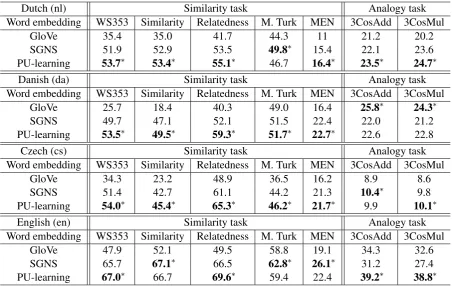
Table 4: Performance of SGNS, GloVe, and the proposed PU-Learning model in four different languages. Results show that the proposed PU-Learning model outperforms SGNS and GloVe in most cases when the size of corpus is relatively small (around 50 million tokens). Star indicates it is significant better than the second best algorithm in the same column according to Wilcoxon signed-rank test. (p <0.05).
mentations of Glove7 and SGNS8 and provided
by the original authors, and we apply the default settings when appropriate. The proposed PU-Learning framework is implemented based onYu et al. (2017a). With the implementation of effi-cient update rules, our model requires less than 500 seconds to perform one iteration over the en-tire text8 corpus, which consists of 17 million to-kens9. All the models are implemented in C++.
We followLevy et al.(2015)10 to set windows
size as 15, minimal count as 5, and dimension of word vectors as 300 in the experiments. Training word embedding models involves selecting sev-eral hyper-parameters. However, as the word em-beddings are usually evaluated in an unsupervised setting (i.e., the evaluation data sets are not seen during the training), the parameters should not be tuned on each dataset. To conduct a fair com-parison, we tune hyper-parameters on the text8 dataset. For GloVe model, we tune the discount parameters xmax and find that xmax = 10
per-7https://nlp.stanford.edu/projects/glove 8https://code.google.com/archive/p/word2vec/ 9http://mattmahoney.net/dc/text8.zip 10https://bitbucket.org/omerlevy/hyperwords
forms the best. SGNS has a natural parameterk which denotes the number of negative samples. Same as Levy et al. (2015), we found that set-ting k to 5 leads to the best performance. For the PU-learning model,ρandλare two important parameters that denote the unified weight of zero entries and the weight of regularization terms, re-spectively. We tuneρin a range from2−1to2−14 andλin a range from20 to2−10. We analyze the sensitivity of the model to these hyper-parameters in the experimental result section. The best perfor-mance of each model on the text8 dataset is shown in the Table 2. It shows that PU-learning model outperforms two baseline models.
5 Experimental Results
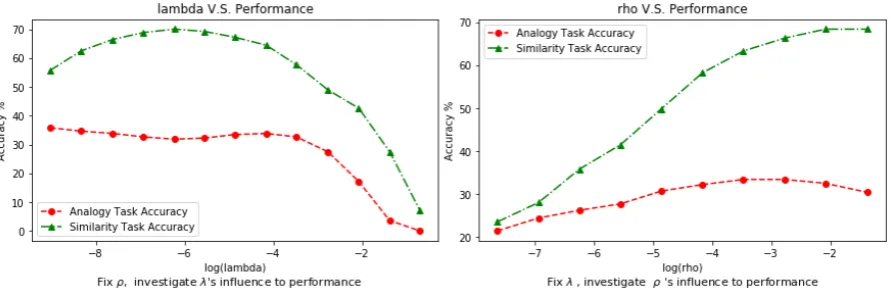
Figure 2: Impact ofρandλin the PU-Learning framework.
sults confirm that the unobserved word pairs carry important information and the PU-Learning model leverages such information and achieves better performance. To better understand the model, we conduct detailed analysis as follows.
Performance v.s. Corpus size We investigate the performance of our algorithm with respect to different corpus size, and plot the results in Fig-ure1. The results in analogy task are obtained by 3CosMul method (Levy and Goldberg,2014a). As the corpus size grows, the performance of all mod-els improves, and the PU-learning model consis-tently outperforms other methods in all the tasks. However, with the size of the corpus increases, the difference becomes smaller. This is reasonable as when the corpus size increases the number of non-zero terms becomes smaller and the PU-learning approach is resemblance to Glove.
Impacts ofρ and λ We investigate how sensi-tive the model is to the hyper-parameters,ρandλ. Figure2 shows the performance along with vari-ous values of λandρ when training on the text8 corpus, respectively. Note that the x-axis is inlog scale. Whenρis fixed, a bigλdegrades the perfor-mance of the model significantly. This is because when λis too big the model suffers from under-fitting. The model is less sensitive whenλis small and in general, λ = 2−11 achieves consistently good performance.
When λis fixed, we observe that large ρ(e.g., ρ≈2−4) leads to better performance. Asρ
repre-sents the weight assigned to the unobserved term, this result confirms that the model benefits from using the zero terms in the co-occurrences matrix.
6 Conclusion
In this paper, we presented a PU-Learning frame-work for learning word embeddings of low-resource languages. We evaluated the proposed approach on English and other three languages and showed that the proposed approach outperforms other baselines by effectively leveraging the infor-mation from unobserved word pairs.
In the future, we would like to conduct experi-ments on other languages where available text cor-pora are relatively hard to obtain. We are also in-terested in applying the proposed approach to do-mains, such as legal documents and clinical notes, where the amount of accessible data is small. Be-sides, we plan to study how to leverage other in-formation to facilitate the training of word embed-dings under the low-resource setting.
Acknowledge
This work was supported in part by National Sci-ence Foundation Grant IIS-1760523, IIS-1719097 and an NVIDIA Hardware Grant.
References
Eneko Agirre, Enrique Alfonseca, Keith Hall, Jana Kravalova, Marius Pas¸ca, and Aitor Soroa. 2009. A study on similarity and relatedness using distribu-tional and WordNet-based approaches. InThe 2009 Annual Conference of the North American Chap-ter of the Association for Computational Linguistics. pages 19–27.
Elia Bruni, Gemma Boleda, Marco Baroni, and Nam-Khanh Tran. 2012. Distributional semantics in tech-nicolor. In Proceedings of the 50th Annual Meet-ing of the Association for Computational LMeet-inguis- Linguis-tics: Long Papers-Volume 1. Association for Com-putational Linguistics, pages 136–145.
John A Bullinaria and Joseph P Levy. 2007. Extracting semantic representations from word co-occurrence statistics: A computational study. Behavior re-search methods39(3):510–526.
Kai-Wei Chang, Wen tau Yih, Bishan Yang, and Chris Meek. 2014. Typed Tensor Decomposition of Knowledge Bases for Relation Extraction. In
EMNLP.
Kai-Wei Chang, Wen-tau Yih, and Christopher Meek. 2013. Multi-relational latent semantic analysis. In
Proceedings of the 2013 Conference on Empirical Methods in Natural Language Processing. pages 1602–1612.
Kenneth Ward Church and Patrick Hanks. 1990. Word association norms, mutual information, and lexicog-raphy.Computational linguistics16(1):22–29.
Scott Deerwester, Susan T Dumais, George W Furnas, Thomas K Landauer, and Richard Harshman. 1990. Indexing by latent semantic analysis. Journal of the American society for information science41(6):391.
Lev Finkelstein, Evgeniy Gabrilovich, Yossi Matias, Ehud Rivlin, Zach Solan, Gadi Wolfman, and Eytan Ruppin. 2001. Placing search in context: The con-cept revisited. InProceedings of the 10th interna-tional conference on World Wide Web. ACM, pages 406–414.
Jiang Guo, Wanxiang Che, Haifeng Wang, and Ting Liu. 2014. Revisiting embedding features for sim-ple semi-supervised learning. InProceedings of the 2014 Conference on Empirical Methods in Natural Language Processing (EMNLP). pages 110–120.
Cho-Jui Hsieh, Nagarajan Natarajan, and Inderjit Dhillon. 2015. Pu learning for matrix completion. In International Conference on Machine Learning. pages 2445–2453.
Yifan Hu, Yehuda Koren, and Chris Volinsky. 2008. Collaborative filtering for implicit feedback datasets. InProceedings of the IEEE International Conference on Data Mining (ICDM). pages 263– 272.
Ozan Irsoy and Claire Cardie. 2014. Deep recursive neural networks for compositionality in language. In Advances in neural information processing sys-tems. pages 2096–2104.
Shihao Ji, Hyokun Yun, Pinar Yanardag, Shin Mat-sushima, and SVN Vishwanathan. 2015. Wor-drank: Learning word embeddings via robust rank-ing. arXiv preprint arXiv:1506.02761.
Andrej Karpathy and Li Fei-Fei. 2015. Deep visual-semantic alignments for generating image descrip-tions. In Proceedings of the IEEE Conference on Computer Vision and Pattern Recognition. pages 3128–3137.
Omer Levy and Yoav Goldberg. 2014a. Linguistic reg-ularities in sparse and explicit word representations. InProceedings of the eighteenth conference on com-putational natural language learning. pages 171– 180.
Omer Levy and Yoav Goldberg. 2014b. Neural word embedding as implicit matrix factorization. In Ad-vances in Neural Information Processing Systems. pages 2177–2185.
Omer Levy, Yoav Goldberg, and Ido Dagan. 2015. Im-proving distributional similarity with lessons learned from word embeddings. Transactions of the Associ-ation for ComputAssoci-ational Linguistics3:211–225.
Xiao-Li Li and Bing Liu. 2005. Learning from positive and unlabeled examples with different data distribu-tions. InEuropean Conference on Machine Learn-ing. Springer, pages 218–229.
Kevin Lund and Curt Burgess. 1996. Producing high-dimensional semantic spaces from lexical co-occurrence. Behavior Research Methods, Instru-ments, & Computers28(2):203–208.
Tomas Mikolov, Kai Chen, Greg Corrado, and Jef-frey Dean. 2013a. Efficient estimation of word representations in vector space. arXiv preprint arXiv:1301.3781.
Tomas Mikolov, Ilya Sutskever, Kai Chen, Greg S Cor-rado, and Jeff Dean. 2013b. Distributed representa-tions of words and phrases and their compositional-ity. InAdvances in neural information processing systems. pages 3111–3119.
Eric Nalisnick, Bhaskar Mitra, Nick Craswell, and Rich Caruana. 2016. Improving document ranking with dual word embeddings. InProceedings of the 25th International Conference Companion on World Wide Web. International World Wide Web Confer-ences Steering Committee, pages 83–84.
Rong Pan and Martin Scholz. 2009. Mind the gaps: Weighting the unknown in large-scale one-class col-laborative filtering. InProceedings of the 15th ACM SIGKDD International Conference on Knowledge Discovery and Data Mining (KDD). pages 667–676.
Rong Pan, Yunhong Zhou, Bin Cao, Nathan N Liu, Ra-jan Lukose, Martin Scholz, and Qiang Yang. 2008. One-class collaborative filtering. In Data Mining, 2008. ICDM’08. Eighth IEEE International Confer-ence on. IEEE, pages 502–511.
Jeffrey Pennington, Richard Socher, and Christopher Manning. 2014. Glove: Global vectors for word representation. InProceedings of the 2014 confer-ence on empirical methods in natural language pro-cessing (EMNLP). pages 1532–1543.
Tao Qin, Tie-Yan Liu, Jun Xu, and Hang Li. 2010. LETOR: A benchmark collection for research on learning to rank for information retrieval. Informa-tion Retrieval13(4):346–374.
Kira Radinsky, Eugene Agichtein, Evgeniy Gabrilovich, and Shaul Markovitch. 2011. A word at a time: computing word relatedness using temporal semantic analysis. In Proceedings of the 20th international conference on World wide web. ACM, pages 337–346.
Karl Stratos, Michael Collins, and Daniel Hsu. 2015. Model-based word embeddings from decomposi-tions of count matrices. InProceedings of the 53rd Annual Meeting of the Association for Computa-tional Linguistics and the 7th InternaComputa-tional Joint Conference on Natural Language Processing (Vol-ume 1: Long Papers). volume 1, pages 1282–1291.
Wen-tau Yih, Geoffrey Zweig, and John C Platt. 2012. Polarity inducing latent semantic analysis. In Pro-ceedings of the 2012 Joint Conference on Empirical Methods in Natural Language Processing and Com-putational Natural Language Learning. Association for Computational Linguistics, pages 1212–1222.
Hsiang-Fu Yu, Mikhail Bilenko, and Chih-Jen Lin. 2017a. Selection of negative samples for one-class matrix factorization. In Proceedings of the 2017 SIAM International Conference on Data Mining. SIAM, pages 363–371.
Hsiang-Fu Yu, Hsin-Yuan Huang, Inderjit S Dhillon, and Chih-Jen Lin. 2017b. A unified algorithm for one-class structured matrix factorization with side information. InAAAI. pages 2845–2851.