S Bandyopadhyay, D S Sharma and R Sangal. Proc. of the 14th Intl. Conference on Natural Language Processing, pages 205–211, Kolkata, India. December 2017. c2016 NLP Association of India (NLPAI)
Beyond Word2Vec: Embedding Words and Phrases in Same Vector Space
Vijay Prakash Dwivedi CSED, MNNIT Allahabad Allahabad, UP 211004, India
Manish Shrivastava LTRC, IIIT Hyderabad Hyderabad, TS 500032, India
Abstract
Word embeddings are being used for sev-eral linguistic problems and NLP tasks. Improvements in solutions to such prob-lems are great because of the recent break-throughs in vector representation of words and research in vector space models. How-ever, vector embeddings of phrases keep-ing semantics intact with words has been challenging. We propose a novel method-ology using Siamese deep neural networks to embed multi-word units and fine-tune the current state-of-the-art word embed-dings keeping both in the same vector space. We show several semantic rela-tions between words and phrases using the embeddings generated by our system and evaluate that the similarity of words and their corresponding paraphrases are maxi-mized using the modified embeddings.
1 Introduction
Vector embeddings in computational linguistics is a model that encodes words in a vector space. These vector encodings are used in mathemati-cal models and serve as a base for computation in NLP.
Development of word embedding technique started in 2000 when Bengio et al. built neural probabilistic language models to reduce the high dimensionality of word representations in contexts by learning a distributed representation for words (Bengio et al., 2003). After that, continuous search has been done in the field resulting in re-markable improvements in word vector represen-tations as well as the methods of learning the em-beddings (Mikolov et al., 2013a; Mikolov et al., 2013b; Pennington et al., 2014). The primary rea-son for the increase in quality and performance of word vector embeddings is the huge growth of
data and and development in computational capa-bilities as of today.
Natural language has both single word and multi-word units. If we want vector semantics to be near perfect, we need to embed multi-word units with the same quality as we do with the sin-gle word units. Improvements in phrase represen-tation will eventually help the areas of question an-swering, search and translation. For a phrase that is similar to a certain word, the embedding of both the word and phrase should be similar and should lie in the same space. Only then a manipulation on a word and its paraphrase embedding can prove them to be similar.
Currently, compositional models are used to build phrase embeddings with less emphasis on building the compositions using deep learning and more using specific composition functions. Our major contribution in this work is employing deep neural architectures to transform constituent word embeddings of a multi-word units into its vector representation. We build a Siamese deep neural network architecture (Siamese LSTM, to be pre-cise) that accepts two inputs, one being a word while another a phrase. The energy function in the Siamese network measures the similarity between these two input units. In the course of training the network, baseline word embeddings (Section 5.2) are modified and phrase embeddings are gen-erated. We describe the model in detail in further sections.
2 Related Work
gram units. They found the simple additive and multiplicative function to be quite effective. How-ever, these simple functions ignored word orienta-tion in phrases and their interacorienta-tion.
To make these compositions robust in order to handle complex structures in sentences, Ma-trix composition functions (Zanzotto et al., 2010; Socher et al., 2012) and Tensor composition func-tions (Bride et al., 2015) were proposed. In 2013, Mikolov et al. generated phrase representation us-ing the same method used for word representation in word2vec (Mikolov et al., 2013a; Mikolov et al., 2013b). High-frequency multi-word units such asNew Yorkwas embedded along with the words by taking them as single token, or pseudo-words, i.e. New York. Though this method is useful for learning short phrase representations with good quality, it does not generalize well to relatively longer and rare occurring phrases in the dataset.
In 2011, Socher et al. used a recursive neu-ral network to learn representations for multi-word phrases. In particular, they used an unsupervised autoencoder and their model performed well on the sentiment classification task but not so well on phrase similarity related problems. The pri-mary reason for this was the low-dimensional rep-resentations (upto 50) they had used to reduce the computational complexity. More recently (Yu and Dredze, 2015), the idea of learning composition functions based on phrase structure and context was proposed to compose phrase embeddings us-ing baseline word embeddus-ings.
The composition model developed by Yu and Dredze used Feature-rich Compositional Transfor-mations (FCT) from words to phrases in which the summation weights were defined by the linguistic features of component words such as POS tags, head words and so on.
3 Methodology
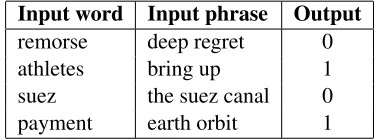
We develop our model with the objective of train-ing a system to predict similarity between a word and a phrase leveraging a similarity dataset. In our work, unlike the previous approaches, we capture the sequence of words in a phrase and their inter-action as well. This is achieved by using a recur-rent neural network to train our model. The model learns to generate phrase representations accord-ing to its closest saccord-ingle word meanaccord-ing. The more the semantic similarity between the word and the phrase, the closer is their similarity metric output
to 0 (1 otherwise). Table 1 shows some examples giving more insight into this.
Input word Input phrase Output
remorse deep regret 0
athletes bring up 1
suez the suez canal 0
[image:2.612.330.519.77.147.2]payment earth orbit 1
Table 1: Input-Output samples. ’Output’ is the similarity metric output, i.e. 0 for similar and 1 for dissimilar
We join the outputs of the two inputs fed to the network using a Siamese similarity function where the input of one sub-network is the baseline em-bedding of a word and the input of another sub-network is the embeddings of constituent words of a phrase which are fed sequentially. The two out-puts thus obtained are the resultant vector embed-dings of the corresponding word and phrase gener-ated by our system. The weights learned are com-mon during both the inputs. In this way, we build a common abstract transformation for both the word and the phrase.
While training our system over a large dataset containing input-output pairs as in Table 1, the model learns weights with which we build phrase embeddings and fine-tune baseline word embed-dings such that both are embedded in the same space.
3.1 Siamese Neural Network
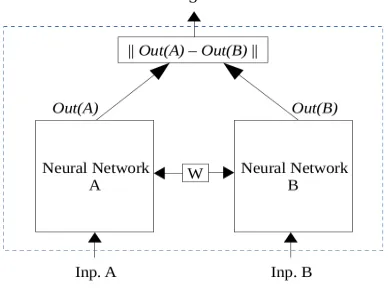
For the task of signature verification, Siamese Neural Networks were first proposed by Bromley et al. in 1993. After that, the architecture has been used in several works of similarity and discrima-tion such as for face verificadiscrima-tion (Chopra et al., 2005), visual search (Liu et al., 2008), sentence similarity (Mueller and Thyagarajan, 2016), simi-lar question retrieval in Q/A (Das et al., 2016), etc. Suppose Out(X) is a set of functions which has a set of parametersW. In Figure 1, input A is first given to the network. Then another input B is fed and a similarity function gets the outputs of these A and B, i.e. Out(A) and Out(B). Siamese network learns a value ofWsuch that the similarity metric is small if Inp. A(first input) andInp. B(second input) are similar and large if they are not. The similarity function can be defined as:
Figure 1: Siamese Neural Network
4 Model Architecture: Siamese LSTM
Long Short Term Memory Networks (LSTMs) (Hochreiter and Schmidhuber, 1997) are often used for problems with temporal (sequential) data. Since in our work, we are dealing with phrases which are sequences of words, we use LSTM net-work in our Siamese architecture. We first briefly describe LSTM networks and then the model ar-chitecture in detail.
4.1 LSTM Networks
Long Short Term Memory Network is a special variant of RNN which is capable of learning long-term dependencies. Each cell of LSTM contains four components: a memory state Ct, an output
gateotthat determines how the memory state
af-fects further units, as well as an input gate it
that controls what gets stored in and a forget gate
ft which determines what gets omitted from the
memory based on each new input and the current state. Figure 2 shows the four components and their interaction with the inputs and past and fu-ture information.
Figure 2: Block diagram of LSTM Cell
The use of LSTM network helps our system to learn the context of constituent words in a phrase. 4.2 Siamese LSTM
We use 3 layers of stacked LSTMs in our Siamese network. The hidden layers and the number of neurons were selected after repeated experiments and we obtained best results with this configura-tion. We limit the timesteps used in the LSTM to 5 since more than 99.8% of phrases in the dataset we use (PPDB1) are constituted of 5 or less units
(words). Table 2 shows the composition of the PPDB data in terms of the n-grams in the phrases.
Size→ XL
N-gram Nums Percentage
2-gram 2,98,536 79.40%
3-gram 60,657 16.13%
4-gram 13,132 3.49%
5-gram 2,993 0.80%
6-gram 682 0.18%
[image:3.612.342.508.220.335.2]Total 3,76,000 100.0%
Table 2: Composition of the PPDB dataset of size XL showing only 0.18% of the phrases are of more than 5-grams; the scores are 0.15% & 0.12% for XXL & XXXL sizes respectively
At each timestep t ∈ {1. . .5}, we use
base-line embeddings of the word at t. For cases (eg.
phrases of length less than 5 or word of length 1) where there is no word at t, we use zero
[image:3.612.322.525.489.628.2]embed-ding vector at thatt.
[image:3.612.86.289.581.711.2]Figure 3: Siamese LSTM model architecture; First input to the network is a single word unit and sec-ond input is a multi-word unit
Figure 3 illustrates the model architecture we use. After training over a large dataset, the model
learns the set of parameters W. ’embd’ is the resul-tant embedding of the word or paraphrase which is input to the network. The outputs of the two inputs to the network are joined using a contrastive loss function (Hadsell et al., 2006) which is defined as:
L= (1−Y)1 2(S)
2+ (Y)1
2{max(0, m−S)}
2
(2) whereY is a binary label assigned to a pair Xa
andXb(0 for similar and 1 for dissimilar),Sis the
similarity energy function which is parameterized byW andmis margin (Hadsell et al., 2006). We usem = 1. When two pairs are not similar the
maximum energy metric outputs 1.
The gradient of the loss function with respect to
W shared by the LSTM networks, is computed
us-ing back-propagation. Adamax optimizer, a vari-ant of the Adam optimizer (Kingma and Lei Ba, 2015) is used to update the parameters of the sub-network.
5 Implementation
5.1 Dataset
We use PPDB dataset (Ganitkevitch et al., 2013) of size XL which has 3,76,000 pairs of words and their corresponding paraphrases. Since these are word-paraphrase pairs, we label the output of these pairs as 0. We augment the data by the same number of negative pairs by choosing a phrase for a word which is not its paraphrase. We label these pairs as 1. Thus, we train our model on 7,52,000 data samples.
5.2 Base Input Embedding
As base word embeddings for the input layers, we use GloVe2word vector embeddings (Pennington
et al., 2014) of dimension 200.
The input pairs are passed through the Siamese network with the final layers of each network giving the resultant embeddings for words and phrases. We have 300 stacked neurons in the fi-nal layer of both the LSTM networks. This is the dimension of our resultant embeddings.
6 Experiments and Results
We perform the following experiments and find impressive results on various tasks.
2https://nlp.stanford.edu/projects/ glove/
6.1 Word - Phrase Similarity Task
In this experiment, we define a classification task to determine if a word-phrase pair are semantically similar. We feed a word-phrase pair to the trained Siamese model and predict whether they are simi-lar (S ≈0) or dissimilar (S≈1).
[image:4.612.318.529.377.542.2]We evaluate on the set of PPDB data (Section 5.1) left aside for validation. Out of the total data size, we choose 2,00,000 word-paraphrase pairs arbitrarily for the evaluation. Besides Siamese LSTM, we also perform this experiment on a Siamese Multi-layer Perceptron Network (MLP) where the MLP has 4 layers of neurons. As per our study in Table 2, we fix the MLP input to 5 words where each input word is in the form of a 200-D vector (we use padding and truncation for word units which are not of length 5). Therefore, the first layer has 1000 neurons. The remaining lay-ers have 512, 512 and 300 neurons in order from second to final layer. We carry out the similarity task using Siamese MLP. However, we get better results (Figure 4) on Siamese LSTM which is also one reason why we chose it over Siamese MLP. We report the best accuracy of 76.65% on this task.
Figure 4: Accuracy of similarity over dataset size
6.2 Nearest Words and Phrases
In our work, we fine-tune the current base word embeddings while we generate phrase embed-dings. Therefore, to validate the new vector em-beddings of the words (300-D) which we obtain at the final layer of the Siamese sub-network, we perform this experiment.
For a pairhU, Vi, whereU &V can be a single
word or a multi-word unit, ifUis given, we predict V (Refer Table 5). We output a list of four units which are closest to U in the vector space. We
Word Nearest Words
viewpoints perspectives, opinions, view-point, views
upbeat optimistic, cautious, outlook, gloomy
sales retail, selling, profits, profit milder colder, mild, warmer, heavier
1600 1400, 1700, 1300, 1500
asem apec, asean, g20, summit
panelists attendees, moderators, jurists, paragraphs
[image:5.612.83.299.37.201.2]medal medals, awarded, won, silver
Table 3: Nearest words for a given word showing that semantic relations are preserved even after the modification in the base embeddings.
Word Nearest Phrases
viewpoints differing views, the viewpoints, different opinions, different per-spectives
upbeat optimistic about, overly opti-mistic, more cautious, cautious sales sales volume, sales orders, export
sales, the sales
milder relatively mild, cold weather, even heavier, very mild
1600 1600 hours, 1300 hours, 1700
hours, 1100 hours
asem the asem process, apec leaders, apec economies, summit meet-ings
panelists discussion forums, two para-graphs, selected topics, panel dis-cussion
[image:5.612.351.503.37.93.2]medal the gold medal, a gold medal, a medal, the bronze
Table 4: Nearest phrases for a given word: we show these for the same words as in Table 3 for the ease of comparison
perform this task by calculating the cosine sim-ilarity between the given U’s embedding and all
the units’ embeddings in our vocabulary.
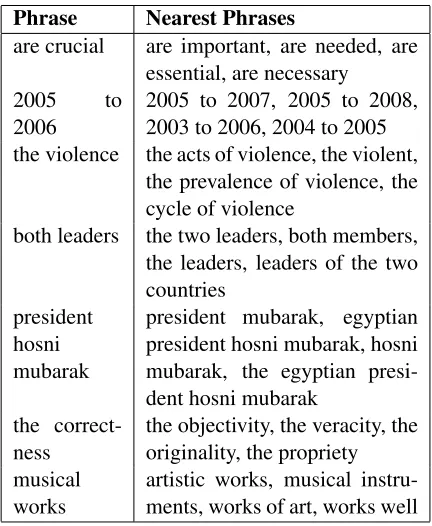
We finally select the top four ranked results for everyU using the embeddings our model has gen-erated and show interesting sample results in Ta-ble 3, TaTa-ble 4 and TaTa-ble 6. We notice several instances where semantics are preserved even af-ter fine-tuning the baseline embeddings using our
[image:5.612.317.533.199.462.2]Experiment U V
[image:5.612.80.297.268.544.2]Table 3 Word Word
Table 4 Word Phrase
Table 6 Phrase Phrase
Table 5: Experiments in this category; wordis 1-gramandphraseisn-gramwheren≥2
approach. The phrase representations generated from this work also stays close to its correspond-ing similar word’s embeddcorrespond-ing.
Phrase Nearest Phrases
are crucial are important, are needed, are essential, are necessary
2005 to
2006 2005 to 2007, 2005 to 2008,2003 to 2006, 2004 to 2005 the violence the acts of violence, the violent, the prevalence of violence, the cycle of violence
both leaders the two leaders, both members, the leaders, leaders of the two countries
president hosni mubarak
president mubarak, egyptian president hosni mubarak, hosni mubarak, the egyptian presi-dent hosni mubarak
the correct-ness
the objectivity, the veracity, the originality, the propriety musical
works artistic works, musical instru-ments, works of art, works well
Table 6: Nearest phrases for a given phrase
6.3 Semantic Similarity Task
We use the embeddings derived by our system to evaluate the phrasal semantic similarity task of Se-mEval20133and compare our results with that of
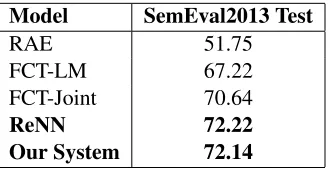
the existing systems. The task of SemEval2013 5(a) is to determine if a word-phrase pair are se-mantically similar (True for similar and False for dissimilar) which is notably as same as the ex-periment in Section 6.1. We report the results (accuracy scores) of our system along with ex-isting benchmark methods in Table 7. RAE is the recursive auto-encoder model developed in (Socher et al., 2011) wheras LM and FCT-Joint are the Feature Rich Compositional Trans-formation Models proposed by (Yu and Dredze,
3https://www.cs.york.ac.uk/ semeval-2013
2015) with Language Modeling and Joint Traning (Language Modeling and Task-Specific) objective respectively for updating the embeddings. We also report our results with the Recursive Neural Net-work (ReNN) based model developed by (Socher et al., 2011; Socher et al., 2013) and obtain compa-rable results with the state-of-the-art system devel-oped for generating phrase representations evalu-ated on this task.
Model SemEval2013 Test
RAE 51.75
FCT-LM 67.22
FCT-Joint 70.64
ReNN 72.22
[image:6.612.109.274.167.252.2]Our System 72.14
Table 7: Performance on the SemEval2013 5(a) Semantic Similarity Task
We see that the Siamese network based model outperforms the RAE by significant margin. How-ever, the ReNN still has the best performance. Since the method proposed in this work is pri-marily dependant on the dataset containing word-paraphrase pairs, the larger this data size, the bet-ter quality embeddings we can generate and the performance on this task can be ultimately im-proved.
7 Conclusion and Discussion
In this work, we present a novel approach in building phrase vector embeddings by the use of its constituent word vectors through a sequential Siamese model. The Siamese network designed for this task leverages a word-phrase similarity dataset (PPDB) and generates embeddings of the phrase keeping in consideration the word position in the phrase, and its orientation and interaction with neighbour words as well which, in particular, is achieved using a Long Short Term Memory Net-work. Unlike previous attempts in building com-positional models for phrase representation, the system presented in this paper does not employ any manual feature based technique for building phrase embedding or rely on a POS tag of partic-ular word’s neighbour or head words, or any other linguistic feature. Rather, we develop a similarity based deep learning network with contrastive loss which learns its weights after training and this set of learned parameters function as an abstract trans-formation which compose the phrase
representa-tion eventually. In addirepresenta-tion, we fine-tune the base word vectors using the same abstract transforma-tion and embed both the words and phrases in the same vector space.
The phrase representations derived from our model are computationally efficient as compared to recursive neural networks employed for this task. Besides, we are able to generate compar-atively higher dimension (300-D) vectors in this work as compared to recursive networks (25-30D) which have a higher computational complexity. We show excellent results on phrase similarity task using the vector embeddings produced from this work. Also, semantic relationship between nearby words-phrases and phrases-phrases has been pre-served.
8 Future Work
Since the network used in this work is trained on the paraphrase dataset, quality of phrase em-beddings will improve if we use more exhaustive set and large number of word-paraphrase pairs for training. If we are able to extract more paraphrases using bigger language corpus and use it for train-ing our system, we can considerably improve the quality of vectors derived. In future, we plan to ex-tend this work to other languages as well by first extracting paraphrases and then learning a similar-ity model to derive phrase representations. How-ever, efficient and reliable word vectors of higher dimension is required for this work to be done. Similarly, we intend to use phrase embeddings generated by our model in several NLP applica-tions with motive of improving the performance.
Acknowledgement
We would like to thank Naveen Kumar Laskari for discussions during the course of this work and Pruthwik Mishra and Saurav Jha for their valuable suggestions.
References
Yoshua Bengio, R´ejean Ducharme, Pascal Vincent, and Christian Janvin. 2003. A neural probabilistic lan-guage model. The Journal of Machine Learning Re-search (JMLR), 3:1137-1155.
Tomas Mikolov, Kai Chen, Greg Corrado, and Jef-frey Dean. 2013a. Efficient estimation of word representations in vector space. arXiv preprint arXiv:1301.3781.
Tomas Mikolov, Ilya Sutskever, Kai Chen, Greg Cor-rado, and Jeffrey Dean. 2013b. Distributed repre-sentations of words and phrases and their composi-tionality.arXiv preprint arXiv:1310.4546.
Jeffrey Pennington, Richard Socher and Christopher D. Manning. 2014. GloVe: Global Vectors for Word Representation. In Empirical Methods in Natural Language Processing (EMNLP), pages 1532–1543.
Jeff Mitchell and Mirella Lapata. 2008. Vector-based models of semantic composition. InAssociation for Computational Linguistics (ACL), pages 236-244.
Mo Yu and Mark Dredze. 2015. Learning Compo-sition Models for Phrase Embeddings. In Transac-tions of the Association for Computational Linguis-tics (ACL), pages 227-242.
Jane Bromley, James W Bentz, L´eon Bottou, Is-abelle Guyon, Yann LeCun, Cliff Moore, Eduard Sackinger, and Roopak Shah. 1993. Signature verification using a siamese time delay neural net-work. International Journal of Pattern Recognition and Artificial Intelligence, 7(4).
Sumit Chopra, Raia Hadsell, and Yann LeCun. 2005. Learning a similarity metric discriminatively, with application to face verification. InIEEE Computer Society Conference on Computer Vision and Pattern Recognition (CVPR), 1:539–546.
Yuanjie Liu, Shasha Li, Yunbo Cao, Chin-Yew Lin, Dingyi Han, and Yong Yu. 2008. Understand-ing and summarizUnderstand-ing answers in community-based question answering services. InInternational Con-ference on Computational Linguistics (COLING), 1:497–504.
Jonas Mueller and Aditya Thyagarajan. 2016. Siamese Recurrent Architectures for Learning Sentence Sim-ilarity. In AAAI Conference on Artificial Intelli-gence.
Arpita Das, Harish Yenala, Manoj Chinnakotla and Manish Shrivastava. 2016. Together We Stand: Siamese Networks for Similar Question Retrieval. InAssociation for Computational Linguistics (ACL), pages 378-387.
Sepp Hochreiter and J¨urgen Schmidhuber. 1997. Long Short-Term Memory. Neural Computation, 9(8):1735–1780.
Juri Ganitkevitch, Benjamin Van Durme and Chris Callison-Burch. 2013. PPDB: The Paraphrase Database. In Proceedings of NAACL-HLT, pages 758–764.
Raia Hadsell, Sumit Chopra, Yann LeCun. 2006. Di-mensionality Reduction by Learning an Invariant Mapping. InIEEE Computer Society Conference on Computer Vision and Pattern Recognition (CVPR), 2:1735–1742.
Richard Socher, Brody Huval, Christopher D. Man-ning, and Andrew Ng. 2012. Semantic Compo-sitionality through Recursive Matrix-Vector Spaces. InEmpirical Methods in Natural Language Process-ing and Computational Natural Language LearnProcess-ing, 1201–1211.
Richard Socher, John Bauer, Christopher D. Manning, and Andrew Ng. 2013. Parsing with compositional vector grammars. InIn Association for Computa-tional Linguistics (ACL), pages 455–465.
Antoine Bride, Tim Van de Cruys, and Nicholas Asher. 2015. A Generalisation of Lexical Functions for Composition in Distributional Semantics. In Asso-ciation for Computational Linguistics (ACL), pages 281–291.
Diederik P. Kingma and Jimmy Lei Ba. 2015. Adam: A Method for Stochastic Optimization. InThe Inter-national Conference on Learning Representations (ICLR).
Fabio M. Zanzotto, Ioannis Korkontzelos, Francesca Fallucchi, and Suresh Manandhar. 2010. Estimat-ing Linear Models for Compositional Distributional Semantics. InInternational Conference on Compu-tational Linguistics (COLING), 1263-1271.
Richard Socher, Jeffrey Pennington, Eric H. Huang, Andrew Y. Ng, and Christopher D. Manning. 2011. Semi-supervised Recursive Autoencoders for Pre-dicting Sentiment Distributions. InEmpirical Meth-ods in Natural Language Processing (EMNLP), 151-161.