Generating Clinically Relevant Texts:
A Case Study on Life-changing Events
Mayuresh Oak1, Anil K. Behera3, Titus P. Thomas1, Cecilia Ovesdotter Alm2, Emily Prud’hommeaux2, Christopher Homan3, Raymond Ptucha1
1Kate Gleason College of Engineering 2College of Liberal Arts
3Golisano College of Computing and Information Sciences Rochester Institute of Technology
Rochester, NY 14623, USA
{mso4106†|akb2701†|tpt7797†|coagla†|emilypx†|cmhξ|rwpeec† †@rit.eduξ@cs.rit.edu
Abstract
The need to protect privacy poses unique challenges to behavioral research. For in-stance, researchers often can not use exam-ples drawn directly from such data to ex-plain or illustrate key findings. In this re-search, we use data-driven models to synthe-size realistic-looking data, focusing on dis-course produced by social-media participants announcing life-changing events. We com-paratively explore the performance of distinct techniques for generating synthetic linguistic data across different linguistic units and top-ics. Our approach offers utility not only for reporting on qualitative behavioral research on such data, where directly quoting a partici-pant’s content can unintentionally reveal sen-sitive information about the participant, but also for clinical computational system devel-opers, for whom access to realistic synthetic data may be sufficient for the software devel-opment process. Accordingly, the work also has implications for computational linguistics at large.
1 Introduction
Behavioral research using personal data, such as that from social media or clinical studies, must continu-ally balance insights gained with respect for privacy. Ethical and legal demands also come into play. De-identification involves removing information such as named entities, address-specific information and so-cial security numbers. However, naive approaches are often prone to privacy attacks. Such de-identified data will often still contain information that, when
combined with other data from different resources, can point to the individual who generated it. For example, if a de-identified dataset contains detailed demographic information, it could then be possible to extract a small list of people matching this infor-mation and to identify a specific person using other, publicly available data.
One approach that strikes a good balance is to synthesize realistic-looking data with the same sta-tistical properties as actual data. Our contribution is to compare different techniques for synthesizing behavioral data. Specifically, we explore this prob-lem in a case study with social media texts that in-volve social media participants making announce-ments about life-changing events, which are per-sonal in nature and which also may affect, positively or negatively, a person’s well-being.
Two immediate applications to clinical research that motivate this approach are: qualitative results reporting involving textual dataanddata access is-sues for software development purposes. Neither readers of scientific reports nor software developers need access to the original data as long as realistic looking synthetic data is available.
2 Related Work
In the clinical setting, data privacy is important. Anonymization aims to ensure that data is untrace-able to an original user, whereas de-identification may allow the data to be traced back to a user with third-party information.
Szarvas et al. (2007) developed a model for anonymizing personal health information (PHI) from discharge records. The model identifies PHIs
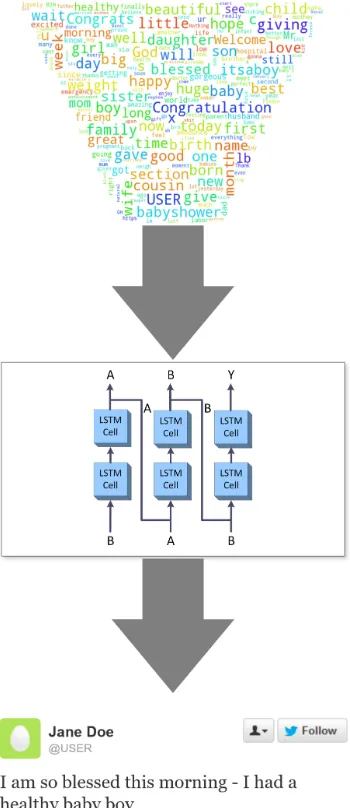
Figure 1: Top level view of the proposed anonymiza-tion system. Data is fed to a model which here is a character-based Long-Short Term Memory (LSTM). The LSTM generates new tweets based on the input data.
in several steps and labels all entities which can be tagged from the text structure. It then queries for additional PHI phrases in the text with help from tagged PHI entities.
Bayardo and Agrawal (2005) present improved k-anonymity methods and provide efficient algorithms for data dimensionality reduction. However, even if information such as names of people or providers or quasi-identifiers (QIs) are removed, there are still ways to compare the de-identified data with other
records having these identifiers.
In contrast to traditional anonymization and de-identification methods, generation of synthetic data can handle various aspects of hiding individuals, by aggregating and severing data from individual users, yet maintaining the statistical properties of the data used to train generation models. For this paper we explore several forms of data generation, using so-cial media (Twitter) data about life-changing events as a case study. For example, Twitter data has been used for studying important life-changing events (De Choudhry et al., 2013; Li et al., 2014). Other studies present methods for anonymizing Twitter datasets. Terrovitis et al. (2008) model social me-dia as an undirected, unlabeled graph which does re-tain privacy of social media users. Daubert et al. (2014) discuss the different methods for anonymiza-tion of Twitter data. However, there is a lack of work that addresses synthetic data creation using machine generation models.
This paper compares traditional statistical lan-guage models and Long Short Term Memory (LSTM) models to learn models from a training set of Twitter data to generate synthetic tweets. LSTMs are recurrent neural networks designed to learn both long and short term temporal sequences. These net-works were introduced by Hochreiter and Schmid-huber (1997), with several improvements over the years, the most common of which include individual gating elements (Graves and Schmidhuber, 2005). LSTMs have been shown to perform at state-of-the-art levels for many tasks, including handwriting recognition and generation, language modeling, and machine translation (Greff et al., 2015).
3 Data
Twitter is a microblogging platform used by peo-ple to post about their lives. If harnessed properly, tweets can be used for analysis and research of be-havioral patterns as well as in studying health infor-mation.
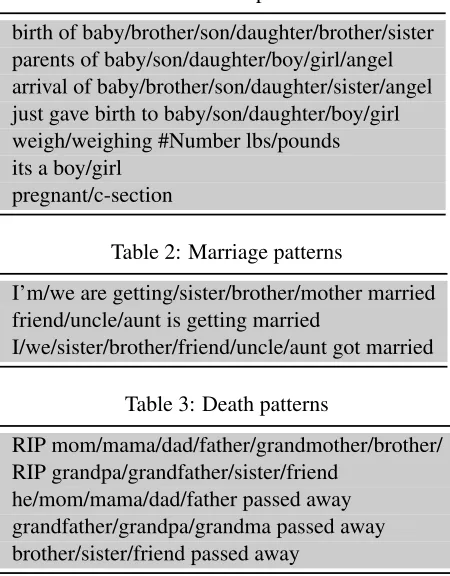
Table 1: Birth patterns
birth of baby/brother/son/daughter/brother/sister parents of baby/son/daughter/boy/girl/angel arrival of baby/brother/son/daughter/sister/angel just gave birth to baby/son/daughter/boy/girl weigh/weighing #Number lbs/pounds its a boy/girl
pregnant/c-section
Table 2: Marriage patterns
I’m/we are getting/sister/brother/mother married friend/uncle/aunt is getting married
I/we/sister/brother/friend/uncle/aunt got married
Table 3: Death patterns
RIP mom/mama/dad/father/grandmother/brother/ RIP grandpa/grandfather/sister/friend
he/mom/mama/dad/father passed away grandfather/grandpa/grandma passed away brother/sister/friend passed away
less likely to share difficult news about death and di-vorce. Tweets on divorce were particularly scarce, so this event was ignored as the study continued.
The pool of tweets came from a collection of tweets from a mid-sized city in the US North East in 2013 as well as streaming tweets irrespective of lo-cation from early 2016. Roughly 18 million tweets were collected, including tweets for the three afore-mentioned categories of birth, death, and marriage. Only the text of the tweets was utilized for this study. After inspecting the data, we formulated a set of lexical keywords, phrases and regular expressions to collect tweets by category. These reflected top-ical patterns, such as announcements of marriage or birth in the family, the weight of the newborn baby or whether it is a girl or a boy, or the passing of a friend or family member. Table 1 shows the patterns used to extract tweets aboutbirth. Similarly, Table 2 shows the patterns for marriage, and Table 3 for death. We attempted to remove tweets about
celebri-ties, TV shows, news stories, and jokes. After filter-ing, we selected and hand-annotated for each cate-gory a set of 2000 tweets. For comparison’s sake we also chose randomly 2000 (unlabeled) tweets from the data, and call this the general category. Note that any tweet could be present in this category, in-cluding those from the first three categories.
We replaced Twitter usernames with the token @USER, while URL links, retweets, and emoti-cons were replaced with the keywordsURL,RT, and EMOT, respectively. We removed the pound signs from hashtags to make it look more like general written language and to reduce the dictionary size of the word-based language models.
For the character-based models, we performed the following further steps. We separated each character in the input data by a space and replaced the usual space characters with<space>. We considered the tags introduced in the earlier pre-processing phase (e.g. -@USER) to be unique characters. On output, we replaced all space characters with the null string and replace the space tag<space>with the space character.
Tables 4 through 6 show samples of collected tweets.
Table 4: Birth tweets She gave birth to the baby aww congrats loulou @USER
birth of Baby Tyler (They picked my baby name suggestion )
Table 5: Death tweets
my grandpa passed away today All I hope is that things get better
@USER my grandma passed away
4 Methods
4.1 Long-Short Term Memory
[image:4.612.108.277.413.519.2]Recurrent neural networks (RNN) are popular mod-els that have shown great potential in many natural language processing (NLP) tasks. LSTMs (Hochre-iter and Schmidhuber, 1997; Graves and Schmidhu-ber, 2005) are a specific subset of RNNs that have been modified to be especially good at condition-ing on both long and short term temporal sequences. LSTMs modify the standard design of neural net-works in several ways: they eliminate the strict re-quirement that neurons only connect to other neu-rons in succeeding layers (adding recurrence), con-vert the standard neuron into a more complex mem-ory cell, and add non-linear gating units which serve to govern the information flowing out of and recur-sively flowing back into the cell (Greff et al., 2015). The memory cell differentiates itself from a simple neuron by including the ability to remember its state over time; this coupled with gating units gives the LSTM the ability to recognize important long-term dependencies while simultaneously forgetting unim-portant collocations.
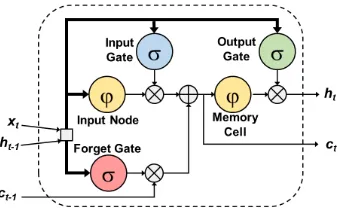
Figure 2: A single LSTM memory block. The three gates govern the input node and memory cell to al-low long term memory. The functionϕis thetanh function and the functionσis thesigmoidfunction.
The LSTM we use here, as implemented by Karpathy (2015) modifies the original architecture by removing peephole connections. The intuitive understanding of the components in an LSTM mem-ory block can be summarized as:
1. Input node: Also known as input modulation gate or new memory gate, takes the input and
the past hidden state to summarize the new in-put in light of the past context fromht−1. 2. Input gate: Also known as write gate, takes the
input and the past hidden state to determine the importance of the current input as it effects the cell.
3. Forget gate: Also known as reset gate, takes the input and the past hidden state and gives the provision for the hidden layer to discard or forget the historical data.
4. Output gate: Takes the input and the past hid-den state and determines what parts of the cell outputctneed to be present in the new hidden
statehtfor the next timestep.
5. Memory cell: Takes advice from the forget gate and governed Input Node to determine the usefulness of the previous memoryct−1to pro-duce the new memoryct.
The functionality above describes only how a sin-gleLSTM memory block works, analogous to a sin-gle neuron in a regular neural network. To create an LSTM which learns, hundreds of these blocks are combined in a single layer (analogous to hundreds of nodes in a hidden layer), with the hidden output,
ht,ctof one block feeding into the input of another.
Further complexity (and learning power) is added by including multiple layers of LSTM memory blocks. The final output of LSTM memory blocks (or inputs from one layer to the next) are provided by calculat-ingyt = Wyf(ht), whereWy is an output weight
matrix to learn and f(·) is an activation function which can vary depending on use case.
The input,xt, to an LSTM memory block differs
up-date the weights. All LSTM models were trained for 500 epochs and sequence length of 50, where the se-quence length is the length of time the LSTM cell is unrolled per iteration. Two LSTM layers were used to train the model on the input data. Each LSTM layer had 512 hidden nodes. Language generation can be performed after training, in which the LSTM is given either a starting sequence of data items (or it calculates the most probable sequence to start with), and then generates new data items based on its own predictions in previous time steps.
4.2 Standard N-gram Language Models
In order to demonstrate the particular utility of LSTMs for generating realistic tweets, the output of our character- and word-based LSTM methods was compared to that of standard n-gram backoff language models. Such models are widely used to model the probability of word sequences for many NLP applications, including machine translation, automatic speech recognition, and part-of-speech tagging. The SRI Language Modeling Toolkit (SRILM) was used to build 4-gram word- and character-based language models (Stolcke, 2002). Using these models, we then generate synthetic tweets using the OpenGRM Ngram library (Roark et al., 2012).
4.3 Experimental Design
For each event category, we divided the dataset of 2000 tweets into 1800 training and 200 testing in-stances. We used the machine translation quality metric BLEU (Papineni et al., 2002) to measure the similarity between machine generated tweets and the held out tests sets. For each model, we gener-ated ten sets of 200 tweets. We calculgener-ated BLEU scores (without the brevity penalty) using the full 200-tweet test set as the reference for each candidate tweet and report the average of the BLEU scores of all ten sets of tweets generated by a given model.
To gain further insight into the effectiveness of the machine generated data, we asked human annota-tors to evaluate the generated tweets. We selected 800 tweets by randomly sampling: 400 human gen-erated tweets (100 from each category), and 400 ma-chine generated tweets. The 400 mama-chine
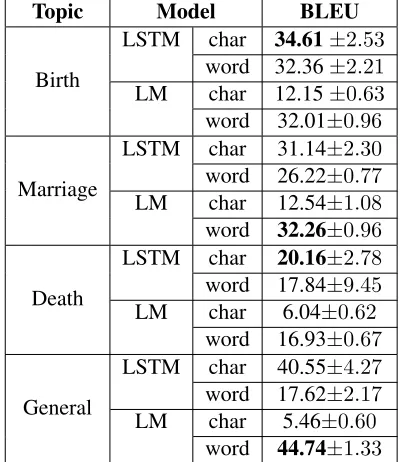
gener-Table 7: Mean BLEU scores and their standard de-viation over ten generated test sets of 200 tweets per model, by topic, model, and linguistic unit.
Topic Model BLEU
Birth
LSTM char 34.61±2.53 word 32.36±2.21 LM char 12.15±0.63 word 32.01±0.96
Marriage
LSTM char 31.14±2.30 word 26.22±0.77 LM char 12.54±1.08 word 32.26±0.96
Death
LSTM char 20.16±2.78 word 17.84±9.45 LM char 6.04±0.62
word 16.93±0.67
General
LSTM char 40.55±4.27 word 17.62±2.17 LM char 5.46±0.60
word 44.74±1.33
ated tweets consisted of 25 tweets for each combi-nation of model (LM-char, LM-word, LSTM-char, LSTM-word) and category (birth, marriage, death, general). For each tweet, the annotators indicated if they thought the tweet was generated by a human or machine, and they rated the quality of the tweet on the basis of syntax and semantics. Also, they in-dicated which topic category they thought the tweet belonged to.
5 Results
[image:5.612.326.528.105.336.2]Table 8: The percent of instances where the four human annotators (A1 - A4) were deceived into thinking a synthetic tweet was human generated. The values in bold are the best performing models for each category by annotator. (B = birth,D = death,M = marriage,B = general).
Model A1 A2 A3 A4
B D M G B D M G B D M G B D M G
LM-char 14 0 0 0 14 0 20 0 40 52 28 16 16 8 8 12 LM-word 18 8 21 10 18 8 50 40 80 80 88 72 32 32 48 44 LSTM-char 45 25 44 0 36 25 56 22 60 72 68 64 40 44 40 44 LSTM-word 33 38 30 11 44 25 40 11 76 72 48 44 36 36 24 28
BLEU, we suspect this is due to the fact that the large feature space of the word-based model in com-bination with the relatively small number of training tweets (roughly 1800) is not optimal for learning an LSTM model.
5.1 Human evaluation
A randomized set of 800 tweets, both real and syn-thetic, from all four topic categories was submitted to a panel of annotators (co-authors). Each annota-tor was asked to decide whether the tweet was real
[image:6.612.335.534.226.440.2]Figure 3: Syntax score by annotator. Higher scores suggest more satisfactory generation of syntactic structures (median = red line, mean = dashed line).
Figure 4: Semantics score by annotator. Higher scores suggest more satisfactory generation of se-mantic contents (median = red line, mean = dashed line).
[image:6.612.95.291.442.652.2](i.e., produced by a human) or synthetic (i.e., gener-ated by one of the LSTM or n-gram language mod-els). Each tweet was also rated in terms of its syntax and semantics on a five point Likert scale. In addi-tion, the annotators were asked to select the intended topic category (birth,death,marriage, orgeneral) of the tweet.
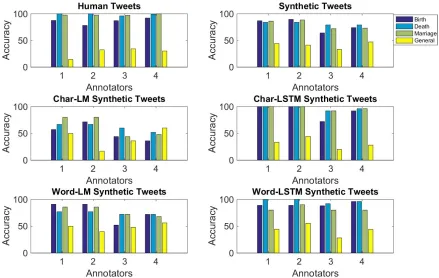
Figure 5: Ability of four human annotators (A1 - A4) to predict the topic category of the data from which a tweet was generated, per model. The top left panel reflects results for human-composed tweets, whereas the top right panel shows results across synthetic tweets, corresponding to the four models in subsequent panels. (Dark blue =birth, light blue =death, green =marriage, yellow =general).
annotators, but accuracy was quite high in all topics other than general. We note that the general cat-egory was not filtered to remove tweets that could have belonged to the other topics, which could ex-plain this discrepancy.
Figures 3 and 4 show the distribution of each annotator’s syntax and semantics scores for each model. These boxplots show that there was signif-icant variance in the annotators’ evaluation of the syntactic and semantic quality of the tweets. We note, however, that the models yielding the high-est BLEU scores, char-LSTM and word-LM, tended to receive more favorable scores for syntactic and semantic quality. The character-based LM model, whose BLEU scores were significantly lower than other models, consistently received the most unsatis-factory evaluation of syntactic and semantic quality by all four annotators. It also seems that the LSTM models produce output that is more consistent in its
semantic and syntactic quality, with smaller annota-tor to annotaannota-tor variance than the LM models.
Table 9: Synthetic tweets marked as human gener-ated by all four annotators.
Congrats to @USER and her husband on the birth of their son Welcome to the Cyclone family, Eally Kinglan URL URL (Char LSTM Generated)
@USER congratulations on birth of your son,20 days,ago,URL (Word LM Generated) @USER @USER @USER,looks like we’re getting hitched in June URL (Word LM Generated)
Im getting married in 17 days death (Char LSTM Generated)
RT @USER rip grandma 2 8 16 (Word LM Generated)
Table 10: Synthetic tweets marked as synthetic by all four annotators.
RT @USER The new partprigialsgive birth tobelysonJuntand I’mdelinedahape
proud (Char LSTM Generated)
I’m so sorry for your loss and world harry
gottingto my funeral it was without URL (Word LM Generated)
Table 8 shows the percent of instances a human annotator marked a synthetic tweet as human gener-ated. Table 9 shows some of the tweets that were generated by language models but were identified by all four annotators as human generated. A few example tweets that were correctly identified by all four annotators as synthetic tweets are displayed in Table 10.
6 Conclusion
We have discussed generating synthetic data in the context of readers of scientific reports or software developers. In addition, one potential clinical appli-cation might be to apply this to patient transcripts so that they could be shown to other patients suf-fering from similar problems, e.g., for anonymized virtual group therapy. Such an approach might be especially useful in rural and developing regions, where clinical resources are sparse. Anonymiza-tion of data in research is often necessary to pro-tect patient or user identity. This research explores
data-driven models to generate realistic-looking dis-course with the same statistical properties as a train-ing corpus. Specifically, this research explores the synthetic generation of tweets, contrasting LM and LSTM models, character-based and word-based lin-guistic units, and the topic categories of birth, death, and marriage. Based on the results from objective BLEU scores and subjective human evaluation, the word-based LM and char-based LSTM models formed well, deceiving annotators 41 and 43 per-cent of the time on average into thinking a synthetic tweet was human generated. This research shows promising evidence that the synthetic generation of user data may be preferred to existing techniques of naive anonymization which can potentially lead to user identification through combination of demo-graphic data mining and ancillary metadata.
References
Puneet Agarwal, Rajgopal Vaithiyanathan, Saurabh Sharma, and Gautam Shroff. 2012. {Catching the Long-Tail: Extracting Local News Events from Twitter}. Proceedings of the Sixth International AAAI Conference on Weblogs and Social Media.
Roberto J Bayardo and Rakesh Agrawal. 2005. Data pri-vacy through optimal k-anonymization. InData Engi-neering, 2005. ICDE 2005. Proceedings. 21st Interna-tional Conference on, pages 217–228. IEEE.
Edward Benson, Aria Haghighi, and Regina Barzilay. 2011. Event discovery in social media feeds. In Pro-ceedings of the 49th Annual Meeting of the Associa-tion for ComputaAssocia-tional Linguistics: Human Language Technologies-Volume 1, pages 389–398. Association for Computational Linguistics.
Deepayan Chakrabarti and Kunal Punera. 2011. Event Summarization Using Tweets. ICWSM, 11:66–73. J. Daubert, L. Bock, P. Kikirasy, M. Muhlhauser, and
M. Fischer. 2014. Twitterize: Anonymous Micro-blogging. In Computer Systems and Applications (AICCSA), 2014 IEEE/ACS 11th International Confer-ence on, pages 817–823, Nov.
Munmun De Choudhry, Scott Counts, and Eric Horvitz. 2013. Major life changes and behavioral markers in social media: Case of childbirth. In Proceedings of the 16th ACM Conference on Computer Supported Co-operative Work (San Antonio, TX, USA, Feb 23-27, 2013). CSCW 2013.ACM.
2013 conference on Computer supported cooperative work, pages 1431–1442. ACM.
Barbara Di Eugenio, Nick Green, and Rajen Subba. 2013. Detecting life events in feeds from twitter. In 2013 IEEE Seventh International Conference on Se-mantic Computing, pages 274–277. Ieee.
Jeffrey Donahue, Lisa Anne Hendricks, Sergio Guadar-rama, Marcus Rohrbach, Subhashini Venugopalan, Kate Saenko, and Trevor Darrell. 2015. Long-term recurrent convolutional networks for visual recogni-tion and descriprecogni-tion. InProceedings of the IEEE Con-ference on Computer Vision and Pattern Recognition, pages 2625–2634.
Lilian Edwards and Andrea M Matwyshyn. 2013. Twit-ter (R) evolution: privacy, free speech and disclosure. In Proceedings of the 22nd international conference on World Wide Web companion, pages 745–750. Inter-national World Wide Web Conferences Steering Com-mittee.
Rumi Ghosh, Tawan Surachawala, and Kristina Lerman. 2011. Entropy-based classification of’retweeting’activity on twitter. arXiv preprint arXiv:1106.0346.
Alex Graves and J¨urgen Schmidhuber. 2005. Framewise phoneme classification with bidirectional LSTM and other neural network architectures. Neural Networks, 18(5):602–610.
Klaus Greff, Rupesh Kumar Srivastava, Jan Koutn´ık, Bas R Steunebrink, and J¨urgen Schmidhuber. 2015. LSTM: A Search Space Odyssey. arXiv preprint arXiv:1503.04069.
Sepp Hochreiter and J¨urgen Schmidhuber. 1997. Long short-term memory. Neural computation, 9(8):1735– 1780.
Andrej Karpathy and Li Fei-Fei. 2015. Deep visual-semantic alignments for generating image descrip-tions. InProceedings of the IEEE Conference on Com-puter Vision and Pattern Recognition, pages 3128– 3137.
Andrej Karpathy. 2015. Char-RNN: Multi-layer re-current neural networks (LSTM, GRU, RNN) for character-level language models in torch. https://
github.com/karpathy/char-rnn. Accessed:
2015-07-17.
Ninghui Li, Tiancheng Li, and Suresh Venkatasubrama-nian. 2007. t-closeness: Privacy beyond k-anonymity and l-diversity. In Data Engineering, 2007. ICDE 2007. IEEE 23rd International Conference on, pages 106–115. IEEE.
Jiwei Li, Alan Ritter, Claire Cardie, and Eduard H Hovy. 2014. Major Life Event Extraction from Twitter based on Congratulations/Condolences Speech Acts. InEMNLP, pages 1997–2007.
Shirin Nilizadeh, Apu Kapadia, and Yong-Yeol Ahn. 2014. Community-enhanced de-anonymization of on-line social networks. InProceedings of the 2014 ACM SIGSAC Conference on Computer and Communica-tions Security, pages 537–548. ACM.
Kishore Papineni, Salim Roukos, Todd Ward, and Wei-Jing Zhu. 2002. BLEU: a method for automatic eval-uation of machine translation. InProceedings of the 40th annual meeting on association for computational linguistics, pages 311–318. Association for Computa-tional Linguistics.
Rene Pickhardt, Thomas Gottron, Martin K¨orner, Paul Georg Wagner, Till Speicher, and Steffen Staab. 2014. A generalized language model as the combi-nation of skipped n-grams and modified kneser-ney smoothing.arXiv preprint arXiv:1404.3377.
Jacob Ratkiewicz, Michael Conover, Mark Meiss, Bruno Gonc¸alves, Alessandro Flammini, and Filippo Menczer. 2011. Detecting and Tracking Political Abuse in Social Media. InICWSM.
Brian Roark, Richard Sproat, Cyril Allauzen, Michael Riley, Jeffrey Sorensen, and Terry Tai. 2012. The OpenGrm open-source finite-state grammar software libraries. In Proceedings of the ACL 2012 System Demonstrations.
Takeshi Sakaki, Makoto Okazaki, and Yutaka Matsuo. 2010. Earthquake Shakes Twitter Users: Real-time Event Detection by Social Sensors. InProceedings of the 19th International Conference on World Wide Web, WWW ’10, pages 851–860, New York, NY, USA. ACM.
Pierangela Samarati and Latanya Sweeney. 1998. Gen-eralizing data to provide anonymity when disclosing information. InPODS, volume 98, page 188.
Priya Sidhaye and Jackie Chi Kit Cheung. 2015. Indica-tive Tweet Generation: An ExtracIndica-tive Summarization Problem? Proceedings of the 2015 Conference on Empirical Methods in Natural Language Processing, pages 138–147.
Amardeep Singh, Divya Bansal, and Sanjeev Sofat. 2014. An approach of privacy preserving based pub-lishing in twitter. InProceedings of the 7th Interna-tional Conference on Security of Information and Net-works, page 39. ACM.
Richard Socher, Milad Mohammadi, and Rohit Mundra. Spring 2015. Cs 224d: Deep learning for NLP. http://cs224d.stanford.edu/lecture notes/LectureNotes4.pdf. Andreas Stolcke. 2002. SRILM – An Extensible
Lan-guage Modeling Toolkit. InProceedings of the Inter-national Conference on Spoken Language Processing, volume 2, pages 901–904.
med-ical records using an iterative machine learning frame-work. Journal of the American Medical Informatics Association, 14(5):574–580.
Manolis Terrovitis, Nikos Mamoulis, and Panos Kalnis. 2008. Privacy-preserving anonymization of set-valued data.Proceedings of the VLDB Endowment, 1(1):115– 125.
Tsung-Hsien Wen, Milica Gasic, Nikola Mrksic, Pei-Hao Su, David Vandyke, and Steve Young. 2015. Seman-tically conditioned lstm-based natural language gen-eration for spoken dialogue systems. arXiv preprint arXiv:1508.01745.