Training Deterministic Parsers with Non-Deterministic Oracles
Yoav Goldberg Bar-Ilan University
Department of Computer Science Ramat-Gan, Israel
Joakim Nivre Uppsala University
Department of Linguistics and Philology Uppsala, Sweden
Abstract
Greedy transition-based parsers are very fast but tend to suffer from error propagation. This problem is aggravated by the fact that they are normally trained using oracles that are deter-ministic and incomplete in the sense that they assume a unique canonical path through the transition system and are only valid as long as the parser does not stray from this path. In this paper, we give a general characterization of oracles that are nondeterministic and com-plete, present a method for deriving such ora-cles for transition systems that satisfy a prop-erty we call arc decomposition, and instanti-ate this method for three well-known transi-tion systems from the literature. We say that these oracles are dynamic, because they allow us to dynamically explore alternative and non-optimal paths during training – in contrast to oracles that statically assume a unique optimal path. Experimental evaluation on a wide range of data sets clearly shows that using dynamic oracles to train greedy parsers gives substan-tial improvements in accuracy. Moreover, this improvement comes at no cost in terms of efficiency, unlike other techniques like beam search.
1 Introduction
Greedy transition-based parsers are easy to imple-ment and are very efficient, but they are generally not as accurate as parsers that are based on global search (McDonald et al., 2005; Koo and Collins, 2010) or as transition-based parsers that use beam search (Zhang and Clark, 2008) or dynamic pro-gramming (Huang and Sagae, 2010; Kuhlmann et
al., 2011). This work is part of a line of research trying to push the boundaries of greedy parsing and narrow the accuracy gap of 2–3% between search-based and greedy parsers, while maintaining the ef-ficiency and incremental nature of greedy parsers.
One reason for the lower accuracy of greedy parsers is error propagation: once the parser makes an error in decoding, more errors are likely to fol-low. This behavior is closely related to the way in which greedy parsers are normally trained. Given a treebank oracle, a gold sequence of transitions is derived, and a predictor is trained to predict transi-tions along this gold sequence, without considering any parser state outside this sequence. Thus, once the parser strays from the golden path at test time, it ventures into unknown territory and is forced to react to situations it has never been trained for.
In recent work (Goldberg and Nivre, 2012), we introduced the concept of adynamic oracle, which is non-deterministic and not restricted to a single golden path, but instead provides optimal predic-tions for any possible state the parser might be in. Dynamic oracles are non-deterministic in the sense that they return aset of valid transitions for a given parser state and gold tree. Moreover, they are well-defined and optimal also for states from which the gold tree cannot be derived, in the sense that they return the set of transitions leading to the best tree derivable from each state. We showed experimen-tally that, using a dynamic oracle for the arc-eager transition system (Nivre, 2003), a greedy parser can be trained to perform well also after incurring a mis-take, thus alleviating the effect of error propagation and resulting in consistently better parsing accuracy.
In this paper, we extend the work of Goldberg and Nivre (2012) by giving a general characteri-zation of dynamic oracles as oracles that are non-deterministic, in that they return sets of transitions, andcomplete, in that they are defined for all possible states. We then define a formal property of transition systems which we call arc decomposition, and in-troduce a framework for deriving dynamic oracles for arc-decomposable systems. Using this frame-work, we derive novel dynamic oracles for the hy-brid (Kuhlmann et al., 2011) and easy-first (Gold-berg and Elhadad, 2010) transition systems, which are arc-decomposable (as is the arc-eager system). We also show that the popular arc-standard system (Nivre, 2004) is not arc-decomposable, and so deriv-ing a dynamic oracle for it remains an open research question. Finally, we perform a set of experiments on the CoNLL 2007 data sets, validating that the use of dynamic oracles for exploring states that result from parsing mistakes during training is beneficial across transition systems.
2 Transition-Based Dependency Parsing We begin with a quick review of transition-based dependency parsing, presenting the eager, arc-standard, hybrid and easy-first transitions systems in a common notation. The transition-based pars-ing framework (Nivre, 2008) assumes a transition system, an abstract machine that processes sentences and produces parse trees. The transition system has a set ofconfigurationsand a set oftransitionswhich are applied to configurations. When parsing a sen-tence, the system is initialized to aninitial configu-rationbased on the input sentence, and transitions are repeatedly applied to this configuration. After a finite number of transitions, the system arrives at aterminal configuration, and a parse tree is read off the terminal configuration. In a greedy parser, a clas-sifier is used to choose the transition to take in each configuration, based on features extracted from the configuration itself. Transition systems differ by the way they define configurations, and by the particular set of transitions available.
2.1 Dependency Trees
We define a dependency tree for a sentence W =
w1, . . . , wnto be a labeled directed treeT = (V, A),
whereV ={w1, . . . , wn}is a set of nodes given by the tokens of the input sentence, andA⊆V×L×V
(for some dependency label setL) is a set of labeled
directed arcs of the form(h, lb, d), whereh ∈V is said to be the head,d∈V the dependent, andlb∈L
the dependency label.
When dealing with unlabeled parsing, or when the label identity is irrelevant, we takeA ⊆ V ×V to
be a set of ordinary directed arcs of the form(h, d). Note that, since the nodes of the tree are given by the input sentence, a dependency tree T = (V, A) for a sentenceW is uniquely defined by the arc setA.
For convenience, we will therefore equate the tree with the arc set and and use the symbolT for the
latter, reserving the symbol A for arc sets that are
not necessarily trees. In the context of this work it is assumed that all the dependency trees areprojective. Although the general definition of a dependency tree does not make any assumptions about which node is the root of the tree, it is common practice in dependency parsing to add a dummy nodeROOT,
which is prefixed or suffixed to the sentence and which always acts as the root of the tree. We will follow this practice in our description of different transition systems below.
2.2 Transition Systems
Arc-Eager In the arc-eager system (Nivre, 2003), a configuration c = (σ, β, A) consists of a stack
σ, a buffer β, and a set A of dependency arcs.1
Given a sentence W = w1, . . . , wn, the system is initialized with an empty stack, an empty arc set, and β = w1, . . . , wn,ROOT, where ROOT is the special root node. Any configurationcwith an empty stack and a buffer containing only ROOT is
terminal, and the parse tree is given by the arc set
Ac of c.2 The system has 4 transitions: RIGHTlb, LEFTlb, SHIFT, REDUCE, defined as follows:
SHIFT[(σ, b|β, A)] = (σ|b, β, A)
RIGHTlb[(σ|s, b|β, A)] = (σ|s|b, β, A∪ {(s, lb, b)})
LEFTlb[(σ|s, b|β, A)] = (σ, b|β, A∪ {(b, lb, s)})
REDUCE[(σ|s, β, A)] = (σ, β, A)
1We useσ
|xto denote a stack with top elementxand re-mainderσ, andx|βto denote a buffer with a headxfollowed by the elements inβ.
2This definition of a terminal configuration differs from that
There is a precondition on the RIGHT and SHIFT
transitions to be legal only whenb6=ROOT, and for
LEFT, RIGHT and REDUCE to be legal only when
the stack is non-empty. Moreover, LEFTis only
le-gal whensdoes not have a parent inA, and REDUCE
whensdoes have a parent inA. In general, we use
LEGAL(c)to refer to the set of transitions that are le-gal in a configurationc. The arc-eager system builds
treeseagerlyin the sense that arcs are added at the earliest time possible. In addition, each word will collect all of its left dependents before collecting its right dependents.
Arc-Standard The arc-standard system (Nivre, 2004) has configurations of the same form c = (σ, β, A) as the arc-eager system. The initial con-figuration for a sentence W = w1, . . . , wn has an empty stack and arc set andβ=ROOT, w1, . . . , wn. A configurationcis terminal if it has an empty buffer
and a stack containing the single node ROOT; the
parse tree is given byAc. The system has 3 transi-tions: RIGHTlb, LEFTlb, SHIFT, defined as follows:
SHIFT[(σ, b|β, A)] = (σ|b, β, A)
RIGHTlb[(σ|s1|s0, β, A)] = (σ|s1, β, A∪ {(s1, lb, s0)})
LEFTlb[(σ|s1|s0, β, A)] = (σ|s0, β, A∪ {(s0, lb, s1)})
There is a precondition on the LEFT transition to
be legal only when s1 6= ROOT, and for LEFT and RIGHTto be legal only when the stack has at least
two elements. The arc-standard system builds trees in a bottom-upfashion: each word must collect all its dependents before being attached to its head. The system does not pose any restriction with regard to the order of collecting left and right dependents.
Hybrid The hybrid system (Kuhlmann et al., 2011) has the same configurations and the same initialization and termination conditions as the arc-standard system. The system has 3 transitions: RIGHTlb, LEFTlb, SHIFT, defined as follows:
SHIFT[(σ, b|β, A)] = (σ|b, β, A)
RIGHTlb[(σ|s1|s0, β, A)] = (σ|s1, β, A∪ {(s1, lb, s0)})
LEFTlb[(σ|s, b|β, A)] = (σ, b|β, A∪ {(b, lb, s)}) There is a precondition on RIGHT to be legal only
when the stack has at least two elements, and on LEFTto be legal only when the stack is non-empty
and s 6= ROOT. The hybrid system can be seen
as a combination of the arc-standard and arc-eager
Algorithm 1Greedy transition-based parsing
1: Input:sentenceW, parameter-vectorw 2: c← INITIAL(W)
3: while notTERMINAL(c)do
4: tp ←arg maxt∈LEGAL(c)w·φ(c, t)
5: c←tp(c)
6: returnAc
systems, using the LEFTaction of arc-eager and the
RIGHTaction of arc-standard. Like arc-standard, it
builds trees in a bottom-up fashion. But like arc-eager, it requires a word to collect all its left depen-dents before collecting any right dependent.
Easy-First In the easy-first system (Goldberg and Elhadad, 2010), a configurationc= (λ, A)consists of a listλand a set Aof dependency arcs. We use li to denote theith member ofλ and write |λ|for the length ofλ. Given a sentenceW =w1, . . . , wn, the system is initialized with an empty arc set and
λ = ROOT, w1, . . . , wn. A configuration c is ter-minal with parse tree Acif λ = ROOT. The set of transitions for a given configurationc= (λ, A)is:
{LEFTi
lb|1< i≤ |λ|} ∪ {RIGHTilb|1≤i <|λ|}, where:
LEFTilb[(λ, A)] = (λ\ {li−1}, A∪ {(li, lb, li−1)})
RIGHTilb[(λ, A)] = (λ\ {li+1}, A∪ {(li, lb, li+1)})
There is a precondition on LEFTitransitions to only
trigger ifli−1 6= ROOT. Unlike the eager, arc-standard and hybrid transition systems that work in a left-to-right order and access the sentence in-crementally, the easy-first system isnon-directional and has access to the entire sentence at each step. Like the arc-standard and hybrid systems, it builds trees bottom-up.
2.3 Greedy Transition-Based Parsing
Assuming that we have a feature-extraction function
φ(c, t) over configurationscand transitionstand a
Algorithm 2 Online training of greedy transition-based parsers (ith iteration)
1: forsentenceW with gold treeT in corpusdo 2: c←INITIAL(W)
3: while notTERMINAL(c)do
4: CORRECT(c)← {t|o(t;c, T) =true} 5: tp←arg maxt∈LEGAL(c)w·φ(c, t)
6: to←arg maxt∈CORRECT(c)w·φ(c, t)
7: iftp6∈CORRECT(c)then
8: UPDATE(w, φ(c, to), φ(c, tp))
9: c←NEXT(c, to)
10: else
11: c←tp(c)
3 Training Transition-Based Parsers We now turn to the training of greedy transition-based parsers, starting with a review of the standard method using static oracles and moving on to the idea of training with exploration proposed by Gold-berg and Nivre (2012).
3.1 Training with Static Oracles
The standard approach to training greedy transition-based parsers is illustrated in Algorithm 2.3 It as-sumes the existence of an oracleo(t;c, T), which returns true if transitiontis correct for
configura-tioncand gold treeT. Given this oracle, training is
very similar to parsing, but after predicting the next transitiontp using the model in line 5 we check if it is contained in the set CORRECT(c) of transitions
that are considered correct by the oracle (lines 4 and 7). If the predicted transition tp is not correct, we update the model parameters w away from tp and toward the oracle predictionto, which is the
highest-scoring correct transition under the current model, and move on to the next configuration (lines 7–9). If
tp is correct, we simply apply it and move totp(c) without changing the model parameters (line 11).
The function NEXT(c, to) in line 9 is used to abstract over a subtle difference in the standard training procedure for the left-to-right systems (arc-eager, arc-standard and hybrid), on the one hand,
3We present the standard approach as an online algorithm in
order to ease the transition to the novel approach. While some transition-based parsers use batch learning instead, the essential point is that they explore exactly the same configurations during the training phase.
and the easy-first system, on the other. In the former case, NEXT(c, to) evaluates toto(c), which means that we apply the oracle transitionto and move on to the next configuration. For the easy-first system, NEXT(c, to)instead evaluates toc, which means that we remain in the same configuration for as many up-dates as necessary to get a correct model prediction. Traditionally, the oracles for the left-to-right sys-tems arestatic: they return a single correct transition and are only correct for configurations that result from transitions predicted by the oracle itself. The oracle for the easy-first system isnon-deterministic and returns a set of correct transitions. However, like the static oracle, it is correct only for configurations from which the gold tree is reachable. Thus, in both cases, we need to make sure that a transition is ap-plied during training only if it is considered correct by the oracle; else we cannot guarantee that later or-acle predictions will be correct. Therefore, on line 9, we either remain in the same configuration (easy-first) or follow the oracle prediction and go toto(c) (left-to-right systems); on line 11, we in fact also go toto(c), because in this case we havetp(c) =to(c). A notable shortcoming of this training procedure is that, at parsing time, the parsing model may pre-dict incorrect transitions and reach configurations that are not on the oracle path. Since the model has never seen such configurations during training, it is likely to perform badly in them, making further mis-takes more likely. We would therefore like the parser to encounter configurations resulting from incorrect transitions during training and learn what constitutes optimal transitions in such configurations. Unfortu-nately, this is not possible using the static (or even the non-deterministic) oracles.
3.2 Training with Exploration
Algorithm 3 Online training with exploration for greedy transition-based parsers (ith iteration)
1: forsentenceW with gold treeT in corpusdo 2: c←INITIAL(W)
3: while notTERMINAL(c)do
4: CORRECT(c)← {t|o(t;c, T) =true} 5: tp←arg maxt∈LEGAL(c)w·φ(c, t)
6: to←arg maxt∈CORRECT(c)w·φ(c, t)
7: iftp6∈CORRECT(c)then
8: UPDATE(w, φ(c, to), φ(c, tp))
9: c←EXPLOREk,p(c, to, tp, i)
10: else
11: c←tp(c)
1: functionEXPLOREk,p(c,to,tp,i) 2: ifi > kandRAND()< pthen 3: returntp(c)
4: else
5: returnNEXT(c, to)
The rest of the training algorithm does not need to change, as the set CORRECT(c) obtained in line 4 would now include the set of optimal transitions to take from configurations reached by following the incorrect transition, as provided by the new oracle. Following Goldberg and Nivre (2012), we call this approach learning with exploration. The modified training procedure is specified in Algorithm 3.
There are three major questions that need to be answered when implementing a concrete version of this algorithm:
Exploration Policy When do we follow an incor-rect transition, and which one do we follow?
Optimality What constitutes anoptimal transition in configurations from which the gold tree is not reachable?
Oracle Given a definition of optimality, how do we calculate the set of optimal transitions in a given configuration?
The first two questions are independent of the spe-cific transition system. In our experiments, we use a simple exploration policy, parameterized by an it-eration number k and a probability p. This policy
always chooses an oracle transition during the firstk
iterations but later chooses the oracle transition with
probability1−pand the (possibly incorrect) model prediction otherwise. This is defined in the function EXPLOREk,p(c, to, tp, i) (called in line 9 of Algo-rithm 3), which takes two additional arguments com-pared to Algorithm 2: the model predictiontp and the current training iterationi. Ifiexceeds the
iter-ation thresholdkand if a randomly generated prob-ability does not exceed the probprob-ability thresholdp,
then the function returnstp(c), which means that we follow the (incorrect) model prediction. Otherwise, it reverts to the old NEXT(c, to)function, returning
cfor easy-first andto(c)for the other systems. We show in Section 5 that the training procedure is rel-atively insensitive to the choice ofkandpvalues as
long as predicted transitions are chosen often. Our optimality criterion is directly related to the attachment score metrics commonly used to evaluate dependency parsers.4 We say that a transition t is optimal in a configuration c if and only if the best
achievable attachment score fromt(c)is equal to the best achievable attachment score fromc.
The implementation of oracles is specific to each transition system. In the next section, we first provide a characterization of complete non-deterministic oracles, also called dynamic oracles, which is what we require for the training procedure in Algorithm 3. We then define a property of tran-sition systems which we callarc decompositionand present a general method for deriving complete non-deterministic oracles for arc-decomposable systems. Finally, we use this method to derive concrete ora-cles for the arc-eager, hybrid and easy-first systems, which are all arc-decomposable. In Section 5, we then show experimentally that we indeed achieve better parsing accuracy when using exploration dur-ing traindur-ing.
4 Oracles for Transition-Based Parsing Almost all greedy transition-based parsers described in the literature are trained using what we callstatic oracles. We now make this notion precise and con-trast it withnon-deterministicandcompleteoracles. Following the terminology of Goldberg and Nivre
4The labeled attachment score (LAS) is the percentage of
(2012), we reserve the termdynamic oraclesfor or-acles that are both non-deterministic and complete.
4.1 Characterizing Oracles
During training, we assume that the oracle is a boolean function o(t;c, T), which returns true if and only if transitiontis correct in configurationc
for gold treeT (cf. Algorithms 2–3). However, such
a function may be defined in terms of different un-derlying functions that we also call oracles.
A static oracle is a function os(T) mapping a tree T to a sequence of transitions t1, . . . , tn. A static oracle is correct if starting in the initial con-figuration and applying the transitions in os(T) in order results in the transition system reaching a terminating configuration with parse tree T.
For-mally, a static oracle is correct if and only if, for every projective dependency tree T with yieldW, os(T) =t1, . . . , tn,c=tn(. . .(t1(INITIAL(W)))), TERMINAL(c) andAc = T.5 When using a static oracle for training in Algorithm 2, the function
o(t;c, T) returns true if os(T) = t1, . . . , tn, c =
ti−1(. . .(t1(INITIAL(W))))(for somei,1≤i≤n) and t = ti. If t 6= ti, o(t;c, T) = false; ifc 6=
ti−1(. . .(t1(INITIAL(W))))(for alli,1 ≤ i ≤ n),
o(t;c, T) is undefined. A static oracle is therefore essentially incomplete, because it is only defined for configurations that are part of the oracle path.6 Static oracles either allow a single transition at a given con-figuration, or are undefined for that configuration.
By contrast, anon-deterministicoracle is a func-tion on(c, T) mapping a configuration cand a tree
T to a set of transitions. A non-deterministic
ora-cle is correct if and only if, for every projective de-pendency treeT, every configurationcfrom which T is reachable, and every transition t ∈ on(c, T),
t(c) is a configuration from which T is still
reach-able. Note that this definition of correctness for non-deterministic oracles is restricted to configura-tions from which a goal tree is reachable.
Non-5Since all the transition systems considered in this paper are
restricted to projective dependency trees, we only define cor-rectness with respect to this class. There are obvious general-izations that apply to more expressive transition systems.
6Static oracles are usually described as rules over parser
configurations, i.e., “if the configuration is X take transition Y”, giving the impressions they are functions from configurations to transitions. However, as explained here, these rules are only correct if the sequence of transitions is followed in its entirety.
deterministic oracles are more flexible than static oracles in that they allow for spurious ambiguity: they support the possibility of different sequences of transitions leading to the gold tree. However, they are still only guaranteed to be correct on a subset of the possible configurations. Thus, when using a non-deterministic oracle for training in Algorithm 2, the functiono(t;c, T)returnstrueifT is reachable
from c and t ∈ on(c, T). However, if T is not reachable fromc,o(t;c, T)is not necessarily well-defined.
Acompletenon-deterministic oracle is a function
od(c, T)for which this restriction is removed, so that correctness is defined over all configurations that are reachable from the initial configuration. Follow-ing Goldberg and Nivre (2012), we call complete non-deterministic oracles dynamic. In order to de-fine correctness for dynamic oracles, we must first introduce a cost functionC(A, T), which measures the cost of outputting parseAwhen the gold tree is T. In this paper, we define cost as Hamming loss
(for labeled or unlabeled dependency arcs), which is directly related to the attachment score metrics used to evaluate dependency parsers, but other cost functions are conceivable. We say that a complete non-deterministic oracle is correct if and only if, for every projective dependency tree T with yield W, every configuration c that is reachable from INITIAL(W), and every transition t ∈ od(c, T), minA:c;AC(A, T) = minA:t(c);AC(A, T), where
c ; Asignifies that the parseA is reachable from
c, a notion that will be formally defined in the next
subsection. In other words, even if the gold treeT
is no longer reachable itself, the best tree reachable fromt(c)has the same cost as the best tree reachable fromc.
In addition to a cost function for arc sets and trees, it is convenient to define a cost function for transi-tions. We define C(t;c, T) to be the difference in cost between the best tree reachable fromt(c)andc, respectively. That is:
C(t;c, T) = min
A:t(c);AC(A, T)−Amin:c;AC(A, T)
A dynamic oracle can then be defined as an oracle that returns the set of transitions with zero cost:
4.2 Arc Reachability and Arc Decomposition We now define the notion of reachability for parses (or arc sets), used already in the previous subsec-tion, and relate it to reachability for individual de-pendency arcs. This enables us to define a prop-erty of transition systems called arc decomposition, which is very useful when deriving dynamic oracles.
Arc Reachability We say that a dependency arc (h, d)7 is reachable from a configuration c,
writ-ten c ; (h, d), if there is a (possibly empty) se-quence of transitions t1, . . . , tk such that (h, d) ∈
A(tk(...t1(c))). In words, we require a sequence of
transitions starting fromcand leading to a
configu-ration whose arc set contains(h, d).
Arc Set Reachability A set of dependency arcs
A = {(h1, d1), . . . ,(hn, dn)} is reachable from a configuration c, writtenc ; A, if there is a
(pos-sibly empty) sequence of transitionst1, . . . , tksuch thatA⊆A(tk(...t1(c))). In words, there is a sequence
of transitions starting fromcand leading to a
config-uration where all arcs inAhave been derived.
Tree Consistency A set of arcsAis said to betree
consistent if there exists a projective dependency treeT such thatA⊆T.
Arc Decomposition A transition system is said to bearc decomposableif, for every tree consistent arc setAand configurationc,c;Ais entailed byc;
(h, d) for every arc (h, d) ∈ A. In words, if every
arc in a tree consistent arc set is reachable from a configuration, then the entire arc set is also reachable from that configuration.
Arc decomposition is a powerful property, allowing us to reduce reasoning about the reachability of arc sets or trees to reasoning about the reachability of individual arcs, and will later use this property to derive dynamic oracles for the arc-eager, hybrid and easy-first systems.
7We consider unlabeled arcs here in order to keep notation
simple. Everything is trivially extendable to the labeled case.
4.3 Proving Arc Decomposition
Let us now sketch how arc decomposition can be proven for the transition systems in consideration.
Arc-Eager For the arc-eager system, consider an arbitrary configuration c = (σ, β, A) and a tree-consistent arc setA0 such that all arcs are reachable fromc. We can partitionA0 into four sets, each of
which is by necessity itself a tree-consistent arc-set: (1) B={(h, d)|h, d6∈β}
(2) B={(h, d)|h, d∈β}
(3) Bh={(h, d)|h∈β, d∈σ} (4) Bd={(h, d)|d∈β, h∈σ}
Arcs inBare already inAand cannot interfere with
other arcs.Bis reachable by any sequence of transi-tions that derives a tree consistent withBfor a sen-tence containing only the words in β. In deriving
this tree, every nodexinvolved in some arc inBhor Bd must at least once be at the head of the buffer. Let cx be the first such configuaration. From cx, every arc (x, d) ∈ Bh can be derived without in-terfering with arcs inA0 by a sequence of REDUCE
and LEFT-ARClbtransitions. This sequence of tran-sitions will trivially not interfere with other arcs in Bh. Moreover, it will not interfere with arcs inBd becauseA0is tree consistent and projectivity ensures
that an arc of the form(y, z) (y ∈ σ, z ∈ β) must
satisfyy < d < x ≤ z. Finally, it will not inter-fere with arcs inB because the buffer remains un-changed. After deriving every arc(x, d) ∈ Bh, we remain with at most one (h, x) ∈ Bd (because of the single-head constraint). By the same reasoning as above, a sequence of REDUCEand LEFT-ARClb transitions will take us to a configuration where h
is on top of the stack without interfering with arcs in A0. We can then derive the arc (h, x) using RIGHT-ARClb. This does not interfere with arcs
re-maining inBhorBdbecause all such arcs must have their buffer node further down the buffer (due to pro-jectivity). At this point, we have reached a configu-rationcx+1to which the same reasoning applies for the next nodex+ 1.
Easy-First For the easy-first system, we only need to partition arcs intoL ={(h, d)|d6∈λ}andL=
{(h, d)|h, d ∈ λ}. The former must already be in A, and for the latter there can be no conflict between arcs as long as we respect the bottom-up ordering. Arc-Standard Unfortunately, arc decomposition does not hold for the arc-standard system. To see why, consider a configuration with the stack σ =
a, b, c. The arc (c, b) is reachable via LEFT, the
arc(b, a)is reachable via RIGHT, LEFT, the arc set A = {(c, b),(b, a)} forms a projective tree and is thus tree consistent, but it is easy to convince oneself thatAis not reachable from this configuration. The reason that the above proof technique fails for the arc-standard system is that the arc set correspond-ing toB in the arc-eager system may involve arcs where both nodes are still on the stack, and we can-not guarantee that all projective trees consistent with these arcs can be derived. In the very similar hybrid system, such arcs exist as well but they are limited to arcs of the form(h, d)whereh < dandhanddare
adjacent on the stack, and this restriction is sufficient to restore arc decomposition.
4.4 Deriving Oracles
We now present a procedure for deriving a dynamic oracle for any arc-decomposable system. First of all, we can define a non-deterministic oracle as follows:
on(c, T) ={t|t(c);T}
That is, we allow all transitions after which the goal tree is still reachable. Note that if c ; T holds,
then the set returned by the oracle is guaranteed to be non-empty. For a sound and complete transition system, we know that INITIAL(W) ; T for any
projective dependency tree with yieldW, and the
or-acle is guaranteed to return a non-empty set as long as we are not in the terminal configuration and have followed transitions suggested by the oracle.
In order to extend the non-deterministic oracle to a dynamic oracle, we make use of the transition cost function introduced earlier:
od(c, T) ={t| C(t;c, T) = 0}
As already mentioned, we assume here that the cost is the difference in Hamming loss between the best
tree reachable before and after the transition.8 As-suming arc decomposition, this is equivalent to the number of gold arcs that are reachable before but not after the transition. For configurations from which
T is reachable, the dynamic oracle coincides with
the non-deterministic oracle. But for configurations from whichT cannot be derived, the dynamic ora-cle returns transitions leading to the best parseA(in
terms of Hamming distance fromT) which is
reach-able fromc. This is the behavior expected from a dynamic oracle, as defined in Section 4.1.
Thus, in order to derive a dynamic oracle for an arc-decomposable transition system, it is sufficient to show that the transition cost function C(t;c, T) can be computed efficiently for that system.9 Next we show how to do this for the arc-eager, hybrid and easy-first systems.
4.5 Concrete Oracles
In a given transition system, the set of individually reachable arcs is relatively straightforward to com-pute. In an arc-decomposable system, we know that any intersection of the set of individually reachable arcs with a projective tree is tree consistent, and therefore also reachable. In particular, this holds for the goal tree. For such systems, we can therefore compute the transition cost by intersecting the set of arcs that are individually reachable from a config-uration with the goal arc set, and see how a given transition affects this set of reachable arcs.
Arc-Eager In the arc-eager system, an arc(h, d) is reachable from a configuration c if one of the following conditions hold:
(1) (h, d)is already derived ((h, d)∈Ac); (2) handdare in the buffer;
(3) his on the stack anddis in the buffer;
(4) dis on the stack and is not assigned a head andhis in the buffer.
8The framework is easily adapted to a different cost function
such as weighted Hamming cost, where different gold arcs are weighted differently.
9In fact, in order to use the dynamic oracle with our current
The cost function for a configuration of the formc= (σ|s, b|β, A)10can be calculated as follows:11
• C(LEFT;c, T): Adding the arc(b, s)and pop-pingsfrom the stack means thatswill not be
able to acquire any head or dependents in β.
The cost is therefore the number of arcs inT
of the form (k, s) or(s, k) such that k ∈ β.
Note that the cost is 0 for the trivial case where (b, s) ∈T, but also for the case wherebis not
the gold head ofs but the real head is not in β(due to an erroneous previous transition) and
there are no gold dependents ofsinβ.
• C(RIGHT;c, T): Adding the arc (s, b) and pushingbonto the stack means thatbwill not
be able to acquire any head inσ orβ, nor any
dependents inσ. The cost is therefore the
num-ber of arcs in T of the form (k, b), such that
k ∈ σ ∪ β, or of the form (b, k) such that
k ∈ σ and there is no arc(x, k) inAc. Note
again that the cost is 0 for the trivial case where (s, b) ∈T, but also for the case wheresis not
the gold head ofbbut the real head is not inσ
orβ (due to an erroneous previous transition)
and there are no gold dependents ofbinσ.
• C(REDUCE;c, T): Popping s from the stack
means thatswill not be able to acquire any de-pendents inB =b|β. The cost is therefore the
number of arcs inTof the form(s, k)such that
k ∈ B. While it may seem that a gold arc of the form(k, s)should be accounted for as well, note that a gold arc of that form, if it exists, is already accounted for by a previous (erroneous) RIGHTtransition whensacquired its head.
• C(SHIFT;c, T): Pushingbonto the stack means
thatb will not be able to acquire any head or
dependents inS = s|σ. The cost is therefore the number of arcs inT of the form (k, b) or (b, k)such thatk∈Sand (for the second case)
there is no arc(x, k)inAc.
10This is a slight abuse of notation, since for the SHIFT
tran-sitionsmay not exist, and for the REDUCEtransitionbmay not exist.
11While very similar to the presentation in Goldberg and
Nivre (2012), this version includes a small correction to the RIGHTand SHIFTtransitions.
Hybrid In the hybrid system, an arc (h, d) is reachable from a configuration c if one of the
fol-lowing conditions holds:
(1) (h, d)is already derived ((h, d)∈Ac);
(2) handdare in the buffer;
(3) his on the stack anddis in the buffer;
(4) dis on the stack andhis in the buffer;
(5) dis in stack locationi,h is in stack
loca-tion i−1 (that is, the stack has the form
σ=. . . , h, d, . . .).
The cost function for a configuration of the form
c= (σ|s1|s0, b|β, A)12can be calculated as follows:
• C(LEFT;c, T): Adding the arc(b, s0)and pop-pings0 from the stack means that s0 will not be able to acquire heads fromH = {s1} ∪β
and will not be able to acquire dependents from
D={b} ∪β. The cost is therefore the number
of arcs inT of the form(s0, d)and(h, s0)for
h∈Handd∈D.
• C(RIGHT;c, T): Adding the arc (s1, s0) and poppings0 from the stack means that s0 will not be able to acquire heads or dependents from
B={b} ∪β. The cost is therefore the number
of arcs inT of the form(s0, d)and(h, s0)for
h, d∈B.
• C(SHIFT;c, T): Pushingbonto the stack means thatb will not be able to acquire heads from H ={s1} ∪σ, and will not be able to acquire
dependents fromD = {s0, s1} ∪σ. The cost is therefore the number of arcs inTof the form
(b, d)and(h, b)forh∈Handd∈D.
Easy-First In the easy-first system, an arc(h, d) is reachable from a configurationcif one of the fol-lowing conditions holds:
(1) (h, d)is already derived ((h, d)∈Ac);
(2) handdare in the listλ.
When adding an arc(h, d), dis removed from the
listλand cannot participate in any future arcs. Thus,
a transition has a cost>0with respect to a treeT if
one of the following holds:
12Note again thats
0 may be missing in the case of SHIFT
0 .3 .6 .9 0 1 2 3 4 5 arabic 81.62 83.88
0 .3 .6 .9
0 1 2 3 4 5 basque 75.19 76.18
0 .3 .6 .9
0 1 2 3 4 5 catalan 91.24 92.10
0 .3 .6 .9
0 1 2 3 4 5 chinese 84.84 85.89
0 .3 .6 .9
0 1 2 3 4 5 czech 79.03 80.37
0 .3 .6 .9
0 1 2 3 4 5 english 86.29 88.69
0 .3 .6 .9
0 1 2 3 4 5 greek 79.36 81.19
0 .3 .6 .9
0 1 2 3 4 5 hungarian 76.35 77.58
0 .3 .6 .9
0 1 2 3 4 5 italian 84.01 84.51
0 .3 .6 .9
[image:10.612.95.516.53.207.2]0 1 2 3 4 5 turkish 77.02 77.67
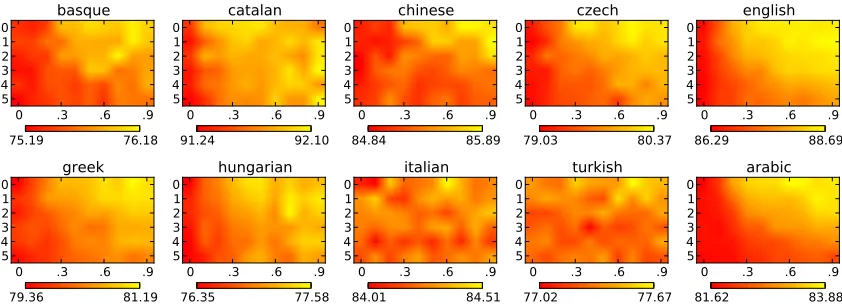
Figure 1: Effect ofk(y axis) andp(x axis) values on parsing accuracies for the arc-eager system on the various CoNLL-2007 shared-task languages. Each point is an average UAS of 5 runs with different seeds. The general trend is that smallerkand higherpare better.
(1) it adds an arc(h, d)such that(h0, d) ∈ T
for someh0 ∈λ,h0 6=h;
(2) it adds an arc(h, d)such that (d, d0) ∈ T
for somed0 ∈λ.
The exact cost can be calculated by counting the number of such arcs.
5 Experiments and Results
Setup, data and parameters The goal of our ex-periments is to evaluate the utility of the dynamic oracles for training, by comparing a training sce-nario which only sees configurations that can lead to the gold tree (following a static oracle for the left-to-right systems and a non-deterministic but in-complete oracle for the easy-first system), against a training scenario that involves exploration of incor-rect states, using the dynamic oracles.
As our training algorithm involves a random com-ponent (we shuffle the sentences prior to each itera-tion, and randomly select whether to follow a cor-rect or incorcor-rect action), we evaluate each setup five times using different random seeds, and report the averaged results.
We perform all of the experiments on the multi-lingual CoNLL-2007 data sets. We use 15 training iterations for the left-to-right parsers, and 20 training iterations for the easy-first parser. We use the stan-dard perceptron update as our update rule in training, and use the averaged weight vector for prediction in test time. The feature sets differ by transition sys-tem but are kept the same across data sets. The
ex-act feature-set definitions for the different systems are available in the accompanying software, which is available on line at the first author’s homepage.
Effect of exploration parameters In an initial set of experiments, we investigate the effect of the ex-ploration parametersk andp on the arc-eager
sys-tem. The results are presented in Figure 1. While the optimal parameters vary by data set, there is a clear trend toward lower values ofkand higher values of p. This is consistent with the report of Goldberg and
Nivre (2012) who used a fixed small value ofkand
large value ofpthroughout their experiments.
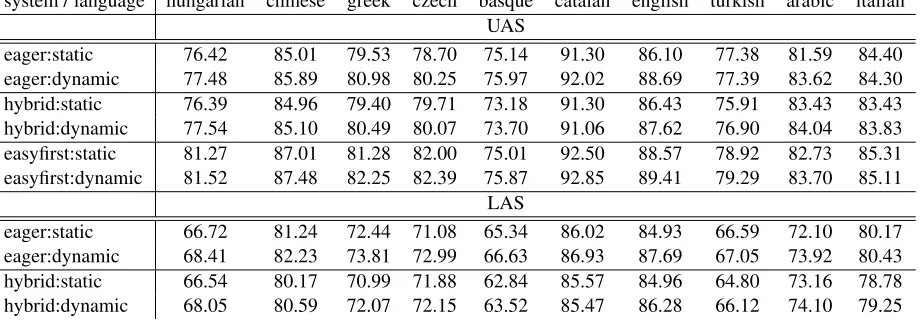
system / language hungarian chinese greek czech basque catalan english turkish arabic italian UAS
eager:static 76.42 85.01 79.53 78.70 75.14 91.30 86.10 77.38 81.59 84.40 eager:dynamic 77.48 85.89 80.98 80.25 75.97 92.02 88.69 77.39 83.62 84.30 hybrid:static 76.39 84.96 79.40 79.71 73.18 91.30 86.43 75.91 83.43 83.43 hybrid:dynamic 77.54 85.10 80.49 80.07 73.70 91.06 87.62 76.90 84.04 83.83 easyfirst:static 81.27 87.01 81.28 82.00 75.01 92.50 88.57 78.92 82.73 85.31 easyfirst:dynamic 81.52 87.48 82.25 82.39 75.87 92.85 89.41 79.29 83.70 85.11
LAS
[image:11.612.80.540.60.220.2]eager:static 66.72 81.24 72.44 71.08 65.34 86.02 84.93 66.59 72.10 80.17 eager:dynamic 68.41 82.23 73.81 72.99 66.63 86.93 87.69 67.05 73.92 80.43 hybrid:static 66.54 80.17 70.99 71.88 62.84 85.57 84.96 64.80 73.16 78.78 hybrid:dynamic 68.05 80.59 72.07 72.15 63.52 85.47 86.28 66.12 74.10 79.25
Table 1: Results on the CoNLL 2007 data set. UAS, including punctuation. Each number is an average over 5 runs with different randomization seeds. All experiments used the same exploration parameters ofk=1,p=0.9.
6 Related Work
The error propagation problem for greedy transition-based parsing was diagnosed by McDonald and Nivre (2007) and has been tackled with a variety of techniques including parser stacking (Nivre and Mc-Donald, 2008; Martins et al., 2008) and beam search and structured prediction (Zhang and Clark, 2008; Zhang and Nivre, 2011). The technique called boot-strapping in Choi and Palmer (2011) is similar in spirit to training with exploration but is applied iter-atively in batch mode and is only approximate due to the use of static oracles. Dynamic oracles were first explored by Goldberg and Nivre (2012).
In machine learning more generally, our approach can be seen as a problem-specific instance of imita-tion learning(Abbeel and Ng, 2004; Vlachos, 2012; He et al., 2012; Daum´e III et al., 2009; Ross et al., 2011), where the dynamic oracle is used to im-plement the optimal expertneeded in the imitation learning setup. Indeed, our training procedure is closely related to DAgger (Ross et al., 2011), which also trains a classifier to match an expert on a dis-tribution of possibly suboptimal states obtained by running the system itself. Our training procedure can be viewed as an online version of DAgger (He et al., 2012) with two extensions: First, our learn-ing algorithm involves a stochastic policy parame-terized byk, p for choosing between the oracle or the model prediction, whereas DAgger always fol-lows the system’s own prediction (essentially run-ning withk = 0,p = 1). The heatmaps in Figure
1 show that this parameterization is beneficial. Sec-ond, while DAgger assumes an expert providing a single label at each state, our oracle is nondetermin-istic and allows multiple correct labels (transitions) which our training procedure tie-breaks according to the model’s current prediction, a technique that has recently been proposed in an extension to DAgger by He et al. (2012). Other related approaches in the machine learning literature include stacked sequen-tial learning (Cohen and Carvalho, 2005), LaSO (Daum´e III and Marcu, 2005), Searn (Daum´e III et al., 2009) and SMILe (Ross and Bagnell, 2010).
7 Conclusion
References
Pieter Abbeel and Andrew Y Ng. 2004. Apprenticeship learning via inverse reinforcement learning. In Pro-ceedings of the 21st International Conference on Ma-chine Learning (ICML), page 1.
Jinho D. Choi and Martha Palmer. 2011. Getting the most out of transition-based dependency parsing. In
Proceedings of the 49th Annual Meeting of the Asso-ciation for Computational Linguistics: Human Lan-guage Technologies, pages 687–692.
William W. Cohen and Vitor R. Carvalho. 2005. Stacked sequential learning. In Proceedings of the Inter-national Joint Conference on Artificial Intelligence, pages 671–676.
Hal Daum´e III and Daniel Marcu. 2005. Learning as search optimization: Approximate large margin meth-ods for structured prediction. In Proceedings of the 22nd International Conference on Machine Learning, pages 169–176.
Hal Daum´e III, John Langford, and Daniel Marcu. 2009. Search-based structured prediction. Machine Learn-ing, 75:297–325.
Yoav Goldberg and Michael Elhadad. 2010. An effi-cient algorithm for easy-first non-directional depen-dency parsing. In Human Language Technologies: The 2010 Annual Conference of the North American Chapter of the Association for Computational Linguis-tics (NAACL HLT), pages 742–750.
Yoav Goldberg and Joakim Nivre. 2012. A dynamic or-acle for arc-eager dependency parsing. In Proceed-ings of the 24th International Conference on Compu-tational Linguistics (COLING), pages 959–976. He He, Hal Daum´e III, and Jason Eisner. 2012. Imitation
learning by coaching. InAdvances in Neural Informa-tion Processing Systems 25.
Liang Huang and Kenji Sagae. 2010. Dynamic program-ming for linear-time incremental parsing. In Proceed-ings of the 48th Annual Meeting of the Association for Computational Linguistics (ACL), pages 1077–1086. Terry Koo and Michael Collins. 2010. Efficient
third-order dependency parsers. InProceedings of the 48th Annual Meeting of the Association for Computational Linguistics (ACL), pages 1–11.
Marco Kuhlmann, Carlos G´omez-Rodr´ıguez, and Gior-gio Satta. 2011. Dynamic programming algorithms for transition-based dependency parsers. In Proceed-ings of the 49th Annual Meeting of the Association for Computational Linguistics (ACL), pages 673–682. Andr´e Filipe Martins, Dipanjan Das, Noah A. Smith, and
Eric P. Xing. 2008. Stacking dependency parsers. InProceedings of the Conference on Empirical Meth-ods in Natural Language Processing (EMNLP), pages 157–166.
Ryan McDonald and Joakim Nivre. 2007. Charac-terizing the errors of data-driven dependency parsing models. InProceedings of the 2007 Joint Conference on Empirical Methods in Natural Language Process-ing and Computational Natural Language LearnProcess-ing (EMNLP-CoNLL), pages 122–131.
Ryan McDonald, Koby Crammer, and Fernando Pereira. 2005. Online large-margin training of dependency parsers. InProceedings of the 43rd Annual Meeting of the Association for Computational Linguistics (ACL), pages 91–98.
Joakim Nivre and Ryan McDonald. 2008. Integrating graph-based and transition-based dependency parsers. InProceedings of the 46th Annual Meeting of the As-sociation for Computational Linguistics (ACL), pages 950–958.
Joakim Nivre. 2003. An efficient algorithm for pro-jective dependency parsing. In Proceedings of the 8th International Workshop on Parsing Technologies (IWPT), pages 149–160.
Joakim Nivre. 2004. Incrementality in deterministic de-pendency parsing. InProceedings of the Workshop on Incremental Parsing: Bringing Engineering and Cog-nition Together (ACL), pages 50–57.
Joakim Nivre. 2008. Algorithms for deterministic incre-mental dependency parsing. Computational Linguis-tics, 34:513–553.
St´ephane Ross and J. Andrew Bagnell. 2010. Efficient reductions for imitation learning. In Proceedings of the 13th International Conference on Artificial Intelli-gence and Statistics, pages 661–668.
St´ephane Ross, Geoffrey J. Gordon, and J. Andrew Bag-nell. 2011. A reduction of imitation learning and structured prediction to no-regret online learning. In
Proceedings of the 14th International Conference on Artificial Intelligence and Statistics, pages 627–635. Andreas Vlachos. 2012. An investigation of imitation
learning algorithms for structured prediction. In Pro-ceedings of the European Workshop on Reinforcement Learning (EWRL), pages 143–154.
Yue Zhang and Stephen Clark. 2008. A tale of two parsers: Investigating and combining graph-based and transition-based dependency parsing. InProceedings of the Conference on Empirical Methods in Natural Language Processing (EMNLP), pages 562–571. Yue Zhang and Joakim Nivre. 2011. Transition-based
dependency parsing with rich non-local features. In