Exploring Compositional Architectures and Word Vector Representations
for Prepositional Phrase Attachment
Yonatan Belinkov, Tao Lei, Regina Barzilay Massachusetts Institute of Technology
{belinkov, taolei, regina}@csail.mit.edu
Amir Globerson The Hebrew University
Abstract
Prepositional phrase (PP) attachment disam-biguation is a known challenge in syntactic parsing. The lexical sparsity associated with PP attachments motivates research in word representations that can capture pertinent syn-tactic and semantic features of the word. One promising solution is to use word vectors in-duced from large amounts of raw text. How-ever, state-of-the-art systems that employ such representations yield modest gains in PP at-tachment accuracy.
In this paper, we show that word vector repre-sentations can yield significant PP attachment performance gains. This is achieved via a non-linear architecture that is discriminatively trained to maximize PP attachment accuracy. The architecture is initialized with word vec-tors trained from unlabeled data, and relearns those to maximize attachment accuracy. We obtain additional performance gains with al-ternative representations such as dependency-based word vectors. When tested on both En-glish and Arabic datasets, our method outper-forms both a strong SVM classifier and state-of-the-art parsers. For instance, we achieve 82.6% PP attachment accuracy on Arabic, while the Turbo and Charniak self-trained parsers obtain 76.7% and 80.8% respectively.1
1 Introduction
The problem of prepositional phrase (PP) attach-ment disambiguation has been under investigation 1The code and data for this work are available athttp: //groups.csail.mit.edu/rbg/code/pp.
She ate spaghetti with butter
[image:1.612.320.512.237.356.2]She ate spaghetti with chopsticks
Figure 1: Two sentences illustrating the importance of lexicalization in PP attachment decisions. In the top sentence, the PPwith butterattaches to the noun spaghetti. In the bottom sentence, the PPwith chop-sticksattaches to the verbate.
for a long time. However, despite at least two decades of research (Brill and Resnik, 1994; Rat-naparkhi et al., 1994; Collins and Brooks, 1995), it remains a major source of errors for state-of-the-art parsers. For instance, in a comparative evaluation of parser performance on the Wall Street Journal cor-pus, Kummerfeld et al. (2012) report that PP attach-ment is the largest source of errors across all parsers. Moreover, the extent of improvement over time has been rather limited, amounting to about 32% error reduction since the work of (Collins, 1997).
PP attachments are inherently lexicalized and part-of-speech (POS) tags are not sufficient for their correct disambiguation. For example, the two sen-tences in Figure 1 vary by a single noun —butter vs chopsticks. However, this word determines the structure of the whole PP attachment. If the
sponding word is not observed in the training data, a standard lexicalized parser does not have sufficient information to distinguish between these two cases. In fact, 72% of head-child pairs (e.g. spaghetti -butter) from the Wall Street Journal test set are un-seen in training. Not surprisingly, resolving these ambiguities is challenging for parsers that have re-stricted access to word semantics.
These considerations have motivated recent ex-plorations in using distributed word representa-tions for syntactic parsing (Cirik and S¸ensoy, 2013; Socher et al., 2013; Lei et al., 2014). Low-dimensional word embeddings help unveil seman-tic similarity between words, thereby alleviating the data sparsity problem associated with PP at-tachment. In this context, large amounts of raw data used to construct embeddings effectively en-rich limited syntactic annotations. While these ap-proaches show initial promise, they still lag behind self-trained parsers (McClosky et al., 2006). These parsers also utilize raw data but in a different way: self-trained parsers use it to get additional (noisy) annotations, without computing new word represen-tations. These results suggest that embedding-based representations have not yet been utilized to their full potential.
We show that embedding-based representations can indeed significantly improve PP attachment ac-curacy. We achieve this by using such represen-tations within a compositional neural network ar-chitecture. The representations are initially learned from an unlabeled corpus, but are then further dis-criminatively trained to maximize PP attachment accuracy. We also explore alternative representa-tions such as dependency-based word vectors that are trained from parsed texts using the syntactic con-text in a dependency tree.
We test our approach for PP attachment disam-biguation on English and Arabic datasets, com-paring it to full-scale parsers and a support vec-tor machine (SVM) ranker. Our model outper-forms all baselines, including a self-trained parser. The difference is particularly apparent on Arabic. For instance, our model achieves PP attachment accuracy of 82.6% while the Turbo (Martins et al., 2013), RBG (Lei et al., 2014), and Charniak self-trained (McClosky et al., 2006) parsers obtain 76.7%, 80.3%, and 80.8% respectively. Our results
demonstrate that relearning the embeddings con-tributes to the model performance, across a range of configurations. We also notice that representations based on syntactic context are more powerful than those based on linear context. This may explain the improved performance of self-trained parsers over parsers that rely on linear context embeddings.
2 Related Work
Problem formulation Typically, PP attachment disambiguation is modeled as a binary classification decision between a preceding noun or verb (Brill and Resnik, 1994; Ratnaparkhi et al., 1994; Collins and Brooks, 1995; Olteanu and Moldovan, 2005; ˇSuster, 2012). In addition, the problem of PP at-tachment has also been addressed in the context of full parsing (Atterer and Sch¨utze, 2007; Agirre et al., 2008). For instance, Green (2009) engineered state-split features for the Stanford parser to improve Ara-bic PP attachment.
In this work, we do isolate PP attachments from other parsing decisions. At the same time, we con-sider a more realistic scenario where multiple can-didate heads are allowed. We also compare against full-scale parsers and show that our model predic-tions improve a state-of-the-art dependency parser.
Information sources Lexical sparsity associated with disambiguating PP attachments (Figure 1) has spurred researchers to exploit a wide range of infor-mation sources. On the one hand, researchers have explored using manually crafted resources (Stetina and Nagao, 1997; Gamallo et al., 2003; Olteanu and Moldovan, 2005; Medimi and Bhattacharyya, 2007). For instance, Agirre et al. (2008) demon-strate that using WordNet semantic classes bene-fits PP attachment performance. On the other hand, researchers have looked into using co-occurrence statistics from raw text (Volk, 2002; Olteanu and Moldovan, 2005; Gala and Lafourcade, 2007). Such statistics can be translated into word vectors from which a cosine similarity score is calculated (ˇSuster, 2012). We also rely on word vectors, but our model captures more complex relations among them.
particular, Socher et al. (2013) obtain good parsing performance by building compositional representa-tions from word vectors. However, to combat the computational complexity of the full parsing sce-nario, they rely on a probabilistic context-free gram-mar to prune search space. In contrast, focusing on PP attachment allows us to consider various neu-ral network architectures that are more appropriate for this task, including ternary, binary, and distance-dependent compositions. Furthermore, we investi-gate modifications to the original word vectors in several important directions: enriching word vectors with semantic and syntactic knowledge resources, relearning them by backpropagating errors from su-pervised data, and using dependency-based vectors. We show that such modifications lead to better word vectors and significant performance gains.
3 Model
We begin by introducing some notation. All vectors v ∈Rn are assumed to be column vectors. We de-note a given sentence byxand the set of prepositions inxbyP R(x). In other words,P R(x)is the set of words whose POS tags areprep. The PP attachment label of the preposition z ∈ P R(x) is denoted by
y(z)∈x. Namely,y(z) =hindicates that the head
of the prepositionzish.
Our classification approach is to construct a scor-ing function s(x, z, h;θ) for a preposition z ∈ P R(x) and its candidate headh in the sentencex.
We then choose the head by maximizings(x, z, h;θ) overh. The set of possible candidates{h}can be of
arbitrary size, thus departing from the binary classi-fication scenario considered in much of the previous work (Section 2). The set of parameters isθ.
3.1 Compositional framework
Our approach to constructing the score function is as follows. First, we assume that all words in the sentence are represented as vectors in Rn. Next, we compose vectors corresponding to the relevant preposition, its candidate head, and other words in the sentence to obtain a new vectorp ∈ Rn. The final score is a linear function of this vector.
The basic composition operation is defined as a single layer in a neural network (Socher et al., 2010). Given vectorsu,v ∈ Rn, representing two words,
we form a new vector via a function:
g(W[u;v] +b) ∈ Rn (1)
whereb∈Rnis a vector of bias terms,[u;v]∈R2n is a concatenation ofu andvinto a column vector, W ∈ Rn×2n is a composition matrix, and g is a non-linear activation function.2
Given a candidate head h for preposition z, we
apply such compositions to a set of words, resulting in a vector p. The final scores(x, z, h;θ) is given by w·p, where w ∈ Rn is a weight vector. The parameters to be learned areθ= (W,b,w). 3.2 Composition architectures
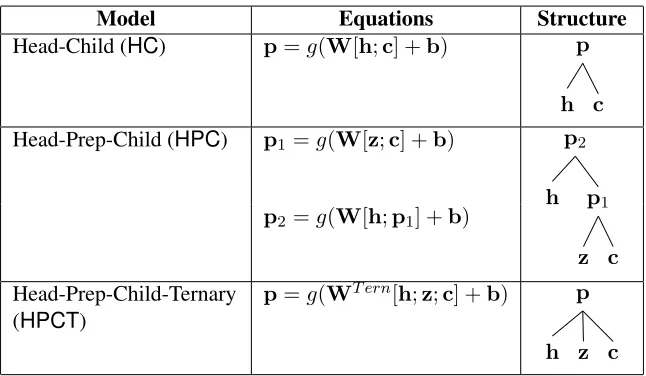
There are various possible ways to compose and ob-tain the vectorp. Table 1 shows three basic compo-sition architectures that are used in our model. In all cases, elements like the head of the PP, the preposi-tion, and the first child of the preposition are com-posed using Eq. 1 to derive a parent vector that is then scored by the score vector w. The architec-tures differ in the number of compositions and their type. For instance, the Head-Child model uses only the head and child in a single composition, ignoring the preposition. The Head-Prep-Child-Ternary com-poses all three elements simultenuously, reflecting ternary interactions. The Head-Prep-Child model, on the other hand, first composes the preposition and child to form a parentp1 representing the PP, then
composesp1 with the head into another parent p2
(=p) that is scored byw. This two-step process fa-cilitates capturing different syntactic relations with different composition matrices. We turn to this next. Granularity The basic composition architectures (Table 1) assume a global matrixWfor all composi-tion operacomposi-tions. In the case of the Head-Prep-Child model, we also consider a local variant with differ-ent matrices for the two compositions:Wbottomfor composing the prepositionz with its childc into a parent p1 representing the PP, and Wtop for
com-posing the head h with p1 into a parent p2. The
composition equations are then:
p1=g(Wbottom[z;c] +bbottom)
p2=g(Wtop[h;p1] +btop)
Model Equations Structure Head-Child (HC) p=g(W[h;c] +b) p
c h Head-Prep-Child (HPC) p1 =g(W[z;c] +b) p2
p1
c z h p2 =g(W[h;p1] +b)
Head-Prep-Child-Ternary (HPCT)
p=g(WT ern[h;z;c] +b) p
[image:4.612.145.468.52.240.2]c z h
Table 1: Basic composition architectures. h,z,c ∈ Rn are vectors for the head, the preposition, and its child respectively; p,p1,p2 ∈ Rn are parent vectors created during composition operations; W ∈
Rn×2n,WT ern ∈Rn×3nare binary and ternary composition matrices respectively;b ∈Rnis a bias term; andgis a non-linear function.
In this case, the set of parameters is θ = (Wtop;btop;Wbottom;bbottom;w). We call this variant the Head-Prep-Child-Local (HPCL) model.
The composition architectures described thus far only considered the composed words but not their relative position in the sentence. Such position in-formation may be useful, since candidates closer to the preposition are typically more likely to attach. To model this difference, we introduce distance-dependent parameters and modify the Head-Prep-Child model (Table 1, middle row) as follows: for a headhat distancedfrom the preposition, we let:
p2=g(Wd[h;p1] +bd)
where Wd ∈ Rn×2n and bd ∈ Rn are the ma-trix and bias for composing with heads at dis-tance d from the preposition. p1 is defined as
in Table 1. The set of parameters is then θ = ({Wd;bd}d;W;b;w). To reduce the number of parameters we use onlyd= 1, . . . ,5, and clip dis-tances greater than 5. We name this model Head-Prep-Child-Dist (HPCD).
Context It may also be useful to exploit words sur-rounding the candidate head such as the following word. This can be integrated in the composition ar-chitectures in the following way: for each candidate head, represented by a vectorh ∈ Rn, concatenate
a vector representing the word following the can-didate. If such a vector is not available, append a zero vector. This results in a new vectorh0 ∈ R2n representing the head. To compose it with a vector p1 ∈ Rnrepresenting the PP, we use a composition
matrix of size n×3n, similar to the ternary
com-position described above. We refer to this model as Head-Prep-Child-Next (HPCN).
3.3 Training
For training, we adopt a max-margin framework. Given a training corpus of pairs of sentences and attachments, {x(i), y(i)}, we seek to minimize the
following objective function:
J(θ) = T
X
i=1
X
z∈P R(x(i))
max h
h
s(x(i), z, h;θ)
−s(x(i), z, y(i)(z);θ) + ∆(h, y(i)(z))i (2)
where∆is the zero-one loss.
For optimization we use minibatch AdaGrad (Duchi et al., 2011). Note that the objective is non-differentiable so AdaGrad is used with the subgradi-ent ofJ(θ), calculated with backpropagation.
are randomly dropped. Random dropping occurs in-dependently for each training example and has the effect of creating multiple thinned networks that are trained with shared parameters. In our implementa-tion we dropout input units before each non-linear layer, including the initial word vectors. We do not dropout units after the final non-linear layer. Note that Dropout is known to be especially useful when combined with AdaGrad (Wager et al., 2013).
Hyperparameters and initialization We use the following default hyperparameters without further tuning unless noted otherwise: Dropout parameter
ρ= 0.5(Hinton et al., 2012), AdaGrad initial learn-ing rate η = 1.0 (Dyer, n.d.), and minibatch size of 500. Learned parameters are initialized simi-larly to previous work (Bengio and Glorot, 2010; Socher et al., 2013): composition matrices are set toW = 0.5[I I] +, where ∼ U(−n1,n1); bias termsbare set to zero; and the weight vector is set tow∼U(−√1
n,
1 √
n).
4 Word vector representations
Our approach assumes a vector representation for each word. Such representations have gained popu-larity in recent years, due to the ability to train them from large unlabeled datasets, and their ease of use in a wide variety of tasks (Turian et al., 2010).
There are various approaches to training vector representations (Collobert and Weston, 2008; Ben-gio et al., 2009). Here we chose to focus on the Skip-gram method recently proposed by Mikolov et al. (2013a). The Skip-gram model maximizes the average log-probability of every word generating its context, which is modeled via a neural net architec-ture, but without the non-linearity. To improve effi-ciency, this probability is approximated by a hierar-chical softmax (Mikolov et al., 2013b) with vocabu-lary words represented in a binary Huffman tree.3
In the simplest variant of our method, we train the Skip-gram representation on unlabeled text, and use it as a fixed representation when training the PP attachment model (see Section 3.3). Below we con-sider several variations on this approach.
3Preliminary experiments with other model variations (e.g. negative sampling) have not led to notable performance gains.
Figure 2: Illustration of an enriched word vector. Initial dimensions learned from raw texts are en-riched with binary vectors indicating part-of-speech tags, VerbNet frames, and WordNet hypernyms.
4.1 Relearning word vectors
The Skip-gram word vectors are originally learned from raw text, with the objective of maximizing the likelihood of co-occurring words. Here our goal is to maximize PP attachment accuracy, and it is possi-ble that a different representation is optimal for this task. We may thus take a discriminative approach and update the vectors to maximize PP attachment accuracy. Technically this just requires taking the subgradient of our objective (Eq. 2) with respect to the word vectors, and updating them accordingly.
Adding the word vectors as parameters signifi-cantly increases the number of free parameters in the model, and may lead to overfitting. To reduce this effect, we use Dropout regularization (Section 3.3). We also employ a smaller initial learning rate for the word vectors compared to other model parameters.4
Finally, note that since the objective is non-convex, the vectors obtained after this procedure will typically depend on the initial value used. The relearning procedure may thus be viewed as fine-tuning the word vectors to improve PP attachment accuracy.
4.2 Enriching word vectors
The word vectors we use are trained from raw text. However, it is easy to enrich them using structured knowledge resources such as VerbNet or WordNet, as well as morpho-syntactic information available in treebanks.
appears with the preposition in a verb frame. Finally, for each top hypernym in WordNet, we add a binary dimension indicating whether it is a hypernym of the candidate head, aiming for semantic clustering information. Note that we do not perform sense dis-ambiguation so this information may be noisy.
Figure 2 illustrates the resulting enriched vector. Similar dimensions are appended to vectors repre-senting other words participating in the composi-tions. Our experiments show that such an extension significantly improves performance.
4.3 Syntactic word vectors
In the standard Skip-gram model word vectors are trained from raw text using the linear context of neighboring words. We also consider an alterna-tive method for creating word vectors by using the syntactic context of words. Such syntactic context is expected to be relevant for resolving PP attach-ments. Given a dependency-parsed text, we follow Bansal et al. (2014) and create a new corpus of tu-ples(l, g, p, c, l), for every wordc, its parentpwith
dependency labell, and its grandparentg. Then we
train an ordinary Skip-gram model on this corpus, but with a small window size of 2. Note that the label
lappears on both ends so it contributes to the
con-text of the word as well as its grandparent. We find that syntactic vectors yield significant performance gains compared to standard vectors.5
5 Experimental setup 5.1 Extracting PP attachments
Instances of PP attachment decisions are extracted from standard treebanks. We use the CATiB de-pendency treebank (Habash and Roth, 2009) for Arabic and a conversion of the Penn treebank (PTB) to dependency format for English.6 Standard
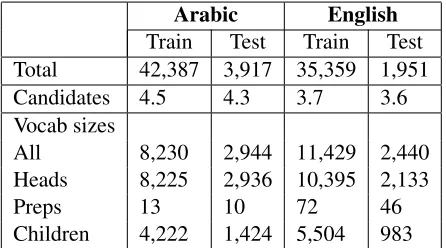
train/dev/test splits are used: sections 2-21/22/23 of the PTB for English, and the split from the SPRML shared-task for Arabic (Seddah et al., 2013). As Ta-ble 2 shows, the datasets of the two languages are fairly similar in size, except for the much larger set of prepositions in the English data.
Extracting instances of PP attachments from the treebanks is done in the following way. For each 5We also experimented with another method for creating syntactic vectors by Levy and Goldberg (2014) and observed
Arabic English Train Test Train Test Total 42,387 3,917 35,359 1,951 Candidates 4.5 4.3 3.7 3.6 Vocab sizes
All 8,230 2,944 11,429 2,440 Heads 8,225 2,936 10,395 2,133
Preps 13 10 72 46
Children 4,222 1,424 5,504 983
Table 2: Statistics of extracted PP attachments, showing total sizes, average number of candidate heads, and vocabulary sizes.
Arabic English Corpus arTenTen Wikipedia BLLIP
Tokens 130M 120M 43M
Types 43K 218K 317K
Table 3: Statistics of Arabic and English corpora used for creating word vectors.
preposition, we look for all possible candidate heads in a fixed preceding window. Typically, these will be nouns or verbs. Only prepositions with a noun child are considered, leaving out some rare excep-tions. Empirically, limiting candidate heads to ap-pear close enough before the preposition is not an unrealistic assumption: we choose a 10-word win-dow and find that it covers about 94/99% of Ara-bic/English PP attachments. Unambiguous attach-ments with a single possible candidate are discarded.
5.2 Creating word vectors
The initial word vectors are created from raw texts using the Skip-gram model with hierarchical soft-max, as described in Section 4.7We use a portion of
Wikipedia for English8and the arTenTen corpus for
Arabic, containing web texts crawled in 2012 (Be-linkov et al., 2013; Arts et al., 2014). Table 3
similar performance gains.
6We used thePennconverter tool: http://nlp.cs. lth.se/software/treebank-converter.
7We used theword2vectool:https://code.google. com/p/word2vec, with default settings. We experimented with word vectors of 25, 50, 100, and 200 dimensions, and found 100 to work best in most cases.
[image:6.612.314.538.243.299.2]shows the comparable sizes of the datasets. The Arabic corpus has been tokenized and lemmatized with MADA (Habash and Rambow, 2005; Habash et al., 2005), a necessary procedure in order to separate some prepositions from their child words. In addi-tion, lemmatization reduces vocabulary size and fa-cilitates sharing information between different mor-phological variants that have the same meaning.
For syntactic word vectors, we use the English vectors in (Bansal et al., 2014), which were trained from a parsed BLLIP corpus (minus PTB). For Ara-bic, we first convert the morphologically-processed arTenTen corpus to CoNLL format with the SPMRL shared-task scripts (Seddah et al., 2013). Then we parse the corpus with a baseline MST parser (Sec-tion 5.3) and create syntactic word vectors as de-scribed in Section 4.3. The Arabic syntactic vectors will be made available to the research community.
For enriching word vectors, we use part-of-speech information9from the treebanks as well as the
Ara-bic and English VerbNets (Kipper et al., 2008; Mousser, 2010) and WordNets (Rodr´ıquez et al., 2008; Princeton University, 2010). In total, these resources add to each word vector 46/67 extended dimensions in Arabic/English, representing syntac-tic and semansyntac-tic information about the word.
5.3 Baselines
We compare against full-scale parsers, an SVM ranker, and a simple but strong baseline of always choosing the closest candidate head.
Parsers We mostly compare with dependency parsers, including the state-of-the-art Turbo (Mar-tins et al., 2010; Mar(Mar-tins et al., 2013) and RBG parsers (Lei et al., 2014), in addition to a second-order MST parser (McDonald et al., 2005) and the Malt parser (Nivre et al., 2006). We also compare with two constituency parsers: an RNN parser (Socher et al., 2013), which also uses word vectors and a neural network approach, and the Charniak self-trained reranking parser (McClosky et al., 2006). We train all parsers on the train/dev sets and report their PP attachment accuracy on the test sets.10 For the self-trained parser we followed the
9We use gold POS tags in all systems and experiments. 10The only exception is the RNN parser, for which we use the built-in English model in Stanford parser’s (version 3.4);
Source Feature Template Treebank hw, pw, cw, hw-cw,
ht, nt, hpd WordNet hh, ch VerbNet hpvf
Word Vectors sim(hv,cv) Brown Clusters hc*, pc*, cc*,
[image:7.612.319.534.53.179.2]hc4, pc4, cc4, hc*-cc*, hc4-cc4
Table 4: Feature templates for the SVM baseline. Bi-lexical templates appear with a “-”. Abbrevi-ations: hw/pw/cw = head/prep/child word, ht = head tag,nt= next word tag,hpd= head-prep dis-tance;hh/ch= head/child hypernym;hpvf= head-prep found in verb frame;hv/cv= head/child vec-tor;hc*/pc*/cc*= head/prep/child full bit string, hc4/pc4/cc4= head/prep/child 4-bit prefix.
procedure in (McClosky et al., 2006) with the same unsupervised datasets that are used in our PP model. SVM We consider a learning-to-rank formulation for our problem, where each example provides a cor-rect candidate head and several incorcor-rect candidates. We order these in a simple list where the correct can-didate has the highest rank and all other cancan-didates have a single lower rank. We then rank these with an SVM ranker11and select the top candidate. This
formulation is necessary because we depart from the binary classification scenario that was used in previ-ous work (Section 2).
The SVM ranker uses the following features: the candidate head, preposition, and child; bi-lexical conjunctions of head-child; part-of-speech tags of the head and the following word; and the candi-date head’s distance from the preposition. We also add top WordNet hypernyms for head and child, and an indicator of whether the preposition appears in the head’s sub-categorization frame in VerbNet. This configuration parallels the information used in our model but fails to exploit raw data. Therefore, we consider two more types of features. First, we use word vectors by computing cosine similarity be-tween vectors of the candidate head and the child for Arabic we do train a new RNN model.
of the preposition. This feature was found useful in previous work on PP attachment (ˇSuster, 2012). While this limits the contribution of the word vec-tors to the learned model to one dimension, attempts to use more dimensions in the SVM were unsuccess-ful.12 In contrast, the compositional models better
capture the full dimensionality of the word vectors. A second type of features induced from raw data that we consider are Brown clusters, which were found to be useful in dependency parsing (Koo et al., 2008). Compared to distributed vectors, Brown clusters provide a more discrete representation that is easier to incorporate in the SVM. We create clus-ters from our unsupervised corpora using the Liang (2005) implementation of Brown’s algorithm, and add features in the spirit of (Koo et al., 2008). Specifically, we add full and prefixed bit strings for the head, preposition, and child, as well as bi-lexical versions for head-child pairs.13 Table 4 shows a
summary of the SVM features.
6 Results
Table 5 summarizes the results of our model and other systems. Our best results are obtained with the Head-Prep-Child-Dist (HPCD) model using syn-tactic vectors, enriching, and relearning. The full model outperforms both full-scale parsers and a ded-icated SVM model. More advanced parsers do demonstrate higher accuracy on the PP attachment task, but our method outperforms them as well. Note that the self-trained reranking parser (Charniak-RS) performs especially well and quite better than the RNN parser. This trend is consistent with the results in (Kummerfeld et al., 2012; Socher et al., 2013).
Our compositional architecture is effective in ex-ploiting raw data: using only standard word vec-tors with no enriching, our HPCD (basic) model per-forms comparably to an SVM with access to all en-riching features. Once we improve the representa-tion, we outperform both the SVM and full parsers. In comparison, the contribution of raw data to the SVM, as either word vectors or Brown clusters, is rather limited.
12For example, we tried adding all word vector dimensions as features, as well as element-wise products of the vectors rep-resenting the head and the child.
13As in (Koo et al., 2008), we limit the number of unique bit strings to 1,000 so full strings are not equivalent to word forms.
System Arabic English
Closest 62.7 81.7
SVM 77.0 86.0
w/ word vectors 77.5 85.9 w/ Brown clusters 78.0 85.7 w/ Brown clusters+prefixes 77.0 85.7
Malt 75.4 79.7
MST 76.7 86.8
Turbo 76.7 88.3
RBG 80.3 88.4
RNN 68.9 85.1
Charniak-RS 80.8 88.6
HPCD (basic) 77.1 85.4 w/ enriching 80.4 87.7 w/ syntactic 79.1 87.1 w/ relearning 80.0 86.6
HPCD (full) 82.6 88.7
RBG + HPCD (full) 82.7 90.1
Table 5: PP attachment accuracy of our HPCD model compared to other systems.HPCD(full) uses syntactic vectors with enriching and relearning. The last row is a modified RBG parser with a feature for the PP predictions of our model.
The relative performance is consistent across both English and Arabic. The table also demonstrates that the Arabic dataset is more challenging for all mod-els. This can be explained by a larger average candi-date set (Table 2), a freer word order that manifests in longer attachments (average head and PP distance is 3.3 in Arabic vs 1.5 in English), and the lexical sparsity induced by the richer morphology.
Effect on parsing To investigate how our PP at-tachment model contributes to the general parsing task, we incorporated the predictions of our model in an existing dependency parser. We modified the RBG parser (Lei et al., 2014) such that a binary arc feature fires for every PP attachment predicted by our model. For both test sets, we find that the pars-ing performance, measured as the unlabeled attach-ment score (UAS), increases by adding the predic-tions in this way (Table 6). The modified parser also achieves the best PP attachment numbers (Table 5).
[image:8.612.315.540.53.306.2]System Arabic English
RBG 87.70 93.96
[image:9.612.316.540.53.223.2]RBG + predicted PP 87.95 94.05 RBG + oracle PP 89.09 94.42
Table 6: Parsing performance (UAS) of the RBG parser, with predicted and oracle PPs.
is relatively larger than the gain in PP accuracy. For example, relative to an oracle upper bound of forc-ing gold PP arcs in the parser output (Table 6), the reduction in English parsing errors is 20%, whereas the reduction in PP errors is only 15%. This affirms the importance of PP attachment disambiguation for predicting other attachments in the sentence. RRR dataset Much of the previous work on PP attachment focused on a binary classification sce-nario (Section 2) and has been evaluated on the RRR dataset (Ratnaparkhi et al., 1994). Such systems cannot be easily evaluated in our setting which al-lows multiple candidate heads. On the other hand, our full model exploits contextual information that is not available in the RRR dataset. Nevertheless, using a simpler version of our model we obtain an accuracy of 85.6% on the RRR test set.14 This is
comparable to much of the previous work (Olteanu and Moldovan, 2005), but still lags behind the 88.1% of Stetina and Nagao (1997), who also used Word-Net information. However, our use of WordWord-Net is rather limited compared to theirs, indicating that our enriching method can be improved with other types of information.
[image:9.612.89.286.54.110.2]6.1 Alternative composition architectures In this section we analyze how different composition architectures (Section 3.2) contribute to the overall performance. To isolate the contribution of the ar-chitecture, we focus on standard (linear) word vec-tors, with no relearning or enriching. As Figure 3 shows, simpler models tend to perform worse than more complex ones. The best variants use differ-ent composition matrices based on the distance of the candidate head from the PP (HPCD,HPCDN). While the results shown are for 100-dimensional 14Here we applied basic preprocessing similarly to (Collins and Brooks, 1995), converting 4-digit numbers to YEAR and other numbers to NUMBER; other tokens were lower-cased.
Figure 3: PP attachment accuracy of different archi-tectures. (HC) uses only the candidate head and the child of the preposition; (HPC*) models use head, preposition, and child, with the following variants: (HPCT) ternary composition; (HPCL) local matri-ces for top and bottom compositions; (HPCN) con-text words; (HPCD) distance-dependent matrices; (HPCDN) combinesHPCD+HPCN.
vectors, similar trends are observed with lower di-mensions, although the gaps between simple and complex models are then more substantial.
We have also experimented with compositions through the entire PP subtree. However, this resulted in a performance drop (to about 50%), implying that adding more words to the composite representation of the PP does not lead to a distinguishing represen-tation with regards to the possible candidate heads.
6.2 Alternative representations
In this section, we analyze how different word vector representations (Section 4) contribute to our model. We focus on theHPCDmodel, which builds a two-step composite structure with distance-dependent composition matrices. We take the basic represen-tation to be standard (linear) word vectors, without enriching or relearning. In each paragraph below, we investigate how a different aspect of the repre-sentation affects PP attachment performance.
Figure 4: Effects of relearning standard word vec-tors in English and Arabic.
these two processes and tailoring the word vectors to the task at hand, we can further improve the ac-curacy of the PP attachments. We thus relearn the word vectors during training as described in Sec-tion 4.1. Indeed, as Figure 4 shows, doing so con-sistently improves performance, especially with low dimensional vectors. Interestingly, syntactic word vectors also benefit from the update (Table 8). This indicates that the supervised PP attachments provide complementary signal to noisy dependencies used to construct syntactic vectors.
Enriching word vectors A substantial body of work has demonstrated that multiple features can help in disambiguating PP attachments (Section 2). To this end, we enrich word vectors with addi-tional knowledge resources (Section 4.2). As Ta-ble 7 shows, this enrichment yields sizaTa-ble perfor-mance gains. Most of the gain comes from part-of-speech information, while WordNet and VerbNet have a smaller contribution. Updating the word vec-tors during training has an additional positive effect. Note that even with no enrichment, our model performs comparably to an SVM with access to all enriching features (Table 5). When enriched, our model outperforms the SVM by a margin of 2-3%. With relearning, the gaps are even larger.
Syntactic word vectors While most of the work in parsing relies on linear word vectors (Socher et al., 2013; Lei et al., 2014), we consider an alter-native vector representation that captures syntactic
Representation Arabic English w/o enriching 77.1 85.4 w/ enriching
+POS 78.5 86.4
+NextPOS 79.7 87.5
[image:10.612.81.285.60.225.2]+WordNet+VerbNet 80.4 87.7 w/ enriching+relearning 81.7 88.1 w/ enriching+relearn.+syn. 82.6 88.7
Table 7: PP attachment accuracy when enriching word vectors with part-of-speech tags of the candi-date head (POS) and the following word (NextPOS), and with WordNet and VerbNet features.
Representation Arabic English
Linear 77.1 85.4
Syntactic 79.1 87.1
Syntactic w/ relearning 80.7 87.7
Table 8: PP attachment accuracy of linear (standard) and syntactic (dependency-based) word vectors.
context. As described in Section 4.3, such vectors are induced from a large corpus processed by an au-tomatic dependency parser. While the corpus is most likely fraught with parsing mistakes, it still contains sufficient dependency information for learning high-quality word vectors. Table 8 confirms our assump-tions: using syntactically-informed vectors yields significant performance gains.
7 Conclusion
[image:10.612.323.528.247.305.2]Acknowledgments
This research is developed in collaboration with the Arabic Language Technologies (ALT) group at Qatar Computing Research Institute (QCRI) within the IYASproject. The authors acknowledge the sup-port of the U.S. Army Research Office under grant number W911NF-10-1-0533, the DARPA BOLT program and the US-Israel Binational Science Foun-dation (BSF, Grant No 2012330). We thank the MIT NLP group and the TACL reviewers for their comments, and Djam´e Seddah and Mohit Bansal for helping with scripts and data. Any opinions, find-ings, conclusions, or recommendations expressed in this paper are those of the authors, and do not neces-sarily reflect the views of the funding organizations.
References
Eneko Agirre, Timothy Baldwin, and David Martinez. 2008. Improving Parsing and PP Attachment Per-formance with Sense Information. InProceedings of ACL-HLT.
Tressy Arts, Yonatan Belinkov, Nizar Habash, Adam Kil-garriff, and Vit Suchomel. 2014. arTenTen: Arabic Corpus and Word Sketches. Journal of King Saud Uni-versity - Computer and Information Sciences.
Michaela Atterer and Hinrich Sch¨utze. 2007. Preposi-tional Phrase Attachment Without Oracles. Computa-tional Linguistics, 33(4).
Mohit Bansal, Keving Gimpel, and Karen Livescu. 2014. Tailoring Continuous Word Representations for De-pendency Parsing. InProceedings of ACL.
Yonatan Belinkov, Nizar Habash, Adam Kilgarriff, Noam Ordan, Ryan Roth, and V´ıt Suchomel. 2013. arTen-Ten: a new, vast corpus for Arabic. InProceedings of WACL.
Yoshua Bengio and Xavier Glorot. 2010. Understanding the difficulty of training deep feedforward neural net-works. InProceedings of AISTATS, volume 9, May. Yoshua Bengio, J´erˆome Louradour, Ronan Collobert, and
Jason Weston. 2009. Curriculum learning. In Pro-ceedings of ICML.
Eric Brill and Philip Resnik. 1994. A Rule-Based Approach to Prepositional Phrase Attachment Disam-biguation. InProceedings of COLING, volume 2. Volkan Cirik and H¨usn¨u S¸ensoy. 2013. The AI-KU
Sys-tem at the SPMRL 2013 Shared Task : Unsupervised Features for Dependency Parsing. InProceedings of SPMRL.
Michael Collins and James Brooks. 1995. Prepo-sitional Phrase Attachment through a Backed-Off Model.CoRR.
Michael Collins. 1997. Three Generative, Lexicalised Models for Statistical Parsing. InProceedings of ACL. Ronan Collobert and Jason Weston. 2008. A Unified Architecture for Natural Language Processing: Deep Neural Networks with Multitask Learning. In Pro-ceedings of ICML.
Fabrizio Costa, Paolo Frasconi, Vincenzo Lombardo, and Giovanni Soda. 2003. Towards Incremental Parsing of Natural Language Using Recursive Neural Networks. Applied Intelligence, 19(1-2).
John Duchi, Elad Hazan, and Yoram Singer. 2011. Adaptive Subgradient Methods for Online Learning and Stochastic Optimization. JMLR, 12.
Chris Dyer. n.d. Notes on AdaGrad. Unpublished manuscript, available at http://www.ark.cs.
cmu.edu/cdyer/adagrad.pdf.
Nuria Gala and Mathieu Lafourcade. 2007. PP attach-ment ambiguity resolution with corpus-based pattern distributions and lexical signatures. ECTI-CIT Trans-actions on Computer and Information Technology, 2. Pablo Gamallo, Alexandre Agustini, and Gabriel P.
Lopes. 2003. Acquiring Semantic Classes to Elabo-rate Attachment Heuristics. In Progress in Artificial Intelligence, volume 2902 ofLNCS. Springer Berlin Heidelberg.
Spence Green. 2009. Improving Parsing
Per-formance for Arabic PP Attachment Ambi-guity. Unpublished manuscript, available at
http://www-nlp.stanford.edu/courses/
cs224n/2009/fp/30-tempremove.pdf.
Nizar Habash and Owen Rambow. 2005. Arabic Tok-enization, Part-of-Speech Tagging and Morphological Disambiguation in One Fell Swoop. InProceedings of ACL.
Nizar Habash and Ryan Roth. 2009. CATiB: The Columbia Arabic Treebank. In Proceedings of the ACL-IJCNLP.
Nizar Habash, Owen Rambow, and Ryan Roth. 2005. MADA+TOKAN: A Toolkit for Arabic Tokenization, Diacritization, Morphological Disambiguation, POS Tagging, Stemming and Lemmatization. In Proceed-ings of the Second International Conference on Arabic Language Resources and Tools.
Geoffrey E. Hinton, Nitish Srivastava, Alex Krizhevsky, Ilya Sutskever, and Ruslan Salakhutdinov. 2012. Im-proving neural networks by preventing co-adaptation of feature detectors. CoRR.
Terry Koo, Xavier Carreras, and Michael Collins. 2008. Simple Semi-supervised Dependency Parsing. In Pro-ceedings of ACL-HLT.
Jonathan K. Kummerfeld, David Hall, James R. Curran, and Dan Klein. 2012. Parser Showdown at the Wall Street Corral: An Empirical Investigation of Error Types in Parser Output. InProceedings of EMNLP-CoNLL.
Tao Lei, Yu Xin, Yuan Zhang, Regina Barzilay, and Tommi Jaakkola. 2014. Low-Rank Tensors for Scor-ing Dependency Structures. InProceedings of ACL. Omer Levy and Yoav Goldberg. 2014.
Dependency-Based Word Embeddings. InProceedings of ACL. Percy Liang. 2005. Semi-Supervised Learning for
Natu-ral Language. Master’s thesis, Massachusetts Institute of Technology.
Andre Martins, Noah Smith, Eric Xing, Pedro Aguiar, and Mario Figueiredo. 2010. Turbo Parsers: Depen-dency Parsing by Approximate Variational Inference. InProceedings of EMNLP.
Andre Martins, Miguel Almeida, and Noah A. Smith. 2013. Turning on the Turbo: Fast Third-Order Non-Projective Turbo Parsers. InProceedings of ACL. David McClosky, Eugene Charniak, and Mark Johnson.
2006. Effective Self-Training for Parsing. In Proceed-ings of HLT-NAACL.
Ryan McDonald, Koby Crammer, and Fernando Pereira. 2005. Online Large-Margin Training of Dependency Parsers. InProceedings of ACL.
Srinivas Medimi and Pushpak Bhattacharyya. 2007. A Flexible Unsupervised PP-attachment Method Using Semantic Information. InProceedings of IJCAI. Sauro Menchetti, Fabrizio Costa, Paolo Frasconi, and
Massimiliano Pontil. 2005. Wide coverage natural language processing using kernel methods and neural networks for structured data. Pattern Recognition Let-ters, 26(12).
Tomas Mikolov, Kai Chen, Greg Corrado, and Jeffrey Dean. 2013a. Efficient Estimation of Word Represen-tations in Vector Space. InProceedings of Workshop at ICLR.
Tomas Mikolov, Ilya Sutskever, Kai Chen, Greg Corrado, and Jeffrey Dean. 2013b. Distributed Representations of Words and Phrases and their Compositionality. In Proceedings of NIPS.
Jaouad Mousser. 2010. A Large Coverage Verb Taxon-omy for Arabic. InProceedings of LREC.
J. Nivre, J. Hall, and J. Nilsson. 2006. MaltParser: A Data-Driven Parser-Generator for Dependency Pars-ing. InProceedings of LREC.
Marian Olteanu and Dan Moldovan. 2005.
PP-attachment Disambiguation using Large Context. In Proceedings of HLT-EMNLP.
Princeton University. 2010. WordNet. http://
wordnet.princeton.edu.
Adwait Ratnaparkhi, Jeff Reynar, and Salim Roukos. 1994. A Maximum Entropy Model for Prepositional Phrase Attachment. InProceedings of HLT.
Horacio Rodr´ıquez, David Farwell, Javi Ferreres, Manuel Bertran, Musa Alkhalifa, and M. Antonia Mart´ı. 2008. Arabic WordNet: Semi-automatic Extensions using Bayesian Inference. InProceedings of LREC. Djam´e Seddah, Reut Tsarfaty, Sandra K¨ubler, Marie
Can-dito, Jinho D. Choi, Rich´ard Farkas, Jennifer Fos-ter, et al. 2013. Overview of the SPMRL 2013 Shared Task: A Cross-Framework Evaluation of Pars-ing Morphologically Rich Languages. InProceedings of SPMRL.
Richard Socher, Christopher D. Manning, and Andrew Y. Ng. 2010. Learning Continuous Phrase Representa-tions and Syntactic Parsing with Recursive Neural Net-works. In Proceedings of NIPS Deep Learning and Unsupervised Feature Learning Workshop.
Richard Socher, John Bauer, Christopher D. Manning, and Ng Andrew Y. 2013. Parsing with Compositional Vector Grammars. InProceedings of ACL.
Jiri Stetina and Makoto Nagao. 1997. Corpus Based PP Attachment Ambiguity Resolution with a Semantic Dictionary. InFifth Workshop on Very Large Corpora. Simon ˇSuster. 2012. Resolving PP-attachment ambi-guity in French with distributional methods. Mas-ter’s thesis, Universit´e de Lorraine & Rijksuniversiteit Groningen.
Joseph Turian, Lev-Arie Ratinov, and Yoshua Bengio. 2010. Word Representations: A Simple and General Method for Semi-Supervised Learning. In Proceed-ings of ACL.
Martin Volk. 2002. Combining Unsupervised and Super-vised Methods for PP Attachment Disambiguation. In Proceedings of COLING.