118
M
INW
IKIS
PLIT: A Sentence Splitting Corpus with Minimal Propositions
Christina Niklaus13, Andr´e Freitas2, and Siegfried Handschuh13
1University of St.Gallen
{christina.niklaus, siegfried.handschuh}@unisg.ch
2University of Manchester
3University of Passau
{christina.niklaus, siegfried.handschuh}@uni-passau.de
Abstract
We compiled a new sentence splitting corpus that is composed of 203K pairs of aligned complex source and simplified target sen-tences. Contrary to previously proposed text simplification corpora, which contain only a small number of split examples, we present a dataset where each input sentence is bro-ken down into a set of minimal propositions, i.e. a sequence of sound, self-contained ut-terances with each of them presenting a min-imal semantic unit that cannot be further de-composed into meaningful propositions. This corpus is useful for developing sentence split-ting approaches that learn how to transform sentences with a complex linguistic structure into a fine-grained representation of short sen-tences that present a simple and more regular structure which is easier to process for down-stream applications and thus facilitates and im-proves their performance.
1 Introduction
Sentences that present a complex linguistic struc-ture can behard to comprehend by human readers, as well asdifficult to analyze by semantic applica-tions(Saggion,2017). Identifying such grammat-ical complexities in a sentence and transforming them into simpler structures, using a set of text-to-text rewriting operations, is the goal of syntactic text simplification (TS). One of the major types of operations that are used to perform this rewrit-ing step issentence splitting: it divides a sentence into several shorter components, with each of them presenting a simpler and more regular structure that is easier to process by both humans and ma-chines (see Table1).
Syntactic TS with a focus on the task of sen-tence splitting has been attracting growing interest in the natural language processing (NLP) commu-nity within the past few years. One line of work
targets reader populations with reading difficul-ties, such as people suffering from dyslexia, apha-sia or deafness (Siddharthan and Mandya, 2014;
Saggion et al.,2015;Ferr´es et al.,2016), while the second line of work aims at generating an inter-mediate representation that is easier to process for downstream semantic tasks whose predictive qual-ity deteriorates with sentence length and complex-ity. Prior work has established that applying syn-tactic TS as a preprocessing step can improve the performance of a variety of applications, including Machine Translation (ˇStajner and Popovic, 2016,
2018), Open Information Extraction (Cetto et al.,
2018), or Text Summarization (Siddharthan et al.,
2004;Bouayad-Agha et al.,2009).
2 Limitations of Existing Sentence Splitting Corpora
All of the TS approaches mentioned above make use of a set of hand-crafted transformation rules
to decompose complex sentences into a sequence of structurally simplified components, requiring a complex rule engineering process. To overcome this expensive manual effort,Narayan et al.(2017) presented a first attempt at modelling a data-driven sentence splitting approach where simplification rewrites are learned automatically from examples of aligned complex source and simplified target sentences. Since previously compiled TS corpora (PWKP (Zhu et al.,2010), EW-SEW (Coster and Kauchak, 2011), and Newsela (Xu et al., 2015)) contain only a small number of split examples, they are ill-suited for learning to decompose sen-tences into shorter, syntactically simplified com-ponents. Therefore, Narayan et al. (2017) gath-ered a new dataset, WEBSPLIT, which is the first
opera-Complex source The house was once part of a plantation and it was the home of Josiah Henson, a slave who escaped to Canada in 1830 and wrote the story of his life.
MINWIKISPLIT The house was once part of a plantation. It was the home of Josiah Henson. Josiah Henson was a slave. This slave escaped to Canada. This was in 1830. This slave wrote the story of his life.
Complex source Gary Goddard, founder of Gary Goddard Entertainment, a company that designs theme parks, attractions and upscale resorts, estimated that about half his work in the last few years has been in Asia and the Middle East.
MINWIKISPLIT About half his work in the last few years has been in Asia. This was what God-dard estimated. About half his work in the last few years has been in the Middle East. This was what Gary Goddard estimated. Gary Goddard was founder of Gary Goddard Entertainment. Gary Goddard Entertainment was a company. This company designs theme parks. This company designs attractions. This company designs upscale resorts.
Complex source The film is a partly fictionalized presentation of the tragedy that occurred in Kasaragod District of Kerala in India, as a result of endosulfan, a pesticide used on cashew plantations owned by the government.
MINWIKISPLIT The film is a partly fictionalized presentation of the tragedy. This tragedy oc-curred in Kasaragod District of Kerala in India. This was as a result of endo-sulfan. Endosulfan is a pesticide. This pesticide is used on cashew plantations. These cashew plantations are owned by the government.
Table 1: Example instances from MINWIKISPLIT. A complex source sentence is broken down into a set of syntactically simplified sentences by decomposing clausal and phrasal elements and transforming them into self-contained propositions that present a simple structure in the form of a sequence of subject, predicate, and optionally an object, adverbial or complement (or simple combination thereof).
tions. It is composed of over one million tuples that map a single complex sentence to a sequence of structurally simplified sentences.
Aharoni and Goldberg(2018) criticized the data split proposed byNarayan et al.(2017). They ob-served that 99% of the simple sentences (which make up for more than 89% of the unique ones) contained in the validation and test sets also ap-pear in the training set. Consequently, instead of learning to split and rephrase complex sen-tences, models that are trained on this dataset will be prone to learn to memorize entity-fact pairs. Hence, this split is not well suited for measuring a model’s ability to generalize to unseen input sen-tences. To fix this issue, Aharoni and Goldberg
(2018) present a new train-development-test data split where nearly no simple sentence that is con-tained in the development or test set occurs verba-tim in the training set.
Lately, Botha et al. (2018) discovered that the sentences from the WEBSPLIT corpus contain
fairly unnatural linguistic expressions over only asmall vocabularyand a ratheruniform sentence structure, which is predominantly composed of a
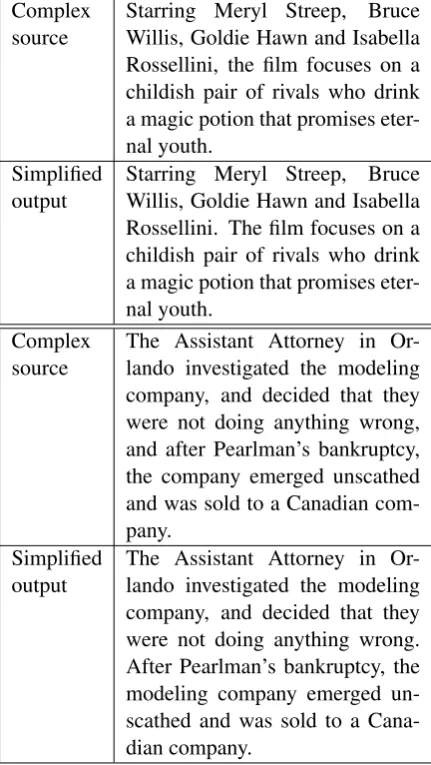
sequence of coordinate clauses, occasionally aug-mented with a relative or adverbial clause (see Ta-ble2). To overcome these limitations, they present WIKISPLIT, a dataset of one million sentences that were mined from Wikipedia edit histories. This corpus provides a rich and varied vocabulary over naturally expressed sentences showing a di-verse linguistic structure, and their extracted splits. However, there is only a single split per source sentence in the training set (see Table3). Accord-ingly, when a model is trained on this dataset, it is susceptible to exhibiting astrong conservatism, splitting each input sentence into exactly two out-put sentences only. Consequently, the resulting simplified sentences are still comparatively long and complex, mixing multiple, potentially seman-tically unrelated propositions that are difficult to analyze for downstream tasks.
3 MINWIKISPLIT Corpus
We improve on previously compiled sentence splitting corpora and present MINWIKISPLIT,1 a
1The M
(1) A Loyal Character Dancer was published by Soho Press, in the United States, where some Native Americans live.
[image:3.595.73.289.193.576.2](2) Dead Man’s Plack is in England and one of the ethnic groups found in England is the British Arabs.
Table 2: Characteristic example source sentences from the WEBSPLITcorpus.
Complex source
Starring Meryl Streep, Bruce Willis, Goldie Hawn and Isabella Rossellini, the film focuses on a childish pair of rivals who drink a magic potion that promises eter-nal youth.
Simplified output
Starring Meryl Streep, Bruce Willis, Goldie Hawn and Isabella Rossellini. The film focuses on a childish pair of rivals who drink a magic potion that promises eter-nal youth.
Complex source
The Assistant Attorney in Or-lando investigated the modeling company, and decided that they were not doing anything wrong, and after Pearlman’s bankruptcy, the company emerged unscathed and was sold to a Canadian com-pany.
Simplified output
The Assistant Attorney in Or-lando investigated the modeling company, and decided that they were not doing anything wrong. After Pearlman’s bankruptcy, the modeling company emerged un-scathed and was sold to a Cana-dian company.
Table 3: Pairs of aligned complex source and simplified target sentences from WIKISPLIT.
new dataset that can be used to train models for the task of decomposing sentences with a com-plex linguistic structure into a simplified represen-tation that presents a more regular structure which is easier to process for downstream semantic ap-plications and may support a faster generalization in machine learning tasks. This output may serve as an intermediate representation to facilitate and improve the performance of a wide range of artifi-cial intelligence (AI) tasks.
Since shorter sentences are generally better pro-cessed by NLP systems (Narayan et al.,2017), we aimed at gathering a corpus whereeach complex source sentence is broken down into a set of minimal propositions, i.e. a sequence of sound, self-contained utterances, with each of them pre-senting a minimal semantic unit that cannot be further decomposed into meaningful propositions (Bast and Haussmann,2013). Thus, we augment the Split-and-Rephrase task that was originally de-fined inNarayan et al.(2017) by the notion of min-imality. In that way, we intend to overcome the conservatism exhibited by state-of-the-art struc-tural TS approaches, which tend to retain the input rather than transforming it, and expect to improve the performance of a wide range of AI tasks.
4 Corpus Construction
MINWIKISPLIT is a large-scale sentence
split-ting corpus consissplit-ting of 203K complex source sentences and their simplified counterparts in the form of a sequence of minimal propositions. It was created by running DISSIM (Niklaus et al.,
2019), a syntactic TS framework, over the one million complex input sentences from the WIKI -SPLIT corpus. DISSIMapplies a small set of 35 hand-written transformation rules to decompose a wide range of linguistic constructs, including both clausal components (coordinations, adver-bial clauses, relative clauses and reported speech) and phrasal elements (appositions, prepositional phrases, adverbial/adjectival phrases and coordi-nate noun phrases). In that way, a fine-grained output in the form of a sequence of minimal, self-contained propositions is produced. Some exam-ple instances are shown in Table1.
#T/S #S/C %SAME LDSC SAMSA SAMSAabl
Complex 30.75 1.18 100 0.00 0.36 0.94
[image:4.595.120.478.61.109.2]MINWIKISPLIT 12.12 3.84 0.00 17.73 0.40 0.48
Table 4: Results of the automatic evaluation procedure on a random sample of 1000 sentences.
adverbial clause modifier or a clausal modifier of a noun. Moreover, we ensure that no conjunction is included in the simplified output sentences. In the future, we will implement some further heuristics toavoid uniformity in the structure of the source sentences. In that way, we aim at guaranteeing a great structural variability in the input in order to enable systems that are trained on the MINWIKI -SPLITcorpus to learn splitting rewrites for a wide range of linguistic constructs.
After running the sentence simplification frame-work DISSIMover the sentences from the WIKI -SPLIT corpus and applying the set of heuristics that we defined to ensure grammaticality and min-imality of the output, 203K pairs of input and cor-responding output sequences were left.
5 Experiments
We performed both a manual analysis and an au-tomatic evaluation to assess the quality of the pro-duced corpus.
5.1 Automatic Metrics
To estimate the quality of the simplified target sen-tences of the MINWIKISPLIT corpus, we
com-puted some basic statistics, including (i) the aver-age sentence length of the simplified sentences in terms of the average number of tokens per output sentence (#T/S); (ii) the average number of sim-plified output sentences per complex input (#S/C); (iii) the percentage of sentences that are copied from the source without performing any simplifi-cation operation (%SAME), serving as an indica-tor for conservatism, i.e. the tendency to retain the input rather than transforming it; and (iv) the av-eraged word-based Levenshtein distance from the input (LDSC), which provides further evidence for how reluctant the underlying system is in splitting the input into minimal semantic units.
Moreover, to measure the structural simplicity of the instances contained in MINWIKISPLIT, we calculated the SAMSA and SAMSAabl scores of both the complex source and the simplified out-put sentences (Sulem et al.,2018b). They are the first metrics that explicitly target syntactic aspects
of TS. The SAMSA metric is based on the idea that an optimal split of the input is one where each predicate-argument structure is assigned its own sentence in the simplified output and measures to what extent this assertion holds for the input-output pair under consideration. Accordingly, the SAMSA score is maximized when each split sen-tence represents exactly one semantic unit in the input. SAMSAabl does not penalize cases where the number of sentences in the simplified output is lower than the number of events contained in the input, indicating separate semantic units that should be split into individual target sentences for obtaining minimal propositions.2
These computations were carried out on a ran-dom sample of 1000 sentences from MINWIKI
-SPLIT. The results are provided in Table4. The scores demonstrate that on average our proposed sentence splitting corpus contains four simpli-fied target sentences per complex source sentence, with every target proposition consisting of 12 to-kens. Moreover, no input is simply copied to the output, but split into smaller components. Both the high averaged Levenshtein distance of almost 18 and the SAMSA score (0.40) confirm previous findings. The latter is highly correlated with struc-tural simplicity and grammaticality, indicating that the output sentences contained in our corpus are grammatically sound and present a simpler syntax than the input. With 0.48, we reach a decent score for the simplified target sentences with regard to SAMSAabl, too, which has a high correlation with meaning preservation.
5.2 Manual Analysis
In a second step, we randomly selected a subset of 300 sentences from MINWIKISPLIT, on which we conducted a manual analysis in order to get some deeper insights into the quality of the simplified sentences. Each input-output pair was rated by
2
2 non-native, but fluent English speakers accord-ing to three parameters: grammaticality, meanaccord-ing preservation and structural simplicity (see Table
5).
G Is the output fluent and grammatical? M Does the output preserve the meaning of
the input?
S Is the output simpler than the input, ignor-ing the complexity of the words?
Table 5: Questions for the human evaluation.
The inter-annotator agreement was computed using Cohens quadratic weighted κ (Cohen,
1968). The obtained rates were 0.24, 0.25 and 0.75 for grammaticality, meaning preservation and structural simplicity, respectively. System scores were calculated by averaging over the annotators’ scores and the 300 sentences.
G M S
4.36 4.10 3.43
Table 6: Averaged human evaluation ratings on a ran-dom sample of 300 sentences from MINWIKISPLIT. Grammaticality (G), meaning preservation (M) and structural simplicity (S) are measured using a 1 (very bad) to 5 (very good) scale.
The results of the human evaluation are dis-played in Table6. These scores show that we suc-ceed in producing output sequences that reach a high level of grammatical soundness and almost always perfectly preserve the original meaning of the input. The third dimension under considera-tion, structural simplicity, which captures the de-gree of minimality in the simplified sentences, scores high values, too. However, our manual analysis revealed some room for improvement. Consequently, in the future, we plan to imple-ment stricter heuristics for sorting out output se-quences that still mix multiple semantically unre-lated propositions.
6 Conclusion
We compiled MINWIKISPLIT, a sentence
split-ting corpus consissplit-ting of 203K complex source sentences and their split counterparts. This dataset can be used to train natural language generation applications that perform a syntactic TS, simpli-fying sentences with a complex linguistic struc-ture into a fine-grained representation of short
sentences that present a simple and more regular structure. The thus generated output may serve as an intermediate representation that is easier to process for downstream semantic applications and may thus lead to a better performance of those tools. We intend to train a sentence simplifica-tion model on MINWIKISPLIT and compare it to
previously proposed systems trained on the WEB -SPLITand WIKISPLITcorpora.
Moreover, we plan to improve the quality of the simplified target sentences in our corpus in ac-cordance with the insights we gained through the analyses described above. First of all, we will per-form a detailed error analysis of the output to de-termine the most common types of mistakes and get some starting points for further improving our heuristics for filtering out malformed simplifica-tions. To enhance the syntactic correctness of the output, we will train a classifier on the recently proposed CoLA dataset (Warstadt et al., 2018) to eliminate instances with ungrammatical target sentences from our corpus. In addition, special attention will be given to improving the heuris-tics that ensure that each simplified target sentence represents a single semantic unit.
References
Roee Aharoni and Yoav Goldberg. 2018. Split and rephrase: Better evaluation and stronger baselines. In Proceedings of the 56th Annual Meeting of the Association for Computational Linguistics (Volume 2: Short Papers), pages 719–724. Association for Computational Linguistics.
Hannah Bast and Elmar Haussmann. 2013. Open infor-mation extraction via contextual sentence decompo-sition. In2013 IEEE Seventh International Confer-ence on Semantic Computing, pages 154–159. IEEE.
Jan A. Botha, Manaal Faruqui, John Alex, Jason Baldridge, and Dipanjan Das. 2018. Learning to split and rephrase from wikipedia edit history. In Proceedings of the 2018 Conference on Empirical Methods in Natural Language Processing, pages 732–737. Association for Computational Linguis-tics.
Nadjet Bouayad-Agha, Gerard Casamayor, Gabriela Ferraro, Simon Mille, Vanesa Vidal, and Leo Wan-ner. 2009. Improving the comprehension of legal documentation: the case of patent claims. In Pro-ceedings of the 12th International Conference on Ar-tificial Intelligence and Law, pages 78–87. ACM.
Semantically-linked propositions in open informa-tion extracinforma-tion. In Proceedings of the 27th Inter-national Conference on Computational Linguistics, pages 2300–2311. Association for Computational Linguistics.
Jacob Cohen. 1968. Weighted kappa: Nominal scale agreement provision for scaled disagreement or par-tial credit.Psychological bulletin, 70(4):213.
William Coster and David Kauchak. 2011. Simple en-glish wikipedia: A new text simplification task. In Proceedings of the 49th Annual Meeting of the Asso-ciation for Computational Linguistics: Human Lan-guage Technologies: Short Papers - Volume 2, HLT ’11, pages 665–669, Stroudsburg, PA, USA. Associ-ation for ComputAssoci-ational Linguistics.
Daniel Ferr´es, Montserrat Marimon, Horacio Saggion, and Ahmed AbuRa’ed. 2016. Yats: Yet another text simplifier. InNatural Language Processing and In-formation Systems, pages 335–342, Cham. Springer International Publishing.
Shashi Narayan, Claire Gardent, Shay B. Cohen, and Anastasia Shimorina. 2017. Split and rephrase. In Proceedings of the 2017 Conference on Empirical Methods in Natural Language Processing, pages 606–616. Association for Computational Linguis-tics.
Christina Niklaus, Matthias Cetto, Andr´e Freitas, and Siegfried Handschuh. 2019. Transforming complex sentences into a semantic hierarchy. InProceedings of the 57th Annual Meeting of the Association for Computational Linguistics, pages 3415–3427, Flo-rence, Italy. Association for Computational Linguis-tics.
Kishore Papineni, Salim Roukos, Todd Ward, and Wei-Jing Zhu. 2002. Bleu: a method for automatic eval-uation of machine translation. In Proceedings of the 40th annual meeting on association for compu-tational linguistics, pages 311–318. Association for Computational Linguistics.
Horacio Saggion. 2017. Automatic text simplification. In Synthesis Lectures on Human Language Tech-nologies.
Horacio Saggion, Sanja ˇStajner, Stefan Bott, Simon Mille, Luz Rello, and Biljana Drndarevic. 2015.
Making it simplext: Implementation and evaluation of a text simplification system for spanish. ACM Trans. Access. Comput., 6(4):14:1–14:36.
Advaith Siddharthan and Angrosh Mandya. 2014. Hy-brid text simplification using synchronous depen-dency grammars with hand-written and automati-cally harvested rules. In Proceedings of the 14th Conference of the European Chapter of the Associa-tion for ComputaAssocia-tional Linguistics, pages 722–731. Association for Computational Linguistics.
Advaith Siddharthan, Ani Nenkova, and Kathleen McKeown. 2004. Syntactic simplification for im-proving content selection in multi-document sum-marization. InProceedings of the 20th international conference on Computational Linguistics, page 896. Association for Computational Linguistics.
Sanja ˇStajner and Maja Popovic. 2016. Can text sim-plification help machine translation? In Proceed-ings of the 19th Annual Conference of the European Association for Machine Translation, pages 230– 242.
Sanja ˇStajner and Maja Popovic. 2018. Improving ma-chine translation of english relative clauses with au-tomatic text simplification. In Proceedings of the First Workshop on Automatic Text Adaptation (ATA).
Elior Sulem, Omri Abend, and Ari Rappoport. 2018a.
Bleu is not suitable for the evaluation of text simpli-fication. InProceedings of the 2018 Conference on Empirical Methods in Natural Language Process-ing, pages 738–744. Association for Computational Linguistics.
Elior Sulem, Omri Abend, and Ari Rappoport. 2018b.
Semantic structural evaluation for text simplifica-tion. In Proceedings of the 2018 Conference of the North American Chapter of the Association for Computational Linguistics: Human Language Tech-nologies, Volume 1 (Long Papers), pages 685–696. Association for Computational Linguistics.
Alex Warstadt, Amanpreet Singh, and Samuel R Bow-man. 2018. Neural network acceptability judg-ments. arXiv preprint arXiv:1805.12471.
Wei Xu, Chris Callison-Burch, and Courtney Napoles. 2015. Problems in current text simplification re-search: New data can help. Transactions of the As-sociation for Computational Linguistics, 3:283–297.