Original Article
Pre-ischemic exercise mitigates brain injury via MEK1/2
and PI3K after ischemic stroke in rats
Mei Li1, Fang Dong2, Feng Zhang3,4
1Department of Rehabilitation Medicine, Harrison International Peace Hospital, Hengshui, P. R. China; 2
Depart-ments of Clinical Laboratory Medicine; 3Rehabilitation Medicine, The Third Hospital of Hebei Medical University,
Shijiazhuang, P. R. China; 4Hebei Provincial Orthopedic Biomechanics Key Laboratory, The Third Hospital of Hebei
Medical University, Shijiazhuang, P. R. China
Received December 6, 2015; Accepted March 30, 2016; Epub June 15, 2016; Published June 30, 2016
Abstract: Physical exercise could exert neuroprotection in both human and animals. However, the exact mechanism of the neuroprotective effect is still not very clear. This study was to explore the possible signal pathway related to the neuroprotective effect of pre-ischemic exercise for ischemic stroke. Thirty-six rats were randomly divided into three groups (n = 12/group): middle cerebral artery occlusion (MCAO) group, exercise with MCAO group and sham surgery group. After treadmill training for three weeks, the MCA was occluded for 1.5 hours so as to induce ischemic stroke, followed by reperfusion. Forty-eight hours after reperfusion, six rats in each group were estimated for neuro-logical deficits and then decapitated to calculate the infarct volume. The rest rats in each group were sacrificed to detect the expression level of phosphor-MEK1/2, MEK1/2 and PI3K (n = 6). The results in our study demonstrated that pre-ischemic treadmill training reduced brain infarct volume and neurological deficits, also alleviated the over expression of phosphor-MEK1/2 after ischemic stroke. The expression level of PI3K was up-regulated by exercise preconditioning. In summary, pre-ischemic exercise mitigated brain damage in the rat brain after ischemic stroke, involving in the regulation of MEK1/2 and PI3K.
Keywords: Neuroprotection, middle cerebral artery occlusion (MCAO), exercise preconditioning, mitogen-activated protein kinase kinase 1/2 (MEK1/2), dysfunction
Introduction
In the past twenty years, a series of animal studies have demonstrated the beneficial ef- fects of exercise training on brain ischemic inju-ry, including promoted survival rates, a down-regulation of neurological deficits, an attenua-tion of blood-brain barrier (BBB) dysfuncattenua-tion and a promotion in neurovascular integrity [1-5]. In summary, exercise intervention has attracted more and more attention.
The method of exercise intervention before ischemic stroke was named as exercise pre-conditioning. Our previous review had summa-rized the related mechanisms of exercise pre-conditioning induced neuroprotective effects, involving different kinds of pathological chang-es pre-and post ischemic stroke [6]. The extra-cellular signal-regulated kinase 1/2 (ERK1/2) related pathway played an important role in the
neuroprotection of pre-ischemic exercise inter-vention [7]. ERK1/2 was an important subfam-ily of mitogen-activated protein kinases which mediated a wide range of cellular activities, including the neuroprotection in the process of ischemic stroke [8].
neuroprotective mechanism in the process of ischemic stroke [11]. The PI3K/Akt pathway also was involved in the neuroprotective effect of exercise. A recent study demonstrated that exercise intervention alleviated neurocognitive deficits and hippocampal neurogenesis dam-age, regulating the level of Akt after radiothera-py injury [12].
Our previous paper demonstrated that pre-ischemic exercise could decrease the over-expression of phospho-ERK1/2 at 24 and 48 hours after ischemia/reperfusion [13, 14]. However, whether exercise preconditioning could influence the level of phospho-MEK1/2 following ischemic stroke is still unknown. Thus, this study was to investigate whether three weeks of pre-ischemic could reduce neurologi-cal deficits, infarct size, the expression of phos-pho-MEK1/2 and PI3K.
Materials and methods
Animals
Thirty-six male Sprague-Dawley rats (200-220 g) were provided by Hebei Province Laboratory Animal Center. The rats stayed in a standard circumstance with a 12-h light/dark cycle. Enough food and water were available. All the procedures in this study were approved by the Animal Care and Use Committee of Hebei Medical University.
Treadmill training
The rats were randomly assigned to three gr- oups (n = 12/group): sham surgery group, MC- AO group and exercise with MCAO group. Before formal training, the rats in the exercise with MCAO group began to receive adaptive running exercise for three days in speed of 6-7 m/min for 20 minutes per day by a treadmill training machine (DSPT-202 Type 5-Lane Treadmill; Litai Biotechnology Co., Ltd, China). After the adaptive exercise training, the rats stated to receive formal exercise intervention at a speed of 20 meters per minute, 30 minutes in one day for six times per week. In the corresponding period, the rats of sham surgery group and MCAO group were available to run freely in their cages.
MCAO model
After the treadmill training, all the rats under-went sham or middle cerebral artery occlusion
(MCAO) surgery. The MCAO model rats were anesthetized by 4% chloral hydrate (10 ml/kg, i.p.) and further doses were needed if the rat could not maintain anesthesia state during the operation. The temperature of rat body was maintained at 37°C with a heating pad. The surgery procedures were in accordance with Longa EZ [15] method.
Briefly, in left side, external carotid artery (ECA), the common carotid artery (CCA) and internal carotid artery (ICA) were separated and exposed firstly. ECA and ICA are two branches of CCA. Our purpose is to occlude ICA. But we need to realize reperfusion of ICA. Therefore, we need to insert the suture from ECA to CCA, finally reaching ICA. A 4-0 nylon suture with a poly-L-lysine covered ending (Beijing Sunbio Biotech Co. Ltd, Beijing, China) was gently inserted into ECA through a small incision. Then, the suture passed into CCA and ICA, finally reached the origin section of MCA to occlude this artery. After 90 minutes of ischemia, reperfusion was realized by removing the filament.
In the sham group, the rats underwent the same procedures but no occlusion of MCA. The System of Blood Gas and Electrolyte (Radio- meter ABL505, Copenhagen, Denmark) was used to monitor the physiological parameters of rats. The neurological deficit scores were assessed 48 hours after reperfusion according to the previous report.
Determination of brain infarct volume
Infarct volume = contralateral hemisphere re- gion-non-infarcted region in the ipsilateral he- misphere
Infarct percentage = Infarct volume/volume of the contralateral hemisphere × 100%
Western blot
The cortex brain tissue near the ischemic area was taken. A protein extraction reagent (Pierce Biotechnology, IL, USA) was used to extract the protein of brain tissue, and the extracted pro-tein concentration was evaluated by the bicin-choninic acid assay. The same amount of pro-tein extract (40 µg) and sample buffer were mingled adequately and stayed at 95°C water for 5 minutes before loading onto 10% poly-acrylamide gels. The proteins were transferred to Hybond nylon membrane (Amersham, Pi-
cago, IL, USA) was employed to analyze all the data. The infarct volume and neurological defi-cit scores between MCAO group and exercise with MCAO group were compared by an inde-pendent t-test. The relative image density among three groups were analyzed by one-way analysis of variance (ANOVA) followed by post-hoc test, LSD. Data were showed as means ± SD. The significant level was set as 0.05 in all statistical assessments.
Results
Physiological variables
[image:3.612.92.388.70.193.2]There were not significant differences of pH (hydrogen ion concentration) values, paCO2 (partial pressure of carbon dioxide in artery), and paO2 (partial pressure of oxygen in arterial blood) among the three groups (P > 0.05). Figure 1. Neurological deficit scores of exercise with MCAO group and the MCAO
group. Data represent the mean ± SD. (n = 6). The neurological deficit scores of sham group were all zero (not shown). *Indicates a statistically significant dif-ference of mean neurological deficit scores between MCAO group and exercise with MCAO group (P < 0.05).
scataway, NJ, USA) in 350 V for 1.5 h with the cold pack, stayed in 5% BSA blocking solution for 1 hour at 25°C, and incubated overnight at 40°C in anti-MEK1/2 (1:1000 dilution; Cell Sig- naling, Danvers, MA, USA) or anti-phospo-MEK1/2 an- tibody (1:1000 dilution; Cell Signaling) or PI3K anti-body (1:1000 dilution; Up- state, Millipore-Merck, Da- rmstadt, Germany). The im- munoreactivity was mea-sured by horseradish per-oxidase-labeled anti-rabbit secondary antibody (1:100 dilution; Hua-Mei Biotech, Beijing, China) for one hour at room temperature with blocking buffer. Finally, the membrane was covered by 300 µL enhanced ECL kit (Amersham Pharmacia Bi- otech, Freiburg, Germany) for 5 minutes and exposed to Kodak film for 5 to 30 seconds. β-actin was used as a loading control.
Statistical analysis
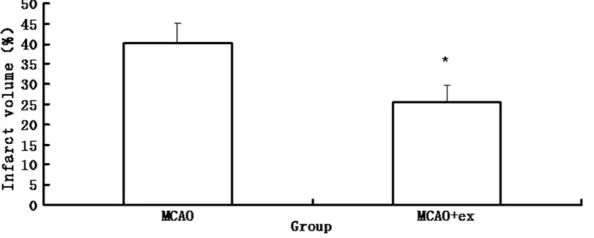
The SPSS for Windows, ver-sion 16.0 (SPSS Inc, Chi- Figure 2. Difference in infarct volume between exercise with MCAO group
[image:3.612.93.390.281.400.2]Behavioral scores
The behavioral scores evaluation was per-formed 48 hours after reperfusion. There were no neurological symptoms in sham surgery gr- oup. There was a significant difference of be- havior scores between MCAO group and exer-cise with MCAO group (P < 0.05), as shown in
Figure 1. The neurological deficit scores of ex- ercise with MCAO group were lower than MCAO group.
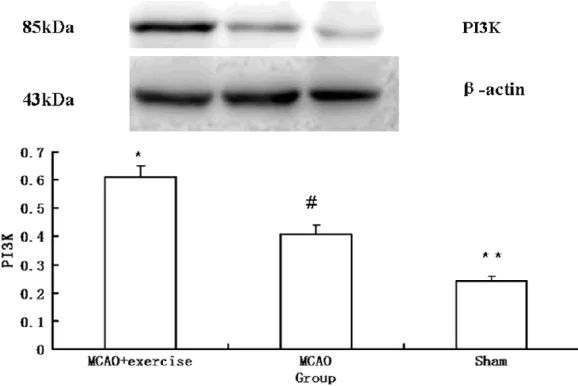
group than sham surgery group (P < 0.05) and the expression of PI3K was higher in exercise with MCAO group than MCAO group (P < 0.05).
Discussion
Ischemic stroke is a main cause of death in the worldwide. Therefore, how to alleviate brain da- mage after ischemic stroke required more and more attention. A series of intervention meth-ods were applied to realize this purpose, includ-Figure 3. Relative image density of total MEK1/2. There was no significant
dif-ference of total-MEK1/2 among the three groups. Data represent mean ± SD.
Infarct volume
[image:4.612.93.387.79.266.2]After behavioral scores ev- aluation, 6 rats of each group were decapitated to reckon the infarct volume. There were no ischemic ar- eas in sham surgery group. There was a significant dif-ference of infarct volume between MCAO group and exercise with MCAO group (P < 0.05), as shown in
Figure 2. The rats of exer-cise with MCAO group sh- owed less ischemic area relative to those in the MC- AO group.
Total-MEK1/2 and phos-pho-MEK1/2
There were no significant differences of total MEK1/ 2 levels among the three groups, as shown in Figures 3 and 4. However, there were significant differences of phospho-MEK1/2 levels among the three groups. Specifically, MCAO rats de- monstrated increased ph- ospho-MEK1/2 compared to sham surgery, and this effect was alleviated by pre-ischemic exercise (P < 0.05).
PI3K
There were significant dif-ferences of PI3K levels among the three groups (Figure 5). The expression of PI3K was higher in MCAO Figure 4. Relative image density of phospho-MEK1/2. The expression of
[image:4.612.93.388.327.521.2]ing physical activity [16]. In order to educate more people with high risk factors of stroke to begin to do regular exercises, the neuropro-tection mechanism of exercise should be clarified.
In the clinic, it was reported that physical exer-cise could alleviate high arterial blood pres-sure, mitigate obesity, alleviate glucose and lipid metabolic disorders and decrease the abnormal rheological properties of blood [17-19]. Moreover, physical exercise was reported to promote endothelial function, partly via acti-vating extracellular superoxide dismutase (ecSOD) and endothelial nitric oxide synthase (eNOS) [18]. Other benefits of exercise training included decreasing fibrinolysis, blood viscosi-ty [20] and plasma fibrinogen concentration, increase High-density lipoprotein (HDL) choles-terol and promote plasma tissue plasminogen activator activity [21].
Ginsenoside Rd reduced ischemia/reperfusion injury in ischemic stroke rat, involving in both PI3K/Akt and ERK1/2 pathways [22]. Activation of the PI3K pathway could alleviate brain injury following cerebral infarction by cilnidipine [23]. Quercetin advanced exercise-regulated func-tional recovery after ischemic stroek by up-reg-ulating PI3K/Akt activity to promote antioxida-tive and anti-apoptotic signaling [24].
mice after ischemic stroke, indicating that the MEK1-ERK1/2 pathway was closely related to brain injury in the process of ischemic stroke [10, 27]. Therefore, over-activation of MEK1-ERK1/2 pathway after stroke is harmful, and interventions which could decrease this effect might alleviate ischemia-induced damage. Our recent paper reported that exercise pre-conditioning promoted SOD activity and re- duced MDA levels, indicating that pre-ischemic treadmill training exercise promoted antioxi-dant ability and alleviated oxidative damage for brain tissue [28]. In this study, pre-ischemic treadmill training decreased brain infarct vol-ume and neurological deficits, also mitigated the over expression of phosphor-MEK1/2 after ischemic stroke.
In conclusion, our results indicated that exer-cise preconditioning could exert neuroprotec-tion against ischemic injury by inhibiting the over-expression of phosphor-MEK1/2 and in- creasing the expression of PI3K after cerebral ischemia after cerebral ischemia, producing brain ischemic tolerance.
Acknowledgements
[image:5.612.94.383.73.266.2]The present study was supported by the National Natural Science Foundation of China (No. 81201512).
Figure 5. Relative image density of PI3K. The expression of PI3K was higher in MCAO group than sham surgery group and was obviously up-regulated by exer-cise preconditioning. Data represent mean ± SD. #P < 0.05 relative to sham surgery. **P < 0.05 relative to MCAO+Exercise. *P < 0.05 relative to MCAO.
Disclosure of conflict of interest
None.
Address correspondence to: Dr. Feng Zhang, Depart- ment of Rehabilitation Medicine, The Third Hospital of Hebei Medical University, No. 139, Ziqiang Road, Shijiazhuang 050051, Hebei, P. R. China. Tel: +86- 311-66776711; Fax: +86311-66776711; E-mail: [email protected]
References
[1] Ang ET, Wong PT, Moochhala S and Ng YK. Neuroprotection associated with running: is it a result of increased endogenous neurotrophic factors? Neuroscience 2003; 118: 335-345. [2] Stummer W, Baethmann A, Murr R, Schurer L
and Kempski OS. Cerebral protection against ischemia by locomotor activity in gerbils. Un-derlying mechanisms. Stroke 1995; 26: 1423-1429; discussion 1430.
[3] Endres M, Gertz K, Lindauer U, Katchanov J, Schultze J, Schrock H, Nickenig G, Kuschinsky W, Dirnagl U and Laufs U. Mechanisms of stroke protection by physical activity. Ann Neu-rol 2003; 54: 582-590.
[4] Li J, Luan X, Clark JC, Rafols JA and Ding Y. Neuroprotection against transient cerebral ischemia by exercise pre-conditioning in rats. Neurol Res 2004; 26: 404-408.
[5] Ding YH, Ding Y, Li J, Bessert DA and Rafols JA. Exercise pre-conditioning strengthens brain microvascular integrity in a rat stroke model. Neurol Res 2006; 28: 184-189.
[6] Zhang F, Wu Y and Jia J. Exercise precondition-ing and brain ischemic tolerance. Neurosci-ence 2011; 177: 170-176.
[7] Liebelt B, Papapetrou P, Ali A, Guo M, Ji X, Peng C, Rogers R, Curry A, Jimenez D and Ding Y. Exercise preconditioning reduces neuronal apoptosis in stroke by up-regulating heat shock protein-70 (heat shock protein-72) and extracellular-signal-regulated-kinase 1/2. Neu-roscience 2010; 166: 1091-1100.
[8] Lu Z and Xu S. ERK1/2 MAP kinases in cell sur-vival and apoptosis. IUBMB Life 2006; 58: 621-631.
[9] Pearson G, Robinson F, Beers Gibson T, Xu BE, Karandikar M, Berman K and Cobb MH. Mito-gen-activated protein (MAP) kinase pathways: regulation and physiological functions. Endocr Rev 2001; 22: 153-183.
[10] Alessandrini A, Namura S, Moskowitz MA and Bonventre JV. MEK1 protein kinase inhibition protects against damage resulting from focal cerebral ischemia. Proc Natl Acad Sci U S A 1999; 96: 12866-12869.
[11] Sung JH, Kim MO and Koh PO. Nicotinamide prevents the down-regulation of MEK/ERK/ p90RSK signaling cascade in brain ischemic injury. J Vet Med Sci 2012; 74: 35-41.
[12] Ji JF, Ji SJ, Sun R, Li K, Zhang Y, Zhang LY and Tian Y. Forced running exercise attenuates hip-pocampal neurogenesis impairment and the neurocognitive deficits induced by whole-brain irradiation via the BDNF-mediated pathway. Biochem Biophys Res Commun 2014; 443: 646-651.
[13] Zhang F, Wu Y, Jia J and Hu YS. Pre-ischemic treadmill training induces tolerance to brain ischemia: involvement of glutamate and ERK1/2. Molecules 2010; 15: 5246-5257. [14] Wang X, Zhang M, Feng R, Li WB, Ren SQ and
Zhang F. Exercise preconditioning alleviates brain damage via excitatory amino acid trans-porter 2 and extracellular signalregulated ki-nase 1/2 following ischemic stroke in rats. Mol Med Rep 2015; 11: 1523-1527.
[15] Longa EZ, Weinstein PR, Carlson S and Cum-mins R. Reversible middle cerebral artery oc-clusion without craniectomy in rats. Stroke 1989; 20: 84-91.
[16] Krarup LH, Truelsen T, Gluud C, Andersen G, Zeng X, Korv J, Oskedra A and Boysen G. Pre-stroke physical activity is associated with se-verity and long-term outcome from first-ever stroke. Neurology 2008; 71: 1313-1318. [17] Lee CD, Folsom AR and Blair SN. Physical
activ-ity and stroke risk: a meta-analysis. Stroke 2003; 34: 2475-2481.
[18] Vinereanu D. Risk factors for atherosclerotic disease: present and future. Herz 2006; 31 Suppl 3: 5-24.
[19] Chrysohoou C, Pitsavos C, Kokkinos P, Panag-iotakos DB, Singh SN and Stefanadis C. The role of physical activity in the prevention of stroke. Cent Eur J Public Health 2005; 13: 132-136.
[20] Alevizos A, Lentzas J, Kokkoris S, Mariolis A and Korantzopoulos P. Physical activity and stroke risk. Int J Clin Pract 2005; 59: 922-930. [21] Evenson KR, Rosamond WD, Cai J, Toole JF,
Hutchinson RG, Shahar E and Folsom AR. Physical activity and ischemic stroke risk. The atherosclerosis risk in communities study. Stroke 1999; 30: 1333-1339.
[22] Liu XY, Zhou XY, Hou JC, Zhu H, Wang Z, Liu JX and Zheng YQ. Ginsenoside Rd promotes neu-rogenesis in rat brain after transient focal cere-bral ischemia via activation of PI3K/Akt path-way. Acta Pharmacol Sin 2015; 36: 421-428. [23] Son JW, Choi H, Yoo A, Park HH, Kim YS, Lee
[24] Chang HC, Yang YR, Wang PS and Wang RY. Quercetin enhances exercise-mediated neuro-protective effects in brain ischemic rats. Med Sci Sports Exerc 2014; 46: 1908-1916. [25] Koh PO. Ferulic acid attenuates the
down-regu-lation of MEK/ERK/p90RSK signaling pathway in focal cerebral ischemic injury. Neurosci Lett 2015; 588: 18-23.
[26] Koh PO. Melatonin attenuates the cerebral ischemic injury via the MEK/ERK/p90RSK/ bad signaling cascade. J Vet Med Sci 2008; 70: 1219-1223.
[27] Namura S, Iihara K, Takami S, Nagata I, Kiku-chi H, Matsushita K, Moskowitz MA, Bonventre JV and Alessandrini A. Intravenous administra-tion of MEK inhibitor U0126 affords brain pro-tection against forebrain ischemia and focal cerebral ischemia. Proc Natl Acad Sci U S A 2001; 98: 11569-11574.