Proceedings of the Multiling 2019 Workshop, co-located with the RANLP 2019 conference, pages 63–72 Varna, Bulgaria, September 6, 2019.
63
A study of semantic augmentation of word embeddings for extractive
summarization
Nikiforos Pittaras DIT, NKUA IIT, NCSR-D
Vangelis Karkaletsis IIT, NCSR-D
Abstract
In this study we examine the effect of se-mantic augmentation approaches on ex-tractive text summarization. Wordnet hypernym relations are used to extract term-frequency concept information, sub-sequently concatenated to sentence-level representations produced by aggregated deep neural word embeddings. Multi-ple dimensionality reduction techniques and combination strategies are examined via feature transformation and clustering methods. An experimental evaluation on the MultiLing 2015 MSS dataset illus-trates that semantic information can intro-duce benefits to the extractive summariza-tion process in terms of F1, ROUGE-1 and ROUGE-2 scores, with LSA-based post-processing introducing the largest im-provements.
1 Introduction
In recent years, the abundance of textual informa-tion resulting from the proliferainforma-tion of the Internet, online journalism and personal blogging platforms has led to the need for automatic summarization tools. These solutions can aid users to navigate the saturated information marketplace efficiently via the production of digestible summaries that retain the core content of the original text (Yogan et al.,
2016). At the same time, advancements intro-duced by deep learning techniques have provided efficient representation methods for text, mainly via the development of dense, low-dimensional vector representations for words and sentences (LeCun et al., 2015). Additionally, semantic in-formation sources have been compiled by humans in a structured manner and are available for use to-wards aiding a variety of natural language
process-ing applications. As a result, semantic augmenta-tion approaches can introduce existing knowledge to the neural pipeline, circumventing the need for the neural model to learn all useful information from scratch.
In this study, we examine the effect of seman-tic augmentation and post-processing techniques on extractive summarization performance. Specif-ically, we modify the input features of a deep neu-ral classification model by injecting semantic fea-tures, simultaneously employing feature transfor-mation post-processing methods towards dimen-sionality reduction and discrimination optimiza-tion. Specifically, we aim to address the following research questions.
• Can the introduction of semantic information in the network input improve extractive sum-marization performance?
• Does the semantic augmentation process benefit via dimensionality reduction post-processing methods?
The rest of the paper is structure as follows. In section2 we cover existing related work relevant to this study. This is followed by a description of our approach (section3). In section4 we outline our experimental methodology and discuss on re-sults and findings. Finally, we present our conclu-sions in section5.
2 Related work
2.1 Text representations
Extensive research has investigated methods of representing text for Natural Language Processing and Machine Learning tasks.
lin-ear algebra techniques for cross-document opera-tions. Approaches like the Bag-of-Words (Salton et al.,1975) have become popular baselines, map-ping the occurence of an input term (e.g. a word) to their occurence frequencies in the text. Mod-ifications to the model include refinements in the term weighting strategy such as DF and TF-IDF normalizations (Yang,1997;Salton and Buckley,
1988), term preprocessing such as stemming and lemmatization (Jivani et al., 2011), and others. Further, sentence and phrase-level terms are exam-ined (Scott and Matwin,1999), along with n-gram approaches, which consider n-tuple occurences of terms instead (Brown et al.,1992;Katz,2003;Post and Bergsma,2013).
Other approaches encode term co-occurence in-formation via representation learning, relying on the distributional hypothesis (Harris,1954) to cap-ture semantic content. At the same time, the need to circumvent the curse of dimensionality (Hastie et al.,2005) of term-weight feature vectors has led to the production dense, rather than sparse rep-resentations. Early such examples used analytic matrix decompositions on co-occurence statistics (Jolliffe,2011;Deerwester et al.,1990;Horn and Johnson, 2012), while more recently, vector em-beddings are iteratively optimized learned by an-alyzing large text corpora using local word con-text in a sliding window fashion (Mikolov et al.,
2013a,b), or using pre-computed pairwise word co-occurences (Pennington et al.,2014). More re-fined methods break down words to subword units (Bojanowski et al., 2017), where learning repre-sentations for the latter enables some success in handling out-of-vocabulary words.
2.2 Extractive summarization
In summarization, contrary to the abstractive ap-proach where output summaries are generated from scratch (Yogan et al., 2016), the extractive method relies on sentence salience detection to retain a minimal subset of the most informative sentences in the original text (Gupta and Lehal,
2010). VSM approaches have been widely uti-lized in sentence modelling for this task, with a variety of methods for determining term weights based on word frequency, probability, mutual in-formation or tf-idf features, sentence similarity, as well as a variety of feature combination methods (Mori,2002;McCargar,2004;Nenkova and Van-derwende, 2005; Galley et al., 2006; Lloret and
Palomar, 2009). Other popular handcrafted fea-tures used are syntactic / grammar information such as part-of-speech tags, as well as sentence-wise features such as sentence position and length. Finally, similarity scores to title, centroid clusters and predefined keywords can be used to score / rank sentences towards salience identification and extraction (Neto et al.,2002;Yogan et al.,2016).
Other works adopt a topic-based approach, us-ing topic modellus-ing techniques towards sentence salience detection. For example, the work in (Aries et al., 2015) builds topics via a cluster-ing process, uscluster-ing a word and sentence-level vec-tor space model and the cosine similarity mea-sure. Clustering techniques have been applied to this end, for sentence grouping and subsequent salience identification (Radev et al.,2000).
Graph methods have also been exploited; In (Lawrie et al., 2001), the authors adopt a graph-based probabilistic language model towards build-ing a topic hierarchy for predictbuild-ing representative vocabulary terms. The MUSE system (Litvak and Last, 2013) combines graph-modelling with ge-netic algorithms towards sentence modelling and subsequent ranking, while the work in (Mihalcea and Tarau, 2004) builds sentence graphs using a variety of feature bags and similarity measures and proceeds to extract central sentences via multiple iterations of the TextRank algorithm.
2.3 Semantic enrichment
Semantic information has been broadly exploited towards aiding NLP tasks, using resources such as Wordnet (Miller, 1995), Freebase (Bollacker et al., 2008), Framenet (Baker et al., 1998) and others. Such external knowledge bases have seen widespread use, ranging from early works on ex-panson of rule-based discrimination techniques (Scott and Matwin,1998), to synonym-based fea-ture extraction (Rodriguez et al.,2000) and large-scale feature generation from WordNet synset re-lationships edges for SVM classification (Mansuy and Hilderman,2006).
extrac-tion, followed by a PCA-based post-processing step for dimensionality reduction. Wordnet is also utilized in (Li et al.,2017) where the authors use the resource for sentence similarity extraction, us-ing synset similarity on the word level and treatus-ing the resulting scores as additional features for sum-marization and citation linkage.
Our approach bears some similarities with the work of (Vicente et al.,2015), extending the inves-tigation to additional post-processing techniques to PCA, examining post-processing application strategies, and adopting deep neural word embed-dings as the lexical representation, while ground-ing on a number of baselines. In the followground-ing section, we will describe our approach in detail, including text representation, semantic feature ex-traction, training and evaluation.
3 Proposed Method
3.1 Problem definition
We formulate the task of automatic summariza-tion as a classificasummariza-tion problem. Given a document consisting of N sentences D = {s1, s2, . . . sN} and a ground truth (extractive) summary of size
k,G = {g1, g2, . . . gk},gi ∈ D, a classification-based extractive summarization system F se-lects salient sentences P = {p1, p2, . . . pk} via
F(D) = P, such that P is as close toGas pos-sible. In this work,F(·)is a data-driven machine learning model, built by exploiting statistical fea-tures in the input text.
3.2 Text representation
We use a variety of approaches for representing the textual component of a sentence. First, we em-ploy Continuous Bag-of-Words (CBOW) variant of the popular word2vec model (Mikolov et al.,
2013b), which builds vector representations of a word using a statistical language model that pre-dicts the word based on its surrounding context. More formally, given a center word in a sentence,
wc and and a set of 2k context words around it wcontext = [wc−k. . . , wc−1, wc+1, . . . , wc+k], CBOW tries to optimize the conditional proba-bilistic neural language modelP(wc|wcontext).
We train embeddings from scratch with this method, optimizing with the cross-entropy loss, ending up with a vector representation for each word in the dataset. We subsequently produce the final, sentence-level representation by averaging the vectors corresponding to words in a sentence.
In addition to embedding training, we examine the performance of pre-trained Fastext (Joulin et al.,
2016) embeddings, produced by a model that captures subword information via character em-beddings, enabling handling of out-of-vocabulary words. Additionally, we employ direct sentence-level modelling alternatives via the doc2vec (Le and Mikolov, 2014) extension of word2vec, as well as a sentence-level TF-IDF baseline.
3.3 Semantic representation
In order to capture and utilize semantic infor-mation in the text, we use the WordNet seman-tic graph (Miller, 1995), a lexical database for English, often used as an external information source for machine learning research in classifi-cation, summarization, clustering and other tasks (Hung and Wermter,2004;Elberrichi et al.,2008;
Liu et al.,2007;Morin and Bengio,2005;Bellare et al., 2004;Dang and Luo, 2008; Pal and Saha,
2014). In Wordnet, semantic relations between concepts are captured in a semantic graph of syn-onymous sets (synsets), as well as multiple types of relations of lexical / semantic nature, such as ike hypernymy and hyponymy (is-agraph edges), meronymy (part-of relations, and others). We employ WordNet as an enrichment mechanism, extracting frequency-based features from corpus words. Specifically, we mine semantic concepts from each word in the text, arriving at a sparse high-dimensional bag-of-concepts for each docu-ment. This vector is concatenated to the lexical representation. To deal with the curse of dimen-sionality (Hastie et al.,2005) of this approach, we apply dimensionality reduction via PCA (Jolliffe,
2011), LSA (Deerwester et al.,1990) or K-Means (Lloyd, 1982). We apply each transformation on two settings; first, the semantic information chan-nel is reduced, then concatenated with the sen-tence embedding vector. Alternatively, we apply the reduction on the concatenated, enriched vector itself.
4 Experiments
4.1 Datasets
We use the english version of the Multiling 2015 single-document summarization dataset ( Gi-annakopoulos et al., 2015; Conroy et al., 2015)
1 for our experimental evaluation. The dataset is
1http://multiling.iit.demokritos.gr/
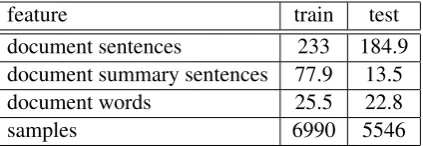
feature train test document sentences 233 184.9 document summary sentences 77.9 13.5 document words 25.5 22.8
[image:4.595.77.289.62.135.2]samples 6990 5546
Table 1: Details of the Multiling 2015 single-document summarization dataset. All values are averages accross documents, except from the number of samples.
built from wikipedia content, consisting of articles paired with a number of human-authored sum-maries. For each of 40 languages, 30 documents and summary sets are provided.
In this work, we focus on the English version of the dataset, due to our reliance on word em-bedding features, which are predomninantly avail-able for the English language. In addition, we apply two preprocessing steps. First, we refor-mat the ground truth towards an extractive sum-marization setting, since the provided summaries are written from scratch. Specifically, we anno-tate source sentences with an extractive summa-rization binary label l ∈ {0,1} (e.g. 1 if it is a member of the extractive summary and 0 oth-erwise). This is accomplised via the following steps. First, for each provided summary sentence
pi, we rank source sentencess∈Swith respect to the n-gram overlap with pi, after stopword filter-ing and excludfilter-ing already positively-labelled sen-tences sj ∈ S : lj = 1, i 6= j. The top-ranked source sentence is matched to the ground truth summary sentence, and considered to be a member of the extractive summary. Secondly, in an effort to address the severe imbalance that results from the modifications of previous step (i.e. class0 be-ing13to14times more populous than class1), we oversample positively labelled sentences for each document, arriving at a2 : 1negative to positive ratio, at most.
After these steps, we end up with the final ver-sion of the dataset which is described in detail in table 1. Having a sentence-level label for sum-mary meronymy, we can thus produce the final summary by concatenating the positively classi-fied sentences. It should be noted that via this setting, evaluating candidate summaries with the dataset provided ground truth summaries implies a minimum performance penalty. This is reported in the results in the succeeding section4.3.
4.2 Setup
We train embeddings with the word2vec CBOW variant using gensim (Rehurek and Sojka,2011). We run the algorithm for 50 epochs, on a 10-word window, mantaining a minimum word frequency threshold of 2 occurences in the training text. We produce 50-dimensional embeddings via this pro-cess. In addition, we use the publicly available2, 300-dimensional pre-trained fastext embeddings for the corresponding configuration.
To setup the deep neural classifier, we run a grid search on the number of layers (ranging from1to 5) and layer size (ranging from64 to2048) for a multilayer perceptron architecture, using a5-fold validation scheme. This process illustrated a 5-layer architecture of512-neuron layers as the best performing, and is the one we adopt for all subse-quent experiments. This architecture is trained for 80 epochs, reducing the learning rate on an adap-tive learning rate reduction policy and mantaining an early-stopping protocol of 25 epochs.
Using this learning framework, we test each candidate configuration using a 5-fold validated scheme, reporting mean measure values as the overall result. For all measures, the cross-fold variance stayed below10e−4and is omitted. The Keras machine learning library3is used for build-ing and trainbuild-ing the neural models.
4.3 Results and discussion
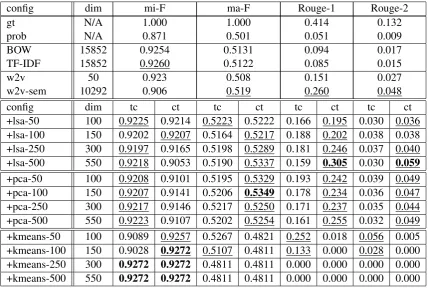
Tables2and3present experimental results for the evaluation of semantic augmentation on word2vec and fastext embeddings, respectively. Each con-figuration is evaluated in terms of micro and macro F1 score (mi-Fandma-Fcolumns, respectively), with respect to classification performance of the oversampled dataset (as detailed in 4.1). In ad-dition, we measure Rouge-1 and Rouge-2 scores of the final composed summary (stiched together from positively classified input sentences) with re-spect to the hand-written ground truth summary provided in the dataset. Since the difference be-tween the latter two guarantees a minimum error (see4.1), we report the best possible performance in thegtconfiguration, depicting performance for each evaluation measure when sentence classifica-tion is perfect. In addiclassifica-tion, via the prob config-uration we report a probabilistic baseline classi-fier, which decides based on the label distribution
2
https://fasttext.cc/
in the training data. Moreover, token frequency-based baselines – namely bag-of-words (BOW) and TF-IDF (Salton and Buckley,1988) – are re-ported in the BOW and TF-IDF rows. Lexical-only and semantically-augmented baseline runs are reported asxandx-semrespectively, where
x∈[w2v,fastext]. Finally, the effect of each post-processing method on the semantically aug-mented baseline is illustrated, where a configura-tion of+conf-Ndenotes a vector post-processing method conf that produces N-dimensional vec-tors. The resulting vector dimension that is fed to the classfier is reported in the columndim, and the different semantic augmentation post-processing methods are denoted bytc– i.e. first transform the semantic channel, then concatenate to the em-bedding – and ct– i.e. concatenate the seman-tic vector to the lexical embedding, then apply the transformation.
Regarding word2vec trained embedings (table
2), we can see that introducing semantic infor-mation improves macro F1, 1, Rouge-2 performance. Compared with the bag-based baselines, we observe the word2vec CBOW em-beddings yielding worse micro F1 performance than both bag approaches, but considerably bet-ter Rouge scores. In addition, the semantically enriched w2v configuration outperforms the bag approaches in macro-F1 score and the examined Rouge measures.
In general, we observe that micro-F1 scores ap-pear to be less reliable measures in this setting, given the considerable large class imbalance of the dataset. This is apparent in the baselinew2v
and w2v-sem baseline runs, however the effect is most pronounced in k-means configurations for dimensions greater than50, where the best micro-F1 score is encountered, but the performance of all other metrics is degenerate. This is understand-able, since cases where the classifier completely relies on the majority class (0, or “non-summary sentences” in our case), it can converge to a state characterized by a total lack of positively classi-fied sentences. This in turn produces zero rouge scores and sub-chance macro-averaged F1 scores, which is the case observed for these configura-tions. The best-performing configuration turns out to be LSA with 500-dimensional vectors, with re-gard to Rouge-1 and Rouge-2 scores, with the 100-dimensional PCA configuration performing best in terms of macro F1.
Regarding comparison between the two post-processing strategies, we can observe thattc ap-pears to be working slightly better when measur-ing micro-F1 scores, but in terms of macro-F1 and Rouge scores, concatenating prior to post-processing works considerably better. This is not surprising, as the transformation of the bimodal vector into a common, shared space can be ex-pected to be a far more efficient fusion of the lex-ical and semantic channels, compared to simple concatenation.
Regarding fastext-based runs, a similar line performance is observed. Bag-based base-lines achieve best micro-F1 score, but inferior re-sults in all other measures. Similarly to word2vec, the lexical-only fastext run achieves better F1 scores, however the semantically enriched em-bedding fares far better in terms of Rouge-1 and Rouge-2 performance. Likewise, similar behav-ior is observed with regard to post-processing and concatenation order and the usefulness of the micro-F1 score compared to the other measures. Notably, the 50-dimensional LSA performs well with the tcstrategy, while an analogous degen-erate behaviour is evident with the K-means con-figurations. As in the word2vec run, the 500-dimensional LSA produces the best macro-F1 and Rouge scores.
Comparing the word2vec and fastext-based runs, we can observe the word2vec configurations (trained on the target dataset from scratch) achieve better Rouge-1 and Rouge-2 scores than the pre-trained fastext embeddings, on the best configura-tions of both baseline and best performing post-processed configurations (500-dimensional LSA). In light of these results, we return to the re-search questions stated in the beginning of this document.
• Can the introduction of semantic informa-tion in the network input improve extrac-tive summarization performance?
config dim mi-F ma-F Rouge-1 Rouge-2
gt N/A 1.000 1.000 0.414 0.132
prob N/A 0.871 0.501 0.051 0.009
BOW 15852 0.9254 0.5131 0.094 0.017
TF-IDF 15852 0.9260 0.5122 0.085 0.015
w2v 50 0.923 0.508 0.151 0.027
w2v-sem 10292 0.906 0.519 0.260 0.048
config dim tc ct tc ct tc ct tc ct
[image:6.595.85.515.68.356.2]+lsa-50 100 0.9225 0.9214 0.5223 0.5222 0.166 0.195 0.030 0.036 +lsa-100 150 0.9202 0.9207 0.5164 0.5217 0.188 0.202 0.038 0.038 +lsa-250 300 0.9197 0.9165 0.5198 0.5289 0.181 0.246 0.037 0.040 +lsa-500 550 0.9218 0.9053 0.5190 0.5337 0.159 0.305 0.030 0.059 +pca-50 100 0.9208 0.9101 0.5195 0.5329 0.193 0.242 0.039 0.049 +pca-100 150 0.9207 0.9141 0.5206 0.5349 0.178 0.234 0.036 0.047 +pca-250 300 0.9217 0.9146 0.5217 0.5250 0.171 0.237 0.035 0.044 +pca-500 550 0.9223 0.9107 0.5202 0.5254 0.161 0.255 0.032 0.049 +kmeans-50 100 0.9089 0.9257 0.5267 0.4821 0.252 0.018 0.056 0.005 +kmeans-100 150 0.9028 0.9272 0.5107 0.4811 0.133 0.000 0.028 0.000 +kmeans-250 300 0.9272 0.9272 0.4811 0.4811 0.000 0.000 0.000 0.000 +kmeans-500 550 0.9272 0.9272 0.4811 0.4811 0.000 0.000 0.000 0.000
Table 2: Experimental results on the MultiLing 2015 MSS dataset using 50-dimensional word2vec em-beddings. Bold values indicate maxima across rows for that column. Underlined values correspond an improvement over the counterpart configuration (tcversusct, orxversusx-sem).
config dim mi-F ma-F Rouge-1 Rouge-2
gt N/A 1.000 1.000 0.414 0.132
prob N/A 0.871 0.501 0.051 0.009
BOW 15852 0.9254 0.5131 0.094 0.017
TF-IDF 15852 0.9260 0.5122 0.085 0.015
fastext 300 0.923 0.517 0.156 0.029
fastext-sem 10542 0.919 0.516 0.204 0.043
config dim tc ct tc ct tc ct tc ct
[image:6.595.85.513.423.709.2]+lsa-50 350 0.9167 0.9214 0.5231 0.5195 0.206 0.182 0.038 0.032 +lsa-100 400 0.9200 0.9212 0.5196 0.5224 0.171 0.189 0.032 0.036 +lsa-250 550 0.9237 0.9134 0.5221 0.5370 0.145 0.278 0.031 0.053 +lsa-500 800 0.9243 0.9083 0.5201 0.5373 0.128 0.296 0.025 0.056 +pca-50 350 0.9186 0.9145 0.5205 0.5319 0.182 0.234 0.036 0.045 +pca-100 400 0.9208 0.9160 0.5187 0.5369 0.160 0.230 0.037 0.044 +pca-250 550 0.9233 0.9146 0.5210 0.5286 0.189 0.229 0.038 0.045 +pca-500 800 0.9239 0.9096 0.5223 0.5261 0.152 0.255 0.032 0.047 +kmeans-50 350 0.8995 0.9238 0.4928 0.4833 0.071 0.022 0.018 0.006 +kmeans-100 400 0.8903 0.9272 0.4897 0.4811 0.071 0.000 0.018 0.000 +kmeans-250 550 0.9272 0.9272 0.4811 0.4811 0.000 0.000 0.000 0.000 +kmeans-500 800 0.9272 0.9272 0.4811 0.4811 0.000 0.000 0.000 0.000
makes these measures less indicative of sys-tem performance, compared to Rouge.
• Does the semantic augmentation process benefit via dimensionality reduction post-processing methods?
The augmentation process can improve with post-processing methods. This is expected, since the sparse bag-based semantic vectors are bound to contain noise and/or redundant and overlapping information that will affect the learning model further down the summa-rization pipeline. For both embeddings ex-amined, such configurations improve upon the baseline and achieve the best scores, for all evaluation measures included.
LSA-based transformations achieve top Rouge performance for both embeddings covered, as well as top F1 scores for the fastext embedding, with its frequency-based decomposition appearing to work better than PCA analysis. On the contrary, K-means clustering mostly failed to capture underlying semantic content into meaningful groups, especialy for higher dimensions examined. Additionally, the post-processing transformation methods work best mostly when applied to the concatenated lexical and semantic vectors, rather than transforming the semantic information alone and then conatenating.
Apart from the specific research questions, it is notable that the large class imbalance has to be carefully handled, as – even with the dataset oversampling measures taken – the sentence classifier can converge into degen-erate cases, as was the case with the higher dimensional configurations of K-means.
At this point, we note that since our system does not account for selected sentence order, we limit our comparison of each approach to only thegtconfiguration, rather than the human-authored summaries; even for cases with perfect classification performance, the results are far from optimal (e.g. Rouge 1, Rouge 2 scores of1.0) since there is no guar-antee that sentence order is preserved in the extractive ground truth generation, detailed in
4.1. This introduces an upper bound to per-formance and prevents meaningful compari-son to related work. Instead, this study
illus-trates the contribution of semantic informa-tion to the pipeline, as illustrated above.
As a last note, we compare our results with respect to the unaltered, human-written sum-maries – i.e. which are not composed of input sentences as per the extractive setting, after reiterate that our preliminary approach does not take into account sentence order or tar-get length. First, the gt extractive ground truth we generated achieves an Rouge-1 and Rouge-2 score of0.245and0.57respectively, effectively serving as an upper bound for our performance. The best-performing 500-dimensional LSA configuration for word2vec trained embeddings performs at 0.196 and 0.015for Rouge-1 and Rouge-2, respectively, and0.191, 0.014 for fasttext. These results fall short of the system performance levels on previous MultiLing community tasks ( Con-roy et al., 2015), however the goal of this investigation was solely to illustrate the util-ity of the semantic component; future work (outlined below) plans on addressing this is-sue and align our results toward related work comparability.
5 Conclusions
schemes via recurrent neural networks ( Hochre-iter and Schmidhuber, 1997), dynamically fus-ing word embeddfus-ings into a sentence encodfus-ing and eliminating the need for word averaging in sentence-level vector generation. Alternatively, sequence-based classification could be explored in a similar fashion. Moreover, higher transforma-tion dimensions could be covered, given the best configuration examined lied on the highest end of the exmained range (500) and additional seman-tic resources can be utilized, via the bag-based ap-proach used in this study, or by alternative meth-ods of semantic vector generation (Faruqui et al.,
2014). Finally, the natural next step in our work would be the application of our semantic aug-mentation approach with a sentence ranking and a target length constraint mechanisms, in order to make the results of pipeline fairly comparable to related summarization systems.
References
Abdelkrime Aries, Djamel Eddine Zegour, and Khaled Walid Hidouci. 2015. Allsummarizer sys-tem at multiling 2015: Multilingual single and multi-document summarization. In Proceedings of the 16th Annual Meeting of the Special Interest
Group on Discourse and Dialogue. pages 237–244.
Collin F Baker, Charles J Fillmore, and John B Lowe. 1998. The berkeley framenet project. In Proceed-ings of the 17th international conference on Compu-tational linguistics-Volume 1. Association for Com-putational Linguistics, pages 86–90.
Kedar Bellare, Anish Das Sarma, Atish Das Sarma, Navneet Loiwal, Vaibhav Mehta, Ganesh Ramakr-ishnan, and Pushpak Bhattacharyya. 2004. Generic text summarization using wordnet. InLREC.
Piotr Bojanowski, Edouard Grave, Armand Joulin, and Tomas Mikolov. 2017. Enriching word vectors with subword information. Transactions of the Associa-tion for ComputaAssocia-tional Linguistics5:135–146.
Kurt Bollacker, Colin Evans, Praveen Paritosh, Tim Sturge, and Jamie Taylor. 2008. Freebase: a collab-oratively created graph database for structuring hu-man knowledge. In Proceedings of the 2008 ACM SIGMOD international conference on Management
of data. AcM, pages 1247–1250.
Peter F Brown, Peter V DeSouza, Robert L Mer-cer, Vincent J Della Pietra, and Jenifer C Lai. 1992. Class-based n-gram models of natural lan-guage. Comput. Linquistics 18(1950):467–479. http://www.aclweb.org/anthology/J92-4003.
John M. Conroy, Jeff Kubina, Peter A. Rankel, and Julia S. Yang. 2015. Multilingual Summarization
and Evaluation Using Wikipedia Featured Articles,
chapter Chapter 9, pages 281–336.
CHENGHUA Dang and XINJUN Luo. 2008.
Wordnet-based dcument summarization. In
WSEAS International Conference. Proceedings. Mathematics and Computers in Science and
Engi-neering. World Scientific and Engineering Academy
and Society, 7.
Scott Deerwester, Susan T ST Dumais, George W GW Furnas, Thomas K Landauer, and Richard Harshman. 1990. Indexing by la-tent semantic analysis. J. Am. Soc. Inf. Sci.
41(6):391. https://doi.org/10.1002/(SICI)1097-4571(199009)41:6¡391::AID-ASI1¿3.0.CO;2-9.
Zakaria Elberrichi, Abdelattif Rahmoun, and Mo-hamed Amine Bentaalah. 2008. Using wordnet for text categorization. International Arab Journal of
Information Technology (IAJIT)5(1).
Manaal Faruqui, Jesse Dodge, Sujay K. Jauhar, Chris Dyer, Eduard Hovy, and Noah A. Smith. 2014. Retrofitting word vectors to seman-tic lexicons. arXiv Prepr. arXiv1411.4166 (i). https://doi.org/10.3115/v1/N15-1184.
Michel Galley, Jonathan Graehl, Kevin Knight, Daniel Marcu, Steve DeNeefe, Wei Wang, and Ignacio Thayer. 2006. Scalable inference and training of context-rich syntactic translation models. In
Proceedings of the 21st International Conference on Computational Linguistics and the 44th annual meeting of the Association for Computational Lin-guistics. Association for Computational Linguistics, pages 961–968.
George Giannakopoulos, Jeff Kubina, John Conroy, Josef Steinberger, Benoit Favre, Mijail Kabadjov, Udo Kruschwitz, and Massimo Poesio. 2015. Multi-ling 2015: multiMulti-lingual summarization of single and multi-documents, on-line fora, and call-center con-versations. InProceedings of the 16th Annual Meet-ing of the Special Interest Group on Discourse and
Dialogue. pages 270–274.
Vishal Gupta and Gurpreet Singh Lehal. 2010. A survey of text summarization extractive techniques.
Journal of emerging technologies in web
intelli-gence2(3):258–268.
Zellig S Harris. 1954. Distributional structure. Word
10(2-3):146–162.
Trevor Hastie, Robert Tibshirani, Jerome Friedman, and James Franklin. 2005. The elements of statisti-cal learning: data mining, inference and prediction.
The Mathematical Intelligencer27(2):83–85.
Sepp Hochreiter and Jurgen J¨urgen
Schmid-huber. 1997. Long short-term
mem-ory. Neural Comput. 9(8):1–32.
Roger A Horn and Charles R Johnson. 2012. Matrix analysis. Cambridge university press.
Chihli Hung and Stefan Wermter. 2004. Neural net-work based document clustering using wordnet on-tologies. International Journal of Hybrid Intelligent
Systems1(3-4):127–142.
Anjali Ganesh Jivani, Others, and Ganesh Jivani Anjali. 2011. A comparative study of stemming al-gorithms.Int. J. Comp. Tech. Appl2(6):1930–1938.
https://www.researchgate.net/profile/Anjali Jivani/publication/284038938 A Comparative Study of Stemming Algorithms/links/56ef8c3008aed17d09f87abd.pdf.
Ian Jolliffe. 2011. Principal component analysis. InInternational encyclopedia of statistical science, Springer, pages 1094–1096.
Armand Joulin, Edouard Grave, Piotr Bojanowski, and Tomas Mikolov. 2016. Bag of tricks for efficient text classification https://arxiv.org/pdf/1607.01759.pdf.
S Katz. 2003. Estimation of probabilities from sparse data for the language model component of a speech recognizer (February):2–4.
Dawn Lawrie, W Bruce Croft, and Arnold Rosenberg. 2001. Finding topic words for hierarchical summa-rization. In Proceedings of the 24th annual inter-national ACM SIGIR conference on Research and
development in information retrieval. ACM, pages
349–357.
Quoc Le and Tomas Mikolov. 2014. Distributed rep-resentations of sentences and documents. In
Inter-national Conference on Machine Learning. pages
1188–1196.
Yann LeCun, Yoshua Bengio, Geoffrey Hinton, Lecun Y., Bengio Y., and Hinton G. 2015. Deep learning. Nature 521(7553):436–444. https://doi.org/10.1038/nature14539.
Lei Li, Yazhao Zhang, Liyuan Mao, Junqi Chi, Moye Chen, and Zuying Huang. 2017. Cist@ clscisumm-17: Multiple features based citation linkage, classifi-cation and summarization. InBIRNDL@ SIGIR (2). pages 43–54.
Marina Litvak and Mark Last. 2013. Multilingual single-document summarization with muse. In Pro-ceedings of the MultiLing 2013 Workshop on
Mul-tilingual Multi-document Summarization. pages 77–
81.
Ying Liu, Peter Scheuermann, Xingsen Li, and Xingquan Zhu. 2007. Using wordnet to disam-biguate word senses for text classification. In
in-ternational conference on computational science.
Springer, pages 781–789.
Elena Lloret and Manuel Palomar. 2009. A gradual combination of features for building automatic sum-marisation systems. InInternational Conference on Text, Speech and Dialogue. Springer, pages 16–23.
Stuart Lloyd. 1982. Least squares quantization in pcm.
IEEE Trans. Inf. theory28(2):129–137.
Trevor N Mansuy and Robert J Hilderman. 2006. Eval-uating wordnet features in text classification models.
InFLAIRS Conference. pages 568–573.
Victoria McCargar. 2004. Statistical approaches to au-tomatic text summarization. Bulletin of the Ameri-can Society for Information Science and Technology
30(4):21–25.
Rada Mihalcea and Paul Tarau. 2004. Textrank: Bring-ing order into text. InProceedings of the 2004 con-ference on empirical methods in natural language processing. pages 404–411.
Tomas Mikolov, Kai Chen, Greg Corrado, and Jef-frey Dean. 2013a. Efficient estimation of word representations in vector space. arXiv preprint
arXiv:1301.3781.
Tomas Mikolov, Ilya Sutskever, Kai Chen, Greg S Cor-rado, and Jeff Dean. 2013b. Distributed representa-tions of words and phrases and their compositional-ity. InAdvances in neural information processing systems. pages 3111–3119.
George A Miller. 1995. Wordnet: a lexical database for english. Commun. ACM38(11):39–41.
Tatsunori Mori. 2002. Information gain ratio as term weight: the case of summarization of ir results. In
COLING 2002: The 19th International Conference on Computational Linguistics.
Frederic Morin and Yoshua Bengio. 2005.Hierarchical probabilistic neural network language model. Proc. Tenth Int. Work. Artif. Intell. Stat. pages 246–252. https://doi.org/10.1109/JCDL.2003.1204852.
Ani Nenkova and Lucy Vanderwende. 2005. The im-pact of frequency on summarization. Microsoft Re-search, Redmond, Washington, Tech. Rep.
MSR-TR-2005101.
Joel Larocca Neto, Alex A Freitas, and Celso AA Kaestner. 2002. Automatic text summarization us-ing a machine learnus-ing approach. InBrazilian Sym-posium on Artificial Intelligence. Springer, pages 205–215.
Alok Ranjan Pal and Diganta Saha. 2014. An approach to automatic text summarization using wordnet. In
2014 IEEE International Advance Computing
Con-ference (IACC). IEEE, pages 1169–1173.
Jeffrey Pennington, Richard Socher, and Christopher Manning. 2014. Glove: Global vectors for word representation. InProceedings of the 2014 confer-ence on empirical methods in natural language
pro-cessing (EMNLP). pages 1532–1543.
Matt Post and Shane Bergsma. 2013. Explicit and im-plicit syntactic features for text classification. In
D Radev, H Jing, and M Budzikowska. 2000. Centroid-based summarization of multiple documents: Clus-tering, sentence extraction, and evaluation. In Pro-ceedings of the ANLP/NAACL-2000 Workshop on Summarization.
Radim Rehurek and Petr Sojka. 2011. Gen-sim—statistical semantics in python. statistical
se-mantics; gensim; Python; LDA; SVD.
M Rodriguez, J Hidalgo, and B Agudo. 2000. Us-ing wordnet to complement trainUs-ing information in text categorization. In Proceedings of 2nd Inter-national Conference on Recent Advances in Natu-ral Language Processing II: Selected Papers from
RANLP. volume 97, pages 353–364.
Gerard Salton and Christopher Buckley. 1988. Term-weighting approaches in automatic text retrieval.
Inf. Process. Manag.24(5):513–523.
Gerard Salton, Anita Wong, and Chung-Shu Yang. 1975. A vector space model for automatic indexing.
Commun. ACM18(11):613–620.
Sam Scott and Stan Matwin. 1998. Text classifica-tion using wordnet hypernyms. Usage of WordNet
in Natural Language Processing Systems.
Sam Scott and Stan Matwin. 1999. Feature engi-neering for text classification. ICML99:379–388.
https://pdfs.semanticscholar.org/6e51/8946c59c8c5d005054af319783b3eba128a9.pdf.
Marta Vicente, Oscar Alc´on, and Elena Lloret. 2015. The university of alicante at multiling 2015: ap-proach, results and further insights. InProceedings of the 16th Annual Meeting of the Special Interest
Group on Discourse and Dialogue. pages 250–259.
Yiming Yang. 1997. A comparative study on feature selection in text categorization http://www.surdeanu.info/mihai/teaching/ista555-spring15/readings/yang97comparative.pdf.
Jaya Kumar Yogan, Ong Sing Goh, Basiron Halizah, Hea Choon Ngo, and C Puspalata. 2016. A review on automatic text summarization approaches.