Decomposing phonological transformations in serial derivations
Andrew Lamont
University of Massachusetts, Amherst [email protected]
Abstract
While most phonological transformations have been shown to be subsequential, there are tonal processes that do not belong to any subregular class, thereby making it difficult to identify a tighter bound on the complex-ity of phonological processes than the regu-lar languages. This paper argues that a tighter bound obtains from examining the way trans-formations are computed: when derived in se-rial, phonological processes can be decom-posed into iterated subsequential maps.
1 Introduction
Phonological transformations map underlying repre-sentations (UR) onto surface forms (SF). The maps between UR and SF are known to be REGULAR
(Johnson, 1972; Kaplan and Kay, 1994), meaning they can be modeled with finite state transducers (FST). This generalization is stated as the Regular Hypothesis (1).
(1) Regular Hypothesis: Phonological transfor-mations are regular.
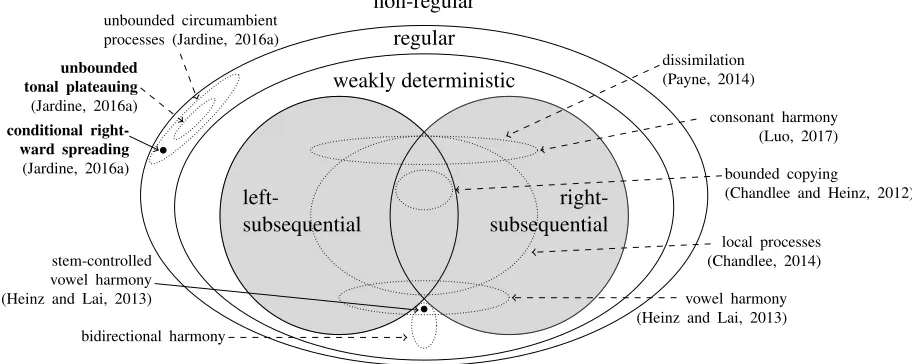
The Regular Hypothesis is not strong enough. There are many regular maps that are phonologi-cally implausible, and most UR7→SF maps belong to the SUBREGULAR classes shown in Figure 1.
The majority are in the SUBSEQUENTIAL classes
in gray. Bidirectional long-distance processes like stem-controlled vowel harmony belong to the more powerful WEAKLY DETERMINISTIC class (Heinz
and Lai, 2013). Only two tonal processes, un-bounded tonal plateauing and conditional rightward
spreading (in bold), have been shown to not belong to any subregular class (Jardine, 2016a).
Because of their wide empirical coverage and computational properties, the union of the subse-quential classes was an early candidate for a tighter bound on the complexity of phonological processes than the regular class (Chandlee and Heinz, 2012; Gainor et al., 2012). Heinz (forthcoming) states this as the Subsequential Hypothesis (2). The Subse-quential Hypothesis is stronger than the Regular Hy-pothesis, while maintaining its uniform generaliza-tion over all phonological transformageneraliza-tions.
(2) Subsequential Hypothesis: Phonological transformations are left- or right-subsequential.
In light of the weakly deterministic and regu-lar processes, the Subsequential Hypothesis is too strong. Because there are phonological transforma-tions that are not subregular, there is not a uniform revision of the Subsequential Hypothesis stronger than the Regular Hypothesis. Jardine (2016a) argues that only tonal processes exceed the weakly deter-ministic class, so a possible revision states that seg-mental processes are weakly deterministic and tonal processes are regular.1 In short, from examining the
UR7→SF maps on their own, there is no subregu-lar class that subsumes all phonological transforma-tions.
This paper argues that a uniform revision of the Subsequential Hypothesis obtains by examining not only the UR7→SF maps, but also how their
deriva-tions are computed. There is an open question in 1Tutrugbu vowel harmony challenges this generalization
(McCollum et al., 2017).
dissimilation (Payne, 2014)
consonant harmony (Luo, 2017)
bounded copying
(Chandlee and Heinz, 2012)
local processes (Chandlee, 2014)
vowel harmony (Heinz and Lai, 2013) stem-controlled
vowel harmony (Heinz and Lai, 2013)
bidirectional harmony unbounded circumambient processes (Jardine, 2016a)
unbounded tonal plateauing
(Jardine, 2016a)
conditional right-ward spreading
(Jardine, 2016a)
non-regular regular weakly deterministic
left-subsequential
[image:2.612.96.552.79.261.2]right-subsequential
Figure 1:Subregular hierarchy of phonological transformations (based on Jardine’s Figure 1 (2016, 263))
phonological theory whether UR7→SF maps are
de-rived in one fell swoop, or whether they are bro-ken down into sub-derivations. For example, con-sider the sibilant harmony process that transforms the UR /sasasaS/ into the SF [SaSaSaS] in Figure 2. The dashed line directly from the UR to the SF shows the PARALLEL derivation, where every /s/ changes at the same time. The solid lines from UR to SF via two intermediate forms show theSERIAL
derivation, where only one /s/ changes at a time. Each line represents one computation made by the phonology. Both derivations yield the same SF, the parallel derivation in one step and the serial in three.
/sasasaS/ sasaSaS saSaSaS [SaSaSaS]
Figure 2:Serial and parallel sibilant harmony
In a parallel derivation, the SF is derived di-rectly from the UR, so the derivation is exactly the UR7→SF map. Because they are identical, parallel
derivations have the same computational complex-ity as UR7→SF maps. This paper argues that in a serial derivation, where the SF is derived gradually over a number of steps, each step is subsequential. This is stated as the Serial Subsequential Hypoth-esis (3). Restricting each step to making a single change requires iterating processes. The solid lines in Figure 2, represent a process that changes one /s/, which applies three times to gradually yield the
SF. As Section 4 argues, this restriction also predicts that some regular maps are not possible phonologi-cal processes.
(3) Serial Subsequential Hypothesis: Phonologi-cal transformations are decomposable into iter-ated left- or right-subsequential maps.
The paper is organized as follows. Section 2 re-views the characterization of the classes in Figure 1 in terms of FSTs, providing empirical examples, and discusses the serial counterparts of the subreg-ular classes. Section 3 demonstrates that the regu-lar tonal processes can be broken down into subse-quential steps in a serial derivation. Sections 4 and 5 discuss the predictions of the Serial Subsequential Hypothesis and conclude.
2 Phonological transformations and FSTs 2.1 Subsequential transformations
Subsequential transformations include local pro-cesses like place assimilation, and unidirectional long-distance processes like regressive sibilant har-mony. They can be computed bySUBSEQUENTIAL
FSTS(Mohri, 1997). These are deterministic FSTs
FSTs (L-SFST) read inputs left-to-right; RIGHT -SUBSEQUENTIALFSTs (R-SFST) read inputs
right-to-left.
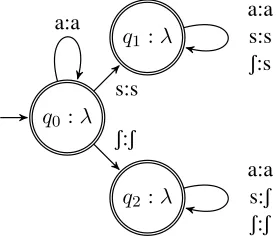
Example subsequential FSTs are given in Figures 3 and 4 for a toy sibilant harmony system. The ma-chines remember the identity of the first sibilant they read. If the first sibilant is /s/, they transition to state q1; if /S/, state q2. That information and the
current position in the input determine what is writ-ten to the output. In the diagrams, the end-of-input string is shown after states’ labels. λstands for the empty string, so neither machine appends to the out-put when the inout-put is exhausted.
The L-SFST in Figure 3 reads inputs left-to-right. The leftmost sibilant controls harmony, yielding progressive sibilant harmony, such as that in Aari (Hansson, 2010, 51). Table 1 gives sample deriva-tions; the I row gives the current symbol in the input read by the FST, Q the state the machine is in, and O the string written to the output.
q0 :λ
q1 :λ
q2 :λ
a:a
s:s
S:S
a:a s:s S:s
[image:3.612.350.496.116.239.2]a:a s:S S:S
Figure 3:L-SFST for progressive sibilant harmony
/saSaSa/7→[sasasa]
I s a S a S a
Q q0 → q1 → q1 → q1 → q1 → q1 → q1
O s a s a s a λ
/Sasasa/7→[SaSaSa]
I S a s a s a
Q q0 → q2 → q2 → q2 → q2 → q2 → q2
O S a S a S a λ
Table 1:Sample derivations for the L-SFST in Figure 3
The R-SFST in Figure 4 is the mirror image of the L-SFST in Figure 3. It reads inputs right-to-left, so the rightmost sibilant controls harmony, yielding re-gressive harmony, such as that in Navajo (Hansson, 2010, 43). For the URs in Table 1, this machine
pro-duces SFs with the opposite direction of harmony: /saSaSa/7→[SaSaSa]; /Sasasa/7→[sasasa].
q0 :λ
q1 :λ
q2 :λ
a:a
s:s
S:S a:a
s:s S:s
[image:3.612.116.256.359.480.2]a:a s:S S:S
Figure 4:R-SFST for regressive sibilant harmony
The direction in which subsequential FSTs read inputs determines whether a long-distance process is regressive or progressive. That is, R-SFSTs model regressive harmony, but L-SFSTs cannot. The R-SFST in Figure 4 first identifies a trigger and remem-bers its identity. This is enough information to write the correct output for every target in the input. A L-SFST would read the targets first, and face the in-surmountable problem of anticipating the identity of the trigger. Until it finds the trigger, a L-SFST does not have enough information to write the correct out-put for a target. Because the trigger may be arbitrar-ily far away, the L-SFST would have to wait until the end of the input to correctly output the targets. Because FSTs cannot remember arbitrarily long se-quences, this strategy fails.
The FSTs in Figures 3 and 4 compute the UR7→SF maps and, equivalently, the parallel derivations of these processes. Once the machines transition into a harmonizing state,q1orq2, they remain in that state
until the input is exhausted, because the only transi-tions from these states are self-loops. The machines therefore apply harmony to every focus in an UR.2
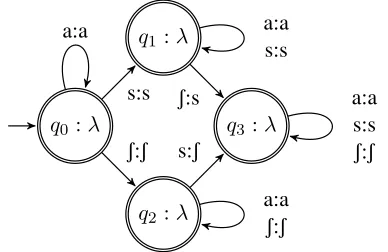
In the corresponding serial derivation, each com-putation applies harmony to only one sibilant in the input. Compare the L-SFST in Figure 3 to its serial counterpart in Figure 5. In the latter, the unfaithful transitions, i.e. the arcs leavingq1 onSandq2 on s,
lead to a stateq3, where the input is copied faithfully
to the output. Thus, once this machine makes a
sin-2In a phonological rule of the form A
[image:3.612.75.298.522.642.2]gle change, it transitions to a state where it is unable to make any further changes. Restricted to making one change at a time, inputs with multiple foci must pass through the machine a number of times before the final SF is computed.
q0:λ
q1 :λ
q2 :λ
q3 :λ
a:a
s:s
S:S
a:a s:s
S:s
a:a S:S s:S
[image:4.612.88.282.150.276.2]a:a s:s S:S
Figure 5:L-SFST for serial progressive sibilant harmony
Subsequential FSTs have enough memory to compute long-distance processes like sibilant har-mony. To satisfy the restriction that they make only one change, they simply have to remember whether they have already made a change. In the L-SFST in Figure 5, this is implemented by transitioning into the faithful stateq3on the unfaithful arcs leavingq1
andq2. This modification does not require any
addi-tional computaaddi-tional power, so the serial FST is still left-subsequential.
2.2 Weakly deterministic transformations
Weakly deterministic maps are defined as length-and alphabet-preserving3 compositions of a
left-subsequential and a right-left-subsequential map (Heinz and Lai, 2013), and include long-distance bidi-rectional processes like stem-controlled vowel har-mony. Because SFSTs are limited to unidirec-tional long-distance processes, they are not powerful enough to compute these maps on their own. Char-acterizing these maps in terms of independent uni-directional processes is empirically sound, as block-ing and other restrictions can vary with directional-ity (Rose and Walker, 2011).
Emphasis spreading in South Palestinian Arabic is an illustrative example. Emphasis spreads bidi-rectionally from a pharyngealized segment. Exam-ples are given in (4-6) (Al Khatib, 2008; Jardine, 3These restrictions are necessary to define a subregular
class. Without them, composing a left- and right-subsequential map can produce any regular map (Elgot and Mezei, 1965).
2016a); targeted segments are underlined in the SFs. Regressive spreading is unrestricted; the final ob-struent in (4) triggers pharyngealization of the en-tire word. Progressive spreading is blocked by /i, S, j, dZ/; pharyngealization in (5) affects one vowel and is stopped by the /j/. In (6), there are no block-ers, and the medial stop triggers pharyngealization of the entire word.
(4) /Xaj:a:tQ/7→[XQaQjQ:aQ:tQ]‘tailor’
(5) /sQaj:a:d/7→[sQaQj:a:d]‘hunter’
(6) /PatQfa:l/7→[PQaQtQfQaQ:lQ]‘children’
While this process is beyond the capability of a subsequential FST, it can be computed by feeding a UR into a left-subsequential FST and its output into a right-subsequential FST. Table 2 makes this ex-plicit, showing emphasis spreading as the outcome of ordering progressive spreading before regressive spreading. Though the SFSTs are not shown here, these processes can be computed by a left- and right-subsequential FST, respectively. As with sibilant harmony, these SFSTs can be restricted to making only one change without affecting their computa-tional complexity. Thus, because weakly determin-istic maps can be decomposed into subsequential maps, they can be further decomposed into iterated subsequential maps in a serial derivation.
[image:4.612.315.555.468.541.2]UR /Xaj:a:tQ/ /sQaj:a:d/ /PatQfa:l/ L→R — sQaQj:a:d PatQfQaQ:lQ R→L XQaQjQ:aQ:tQ — PQaQtQfQaQ:lQ SF [XQaQjQ:aQ:tQ] [sQaQj:a:d] [PQaQtQfQaQ:lQ]
Table 2:Emphasis spreading as two directional processes
2.3 Regular transformations
Weakly deterministic maps can be decomposed into two unidirectional processes because each process has a single trigger. Thus, even though crucial in-formation may be at a distance from a target, a sub-sequential FST can identify the trigger before it en-counters a target. This is not the case with regular transformations that areUNBOUNDED CIRCUMAM -BIENT, meaning crucial information lies both to the
property means that a subsequential FST will not have enough information when it reaches a target to write the correct output (see Jardine (2016a) for a formal account). In the attested unbounded circum-ambient processes, the crucial information consists of a trigger and a blocker, as in conditional right-ward spreading, or two triggers, as in unbounded tonal plateauing.
Conditional rightward spreading (CRS) is a pro-cess in Copperbelt Bemba that exemplifies the com-bination of a trigger and a blocker. Tone bearing units (TBU) surface with high tones if there is a high tone to the left and there is no high tone at the right edge of the prosodic word; examples are given in (7-8) (Bickmore and Kula, 2013; Kula and Bick-more, 2015; Jardine, 2016a). High tones are indi-cated with an acute accent ( ´V) and low tones with a grave accent ( `V). When no underlying high tones are present, words surface with all low tones (7a). In words with high tones and underlyingly tone-less final vowels, the rightmost high tone spreads all the way to the right edge; in (7b-c), the sub-ject marker /b´a-/ provides the high tone. Word-final high-tones block conditional rightward spread-ing, and high tones only spread across two TBUs; in (8), the locative enclitic/=k´o/provides the blocker.
(7) a. /u-ku-tul-a/7→[`uk`ut`ul`a]‘to pierce’ b. /b´a-ka-fik-a/ 7→ [b´ak´af´ık´a] ‘they will
ar-rive’
c. /b´a-ka-mu-londolol-a/7→
[b´ak´am´ul´o´ond´ol´ol´a] ‘they will intro-duce him/her’
(8) a. /b´a-ka-pat-a=k´o/ 7→ [b´ak´ap´at`ak´o] ‘they will hate’
b. /b´a-mu-luk-il-a=k´o/ 7→ [b´am´ul´uk`ıl`ak´o] ‘they will plait a bit for him’
c. /b´a-ka-londolol-a=k´o/7→
[b´ak´al´o`ond`ol`ol`ak´o] ‘they will intro-duce’
CRS cannot be decomposed into two unidirec-tional processes because a subsequential FST will not have enough information once it encounters a target TBU. Reading inputs left-to-right, a L-SFST remembers whether a triggering high tone is present, but cannot anticipate whether a blocking high tone is
present word-finally. Likewise, reading right-to-left, a R-SFST remembers whether a blocker is present, but cannot anticipate the presence of a trigger.
Unbounded tonal plateauing (UTP) exemplifies the combination of two triggers. TBUs surface with high tones if there is a high tone to the left and a high tone to the right; examples from Luganda are given in (9-10) (Hyman and Katamba, 2010; Jardine, 2016a). Underlyingly toneless TBUs in phrases without high tones (9a) and in phrases with only one high tone span (9b) surface with low tones. In words with multiple high tone spans, underly-ingly toneless TBUs flanked by two high tones sur-face with high tones (10).
(9) a. /mu-tund-a/7→[m`ut`und`a]‘seller’ b. /mu-t´em-a/7→[m`ut´em`a]‘chopper’
(10) a. /mu-t´em-a-bi-sik´ı/ 7→ [m`ut´em´ab´ıs´ık´ı] ‘log-chopper’
b. /tw-´aa-l´ab-w-a wal´usimbi/7→[tw´a´al´abw´a w´al´us`ımb`ı]‘we were seen by Walusimbi’ c. /tw-´aa-g´end-a na=byaa=ba=wal´usimbi/
7→ [tw´a´ag´end´a n´aby´a´ab´aw´al´us`ımb`ı] ‘we went with those of Walusimbi’
Like CRS, UTP cannot be decomposed into two unidirectional processes. A SFST reading the input in either direction will have only seen one trigger when it identifies a target. Because both triggers must be present for an underlyingly toneless TBU to surface with high tone, the SFST will not have enough information to write the correct output.
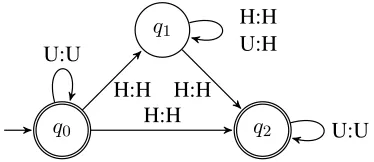
Jardine (2016a) argues that CRS and UTP must be modeled by non-deterministic FSTs. Unlike fi-nite state acceptors, non-deterministic FSTs cannot in general be determinized (Lothaire, 2013), and can compute regular maps that deterministic FSTs can-not. The FST for UTP is given in Figure 6 (Jardine, 2016a, 268). Following Jardine (2016a), tonal FSTs read inputs in TBU-sized chunks; U indicates a TBU unspecified for tone and H a high-toned TBU. An-ticipating Section 3, while the circumambient pro-cesses cannot be decomposed into two subsequential maps like weakly deterministic processes, they can be decomposed into arbitrarily many iterated subse-quential maps in a serial derivation.
q0
q1
q2
U:U
H:H H:H
H:H U:H
H:H
[image:6.612.94.281.71.152.2]U:U
Figure 6:Non-deterministic FST for UTP (based on Jardine’s Figure 5 (2016, 268))
unbounded lookahead. The FST in Figure 6 accepts an input with exactly one high tone only if it takes the lower path, transitioning toq2 on its high tone.
Inputs with more than one high tone must take the upper path, transitioning toq1on the first high tone.
In this state, high tones are written for unspecified TBUs. Reading inputs without high tones, the FST does not transition out ofq0, and faithfully maps the
input string. Table 3 gives sample derivations.
/UUHUU/7→[UUHUU]
I U U H U U
Q q0 → q0 → q0 → q2 → q2 → q2
O U U H U U
/HUUUH/7→[HHHHH]
I H U U U H
Q q0 → q1 → q1 → q1 → q1 → q2
[image:6.612.75.298.338.456.2]O H H H H H
Table 3:Sample derivations for the FST in Figure 6
Unlike weakly deterministic maps, which can be decomposed into two independently attested sub-sequential processes, Jardine (2016a) argues that unbounded circumambient processes are different. Taking a derivational perspective, Section 3 argues that in a serial derivation, the regular tonal maps can be decomposed into empirically-motivated sub-sequential processes that are iterated.
3 Decomposing regular transformations in serial derivations
This section presents the main contribution of this paper, that, under a serial derivation, the compu-tation of the unbounded circumambient processes can be decomposed into iterated subsequential maps which are empirically motivated. In a serial deriva-tion, the left high tone trigger is always adjacent to the target, so no step depends on non-local
informa-tion on both sides. By exploiting this locality, FSTs in serial do not require unbounded lookahead, obvi-ating nondeterminism. In parallel, this connection is not obvious, and the computation requires non-determinism just like the UR7→SF map.
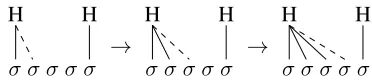
The tonal processes discussed in §2.3 have been characterized as spreading (Kisseberth and Odden, 2003; Kula and Bickmore, 2015). Spreading in-volves associating a tone onto a TBU adjacent to a TBU already associated with that tone. This is rep-resented visually in Figure 7 for UTP; solid lines in-dicate associations between tones and TBUs (here syllables) in the UR and dashed lines indicate new associations. The high tones of the UR /HUUUH/ trigger spreading, which is assumed to be progres-sive (Hyman, 2011), yielding the SF [HHHHH].
σ σ σ σ σ
H H
Figure 7:UTP as high tone spreading
Evidence supporting a spreading analysis comes from inhibitory effects by blockers, which produce partial spreading. A clear example of this is found in Digo, where voiced obstruents impede high tone spreading; examples are given in (11-12) (Kisse-berth, 1984). In these examples, UTP is fed by a process that displaces a high tone to the word-final vowel, which realizes as a word-final rise-fall con-tour ( ˇV ˆV). The displaced high tone of the subject prefix/´a-/realizes as this final rise-fall in isolation (11a). In (11b-c), the object prefix/´a-/provides a second high tone, creating the context for UTP. Verb stems with initial voiceless obstruents show right-ward spreading (11b), but stems with initial voiced obstruents do not (11c).
(11) a. /´a-na-tsukur-a/7→[`an`ats`ukˇurˆa]‘he/she is taking’
b. /´a-na-´a-tsukur-a/7→[`an`a´ats´uk´urˆa]‘he/she is taking them’
c. /´a-na-´a-demurir-a/ 7→ [`an`a´ad`em`urˇırˆa] ‘he/she is scolding them’
(12) a. /a-k´a-´ezeker-a/ 7→ [`ak`a´ez`ekˇerˆa] ‘he/she has thatched with/for’
b. /a-k´a-s´urubik-a/ 7→ [`ak`as´ur´ubˇık-ˆa] ‘he/she is strong/firm’
The pattern in Digo reveals a local relation be-tween the target and left high tone trigger in UTP. TBUs to the right of a voiced obstruent do not sur-face with high tones because the left high tone can-not spread across voiced obstruents to establish ad-jacency. These facts receive a natural explanation under a spreading analysis.
Further evidence for UTP being sensitive to lo-cality comes from Saramaccan Creole. Saramac-can Creole has an underlying three-way contrast between high-toned TBUs, low-toned TBUs, and TBUs unspecified for tone. UTP only targets un-specified TBUs. When a low tone intervenes be-tween either high tone and a span of toneless TBUs, plateauing is blocked; examples are given in (13-14) (Good, 2004; McWhorter and Good, 2012). When toneless TBU spans contact only one high tone, they surface with default low tone (13a). When toneless TBUs are flanked by two high tones, as with the sub-ject and verb in (13b), they surface with high tones. The high tones must be adjacent to the toneless span as the examples in (14) show. In (14a), two low tones intervene between the left high tone and the toneless span, and in (14b), the intervention is be-tween the toneless span and the right high tone. In both cases, spreading is blocked and the unspecified TBUs surface with low tones.
(13) a. /p´a´ulu l`Eg`Ed`E/ 7→ [p´a´ul`u l`Eg`Ed`E] ‘Paul lies’
b. /d´ı w´omi kul´e al´a/ 7→[d´ı w´om´ı k´ul´e `al´a] ‘the man runs there’
(14) a. /d´ı k´a`ım`a kul´e al´a/7→[d´ı k´a`ım`a k`ul´e `al´a] ‘the alligator runs there’
b. /d´ı w´omi b`a w´ata/7→ [d´ı w´om`ı b`a w´at`a] ‘the man carried water’ (Good, p.c.)
The Saramaccan Creole pattern supports the gen-eralization drawn from Digo that the left high tone trigger must be adjacent to a target TBU. Further, it also shows that the right high tone trigger must be adjacent to the span of toneless TBU targets. This indicates that the structural description is subject to locality constraints defined over the tonal tier rather than being unbounded over the timing tier (Jardine, 2016b; Jardine, 2017).
The locality between the left high tone trigger and the target may be implicit in the UR7→SF map, but it is made explicit in a serial derivation. Consider Figure 8, which gives the serial derivation of the UR7→SF map in Figure 7. In each step, the target is adjacent to the left high tone trigger, but may be at a distance from the right trigger. Because only the triggering high tone to the right is ever at a distance, no single step is unbounded circumambient.
σ σ σ σ σ
H H
→
σ σ σ σ σ
H H
→
σ σ σ σ σ
[image:7.612.332.518.324.365.2]H H
Figure 8:UTP as high tone spreading in a serial derivation
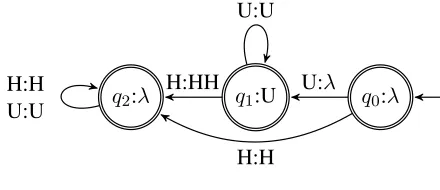
Each step in the serial derivation of UTP is right-subsequential and can be computed by the R-SFST in Figure 9. Reading an input without a high tone, the R-SFST does not transition out ofq0, and
faith-fully outputs the input. Likewise, inputs with one high tone span do not trigger any changes (e.g. /UUHUU/ in Table 4). On inputs with U. . . H se-quences, the R-SFST transitions toq2, where it waits
to identify a HU string. If it does, it writes two high tones to the output and makes no more changes (e.g. /HUUUH/ in Table 4). If the input ends before an-other high tone trigger is identified, the end-of-input function writes a toneless TBU to the output.
q0:λ
q1:λ
q2:U
q3:λ
U:U
H:H H:H
U:λ U:U
[image:7.612.316.537.580.668.2]H:HH H:H U:U
Figure 9:R-SFST for serial UTP
finds the right high tone trigger and a toneless TBU. Stateq2 enables lookahead. Transitioning toq2, the
R-SFST writes nothing onto the output; instead it re-members that it has seen one U. Rather than having to memorize an arbitrarily long sequence of toneless TBUs, the self-loop on q2 allows it to keep one in
memory. If the input ends inq2, the memorized U
is written to the output. Otherwise, if a second high tone is found, the memorized U is forgotten, and a second high tone is written to the output.
/UUHUU/7→[UUHUU]
U U H U U I
q2 ← q2 ← q1 ← q0 ← q0 ← q0 Q
U U λ H U U O
/HUUUH/7→[HHUUH]
H U U U H I
q3 ← q2 ← q2 ← q2 ← q1 ← q0 Q
[image:8.612.74.296.217.336.2]λ HH U U λ H O
Table 4:Sample derivations for the FST in Figure 9
CRS can be similarly broken down. The R-SFST in Figure 10 computes each step in a serial deriva-tion, using exactly the same lookahead strategy as the R-SFST for UTP in Figure 9. The only differ-ence is that it checks for a blocker rather than a trig-ger. Reading an input right-to-left, if the first TBU is high-toned, the machine transitions directly from the starting state to the faithful stateq2(bounded
spread-ing is assumed to be a separate process). Otherwise, it looks for a HU sequence and spreads the high tone.
q0:λ
q1:U
q2:λ U:λ
H:H U:U
H:HH H:H
U:U
Figure 10:R-SFST for serial CRS
4 Discussion
Phonologists have long debated whether to describe phonological processes as applying in parallel or in serial. In rule-based models, the debate is whether a rule applies simultaneously to a string with mul-tiple foci (Chomsky and Halle, 1968; Anderson, 1974) or whether rules apply to each focus
one-by-one (Howard, 1972; Johnson, 1972; Lightner, 1972; Kenstowicz and Kisseberth, 1977). In constraint-based models, the debate is whether competing pos-sible outputs may differ from inputs in unlimited ways, as in parallel Optimality Theory (Prince and Smolensky, 1993/2004), or whether they can only differ from the input by only one change, as in Har-monic Serialism (McCarthy, 2000, et seq.), where the derivation iterates until converging. This is a fundamental question in phonological theory.
This paper has argued that serial phonological models, where only one focus is changed at a time, are advantageous to characterizing the class of UR7→SF maps. Parallel models of phonology, where
derivations are identical to UR7→SF maps, do not offer stronger generalizations than the Regular Hy-pothesis. Serial models, on the other hand, allow for the decomposition of UR7→SF maps, yielding the Serial Subsequential Hypothesis. The Serial Subse-quential Hypothesis is stated as a uniform general-ization over phonological transformations and does not need to distinguish between segmental and tonal processes. This is desirable as a general, restrictive characterization.
As a general characterization, it can reduce the computational differences between related phono-logical processes. Consider the case of UTP, which avoids sequences of H. . . U. . . H from surfacing (Yip, 2002). Cross-linguistically, this sequence is also avoided by deleting the second high tone, giv-ing maps like /HUH/7→[HUU]. Examples of this progressive lowering process in Barasana are given in (15-16) (Gomez-Imbert and Kenstowicz, 2000; Gomez-Imbert, 2001; Hyman, 2010); the tilde ∼
marks nasalized stems. This is also attested in Yongning Na (Michaud, 2017). The high tone of the diminutive suffix/-´aka/surfaces when attached to stems with all high-toned TBUs (15a) and stems with UH contours (15b). Attaching the suffix to stems with HU contours creates a H. . . U. . . H se-quence, triggering the diminutive high tone to lower (16). Progressive lowering also targets the underly-ing high tone on the suffix/-´:ri/(16c). This process is left-subsequential; the L-SFST in Figure 11 com-putes the UR7→SF map.
[image:8.612.77.297.498.593.2]b. /goh´e-´aka/7→[g`oh´e´ak`a]‘small hole’
(16) a. /∼c´eda-´aka/ 7→ [∼c´ed`a`ak`a] ‘a bit of pineapple’
b. /∼c´eda-a-´aka/ 7→ [∼c´ed`a`a`ak`a] ‘a small pineapple’
c. /∼c´eda-a-´:ri-´aka-re/ 7→ [∼c´ed`a`ar`ı`ak`ar`e] ‘small pineapples-OBJ’
Progressive lowering and UTP target the same marked structure. In a parallel derivation, lan-guages like Luganda use a regular process to re-pair H. . . U. . . H sequences, while languages like Barasana use a subsequential repair. This compu-tational gap disappears in a serial derivation, where both repairs comprise iterated subsequential maps.
q0:λ q1:λ q2:λ
U:U
H:H H:H
U:U H:U
[image:9.612.329.521.76.164.2]U:U
Figure 11:L-SFST for progressive lowering
As a restrictive characterization, the Serial Sub-sequential Hypothesis predicts that certain regular maps are not possible phonological transformations. For example, consider a variant of Saramaccan Cre-ole, Saramaccan0, in which low tones do not act
as blockers. In Saramaccan0, arbitrarily many low
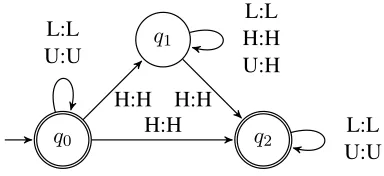
tones may intervene between a toneless TBU and the two triggering high tones, yielding maps such as /HLmULnH/7→[HLmHLnH], where L indicates a low-toned TBU. This cannot be modeled by an it-erated subsequential map, as there is no guarantee that a SFST will identify the second high tone trig-ger within a bounded distance from the target. Be-sides its larger alphabet, the non-deterministic FST for Saramaccan0 in Figure 12 is indistinguishable
from that for UTP in Figure 6. Without consider-ing the derivation, it is not clear how to predict the non-existence of Saramaccan0, or for that matter, any
regular map in a principled way.
While the Serial Subsequential Hypothesis ex-cludes some regular maps like Saramaccan0, it also
overgenerates. Consider the phonological rule∅ →
ab / a b. Kaplan and Kay (1994) demonstrate that iteratively applying this rulen≥1times to an input
/ab/ produces the context-free string setanbn. Such a derivation is within the scope of the Serial
Subse-q0
q1
q2
L:L U:U
H:H H:H
L:L H:H U:H H:H
L:L U:U
Figure 12:Non-deterministic FST for Saramaccan0
quential Hypothesis, because the rule can be com-puted subsequentially. The overgeneration caused by this particular rule stems from its ability to ap-ply without motivation. Moreton (2004) argues that constraint-based frameworks like Optimality The-ory, which limit processes to apply only if motivated by marked structures, avoid circular processes and infinite augmentation. In the case of inserting [ab] into the string, there is no clear improvement in these terms. Imposing restrictions of this sort from for-mal phonological analyses is a promising direction to take to characterize the class of serial SFSTs.
5 Conclusion
This paper argued that a phonologically uniform characterization of UR7→SF maps obtains under a
serial model of phonology. Phonological transfor-mations can be decomposed into iterated left- or right-subsequential maps, when computed in se-rial. Combined with restrictions already imposed on phonological computations, the Serial Subsequen-tial Hypothesis was argued to make restrictive typo-logical predictions. This demands a precise charac-terization of the class of maps produced by iterating subsequential maps, and is left to future work.
The result of this paper draws on the interac-tion between formal language theory and tradi-tional phonology. The decision to examine whether UR7→SF maps are computed in parallel or serial
Acknowledgments
This work has greatly benefited from discussions with Carolyn Anderson, Thomas Graf, Jeff Heinz, Adam Jardine, Gaja Jarosz, John McCarthy, Joe Pa-ter, Brandon Prickett, Kristine Yu, participants in the Phonology Reading Group and Sound Workshop at the University of Massachusetts, Amherst, and the audience at NECPHON 11, as well as comments from three anonymous reviewers for SCiL 2018. This work was supported by the National Science Foundation through grant BCS-424077. All remain-ing errors are of course my own.
References
Sam Al Khatib. 2008. On the directionality of emphasis spread. In Susie Jones, editor,Proceedings of the 2008 annual conference of the Canadian Linguistic Associ-ation.
Stephen R. Anderson. 1974. The Organization of Phonology. Academic Press, New York.
Lee S. Bickmore and Nancy C. Kula. 2013. Ternary spreading and the OCP in Copperbelt Bemba. Studies in African Linguistics, 42:101–132.
Jane Chandlee and Jeffrey Heinz. 2012. Bounded copying is subsequential: Implications for metathesis and reduplication. InProceedings of SIGMORPHON 2012, pages 42–51.
Jane Chandlee. 2014. Strictly local phonological pro-cesses. Ph.D. thesis, University of Delaware.
Noam Chomsky and Morris Halle. 1968. The Sound Pattern of English. Harper & Row, New York. C. C. Elgot and J. E. Mezei. 1965. On relations defined
by generalized finite automata. IBM Journal of Re-search and Development, 9:47–68.
Brian Gainor, Regine Lai, and Jeffrey Heinz. 2012. Computational characterizations of vowel harmony patterns and pathologies. In Proceedings of the 29th West Coast Conference on Formal Linguistics, pages 63–71.
Elsa Gomez-Imbert and Michael Kenstowicz. 2000. Barasana tone and accent. International Journal of American Linguistics, 66:419–463.
Elsa Gomez-Imbert. 2001. More on the tone versus pitch accent typology: Evidence from Barasana and other Eastern Tukanoan languages. In Shigeki Kaji, editor, Proceedings of Symposium Cross-Linguistic Studies of Tonal Phenomena: Tonogenesis, Japanese Accentol-ogy, and Other Topics, pages 369–412.
Jeff Good. 2004. Tone and accent in Saramaccan: chart-ing a deep split in the phonology of a language. Lin-gua, 114:575–619.
Gunnar ´Olafur Hansson. 2010. Consonant Harmony: Long-Distance Interactions in Phonology. University of California Press, Berkeley, CA.
Jeffrey Heinz and Regine Lai. 2013. Vowel harmony and subsequentiality. InProceedings of the 13th Meeting on the Mathematics of Language, pages 52–63. Jeffrey Heinz. forthcoming. The computational nature
of phonological generalizations. In Larry Hyman and Frans Plank, editors,Phonological Typology. Mouton. Irwin Howard. 1972. A Directional Theory of Rule Application. Ph.D. thesis, Massachusetts Institute of Technology.
Larry M. Hyman and Francis Katamba. 2010. Tone, syn-tax and prosodic domains in Luganda. ZAS Papers in Linguistics, 53:69–98.
Larry M. Hyman. 2010. Amazonia and the typology of tone systems. Technical report, UC Berkeley Phonol-ogy Lab Annual Reports.
Larry M. Hyman. 2011. Tone: Is it different? In John Goldsmith, Jason Riggle, and Alan C. L. Yu, editors, The Handbook of Phonological Theory, pages 197– 239. Blackwell Publishing, Malden, MA, 2 edition. Adam Jardine. 2016a. Computationally, tone is different.
Phonology, 33:247–283.
Adam Jardine. 2016b. Locality and Non-Linear Repre-sentations in Tonal Phonology. Ph.D. thesis, Univer-sity of Delaware.
Adam Jardine. 2017. The expressivity of autosegmental grammars. Unpublished manuscript.
C. Douglas Johnson. 1972.Formal Aspects of Phonolog-ical Description. Mouton, The Hague.
Ronald Kaplan and Martin Kay. 1994. Regular models of phonological rule systems. Computational Linguis-tics, 20:331–378.
Michael Kenstowicz and Charles Kisseberth. 1977. Top-ics in Phonological Theory. Academic Press, New York.
Charles W. Kisseberth and David Odden. 2003. Tone. In Derek Nurse and G´erald Philippson, editors, The Bantu languages, pages 59–70. Routledge, London. Charles W. Kisseberth. 1984. Digo tonology. In George
N. Clements and John Goldsmith, editors, Autoseg-mental Studies in Bantu Tone, pages 105–182. Foris Publications, Dordrecht.
Nancy C. Kula and Lee S. Bickmore. 2015. Phrasal phonology in Copperbelt Bemba.Phonology, 32:147– 176.
Theodore M. Lightner. 1972. Problems in the Theory of Phonology. Linguistic Research, Inc., Edmonton. M. Lothaire. 2013. Applied Combinatorics on Words.
Cambridge University Press, Cambridge.
John J. McCarthy. 2000. Harmonic serialism and paral-lelism. In Masako Hirotani, Andries Coetzee, Nancy Hall, and Ji-Yung Kim, editors, Proceedings of the North East Linguistics Society 30, pages 501–524. GLSA, Amherst, MA.
Adam McCollum, Eric Bakovi´c, Anna Mai, and Eric Meinhardt. 2017. Conditional blocking in Tutrugbu requires non-determinism: implications for the sub-regular hypothesis. Presentation at NELS 48.
John H. McWhorter and Jeff Good. 2012. A Grammar of Saramaccan Creole. De Gruyter Mouton, Berlin. Alexis Michaud. 2017. Tone in Yongning Na. Language
Science Press, Berlin.
Mehryar Mohri. 1997. Finite-state transducers in lan-guage and speech processing.Computational Linguis-tics, 23:269–311.
Elliott Moreton. 2004. Non-computable functions in Op-timality Theory. In John J. McCarthy, editor, Optimal-ity Theory in Phonology: A Reader, pages 141–163. Blackwell Publishing, Malden, MA.
Amanda Payne. 2014. Dissimilation as a subsequen-tial process. In Jyoti Iyer and Leland Kusmer, editors, NELS 44, volume 2, pages 79–90.
Alan Prince and Paul Smolensky. 1993/2004.Optimality Theory: Constraint Interaction in Generative Gram-mar. Blackwell Publishing, Malden, MA.
Sharon Rose and Rachel Walker. 2011. Harmony sys-tems. In John Goldsmith, Jason Riggle, and Alan C. L. Yu, editors,The Handbook of Phonological Theory, pages 240–290. Wiley-Blackwell, Malden, MA, 2 edi-tion.