Three Knowledge-Free Methods
for Automatic Lexical Chain Extraction
Steffen RemusandChris Biemann
FG Language Technology Department of Computer Science Technische Universit¨at Darmstadt
[email protected], [email protected]
Abstract
We present three approaches to lexical chain-ing based on the LDA topic model and eval-uate them intrinsically on a manually anno-tated set of German documents. After motivat-ing the choice of statistical methods for lexi-cal chaining with their adaptability to different languages and subject domains, we describe our new two-level chain annotation scheme, which rooted in the concept of cohesive har-mony. Also, we propose a new measure for direct evaluation of lexical chains. Our three LDA-based approaches outperform two knowledge-based state-of-the art methods to lexical chaining by a large margin, which can be attributed to lacking coverage of the knowl-edge resource. Subsequent analysis shows that the three methods yield a different chaining behavior, which could be utilized in tasks that use lexical chaining as a component within NLP applications.
1 Introduction
A text that is understandable by its nature exhibits an underlying structure which makes the text co-herent; that is, the structure is responsible for mak-ing the text “hang” together (Halliday and Hasan, 1976). The theoretic foundation of this structure is defined as coherenceandcohesion. While the for-mer is concerned with the meaning of a text, the lat-ter can be seen as a collection of devices for cre-ating it. Cohesion and coherence build the basis for most of the current natural language processing problems that deal with text understanding. Lex-ical cohesion ties together words or phrases that
are semantically related. Once all the cohesive ties are identified the involved items can be grouped to-gether to form so-calledlexical chains, which form a theoretically well-founded building block in various natural language processing applications, such as word sense disambiguation (Okumura and Honda, 1994), summarization (Barzilay and Elhadad, 1997), malapropism detection and correction (Hirst and St-Onge, 1998), document hyperlinking (Green, 1996), text segmentation (Stokes et al., 2004), topic track-ing (Carthy, 2004), and others. The performance of the individual task heavily depends on the quality of the identified lexical chains.
1.1 Motivation for Corpus-driven Approach
Previous approaches mainly focus on the use of knowledge resources like lexical semantic databases (Hirst and St-Onge, 1998) or thesauri (Morris and Hirst, 1991) as background information in order to resolve possible semantic relations. A major draw-back of this strategy is the dependency on the cov-erage of the resource, which has a direct impact on the lexical chains. Their quality can be expected to be poor for resource-scarce languages or specialized application domains.
Statistical methods to modeling language seman-tics have proven to deliver good results in many nat-ural language processing applications. In particu-lar, probabilistic topic models have been success-fully used for tasks such as summarization (Gong and Liu, 2001; Hennig, 2009), text segmentation (Misra et al., 2009), lexical substitution (Dinu and Lapata, 2010) or word sense disambiguation (Cai et al., 2007; Boyd-Graber et al., 2007).
In this work, we address the question, whether statistical methods for the extraction of lexi-cal chains can yield better results than existing knowledge-based methods, especially for underre-sourced languages or domains, following principles of Structure Discovery (Biemann, 2012). To address this, we have developed a methodology for evaluat-ing the quality of lexical chains intrinsically, have carried out an annotation study, and report results on a corpus of manually annotated German news docu-ments.
After defining a measure for the comparison of (manually or automatically created) lexical chains in Section 2, Section 3 describes our annotation methodology and discusses issues regarding the in-herent subjectivity of lexical chain annotation. In Section 4, three statistical approaches for lexical chaining are developed on the basis of the LDA topic model. Experiments that demonstrate the advantage of these approaches over a knowledge-baseline are conducted and evaluated in Section 5, and Section 6 concludes and provides an outlook future directions.
1.2 Previous Work on Lexical Chains
Morris and Hirst (1991) initially proposed an al-gorithm for lexical chaining based on Roget’s the-saurus (Roget, 1852), and manually assessed the quality of their algorithm. Hirst and St-Onge (1998) first presented a computational approach to lexical chaining based on WordNet showing that the lexi-cal database is a reasonable replacement to Roget’s. The basic idea behind these algorithms is that se-mantically close words should be connected to form chains. Subsequent approaches mainly concentrated on disambiguation of words to WordNet concepts (WSD), since ambiguous words can lead to the over-generation of connections. Barzilay and Elhadad (1997) improved the implicit word sense disam-biguation (WSD) by keeping a list of different inter-pretations of the text and finally choosing the most plausible senses for chaining. Silber and McCoy (2002) introduced an efficient variant of the algo-rithm with linear complexity in the number of can-didate terms. Galley and McKeown (2003) further improved accuracy by first performing WSD, and then using the remaining links between the disam-biguated concepts only. They also introduced a so-called disambiguation graph, a representation that
has also been utilized by the method of Medelyan (2007), where she applied a graph clustering algo-rithm to the disambiguation graph to cut weak links, performing implicit WSD. A combination of statis-tical and knowledge-based methods is presented by Marathe and Hirst (2010), who combine distribu-tional co-occurrence information with semantic in-formation from a lexicographic resource for extract-ing lexical chains and evaluate them by text segmen-tation. We are not aware of previous lexical chain-ing algorithms that do not rely on a lexicographic resource at all.
A major issue in developing a new lexical chain-ing algorithm is the comparison to previous systems. Most of previous approaches are validated by the evaluation in a certain task like summarization, word sense disambiguation, keyphrase extraction or infor-mation retrieval (Stairmand, 1996). Hence, these ex-trinsic evaluations are heavily influenced by the par-ticular task at hand. We propose to re-consider lexi-cal chaining as a task on its own, and propose objec-tive criteria for directly comparing lexical chains to this end.
2 Comparing Lexical Chains
The comparison of lexical chains is a non-trivial task. We adopt the idea of interpreting lexical chains as clusters and a particular set of lexical chains as a clustering, and develop a suitable cluster com-parison measure. As stated by Meil˘a (2005) and Amig´o et al. (2009), a best clustering comparison measure for the general case does not exist. It should be stressed that the appropriate clustering measure highly depends on the task at hand.
After exploring a number of measures1, we de-cided on a combination of the adjusted Rand in-dex (ARI, Hubert and Arabie (1985)) and thebasic merge distance (BM D, Menestrina et al. (2010)) for our new measure. Menestrina et al. (2010) in-troduced a linear time algorithm for computing the generalized merge distance (GM D), which counts
1
split andmergecluster editing operations. Using a constant factor of1for both splits and merges gives the basic merge distance (BM D): Considering>
as the most general clustering of a datasetD, where all elements are grouped into the same cluster, and further considering ⊥ as the most specific cluster-ing of D, where each element builds its own clus-ter, the latticebetween>and⊥spans all possible clusterings and theBM Dcan be interpreted as the shortest pathfrom a clusteringC to a clusteringC0 in the lattice with some restrictions (see Menestrina et al. (2010) for details). We normalize theBM D score by the maximum BM D2 to the normalized basic merge distance (N BM D). ARI is is based on pair comparisons, and is computed as3:
index=T P
expected index= (T P +F P)×(T P +F N)
T P +T N+F P +F N
max index=T P + 1
2(F P +F N)
ARI(C, C0) = index−expected index
max index−expected index
The reasons for choosing these two particular measures are the following: ARI is a well known measure which is adjusted (corrected) for decisions made by chance. But since it is based on pairwise element comparison it completely disregards single-ton clusters (chains) and some types of errors are not adequately penalized. The NBMD on the other hand penalizes various errors almost equally.
We combine the two single measures into a newlccm (lexical chain comparison measure),
de-fined as the arithmetic mean between ARI and
1−N BM D. Anlccmof 1 indicates perfect con-gruence and anlccm= 0indicates that not a single pair of items inC is found in a cluster together in C0.
lccm(C, C0) = 1 2
1−N BM D(C, C0) +ARI(C, C0).
2
BM D(>,⊥)for|D| ≤2,BM D(>,⊥) + 1otherwise
3
T P: pairs in D and D’,F P: pairs in D’ but not in D,F N: pairs in D but not in D’,T N: pairs not in D and not in D’, where D is the underlying dataset of C, D’ is the underlying dataset of C’, and pairs means all unique combinations of elements that are in the same cluster.
3 Annotating Lexical Chains
A challenge with the annotation of lexical chains is the subjective interpretation of the text by individ-ual annotators (Morris and Hirst, 2004), which also substantiates the fact that currently no gold stan-dard exist, and all previous automatic approaches are evaluated by performing a certain NLP task. Hollingsworth and Teufel (2005) as well as Cramer et al. (2008) conclude from their lexical chain anno-tation projects that high inter-annotator agreement is very hard to achieve. We argue that directly evalu-ating on lexical chains should enable us to optimize towards higher-quality chain annotations, which is a task of its own right and which has the potential to improve all subsequent applications. For this, we devise an annotation scheme that gets us reasonable inter-annotator agreement, inspired by the concept ofcohesive harmony (Hasan, 1984), and report on an annotation project for German newswire texts.
Documents from the SALSA 2.0 (Burchardt et al., 2006) corpus were chosen to form the basis for the annotation of lexical chain information. SALSA is based on the semi-automatically annotated TIGER Treebank 2.1 (Brants et al., 2002). The TIGER treebank provides manual annotations, such as lem-mas, part-of-speech tags, and syntactic structure, the SALSA part of the corpus is also partially annotated with FrameNet-style (Baker et al., 1998) frame an-notation. The documents are general domain news articles from a German newspaper comprising about 1,550 documents and around 50,000 sentences in to-tal, with a median document length of 275 tokens.
3.1 Annotation Scheme
In order to minimize the subjectiveness of choices by different annotators, annotation guidelines were developed comprising a total of ten pages. We decided to consider only nouns, noun compounds and non-compositional adjective noun phrases like “dirty money” as candidate terms for lexical chain-ing, which is consistent with the procedures of Hollingsworth and Teufel (2005) and Cramer et al.
(2008). For annotation, we used the MMAX24
(M¨uller and Strube, 2006) tool.
We introduce the termdense chain, which refers to a type of lexical chain in which every element is
related to every other element in that chain. Terms are considered to be related if they share the same topic, i.e. common sense and knowledge of the lan-guage is needed to decide which terms belong to-gether in the same topic and whether a chosen topic is neither too broad nor too narrow. A single dense chain can thus be assigned a definite topical descrip-tion of its items. Whereas Hollingsworth and Teufel (2005) dealt with the inherent fuzziness of member-ship of terms to lexical chains by allowing terms to occur in different lexical chains, we follow the concept of cohesive harmony introduced by Hasan (1984) here, where complete chains can be linked to others. For this purpose, we introduce so-called level two links, which are cohesive ties between lex-ical items in distinct dense chains. Having such a link between two chains, both chains can be as-signed a topical description which is broader than the description of the individual chains. This results in a two-level representation of chains. We report on dense lexical chains and merged lexical chains (dense chains are merged into a common chain if a level two link exists between them) separately.
In total, 100 documents were annotated by two expert annotators. Documents were chosen around the length median and consist of 248 – 304 tokens. The two rightmost columns of Table 3 show the characteristics of the annotated data set. It can be concluded that there is a moderate to high agree-ment regarding the annotator selections of candidate terms, which is ensured by preselection of candidate terms by part-of-speech patterns. A value of 81 % in the average agreement on lexical items (cf. Figure 1) shows that even though the choice of lexical items is limited to nouns and adjective noun phrases only, the decision on candidate termhood is somewhat dif-ferent between the annotators, but compares favor-ably with previous findings of 63 % average pairwise agreement (Morris and Hirst, 2004).
Figure 2 shows the annotator agreement on the individual documents using the lccm (cf. Sec. 2), sorted in the same way as in Figure 1. In order to use the level two link information the figure also shows a second agreement score, which was computed on merged chains.
The agreement scores of the assignment of lexical items to lexical chains depend partially on the agree-ment scores of the identified lexical items
them-0600 2068 1069 0337 0364 0897 1323 0100 1388 0962 0545 1156 1190 0122 1194 1855 1808 0356 1779 2040 0219 1734 1216 0947 0937 2026 1548 1232 1826 1224 1251 1239 2044 1119 0174 1650 2014 0630 0199 0655 1818 0310 1150 1726 2035 0382 1639 0275 1047 1707 0228 1050 1607 0984 0755 0752 0747 1162 1018 0182 0942 0492 0675 0928 1399 1072 1310 0268 1033 1168 1523 1737 0524 0338 0976 0639 0299 1524 1387 0694 0278 1692 1534 1037 0499 0721 0283 0736 0258 1130 0988 0649 1777 0309 0110 1319 0729 0730 0390 0925
Document ID
0 20 40 60 80 100
[image:4.612.317.539.58.116.2]%
Figure 1: Agreement of lexical items annotated by anno-tator A and annoanno-tator B as a percentage of lexical items annotated by annotator A or annotator B. The average agreement is 81 %.
0600 2068 1069 0337 0364 0897 1323 0100 1388 0962 0545 1156 1190 0122 1194 1855 1808 0356 1779 2040 0219 1734 1216 0947 0937 2026 1548 1232 1826 1224 1251 1239 2044 1119 0174 1650 2014 0630 0199 0655 1818 0310 1150 1726 2035 0382 1639 0275 1047 1707 0228 1050 1607 0984 0755 0752 0747 1162 1018 0182 0942 0492 0675 0928 1399 1072 1310 0268 1033 1168 1523 1737 0524 0338 0976 0639 0299 1524 1387 0694 0278 1692 1534 1037 0499 0721 0283 0736 0258 1130 0988 0649 1777 0309 0110 1319 0729 0730 0390 0925
Document ID
0.0 0.2 0.4 0.6 0.8 1.0
lc
cm
Figure 2: Individual annotator agreement scores on 100 documents sorted by their agreement on candidate terms. The red circles show the agreement of both annotators on the dense lexical chains disregarding the cohesive links, and the green dots show the agreement of both annotators on the merged lexical chains (via the cohesive links) both using the proposedlexical chain comparison measure.
selves, which is a desired property. Across all doc-uments, a perfect agreement was never achieved, which confirms the difficulty of annotating such a subjective task: The averagelccmper document on the manual annotations is 0.56 (dense chains), re-spectively 0.54 (merged chains). However, the con-siderable overlap between the annotators still en-ables us to evaluate automatic chaining methods, and the lccm agreement score serves as an upper bound. Note that by performing no reconciliation of the annotations we explicitly allow the possibil-ity of different interpretations which is in our opin-ion appropriate here due to the subjectiveness of the task itself. By doing so, we evaluate our algorithms against individual annotator interpretations.
4 Statistical Methods for Lexical Chaining
This work employs a well-studied statistical method for creating something that Barzilay (1997) called anautomatic thesaurus which will then be adapted for lexical chaining. For our automatic approaches, candidate lexical items in a text are preselected by the same heuristic that is also applied in Section 3 for the annotation process.
[image:4.612.316.539.188.249.2]unsuper-vised algorithms designed for unveiling some hid-den structure in large data collections. The key idea is that documents can be represented as compos-ites of so-called topics where a topic itself repre-sents as a composite of words. Hofmann (1999) defined a topic to be a probability distribution over words and a document to be a probability distribu-tion over a fixed set of topics. We use the latent Dirichlet allocation(LDA, Blei et al. (2003)) topic model for estimating the semantic closeness of can-didate terms, and explore different ways of utilizing LDA’s topic information in automatic lexical chain-ers. Specifically, we use the GibbsLDA++5 frame-work for topic model estimation and inference, and examine the following LDA parameters: number of topics T, Dirichlet hyperparameters for document-topic distributionαand topic-term distributionβ.
We now describe three LDA-based approaches to lexical chaining.
4.1 LDA Mode Method (LDA-MM)
The LDA-MM approach places all word tokens that share the same topic ID into the same chain. The point is now how to decide to which topic a word belongs to. Since single samples of topics per word exhibit a large variance (Riedl and Biemann, 2012), we follow these authors by sampling several times and using the mode (most frequently assigned) topic ID per word as the topic assignment. This strategy reduced the variance in thelccmto a tenth6.
More formally, let samples(d,w) be the vector of assignments that have been collected for a cer-tain word w in a certain document d with each samples(id,w)referring to thei-th sampled topic ID for(d, w). In other words,samples(d,w)can be seen as the Markov chain for a particular word in a par-ticular document. Further letz(d,w)be the topic ID that was most assigned to the word wwith respect to the samples insamples(d,w). Precisely,z(d,w)is
defined to be the sampled mode insamples(d,w)— in case of multiple modes a random mode is chosen,
5
http://gibbslda.sourceforge.net
6
Preliminary experiments yielded a variance of2.6×10−6 inlccmusing the mode method and3.07×10−5using a single sample for lexical chain assignment.
which never happened in our experiments.
z(d,w)= mode (samples(d,w)) ≈arg max
j
(P(z=j|w, d))
The LDA-MM assigns for every word w which
is a candidate lexical item of a certain documentd which is assigned the same topicz(d,w)to the same chain; hence implicitly disambiguating the terms.
The possibility to create level two links is given by taking the second most occurring topic for a given word if it exceeds a certain threshold.
4.2 LDA Graph Method (LDA-GM)
The LDA-GM algorithm creates a similarity graph based on the comparison of topic distributions for given words and then applies a clustering algorithm in order to find semantically related words.
Let ψ(d,w) be the per-word topic distribution P(z|w, d). Analogously to the LDA-MM, ψ(d,w) can be obtained by counting the occurrences of a certain topic ID z in the sample collection samples(d,w)for a particular wordwand document d.
The semantic relatedness between any two words wiandwj can then be measured by their similarity score of the topic distributionsψ(d,wi) andψ(d,wj),
which is stored in a term similarity matrix. This matrix can also be interpreted as an adjacency ma-trix of a graph, with candidate items being nodes and edges being weighted with the similarity value simij for any two nodes i, j : i 6= j ∧ i, j ∈ {1,2, . . . , Nd}. We test two similarity measures: Euclidian (dis-)similarity and cosine similarity.
Let G = (V, E) be the graph
represen-tation of a document with term vertices
V = {v1, . . . , vN d} and weighted edges E = {(v1, v2, sim12), . . .(vN d, vN d−1, simNdNd−1)},
three parameters to regulate the node weight based on its degree, which influences cluster size and granularity. We test options ”top”, ”dist log” and ”dist lin”.
The final chaining procedure is straightforward: The LDA-GM algorithm assigns every candidate lexical item wi of a certain document d which is assigned the same class label ci to the same chain. Level two links are drawn using the second domi-nant class of a vertex’s neighborhood, which is pro-vided by the CW implementation.
4.3 LDA Top-N Method (LDA-TM)
The LDA-TM method is different to the others in that it uses the information of the per-topic word dis-tributionφ(z)=P(w|z)and the per-document topic distributionθ(d)=P(z|d). Given a parametern re-ferring to the topntopics to choose fromθ(d)and a parametermreferring to the topmwords to choose from φ(z) the main procedure can be described as follows: for allz ∈top ntopics in θ(d): chain the topmwords inφ(z).
Note that although the number of chains and chain members for each chain is bound and could lead to the same number and sizes of chains, in practice the number of generated chains as well as the number of chain members still varies considerably across doc-uments: often some of the topmwords for a (glob-ally computed) topic do not even occur in a partic-ular document. This implies that the parametersn and m must not be set globally but dependent on the particular document. To overcome this to some extent, additional thresholding parametersθandφ are used for further bounding the respectivenorm parameter. The procedure works like this: for allz
∈topntopics inθ(d) ∧ θz(d) < θ: chain the topm wordswinφ(z) ∧ φ(wz)< φ.
Level two links are created by computing the co-sine similarity between every pair of the topntopic distributions, and thresholding with a link parame-ter.
4.4 Repetition Heuristic
All methods described above can be applied to new unseen documents that are not in the training set. To alleviate a possible vocabulary mismatch between training set and test set, which happens when terms in the test set have not been contained in our training
documents, we add a heuristic that chains repetitions of (previously unknown) words as a post-processing step to all methods.
5 Empirical Analysis
In order to provide a realistic estimate of the qual-ity of our methods to unseen material, we randomly split our annotated documents in two parts of 50 documents each. One part is used as adevelopment setfor optimizing the parameters of the methods (i.e. model selection), the other part forms ourtest setfor evaluation.
The training corpus, on the other hand, consists of all 1,211 SALSA/Tiger documents that are not part of the development and test corpus and nei-ther very long nor very short. These documents are taken from the German newspaper “Frankfurter Rundschau” around 1992. Additionally the training corpus is enriched with 12,264 news texts from the same newspaper around 1997 with similar charac-teristics7, making up a total of 13,457 training doc-uments for the estimation of topic models.
Input to the LDA model training are verbs, nouns and adjectives, as well as candidate terms as de-scribed in Section 3.1, all in their lemmatized form. We further filter words that occur in more than 1/3 of the training documents, as well as known stop-words, and words that occur in less than two doc-uments which results in a vocabulary size of about 100K words.
5.1 Experimental Setup
For comparison, we implemented three baselines, which we describe below. One baseline is trivial, two baselines are state-of-the art knowledge-based systems adapted to German.
Random: Candidate lexical items are randomly tied together to form sets of lexical chains. Level two links are created analogously. We regulate the process to yield the same average number of chains and links as in the develop-ment and test data.
S&M GermaNet: Algorithm by Silber and McCoy (2002) with GermaNet as its knowledge re-source.
7as provided by Projekt Deutscher Wortschatz,
G&M GermaNet: Algorithm by Galley and McK-eown (2003), also using GermaNet.
GermaNet (Hamp and Feldweg, 1997) is a large WordNet-like resource for German, containing al-most 100,000 lexical units and over 87,000 concep-tual relations between synsets. While its size is only about half of WordNet, it is one of the largest non-English lexical semantic resources.
5.2 Model Selection
We optimize two sets of parameters: parameters for the LDA topic model (number of topicsK, Dirich-let hyperparametersα andβ) are optimized for the LDA-MM method only, and the same LDA model is used in the other two LDA-based methods. Pa-rameters particular to the respective method are op-timized individually. For LDA, we tested sensible combinations in the ranges K = 50..1000, α = 0.05/K..50/K and β = 0.001..0.1. The highest performance of the LDA-MM method was found for K = 500,α = 50/K,β = 0.001, and the result-ing topic model is used across all methods. The final parameter values for the other methods, found by ex-haustive search, are summarized in Table 1.
Method Parameter
LDA-GM similarityf unction= cosine similarity labelweightscheme= dist log
sim= 0.95
LDA-TM n= 10,m= 20,θ= 0.2,φ= 0.2
Table 1: Final parameter values.
5.3 Evaluation
For evaluation purposes, terms that consist of multi-ple words are mapped to its rightmost term which is assumed to be the head, e.g. “dirty money” is mapped to “money”. Additionally, singleton chains, i.e. chains that contain only a single lexical item are omitted unless the respective lexical item is not linked by a level two link.
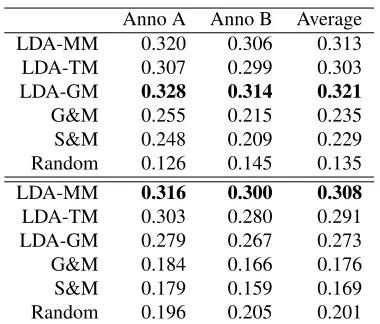
Dense Chains Comparative results of the ap-proaches in terms of lccmfor both annotators are summarized in Table 2 (upper half). We observe that all our new methods beat the random baseline and the two knowledge-based baselines by a large margin. The knowledge-based baselines, both using
Anno A Anno B Average
LDA-MM 0.320 0.306 0.313
LDA-TM 0.307 0.299 0.303
LDA-GM 0.328 0.314 0.321
G&M 0.255 0.215 0.235
S&M 0.248 0.209 0.229
Random 0.126 0.145 0.135
LDA-MM 0.316 0.300 0.308
LDA-TM 0.303 0.280 0.291
LDA-GM 0.279 0.267 0.273
G&M 0.184 0.166 0.176
S&M 0.179 0.159 0.169
[image:7.612.332.522.54.216.2]Random 0.196 0.205 0.201
Table 2: Results of the evaluation based on dense chains (upper half) and merged chains (lower half). The annota-tor agreement on the test set’s chains = 0.585; on merged chains = 0.553
GermaNet, produce very similarlccmscores, which highlights the important role of the knowledge re-source. Data analysis revealed that while chains pro-duced by knowledge-based baselines are sensible, the main problem is a lack of coverage in terms of vocabulary and relations in GermaNet. Comparing the statistical methods, the LDA-GM method excels over the others.
Level Two Links Table 2 (lower half) summarizes the evaluation results of the merged chains via level two links. Because of merging, a text now contains fewer chains with more lexical items each. Note that knowledge-based baselines do not construct level two links, which is why they are heavily penalized in this setup.
LDA-MM LDA-GM LDA-TM S&M G&M Anno A Anno B
avg. num. of lexical items per doc. 38.20 29.32 30.82 14.40 15.29 38.66 38.96
avg. num. of chains per doc. 13.80 9.12 7.32 5.83 5.71 11.25 7.38
avg. num. of links per doc. 8.60 2.06 1.44 – – 5.47 2.41
avg. size lexical chains 2.82 3.41 4.61 2.48 2.68 3.69 5.57
avg. num. of merged lexical chains 5.76 7.06 5.98 – – 6.10 4.99
avg. size merged lexical chains 8.29 4.45 5.57 – – 7.60 8.91
Table 3: Quantitiative characteristics of automatic and manual lexical chains. In average, a document contains 51.58 candidate terms as extracted by our noun phrase patterns
Davud Bouchehri,
[Davud Bouchehri,] seit[since] der[the] letzten[last] Spielzeit[playing period] als[as] Dramaturg[dramaturg] in[in] Basel[Basle] t¨atig,[acting,] wechselt[switches] zur[to the]
Saison1996 / 97
[1996 / 97 season] als[as] k ¨unstlerischer[art] Gesch¨aftsf ¨uhrer[director] des[of the] [play]Schauspielsan[to] das[the] Staatstheater[state theater] Darmstadt.[Darmstadt.] Der[The]
aus
[from] dem[the] Iran[Iran] stammende[coming] 34j¨ahrige[34-year-old] soll[shall] [besides]danebenauch[also] f¨ur[for] sparten ¨ubergreifende[multi discipline] Projekte[projects] zust¨andig[responsible] sein,[be,]
teilte
[aquainted] das[the] Basler[Basle’s]
Theater
[theather] am[on] Donnerstag[Thursday] mit.[with.]
LDA-MM:
c1:{Spielzeit, Schauspiels, Staatstheater}
c2:{Dramaturg, Theater}
c3:{Saison}
l1: (Theater→Spielzeit)
l2: (Spielzeit→Saison)
LDA-GM:
c1:{Dramaturg, Theater}
c2:{Schauspiels, Staatstheater}
LDA-TM:
c1:{Schauspiels, Staatstheater, Theater}
c2:{Dramaturg}
c3:{Spielzeit, Saison}
l1: (Theater→Dramaturg) S&M-GermaNet:
–
G&M-GermaNet:
c1:{Staatstheater, Theater}
Figure 3: Diverse output of the various lexical chaining systems after applying them on a short German example text from the used TIGER/SALSA corpus. For a better understanding the text is calqued. Candidate items are highlighted and theciare the resulting dense lexical chains and theliare the level two links produced by the various methods.
Data Analysis Table 3 shows quantitative num-bers of the extracted lexical chains in the test set.
The LDA-MM approach chains and links a lot more items than the other statistical methods: it cre-ates a lot more links between items that would oth-erwise be removed because they form unlinked sin-gleton chains. As opposed to this, the graph method (LDA-GM), as well as the top-n method (LDA-TM) perform an implicit filtering on the candidate lexi-cal items by creating less level two links, yet larger dense chains. The knowledge based algorithms by Silber and McCoy (2002) and Galley and McKeown (2003) extract fewer and smaller chains than the sta-tistical approaches, which reflects GermaNet’s spar-sity issues. While higher lexical coverage in the underlying resource would increase the coverage of our knowledge-based systems, this is only one part of the story. The other part is rooted in the fact that lexical cohesion relations, which are used in lexical chains, encompass many more semantic re-lations than listed in today’s lexical semantic
net-works. This especially holds for cases where sev-eral expressions refer to the same event or theme for which no well-defined relation exists, such as e.g. ”captain” and ”harbor”.
Comparing the three LDA-based approaches, no overall best method could be determined. the LDA-MM seems especially suited for a high coverage and coarse (level two) chains, the LDA-GM appears most suited for dense chains, and LDA-TM pro-duces the longest chains on average.
G&M algorithm produces only a single chain con-taining only two words. This is mostly due to Ger-maNet’s lacking lexical and relational coverage and the scope of the algorithms for finding relations be-tween the words.
6 Conclusion
In this paper, we presented experiments for auto-matic lexical chain annotation and evaluated them directly on a manually annotated dataset for Ger-man. A new two-level annotation scheme for lexi-cal chains was proposed and motivated by the con-cept of cohesive harmony. We further proposed a new measure for comparing lexical chain annota-tions that is especially suited for the characteristics of lexical chain annotations. Three variants of sta-tistical lexical chaining methods based on the LDA topic model were proposed and evaluated against two knowledge-based baseline systems. Our sta-tistical methods exhibit a substantially higher per-formance than the knowledge-based systems on our dataset. This can partially be attributed to miss-ing relations, partially to the lack of lexical cov-erage of GermaNet, which was used in these sys-tems. Since GermaNet is a large lexical-semantic net, however, this strengthens our main point: Espe-cially for under-resourced languages or subject do-mains, statistical and data-driven methods should be preferred over their knowledge-based counterparts, since they do not require the development of lexical-semantic nets and adopt easily to subject domains by training their unsupervised models on an in-domain collection.
In future work, we would like to explore better ways of selecting candidate items. While our POS-pattern-based selection mechanism works for practi-cal purposes, it currently only extracts noun phrases and over-generates on compositional adjective mod-ifiers. We would like to define a better filter to re-duce over-generation. Further, especially for com-pounding languages such as German, we would like to decompose one-word compounds as to be able to link their heads in lexical chains.
While we found it important to directly evalu-ate our lexical chaining algorithms on manually an-notated data, a natural next step in this line of re-search is to use our lexical chaining methods as
pre-processing steps for applications such as sum-marization, text segmentation or word sense disam-biguation. This would enable to find out advantages and disadvantages of our three variants with respect to an application.
The manually annotated data, the open source an-notation tool, the anan-notation guidelines and the im-plementations of all described methods and base-lines are available for download8.
Acknowledgments
This work has been supported by the Hessian re-search excellence program Landes-Offensive zur Entwicklung Wissenschaftlich-¨okonomischer Exzel-lenz (LOEWE)as part of the research centerDigital Humanities.
Proof: Equality of NMI and V
Using the standard notation from information retrievalH(X)= Entropy, I(X, Y)= Information,H(X|Y)= Conditional Entropy, NMI(X,Y)= Normalized Mutual Information, V(X,Y)= V-Measure:
V(C, K) = 2×h×c
h+c (1)
h= 1−H(C|K)
H(C) , c= 1−
H(K|C)
H(K) (2)
and
N M I(C, K) = I(C, K)
H(C)+H(K) 2
= 2× I(C, K)
H(C) +H(K) (3)
reformulate h and c using the fact that I(C, K) = H(C) −
H(C|K) =H(K)−H(K|C):
h= 1−H(C|K)
H(C) =H(C)
H(C)−
H(C|K)
H(C) =I(C, K)
H(C)
(4)
c= 1−H(K|C)
H(K) =H(K)
H(K)−
H(K|C)
H(K) =I(C, K)
H(K)
(5)
simplifyingh×cusing (4) and (5): h×c=I(C, K)
H(C) ×
I(C, K)
H(K)
= I(C, K)
2
H(C)H(K)
(6)
simplifyingh+cusing (4) and (5): h+c=I(C, K)
H(C) +
I(C, K)
H(K)
=I(C, K)H(K) +I(C, K)H(C)
H(C)H(K) =I(C, K)[(H(K) +H(C)]
H(C)H(K)
(7)
simplifyingh×ch+cusing (6) and (7): h×c
h+c=
I(C, K)2 H(C)H(K)×
H(C)H(K)
I(C, K)[H(K) +H(C)]
= I(C, K)
H(K) +H(C)
(8)
8http://www.ukp.tu-darmstadt.de/
substituting (8) into (1) shows that NMI and V are equal:
V(C, K) = 2×h×c
h+c= 2×
I(C, K)
H(K) +H(C)=N M I(C, K) (9)
References
Jitendra Ajmera, Herv´e Bourlard, and I. Lapidot. 2002. Unknown-Multiple Speaker clustering using HMM. InProceedings of the International Conference of Spo-ken Language Processing, ICSLP ’02, Denver, Col-orado, USA.
Enrique Amig´o, Julio Gonzalo, Javier Artiles, and Felisa Verdejo. 2009. A comparison of extrinsic clustering evaluation metrics based on formal constraints. Infor-mation Retrieval, 12:461–486.
Amit Bagga and Breck Baldwin. 1998. Algorithms for Scoring Coreference Chains. In Proceedings of the Linguistic Coreference Workshop at The First Interna-tional Conference on Language Resources and Evalu-ation, LREC ’98, pages 563–566, Granada, Spain. Collin F. Baker, Charles J. Fillmore, and John B. Lowe.
1998. The Berkeley FrameNet Project. InCOLING ’98: Proceedings of the 17th International Conference on Computational Linguistics, volume 1, pages 86–90, Montreal, Quebec, Canada.
Regina Barzilay and Michael Elhadad. 1997. Using Lex-ical Chains for Text Summarization. InProceedings of the ACL Workshop on Intelligent Scalable Text Sum-marization, pages 10–17, Madrid, Spain.
Regina Barzilay. 1997. Lexical Chains for Summariza-tion. Master’s thesis, Ben-Gurion University of the Negev, Beersheva, Israel.
Omar Benjelloun, Hector Garcia-Molina, David Men-estrina, Qi Su, Steven Whang, and Jennifer Widom. 2009. Swoosh: a generic approach to entity resolu-tion. The VLDB Journal, 18:255–276.
Chris Biemann. 2006. Chinese Whispers – an Effi-cient Graph Clustering Algorithm and its Application to Natural Language Processing. In Proceedings of TextGraphs: the Second Workshop on Graph Based Methods for Natural Language Processing, pages 73– 80, New York City, USA.
Chris Biemann. 2012. Structure Discovery in Natural Language. Theory and Applications of Natural Lan-guage Processing. Springer Berlin / Heidelberg. David M. Blei, Andrew Y. Ng, and Michael I. Jordan.
2003. Latent Dirichlet Allocation. Journal of Ma-chine Learning Research, 3:993–1022.
Jordan Boyd-Graber, David M. Blei, and Xiaojin Zhu. 2007. A Topic Model for Word Sense Disambigua-tion. In Proceedings of the 2007 Joint Conference on Empirical Methods in Natural Language Process-ing and Computational Natural Language LearnProcess-ing (EMNLP-CoNLL), pages 1024–1033, Prague, Czech Republic.
Sabine Brants, Stefanie Dipper, Silvia Hansen, Wolfgang Lezius, and George Smith. 2002. TIGER Treebank. InProceedings of the Workshop on Treebanks and Lin-guistic Theories (TLT02), Sozopol, Bulgaria.
Aljoscha Burchardt, Katrin Erk, Anette Frank, Andrea Kowalski, Sebastian Pad´o, and Manfred Pinkal. 2006. The SALSA Corpus: a German corpus resource for lexical semantics. InProceedings of the 5th interna-tional conference on Language Resources and evalua-tion (LREC-2006), Genoa, Italy.
Junfu Cai, Wee Sun Lee, and Yee Whye Teh. 2007. Improving Word Sense Disambiguation Using Topic Features. InProceedings of the 2007 Joint Conference on Empirical Methods in Natural Language Process-ing and Computational Natural Language LearnProcess-ing (EMNLP-CoNLL), pages 1015–1023, Prague, Czech Republic.
Joe Carthy. 2004. Lexical Chains versus Keywords for Topic Tracking. In A. Gelbukh, editor, Compu-tational Linguistics and Intelligent Text Processing, volume 2945 of Lecture Notes in Computer Science, pages 507–510. Springer, Berlin / Heidelberg. Irene Cramer, Marc Finthammer, Alexander Kurek,
Lukas Sowa, Melina Wachtling, and Tobias Claas. 2008. Experiments on Lexical Chaining for Ger-man Corpora: Annotation, Extraction, and Applica-tion. Journal for Language Technology and Computa-tional Linguistics (JLCL), 23(2):34–48.
Georgiana Dinu and Mirella Lapata. 2010. Topic Mod-els for Meaning Similarity in Context. In COLING ’10: Proceedings of the 23rd International Conference on Computational Linguistics: Posters, pages 250– 258, Beijing, China.
Michel Galley and Kathleen McKeown. 2003. Im-proving word sense disambiguation in lexical chain-ing. In IJCAI’03: Proceedings of the 18th interna-tional joint conference on Artificial intelligence, pages 1486–1488, Acapulco, Mexico.
Yihong Gong and Xin Liu. 2001. Generic Text Sum-marization Using Relevance Measure and Latent Se-mantic Analysis. InSIGIR 2001: Proceedings of the 24th Annual International ACM SIGIR Conference on Research and Development in Information Retrieval, pages 19–25, New Orleans, Louisiana, USA.
Stephen J. Green. 1996. Using Lexical Chains to Build Hypertext Links in Newspaper Articles. In AAAI-96 Workshop on Internet-based Information Systems, pages 115–141, Portland, Oregon, USA.
Michael A. K. Halliday and Ruqaiya Hasan. 1976. Co-hesion in English. English language series. Longman, London.
Proceed-ings of the ACL/EACL-97 workshop Automatic Infor-mation Extraction and Building of Lexical Semantic Resources for NLP Applications, Madrid, Spain. Ruqaiya Hasan. 1984. Coherence and Cohesive
Har-mony. In James Flood, editor,Understanding Reading Comprehension, Cognition, Language, and the Struc-ture of Prose, pages 181–220. International Reading Association, Newark, Delaware, USA.
Leonhard Hennig. 2009. Topic-based multi-document summarization with probabilistic latent semantic anal-ysis. In Proceedings of the International Conference RANLP-2009, pages 144–149, Borovets, Bulgaria. Graeme Hirst and David St-Onge. 1998. Lexical Chains
as representation of context for the detection and cor-rection malapropisms. In Christiane Fellbaum, edi-tor, WordNet: An Electronic Lexical Database, Lan-guage, Speech, and Communication, pages 305–332. The MIT Press, Cambridge, Massachusetts, USA. Thomas Hofmann. 1999. Probabilistic Latent
Seman-tic Analysis. InProceedings of the Fifteenth Confer-ence on Uncertainty in Artificial IntelligConfer-ence, UAI ’99, pages 289–296, Stockholm, Sweden.
William Hollingsworth and Simone Teufel. 2005. Hu-man annotation of lexical chains: Coverage and agree-ment measures. In Proceedings of the Workshop ELECTRA: Methodologies and Evaluation of Lexical Cohesion Techniques in Real-world Applications, In Association with SIGIR ’05, Salvador, Brazil. Lawrence Hubert and Phipps Arabie. 1985. Comparing
partitions. Journal of Classification, 2(1):193–218. Christopher Manning, Prabhakar Raghavan, and Hinrich
Sch¨utze. 2008. An Introduction to Information Re-trieval. Cambridge University Press, Cambridge, UK. Meghana Marathe and Graeme Hirst. 2010. Lexical Chains Using Distributional Measures of Concept D. In Proceedings of the 11th International Conference on Computational Linguistics and Intelligent Text Pro-cessing, CICLing’10, pages 291–302, Ias¸i, Romania. Olena Medelyan. 2007. Computing lexical chains with
graph clustering. In Proceedings of the 45th Annual Meeting of the ACL: Student Research Workshop, ACL ’07, pages 85–90, Prague, Czech Republic.
Marina Meil˘a. 2005. Comparing clusterings: an ax-iomatic view. In Proceedings of the 22nd Interna-tional Conference on Machine Learning, ICML ’05, pages 577–584, Bonn, Germany.
David Menestrina, Steven Euijong Whang, and Hec-tor Garcia-Molina. 2010. Evaluating entity resolu-tion results. Proceedings of the VLDB Endowment, 3(1):208–219.
Hemant Misra, Franc¸ois Yvon, Joemon Jose, and Olivier Capp´e. 2009. Text Segmentation via Topic Mod-eling: An Analytical Study. In Proceedings of the
18th ACM Conference on Information and Knowledge Management, CIKM 2009, pages 1553–1556, Hong Kong, China.
Jane Morris and Graeme Hirst. 1991. Lexical cohesion computed by thesaural relations as an indicator of the structure of text. Computational Linguistics, 17:21– 48.
Jane Morris and Graeme Hirst. 2004. The Subjectivity of Lexical Cohesion in Text. InProceedings of the AAAI Spring Symposium on Exploring Attitude and Affect in Text: Theories and Applications, Palo Alto, California, USA.
Christoph M¨uller and Michael Strube. 2006. Multi-level annotation of linguistic data with MMAX2. In Sabine Braun, Kurt Kohn, and Joybrato Mukherjee, editors,
Corpus Technology and Language Pedagogy: New Re-sources, New Tools, New Methods, pages 197–214. Pe-ter Lang, Frankfurt a.M., Germany.
Manabu Okumura and Takeo Honda. 1994. Word sense disambiguation and text segmentation based on lexical cohesion. InCOLING ’94: Proceedings of the 15th Conference on Computational Linguistics, volume 2, pages 755–761, Kyoto, Japan.
Martin Riedl and Chris Biemann. 2012. Sweeping through the Topic Space: Bad luck? Roll again! In
ROBUS-UNSUP 2012: Joint Workshop on Unsuper-vised and Semi-SuperUnsuper-vised Learning in NLP held in conjunction with EACL 2012, pages 19–27, Avignon, France.
Peter Mark Roget. 1852. Roget’s Thesaurus of English Words and Phrases. Longman Group Ltd., Harlow, UK.
Andrew Rosenberg and Julia Hirschberg. 2007. V-measure: A conditional entropy-based external cluster evaluation measure. InProceedings of the 2007 Joint Conference on Empirical Methods in Natural guage Processing and Computational Natural Lan-guage Learning (EMNLP-CoNLL), pages 410–420, Prague, Czech Republic.
H. Gregory Silber and Kathleen F. McCoy. 2002. Effi-ciently computed lexical chains as an intermediate rep-resentation for automatic text summarization. Compu-tational Linguistics, 28(4):487–496.
Mark A. Stairmand. 1996. A Computational Analysis of Lexical Cohesion with Applications in Information Retrieval. Ph.D. thesis, Center for Computational Lin-guistics, UMIST, Manchester.
Nicola Stokes, Joe Carthy, and Alan F. Smeaton. 2004. SeLeCT: A Lexical Cohesion Based News Story Seg-mentation System. AI Communications, 17(1):3–12. Alexander Strehl. 2002. Relationship-based