Unsupervised Code-Switching for
Multilingual Historical Document Transcription
Dan Garrette∗ Hannah Alpert-Abrams† Taylor Berg-Kirkpatrick‡ Dan Klein‡
∗Department of Computer Science, University of Texas at Austin,[email protected] †Comparative Literature Program, University of Texas at Austin,[email protected]
‡Computer Science Division, University of California at Berkeley,{tberg,klein}@cs.berkeley.edu
Abstract
Transcribing documents from the printing press era, a challenge in its own right, is more complicated when documents interleave multiple languages—a common feature of 16th century texts. Additionally, many of these documents precede consistent ortho-graphic conventions, making the task even harder. We extend the state-of-the-art his-torical OCR model of Berg-Kirkpatrick et al. (2013) to handle word-level code-switching between multiple languages. Further, we en-able our system to handle spelling variabil-ity, including now-obsolete shorthand systems used by printers. Our results show average rel-ative character error reductions of 14% across a variety of historical texts.
1 Introduction
Transcribing documents printed on historical print-ing presses poses a number of challenges for OCR technology. Berg-Kirkpatrick et al. (2013) presented an unsupervised system, called Ocular, that han-dles the types of noise that are characteristic of pre-20th century documents and uses a fixed monolin-gual language model to guide learning. While this approach is highly effective on English documents from the 18th and 19th centuries, problems arise when it is applied to older documents that feature code-switching between multiple languages and ob-solete orthographic characteristics.
In this work, we address these issues by devel-oping a new language model for Ocular. First, to handle multilingual documents, we replaceOcular’s simple n-gram language model with an unsuper-vised model of intrasentential code-switching that
allows joint transcription and word-level language identification. Second, to handle orthographic vari-ation, we provide an interface that allows individ-uals familiar with relevant languages to guide the language model with targeted orthographic informa-tion. As a result, our system handles inconsistent spelling, punctuation, and diacritic usage, as well as now-obsolete shorthand conventions used by print-ers.
We evaluate our model using documents from the Primeros Librosproject, a digital archive of books printed in the Americas prior to 1601 (Dolan, 2012). These texts, written in European and indigenous lan-guages, often feature as many as three languages on a single page, with code-switching occurring on the chapter, sentence, and word level. Orthographic variations are pervasive throughout, and are particu-larly difficult with indigenous languages, for which writing systems were still being developed.
Our results show improvements across a range of documents, yielding an average 14% relative charac-ter error reduction over the previous state-of-the-art, with reductions as high as 27% on particular texts.
2 Data
Writing during the early modern period in Europe was characterized by increasing use of vernacu-lar languages alongside Latin, Greek, and Hebrew. In the colonies, this was matched by the develop-ment of grammars and alphabetic writing systems for indigenous languages (see Eisenstein (1979) and Mignolo (1995)). In all cases, orthographies were regionally variable and subject to the limited re-sources of the printing houses; this is particularly true in the Americas, where resources were scarce,
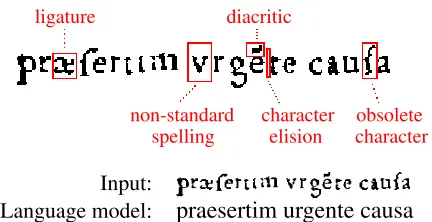
ligature diacritic
non-standard character obsolete spelling elision character
Input:
[image:2.612.82.298.56.167.2]Language model: praesertim urgente causa
Figure 1: An example OCR input showing the origi-nal image and an example of an equivalent modern-ized text similar to data used to train the LM.
and where indigenous-language orthographies were first being developed (Baddeley and Voeste, 2013).
The 349 digital facsimiles in the Primeros Li-broscollection are characteristic of this trend. Pro-duced during the first century of Spanish coloniza-tion, they represent the introduction of printing tech-nology into the Americas, and reflect the (sometimes conflicted) priorities of the nascent colony, from re-ligious orthodoxy to conversion and education.
For our experiments, we focus on multilingual documents in three languages: Spanish, Latin, and Nahuatl. As Berg-Kirkpatrick et al. (2013) show, a language model built on contemporaneous data will perform better than modern data. For this reason, we collected 15–17th century texts from Project Guten-berg,1producing Spanish and Latin corpora of more
than one million characters each. Due to its relative scarcity, we augmented the Nahuatl corpus with a private collection of transcribed colonial documents. 3 Baseline System
The starting point for our work is theOcularsystem described by Berg-Kirkpatrick et al. (2013). The fonts used in historical documents are usually un-known and can vary drastically from document to document.Oculardeals with this problem by learn-ing the font in an unsupervised fashion – directly from the input historical document. In order to ac-complish this, the system uses a specialized gener-ative model that reasons about the main sources of variation and noise in historical printing. These in-clude the shapes of the character glyphs, the hor-izontal spacing between characters, and the
verti-1http://www.gutenberg.org/
cal offset of each character from a common base-line. Additionally, since documents exhibit variable inking levels (where individual characters are often faded or smeared with blotched ink) the system also models the amount of ink applied to each type piece. The generative process operates as follows. First, a sequence of character tokens is generated by a charactern-gram language model. Then, bounding boxes for each character token are generated, con-ditioned on the character type, followed by verti-cal offsets and inking levels. Finally, the pixels in each bounding box are generated, conditioned on the character types, vertical offsets, and inking levels. In this work, we focus on improving the language model, and leave the rest of the generative process untouched.
4 Language Model
We present a new language model forOcularthat is designed to handle issues that are characteristic of older historical documents: code-switching and or-thographic variability. We extend the conventional character n-gram language model and its training procedure to deal with each of these problems in turn.
4.1 Code-Switching
Because Ocular’s character n-gram language model (LM) is fixed and monolithic, even when it is trained on corpora from multiple languages, it treats all text as a single “language”—a multilingual blur at best. As a result, the system cannot model the fact that different contiguous blocks of text correspond to specific languages and thus follow specific statis-tical patterns. In order to transcribe documents that feature intrasentential code-switching, we replace Ocular’s simplen-gram LM with one that directly models code-switching by representing language segmentation as a latent variable.
Our code-switching LM generates a sequence of pairs (ei,`i) whereeiis the current character and`iis
the current language. The sequence of languages`i
com-ponent model corresponding to language`is called PCHAR
` . Second, our LM also incorporates a model
that governs code-switching between languages. We call this modelPLANG. The generative process for
our LM works as follows. For theith character posi-tion, we first generate the current language`i
condi-tioned on the previous characterei−1 and the previ-ous language`i−1 using PLANG. Then, conditioned on the current language li and the previousn−1
characters, we generate the current characterei
us-ingPCHAR
`i . This means that the probability of pair (ei,`i) given its context is computed as:
PLANG(`
i |ei−1, `i−1)·P`CHARi (ei|ei−1... ei−n+1)
We parameterize PLANG in a way that enforces
two constraints. First, to ensure that each word is assigned a single language, we only allow language transitions for characters directly following whites-pace (a swhites-pace character or a page margin, unless the character follows a line-end hyphen). Second, to resist overly frequent code-switching (and encour-age longer spans), we let a Bernoulli parameter κ specify the probability of choosing to draw a new language at a word boundary (instead of determin-istically staying in the same language). By setting κ low, we indicate a strong belief that language switches should be infrequent, while still allowing a switch if sufficient evidence is found in the image.2
Finally, we parameterize the frequency of each lan-guage in the text. Specifically, for each lanlan-guage`, a multinomial parameterθ`specifies the probability
of transitioning to`when you draw a new language. We learn this group of multinomial parameters, θ`
for each language, in an unsupervised fashion, and in doing so, adapt to the proportions of languages found in the particular input document. Thus, using our parameterization, the probability of transitioning from language`to`0, given previous charactere, is:
PLANG(`0 |e, `) =
(1−κ) +κ·θ`0 ife=spaceand`=`0
κ·θ`0 ife=spaceand`6=`0
1 ife6=spaceand`=`0
0 ife6=spaceand`6=`0
2We useκ= 10−6across all experiments.
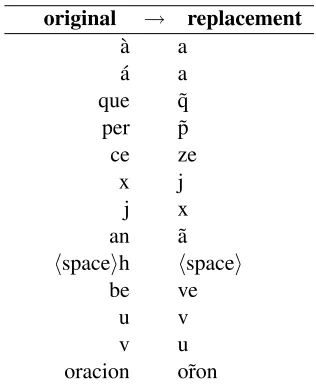
original → replacement
`a a
´a a
que ˜q
per ˜p
ce ze
x j
j x
an ˜a
hspaceih hspacei
be ve
u v
v u
[image:3.612.347.505.58.250.2]oracion o˜ron
Table 1: An example subset of the orthographic re-placement rules for Spanish.
Finally, because our code-switching LM uses multiple separate language-specificn-gram models PCHAR
` , we are able to maintain a distinct set of valid
characters for each language. By restricting each language’s model to the set of characters in the cor-pus for that language, we can cor-push the model away from incompatible languages during transcription if it is confident about certain rare characters, and limit the search space by reducing the number of charac-ter combinations considered for any given position. We also include, for all languages, a set of punctua-tion symbols such as¶and§that appear in printed books but not in the LM training data.
4.2 Orthographic Variability
author Gante Anunciaci´on Sahag´un Rinc´on Bautista Macro Average
pub. year 1553 1565 1583 1595 1600 WER
CER WER CER WER CER WER CER WER CER WER CER WER w.p.
Ocular 13.7 55.9 15.7 53.6 10.8 44.3 11.6 38.4 9.7 25.7 12.3 43.6 56.6 +code-switch 12.8 55.0 14.6 53.8 9.6 38.7 10.7 35.4 8.8 24.5 11.3 41.5 53.5 +orth. var. 13.5 55.3 14.1 51.6 8.4 34.9 9.5 31.0 7.1 18.2 10.5 38.2 51.0
Table 2: Experimental results for each book, and average across all books. Columns show Character Error Rate (CER) or Word Error Rate (WER; excluding punctuation). The final column gives the average WER includingpunctuation (w.p.). TheOcularrow is the previous state-of-the-art: Berg-Kirkpatrick et al. (2013). The second row uses our code-switching model, and the third additionally handles orthographic variability.
[image:4.612.71.542.60.134.2]Gan.(1553) Anu.(1565) Sah.(1583) Rin.(1595) Bau.(1600)
Table 3: An example line from each test book.
incorporating orthographic variability into the train-ing procedure for the component LMs.
For our experiments, we built Latin, Nahuatl, and Spanish variability rulebanks by asking language ex-perts to identify spelling anomalies from among sev-eral sample pages fromPrimeros Librosdocuments, and specifyrewrite rulesthat map modern spellings back to variant spellings; we also drew on data from paleographic textbooks. Example rules can be seen in Table 1. These rules are used to rewrite corpus text before the LMs are trained; for instance, every nth occurrence ofenin the Spanish corpus might be rewritten as ˜e. This approach reintroduces histori-cally accurate orthographic variability into the LM.
5 Experiments
We compare to Ocular, the state of the art for his-torical OCR.3SinceOcularonly supports
monolin-gual English OCR, we added support for alterna-tive alphabets, including diacritics and ligatures, and trained a single mixed-language model on a com-bined Spanish/Latin/Nahuatl corpus.
We evaluate our model on five different books from thePrimeros Libroscollection, representing a variety of printers, presses, typefaces, and authors (Table 3). Each book features code-switching
be-3http://nlp.cs.berkeley.edu/projects/ocular.shtml
tween Spanish, Latin, and Nahuatl. For each book, a font was trained on ten (untranscribed) pages using unsupervised learning procedure described by Berg-Kirkpatrick et al. (2013). The font was evaluated on a separate set of ten pages, manually transcribed.4 6 Results and Analysis
Our overall results (Table 2) show improvements on every book in our evaluation, achieving as high as 29% relative word-error (WER) reduction.
Replacing Ocular’s single mixed-language LM with our unsupervised code-switch model results in immediate improvements. An example of transcrip-tion output, including the language-assignments made by the model, can be seen in Figure 2.
Further improvements are seen by handling ortho-graphic variation. Figure 3 gives an example of how a single spelling variation can lead to a cascade of transcription errors. Here, the baseline system, con-fused by the elision of the letternin the wordm˜etira (frommentira, “lie”), transcribed it with an entirely different word (merita, “merit”). When our handling of alternate spellings is employed, the LM has good statistics for character sequences including the char-acter˜e, and is able to decode the word correctly.
There are several explanations for the differences in results among the five evaluation books. First, the two oldest texts,GanteandAnunciaci´on, use Gothic fonts that are more difficult to read and feature capi-tal letters that are nearly impossible for the model to recognize (see Table 3). This contributes to the high character error rates for those books.
Second, the word error rate metric is complicated by the inconsistent use of spaces in Nahuatl
writ-4Hyperparameters were set to be consistent with
Ay proprio vocablo de logr´o, que estetech -tlaixtlapanaliztli, tetechtla miec caquixtiliztli,
y para dezir di te alogro? Cuix tetech
otitlaix-Figure 2: A passage with Spanish/Nahuatl code-switching, and our model’s language-coded output. (Spanish in blue; Nahuatl in red/italics.)
no variation handling mentira merita handling variation mentira m˜etira
Figure 3: Two variants of the same word (mentira), pulled from the same page of text. The form men-tiraappears in the LM training corpus, but the short-handm˜etiradoes not. Without special handling, the model does not know thatm˜etirais valid.
ing, falsely claiming “word” errors when all charac-ters are correct. Use of spaces is not standardized across the printed books, or across the digitized LM training corpora, and is still in fact a contested is-sue among modern Nahuatl scholars. While it is im-portant for the transcription process to insert spaces appropriately into the Spanish and Latin text (even when the printer left little, as withyparain Figure 2), it is difficult to assess what it means for a space to be “correctly” inserted into Nahuatl text.Rinc´onand Bautistacontain relatively less Nahuatl text and are affected less by this problem.
A final source of errors arises when our model “corrects” the original document to match modern conventions, as with diacritics, whose usages were less conventionalized at the time these books were printed. For example, the string numero is often transcribed asn´umero, the correct modern spelling.
7 Conclusions and Future Work
We have demonstrated an unsupervised OCR model that improves upon Berg-Kirkpatrick et al. (2013)’s state-of-the-artOcularsystem in order to effectively handle the code-switching and orthographic vari-ability prevalent in historical texts. In addition to
transcribing documents, our system also implicitly assigns language labels to words, allowing their us-age in downstream tasks. We have also presented a new corpus, with transcriptions, for the evaluation of multilingual historical OCR systems.
Our system, as currently designed, attempts to faithfully transcribe text. However, for the purposes of indexability and searchability of these documents, it may be desirable to also produce canonicalized transcriptions, for example collapsing spelling vari-ants to their modern forms. Fortunately, this can be done in our approach by running the variability rewrite rules “backward” as a post-processing step.
Further technical improvements may be made by having the system automatically attempt to boot-strap the identification of spelling variants, a pro-cess that could complement our approach through an active learning setup. Additionally, since even our relatively simple unsupervised code-switch lan-guage modeling approach yielded improvements to OCR performance, it may be justified to attempt the adaptation of more complex code-switch recogni-tion techniques (Solorio et al., 2014).
The automatic transcription of the Primeros Li-bros collection has significant implications for scholars of the humanities interested in the role that inscription and transmission play in colonial history. For example, there are parallels between the way that the Spanish transformed indigenous languages into Latin-like writing systems (removing “noise” like phonemes that do not exist in Latin), and the way that the OCR tool transforms historical printed documents into unicode (removing “noise” like arti-facts of the printing process and physical changes to the pages); in both instances, arguably impor-tant information is lost. We present some of these ideas at the American Comparative Literature As-sociation’s annual meeting, where we discuss the relationship between sixteenth century indigenous orthography andOcular’s code-switching language models (Alpert-Abrams and Garrette, 2015).
Acknowledgements
References
Hannah Alpert-Abrams and Dan Garrette. 2015. Read-ingPrimeros Libros: From archive to OCR. In Pro-ceedings of The Annual Meeting of the American Com-parative Literature Association.
Susan Baddeley and Anja Voeste. 2013. Orthographies in Early Modern Europe. De Gruyter.
Taylor Berg-Kirkpatrick and Dan Klein. 2014. Improved typesetting models for historical OCR. InProceedings of ACL.
Taylor Berg-Kirkpatrick, Greg Durrett, and Dan Klein. 2013. Unsupervised transcription of historical docu-ments. InProceedings of ACL.
Thomas G. Dolan. 2012. The Primeros Libros Project. The Hispanic Outlook in Higher Education, 22:20–22, March.
Elizabeth L. Eisenstein. 1979. The printing press as an agent of change. Cambridge University Press. Walter Mignolo. 1995. The Darker Side of the
Renais-sance. University of Michigan Press.