Initial Steps for Building a Lexicon of Adjectives with Scalemates
Bryan Wilkinson
Dept. of Computer Science and Electrical Engineering University of Maryland, Baltimore County
1000 Hilltop Circle Baltimore, MD 21250
Abstract
This paper describes work in progress to use clustering to create a lexicon of words that engage in the lexico-semantic relationship known as grading. While other resources like thesauri and taxonomies exist detailing rela-tionships such as synonymy, antonymy, and hyponymy, we do not know of any thorough resource for grading. This work focuses on identifying the words that may participate in this relationship, paving the way for the cre-ation of a true grading lexicon later.
1 Introduction
Many common adjectives, like small and tiny, can be defined in terms of intensities of other adjec-tives. These relations, known as grading, intensifi-cation, magnification and others, are hypothesized to be one of the more important types in a lexicon (Evens, 1980). This type of relationship has appli-cations in question answering and ontological rep-resentations (de Marneffe et al., 2010; Raskin and Nirenburg, 1996).
While the existence of this relationship is widely agreed upon, the study of it has fallen far behind that of synonymy, antonymy, and hyponymy, especially in the computational linguistics community. Recent work has brought renewed attention to this area of research, but there is still no large resource of words that participate in this relationship (van Miltenburg, 2015; Ruppenhofer et al., 2014).
The phenomenon of grading is not the same as gradability, although there is significant overlap among the adjectives that have it. Gradability refers
to an adjective’s ability to be combined with ad-verbs like very or be used in comparative expres-sions. It is possible that words likelukewarm, which are not considered gradable by most linguists, still have the lexico-semantic relation of grading. Simi-larly, a word likespotted, which is gradable, and in fact can be viewed on its own scale, does not express the relationship of grading with any other words in English.
There is no agreement on what types of adjectives express this relationship. Paradis and Kennedy & McNally propose two similar views that were influ-ential to this work. Kennedy and McNally (2005) fo-cus on the structure of scales, whether they are open at both ends (tall, short), closed at both ends ( vis-ible, invisible), or a combination of the two (bent, straightandsafe, dangerous). Paradis (1997) on the other hand, defines three classes of gradable adjec-tives, limit adjecadjec-tives, extreme adjecadjec-tives, and scalar adjectives. For her,deadandaliveare gradable ad-jectives but of the limit variety, meaning there is a definite boundary between the two. Extreme and scalar adjectives, such asterrible andgood respec-tively, are both conceptualized as being on a scale, although extreme adjectives share some properties with limit adjectives as well. Paradis also points out that many adjectives can easily have a scalar inter-pretation, such as someone beingvery Swedish.
The study of grading has focused on a small num-ber of adjectives (van Tiel et al., 2014). Many pre-vious approaches of automatically learning the rela-tion have relied on existing ontologies such as Word-Net and FrameWord-Net to choose which words occur on scales (Sheinman et al., 2013; Ruppenhofer et al.,
2014). The issues with using ontologies like these as starting points are pointed out by Van Miltenburg (2015). He notes that words like difficult and im-possibleare not grouped together and that limiting scales to WordNet networks prevents ad-hoc scales as introduced by Hirschenberg (1985) from being studied. To this we can add our own observation that many times an ontology can be too broad, including
puffy, rangy, and large-mouthed under size along-side expected senses ofbig,small, and others. West-ney investigated what might be necessary for a word to be on a scale while recent work in cognitive sci-ence has focused on the acquisition of scalar impli-catures in children (Westney, 1986; Verbuk, 2007).
We demonstrate work in progress to cluster ad-jectives into those that participate in grading and those that do not. While our metrics do not currently match the supervised solution of (Hatzivassiloglou and Wiebe, 2000), the lack of large amounts of train-ing data encourages us to continue to pursue the un-supervised approach. Clustering the adjectives is a critical first step to support further research into se-mantic intensities of adjectives, which is outlined in section 2.
1.1 Adverb Types
As shown above, adverbs can play a large role in the study of adjectives. Many types of adverbs have been recognized in the literature, with many stud-ies being derived from the classification of Quirk (1985). Many of these studies have been done with an emphasis on adverbs’ interactions with verbs. Moryzcki (2008) has noted that at least the sub-ject oriented class (deliberately, purposely, willfully, etc.) and what he terms “remarkably adverbs” ( as-toundingly, disappointingly, remarkably, etc.) occur with adjectives as well.
The group of adverbs that have received the most attention in regards to their combinations with ad-jectives has been degree adverbs. In addition to Kennedy and McNally’s use of co-occurrence with degree adverbs to arrive at the scale structures men-tioned earlier, Paradis (1997) performed detailed re-search on this class of adverbs. She found that certain adverbs combine only with certain types of gradable adjectives. Adverbs she terms scalar mod-ifiers (fairly, slightly, very, etc.) combine only with scalar adjectives while maximizer adverbs like
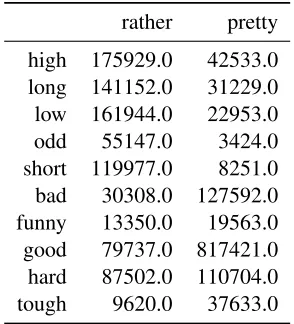
[image:2.612.353.500.54.216.2]ab-rather pretty high 175929.0 42533.0 long 141152.0 31229.0 low 161944.0 22953.0 odd 55147.0 3424.0 short 119977.0 8251.0 bad 30308.0 127592.0 funny 13350.0 19563.0 good 79737.0 817421.0 hard 87502.0 110704.0 tough 9620.0 37633.0
Table 1: Co-occurrence matrix from Google syntactic ngrams corpus
solutelycombine with extreme adjectives.
This type of pattern of co-occurrence has not only been observed between the classes of adjectives and adverbs but also within them. Desaguilier (2014) showed thatrathercombined more often with words likelongandhighwhileprettycombined more often with words likegoodandstupid, yet both are consid-ered not only scalar modifiers, but a subtype known as moderators according to (Paradis, 1997). This ef-fect can be seen in the co-occurrence matrix shown in Table 1.
2 Related Work
While this is the first attempt we know of to create a general lexicon of adjectives that participate in grad-ing, several related studies have occurred. We first discuss work on defining gradable and non-gradable adjectives and then discuss several recent works on automatically ordering adjectives.
was trained on 100 randomly selected subsets of 300 adjectives and tested on randomly selected subsets of 100 adjectives.
Since Hatzivassiloglou and Wiebe was published, a great number of corpora have been produced. One issue we now face is that the class of degree adverbs is generally agreed to be a closed class in English, while other adverbs are not. This means we can rea-sonably expect the number of non-modifier adverbs would dominate the other features in an unsuper-vised situation. Additionally, while the degree ad-verb class is considered closed, we have not found a comprehensive list of all of them, leading to fur-ther reservations about simply counting adverbs as degree modifying and non degree modifying based on a list.
Several works have looked at automatically order-ing a group of adjectives by intensity given that they occur on the same scale. Van Miltenburg (van Mil-tenburg, 2015) uses patterns to find scalemates from a large corpus. He is particularly interested in pairs of words for use in reasoning about scalar implica-tures. The candidate pairs generated by the patterns are then validated by using various similarity mea-sures, such as LSA or being under the same attribute in WordNet. This pattern based approach has also been taken by Sheinman (Sheinman et al., 2013), al-though she starts out with the words on a scale from WordNet and uses the patterns to order the words. As pointed out by (Ruppenhofer et al., 2014), pat-tern based approaches do not have wide applicabil-ity, a fact backed up by the results of van Miltenburg. Out of 32470 pairs identified, only 121 occur in 4 or more of the 6 patterns used.
Ruppenhoffer (2014) has also investigated the au-tomatic ordering of adjectives on a scale. Using ad-jectives taken from FrameNet, they compare the oc-currence of adjectives with 3 “end-of-scale” modi-fiers and 3 “normal” modimodi-fiers, using (Kennedy and McNally, 2005) as a guide. They achieve good cor-relations to human standards on the 4 scales they chose to investigate using this method, though it should be noted that once these co-occurrence met-rics were computed, the scale was constructed man-ually.
Shivade, et al. (2015) use a combination of clus-tering and patterns in their approach to ordering not only adjectives, but adverbs as well. To
deter-mine scale membership, they cluster 256 adjectives known to occur on scales by their co-occurrence with nouns. They then match patterns of parse trees rather than at string level to derive features for order-ing. The order is computed using Mixed Linear In-teger Programming as done in (de Melo and Bansal, 2013). Our contribution can be seen as a precursor to their pipeline, providing a list of adjectives that are known to participate in grading to the clustering algorithm.
3 Methodology
While the group of gradable adjectives and those that participate in grading do not entirely overlap, it is a good starting point to build a lexicon of graded adjectives. There are rare cases, likelukewarm, but it is not believed there are many other words that would be missed by this assumption.
For a given set of adjectives that we wish to de-rive a lexicon from, we first build a co-occurrence matrix using the Google syntactic ngrams to select adverbs that are dependent on adjectives (Goldberg and Orwant, 2013). We used the arc relations in this dataset that represent a direct dependency between two words. The adverbs were required to participate in the advmod dependency with the adjective. To ensure a wide representation of adverbs, we use the degree modifiers discussed by Paradis (1997), the remarkably adverbs discussed by Moryzcki (2008), the subject oriented adverbs discussed by Moryzcki and enumerated by Quirk (1985), and the viewpoint and time adverbs from Quirk as our features. This gives us a total of 84 features, which we call the Manual feature set in Table 2. We also produce a variation of the feature set with only five features, where the adjectives are grouped together by type as defined above, denoted by Manual Collapsed in Table 2. A third feature set we investigated was the 1000 most frequent adverbs in the corpus, regardless of their occurrence with adjectives, denoted by Top 1000 Advs.
The matrix is weighted with PPMI as imple-mented in DISSECT (Dinu et al., 2013). We then run k-means(k=2) clustering to split the adjectives into a group of gradable adjectives and a group of non-gradable adjectives.
guarantee an adjective participates in the grading lexico-semantic relation. As an approximation of finding only adjectives that occur on the same scale as others, we run anomaly detection on the adjec-tives which were clustered into the gradable group. We used local outlier factor (LOF) due to its abil-ity to find anomalies locally, rather than on a global scale, better approximating adjectives without scale-mates (Breunig et al., 2000).
4 Evaluation
As Hatzivassiloglou and Wiebe did, we use the Collins COBUILD Dictionary for our evaluation (Sinclair et al., 1987). The dictionary classifies ad-jectives as either classifying or qualitative which correspond approximately to non-gradable and grad-able. The distinction here is the narrow sense of gradable, meaning the adjectives can be modified by only scalar modifiers, not maximizers or approxima-tors. This is the best resource we know of at this time however, and it allows comparisons to earlier work. We follow Hatzivassiloglou and Wiebe in re-moving adjectives from the dataset that we could not reliably label as classifying or qualitative when dif-ferent senses had conflicting labels.
We ran the clustering and anomaly detection on the 500 and 1000 most common adjectives in the Google syntactic ngrams corpus, removing any that were not labeled as an adjective by COBUILD. This gives of datasets of length 427 (237 gradable and 190 non-gradable) and 838 (461 gradable and 377 non-gradable) respectively. Due to many of the words having conflicting senses, we ran another dataset consisting of only the words for which all senses unanimously chose the same classification.
The results of evaluating the clustering can be seen in Table 2. The data set that should be com-pared to (Hatzivassiloglou and Wiebe, 2000) who report a precision of .9355, recall of .8224, and ac-curacy of .8797, is the 500 most frequent adjectives. While we don’t achieve as high a precision, our re-call is much higher. Partial reasons for this could be that using COBUILD is a flawed choice, as it as-signs words likefarto the classifying class of adjec-tives in all senses, even though it can be inflected as farther and farthest. The words that were la-beled by COBUILD as non-gradable but clustered as
able above absolute actual additional alive available average based central chief chronic comprehensive constant contemporary continuous corresponding criminal current dead dear double east entire equivalent eternal everyday extreme facial far fatal fellow few fewer free front fundamental future gay giant global horizontal identical illegal induced inevitable intermediate known lateral left like logical natural neutral objective occasional ongoing operational overall parallel particular past positive possible potential present previous principal proper pure ready real related responsible right same separate silent single solid special specific subject subsequent sufficient
temporary top total traditional ultimate unable unique universal unknown up usual various vertical very whole
Figure 1: Words labeled by COBUILD as non-gradable, but clustered with gradable words in our data
gradable by our method from the 500 words dataset using the 1000 most frequent adverbs are shown in figure 1. While some of the words are true er-rors, words likedead andaliveare commonly dis-cussed in linguistic literature, with many consider-ing them gradable (Kennedy and McNally, 2005). Other words that were misclustered can easily be placed on a scale, such assilent oreveryday. Ulti-mately we are using a broader definition of gradable than COBUILD. Additionally it is more likely for a word not traditionally viewed as gradable to ap-pear in gradable context rather than vice-versa. This leads to a high recall due to the fact that the gradable adjectives rarely appear in non-gradable contexts.
The most interesting outcome is that the use of manual features does not provide an advantage. This is promising for future work, especially for applica-tions in other languages. Constructing manual fea-tures requires the existence of detailed descriptive grammars for the language in question.
Data Set Feature Set Precision Recall F1 Accuracy
[image:5.612.385.468.262.417.2]1000 Manual .7061 .9696 .8171 .7613 Manual Collapsed .7154 .9652 .8217 .7697 Top 1000 Advs .6931 .9848 .8136 .7517 500 Manual .7030 .9789 .8183 7587 Manual Collapsed .7285 .8945 .8030 .7564 Top 1000 Advs .7005 .9873 .8196 .7587 Unanimous Manual .6493 .9765 .78 .7417 Manual Collapsed .6445 .9843 .7789 .7380 Top 1000 Advs .6791 .9921 .8063 .7765 (Hatzivassiloglou and Wiebe, 2000) Custom Features .9355 .8224 .8753 .8797
Table 2: Evaluation against COBUILD classifications
less frequent words of the top 1000, rather than any effect from the classification itself.
One group of words that is reliably identified as not having any scalemates are demonyms like Amer-ican and Swedish. As another heuristic on our al-gorithm, we use the list of denonymic names from Wikipedia1. We found that 100% of these were
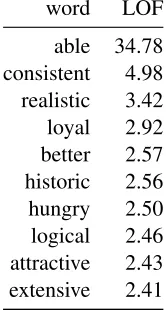
cor-rectly excluded from the final list for all feature sets. While we have no evaluation for the effective-ness of the anomaly detection, the words with the 10 highest LOF are shown in Table 3. Of these,able
and logical are identified by COBUILD as classi-fying adjectives. If we assume that the synonyms and antonyms given by COBOUILD could be scale-mates for these words, we find that onlyconsistent
andhistoric do not have scalemates in the dataset. This suggests that at least LOF is not a good esti-mate of words sharing a scale, and possibly anomaly detection in general.
5 Future Work
There are many areas for improvement. In the methodology, we feel that there is currently too much manual selection of the features. This includes both the selection of adverbs that apply to a wider range of adjectives as well as the ability to automat-ically group the adverbs into classes similar to those defined in section 2.1.
While using more semantically related feature sets revealed no large improvement, we still believe
1http://en.wikipedia.org/wiki/List_
of_adjectival_and_demonymic_forms_for_ countries_and_nations
word LOF able 34.78 consistent 4.98 realistic 3.42 loyal 2.92 better 2.57 historic 2.56 hungry 2.50 logical 2.46 attractive 2.43 extensive 2.41
Table 3: Top 10 Highest LOF
this could be a productive avenue of further work. One possible source of inspiration for this would be biclustering often used in biology. This works on the assumption that the underlying data has a checker-board pattern. The problem with this assumption is that this may actually separate the related adjectives and adverbs more. The idea of of grouping the ad-verbs and adjectives simultaneously is an attractive one however.
as well. Additionally, (Kanzaki et al., 2004) have exploited the relationship between abstract nouns and adjectives to build a hierarchy of adjectives in Japanese.
Another area of improvement is the need for a bet-ter evaluation. In addition to the issue of COBUILD using a narrower version of gradability than us, there is no resource to reliably check if the words pro-duced do in fact have scalemates. Work by (van Mil-tenburg, 2015) on finding pairs of scalemates used in scalar implicature is a possible solution but notes that their techniques also face evaluation issues.
The relationship between gradability, subjectivity and the lexical relationship we investigate in this pa-per needs to be further explored. While we do not believe they are the same, they may serve as re-sources for both the creation of our lexicon as well as evaluation.
Beyond the creation of the lexicon, it will have many potential uses once created. For linguists, it will provide new data on which to test theoretical models of scales, scale structures, and gradability. For the NLP community, it will serve as a resource in investigations into scalar implicature as well as the automatic ordering of adjectives.
6 Conclusion
In this paper we discuss a method to automatically build a lexicon of words that appear on a scale. Our clustering step achievedF1 scores between .78
and .82. While these are not as high as the those achieved by (Hatzivassiloglou and Wiebe, 2000), we have demonstrated that using an unsupervised method comes close to a supervised one. In addi-tion, we have pointed out many potential flaws with the current evaluation, and provided several future directions on which to further improve the lexicon.
References
Markus Breunig, Hans-Peter Kriegel, Raymond Ng, and J¨org Sander. 2000. LOF: Identifying density-based local outliers. SIGMOD Rec., 29(2):93–104, May. Marie-Catherine de Marneffe, Christopher D Manning,
and Christopher Potts. 2010. Was it good? it was provocative. learning the meaning of scalar adjectives. InProceedings of the 48th Annual Meeting of the Asso-ciation for Computational Linguistics, pages 167–176. Association for Computational Linguistics.
Gerard de Melo and Mohit Bansal. 2013. Good, great, excellent: Global inference of semantic intensities.
Transactions of the Association for Computational Linguistics, 1:279–290.
Guillaume Desagulier. 2014. Visualizing distances in a set of near-synonyms. Corpus Methods for Seman-tics: Quantitative studies in polysemy and synonymy, 43:145.
Georgiana Dinu, Nghia The Pham, and Marco Baroni. 2013. Dissect: Distributional semantics composition toolkit. InProceedings of the System Demonstrations of ACL 2013 (51st Annual Meeting of the Association for Computational Linguistics), East Stroudsburg PA. Association for Computational Linguistics.
Martha W Evens. 1980. Lexical-semantic relations : a comparative survey. Linguistic Research, Carbondale [Ill.].
Yoav Goldberg and Jon Orwant. 2013. A dataset of syntactic-ngrams over time from a very large corpus of english books. InSecond Joint Conference on Lexi-cal and Computational Semantics (* SEM), volume 1, pages 241–247.
Vasileios Hatzivassiloglou and Janyce Wiebe. 2000. Ef-fects of adjective orientation and gradability on sen-tence subjectivity. InProceedings of the 18th Confer-ence on Computational Linguistics, volume 1 of COL-ING ’00, pages 299–305, Stroudsburg, PA, USA. As-sociation for Computational Linguistics.
Julia Hirschberg. 1985. A theory of scalar implicature. Ph.D. thesis, University of Pennsylvania.
Kyoko Kanzaki, Eiko Yamamoto, Hitoshi Isahara, and Qing Ma. 2004. Construction of an objective hierar-chy of abstract concepts via directional similarity. In
Proceedings of the 20th international conference on Computational Linguistics, page 1147. Association for Computational Linguistics.
Chris Kennedy and Louise McNally. 2005. Scale struc-ture, degree modification, and the semantics of grad-able predicates.Language, 81(2):345–381.
Alessandro Lenci and Giulia Benotto. 2012. Iden-tifying hypernyms in distributional semantic spaces. In Proceedings of First Joint Conference on Lexical and Computational Semantics (*SEM), pages 75–79, Stroudsburg, PA, USA. Association for Computational Linguistics.
Marcin Morzycki. 2008. Adverbial modification in AP: Evaluatives and a little beyond. In Johannes D¨olling and Tatjana Heyde-Zybatow, editors,Event Structures in Linguistic Form and Interpretation, pages 103–126. Walter de Gruyter, Berlin.
Randolph Quirk, Sidney Greenbaum, Geoffrey Leech, and Jan Svartvik. 1985. A Comprehensive Grammar of the English Language (General Grammar). Long-man, 2nd revised edition edition.
Victor Raskin and Sergei Nirenburg. 1996. Adjecti-val modification in text meaning representation. In
Proceedings of the 16th conference on Computational Linguistics, volume 2, pages 842–847. Association for Computational Linguistics.
Josef Ruppenhofer, Michael Wiegand, and Jasper Bran-des. 2014. Comparing methods for deriving intensity scores for adjectives. InProceedings of the 14th Con-ference of the European Chapter of the Association for Computational Linguistics, pages 117–122. Associa-tion for ComputaAssocia-tional Linguistics.
Vera Sheinman, Christiane Fellbaum, Isaac Julien, Pe-ter Schulam, and Takenobu Tokunaga. 2013. Large, huge or gigantic? identifying and encoding intensity relations among adjectives in WordNet. Language Re-sources and Evaluation, 47(3):797–816, 1 September. Chaitanya Shivade, Marie-Catherine de Marneffe, Eric Folser-Lussier, and Albert Lai. 2015. Corpus-based discovery of semantic intensity scales. InIn Proceed-ings of NAACL-HTL 2015, Denver, CO. Association for Computational Linguistics.
John Sinclair, Patrick Hanks, Gwyneth Fox, Rosamund Moon, Penny Stock, et al. 1987. Collins COBUILD English language dictionary. Collins London. Emiel van Miltenburg. 2015. Detecting and ordering
adjectival scalemates. InMAPLEX, Yamagata, Japan. Bob van Tiel, Emiel van Miltenburg, Natalia Zevakhina,
and Bart Geurts. 2014. Scalar diversity. Journal of Semantics, 23 December.
Anna Verbuk. 2007. Acquisition of scalar implicatures. Ph.D. thesis, University of Massachusetts Amherst. Paul Westney. 1986. Notes on scales. Lingua,