
Improving Lexical Semantics for Sentential Semantics: Modeling Selectional
Preference and Similar Words in a Latent Variable Model
Weiwei Guo
Department of Computer Science Columbia University
Mona Diab
Department of Computer Science George Washington University
Abstract
Sentence Similarity [SS] computes a similar-ity score between two sentences. The SS task differs from document level semantics tasks in that it features the sparsity of words in a data unit, i.e. a sentence. Accordingly it is crucial to robustly model each word in a sen-tence to capture the complete semantic picture of the sentence. In this paper, we hypoth-esize that by better modeling lexical seman-tics we can obtain better sentential semanseman-tics. We incorporate both corpus-based (selectional preference information) and knowledge-based (similar words extracted in a dictionary) lex-ical semantics into a latent variable model. The experiments show state-of-the-art perfor-mance among unsupervised systems on two SS datasets.
1 Introduction
Sentence Similarity [SS] is emerging as a crucial step in many NLP tasks that focus on sentence level semantics such as word sense disambiguation (Guo and Diab, 2010; Guo and Diab, 2012a), summariza-tion (Zhou et al., 2006), text coherence (Lapata and Barzilay, 2005), tweet clustering (Sankaranarayanan et al., 2009; Jin et al., 2011), etc. SS operates in a very small context, on average 11 words per sen-tence in Semeval-2012 dataset (Agirre et al., 2012), resulting in inadequate evidence to generalize to ro-bust sentential semantics.
Weighted Textual Matrix Factorization [WTMF] (Guo and Diab, 2012b) is a latent variable model that outperforms Latent Semantic Analysis [LSA] (Deer-wester et al., 1990) and Latent Dirichelet Allocation [LDA] (Blei et al., 2003) models by a large margin in
the SS task, yielding state-of-the-art performance on the LI06 (Li et al., 2006) SS dataset. However, all of these models make harsh simplifying assumptions on how a token is generated: (1) in LSA/WTMF, a token is generated by the inner product of the word latent vector and the document latent vector; (2) in LDA, all the tokens in a document are sampled from the same document level topic distribution. Under this framework, they ignore rich linguistic phenom-ena such as inter-word dependency, semantic scope of words, etc. This is a result of simply using docu-ment IDs as features to represent a word.
Modeling quality lexical semantics in latent vari-able models does not draw enough attention in the community, since people usually apply dimension reduction techniques for documents, which have abundant words for extracting the document level semantics. However, in the SS setting, it is crucial to make good use of each word, given the limited num-ber of words in a sentence. We believe a reasonable word generation story will avoid introducing noise in sentential semantics, encouraging robust lexical semantics which can further boost the sentential se-mantics. In this paper, we explicitly encode lexical semantics, both corpus-based and knowledge-based information, in the WTMF model, by which we are able to achieve even better results in SS task.
The additional corpus-based information we ex-ploit is selectional preference semantics (Resnik, 1997), a feature already existing in the data yet ig-nored by most latent variable models. Selectional preference focuses on the admissible arguments for a word, thus capturing more nuanced semantics than the sentence IDs (when applied to a corpus of sen-tences as opposed to documents). Consider the fol-lowing example:
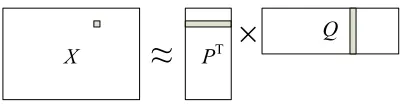
Figure 1:matrix factorization
Many analysts say the global Brent crude oil bench-mark price, currently around$111 a barrel ...
In WTMF/LSA/LDA, a word will receive semantics from all the other words in a sentence, hence, the wordoil, in the above example, will be assigned the incorrectfinancetopic that reflects the sentence level semantics. Moreover, the problem worsens for ad-jectives, adverbs and verbs, which have a much nar-rower semantic scope than the whole sentence. For example, the verbsayshould only be associated with
analyst(only receiving semantics fromanalyst), as it is not related to other words in the sentence. In contrast,oil, according to its selectional preference, should be associated with crude indicating the re-sourcetopic. We believe modeling selectional pref-erence capturing local evidence completes the se-mantic picture for words, hence further rendering better sentential semantics. To our best knowledge, this is the first work to model selectional preference for sentence/document semantics.
We also integrate knowledge-based semantics
in the WTMF framework. Knowledge-based
se-mantics, a human-annotated clean resource, is an important complement to corpus-based noisy co-occurrence information. We extract similar word pairs from Wordnet (Fellbaum, 1998). Leveraging these pairs, an infrequent word such as purchase
can exploit robust latent vectors from its synonyms such asbuy. Similar words pairs can be seamlessly modeled in WTMF, since in the matrix factorization framework a latent vector profile is explicitly created for each word, while in LDA all the data structures are designed for documents/sentences. We construct a graph to connect words according to the extracted similar word pairs, to encourage similar words to share similar latent vector profiles. We will refer to our proposed novel model as WTMF+PK.
2 Weighted Textual Matrix Factorization
Our previous work (Guo and Diab, 2012b) models the sentences in the weighted matrix factorization
framework (Figure 1). The corpus is stored in an
M×N matrixX, with each cell containing the TF-IDF values of words. The rows ofXareM distinct words and columns areN sentences. As in Figure
1, X is approximated by the product of a K ×M
matrixP and aK×N matrixQ. Accordingly, each sentence sj is represented by a K dimensional
la-tent vectorQ·,j. Similarly a wordwi is generalized
byP·,i. P andQis optimized by minimize the
ob-jective function:
X
i X
j
Wij(P·,i·Q·,j−Xij)2+λ||P||22+λ||Q|| 2 2
Wi,j=
1, ifXij6= 0
wm, ifXij= 0
(1)
whereλis a regularization term. Missing tokens are modeled by assigning a different weightwmfor each
0 cell in the matrixX. We can see the inner product of a word vector P·,i and a sentence vector Q·,j is
used to approximate the cellXij.
The graphical model of WTMF is illustrated in Figure 2a. Awi/sj node is a latent vectorP·,i/Q·,j,
corresponding to a word/sentence, respectively. A shaded node is a non-zero cell in X, representing an observed token in a sentence. For simplicity, the missing tokens and weights are not shown in the graph.
3 Corpus-based Semantics: Selectional Preference
In this paper, we focus on selectional preference that reflects the association of two words: if two words form a bigram, then the two words should share similar latent dimensions. In the previous example,
crudeandoilform a bigram, and they share the re-sourcetopic. In our framework, this is implemented by adding extra columns in X, so that each addi-tional column corresponds to a bigram, treating each bigram as apseudo-sentencefor the two words. The graphical model is illustrated in Figure 2b. There-fore,oilwill receive moreresourcetopic fromcrude
through the bigramcrude oil, instead of onlyfinance
topic from the sentence as a whole.
Each non-zero cell in the new columns ofX, i.e. an observed token in a bigram (pseudo-sentence), is given a different weight:
Wi,j=
1, ifXij6= 0and j is a sentence index
γ·f req(j), ifXij6= 0and j is a bigram index
w1 w2 w3 w4 w5
s1 s2
b2
(c)
b1
w1 w2 w3 w4 w5
s1 s2
(a) (b)
w1 w2 w3 w4 w5
s1 s2
b2
[image:3.612.92.532.56.154.2]b1
Figure 2: WTMF+PK model (WTMF + corpus-based Selectional [P]references semantics + [K]nowledge-based semantics): aw/s/bnode represents a word/sentence/bigram, respectively
f req(j) denotes the frequency of bigramj appear-ing in the corpus, hence the strength of association is differentiated such that higher weights are assigned on the more probable bigrams. The coefficientγ is the importance of selectional preference. A larger
γ indicates that we trust the selectional preference over the global sentential semantics.
4 Knowledge-based Semantics: Similar Word Pairs
We first extract synonym pairs from WordNet, which are words associated with the same sense, synset. We further expand the set by exploiting the relations defined in WordNet. For the extracted words, we consider the first sense of each word, and if it is con-nected to other senses by any of the WordNet defined relations (hypernym, similar words, etc.), then we treat the words associated with the other senses as similar words. In total, we are able to discover80K
pairs of similar words for the46Kdistinct words in our corpus.
Given a pair of similar words wi1/wi2, we want the two corresponding latent vectorsP·,i1/P·,i2to be as close as possible, namely the cosine similarity to be close to 1. Accordingly, a term is added in equa-tion 1 for each similar word pairwi1/wi2:
δ·(P·,i1·P·,i2− |P·,i1||P·,i2|)
2
(2)
|P·,i|denotes the length of the vectorP·,i. The
co-efficient δ, analogous toγ, denotes the importance of the knowledge-based evidence. The Figure 2c shows the final WTMF+PK model.
5 Inference
In (Guo and Diab, 2012b) we use Alternating Least Square [ALS] for inference, which is to set the
derivative of equation 1 for P/Q to 0 and iteratively compute P/Q by fixing the other matrix (Srebro and Jaakkola, 2003). However, it is no longer applicable with the new term (equation 2) involving the length of word vectors|P·,i|. Therefore we approximate the
objective function by treating the vector length|P·,i|
as fixed values during the ALS iterations:
Q·,j =
PW˜(j)P>+λI
−1
PW˜(j)X·,j
P·,i=
QW˜(i)Q>+λI+δP·,s(i)P
> ·,s(i)
−1
QW˜(i)Xi,·>+δLiP·,s(i)Ls(i)
(3)
whereP·,s(i) are the latent vectors of similar words
of wordi; the length of these vectors in the current iteration are stored inLs(i) (similarlyLi is the
cur-rent length ofP·,i) (cf. (Steck, 2010; Guo and Diab,
2012b) for optimization details).
6 Experimental Setting
We build the model WTMF+PK on the same
cor-poraas used in our previous work (Guo and Diab, 2012b), comprising the following: Brown corpus (each sentence is treated as a document), sense def-initions from Wiktionary and Wordnet (only defini-tions without target words and usage examples). We follow the preprocessing steps in (Guo and Diab, 2012c): tokenization, pos-tagging, lemmatization and further merge lemmas. The corpus is used for building matrixX.
The evaluation datasets are LI06 dataset and
Semeval-2012 STS [STS12] (Agirre et al., 2012) dataset. LI06 consists of 30 sentence pairs (dic-tionary definitions). For STS12,1 the training data (2000 pairs) are used as the tuning set for setting the
1A detailed description of the data sets is provided in (Agirre
parameters of our models. This data comprises msr-par, msr-vid, smt-eur. Once the models are tuned, we evaluate them on the STS12 test data that com-prises 3150 sentence pairs from msr-par, msr-vid, smt-eur, smt-news, On-WN. It is worth noting that smt-news and On-WN are not part of the tuning data. We use cosine similarity to measure the similarity scores between two sentences. Pearson correlation between the system’s answer and gold standard sim-ilarity scores is used as the evaluation metric.
We include three baselines LSA, LDA and
WTMF using the setting described in (Guo and Diab, 2012b). We run Gibbs Sampling based LDA for 2000 iterations and average the model over the last 10 iterations. For WTMF, we run 20 iterations and fix the missing words weight atwm= 0.01with
a regularization coefficient set at λ = 20, which is the best condition found in (Guo and Diab, 2012b).
7 Experiments
Table 1 summarizes the results at dimension K = 100 (the dimension of latent vectors). To remove randomness, each reported number is the averaged results of 10 runs. Based on the STS tuning set, we experiment with different values for the selec-tional preference weight (γ = {0,1,2}), and like-wise for the similar word pairs weight varying theδ
value as followsδ={0,0.1,0.3,0.5,0.7}. The per-formance on STS12 tuning and test dataset as well as on the LI06 dataset are illustrated in Figures 3a, 3b and 3d. The parameters of model 6 in Table 1
(γ = 2, δ = 0.3) are the chosen values based on
tuning set performance.
7.1 Evaluation on the STS12 datasets
Table 1 shows WTMF is already a very strong base-line: it outperforms LSA and LDA by a large mar-gin. Same as in (Guo and Diab, 2012b), LSA per-formance degrades dramatically when trained on a corpus of sentence sized documents, yielding results worse than the surface words baseline31%(Agirre et al., 2012). Using corpus-based selectional
prefer-ence semanticsalone (model 4 WTMF+P in Table
1) boosts the performance of WTMF by+1.17%on the test set, while using knowledge-based semantics
alone (model 5 WTMF+K) improves the over the
WTMF results by an absolute+2.31%. Combining
them (model 6 WTMF+PK) yields the best results, with an absolute increase of +3.39%, which sug-gests that the two sources of semantic evidence are useful, but more importantly, they are complemen-tary for each other.
Table 1 also presents the performance on each in-dividual dataset. The gain on each inin-dividual source is not as much as the overall gain, which suggests part of the overall gain comes from the correct rank-ing of intra-source pairs. Note that WTMF+PK im-proves all individual datasets except smt-eur. This may be caused by too many overlapping words in the sentence pairs in smt-eur, while our approach focuses on extracting similarity between different words.
Observing the performance using different values of weights in figure 3a and 3b, we can conclude that the selectional preference and similar word pairs yield very promising results. The trends hold in different parameter conditions with a consistent im-provement. Figure 3c illustrates the impact of di-mension K = {50,75,100,125,150} on WTMF
and WTMF+PK. Generally a larger K leads to a
higher Pearson correlation, but the improvement is tiny whenK≥100(0.1%increase).
Compared to all the unsupervised systems that participated in Semeval STS 2012 task, WTMF+PK yields state-of-the-art performance (70.70%).2 In
(Guo and Diab, 2012c) we also apply WTMF (K=
100) on STS12, achieving a correlation of 69.5%.
However, additional data is incorporated in the train-ing corpora: (1) STS12 tuntrain-ing set; (2) for WordNet and Wiktionary data, the target words are also in-cluded in the definitions (hence synonym pairs were used); (3) the usage examples of target words were also appended to the definitions.3While trained with this experimental setting, our model WTMF+PK
(γ = 2, δ = 0.3, K = 100) is able to reach an even
higher correlation of72.0%.
2
WTMF+PK is an unsupervised system, since the gold stan-dard similarly scores are never used in the objective function. Moreover, even without a tuning set, a non-zero value ofγorδ will always improve the baseline WTMF according to figure 3a and 3b.
3We do not adopt this corpora schema, since some
Models Parameters STS12 tune STS12 test msr-par msr-vid On-WN smt-eur smt-news LI06
1. LSA - 21.67% 24.41% 27.18% 9.91% 50.93% 27.86% 19.73% 63.77%
2. LDA α= 0.05, β= 0.05 71.10% 63.18% 29.15% 76.73% 62.81% 47.81% 27.2% 83.71%
3. WTMF - 71.41% 67.31% 44.00% 82.59% 70.78% 50.89% 37.77% 89.81%
4. WTMF+P γ= 2, δ= 0 72.94% 68.48% 46.21% 83.29% 70.61% 49.54% 39.50% 90.16%
5. WTMF+K γ= 0, δ= 0.3 73.84% 69.64% 45.04% 83.04% 70.40% 49.88% 41.66% 90.11%
[image:5.612.70.567.57.128.2]6. WTMF+PK γ= 2, δ= 0.3 75.29% 70.70% 46.77% 83.90% 71.03% 49.77% 40.48% 90.17%
Table 1: Evaluation Results using Pearson Correlation on STS12 and LI06
0 0.1 0.3 0.5 0.7
71 72 73 74 75
correlation%
δ
γ=0
γ=1
γ=2
(a)STS12 tuning set (K= 100)
0 0.1 0.3 0.5 0.7
67 68 69 70 71
δ
γ=0
γ=1
γ=2
(b)STS12 test set (K= 100)
50 75 100 125 150 66
67 68 69 70 71
K WTMF WTMF+PK, γ=2, δ=0.3
(c) STS12 test set
0 0.1 0.3 0.5 0.7 89.5
90 90.5 91
δ
γ=0
γ=1
γ=2
[image:5.612.88.526.172.277.2](d)LI06 (K= 100)
Figure 3: Pearson correlation at different parameter settings
7.2 Evaluation on the LI06 dataset
Figure 3d presents the results obtained on the LI06 data set at different weight values for the corpus-based selectional preference semanticsγ and for the knowledge-based semanticsδ. Our previous exper-iments (Guo and Diab, 2012b) show that WTMF is the state-of-the-art model on LI06. With lexi-cal semantics explicitly modeled, WTMF+PK yields better results than WTMF (see Table 1). It should be noted that LI06 prefers a smaller similar word pair weight ( a δ = 0.1 yields the best perfor-mance around of 90.75%), yet in almost all condi-tions WTMF+PK outperforms WTMF as shown in Figure 3d.
8 Related Work
SS has progressed immensely in recent years, espe-cially with the establishment of the Semantic Tex-tual Similarity task in SEMEVAL 2012. Early work in SS focused on word pair similarity in the high di-mensional space (Li et al., 2006; Liu et al., 2007; Islam and Inkpen, 2008; Tsatsaronis et al., 2010; Ho et al., 2010), where co-occurrence information was not efficiently exploited. Researchers (O’Shea et al., 2008) find LSA does not yield good performance. In (Guo and Diab, 2012b; Guo and Diab, 2012c), we show the superiority of the latent space approach in WTMF. In this paper, we improve the WTMF model
and achieve state-of-the-art Pearson correlation on two standard SS datasets.
There are latent variable models designed for lex-ical semantics, such as word senses (Boyd-Graber et al., 2007; Guo and Diab, 2011), function words (Griffiths et al., 2005), selectional preference (Ritter et al., 2010), synonyms and antonyms (Yih et al., 2012), etc. However little improvement is shown on document/sentence level semantics: (Ritter et al., 2010) and (Yih et al., 2012) focus on selectional preference and antonym identification, respectively; in (Griffiths et al., 2005) the LDA performance de-grades in the text categorization task including the modeling of function words. Rather, we concentrate on nuanced lexical semantics phenomena that could benefit sentential semantics.
9 Conclusion
We incorporate corpus-based (selectional prefer-ence) and knowledge-based (similar word pairs) lex-ical semantics into a latent variable model. Our system yields state-of-the-art unsupervised perfor-mance on two most popular and standard SS datasets.
10 Acknowledgment
References
Eneko Agirre, Daniel Cer, Mona Diab, and Aitor Gonzalez-Agirre. 2012. Semeval-2012 task 6: A pilot on semantic textual similarity. In First Joint Conference on Lexical and Computational Semantics (*SEM).
David M. Blei, Andrew Y. Ng, and Michael I. Jordan. 2003. Latent dirichlet allocation. Journal of Machine Learning Research, 3.
Jordan Boyd-Graber, David Blei, and Xiaojin Zhu. 2007. A topic model for word sense disambiguation. In Pro-ceedings of the 2007 Joint Conference on Empirical Methods in Natural Language Processing and Com-putational Natural Language Learning.
Scott Deerwester, Susan T Dumais, George W Furnas, Thomas K Landauer, and Richard Harshman. 1990. Indexing by latent semantic analysis. Journal of the American Society for Information Science.
Christiane Fellbaum. 1998. WordNet: An Electronic Lexical Database. MIT Press.
Thomas L. Griffiths, Mark Steyvers, David M. Blei, and Joshua B. Tenenbaum. 2005. Integrating topics and syntax. InAdvances in Neural Information Processing Systems.
Weiwei Guo and Mona Diab. 2010. Combining orthogo-nal monolingual and multilingual sources of evidence for all words wsd. InProceedings of the 48th Annual Meeting of the Association for Computational Linguis-tics.
Weiwei Guo and Mona Diab. 2011. Semantic topic mod-els: Combining word distributional statistics and dic-tionary definitions. InProceedings of the 2011 Con-ference on Empirical Methods in Natural Language Processing.
Weiwei Guo and Mona Diab. 2012a. Learning the latent semantics of a concept by its definition. In Proceed-ings of the 50th Annual Meeting of the Association for Computational Linguistics.
Weiwei Guo and Mona Diab. 2012b. Modeling sen-tences in the latent space. InProceedings of the 50th Annual Meeting of the Association for Computational Linguistics.
Weiwei Guo and Mona Diab. 2012c. Weiwei: A simple unsupervised latent semantics based approach for sen-tence similarity. InFirst Joint Conference on Lexical and Computational Semantics (*SEM).
Chukfong Ho, Masrah Azrifah Azmi Murad, Rabiah Ab-dul Kadir, and Shyamala C. Doraisamy. 2010. Word sense disambiguation-based sentence similarity. In
Proceedings of the 23rd International Conference on Computational Linguistics.
Aminul Islam and Diana Inkpen. 2008. Semantic text similarity using corpus-based word similarity and
string similarity. ACM Transactions on Knowledge Discovery from Data, 2.
Ou Jin, Nathan N. Liu, Kai Zhao, Yong Yu, and Qiang Yang. 2011. Transferring topical knowledge from auxiliary long texts for short text clustering. In Pro-ceedings of the 20th ACM international conference on Information and knowledge management.
Mirella Lapata and Regina Barzilay. 2005. Automatic evaluation of text coherence: Models and representa-tions. InProceedings of the 19th International Joint Conference on Artificial Intelligence.
Yuhua Li, Davi d McLean, Zuhair A. Bandar, James D. O’Shea, and Keeley Crockett. 2006. Sentence similar-ity based on semantic nets and corpus statistics. IEEE Transaction on Knowledge and Data Engineering, 18. Xiao-Ying Liu, Yi-Ming Zhou, and Ruo-Shi Zheng. 2007. Sentence similarity based on dynamic time warping. InThe International Conference on Seman-tic Computing.
James O’Shea, Zuhair Bandar, Keeley Crockett, and David McLean. 2008. A comparative study of two short text semantic similarity measures. In Proceed-ings of the Agent and Multi-Agent Systems: Technolo-gies and Applications, Second KES International Sym-posium (KES-AMSTA).
Philip Resnik. 1997. Selectional preference and sense disambiguation. InProceedings of the ACL SIGLEX Workshop on Tagging Text with Lexical Semantics: Why, What, and How?
Alan Ritter, Mausam, and Oren Etzioni. 2010. A latent dirichlet allocation method for selectional preferences. InProceedings of the 48th Annual Meeting of the As-sociation for Computational Linguistics.
Jagan Sankaranarayanan, Hanan Samet, Benjamin E. Teitler, Michael D. Lieberman, and Jon Sperling. 2009. Twitterstand: news in tweets. InProceedings of the 17th ACM SIGSPATIAL International Conference on Advances in Geographic Information Systems. Nathan Srebro and Tommi Jaakkola. 2003. Weighted
low-rank approximations. InProceedings of the Twen-tieth International Conference on Machine Learning. Harald Steck. 2010. Training and testing of
recom-mender systems on data missing not at random. In
Proceedings of the 16th ACM SIGKDD International Conference on Knowledge Discovery and Data Min-ing.
George Tsatsaronis, Iraklis Varlamis, and Michalis Vazir-giannis. 2010. Text relatedness based on a word the-saurus.Journal of Articial Intelligence Research, 37. Wentau Yih, Geoffrey Zweig, and John C. Platt. 2012.
![Figure 2: WTMF+PK model (WTMF + corpus-based Selectional [P]references semantics + [K]nowledge-basedsemantics): a w /sb / node represents a word/sentence/bigram, respectively](https://thumb-us.123doks.com/thumbv2/123dok_us/1408289.676184/3.612.92.532.56.154/selectional-references-semantics-nowledge-basedsemantics-represents-sentence-respectively.webp)
