Processing Spontaneous Orthography
Ramy Eskander, Nizar Habash, Owen Rambow, and Nadi Tomeh Center for Computational Learning Systems
Columbia University
{reskander,habash,rambow,nadi}@ccls.columbia.edu
Abstract
In cases in which there is no standard or-thography for a language or language vari-ant, written texts will display a variety of or-thographic choices. This is problematic for natural language processing (NLP) because it creates spurious data sparseness. We study the transformation of spontaneously spelled Egyptian Arabic into a conventionalized or-thography which we have previously proposed for NLP purposes. We show that a two-stage process can reduce divergences from this stan-dard by 69%, making subsequent processing of Egyptian Arabic easier.
1 Introduction
In areas with diglossia, vernacular spoken variants (“low”) of a language family co-exist with a largely written variant (“high”), which is often not spoken as a native language. Traditionally, the low variants have not been written: written language is reserved for formal occasions and in those formal occasions only the high variant is used. Prototypical exam-ples of diglossia are the German speaking parts of Switzerland, and the Arab world. The advent of the internet has changed linguistic behavior: it is now common to find written informal conversations, in the form of email exchanges, text messages, Twit-ter exchanges, and inTwit-teractions on blogs and in web forums. These written conversations are typically written in the low variants (or in a mixture of low and high), since conversations in the high variant seem unnatural to the discourse participants. For natural language processing (NLP), this poses many chal-lenges, one of which is the fact that the low vari-ants have not been written much in the past and
do not have a standard orthography which is gen-erally agreed on by the linguistic community (and perhaps sanctioned by an authoritative institution). Instead, each discourse participant devises a spon-taneous orthography, in which she chooses among conventions from the high variant to render the spo-ken language. We are thus faced with a large number of ways to spell the same word, none of which can be assumed as “standard” since there is no standard. As a result, the increased data sparseness adds to the challenges of NLP tasks such as machine transla-tion, compared to languages for which orthography is standardized.
In this paper, we work on Egyptian Arabic (EGY). We follow the conventions which we have previously proposed for the normalized orthogra-phy for EGY (Habash et al., 2012), called CODA (Conventional Orthography for Dialectal Arabic). In this paper, we investigate how easy it is to con-vert spontaneous orthography of EGY written in Arabic script into CODA orthography automatically. We will refer to this process as “normalization” or “codafication”. We present a freely available system called CODAFY, which we propose as a preproces-sor for NLP modules for EGY. We show that a “do nothing” baseline achieves a normalization perfor-mance of 75.5%, and CODAFYachieves a normal-ization performance of 92.4%, an error reduction of 69.2% over this baseline on an unseen test set.
The paper is structured as follows. We first re-view relevant linguistic facts in Section 2 and then present the conventionalized orthography we use in this paper. After reviewing related work in Sec-tion 4, we present our data (SecSec-tion 5), our approach (Section 6), and our results (Section 7). We conclude
with a discussion of future work.
2 Linguistic Facts
2.1 Writing without a Standard Orthography
Anorthographyis a specification of how the words of a language are mapped to and from a particular script (in our case, the Arabic script). In cases when a standard orthography is absent, writers make deci-sions about spontaneous orthography based on vari-ous criteria. Most prominent among them is phonol-ogy: how can my pronunciation of the word be rendered in the chosen writing system, given some (language-specific) assumptions about grapheme-to-phoneme mapping? Often, these assumptions come from the “high” variant of the language, or some re-lated language. Another criterion for choosing or-thography is a cognate in a related language or lan-guage variant (Modern Standard Arabic or MSA, the high variant for EGY), where a cognate pair is a pair of words (or morphemes) in two languages or language variants which are related by etymol-ogy(in some unspecified manner) and which have roughly the same meaning. Finally, the chosen spontaneous orthography can be altered to reflect
speech effects, notably the lengthening of syllables to represent emphasis or other effects (such as
QJJJ»
ktyyyyr1‘very’).
It is important to distinguish typos from sponta-neous orthography. We definespontaneous orthog-raphyto be an intentional choice of graphemes to render the words in a language or language variant. We define atypographical error (typo)to be an un-intended sequence of graphemes. For example,
@Y»
kdAand
èY»
kdhcan be intended spellings for EGY/kida/ ‘like this’, while
@Q»
krAis not a plausible in-tentional spelling since it neither relates /kida/ to an MSA cognate, nor does the sequence of graphemes represent the phonology of EGY using standard as-sumptions. Instead, we can explain the spelling by assuming that the writer accidentally substituted the graphemeP
for the graphemeX
, which look some-what alike and are near each other on some Arabic keyboard layouts. Of course, when we encounter1
Arabic transliteration is presented in the Habash-Soudi-Buckwalter scheme (Habash et al., 2007): (in alphabetical or-der)AbtθjHxdðrzsšSDT ˇDςγfqklmnhwyand the additional sym-bols: ’
Z
, Â@
, ˇA@
, ¯A@
, ˆwð'
, ˆyZø'
,¯hè
, ýø
.a specific spelling in a corpus, it can be, in certain cases, difficult to determine whether it is a conscious choice or a typo.
2.2 Relevant Differences betweenEGYand
MSA
Lexical VariationsLexically, the number of differ-ences is quite significant. For example, EGY
H@QÓ
mrAt‘wife [of]’ corresponds to MSA
ék.ð P
zwj¯h. In such cases of lexical difference, no cognate spelling is available.Phonological Variations There is an extensive literature on the phonology of Arabic dialects (Wat-son, 2002; Holes, 2004; Habash, 2010). Several phonological differences exist between EGY and MSA which relate to orthography. Here, we dis-cuss one representative difference. The MSA con-sonant
H
/θ/ is pronounced as /t/ in EGY (or /s/ in more recent borrowings from MSA). For exam-ple, MSAQºK
ykθr‘increase (imperfective)’ is pro-nounced /yakθur/ in MSA versus /yiktar/ in EGY, giving rise to the EGY phonological spellingQºK
yktr.
Morphological Variations There are a lot of morphological differences between MSA and EGY. For orthography, two differences are most relevant. The MSA future proclitic /sa/+ (spelled +
s+) pears in EGY as /ha/+ or /Ha/+. The two forms ap-pear in free variation, and we have not been able to find a variable that predicts which form is used when. This variation is not a general phonological variation between /h/ and /H/, we find it only in this morpheme. Predictably, this leads to two spellings in EGY: +h
H+ and +ë
h+. Negation in EGY is realized as the circum-clitic /m¯a/+ . . . +/š/. The prin-cipal orthographic question is whether the prefix is a separate word or is part of the main word; both variants are found.3 CODA
CODA is a conventionalized orthography for Arabic dialects (Habash et al., 2012). In this section, we summarize CODA so that the reader can understand the goals of this paper. CODA has five key proper-ties.
single orthographic rendering.
2. CODA is created for computational purposes.
3. CODA uses the Arabic script as used for MSA, with no extra symbols from, for example, Per-sian or Urdu.
4. CODA is intended as a unified framework for writing all dialects. In this paper, we only dis-cuss the instantiation of CODA for EGY.
5. CODA aims to maintain a level of dialectal uniqueness while using conventions based on similarities between MSA and the dialects. We list some features of CODA relevant to this paper.
Phonological Spelling CODA generally uses phonological spelling for EGY (as MSA spelling does for MSA).
Etymologically Spelled Consonants A limited number of consonants may be spelled differently from their phonology if the following two conditions are met: (1) the consonant must be an EGY root radical and (2) the EGY root must have a cognate MSA root. If the conditions are met, then we spell the consonant using the corresponding radical from the cognate MSA root of the dialectal word’s root. One such example is the spelling of the EGY verb pronounced /kitir/ as
Q»
kθr‘ it increased’.Morphologically Faithful CODA preserves di-alectal morphology and spells the didi-alectal mor-phemes (clitics and inflections) phonologically. For example, for the attachable future marker clitic, the variant +
h
is chosen, not the MSA +
, so that EGY /Hatiktar/ (and its variant /hatiktar/) are both spelledQºJk
Htkθr. The negation prefix and indi-rect object pronoun (l+pronoun) suffixes are sepa-rated, e.g.,AêË
IÊ
¯ AÓ
mA qlt lhAš/ma’ultilh¯aš/ ‘I did not tell her’.Alif-Maqsura The letter
ø
ý is often used in Egypt to write word-finalø
yandvice versa(even when writing MSA). In CODA, all rules for us-ing Alif-Maqsura are the same as MSA. For exam-ple, EGY /maSr¯ı/ ‘Egyptian’ can be seen in sponta-neous orthography asøQåÓ
mSrý, but in CODA it isøQåÓ
mSry.Ta-MarbutaAs in MSA, the Ta-Marbuta (
è
¯h) is used morphemically in CODA. The Ta-Marbuta isalways written as
è
¯hin CODA, e.g., /’arbaςa/ ‘four’is
éªK.P
@
Ârbς¯h in CODA, though it can be found aséªK.P
@
Ârbςh(oréªK.P@
Arbςh) in spontaneous orthog-raphy.Lexical Exceptions EGY CODA guidelines in-clude a word list specifying ad hoc spellings of EGY words that may be inconsistent with the default map-ping outlined above. An example is /kida/ ‘like this’, which we find as both
@Y»
kdAandèY»
kdhin spon-taneous orthography; the CODA spelling isèY»
kdh.4 Related Work
To our knowledge, this paper is the first to discuss the task of automatically providing a conventional-ized spelling for a written Arabic dialect text. While there is no direct precedent, we discuss here some related research.
Our proposed work has some similarity to auto-matic spelling correction(ASC) and related tasks such as post editing for optical character recogni-tion (OCR). Our task is different from ASC since ASC work assumes a standard orthography that the writer is also assumed to aim for. Both supervised and unsupervised approaches to this task have been explored. Unsupervised approaches rely on improv-ing the fluency of the text and reducimprov-ing the percent-age of out-of-vocabulary words using NLP tools, re-sources, and heuristics, e.g., morphological analyz-ers, language models, and edit-distance measure, re-spectively (Kukich, 1992; Oflazer, 1996; Ben Oth-mane Zribi and Ben Ahmed, 2003; Shaalan et al., 2003; Haddad and Yaseen, 2007; Hassan et al., 2008; Shaalan et al., 2010; Alkanhal et al., 2012). Supervised approaches learn models of correction by training on paired examples of errors and their corrections. This data is hard to come by nat-urally, though for applications such as OCR cor-pora can be created from the application itself (Ko-lak and Resnik, 2002; Magdy and Darwish, 2006; Abuhakema et al., 2008; Habash and Roth, 2011).
(2010) and Salloum and Habash (2011) showed that translating dialectal Arabic to MSA can im-prove dialectal Arabic machine translation into En-glish by pivoting on MSA. A common feature across these conversion efforts is the use of morphological analysis and morphosyntactic transformation rules (for example, Al-Gaphari and Al-Yadoumi (2010)). While all this work is similar to ours in that dialec-tal input is processed, our output is still dialecdialec-tal, while the work on conversion aims for a transforma-tion into MSA.
The work most closely related to ours is that of Dasigi and Diab (2011). They identify the spelling variants in a given document and normalize them. However, they do not present a system that con-verts spontaneous spelling to a pre-existing conven-tion such as CODA, and thus their results cannot be directly related to ours. Furthermore, their tech-nique is different. First, similarity metrics based on string difference are used to identify if two strings are similar. Also, a contextual string similarity is used based on the fact that if two words are ortho-graphic variants of each other, then they are bound to appear in similar contexts. After identifying the similar strings, the strings of interest are modeled in a vector space and clustered according to the simi-larity of their vectors.
5 Data
In this work, we use a manually annotated EGY Arabic corpus, developed by the Linguis-tic Data Consortium (LDC), and labeled as “ARZ” (Maamouri et al., 2012), parts 1, 2, 3, 4 and 5. The corpus consists of about 160K words (excluding numbers and punctuations), and follows the part-of-speech (POS) guidelines used by the LDC for Egyp-tian Arabic. The corpus contains a full analysis of Egyptian Arabic text in spontaneous orthography. The analysis includes the correct CODA orthogra-phy of the raw text, in addition to the full morpho-logical/POS annotations.
Data Preparation We divide the ARZ corpus into three parts: training, development and test, which are of about 122K, 19K and 19K words, respec-tively. We only consider the orthographic informa-tion in the ARZ corpus: for every word in the cor-pus, we retain the spontaneous orthographic form
and its CODA-compliant form.
We manually checked the CODA-compliant an-notations for about 500 words in the development corpus. We found that the accuracy of the gold an-notations in this subset is about 93%. We performed next an error analysis for the erroneous gold annota-tions. About one half of the gold errors are CODA phonological and orthographical errors. Examples of the CODA phonological errors include wrong ad-ditions and deletions of
@
Aandø
y, in addition tothe
H
/H
t/θ transformations, and the transforma-tions that correspond to the different phonological forms of pronouncing the letterè
h. The CODA thographical errors are those errors where a word or-thography looks the same as its pronunciation, while it should not be, such as theè
/è
h/¯htransformations. One fifth of the gold errors are annotation typos, such as writingH@Pñ¢
¯
qTwrAt instead ofH@PA¢
¯
qTArAt‘trains’. Moreover, 9% of the gold errors are wrong merges for the negation particle
AÓ
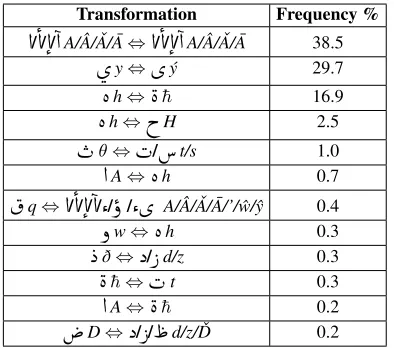
mA and the indirect object pronouns (l+pronouns). Since we use the gold in our study, and given the error analy-sis for the gold, we expect a qualitatively better gold standard to yield better results.Transformation Statistics We observe two types of transformations when converting from sponta-neous orthography to CODA: character substitu-tions that do not affect the word length, and charac-ter additions/deletions that change the word length. Tables 1 and 2 show the most common character substitution and addition/deletion transformations, respectively, as they appear in the training corpus, associated with their frequencies relative to the oc-currence of transformations. The character sub-stitutions are dominant, and constitute about 84% of all the transformations in the training corpus. While the classification of the character substitu-tions is automatically generated, the classification of the character additions/deletions is done manually using a random sample of 400 additions/deletions in the training corpus. This is because many addi-tions/deletions are ambiguous.
6 Approach
contex-Transformation Frequency %
@
/@
/@
/@
A/Â/ ˇA/ ¯A⇔@
/@
/@
/@
A/Â/ ˇA/ ¯A 38.5ø
y⇔ø
ý 29.7è
h⇔è
¯h 16.9è
h⇔h
H 2.5H
θ⇔H
/
t/s 1.0@
A⇔è
h 0.7
q⇔@
/@
/@
/@
/Z
/ð'
/Zø'
A/Â/ ˇA/ ¯A/’/ ˆw/ˆy 0.4ð
w⇔è
h 0.3X
ð⇔X
/P
d/z 0.3 [image:5.612.88.285.56.230.2]è
¯h⇔H
t 0.3@
A⇔è
¯h 0.2
D⇔X
/P
/d/z/ ˇD 0.2
Table 1: Spontaneous to CODA character substitu-tion transformasubstitu-tions
Transformation Frequency % Errors in closed class words 22.0 Missing space after
AÓ
/B
/AK
mA/lA/yA 19.0@
Aadditions & deletions 16.8Gold errors 10.3
Speech effects 8.5
Missing space before
È
l(+pron) 8.5ð
/è
/@ð
w/h/wA⇔ð
/è
/@ð
w/h/wA 8.3ø
yadditions & deletions 3.0Table 2: Spontaneous to CODA character addi-tion/deletion transformations
tual and non-contextual, where the non-contextual approaches are a lot faster than the contextual ones.
6.1 Speech Effect Handling
Before applying any codafication techniques, we perform a special preprocessing step for speech ef-fects, which represent redundant repetitions of some letter in sequence. Sometimes people intend these repetitions to show affirmation or intensification. This is simply handled by removing the repetitions when a letter is repeated more than twice in a row, except for some letters whose repetitions for more than once indicates a speech effect; these letters are
@
A,@
A¯,Z
’,Zø'
ˆy,ø
ý andè
¯h. Handling speech effects on its own corrects about 2% of the non-CODA spontaneous orthography to its CODA-compliant form, without introducing any new errors. In all experiments we report in this paper, we have initially processed speech effects.6.2 Character Edit Classification (CEC)
In this approach, a set of transformations is applied on a character level, where a character may receive a change or not. As a result, a word changes if one or more of its characters is changed. The output of these transformations is what constitutes the CODA orthography. This is a surface modeling technique that does not depend on the word context (though it does depend on character context inside the word).
First, we train classifiers for the most frequent transformations from EGY spontaneous orthogra-phy to the corresponding CODA, listed in Tables 1 and 2 in Section 5. Second, we apply the trained classifiers to generate the CODA output.
Training the classifiers For each transformation listed in the data section, we train a separate classi-fier. The classifiers are trained on our training cor-pus using the k-nearest neighbor algorithm (k-NN) (Wang et al., 2000), which is a method for classi-fying objects based on the closest training examples in the feature space. We did experiments using the other classification methods included in the WEKA machine learning tool (Hall et al., 2009), including SVMs, Naïve Bayes, and decision trees. However, k-NN gives the best results for our problem.
In the training process, a set of nine static features is applied, which are the character that is queried for the transformation with its preceding and following two characters (a special token indicates a character position that does not exist because it is beyond the word boundary), along with the first two and the last two characters in the underlying word.
[image:5.612.81.288.278.389.2]1. The different
@
Aform (@
/@
/@
/@
A/Â / ˇA/ ¯A) classifier. The classifier can change any@
Aform into any other@
A form. The arbitrary selection of the different@
Aforms represents the most frequent divergence from CODA in Arabic spontaneous orthography.2. The
ø
/ø
y/ý classifier. The classifier handlestransformations between
ø
yandø
ý in both directions, as their selection is mostly arbitrary in EGY spontaneous orthography.3. The
è
/è
/ð
h/¯h/w classifier. The classifier han-dles transformations betweenè
h,è
¯handð
win both directions. These transformations are likely to happen at word endings, since they represent common misspellings in writing
è
h,è
¯handð
w, whereè
h is often substituted for the graphically similarè
¯h, andè
handð
wcan both be used to represent the 3rd person mascu-line singular accusative or genitive clitic. (Note that in Table 1, we list transformations betweenè
handè
¯has well as betweenè
handð
w; the remaining transformations are not frequent.)4. The
è
/h
h/H classifier. The transformationfrom
è
h toh
H is likely to happen at word beginnings, since it represents a common devi-ation in writing theh
Hfuture particle.5. The
@
Adeletion classifier. The classifier han-dles the deletion of extra@
Aat some positions, which is a common deviation in EGY sponta-neous orthography, where the CODA orthog-raphy requires only short vowels instead.6. The
@
Aaddition classifier. The classifier han-dles the addition of@
Ain some positions, where it is mostly omitted in EGY spontaneous or-thography, such as adding@
Aafter theh
Hfu-ture particle and the
H.
b progressive particle (when used with the 1st person singular imper-fective), as well as theð
w plural pronoun at word endings. When training this classifier, we target the letter after which the@
A should be added.7. The space addition classifier. The classifier handles the addition of spaces in the middle
of words, i.e., splitting a word into two words. This is required to add spaces after
AÓ
/B
/AK
mA/lA/yA for negation and vocation, and be-fore the indirect objectl+pronoun, so that the text becomes CODA-compliant.
Generating CODA Orthography Next, we ap-ply the trained classifiers on the spontaneous-orthography text. Each classifier determines a set of character corrections, where the characters may receive transformations corresponding to those on which the classifier is trained. The classifiers are independent of one another, so their order of appli-cation is irrelevant.
By way of example, we apply the classifiers on the word
éªK.P@
Arbςh, ‘four’. The first classifier, corre-sponding to the different@
A forms, determines thetransformation of
@
A to@
Â, while theè
/è
h/¯h clas-sifier determines the correction ofè
h toè
¯h. The other classifiers are either not involved since they do not work on any of the word characters, or they de-termine that no character transformation should hap-pen for this word. Thus applying the CEC tech-nique in this case changes the wordéªK.P@
ArbςhtoéªK.P
@
Ârbς¯h, which is the correct CODA form.6.3 Maximum Likelihood Estimate (MLE)
Another surface modeling approach for spontaneous orthography codafication is to use a maximum like-lihood model that operates on the word level. In this approach, we build a unigram model that replaces every word in the spontaneous orthography with its most likely CODA form as seen in the training data. This assumes that the underlying word exists in the training corpus. For unseen words, the technique keeps them with no change.
The MLE approach chooses the correct CODA form for most of the words seen in training, making this approach highly dependent on the training data. It is efficient at correcting common misspellings in frequent words, especially those that are from closed classes.
6.4 Morphological Tagger
In addition to the approaches discussed above, we use a morphological tagger, MADAARZ
Egyp-tian Arabic) (Habash et al., 2013). Although MADAARZ is originally developed to work as a
morphological tagger, it still can help the codafica-tion process, since the choice of a full morpholog-ical analysis for a word in context determines its CODA spelling. Therefore, MADAARZ is able to
correct many word misspellings that are common in spontaneous orthography. These corrections include
(
@
/@
/@
/@
A/Â/ ˇA/ ¯A),ø
/ø
y/ý andè
/è
h/¯h transforma-tions. However, MADAARZ, as a codaficationtech-nique, uses the context of the word, which makes it a contextual modeling approach unlike CEC and MLE. It is much slower than they are.
6.5 Combined Techniques
The CEC and MLE techniques can be applied alone, or they can be applied together in a pipeline in either order. This gives a total of four possible com-binations. Next, we conducted experiments with MADAARZ, running alone and as a pre- or
postpro-cessor for a combination of CEC and/or MLE. In all cases, when we first apply one module and then another on the output of the first, we train the sec-ond module on the training corpus which has been passed through the first module. The results of run-ning the different codafication approaches are dis-cussed next.
7 Evaluation
7.1 Accuracy Evaluation
The different codafication approaches, discussed in the previous section, are tested against the develop-ment set, which was not used as part of our train-ing. The evaluation metric we use is a word accuracy metric, i.e., we evaluate how well we can correctly predict the CODA form of the input spontaneous or-thography.
Table 3 lists the effects of using the different codafication approaches. For each approach, two numbers are reported; exact and normalized. In the exact evaluation, the output of the codafica-tion approach is exactly matched against the correct CODA orthography, while in the normalized eval-uation, the match is relaxed for the (
@
/@
/@
/@
A/Â/ ˇA/ ¯A) andø
/ø
y/ýalternations, i.e., these differences do not count as errors. In many NLP applications (suchas machine translation), the input is normalized for these two phenomena, so that the normalized evalu-ation gives a sense of the relevance of codaficevalu-ation to downstream processes which normalize.
In this evaluation we compare our different codafication techniques, CEC, MLE, CEC+MLE and MLE+CEC, against the baseline. We also show the effect of using MADAARZas a codafication
sys-tem. We see that MLE on its own outperforms CEC. Running CEC first and then MLE gives us our best result using surface techniques, namely 91.5%, for an error reduction of 63.4% against the baseline. This configuration also gives the highest normalized accuracy of 95.2%, for an error reduction of 49.5% against the baseline.
We now turn to deep modeling techniques. The performance of MADAARZ on its own as a
codafication system is close to the performance of CEC+MLE, by which it is outperformed in the exact-match accuracy by 0.4%.
The best deep modeling (and the best overall) performance is achieved when running MADAARZ
on top of MLE. This gives the highest accuracy of 92.6% (exact) and 95.8% (normalized), for er-ror reductions of 68.1% (exact) and 55.8% (nor-malized) against the baseline, respectively. Note that the non-contextual modeling techniques CEC (5,584 words/sec) and MLE (6,698 words/sec) are a lot faster than the deep modeling tech-nique MADAARZ (53 words/sec), while their
com-bination CEC+MLE+MADAARZ is the slowest
among all the approaches, operating at a rate of 52 words/sec. Thus, a small drop in accuracy results in a large increase in speed.
We also evaluated using MADAM SA (v 3.2)
(Morphological Analysis and Disambiguation for MSA) (Habash and Rambow, 2005; Habash et al., 2010). MADAM SAis able to do some codafication,
but it performs far worse than our codafication ap-proaches.
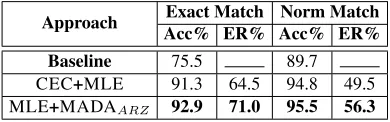
Table 4 lists the results of the best perform-ing codafication surface approach, CEC+MLE, and deep approach, MLE+MADAARZ, when applied
on the test set, which was not used as part of our training or development, i.e., a completely blind test. We see that on the test set, the addition of MADAARZ improves results relatively more as
Approach Exact Match Norm Match w/s Acc% ER% Acc% ER%
Baseline 76.8 90.5
MADAM SA 83.6 29.3 91.7 12.6 70
CEC 90.0 56.9 93.9 35.8 5,584 MLE 90.5 59.1 94.6 43.2 6,698 CEC+MLE 91.5 63.4 95.2 49.5 4,284 MLE+CEC 90.7 59.9 94.7 44.2 4,284 MADAARZ 91.1 61.6 95.2 49.5 53
MADAARZ+CEC 91.5 63.4 95.4 51.6 53
MADAARZ+MLE 91.9 65.1 95.8 55.8 53
CEC+MADAARZ 92.2 66.4 95.6 53.7 53
MLE+MADAARZ 92.6 68.1 95.8 55.8 53
MADAARZ+CEC+MLE 91.8 64.7 95.6 53.7 52
[image:8.612.162.452.55.270.2]CEC+MLE+MADAARZ 92.0 65.5 95.8 55.8 52
Table 3: Comparison of the performance of the different codafication approaches on the development corpus.
Accstands for Accuracy;ERis error reduction against the Baseline. w/s is speed (words/sec).
Approach Exact Match Norm Match Acc% ER% Acc% ER%
Baseline 75.5 89.7
CEC+MLE 91.3 64.5 94.8 49.5 MLE+MADAARZ 92.9 71.0 95.5 56.3
Table 4: Comparison of the performance of the different codafication approaches on the test cor-pus. Accstands for Accuracy;ERis error reduction against the Baseline.
7.2 Extrinsic Evaluation
Morphological Analysis We tested the effect of codafication on morphological tagging, specifically full POS and lemma determination in context by the morphological tagger MADAARZ. Here, we
are evaluating MADAARZ not on its conversion
to CODA (as above), but on its core functional-ity, namely morphological tagging. We compare the performance of MADAARZ against running
CEC+MLE+MADAARZ. When tested on the
de-velopment set, the initial CEC+MLE codafication step helps MADAARZ improve the identification
of the complete Arabic (Buckwalter) POS tag from 84% to 85.3%, for an error reduction of 8.1%, while the correct lemma choice increases from 85.2% to 85.7%, for an error reduction of 3.4%. When tested on the test set, we get improvements on the choice
of the complete Buckwalter POS tag and lemma from 84.5% to 85.4% (5.8% error reduction) and from 86.3% to 86.7% (2.9% error reduction), re-spectively.
Arabic to English MT The goal of this exper-iment is to test the effect of codafication on ma-chine translation from dialectal Arabic to English. We use the open-source Moses toolkit (Koehn et al., 2007) to build a phrase-based SMT system. We use MGIZA++ for word alignment (Gao and Vogel, 2008). Phrase translations of up to 8 words are ex-tracted in the phrase table. We use SRILM (Stol-cke, 2002) with modified Kneser-Ney smoothing to build two 4-gram language models. The first model is trained on the English side of the bitext, while the other is trained on the English Gigaword data. Feature weights are tuned to maximize BLEU (Pap-ineni et al., 2002) on a development set using MERT (Och, 2003). We perform case-insensitive evalua-tion in terms of the BLEU metric.
[image:8.612.88.283.327.388.2]12,116 untokenized Arabic words. Both develop-ment and test sets have two reference translations each. The English data is lower-cased and tokenized using simple punctuation-based rules.
We build two systems which vary in preprocess-ing of the Arabic text. The baseline system ap-plies only simple punctuation-based rules. The sec-ond system applies our codafication in addition to punctuation separation. The Arabic text is Alif/Ya normalized and is kept untokenized in both set-tings. The baseline system achieves a BLEU score of 22.1%. The system using codafication obtains a BLEU score of 22.6%, and outperforms the baseline by 0.5% absolute BLEU points. This result shows that improvements observed in intrinsic evaluation of codafication carry on to the extrinsic task of ma-chine translation.
7.3 Error Analysis
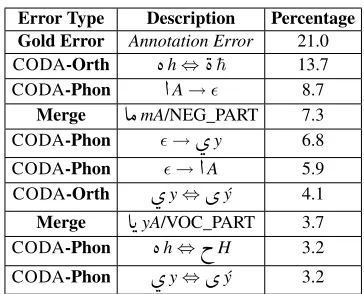
We conducted an error analysis for the best perform-ing codafication approach on the development set. The most frequent error types are listed in Table 5. About two thirds of the errors are CODA phonolog-ical and orthographphonolog-ical errors, denoted by CODA-Phon and CODA-Orth, respectively. The wrong ad-ditions and deletions of
@
Aandø
yand theH
/H
t/θtransformations are examples of CODA phonologi-cal errors. The CODA orthographic errors include cases such as the
ø
/ø
y/ýtransformations. 21% of the errors are not real errors in the codafication out-put, but result from gold errors. Finally, about 13% of the errors are wrong merges and splits for the the negation particleAÓ
mA, the vocative particleAK
yAand the indirect-objectl+pronouns.
8 Conclusion and Future Work
We have presented the problem of transforming spontaneous orthography of the Egyptian Arabic di-alect into a conventionalized form, CODA. Our best technique involves a combination of character trans-formations, whole-word transtrans-formations, and the use of a full morphological tagger. The tagger can be omitted for a small decrease in performance and a large increase in speed.2 In future work, we plan to extend our approach to other Arabic dialects. We
2Our system will be freely available. Please contact the
au-thors for more information.
Error Type Description Percentage Gold Error Annotation Error 21.0 CODA-Orth
è
h⇔è
¯h 13.7CODA-Phon
@
A→ 8.7Merge
AÓ
mA/NEG_PART 7.3CODA-Phon →
ø
y 6.8CODA-Phon →
@
A 5.9 [image:9.612.335.517.54.201.2]CODA-Orth
ø
y⇔ø
ý 4.1 MergeAK
yA/VOC_PART 3.7 CODA-Phonè
h⇔h
H 3.2 CODA-Phonø
y⇔ø
ý 3.2Table 5: System Error Analysis: the most frequent error types.
will also investigate incorporating the unsupervised work of Dasigi and Diab (2011) into our algorithm, as well as other unsupervised techniques.
Acknowledgment
References
G. Abuhakema, R. Faraj, A. Feldman, and E. Fitzpatrick. 2008. Annotating an Arabic Learner Corpus for Er-ror. Proceedings of the Sixth International Language Resources and Evaluation (LREC’08).
G Al-Gaphari and M Al-Yadoumi. 2010. A method to convert Sana’ani accent to Modern Standard Ara-bic. International Journal of Information Science and Management, pages 39–49.
Mohamed I. Alkanhal, Mohammed A. Al-Badrashiny, Mansour M. Alghamdi, and Abdulaziz O. Al-Qabbany. 2012. Automatic Stochastic Arabic Spelling Correction With Emphasis on Space Inser-tions and DeleInser-tions. IEEE Transactions on Audio, Speech & Language Processing, 20:2111–2122. Chiraz Ben Othmane Zribi and Mohammed Ben Ahmed.
2003. Efficient Automatic Correction of Misspelled Arabic Words Based on Contextual Information. In
Proceedings of the Knowledge-Based Intelligent Infor-mation and Engineering Systems Conference, Oxford, UK.
Pradeep Dasigi and Mona Diab. 2011. CODACT: To-wardsIdentifying Orthographic Variants in Dialectal Arabic. InProceedings of the 5th International Joint Conference on Natural Language Processing, pages 318–326, Chaing Mai, Thailand.
Qin Gao and Stephan Vogel. 2008. Parallel implemen-tations of word alignment tool. In Software Engi-neering, Testing, and Quality Assurance for Natural Language Processing, SETQA-NLP ’08, pages 49–57, Stroudsburg, PA, USA. Association for Computational Linguistics.
Nizar Habash and Owen Rambow. 2005. Arabic Tok-enization, Part-of-Speech Tagging and Morphological Disambiguation in One Fell Swoop. InProceedings of the 43rd Annual Meeting of the Association for Com-putational Linguistics (ACL’05), pages 573–580, Ann Arbor, Michigan.
Nizar Habash and Ryan Roth. 2011. Using deep mor-phology to improve automatic error detection in ara-bic handwriting recognition. In Proceedings of the 49th Annual Meeting of the Association for Compu-tational Linguistics: Human Language Technologies, pages 875–884, Portland, Oregon, USA, June. Associ-ation for ComputAssoci-ational Linguistics.
Nizar Habash, Abdelhadi Soudi, and Tim Buckwalter. 2007. On Arabic Transliteration. In A. van den Bosch and A. Soudi, editors, Arabic Computational Mor-phology: Knowledge-based and Empirical Methods. Springer.
Nizar Habash, Owen Rambow, and Ryan Roth. 2010. MADA+TOKAN Manual. Technical Report CCLS-10-01, Center for Computational Learning Systems (CCLS), Columbia University.
Nizar Habash, Mona Diab, and Owen Rabmow. 2012. Conventional Orthography for Dialectal Arabic. In
Proceedings of the Language Resources and Evalua-tion Conference (LREC), Istanbul.
Nizar Habash, Ryan Roth, Owen Rambow, Ramy Eskan-der, and Nadi Tomeh. 2013. Morphological Analysis and Disambiguation for Dialectal Arabic. In Proceed-ings of the 2013 Conference of the North American Chapter of the Association for Computational Linguis-tics: Human Language Technologies (NAACL-HLT), Atlanta, GA.
Nizar Habash. 2010. Introduction to Arabic Natural Language Processing. Morgan & Claypool Publish-ers.
Bassam Haddad and Mustafa Yaseen. 2007. Detection and Correction of Non-Words in Arabic: A Hybrid Approach. International Journal of Computer Pro-cessing Of Languages (IJCPOL).
Mark Hall, Eibe Frank, Geoffrey Holmes, Bernhard Pfahringer, Peter Reutemann, and Ian H. Witten. 2009. The weka data mining software: an update.
SIGKDD Explor. Newsl., 11(1):10–18.
Ahmed Hassan, Sara Noeman, and Hany Hassan. 2008. Language Independent Text Correction using Finite State Automata. In Proceedings of the International Joint Conference on Natural Language Processing (IJCNLP 2008).
Clive Holes. 2004. Modern Arabic: Structures, Func-tions, and Varieties. Georgetown Classics in Ara-bic Language and Linguistics. Georgetown University Press.
Philipp Koehn, Hieu Hoang, Alexandra Birch, Christo-pher Callison-Burch, Marcello Federico, Nicola Bertoldi, Brooke Cowan, Wade Shen, Christine Moran, Richard Zens, Christopher Dyer, Ondrej Bo-jar, Alexandra Constantin, and Evan Herbst. 2007. Moses: open source toolkit for statistical machine translation. InProceedings of the 45th Annual Meet-ing of the Association for Computational LMeet-inguistics Companion Volume Proceedings of the Demo and Poster Sessions, pages 177–180, Prague, Czech Re-public.
Okan Kolak and Philip Resnik. 2002. OCR error cor-rection using a noisy channel model. InProceedings of the second international conference on Human Lan-guage Technology Research.
Karen Kukich. 1992. Techniques for Automatically Correcting Words in Text. ACM Computing Surveys, 24(4).
Mohamed Maamouri, Ann Bies, Seth Kulick, Dalila Tabessi, and Sondos Krouna. 2012. Egyptian Arabic Treebank Pilot.
Language Modeling, and Shallow Morphology. In
Proceedings of 2006 Conference on Empirical Meth-ods in Natural Language Processing (EMNLP 2006), pages 408–414, Sydney, Austrailia.
Franz Josef Och. 2003. Minimum Error Rate Training for Statistical Machine Translation. In Proceedings of the 41st Annual Conference of the Association for Computational Linguistics, pages 160–167, Sapporo, Japan.
Kemal Oflazer. 1996. Error-tolerant finite-state recog-nition with applications to morphological analysis and spelling correction. Computational Linguistics, 22:73–90.
Kishore Papineni, Salim Roukos, Todd Ward, and Wei-Jing Zhu. 2002. BLEU: a Method for Automatic Eval-uation of Machine Translation. InProceedings of the 40th Annual Meeting of the Association for Computa-tional Linguistics, pages 311–318, Philadelphia, PA. Wael Salloum and Nizar Habash. 2011. Dialectal
to Standard Arabic Paraphrasing to Improve Arabic-English Statistical Machine Translation. In Proceed-ings of the First Workshop on Algorithms and Re-sources for Modelling of Dialects and Language Va-rieties, pages 10–21, Edinburgh, Scotland.
Hassan Sawaf. 2010. Arabic dialect handling in hybrid machine translation. In Proceedings of the Confer-ence of the Association for Machine Translation in the Americas (AMTA), Denver, Colorado.
Khaled Shaalan, Amin Allam, and Abdallah Gomah. 2003. Towards Automatic Spell Checking for Ara-bic. InConference on Language Engineering, ELSE, Cairo, Egypt.
K. Shaalan, Abo Bakr, and I. H. Ziedan. 2007. Transfer-ring Egyptian Colloquial into Modern Standard Ara-bic. InInternational Conference on Recent Advances in Natural Language Processing (RANLP), Borovets, Bulgaria.
K. Shaalan, R. Aref, and A. Fahmy. 2010. An approach for analyzing and correcting spelling errors for non-native Arabic learners. Proceedings of Informatics and Systems (INFOS).
Andreas Stolcke. 2002. SRILM - an Extensible Lan-guage Modeling Toolkit. InProceedings of the Inter-national Conference on Spoken Language Processing (ICSLP), volume 2, pages 901–904, Denver, CO. Jun Wang, Zucker, and Jean-Daniel. 2000. Solving
multiple-instance problem: A lazy learning approach. In Pat Langley, editor, 17th International Conference on Machine Learning, pages 1119–1125.