Physical function performance and recovery of
patients undergoing abdominal surgery in
relation to post-operative complications – A
prospective real world study
by
Mary Flahive
Student ID 15330776
Thesis submitted to Trinity College Dublin for the purposes
of the award of Master of Science
i. Declaration
I declare that this thesis has not been submitted as an exercise for a degree at
this or any other university and it is entirely my own work. I agree to deposit this
thesis in the University’s open access institutional repository or allow the Library
to do so on my behalf, subject to Irish Copyright Legislation and Trinity College
Library conditions of use and acknowledgement.
Signature:_________________________ Date:__________
ii. Summary
Title: Physical function performance and recovery of patients undergoing abdominal surgery in relation to post-operative complications – A prospective real world study.
Objective: The primary aim of the study is to evaluate the physical function performance differences between those who develop complications and those
who do not and determine their impact on recovery.
Background: Complication rates in abdominal (colorectal, hernia repair & cholecystectomies) surgery are variable and appear to be lower in minimally
invasive, less complex surgery. Complications are associated with significant
costs in terms of morbidity, finance, psychological and impact on recovery.
Factors that have been identified as associated with complications include
age, BMI, surgical approach, co-morbidities, American Society of
Anaesthesiologists (ASA) status, physical function frailty and level of
dependency. It is also clear that these factors individually are unlikely
predictors but highlight the need for multifactorial assessment. Surgical
procedures in their essence cause significant physiological stress which can
often mimic similar physiological effects of exercise. Cardiopulmonary
exercise testing (CPET) can be useful in predicting complications, however is
generally unavailable and not always suitable. No one measure has been
identified to predict complications in an abdominal surgery population, hence
the need to evaluate physical function performance as a whole and analyse
differences that may emerge between those who develop complications and
those who do not.
Methods: Participants were recruited (n = 49) via the pre-operative assessment unit in the University Hospital Limerick. Pre-operative
assessment included the following: demographics data, six-minute walk
distance, VO2Peak, spirometry, peak cough flow, self-reported activity using
grade, Malnutrition Universal Scoring Tool (MUST) score, albumin and
creatinine levels. Post-surgery data included surgery type, length, surgical
approach, initial 24-hour pain relief, length of stay and complications. At 30
and 60 days, participants were contact via telephone and the telephone IPAQ
repeated, questioned regarding their self-assessed physical recovery and
post hospital discharge complications.
Results: Surgery types fell into the following 4 categories: colorectal (n = 21), colorectal reversals (n = 7), hernia repairs (n = 10) and cholecystectomies (n
= 5). The complications rate was 41.9% (n=18) pre-discharge, 30.2% (n=13) at 30 day’s post- surgery and 21% (n = 9) at 60 day’s post-surgery. Obesity
(P=0.005*), longer operating time (P=0.05*), >2 co-morbidities (P = 0.033*),
low activity levels (P=0.020*), low VO2Peak (P=0.017*) and lower 6-minute
walk distance (P=0019*) were statistically different between complications
and non-complications groups with worse scores seen in the complications
group. Length of stay was significantly increased in the complications groups
at a median of 8.5 nights versus 2 nights in the non-complications group
(P<0.001*). Both the complications and non-complications groups activity
levels reduced significantly regardless of the presence of complications and
did not return to baseline levels by 60-days post-surgery (P<0.001*). The
complications groups also significantly increased their sedentary time from a
median of 5 to 7.5 hours daily (P=0.007*). Self-reported physical recovery was
almost 100% in the non-complications group at 60 days whilst the
complications groups reported a median of feeling approximately 75%
recovered.
Conclusion: This study highlighted significant differences between groups which are potentially modifiable such as BMI and physical activity and as such
warrants further investigation. Regardless of complications, this cohort did not
return to or near baseline activity levels and the complications group
increased their sedentary activity significantly. If looked at in the larger context
of physical activity in the prevention and management of various diseases,
iii. Acknowledgements
Most importantly, the patients who gave their time and efforts to participate in this
study. Without their involvement and willingness to help, this study would not
have been possible and due to their selflessness, others will benefit in the future.
No words can express my gratitude to them and their families.
I would like to thank my Supervisor, Dr Julie Broderick for all her support and
professionalism throughout this process. Also to Jonathan Moran for his input
and direction. Thanks to Ms. Jean Saunders and Mr. David Mockler for their help
with statistical advice and literature search methods.
A huge debt of gratitude is due to the nurses and Anaesthetist in the pre-operative
assessment unit in the University Hospitals Limerick, particularly Mags, Mary, Mary, Trish and Dr. James O’ Donoghue.
Thanks to my Manager Ms. Jean Quinn McDonogh for being supportive and
flexible during the last two years to allow me to complete this work. To my
colleagues, many of whom helped and encouraged me along the way, thank you.
To my family and friends who have been a source of support throughout despite
poor contact and a forgotten social life. Thanks for keeping me sane and being
good for my soul.
To my parents, who have also encouraged me to continue to learn, develop and
do my best over the years. Their continued love and support makes difficult times
manageable. I am forever grateful.
To my wonderful husband, Dino, who despite your own bumps along the road,
was a constant source of encouragement, particularly when times were tough.
Your unrelenting love, support, enthusiasm and occasional housework and
iv.
Abbreviations
Abbreviation
Full term
ADL’s Activities of Daily Living
ASA American Society of Anaesthesiologists
AT Anaerobic Threshold
BMI Body Mass Index
CCI Comprehensive Classification Index
CHAMPS Community Health Activities Model Programme for Seniors
COPD Chronic Obstructive Pulmonary Disease
CPET Cardiopulmonary Exercise Testing
CVA Cerebrovascular Accident
ESC European Society of Cardiology
FEV1 Forced expiratory volume in one second
FVC Forced vital capacity
GI Gastrointestinal
IADL’s Independent Activities of Daily Living
ICF Institutional Care Facilities
ISWT Incremental Shuttle Walk Test
IQR Inter Quartile Ratio
LAPAQ LASA Physical Activity Questionnaire
LOS Length of Stay
LRTI Lower Respiratory Tract Infection
METS Metabolic Equivalents
Md Median
MUST Malnutrition Universal Scoring Tool
MI Myocardial infarction
O2 Oxygen
OR Odds Ration
OT Operating Theatre
PEFR Peak Expiratory Flow Rate
PCF Peak Cough Flow
POMS Postoperative morbidity survey
QoL Quality of Life
SD Standard Deviation
SDS Symptom Distress Scale
SF36 Short Form 36
SPPB Short Physical Performance Battery
SSI’s Surgical site infections
STS Sit to Stand
TUGT Timed Up and Go Test
USA United States of America
VO2max Maximal Oxygen Uptake
VO2Peak Peak Oxygen Uptake
WHO World Health Organisation
Table of Contents
i Declaration -2-
ii Summary -3-
iii Acknowledgements -5-
iv Abbreviations -6-
1. Introduction ... 13
-1.1 Background ... 13
-1.2 Literature Review ... 19
-1.3 Research Gap ... 48
-1.4 Purpose of the study ... 49
-1.5 Aims and Objectives ... 49
-2. Methodology... 51
-2.1 Design... 51
-2.2 Ethics ... 51
-2.3 Setting ... 51
-2.4 Study Procedure ... 52
-2.5 Study Size ... 67
-2.6 Bias... 67
-2.7 Statistical Evaluation ... 67
-3. Results ... 69
-3.1 Participation ... 69
-3.2 Demographics of Participants ... 71
-3.3 Complications ... 75
-3.4 Age ... 82
-3.5 Sex... 82
-3.6 Smoking Status ... 82
-3.7 Dependence ... 82
-3.8 BMI... 82
-3.9 CoMorbidities ... 82
-3.10 Surgery ... 83
-3.11 Length of Stay ... 86
-3.13 Recovery ... 95
-3.14 Summary of main findings ... 99
-4. Discussion ... 102
-4.1 Demographics ... 103
-4.2 Complications ... 103
-4.3 Age ... 105
-4.4 Gender... 105
-4.5 Smoking Status ... 105
-4.6 Dependence ... 106
-4.7 Body Mass Index ... 106
-4.8 CoMorbidities ... 107
-4.9 Surgery ... 107
-4.10 Length of Stay ... 109
-4.11 Physical Status Measurements ... 109
-4.12 Recovery ... 115
-4.13 Strengths ... 116
-4.14 Limitations ... 117
-4.15 Current Trends in Risk Reduction ... 119
-4.16 Anticipated Changes Based on Findings ... 121
-4.17 Future Research Recommendations ... 121
-4.18 Conclusion ... 122
-Appendices -123-
List of Tables
Table 1.1 Surgical Grades & Examples NICE 2016 ... 17
Table 1.2 – ClavienDindo Surgical Complications Classification 2004 ... 23
-Table 1.3 Percentage of patients returning to baseline function following abdominal surgery ... 26
Table 1.4 Ranking of Potentially Preventable Complication’s ... 30
Table 1.5 ASA Score Definitions ... 40
-Table 1.6 VO2max Cut off Values in Complication Prediction in Lung Resection Surgery (Beckles et al 2003) ... 42
Table 3.1 General Participant Demographics ... 72
Table 3.2 Demographics details of study participant’s variables ... 74
-Table 3.3 Pre and Post Surgery Patient Variables. Patients were separated by presence of postoperative complications. ... 76
Table 3.4 Complications, Severity and Occurrence at all time points ... 79
Table 3.5 Complication Types, Grades and Timeline ... 80
Table 3.6 Surgical Categories and Complications ... 83
Table 3.7Incision Types & Complications ... 84
Table 3.8 Surgical Grade & Surgery Type ... 84
Table 3.9 Mean LOS & Complication Grade ... 86
Table 3.10 IPAQ analysis of changes between time points... 89
-Table 3.11IPAQ (Weekly MET minutes) Statistical Analysis between groups at all time points ... 90
Table 3.12 Median postoperative selfreported recovery levels ... 96
-List of Figures
Figure 1.1 Colostomy & Ileostomy ... 15
Figure 1.2 Various Surgical Incisions ... 16
Figure 1.3 Literature Search Prisma ... 20
Figure 2.1 Study Eligibility Criteria ... 53
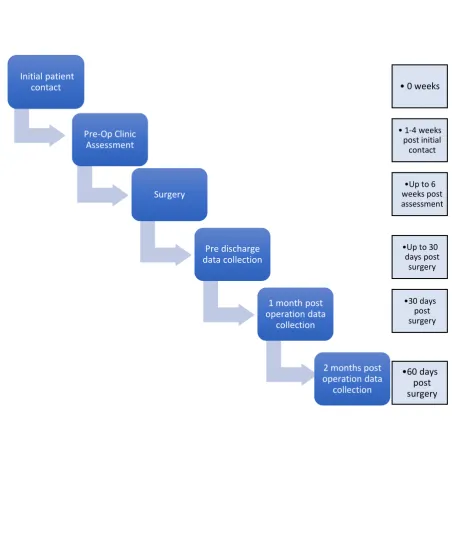
Figure 2.2 Timeline of Data Collection ... 54
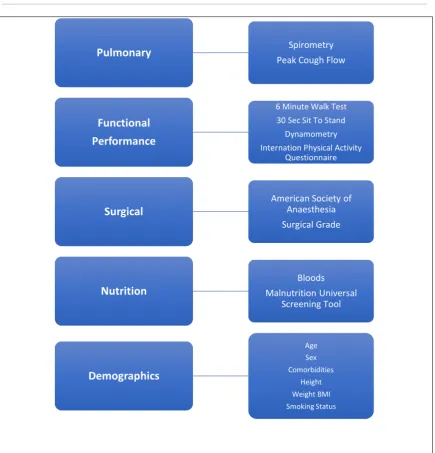
Figure 2.3 PreOperative Data Collection ... 55
Figure 2.4 Vitalograph Spirometer ... 57
Figure 2.5 Peak Cough Flow ... 58
Figure 2.6 Predicted Walk Distance Calculation (Enright et al 1998) ... 59
-Figure 2.7 VO2 Peak calculation (Ross et al 2010) ... 59
Figure 2.8 Hand Dynamometer ... 61
Figure 2.9 IPAQ Scoring Protocol – MET level ... 62
Figure 2.10 Postoperative Data Collection ... 65
Figure 3.1 Participation ... 70
Figure 3.2 Complication rates at all time points ... 78
Figure 3.3 Complications & Surgical Grade ... 85
Figure 3.4 Mean Length of Stay, Surgical Grade & Complications ... 87
-Figure 3.5 Weekly METS at all time points – total, complications & non-complications groups ... 88
-Figure 3.6 Sitting (mins) – All time points (Complications (n=18) vs Non-complications (n= 25)) ... 92
1. Introduction
1.1 Background
In 2012 the World Health Organisation reported that in Ireland alone, 299,335
various surgeries were performed, equating to 6,526 per 100,000 population with
a significant proportion of these being abdominal surgery (Weiser et al 2012). A
number of studies have highlighted the physiological stresses of surgery, the risks
associated with surgery and the types of complications that patients may
experience as a result of abdominal surgery (Finnerty et al 2013, Kirchoff et al
2010). These post-operative complications have significant costs associated with
them, both financially and on quality of life (Fuller et al 2009, Derogar et al 2012).
Due to the increasing age of the general population, there is a subsequent
increase in the number of elderly patients undergoing elective surgery and the
associated risk of post-operative complications. These increased complication
rates will add to further costs and demands on health resources worldwide
(Manton et al 1995, Weiser et al 2012). Thus, it would seem logical to research
ways to identify and minimise these risks, where possible.
1.1.1 Abdominal Surgeries
The term abdominal surgeries encompasses a wide variety of surgeries which
breach the abdominal wall, known as a laparotomy. However, they vary according
to the anatomical system causing the initial issue e.g. aortic aneurysm is regarded
as a vascular surgery, caesarean section as a uterine surgery and a
cholecystectomy as an upper gastro-intestinal (GI) tract surgery (Lavelle-Jones,
2002). As the range of abdominal surgeries is quite broad, the following will
mainly focus on colorectal surgeries as surgeries representing the lower GI tract,
cholecystectomies as representing the upper GI tract and hernia repairs due to
internal breaches of the abdominal wall.
Colorectal surgeries pertain to areas of the large intestine and rectum. Stoma’s
may also be formed where by part of the bowel that has been resected is brought
initial reason for its formation (Williams et al 2008). See Figure 1.1. Hernia repairs are performed due to part of the bowel herniating through the part of the
abdominal wall (Williams et al 2008). Cholecystectomies refer to removal of the
gallbladder (Lavelle-Jones, 2002).
Abdominal surgeries are generally performed using three different incision types:
open, laparoscopic and robotic laparoscopic (Williams et al 2008). See Figure 1.2. Open incisions are known to provoke a stronger physiological stress
response versus a laparoscopic approach (Scott and Miller 2015). All surgeries
are graded according to their complexity regardless of the problematic bodily
system where the issue originates (NICE, 2016). For example a colonic resection
would be regarded as a major complex surgery versus drainage of an abscess
would be regarded as minor surgery. See Table 1.1 for further examples. The
complexity of the surgery also affects the physiological stress responses that the
Figure 1.1 Colostomy & Ileostomy -
Figure 1.2 Various Surgical Incisions -
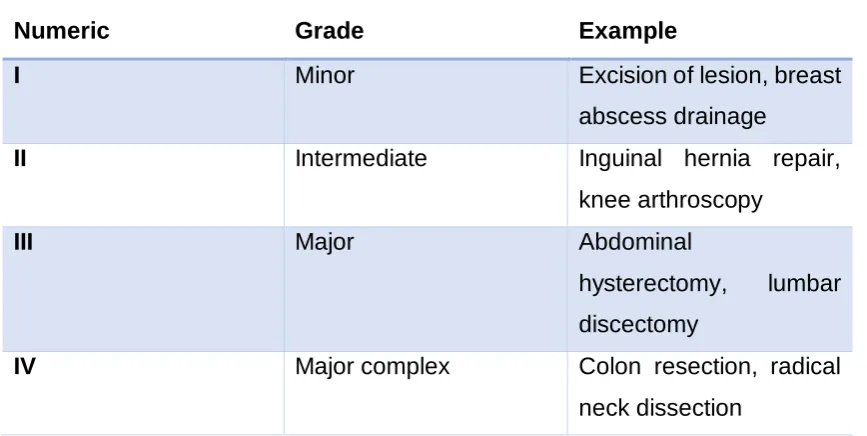
Table 1.1 Surgical Grades & Examples NICE 2016
Numeric Grade Example
I Minor Excision of lesion, breast
abscess drainage
II Intermediate Inguinal hernia repair,
knee arthroscopy
III Major Abdominal
hysterectomy, lumbar
discectomy
IV Major complex Colon resection, radical
neck dissection
1.1.2 Physiological Stress of Surgery
It is widely known that surgery produces significant stress response effects on
the body. (Scott & Miller 2015, Finnerty et al 2013). The cause of this stress is twofold: initial injury from the incision(s) and mobilisation of tissues and secondly
from the inflammatory responses that follow (Scott & Miller 2015). Metabolic rate
increases in response to stresses placed on the body in an attempt to restore
homeostasis. Initially these changes may be beneficial, however, prolonged
changes in inflammatory, metabolic and catabolic responses lead to
complications, delayed healing and increased mortality (Finnerty et al 2013). Prolonged reactions are also responsible for catabolism of muscle tissue which
in turn leads to poorer muscle function and when teamed with poor immunity and
delayed wound healing, can lead to detrimental complications. The ability of the
gut to absorb nutrients may also be affected during a time when optimal nutrition is imperative to respond to the body’s hypermetabolic and hyper catabolic state
Sharma et al 1996 identified the responses that occur to the body in response to the creation of a pneumoperitoneum1, in order to visualise the abdomen in
laparoscopic surgery. As a result of increased intra-abdominal pressure, there
are significant increases in heart rate, systemic blood pressure, mean arterial
pressure, venous return and systemic vascular resistance. Stroke volume
decreases and cardiac output is maintained via tachycardia, thus significantly
impacting on the body, particularly in patients who are cardiac compromised.
These responses are also seen during exercise and so patients who are
accustomed to these changes regularly, may have more reserve to cope with the
stresses of surgery (Plowman & Smith 2013). The respiratory system can also be
compromised due to the effects of ventilation and anaesthesia. This can lead to
immediate postoperative complications such as hypoventilation, upper airway
obstruction and hypoxaemia (Karcz & Papadakos 2013).
The European Society of Cardiology (Poldermans et al 2009) recommends
preoperative assessment for patients undergoing laparoscopic surgery as the “procedures demonstrate a cardiac stress similar to open procedures and it is recommended that patients should be screened accordingly” despite the fact that
laparoscopic surgeries tend to yield less complications and less of a stress response (Desborough 2000). It appears to be reasonable that a person’s
preoperative physical function and fitness should be sufficient in order to
withstand the stress placed on their body during surgery and to enable quicker
return to normal function.
1.2 Literature Review
1.2.1 Literature Review Aims
This literature review aims to:
• Identify the postoperative complications related to abdominal surgeries.
• Analyse the costs to the patients and health systems.
• Identify the risk factors associated with the development of postoperative
complications.
• Investigate the evidence surrounding physical function assessments
methods used to predict complications.
• Examine current guidance in preoperative assessment.
1.2.2 Literature Search Methods
A systematic search was conducted using the EMBASE and Medline EBSCO
search engines in March 2016 and July 2017. Terms that were used were related
to functional and physical activity screening, complications, abdominal surgeries
and recovery. See Appendix I for full search terms used. The search criteria was
English articles, including only humans and between the years 2000-2017.
Literature was searched from the year 2000 onwards to reflect more recent
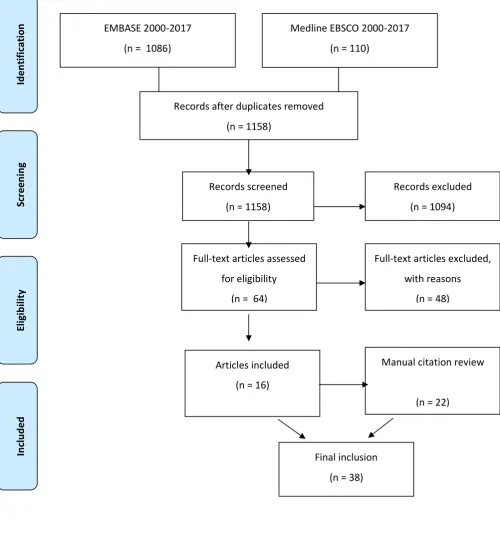
laparoscopic surgical trends. A total of 1196 articles were yielded. After title and
abstract screening, 64 were included and upon further full article reading 16 of
these were suitable for inclusion. Inclusion criteria was terms related to the
following: abdominal surgery, risk factors, complications, morbidity, physical
fitness and recovery. Manual review of individual reference lists of studies yielded
a further 22 relevant articles for inclusion. International guidance documents were
also searched and included (n = 6). See Figure 1.3. Please see Appendix II for
Figure 1.3 Literature Search Prisma
EMBASE 2000-2017 (n = 1086)
Sc re en in g In cl ud ed El ig ib ili ty Id en tifi ca tio
n Medline EBSCO 2000-2017
(n = 110)
Records after duplicates removed (n = 1158)
Records screened (n = 1158)
Records excluded (n = 1094)
Full-text articles assessed for eligibility
(n = 64)
Full-text articles excluded, with reasons
(n = 48)
Articles included (n = 16)
Manual citation review
(n = 22)
1.2.3 Complications
Complications after abdominal surgery are defined as “any deviation from the normal post-operative course” (Dindo et al 2004).
1.2.3.1 Rates of complications
Rates of overall morbidity post colorectal surgery range from 11-69% (mean
33%), as identified in a systematic review by Schiphorst et al 2015 analysing data from 18 studies, including 6153 patients. The variability is largely due to many of
the studies not using pre-defined determinants of postoperative surgical and
nonsurgical morbidity. Pulmonary complications were reported between 0-11%
of cases of the 6152 patients. Cardiac complications were identified as ranging
from 0-7% in the analysis of 10 studies (n=3773) but have been reported as up
to 28% in general abdominal surgery patients and vary according to
co-morbidities (Atalay et al 2011, Wiklund et al 2001). The variability in reporting classification of postoperative complications throughout the evidence will be
further discussed.
1.2.3.2 Types of complications
Complications can be broadly categorised into surgical and medical. Surgical
complications that have been identified post abdominal surgery include wound
inflammation, wound discharge, ileus, incisional hernia, necrotising intestine,
intra-abdominal abscess, bleeding and anastomotic leakage (Kirchoff et al 2010,
McGillicuddy et al 2009, Wolters et al 1996, Bosma et al 2016).
Medical complications can include pulmonary, cardiovascular and other systems.
Pulmonary complications that have been identified include atelectasis, pulmonary
infection, pneumonia, respiratory failure, refractory hypoxaemia and pleural
effusion (McGillicuddy et al 2009, Wolters et al 1996, Atalay et al 2011, Artinyan et al 2008, Longo et al 2000, Schiphorst et al 2015). Cardiovascular complications include myocardial ischaemia, cardiac arrest, deep venous thrombosis,
pulmonary thrombosis, arrhythmias, supraventricular tachycardia,
2009, Wolters et al 1996, Atalay et al 2011, Schiphorst et al 2015). Other reported complications include urinary tract infections, renal failure/insufficiency, sepsis,
gastroenteritis and delirium have also been documented as complications
(Wolters et al 1996, McGillicuddy et al 2009, Artinyan et al 2008, Longo et al 2000, Bosma et al 2016). The diversity of complications on the various bodily systems that can occur post abdominal surgery is evident.
1.2.3.3 Classification of Complications
A limitation of the literature is the non-uniform classification of complications. The
most commonly used surgical complication classification tool is the
Clavien-Dindo classification. Clavien-Dindo et al 2004 introduced an updated classification tool
based on the previous tool developed by Clavien et al 1992 in order to address
this problem. Previously, complications were named, however this scoring tool
grades complications according to what management they require. This allowed
for a more robust way of capturing data which has been found to be a reliable
and comprehensive tool (Dindo et al 2004). Complications range from grade I –
V and vary from small deviations in the postoperative course such as localised
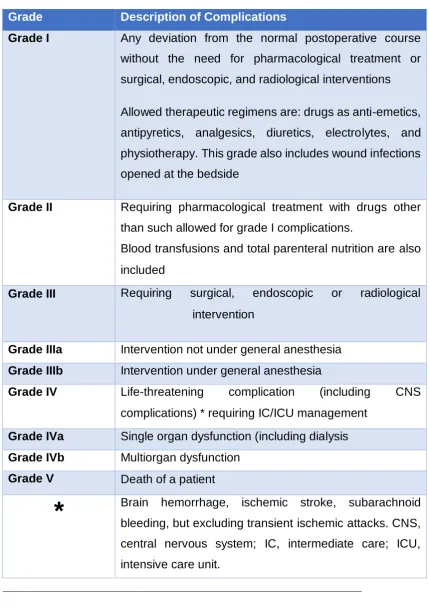
surface wound infection to patient death. See Table 1.2.
Lesser known classification tools include the Comprehensive Classification Index
(CCI) or Complications Index Tool and the postoperative morbidity survey
(POMS). The CCI is relatively new and uses the Clavien-Dindo classification but
also takes the number of complications into account and scores them between
0-100. This was developed due to a limitation of the Clavien-Dindo classification
as it only takes into account the worst complication and does not account for any
complications deemed as less severe (Slankemanac et al 2013). The POMS, an
older and not widely used tool, categorises morbidity in terms of the following:
pulmonary, infections, renal, cardiovascular, GI, neurological, haematological,
Table 1.2 – Clavien-Dindo Surgical Complications Classification 2004
Grade Description of Complications
Grade I Any deviation from the normal postoperative course without the need for pharmacological treatment or
surgical, endoscopic, and radiological interventions
Allowed therapeutic regimens are: drugs as anti-emetics,
antipyretics, analgesics, diuretics, electrolytes, and
physiotherapy. This grade also includes wound infections
opened at the bedside
Grade II Requiring pharmacological treatment with drugs other than such allowed for grade I complications.
Blood transfusions and total parenteral nutrition are also
included
Grade III Requiring surgical, endoscopic or radiological intervention
Grade IIIa Intervention not under general anesthesia Grade IIIb Intervention under general anesthesia
Grade IV Life-threatening complication (including CNS
complications) * requiring IC/ICU management
Grade IVa Single organ dysfunction (including dialysis Grade IVb Multiorgan dysfunction
Grade V Death of a patient
*
Brain hemorrhage, ischemic stroke, subarachnoid bleeding, but excluding transient ischemic attacks. CNS,central nervous system; IC, intermediate care; ICU,
1.2.4 Costs associated with post-operative complications
Complications are widely accepted to be associated with costs be they life
limiting, physical, financial or psychological (Zoucas and Lydrup 2014,
Vonlanthen et al 2011, Fuller et al 2009, Walburn et al 2009, Ebrecht et al 2004, Herbert et al 1993, Kiecolt- Glaser et al 2002, Kiecolt- Glaser et al 1998, Pinto et al 2016 , Bosma et al 2016, Lawrence et al 2004, Tahiri et al 2016 and Tran et al 2014) .
1.2.4.1 Mortality
Mortality appears to be as low as 1% in elective colorectal surgeries but has
been reported up to 5.8% (Schiphorst et al 2015, Tevis & Kennedy 2013). It has been reported to be as high as 15% for emergency colorectal surgeries
(McGillicuddy et al 2009). Factors associated with an increase mortality risk in elderly patients undergoing emergency colorectal procedures include older age,
high estimated blood loss, sepsis at initial presentation, delayed surgery and the
development of complications (McGillicuddy et al 2009). The link between
postoperative complications and mortality in this group and general surgical
patients, has been proven to be significant with the relative risk of mortality
increasing from 2.1 in the presence of one complication to 7.2 when multiple
complications are present (Tevis & Kennedy 2013).
1.2.4.2 Recovery and Functional Ability
The loss of a person’s ability to be functionally independent has been linked to
depression, poor quality of life (QoL), shorter survival and huge economic impact on all associated with a person’s care, particularly in the elderly (>65 years)
(Luciani et al 2008). More importantly, elderly patients often regard their recovery, after surgery, to their previous baseline functional status as being as
important as survival itself (Chee 2010, Fried et al 2002). Few studies have analysed the impact that post-operative complications have on a patients
recovery in returning to preoperative functional levels.
Lawrence et al 2004 studied the return to functional independence in 372 patients
multi-factorial assessment approach using self-reported and performance based tools.
At six months post-surgery, they found the following percentages of study participants had not returned to baseline: Activities of Daily Living (ADL’s), 9%,
Instrumental Activities of Daily Living (IADL) 19%, Physical component of the
Short Form 36 (SF36) 16%, the mental component scale of the SF36, 17%, timed
walk 37%, functional reach, 58%, and grip strength , 52%. These results are
limited in that they do not account for complications and so cannot be assumed
to be directly related to the presence of complications. Nevertheless, the results
show a large percentage who failed to reach full recovery by 6 months, in many
domains of functional ability, many of which can be addressed with appropriate
interventions such as exercise or individualised rehabilitation.
Tahiri et al 2016 assessed the impact of post-operative complications on the recovery of 149 elderly patients (>70 years) who underwent elective abdominal
surgery in a Canadian hospital. Surgeries included colorectal, hernia repairs,
hepatobiliary, gastric and splenectomy surgeries. A complication rate of 34.9%
and a mortality rate of 2.68% was reported in this study. Assessment was once
again multi-factorial in relation to functional ability, co-morbidities and frailty.
Functional ability was measured using the short physical performance battery
(SPBB) which assesses standing balance, gait speed and ability to rise from a
chair. Complications were reported using the Complications Index Tool. The
SPBB was repeated at 1 week, and at 1,3 and 6 months postoperatively. Results
are shown in Table 1.3. It was shown that the more severe the complication, the
longer the recovery. Results indicated that even at 6 months, only 58.3% returned
to baseline function, concluding that the number and severity of complications
impact negatively on recovery. This study also highlighted a significant number
of patients with an uncomplicated post-operative course who did not fully return
to their baseline function. This mirrors the Lawrence et al 2004 study findings that a large proportion of patients do not return to baseline function by six months, as
both populations were of similar age and underwent similar surgeries. The
authors hypothesised that those without complications had higher baseline SPBB
and therefore possibly found it harder to achieve their baseline SPPB scores
begin. This theory does not explain why those who had a better baseline and an
uncomplicated post-operative period should experience delayed recovery even
at 6 months.
Table 1.3 Percentage of patients returning to baseline function following abdominal surgery – adapted from Tahiri et al 2016
Recovery time
line
1 Week 1 Month 3 Months 6 Months
No complications 30.4% 58.3% 69% 73.7%
Complications 10.9% 34.2% 53.7% 58.3%
Tran et al 2014 reviewed functional recovery outcomes in 137 abdominal surgery
patients who were discharged on the day of surgery. Seventeen various surgeries
were performed and the most prevalent included open inguinal herniorrhaphy
(40%) and laparoscopic cholecystectomy (28%). Eleven percent reported
complications categorised as per the Clavien-Dindo classification. They found
that 33% (n = 44) of participants, at 2 months, had not returned to their
preoperative functional activity levels. On the contrary, there were a significant
number (n = 88) who were better than baseline at 2 months postoperatively (P
<0.01). The most significant determinants of recovery at 3 weeks were presence
of a complication, older age, low baseline health related quality of life or greater
baseline energy expenditure as measured by the community health activities
model programme for seniors (CHAMPS). The CHAMPS is a questionnaire
relating to physical activities which are converted to metabolic equivalents (MET’s) from which total weekly energy expenditure is calculated. At 2 months
post-surgery, only baseline energy expenditure was significant in relating
recovery to baseline measures. The authors reported that those with higher
baseline CHAMPS scores were less likely to have recovered to these levels at 2 months. This may support the previous study’s theory regarding those having
age however was 53 with a range from 18-84 and so the CHAMPS may not be
suitable for all participants as it is aimed at senior citizens and so may not account
for those with higher baseline status.
A similar study by Onerup et al 2015 analysed how preoperative physical activity
levels were associated with recovery after elective cholecystectomy, which would
be regarded as a non-complex surgery (n=150). Physical activity was measured
using a self-reported questionnaire, The Saltin-Grimby Physical Activity Scale.
Objective measures showed that those who were more physically active prior to
the operation were more likely to be discharged after one day and back to work
within three days. This may be in contrast to the previous two studies findings,
however they did not analyse return to work. Participants were also asked to rate
how physically recovered they felt given the options of 0%, up to 25%,up to 50%,
up to 75% and fully recovered. They found no significant relationship between
baseline activity and postoperative subjective physical recovery. However they
did find that those who underwent laparoscopic surgery versus open had a 2.7
times higher chance of feeling recovered (P = .01) with 77% feeling highly
physically recovered after three weeks. The mean age of participants was 51.9
years and so may reflect a younger population than the previously mentioned
studies. Another factor may be the minimally invasive, low complexity of the
surgery in comparison to the previous studies. There is a lack of high quality
evidence in relation to self-recovery reports in patients undergoing abdominal
surgery but this shows some promise in using even simple tools.
Van. Cleave et al 2011 studied the factors that influenced recovery in 316 patients over the age of 65 who underwent surgery for various cancers including
colorectal. The findings are similar to the work of Tran et al 2014 as they found
that those with an uncomplicated postoperative course had better than baseline
functional ability at 6 months. Conversely, those who had complications were
more likely to have three or more co-morbidities. Co-morbidities will be discussed
further. Poorer functional recovery was also associated with those who reported
three or more symptoms on the Symptom Distress Scale (SDS) which assesses
severity of pain, bowel pattern, concentration, appearance, breathing, outlook
and cough. A limitation of this study was that it was retrospectively conducted
using data from previous studies and had a variety of cancer types where
recovery and treatment may vary. It does however highlight some possibly
modifiable risk factors that may help predict complications and recovery
trajectory.
Tevis and Kennedy 2013 reviewed 18 studies relating to how surgical
complications impact on patient centred outcomes, in a general surgical
population. Surgeries included general abdominal, colectomies, colorectal,
abdominopelvic and pancreatectomy. Patient centred outcomes were seen as
mortality, morbidity, discharge disposition, QoL and LOS. They highlighted that
having one or more complications increased the likelihood of needing care in an
institutional care facility (ICF) two fold. Presence of any complication(s)
increased mortality rates at thirty days, ninety days and one year post surgery. In
agreement with Van. Cleave et al 2011 mortality levels at all time points were lowest in those who were able to be discharged to their own home independently
followed by those who required home assistance upon discharge and the highest rates were seen in those who were discharged to ICF’s. These findings may not
necessarily be as a result of complications alone and may be associated with
poorer initial functional capacity, age and frailty. The review is limited in that few
of studies included used a standardised complication classification system and
arbitrary grading from minor to severe was used, thus complication rates may
have been under or over estimated.
It is evident from the literature that recovery to baseline functional ability appears
to be influenced by the complexity of the surgery, severity of the complications,
baseline physical activity levels and co-morbidities (Tahiri et al 2016, Tran et al 2014, Van. Cleave et al 2011, Onerup et al 2015) . There is conflicting evidence that some patients recover to better than baseline functional activity levels whilst
some, even without complication, appear not to return to baseline functional
2016, Lawrence et al 2004). It raises the question of why do some people physically recover very well and why some don’t seem to.
1.2.4.3 Financial
Zoucas and Lydrup 2014 performed a retrospective study to determine the costs
of elective colorectal surgical morbidity in a hospital in Sweden. They found in a
group of 530 patients that 35% of them developed complications but only 14% of
them required intervention. The highest costs were associated with complications
graded as >II as per the previously mentioned Clavien-Dindo classification. Table
1.2. These complications were associated with a 78% increase in length of stay
(LOS), thus increasing financial costs. Patients who had a normal post-operative course, average LOS was 9 days and mean(SD) costs were €12,410 ± 384. Their
study showed a significant rise in costs when patients develop complications costing a mean(SD) of €25,680 ± 2289 when any complication was present to
the most expensive being suture/staple line dehiscence costing a mean(SD) of €47,306 ± 17194). This is particularly important when SSI’s are largely
preventable (Odom-Forren 2006). A potential limitation is that costs may have
been under or over estimated as costs were estimated based on LOS, time under
anaesthesia and time spent in postoperative care unit or the intensive care unit.
These parameters however did incorporate the costs of salaries, medical
supplies and medications which would improve the accuracy of costs.
Vonlanthen et al 2011 performed a cost analysis of complications associated with
major surgical procedures in the Switzerland and reported their health care costs
as being comparable to the United States of America (USA). On a cohort of 1200
patients, 389 of these had abdominal surgery in the form of colon resections, with
a mean LOS of 11 days. Morbidity levels were higher than previously mentioned
studies at 54.8%, compared with Schiphorst et al 2015 (mean 33%) and Zoucas
and Lydrup 2014 (35%). Of those who developed complications, 28.3% of these
had more than one complication. Vonlanthen et al 2011 measured morbidity
using the Clavien-Dindo classification and reported a proportional relationship
with increasing severity of complications and total hospital costs, which is
comparable to the previous study. Those without complications had an mean(SD)
were apparent: Grade I ($29,166 ± 19,106), Grade II ($43,370 ± 29,399), Grade
IIIa ($59,822 ± 37,330) and Grade IIIb ($95,550 ± 70,362). They also determined
the cost of some organ specific complications e.g. cardiopulmonary, as per the
grade that they were i.e. Grade I $33,046, Grade II $ 36,107, Grade III $44,049,
Grade IV/IVb $138,971 and Grade V $87,039. Grade V costs were likely lower
as this grade correlates with patient death. The financial analysis methods used
in this study were more robust than Zoucas and Lydrup 2014 as costs were
directly attributed to each individual case, giving more reporting accuracy.
Fuller et al 2009, USA, investigated the costs of 64 potentially preventable hospital acquired complications and were able to report costs for specific
complications. Although the data was from a variety of surgeries, not exclusively
abdominal, the information is still useful as they calculated the costs of the
complications on top of standard care costs depending on their reason for
admission. They extrapolated data from claims made at 278 hospitals in Maryland
and California and found similar costs. Post-operative respiratory failure was the
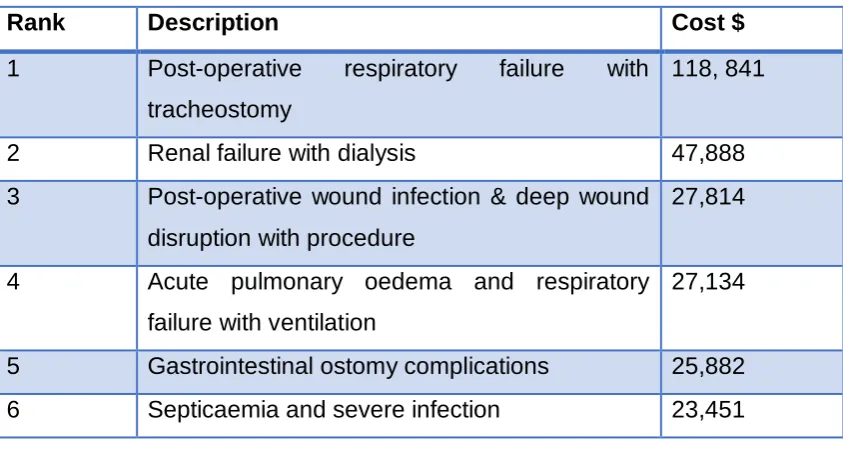
most expensive at $118,841 and obstetric haemorrhage with transfusion the least
expensive at $3,081. See Table 1.4 for some of the complications associated with
[image:30.595.102.524.551.777.2]abdominal surgery.
Table 1.4 - Ranking of Potentially Preventable Complication’s – adapted from Fuller et al 2009
Rank Description Cost $
1 Post-operative respiratory failure with
tracheostomy
118, 841
2 Renal failure with dialysis 47,888
3 Post-operative wound infection & deep wound
disruption with procedure
27,814
4 Acute pulmonary oedema and respiratory
failure with ventilation
27,134
5 Gastrointestinal ostomy complications 25,882
7 Re-opening surgical site 19,442
8 Pneumonia and other lung infections 16,901
9 Pulmonary embolism 16,331
10 Moderate infection 16,063
11 Venous thrombosis 15,976
12 Ventricular fibrillation/ Cardiac arrest 15,241
13 Post-operative infection and deep wound
disruption without procedure
14,347
14 Stroke and intracranial haemorrhage 14,013
15 Other pulmonary complications 11,566
16 Renal failure without dialysis 9,934
17 Urinary tract infection 9,637
18 Acute myocardial infarction 8,147
19 Acute pulmonary oedema and respiratory
failure without ventilation
7,109
20 Congestive heart failure 5,801
21 Other cardiac complications 4,642
22 Cardiac arrhythmias and conduction
disturbances
4,431
23 Obstetric haemorrhage with transfusion 3,081
This information may be very helpful for hospitals in budget planning once they
can classify their average complication rates and highlight the substantial cost
increases associated with complications. It is difficult to deduce if the costs that
have been reported are useful or comparable locally due to a lack of available
data in Ireland and the United Kingdom, but a common trend shows that the
financial costs increase significantly with rate and severity of complications (Fuller
et al 2009, Zoucas & Lydrup 2014, Vonlanthen et al 2011).
1.2.4.4 Psychosocial, Anxiety and Depression
Evidence analysing the impact of complications on psychological factors
distress caused by surgical complications can delay wound healing and reduce
immunity (Walburn et al 2009, Ebrecht et al 2004, Herbert et al 1993, Kiecolt- Glaser et al 2002, Kiecolt- Glaser et al 1998).
Bosma et al 2016 investigated the impact of colorectal surgery on health status,
anxiety and depressive symptoms, regardless of complications. The study was
prospective and conducted in the Netherlands on 218 patients. Patients were
asked to fill in 3 different questionnaires relating to depression, anxiety and health status preoperatively and at 3 time points post-operatively – 3 days, 6 weeks and
1 year. Similarly to Vonlanthen et al 2011, they reported a complication rate of
59.6%. They found that levels of anxiety and depressive symptoms in all patients
who underwent colorectal surgery increased post-operatively but tended to return
to normal levels at 6 weeks post-surgery, regardless of the presence of
complications or not. However, they did find that those who had complications
greater than grade III on the Clavien-Dindo classification had poorer overall
health status. Of note, the domains that they suffered most were in limitations in
physical activities, social activities, general mental health, vitality and general
health perception. They also found that these had usually returned to normal by
one year post complication.
Pinto et al 2016 conducted a systematic review and meta-analysis analysing the
effect of surgical complications on psychosocial well-being. The 51 studies used
included cardiothoracic (n=17), vascular (n=4) and GI (n=29) surgeries. The
authors reported that those who had complications had significantly worse
psychosocial outcomes over their counterparts who had none and that these
effects can last up to and beyond one year post complication. QoL appears to
suffer also for a lengthy period. These results found that the negative impact of
the complications on the patients was not influenced by either the complexity of
the surgery or the severity of the complications encountered. This is useful to
note as there may be an assumption that the more severe the complication or
surgery, the more of a negative impact it would have on the patient, but this
appears not to be true in all cases. This also contradicts the findings of Bosma et
were analysed whereas the GI surgeries in this study varied from surgeries on
the stomach, the bowel, rectum and gallbladder or indeed the variety of QoL
assessment tools used. The authors also highlighted that more attention may be
needed to patients psychological needs in the early postoperative phase to
ensure no psychological adverse outcomes in the long term. A strength of the
review is that only studies were included that used patient self-reported
measures.
These studies highlight a need for high quality studies investigating the
effectiveness of post-operative psychological care in the short and long term. It has clear implications for patient’s welfare up to and beyond a year
post-operatively and could impact on other areas of their health with altered health
perception (Pinto et al 2016, Bosma et al 2016).
1.2.5 Risk Factors Associated with the Development of Postoperative Complications
Physical parameters will be discussed in terms of physical activity, sedentary
behaviour, strength and frailty to investigate its relationship with postoperative
morbidity.
1.2.5.1 Physical Function and Activity
The World Health Organisation (WHO) has recognized physical inactivity as one
of the biggest risk factors for premature mortality and morbidity, regardless of
co-morbidities (WHO 2011). However, the influence of physical activity on outcome
has not been effectively studied given the significant physiological stress of
surgery and recovery on the body (Desborough 2000).
Wiklund et al 2001 investigated 5939 patients who underwent non cardiac
surgeries in the USA to assess if preoperative activity levels were predictive of
cardiac complications. Surgeries were varied and included abdominal, hepatic,
the Duke Activity Status which was a limitation of the study with a high chance of
bias introduced. Ninety-four participants (1.6%) suffered cardiac complications
and 6 of those died as a direct result of the complications. Complications were determined retrospectively by analysing the hospital’s medical records and codes
relating to cardiac issues. These were then reviewed by an assessor to determine
if the patients had new or old cardiac coding attached to their records. No formal
complication classification system was used and no details were included as to
inclusion/exclusion criteria of complications which is another potential limitation
of this study. They found that baseline MET level did not predict cardiac
complications (P = 0.793), however, the accuracy of how these were calculated has been called into question. There was a trend that < 4 MET’s at baseline,
coupled with an American Society of Anaesthesiologists (ASA) score of 3 or more
influenced likelihood of cardiac complication. See Table 1.5 for ASA categories.
The descriptors used of METS <4 included : self-care of oneself, eat, dress, use
a toilet, walk indoors around the house and walk 1-2 blocks on the level at
2-3mph. However, they found a significant relationship between cardiac
complications, age and ASA physical status (P <0.001). Whilst the study had
large numbers and found some significant results, it would be more worthwhile
had they used more robust measures of physical activity as this limits the study
in some respects.
Feeney et al 2011 studied the correlation between pre-esophagectomy patients
activity levels and postoperative pulmonary complication’s (PPC’s). Activity levels
measured were more accurate than the previous study as physical activity was
measured objectively using a triaxial accelerometer for at least 4 days. Feeney
et al 2011 found activity levels to be low with participants spending 78.75% of a typical day inactive and 18.75% of the day in light activity. In relation to
complications, there was a significant difference between the PPC and non PPC
groups as they tended to be less active whereas those who did not develop
complications, spent more time in moderate intensity activities (P <0.01). Despite
Dronkers et al 2013 found preoperative physical activity and function to be statistically significant in predicting recovery through the use of physical tests and
self-reported activity scores. Participants (n=169) were scheduled for major
oncological abdominal surgery. Activity levels were measured using a subjective
tool, the LASA physical activity questionnaire (LAPAQ) and physically measured
using the Timed Up and Go Test (TUG). The LAPAQ was found to be the most
robust in predicting outcomes of recovery. A potential limitation of the study is
that recovery was determined as being discharged home as it suggests that they
are physically well enough to do so, but potentially differing levels of support
mean this measure of recovery may be flawed. The study may have been
strengthened had a measure of physical recovery been used. Other assessment
methods used by this study will be further discussed in section 1.2.7.5 and
1.2.7.6.
Dependency in relation to functional health status, as determined by ability to perform basic ADL’s, has been proven to have a linear relationship with risk of
development of surgical infection, pulmonary, cardiovascular, neurological and
renal complications (p<0.05) (Isik 2014). These results were from a robust
retrospective study of 25,591 colorectal cancer surgery patients whereby their
functional status was ranked as either independent, partially dependent or totally dependent based on their ability to perform basic ADL’s. Basic ADL’s included
bathing, dressing, toileting, feeding and mobility and are relatively simple to
question patients on their ability to perform. The assessors determined participants’ ability when self-assessed on whether they could perform the tasks
independently, with some assistance or requiring total assistance regardless of
aids or prostheses. The authors suggested that using this tool would lead to more
realistic outcomes during the postoperative period.
It appears from the studies mentioned that physical activity and physical function
play a role in determining patients chances of developing complications and
indeed their recovery and discharge destinations (Wiklund et al 2001, Feeney et al 2011, Dronkers et al 2013, Isik 2014). However, more studies need to be conducted using a multifactorial approach to measuring physical activity and
1.2.5.2 Sedentary Behaviour
To the best of the authors knowledge, no studies have specifically examined the
relationship between preoperative sedentary behaviour or inactivity and if it
presents an increased risk of complication development post abdominal surgery.
Feeney et al 2011, in esophagectomy patients, as previously mentioned, did find
a significant difference between PPC and non PPC groups in relation to their
inactivity levels (P<0.05).
1.2.5.3 Muscular Strength and Endurance
Muscular strength has been shown to have a strong association with all-cause
mortality regardless of physical activity, muscle mass or fitness levels (Volaklis et
al 2015, Newman et al 2006). Simple, quick measures such as hand
dynamometry have been proven to be reliable as a measure of overall physical
strength and as a predictor of mortality. It has also been shown to be useful in
predicting post-operative complications (Volaklis 2015, Newman et al 2006).
Newman et al (2006) studied 2292 healthy adults between 70-79 years in the USA to determine if strength and/or muscle mass were predictive of mortality. To
assess strength, knee extension was measured using an isokinetic dynamometer
and hand grip strength measured using a isometric dynamometer. CT scans were
used to determine muscle mass. Participants were contacted every six months
for six years to determine mortality rates. Results showed a strong relationship
between quadriceps and hand grip strength and mortality, whereas muscle mass
did not. This study used a more objective measure of strength and was conducted
on healthy adults so it is unclear if this data relates to a surgical population also.
Volaklis et al 2015 in a narrative review of 23 studies investigating the presence of an association between mortality risk and strength in healthy and non-healthy
individuals. They found that mortality risk increased as strength levels decreased
when all-cause mortality was examined. This was also the case for people >85
patients but did conclude that higher muscular strength is protective of mortality
in people with cardiovascular disease (CVD), renal failure, cancer, peripheral
arterial disease (PAD) and chronic obstructive pulmonary disease (COPD). This
study is in agreement with the findings Newman et al 2006 suggesting that muscular strength play an important role in its relationship with mortality. More
studies are required examining its relationship with morbidity and the most
appropriate assessment tools to do so.
1.2.5.4 Frailty
Frailty has been shown to be a risk factor, however the definition of frailty is varied
amongst the literature (Trevis and Kennedy 2013). Nevertheless, in colorectal
and cardiac surgeries, frailty has been identified as a risk factor for post-operative
complications, independent of age, which leads to increased length of stay and
re-admission rates (Robinson et al 2013). In review by Partridge et al 2012, they highlighted that frailty has been reported as high as 41.8-50.3% in an older
population requiring elective surgery of any type. This suggests that a large
cohort of those who require surgery will inevitably be frail and therefore at a higher
risk. The various definitions and assessment tools used to measure frailty make
it difficult to reach consensus on what types of patients are deemed frail.
An older study from 1980, measured frailty using a hand dynamometer and found
that those deemed as frail had a higher risk of developing complications and an
increased length of stay (Klidjian et al 1980). Mackary et al 2010 sub categorised 594 surgical patients, >65 years, frailty levels through assessing their weight
loss, grip strength, exhaustion, physical activity levels and walking speed and
scoring them from 0-5. Classifications were: 0-1 non frail, 2-3 intermediately frail,
4-5 frail. Patients who were deemed as intermediately frail had an odd ratio (OR)
of 2.06 while frail patients had an OR of 2.54 in developing complications. Frailty
was shown to be independently associated with complications, LOS and
discharge to an assisted care facility. It must also be noted that some of the
markers used to determine frailty in this study are potentially reversible and
measured and may be useful in preoperative assessment, particularly to take into
account physiological versus chronological age.
1.2.6 General Identified Risk Factors
1.2.6.1 Age
There is conflicting evidence regarding age as a risk factor. In studies where age
has been shown to be a risk factor, it has also been linked with co-morbidities
and physical function and so may not be the only influencing factor Kirchoff et al
2010, Dronkers et al 2013, Bosma et al 2016, Zoucas et al 2014, Wiklund et al 2001). The idea that physiological age may be of more use that chronological
age was suggested by Dronkers et al 2013. The author suggested that
chronological age is not always an appropriate assessment of a person and that
their ability to perform physical tasks or gravity of a disease may be more of a
reflection of their physiological age. This theory may be useful in answering why
there is conflicting evidence surrounding age as a predictor of complications and
future studies may need to assess physical parameters and disease severity also.
This highlights the links between physical functional ability and predicting
postoperative outcomes.
1.2.6.2 Body Mass Index (BMI) and Nutritional Status
BMI >25 has been shown to be a risk factor in the development of intra-operative
complications and has led to a need for the surgeon to convert from a
laparoscopic to an open surgical approach ( Dostalik et al 2005, Pikarsky et al
2002, Brooks-Brunn 1997). The main reason for conversion is that the increased
intra-abdominal fat distribution hinders the surgeons visibility (Martin and Stochii,
2011). Patients with increased BMI are also more likely to develop surgical site infections (SSI’s), ileus and incisional hernias (Pikarsky et al 2002). Obese patients tend to have higher complications rates, higher chance of reoperation
and therefore length of stay (Pikarsky et al 2002, Amri et al 2014). Malnutrition and preoperative weight loss of >10% have also been shown to negatively
1.2.6.3 Surgeon Experience
Surgeon experience and speciality has been shown to be a risk factor until the
surgeon reaches a plateau in his or her learning curve (Kirchoff et al 2010). Unfortunately, there is no definite number of surgeries that constitutes mastery in
their skill and so outcomes that are used to assess their skill include are length
of surgery, conversion rates, complications, length of stay, overall morbidity and
mortality (Kirchoff et al 2010).
1.2.6.4 Hospital Facilities
Tevis and Kennedy 2013 reported lower mortality rates, following complications,
were associated with hospitals who had sufficient nursing staff, more than two
hundred beds, high quality technology and were teaching hospitals in general
surgical patients. Conversely, they reported on a study that analysed mortality
rates in two similar hospitals and found that mortality rates differed between 4.1 – 7.6% and rose to 11.1 - 16.8% when mortality after complications were
considered. More research should be conducted to assess if hospital resources
play a key role in patient mortality due to surgical complications.
1.2.6.5 Laparoscopic versus Open Surgical Approach
The laparoscopic approach has been proven to be associated with a lesser risk
of complications versus an open approach, hence a paradigm shift towards more
minimally invasive approaches in recent years. Patients post laparoscopic
colectomy have been shown to have better morbidity rates at 30 days than those
who had an open approach (Tevis and Kennedy 2013). In elderly patients with
colorectal cancer, the laparoscopic approach has proven significant in reducing
the risk of cardiac complications versus an open approach and the trend remains
the same in relation to pulmonary complications (Sciphorst et al 2015). In frail patients, the laparoscopic approach was associated with decreased mortality,
where an open approach was necessary, it was associated with development of
post-operative pneumonia (McGillicuddy et al 2009).
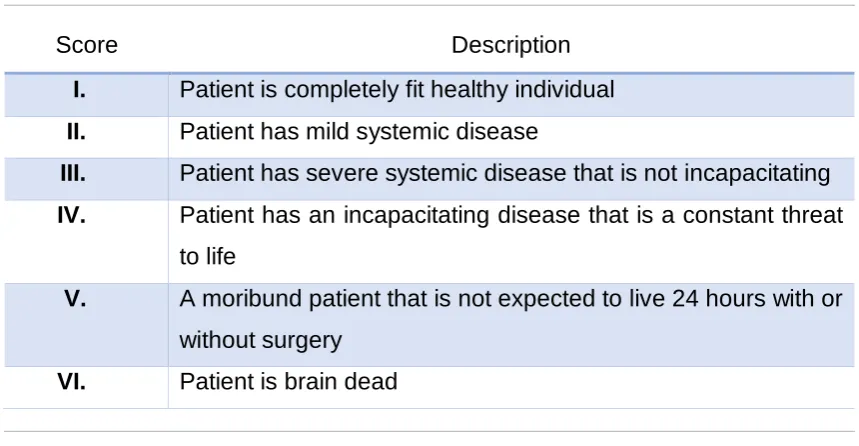
1.2.6.6 ASA Score
This is an internationally used score, by Anaesthetists, describing a patients
physical status with grade I being a normal healthy patient and grade VI
classifying someone as brain dead. Various factors are taken into consideration
when determining the suitable grade such as BMI, smoking status, co-morbidities and the acuity of a patient’s main complaint at the time. It is used for all patients
undergoing anaesthesia. Those who are classified as grade III or IV
preoperatively have a higher risk of complication development both intra and
postoperatively (Wolters et al 1996). This is supported by the work of Bowles et
al, 2008 who reported having an ASA score of III and at least two comorbidities
[image:40.595.97.527.413.636.2]were predictive of grade 3 complications and mortality.
Table 1.5 ASA Score Definitions
Score Description
I. Patient is completely fit healthy individual
II. Patient has mild systemic disease
III. Patient has severe systemic disease that is not incapacitating
IV. Patient has an incapacitating disease that is a constant threat
to life
V. A moribund patient that is not expected to live 24 hours with or
without surgery
VI. Patient is brain dead
1.2.6.7 Comorbidities
The presence of co-morbidities increase the risk of developing complications,
particularly when coupled with ASA scores 3. Presence of comorbidities such
as chronic obstructive pulmonary disease (COPD), neurological disorders,
smoking status have been strongly linked as risk factors in the development of
complications (Wolters et al 1996, Bosma et al 2016, Atalay et al 2011, Robinson et al 2009).
1.2.6.8 Blood Results
Haematocrit <30%, albumin <3.5g/L, creatinine >1.4mmol/L levels, preoperative
anaemia and hyponatraemia have all been linked with risk of complications. In
many cases these are potentially reversible (Kirchoff et al 2010).
1.2.7 Physical Performance Assessment Review
The following will review some established and emerging evidence that supports
the use of various assessments in order to assist with risk stratification and
prediction of outcomes.
1.2.7.1 Cardiopulmonary Exercise Testing (CPET)
CPET is regarded as the gold standard in the measurement of aerobic capacity.
In the determination of its predictive use for mortality, Lai et al 2013 established cut off values of anaerobic threshold (AT) and found that these were highly
predictive of mortality post colorectal surgery. They also found that those who
were fitter, had a reduced length of stay. CPET has also been found to be useful
in predicting morbidity in both colorectal and rectal surgery (West et al 2014,
West et al 2014). Moran et al 2016, in a systematic review analysed the role of
CPET as a risk assessment method for patients undergoing intra-abdominal
surgery, concluded that the evidence to support CPET testing as a predictor was
strong but added that cut off values for protective levels of fitness need to be
established in this population. This echoed the results of a previous systematic
review by Smith et al 2009. Predictive cut off values of maximal oxygen uptake
(VO2max) have been well established in lung resection surgery (Beckles et al
2003) – see Table 1.6. However, in 2016, West et al, provided evidence to support the following cut off points in 703 patients post major colorectal surgery: