Original Article
Randomized controlled trial of TEAS with different
acupoints combination on opioids consumption
in patients undergoing off-pump coronary
artery bypass grafting
Hui Zhang1*, Chong Lei1*, Taoyuan Zhang1, Lihong Hou1, Qiang Wang1, Hailong Dong1, Jiange Han2, Lize Xiong1
1Department of Anesthesiology, Xijing Hospital, Fourth Military Medical University, Xi’an 710032, Shaanxi Prov-ince, People’s Republic of China; 2Department of Anesthesiology, Tianjin Chest Hospital, Tianjin 300051, Tianjin, People’s Republic of China. *Equal contributors.
Received May 1, 2016; Accepted July 26, 2016; Epub December 15, 2016; Published December 30, 2016
Abstract: We conducted this prospective, double-blinded, randomized controlled trial to compare the opioid spar-ing effect of transcutaneous electric acupoint stimulation (TEAS) on the distal-proximal acupoints combination and regional acupoints combination. 186 adults scheduled for elective off-pump coronary artery bypass grafting (OP-CABG) surgery were randomized to TEAS with distal-proximal acupoints combination (LI4 and CV17), regional acu-points combination (CV17 and CV14) and control (non-acuacu-points) groups. The primary endpoint was intraoperative sufentanil consumption. Secondary endpoints included perioperative hemodynamics, duration of mechanic ventila-tion, length of cardiac care unit (CCU) and postoperative hospital stay, incidence and the duration of re-intubaventila-tion, re-admission to CCU, placement of intra-aortic balloon counter pulsation (IABP) or ventricular assisted device (VAD), postoperative cardiac function, incidence of postoperative complications, and all cause mortality by day 30. The cumulative consumption of sufentanil was significantly reduced in the distal-proximal acupoints combination group when compared with those in the regional acupoints combination and control groups (255.0 ± 106.1 μg vs 300.4 ± 106.9 μg and 305.9 ± 119.1 μg, P = 0.027). No significant differences among the three groups were found as refer to all of the secondary endpoints. TEAS with distal-proximal acupoints combination has better efficacy in reducing intraoperative opioid consumption in patients undergoing OP-CABG surgery.
Keywords: Transcutaneous electric acupoint stimulation, coronary artery bypass grafting, opioids, randomized controlled trial
Introduction
Transcutaneous electric acupoint stimulation (TEAS) is reported to reduce intraoperative opi-oids consumption and alleviate postoperative side effects in surgical patients [1]. A number of trials suggested that TEAS is an effective adjunct to anesthesia and analgesia, and thus enhance postoperative recovery [2, 3]. How- ever, questions remain to be answered before promoting the clinical application of TEAS such as the selection of acupoints and the patterns of acupionts combination. According to tradi-tional Chinese Medicine (TCM) theory, the effe- cts of acupuncture vary when different acu-points or different combination of acuacu-points
are targeted. Compelling evidence has support-ed that stimulation on combination of acupoints trumps that of single acupoint [4, 5]. There are certain rules regard to acupoints combination in clinical practice, including anterior-posterior acupoints combination, superior-inferior acu-points combination, distal-proximal acuacu-points combination, regional acupoints combination
and superficies-interior acupoints combination.
The stimulation on distal-proximal acupoints combination exerts better effects than those of regional acupoints combination in TCM theory and clinical practice.
CABG) surgery is associated with predictable risks of postoperative complications, including increased postoperative morphine consump-tion, pain and hyperalgesia [6], respiratory de- pression, prolonged mechanic ventilation, in- creased risk of myocardial ischemia and infarc-tion [7], and delayed bowel movement recovery [8]. Few studies investigated the effects of dis-tal-proximal acupoints combination versus re- gional acupoints combination on opioids con-sumption in cardiac surgery. Although empirical evidence of TCM and clinical experiences sug-gested that stimulation on distal-proximal acu-points combination (acuacu-points distal and adja-cent to lesion position) has synergistic effects
and produces greater efficacy than those of
regional combination of acupoints [1, 9-11], the experimental evidence is yet to be obtained. In this prospective, double-blinded, random-ized controlled trial, the effects of TEAS with different combination of acupoints on opioids consumption in patients undergoing OP-CABG surgery were investigated. Because
acupunc-ture was proven to have many other benefits,
therefore, the endpoints such as hemodynam-ics, cardiac function, incidence of postopera-tive complications and mortality were also included in this clinical trial.
Methods
Trial design
This prospective, double-blinded, randomized controlled trial was conducted in Xijing Hospital and Tianjin Chest Hospital in China (Clini- calTrials.gov number, NCT02443220). The trial was approved by the institutional ethics review committees at both centers, and the study pro-tocol conformed to the principles outlined in the Declaration of Helsinki. The patient data
were de-identified. Patients were screened and
underwent randomization during the period from August 2014 through February 2015 at the Xijing and Tianjin Chest hospitals. The study was partly funded by the National Key Basic Research Program of China (973 Program, 2014CB543202) and National Natural Science Foundation of China (81370011), which were not involved in the design of the protocol, the conduct of the trial, or the analysis or reporting of the data. Independent statisticians at the Clinical Trial Center of Xijing Hospital performed all the analysis. The site investigators were
unaware of the study group assignments until the data were unblinding in March 2015. All authors had full and independent access to all the data and vouch for the integrity, accuracy,
and completeness of the data and the fidelity
of the study to the protocol. Staff at the Clinical Trial Center of Xijing Hospital monitored the trial data.
In this prospective, double-blinded, random-ized controlled clinical trial, 186 patients under-going off-pump CABG surgery were enrolled. Randomization was performed centrally at the Clinical Trial Center of Xijing Hospital. The con-duct of the trial and the safety of the partici-pants were overseen by the steering com- mittee.
Patients
Patients above 18 years old who were sched-uled for elective off-pump CABG surgery and provided written informed consent were eligible for enrollment. Exclusion criteria included ASA physical status of IV, emergency and urgent surgery, life expectancy < 1 year at the time of
enrollment, hemodynamic instability as defined
by a SBP < 90 mmHg, preoperative intra-aortic balloon counter pulsation (IABP) or ventricular assisted device (VAD), severe hepatic or renal dysfunction, history of thoracotomy,
mediasti-nal fiber thickening or severe pleural adhesions,
severe systemic infection, with contraindica-tions to the use of TEAS such as skin damage or infection at acupoints, suffering from ner-vous system diseases or abnormal mental state, participating in other clinical trial within 3 months of enrollment. Patients who were trans-ferred to cardiopulmonary bypass (CPB), had severe adverse reactions, and could not follow the study protocols were withdrawn from the study.
Intervention and blinding
(CV17) and Juque (CV14) were chosen as regional acupoints for combination. In patients assigned to control group, 2 cm parallel to the right of the regional acupoints (CV17 and CV14) were chosen to be stimulated. The acupoints
were identified according to the traditional ana -tomic localization (see Figure 1). Gel electrodes were applied to the skin after cleaned with alco-hol pad. The acupoints were then stimulated electrically with an intensity of 7-11 mA and dense-disperse frequency of 2/10 Hz for 30 min before the anesthesia induction, using the Hwato electronic acupuncture treatment instru-ment (model No. SDZ-V, Suzhou Medical App- liances Co., Ltd, Suzhou, China). The stimulat-ing intensity was adjusted to maintain a slight twitching of the local muscles based on indi-vidual maximum tolerance, indicating the so-called “De-Qi” sensations of heaviness, numb-ness, and swelling. To ensure double blinding, all of the patients were stimulated, and surgical drapes were used to cover the patients. The patients, the staff involved in intraoperative care (anesthesia and the cardiac surgical team) and postoperative care (the CCU physicians), the investigators who obtained and document-ed data and performdocument-ed follow-up assessment, and the clinical endpoint committee were unaware of the study group assignments.
Identical surgical team at each center perfor- med surgical procedures for the enrolled patients at each participant Clinical Trial Center. Anesthesia was induced with bolus injection of 0.03 mg/kg midazolam, target-controlled infu-sion (TCI) of propofol with plasma concentra-tion of 1.0-2.0 ug/ml (Marsh model [12]) and sufentanil with initial effect site concentration of 0.2 ng/ml (Gepts model [13]) and increased 0.2 ng/ml per minute according to the bispec-tral index. When the consciousness of patients were lost, rocuronium was administered at 0.6 mg/kg to facilitate endotracheal intubation. During the surgery, the bispectral index was maintained at 40 to 60. The effect site concen-tration of sufentanil was adjusted based on hemodynamics, BIS and the experience of anesthetist while the plasma concentration of propofol was relatively stable. Swan-Ganz cath-eter was placed after induction for monitoring of hemodynamics and cardiac function (Ed- wards Lifesciences LLC, One Edwards Way, Irvine, USA). Patients were mechanically venti-lated in a volume-controlled mode with a tidal volume of 6 ml/kg, 12 times/min and FiO2 of 50%.
[image:3.612.92.523.83.296.2]sciousness (T1), before intubation (T2), one minute after intubation (T3), initiation of sur-gery (T4), after the sternotomy (T5), after dis-section of internal mammary artery (T6), at clamping (T7) and unclamping (T8) the aorta, 5 minutes after revascularization (T9), closure of sternum (T10), end of surgery (T11).
Primary and secondary endpoints
The primary endpoint was intraoperative sufen-tanil consumption. The secondary endpoints were the intraoperative hemodynamics and cardiac functional parameters, the duration of mechanic ventilation, the length of CCU stay, the incidence and the duration of re-intubation, re-admission to CCU, the incidence of IABP or VAD, the length of postoperative hospital stay,
postoperative cardiac function as reflected by
serum cardiac troponin I levels and inotrope scores, the incidence of postoperative compli-cations and all cause mortality at day 30.
distal-proximal acupoints combination group than with control group with the use of One-Way ANOVA with continuity correction, at a
sig-nificance level of 0.05.
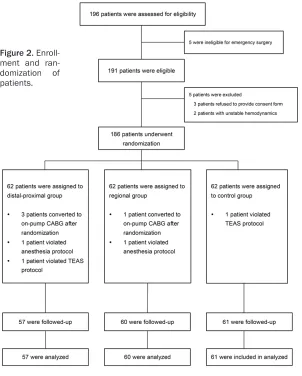
The measurement data with normal distribu-tion are expressed as mean and standard devi-ations (SD) or standard error of the mean (SEM). Discrete data are expressed as numbers and percentages. Baseline clinical and demograph-ic characteristdemograph-ics and procedural data were compared among the three groups by the Student’s t-test or t-test for continuous vari-ables, and the chi-square test or Fisher’s exact test for categorical variables whenever appro-priate. The differences in time course of effect-site concentration of sufentanil, hemodynam-ics, cardiac function parameters, postoperative serum cardiac troponin I and inotrope scores among study groups and among time points within each group were analyzed by repeated measures analysis of variance. For each indi-Figure 2.
Enroll-ment and ran-domization of patients.
Statistical analysis
The trial was conducted to determine whether TEAS on distal-proximal acupo- ints combination was bet-ter in reducing intraopera-tive opioids consumption in patients undergoing OP- CABG surgery as compared to those of regional acu-points combination and control groups. To estimate the sample size, a pilot study was conducted, in which the sufentanil con-sumption was measured in 15 patients undergoing OP-CABG surgery. The ov- erall sufentanil
consump-tion was 351 ± 88 μg in the
preliminary data. Antici-pating a overall intraopera-tive sufentanil
consump-tion of 351 ± 88 μg and
[image:4.612.90.392.71.447.2]vidual, missing values were replaced by the last observed variable value (last observation car-ried forward). SPSS software package version 19.0 (SPSS, Chicago, IL) was used for data analysis. A p value < 0.05 was considered
sta-tistically significant.
Results
Study population
A total of 196 patients were assessed for eligi-bility, 191 patients were eligible while 5 patients were ineligible for enrollment as those were subjected to emergency surgery. Five patients was not randomized although eligible
for the trial, 3 of them refused to provide con-sent form and 2 of them was hemodynamic unstable after entering the operating room. 186 patients underwent randomization and received the intervention according to the
ran-domization assignment. 178 patients fulfilled
the criteria for the full analysis set (61 in control group, 57 in distal-proximal group, 60 in region-al group). Eight patients (one in control group,
five in distal-proximal group, two in regional
[image:5.612.91.522.84.481.2]group) were not included in the full analysis set. Among them, three patients in distal-proximal group and one patient in regional group were transferred to CPB; one patient in distal-proxi-mal group and one patient in regional group violated the standard anesthesia protocol by Table 1. Characteristics and surgical details of patients
Characteristics Control (n = 61) Distal-Proximal (n = 57) Regional (n = 60) P Value
Age (years) 61.3 ± 6.6 61.0 ± 6.3 59.8 ± 7.9 0.503
Male sex-no. (%) 48 (78.7%) 47 (82.5%) 48 (80.0%) 0.873
BMI (kg/m2) 25.4 ± 3.1 25.8 ± 3.5 25.0 ± 5.1 0.567
Preexisting conditions-no. (%) 39 (63.93%) 42 (73.68%) 40 (66.67%) 0.507
Diabetes 23 (37.70%) 18 (31.58%) 19 (31.67%) 0.718
Cerebrovascular disease 8 (13.11%) 9 (15.79%) 7 (11.67%) 0.804
Chronic pulmonary disease 2 (3.28%) 2 (3.51%) 0 0.352
Ulcer disease 3 (4.92%) 1 (1.75%) 1 (1.67%) 0.469
Peripheral vascular disease 2 (3.28%) 1 (1.75%) 3 (5%) 0.623
Preoperative inotrope scores 0.44 ± 0.96 0.19 ± 0.61 0.47 ± 0.97 0.163
Preoperative Laboratory findings
Hb (g/L) 141.2 ± 15.6 141.9 ± 16.9 137.0 ± 17.7 0.246
Scr (umol/L) 86.3 ± 18.7 90.3 ± 18.2 84.6 ± 17.3 0.244
Troponin (ng/mL) 0.55 ± 3.52 2.84 ± 17.86 4.17 ± 29.08 0.606
SV (ml) 54.0 ± 12.8 62.0 ± 19.6 56.7 ± 13.0 0.245
EF
≥55% 44 (72.13%) 41 (71.93%) 45 (75%) 0.915
30-55% 17 (27.87%) 16 (28.07%) 15 (25%) 0.915
EDV (ml) 97.3 ± 22.4 112.6 ± 42.7 101.5 ± 25.2 0.261
LAD (mm) 64.7 ± 14.8 63.1 ± 15.1 63.9 ± 14.6 0.837
ASA Status 0.13
II 9 (14.75%) 14 (24.56%) 18 (30%)
III 52 (85.25%) 43 (75.44%) 42 (70%)
Surgical details
Propofol dosage (mg) 784.0 ± 255.4 826.0 ± 270.4 796.8 ± 263.1 0.674 Time of anaesthesia (min) 200.2 ± 49.8 208.4 ± 57.6 206.3 ± 43.4 0.657
Time of surgery (min) 171.5 ± 40.6 183.0 ± 51.9 179.1 ± 40.0 0.358
Intraoperative inotrope score 3.13 ± 2.28 3.30 ± 2.17 3.46 ± 2.99 0.776
No. of bypassed vessels 2.8 ± 0.8 2.7 ± 0.8 2.7 ± 0.7 0.789
using different sufentanil TCI model; one pa- tient in control group and one patient in distal-proximal group violated the standard TEAS pro-tocol by not starting 30 minutes before anes-thesia (see Figure 2). Baseline demographic and clinical characteristics are shown in Table 1. There were no relevant imbalances among groups at the baseline.
Endpoints results
The cumulative intraoperative consumption of sufentanil in the distal-proximal group (255.0 ±
106.1) was significantly less than those in the
regional group (300.4 ± 106.9) and control group (305.9 ± 119.1) (P = 0.027, Table 2).
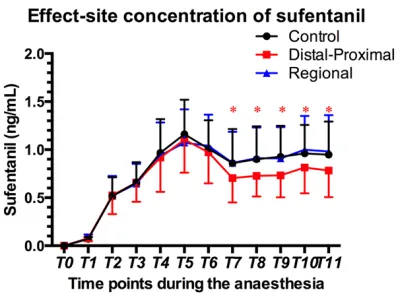
There was no significant difference in sufent -anil effect-site concentration at time points before internal mammary artery dissection (T1-T6). Effect-site concentration of sufentanil was
significantly lower in distal-proximal group than
those in regional and control groups at the time points of T7-T11, which is from the end of inter-nal mammary dissection to the end of opera-tion (Figure 3, P < 0.05). There was no signifi -cant difference in intraoperative propofol consumptions among the groups (P = 0.674). The intraoperative variables as refer to the time of surgery, intraoperative inotrope scores, and the number of vascularized vessels were com-parable among groups (Table 1).
There were no significant differences with
[image:6.612.91.521.87.271.2]res-pect to the secondary endpoints among three groups. The postoperative clinical recovery pa- rameters including APACHE II score, the dura-tion of mechanic ventiladura-tion, the length of CCU stay, the incidence and the duration of re-intu-bation, re-admission to CCU, the incidence of IABP or VAD, the length of postoperative hospi-tal stay, re-operation and re-admission to hos-pital were comparable among groups (Table 2). No TEAS related adverse events were observed. Table 2. Results of endpoints analysis
Endpoints Control (n = 61) Distal-Proximal (n = 57) Regional (n = 60) P Value Primary endpoint
Sufentanil (µg) 305.9 ± 119.1 255.0 ± 106.1* 300.4 ± 106.9 0.027
Secondary endpoints
APACHE II score 18.0 ± 0.9 18.1 ± 1.0 17.9 ± 0.7 0.743
Duration of Ventilation (h) 23.0 ± 29.9 19.0 ± 13.3 20.8 ± 18.1 0.608
Length of CCU stay (h) 62.3 ± 35.3 59.4 ± 28.2 58.2 ± 33.4 0.793
Re-intubation (%) 4 (6.56%) 2 (3.51%) 3 (5.1%) 0.752
Re-admission to CCU (%) 1 (1.64%) 0 (0) 4 (6.67%) 0.073
Length of secondary CCU stay (h) 70.0 ± 0 - 63.5 ± 59.1 0.928
IABP or VAD 0 (0) 0 (0) 0 (0) 1.000
Postoperative hospital stay(day) 8.8 ± 3.4 8.8 ± 2.7 8.8 ± 3.5 0.990
Reoperation (%) 3 (4.92%) 1 (1.75%) 6 (10%) 0.147
Readmission to Hospital (%) 1 (1.64%) 0 (0) 4 (6.67%) 0.093
NOTE. Data are presented as number (%) or mean ± standard deviation. *P < 0.05 compared with control group and regional group. Abbreviations: APACHE, Acute Physiology, Age, Chronic Health Evaluation; CCU, cardiac care unit; IABP, intra-aortic bal-loon counter pulsation; VAD, ventricular assisted device.
[image:6.612.90.293.324.471.2]The hemodynamics was maintained stable dur-ing the whole process (see Figures 4 and 5). The level of postoperative serum cardiac tropo-nin I release was associated with surgical
pro-cedure but did not differ significantly among
groups (see Figure 6A). In addition, the postop-erative cardiac function as measured by the use of cardiac supportive medicine (inotrope
scores) did not differ significantly among groups
(see Figure 6B). Also, there was no significant
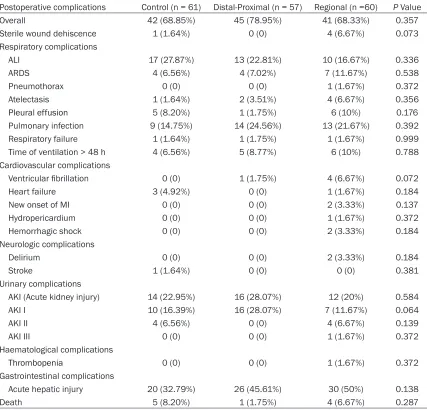
difference with respect to any other secondary endpoints, as refer to postoperative complica-tions and all cause mortality at day 30 among groups (Table 3).
Discussion
In this prospective, double-blinded, random-ized controlled trial in patients scheduled for elective off-pump CABG surgery under total intravenous anesthesia at two medical centers, we demonstrated that TEAS with
distal-proxi-mal acupoints combination significantly
redu-ced intraoperative sufentanil consumption. The
study was the first to compare the opioid spar -ing effect of TEAS between distal-proximal acu-points combination and regional acuacu-points combination in patients undergoing off-pump CABG surgery. The result provides the new evi-dence for the combination of acupoints if the TEAS or acupuncture-drug balanced anesthe-sia [14] is applied to clinical practice.
[image:8.612.93.516.158.330.2]The potent analgesic effects of acupuncture make it be increasingly used during surgery to assist anesthesia [1, 2]. Accumulating evidence suggested that acupuncture alleviated pain and regulated the physiological functions of the body [15, 16]. TEAS combines traditional Ch- inese acupuncture and modern electrical tech-niques, which is non-invasive, safer and more acceptable to patients and clinical doctors [17]. It was reported that acupuncture, electro-acu-puncture (EA) and TEAS were all effective in reducing perioperative analgesic demand and in relieving postoperative pain [1, 18, 19]. How- ever, few studies have investigated the opioid sparing effects of TEAS with different acupoints combination.
Figure 5. Continuous monitoring of cardiac functional parameters during the surgery of off-pump coronary artery bypass grafting in patients receiving control, distal-proximal and regional TEAS. Data were presented as mean ± standard deviation (range bars); A. Cardiac output (CO); B. Cardiac index (CI); C. SVR (systemic vascular resistance); D. Pulmonary vascular resistance (PVR). Time points during the surgery: T4: at the start of surgery, T5: after the sternotomy, T6: after the separation of Internal mammary artery, T7: before clamping the aorta, T8: at the time of re-leasing lateral forceps, T9: 5 minutes after revascularization, T10: at the time of closure, T11; at the end of surgery.
Among the parameters and factors, by which the effects of TEAS are determined, the
speci-ficity of acupoints and different acupoints com -bination are of the paramount importance. Based on the TCM theory and outcomes from previous studies, different acupoints are select-ed for different purposes [20]. Hegu (LI4) is an important acupoint for analgesia as proved in various animal models [21, 22]. In clinical tri-als, TEAS at Hegu (LI4) significantly decreased
intraoperative sufentanil requirements, enhan- ced pain relief postoperatively and thus im- proved postoperative recovery for patients sub-jected to supratentorial tumour resection [18] and sinusotomy [1]. Danzhong (CV17) and Juque (CV14) acupoints are located on the Ren
meridian, which exert therapeutic effects on coronary heart diseases (angina pectoris) ac- cording to Huangdi Neijin (the Yellow Emperor’s Classic). Also, a meridian that passes through or close to the surgical area is usually selected in order to achieve the analgesic effects. Therefore, these three acupoints were selected in the present clinical trial.
Different acupoints combination is the other
key determinant of the clinical efficacy of acu -puncture. Reza et al [4] demonstrated stimula-tion at PC6 and LI4 combinastimula-tion profoundly decreased the incidence of postoperative nau-sea and vomiting when compared to those stimulation at single acupoint PC6 in a double-Table 3. Postoperative complications & mortality(no. (%))
Postoperative complications Control (n = 61) Distal-Proximal (n = 57) Regional (n =60) P Value
Overall 42 (68.85%) 45 (78.95%) 41 (68.33%) 0.357
Sterile wound dehiscence 1 (1.64%) 0 (0) 4 (6.67%) 0.073
Respiratory complications
ALI 17 (27.87%) 13 (22.81%) 10 (16.67%) 0.336
ARDS 4 (6.56%) 4 (7.02%) 7 (11.67%) 0.538
Pneumothorax 0 (0) 0 (0) 1 (1.67%) 0.372
Atelectasis 1 (1.64%) 2 (3.51%) 4 (6.67%) 0.356
Pleural effusion 5 (8.20%) 1 (1.75%) 6 (10%) 0.176
Pulmonary infection 9 (14.75%) 14 (24.56%) 13 (21.67%) 0.392
Respiratory failure 1 (1.64%) 1 (1.75%) 1 (1.67%) 0.999
Time of ventilation > 48 h 4 (6.56%) 5 (8.77%) 6 (10%) 0.788
Cardiovascular complications
Ventricular fibrillation 0 (0) 1 (1.75%) 4 (6.67%) 0.072
Heart failure 3 (4.92%) 0 (0) 1 (1.67%) 0.184
New onset of MI 0 (0) 0 (0) 2 (3.33%) 0.137
Hydropericardium 0 (0) 0 (0) 1 (1.67%) 0.372
Hemorrhagic shock 0 (0) 0 (0) 2 (3.33%) 0.184
Neurologic complications
Delirium 0 (0) 0 (0) 2 (3.33%) 0.184
Stroke 1 (1.64%) 0 (0) 0 (0) 0.381
Urinary complications
AKI (Acute kidney injury) 14 (22.95%) 16 (28.07%) 12 (20%) 0.584
AKI I 10 (16.39%) 16 (28.07%) 7 (11.67%) 0.064
AKI II 4 (6.56%) 0 (0) 4 (6.67%) 0.139
AKI III 0 (0) 0 (0) 1 (1.67%) 0.372
Haematological complications
Thrombopenia 0 (0) 0 (0) 1 (1.67%) 0.372
Gastrointestinal complications
Acute hepatic injury 20 (32.79%) 26 (45.61%) 30 (50%) 0.138
Death 5 (8.20%) 1 (1.75%) 4 (6.67%) 0.287
[image:9.612.93.520.85.495.2]blinded, randomized controlled trial involving 227 surgical patients. Eighty (69.6%) of 115 patients in the combined acupoints group com-plained nausea and vomiting compared with 96 (85.7%) in the single acupoint group. In car-diac surgery, EA bilaterally at regional combina-tion of ZhongFu (LU1), LieQue (LU7), and XiMen (PC4) acupoints for 15-20 min prior to surgical incision to the end of surgery which discontin-ued during cardiopulmonary bypass and res- tarted as the cardiopulmonary bypass pump
flow down to 1.5 L/min consumed only 13% of
the fentanyl required in the control group with-out EA [23]. Empirical evidence of TCM sug-gested the combination of distal-proximal
acu-points produces greater efficacy [9, 11]. Clinical
practice demonstrated acupuncture on distal-proximal acupoints combination had positive therapeutic effects on peripheral facial paraly-sis [11] and advanced osteoarthritis of the knee [24]. In a prospective, randomized, place-bo-controlled trial, TEAS with distal -proximal acupoints combination for 30 min versus no stimulation at the same acupoints before
anes-thesia significantly reduced intraoperative
rem-ifentanil consumption and alleviated postoper-ative side effects in patients undergoing sinus-otomy [1]. Up to now, few studies have com-pared the effects of distal-proximal acupionts combination to the other acupoints combina-tion patterns. Therefore, experimental evidence supporting the superiority of TEAS on distal-proximal acupoints combination to the regional acupoints combination is yet to be obtained. It was demonstrated in the present clinical trial that stimulation on distal-proximal combination of Hegu (LI4) and Danzhong (CV17) consumed less sufentanil than those in regional and con-trol groups in patients undergoing OP-CABG. Patients’ perception and expectations to
treat-ment are one of the central eletreat-ments to the effi -cacy of analgesia and that these elements may contribute to self-reinforcing effects in acu-puncture treatment. To avoid possible bias and to blind the patients, stimulation at non-points (2 cm parallel to the right of regional acu-points) was served as control in the present study. However, the dosage of sufentanil in the regional and control groups was still much lower than those reported in other clinical trial
(468 ± 41 μg) [25] and our preliminary study (351 ± 88 μg). In fact, non-acupoint stimulation exhibited efficacy was demonstrated in other
study [26]. In a largest clinical study for knee
pain [27], acupuncture was found to be not dif-ferent from sham acupuncture treatment at non-acupoints. This was probably due to the fact that the therapeutic effect of the acupunc-ture at non-acupoints does exist or because of the individuals modify or improve their behavior in response to the awareness of being observed (Hawthorne effect). Besides, there is persistent uncertainty about the size and area of acu-points. The acupoint was considered as an area instead of a single point according to TCM theory. Use of electrical stimulation may make
it difficult to separate activation of acupoints
from non-acupoints since the electrical current spreads between acupoints, which may explain the positive effect of the non-acupoints in this study. Moreover, a randomized study [28] showed that patients who believed they received active acupuncture had lower pain lev-els than those who believed they received pla-cebo acupuncture, which backed up the theory of Hawthorne effect. In recent years, the acu-point sensitization phenomenon was observed [29]. That is when the function of internal organs is damaged, the size of acupoints’
receptive fields and the sensitivity of acupoints
changed accordingly. This may also explain the therapeutic effect of controlled non-acupoints stimulation when acupoint sensitization phe-nomenon happened.
Our study has several limitations. As mentioned above, stimulation at non-acupoints close to the regional acupoints as a control might blunt the anesthetic sparing effects of TEAS. The other effects of distal-proximal acupoints com-bination of TEAS on postoperative recovery were inexplicit as well. This may be the poten-tial explanation for failure to detect any differ-ences as refer to the postoperative complica-tions or mortality among three groups. In addition, the small sample size in present trial
may be underpowered to detect any significant benefits of TEAS on postoperative outcomes. A large-scale trial is needed to clarify the benefits
of TEAS with distal-proximal acupoints combi-nation including long-term outcome after sur- gery.
In conclusion, in this prospective,
double-blind-ed, randomized controlled trial, significant
of TEAS with distal-proximal acupoints combi-nation on long-term outcome of patients under-going cardiac surgery.
Acknowledgements
This work was partly supported by National Key Basic Research Program of China (No. 2014CB543202) and National Natural Science Foundation of China (81370011). We thank all the patients who participated in the study and the clinical research staff at the both trial cen-ters, without whose assistance the study would have never been completed. Specially, We thank the research staff at Tianjin Chest Hospital: Jianxu Er, Jiapeng Liu, Wenqian Zhai; the statistician of the Department of Health Statistics of the Fourth Military Medical University: Chen Li.
Disclosure of conflict of interest
None.
Address correspondence to: Lize Xiong, Department of Anesthesiology, Xijing Hospital, Fourth Military Medical University, Xi’an 710032, Shaanxi Province, People’s Republic of China. Tel: +86-13609283068; E-mail: [email protected]; Jiange Han, Department of Anesthesiology, Tianjin Chest Hospital, Tianjin 300051, Tianjin, People’s Republic of China. Tel: +86-13821001156; E-mail: [email protected]
References
[1] Wang H, Xie Y, Zhang Q, Xu N, Zhong H, Dong H, Liu L, Jiang T, Wang Q and Xiong L. Transcu-taneous electric acupoint stimulation reduces intra-operative remifentanil consumption and alleviates postoperative side-effects in pa-tients undergoing sinusotomy: a prospective, randomized, placebo-controlled trial. Br J An-aesth 2014; 112: 1075-1082.
[2] Liu X, Li S, Wang B, An L, Ren X and Wu H. In-traoperative and postoperative anaesthetic and analgesic effect of multipoint transcutane-ous electrical acupuncture stimulation com-bined with sufentanil anaesthesia in patients undergoing supratentorial craniotomy. Acu-punct Med 2015; 33: 270-276.
[3] Yang X, Xiao J, Chen Y, Wang Z, Wang H, He D and Zhang J. Dexamethasone alone vs in com-bination with transcutaneous electrical acu-point stimulation or tropisetron for prevention of postoperative nausea and vomiting in gyn-aecological patients undergoing laparoscopic surgery. Br J Anaesth 2015; 115: 883-889.
[4] Alizadeh R, Esmaeili S, Shoar S, Bagheri-Hariri S and Shoar N. Acupuncture in preventing postoperative nausea and vomiting: efficacy of two acupuncture points versus a single one. J Acupunct Meridian Stud 2014; 7: 71-75. [5] Chen SZ, Cong Q and Zhang BF. Preliminary
comparison on the time-effect rule of pain-re-lieving in the treatment of moderate dysmen-orrhea between acupuncture on single-point and acupuncture on multi-point. Zhongguo Zhen Jiu 2011; 31: 305-308.
[6] Fechner J, Ihmsen H, Schuttler J and Jeleazcov C. The impact of intra-operative sufentanil dos-ing on post-operative pain, hyperalgesia and morphine consumption after cardiac surgery. Eur J Pain 2013; 17: 562-570.
[7] Bovill JG, Sebel PS and Stanley TH. Opioid an-algesics in anesthesia: with special reference to their use in cardiovascular anesthesia. An-esthesiology 1984; 61: 731-755.
[8] Yukioka H, Tanaka M and Fujimori M. Recovery of bowel motility after high dose fentanyl or morphine anaesthesia for cardiac surgery. An-aesthesia 1990; 45: 353-356.
[9] Ling HU. Study and Thinking of the Synergistic Effect of Acupuncture Points. Shanghai Jour-nal of Acupuncture & Moxibustion 2012; 31: 434-437.
[10] Sun YZ. Observations on the Efficacy of Distal-proximal Point Combination in Treating Excess Fire Tinnitus. Shanghai Journal of Acupuncture & Moxibustion 2011; 115: 105-121.
[11] Zhiwei SU, Ying LI, Qin H and Al E. Theoretical Exploration on Distal Proximal Point Combina-tion for Treatment of Peripheral Facial Paraly-sis. Journal of Sichuan of Traditional Chinese Medicine 2013; 31: 26-29.
[12] Marsh B, White M, Morton N and Kenny GN. Pharmacokinetic model driven infusion of pro-pofol in children. Br J Anaesth 1991; 67: 41-48.
[13] Gepts E, Shafer SL, Camu F, Stanski DR, Woes-tenborghs R, Van Peer A and Heykants JJ. Lin-earity of Pharmacokinetics and Model Estima-tion of Sufentanil. Anesthesiology 1995; 83: 1194-1204.
[14] Wu G, Wang Y and Cao X. Acupuncture-Drug Balanced Anesthesia. Springer Berlin Heidel-berg; 2010. pp. 143-161.
[15] Ernst E. Re: Han JS. Acupuncture analgesia: areas of consensus and controversy. Pain 2011; 152(3S): S41-8. Pain 2011; 152: 1439; author reply 1439.
[16] Lee A and Chan S. Acupuncture and anaesthe-sia. Best Pract Res Clin Anaesthesiol 2006; 20: 303-314.
re-duces postoperative pain, nausea and vomit-ing, analgesic requirement, and sympathoad-renal responses. Anesthesiology 2001; 95: 349-356.
[18] An LX, Chen X, Ren XJ, Wu HF. Electro-acupunc-ture decreases postoperative pain and im-proves recovery in patients undergoing a su-pratentorial craniotomy. Am J Chin Med 2014; 42: 1099-1109.
[19] Sun Y, Gan TJ, Dubose JW, Habib AS and Fleck-enstein J. Acupuncture and related techniques for postoperative pain: a systematic review of randomized controlled trials. Br J Anaesth 2008; 101: 54-55.
[20] Lu Z, Dong H, Wang Q, Xiong L and Hardman JG. Perioperative acupuncture modulation: more than anaesthesia. Br J Anaesth 2015; 115: 183-193.
[21] Gao YH, Chen SP, Wang JY, Qiao LN, Han YJ, Lin D, Ji CF, Xu QL, Liu JL. Effects of Electroacu-puncture of “Futu” (LI 18), etc.on Pain Behav-ior and Expression of GABA Receptor Subunit Genes in Cervical Spinal Cord in Rats with Thy-roid Regional Pain. Zhen Ci Yan Jiu 2012; 37: 93-98.
[22] Lin D, Kan Y, Qiao LN, Wang JY, Chen SP, Han YJ, Zhang JL and Liu JL. Effects of Electroacu-puncture at “Futu” (LI 18), etc.on Pain Thresh-old and Cervico-spinal mGlu Receptor 5/ cAMP/CREB Signaling in Rats with Neck Inci-sion Pain. Zhen Ci Yan Jiu 2012; 37: 191-196. [23] Zhou J, Chi H, Cheng TO, Chen TY, Wu YY, Zhou
WX, Shen WD and Yuan L. Acupuncture anes-thesia for open heart surgery in contemporary China. Int J Cardiol 2011; 150: 12-16.
[24] Tillu A, Roberts C and Tillu S. Unilateral versus bilateral acupuncture on knee function in ad-vanced osteoarthritis of the knee--a prospec-tive randomised trial. Acupunct Med 2001; 19: 15-18.
[25] Ma J, Wang X, Xie Y, Yu J, He Q, Li Z, Du J and Jiang X. Spectral entropy monitoring reduces anesthetic dosage for patients undergoing off-pump coronary artery bypass graft surgery. J Cardiothorac Vasc Anesth 2012; 26: 818-821. [26] Liu CZ, Xie JP, Wang LP, Liu YQ, Song JS, Chen
YY, Shi GX, Zhou W, Gao SZ, Li SL, Xing JM, Ma LX, Wang YX, Zhu J, Liu JP. A Randomized Con-trolled Trial of Single Point Acupuncture in Pri-mary Dysmenorrhea. Pain Med 2014; 15: 910-920.
[27] Manheimer E, Linde K, Lao L, Bouter LM and Berman BM. Meta-analysis: acupuncture for osteoarthritis of the knee. Ann Intern Med 2007; 146: 868-877.
[28] Lene V, Sara B, Nobuari T, Hiroyoshi Y, Miho T, Kaptchuk TJ S, Ren S, Troels Staehelin J, Rob-ert Z and Peter S. Specifying the non-specific components of acupuncture analgesia. Pain 2013; 154: 1659-1667.