Annotating the discourse and dialogue structure of SMS message
conversations
Nianwen Xue, Qishen Su, Sooyoung Jeong Brandeis University
Computer Science Department
{xuen,qsu,jeong}@brandeis.edu
Abstract
In this paper we present a framework for annotating the discourse and dialogue structure of SMS message conversations. The annotation specifications integrate el-ements of coherence-based discourse re-lations and communicative acts in con-versational speech. We present annota-tion experiments that show reliable anno-tation can be achieved with this annoanno-tation framework.
1 Introduction
With the pervasive use of mobile devices, Short Message Service (SMS) has been used widely in day-to-day communications. In many cases SMS messages have taken the place of traditional tele-phone conversations, and have become the pre-ferred method for people to communicate with one another. SMS messages are by definition short, and due to its asynchronous nature, a participant does not have to wait to respond before another participant finishes. As a result, it is often the case that the conversation does not alternate in a rigid manner between participants.
The relations between the messages in an SMS conversation are in some ways very similar to those between utterances in conversational speech, where a conversant may agree or disagree with, respond to, or indicate understanding (or non-understanding) of an utterance by another speaker. To the extent that they are similar, the relations between SMS messages can be characterized in terms of the dialogue annotation framework de-scribed in (Core and Allen, 1997). The dialogue structure of the SMS “conversations” also tends to be more complex than that of speech conversa-tions as a result of the more complex turn-taking patterns in SMS messages.
SMS message conversations are also different from conversational speech in that they are primar-ily in text form. Text within a single message also demonstrates the kind of discourse coherence that is typical of written text.
In this paper we describe a framework for anno-tating the discourse and dialogue structure of SMS message conversations. Based on the linguistic characteristics of SMS messages, we design an an-notation framework that integrates elements of di-alogue and discourse annotations, and report ex-periments that show reliable annotation with this framework.
The rest of the paper is organized as follows. In Section 2, we describe our annotation framework in detail. In Section 3 we report results on anno-tation experiments that show reliable annoanno-tation, and we will also discuss sources of disagreement. In Section 4 we discuss related work. We conclude our paper and describe future work in Section 5.
2 Annotation framework
In this section, we describe key elements of our an-notation framework. We first describe basic units of our annotation, and then discuss how the basic units relate to each other to form a dialogue struc-ture. Finally we present the set of relations we use in interpreting this structure.
2.1 Units of annotation
The basic units of annotation are individual text messages. The SMS messages are usually short, and most of the messages consist of single sen-tences, but there are a small and yet significant proportion of messages that consist of multiple sentences. In our current round of annotation, we do not analyze relations between the sentences in-side one message, but we leave that possibility open for future rounds of annotation. Compared
with discourse annotation of newswire text (Carl-son et al., 2001; Prasad et al., 2008), determining the text units to perform annotation on is a rela-tively simple task, due to the fact that there is a natural boundary between text messages.
2.2 Structure of the SMS message conversations
Due to the asynchronous nature of SMS message conversations, individual messages are often “out of order”, and determining which message relates to which is a substantial part of the annotation. This aspect of the annotation is different from the annotation of newswire texts or even conversa-tional speech, where the “normal” order is gener-ally maintained, although in conversation speech, there are often interruptions that break the normal pattern of turn-taking (Stolcke et al., 2000). Al-though there are some exceptions, in general, we assume that one message is only related to one previous message.1 We call the message we are
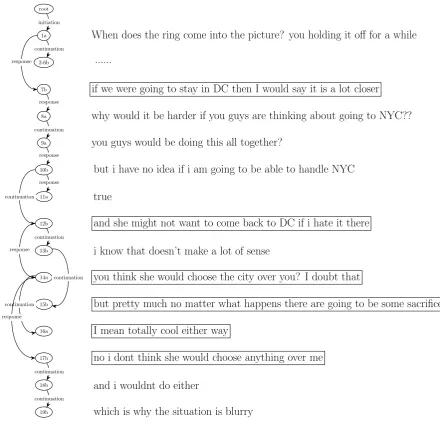
annotating the “anaphor”, and the previous mes-sage that it relates to the “antecedent”. Because the messages are “scrambled”, the antecedent of a message is not always the immediately previ-ous one, although it is in most cases. In addition, the antecedent of a message may not always be from a different participant. A participant may re-spond to a prior message by another participant, or continue his/her own line of thought without re-sponding to an outstanding message from the other participant. A short snippet of an SMS message conversation is presented in Figure 1. On the left side of the figure is a graph that shows how the messages are connected. Each message is identi-fied by a numerical number followed by a letter indicating the ID of the participant. For exam-ple, “7b” indicates message No 7 by participant “b”. As should be clear from the graph, some messages (e.g., 7b,12b,14a, 15b,16a, 17b) are not linked to an immediately previous message, and some messages are connected to a previous mes-sage by the same participant. The graph shares many properties of a dependency tree in that there is a single root, and each anaphor is connected to one antecedent. It also more constrained than a dependency tree at the syntactic level in that the antecedent is always before the anaphor. The de-pendency tree is non-projective, since if all the 1The assumption always holds except for a negligible number of cases where one message responds to multiple pre-vious messages.
arcs are drawn one one side, there will be crossing edges. These properties are important in fashion-ing a strategy for parsfashion-ing this structure automati-cally, a topic that is out of the scope of this paper. Linking each message to its antecedent message is the first step of our annotation project.
2.3 Relations between the messages
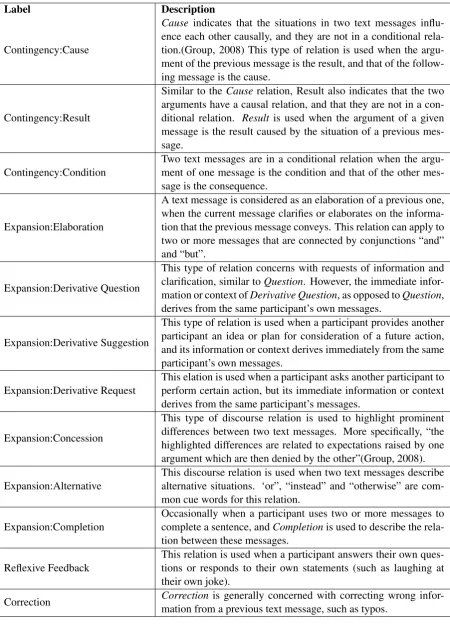
The second aspect of our annotation is to label the edges in graph, that is, to determine the re-lationship between each pair of connected mes-sages. When annotating these relations, we make the distinction between same-participant message pairs and different-participant message pairs. The relations we use to label same-participant mes-sage pairs are drawn from the discourse relations defined in the Penn Discourse TreeBank (Prasad et al., 2008), but some PDTB relations are non-existent in the SMS data. For example, we did not find cases of temporal relations in our SMS con-versation data. This makes senses, since there is not much narrative text in SMS messages as there is in newswire such as Wall Street Journal articles in the PDTB and as a result, temporal relations are mostly unnecessary. On the other hand, there are also relations not covered in the PDTB. For example, there are cases where a participant uses another message to complete a previous message, presumably because s/he hit the “send” button in the middle of a message and later had to complete that message. There are also messages used to cor-rect spelling mistakes of a previous message from the same participant. Such cases are not attested in carefully edited newswire text but they need to be accounted for in our annotation. The complete list of same-participant relations are presented in Table 3.
root
1a When does the ring come into the picture? you holding it off for a while
2-6b ...
7b if we were going to stay in DC then I would say it is a lot closer
8a why would it be harder if you guys are thinking about going to NYC??
9a you guys would be doing this all together?
10b but i have no idea if i am going to be able to handle NYC
11a true
12b and she might not want to come back to DC if i hate it there
13b i know that doesn’t make a lot of sense
14a you think she would choose the city over you? I doubt that
15b but pretty much no matter what happens there are going to be some sacrificest
16a I mean totally cool either way
17b no i dont think she would choose anything over me
18b and i wouldnt do either
19b which is why the situation is blurry initiation
continuation response
response
continuation
response
response
continuation
continuation response
continuation
continuation response
continuation
[image:3.595.72.513.59.489.2]continuation
Figure 1: The SMS message as a dependency tree. The suffixes “a” and “b” on the tree nodes are the two participants. Messages in boxes have non-local (not immediately before) antecedents.
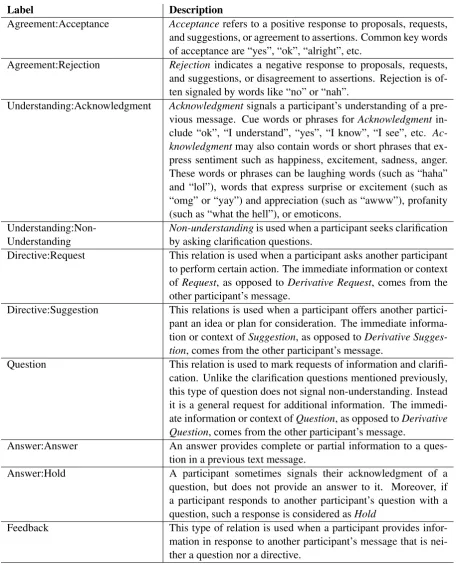
requests or suggestions in the context of a previ-ous message. The following example is a case of directive:suggestion:
(1) A: I’m hungry.
B: let’s go get some food!
It is important to note that unlike DAMSL, the tar-gets of our annotation project are not individual utterances but are relations between pairs of mes-sages. When labeling the backward communica-tive functions of an utterance in DAMSL, the an-tecedent of the utterance is assumed to be the im-mediately previous one, but we cannot make this assumption in our annotation.
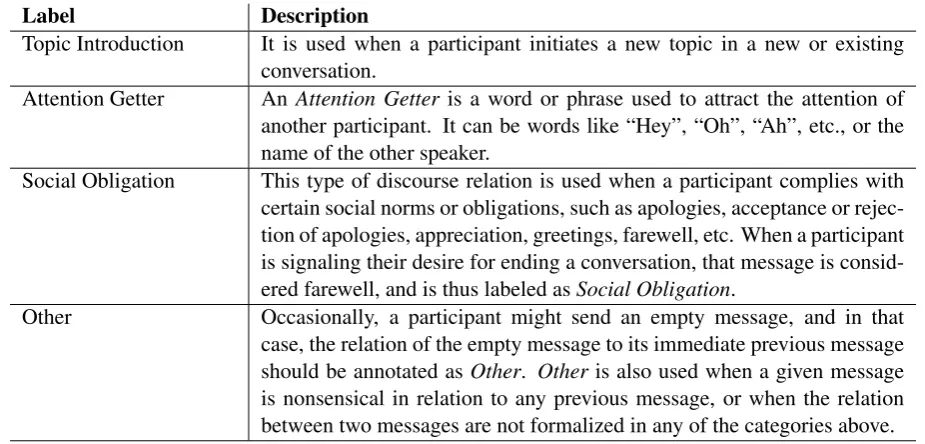
There is a third group of labels that don’t fit nicely into either group of same-participant or
different-participant labels. Those labels are used to label messages that initiate a new topic, get at-tention, or fulfill a social obligation. These mes-sages are explained in Table 4.
3 Annotation Experiments
un-Label Description
Agreement:Acceptance Acceptancerefers to a positive response to proposals, requests, and suggestions, or agreement to assertions. Common key words of acceptance are “yes”, “ok”, “alright”, etc.
Agreement:Rejection Rejection indicates a negative response to proposals, requests, and suggestions, or disagreement to assertions. Rejection is of-ten signaled by words like “no” or “nah”.
Understanding:Acknowledgment Acknowledgmentsignals a participant’s understanding of a pre-vious message. Cue words or phrases forAcknowledgment in-clude “ok”, “I understand”, “yes”, “I know”, “I see”, etc. Ac-knowledgmentmay also contain words or short phrases that ex-press sentiment such as happiness, excitement, sadness, anger. These words or phrases can be laughing words (such as “haha” and “lol”), words that express surprise or excitement (such as “omg” or “yay”) and appreciation (such as “awww”), profanity (such as “what the hell”), or emoticons.
Understanding:Non-Understanding Non-understandingby asking clarification questions.is used when a participant seeks clarification Directive:Request This relation is used when a participant asks another participant to perform certain action. The immediate information or context ofRequest, as opposed toDerivative Request, comes from the other participant’s message.
Directive:Suggestion This relations is used when a participant offers another partici-pant an idea or plan for consideration. The immediate informa-tion or context ofSuggestion, as opposed toDerivative Sugges-tion, comes from the other participant’s message.
Question This relation is used to mark requests of information and clarifi-cation. Unlike the clarification questions mentioned previously, this type of question does not signal non-understanding. Instead it is a general request for additional information. The immedi-ate information or context ofQuestion, as opposed toDerivative Question, comes from the other participant’s message.
Answer:Answer An answer provides complete or partial information to a ques-tion in a previous text message.
Answer:Hold A participant sometimes signals their acknowledgment of a question, but does not provide an answer to it. Moreover, if a participant responds to another participant’s question with a question, such a response is considered asHold
[image:4.595.71.528.59.630.2]Feedback This type of relation is used when a participant provides infor-mation in response to another participant’s message that is nei-ther a question nor a directive.
Figure 2: Dialogue Only Labels
clear instructions in the guidelines or unclear dis-tinctions in the tagset, the guidelines are revised before the next round of annotation starts. We made sure that the document sizes and the num-ber of messages that we annotate in each round stay constant so that we can observe the trend in the agreement statistics after each round of
mes-Label Description
Contingency:Cause
Cause indicates that the situations in two text messages influ-ence each other causally, and they are not in a conditional rela-tion.(Group, 2008) This type of relation is used when the argu-ment of the previous message is the result, and that of the follow-ing message is the cause.
Contingency:Result
Similar to theCauserelation, Result also indicates that the two arguments have a causal relation, and that they are not in a con-ditional relation. Result is used when the argument of a given message is the result caused by the situation of a previous mes-sage.
Contingency:Condition Two text messages are in a conditional relation when the argu-ment of one message is the condition and that of the other mes-sage is the consequence.
Expansion:Elaboration
A text message is considered as an elaboration of a previous one, when the current message clarifies or elaborates on the informa-tion that the previous message conveys. This relainforma-tion can apply to two or more messages that are connected by conjunctions “and” and “but”.
Expansion:Derivative Question
This type of relation concerns with requests of information and clarification, similar toQuestion. However, the immediate infor-mation or context ofDerivative Question, as opposed toQuestion, derives from the same participant’s own messages.
Expansion:Derivative Suggestion
This type of relation is used when a participant provides another participant an idea or plan for consideration of a future action, and its information or context derives immediately from the same participant’s own messages.
Expansion:Derivative Request This elation is used when a participant asks another participant toperform certain action, but its immediate information or context derives from the same participant’s messages.
Expansion:Concession
This type of discourse relation is used to highlight prominent differences between two text messages. More specifically, “the highlighted differences are related to expectations raised by one argument which are then denied by the other”(Group, 2008).
Expansion:Alternative This discourse relation is used when two text messages describealternative situations. ‘or”, “instead” and “otherwise” are com-mon cue words for this relation.
Expansion:Completion Occasionally when a participant uses two or more messages tocomplete a sentence, andCompletionis used to describe the rela-tion between these messages.
Reflexive Feedback This relation is used when a participant answers their own ques-tions or responds to their own statements (such as laughing at their own joke).
Correction Correctionmation from a previous text message, such as typos.is generally concerned with correcting wrong
infor-Figure 3: Non-Dialogue Only Labels
sage is the immediately previous message in only 77.97% of the cases. For the remaining 22.03% of the cases, the antecedent is not the
[image:5.595.74.525.60.687.2]Label Description
Topic Introduction It is used when a participant initiates a new topic in a new or existing conversation.
Attention Getter An Attention Getteris a word or phrase used to attract the attention of another participant. It can be words like “Hey”, “Oh”, “Ah”, etc., or the name of the other speaker.
Social Obligation This type of discourse relation is used when a participant complies with certain social norms or obligations, such as apologies, acceptance or rejec-tion of apologies, appreciarejec-tion, greetings, farewell, etc. When a participant is signaling their desire for ending a conversation, that message is consid-ered farewell, and is thus labeled asSocial Obligation.
[image:6.595.67.530.61.283.2]Other Occasionally, a participant might send an empty message, and in that case, the relation of the empty message to its immediate previous message should be annotated asOther. Otheris also used when a given message is nonsensical in relation to any previous message, or when the relation between two messages are not formalized in any of the categories above.
Figure 4: Dialogue and Non-Dialogue Labels
of “scrambling” is even higher between different-participant message pairs, where one different-participant is responding to a message of another participant.
The inter-annotator agreement statistics for the four rounds of annotation are presented in Table 1. Column 4 shows the agreement on connec-tions only, which is computed as the percentage of messages that are linked to the same antecedent for both annotators. Column 5 shows the agree-ment on relations, which is computed as the pro-portion of message pairs that are annotated with the same relation, out of the total number of con-nections that both annotators agree on. So this cal-culation factors out connections that the two an-notators have disagreements on. Column 6 shows the Cohen’s Kappa on relation agreement. The results show the agreement on connections stays relatively stable between rounds, indicating this aspect of the annotation is rather intuitive, and does not benefit from additional rounds of train-ing. In contrast, there is significant improvement in the agreement on relations as guidelines are re-fined and the distinction between the relations are clarified. The final column shows the agreement on both connections and labels. The agreements statistics are lower, indicating a cumulative effect, but overall, it shows that reliable annotation can be achieved.
The inter-annotator agreement (IAA) statistics on connections are calculated with equation 3
P = Na
Nt
whereNais the total number of same connections, and Nt is the total number of connections. The inter-annotator agreement for connections with la-bel is calculated similarly: Nais the total number of same connections with the same label.
The Cohen’s Kappa score for labels on the same connections is calculated as follows:
K = P1o−−PPe e
wherePo is the sum of probabilities of choosing the same label, andPeis the probability of choos-ing the same label by chance,
Pe= X
Pa i ×Pib
wherePa
i andPibare the probabilities of annotator A and annotator B choosing labeli, respectively.
Peis the sum of the products ofPiaandPib for all labels.
3.1 Examples of Inter-annotator Disagreement
Distance 1 2 3 4 and greater
Dialogue Links 73.30% 17.08% 5.72% 3.88% Non-dialogue
Links 84.22% 11.18% 3.22% 1.36%
Dialogue and Non-dialogue Combined
[image:7.595.73.526.62.159.2]77.97% 14.56% 4.65% 2.80%
Figure 5: Distance Distributions
Number of
Files Number ofMessages Agreementon connec-tions
Agreement
on relations Kappa onrelations Agreementon both
Round 1 10 898 0.886 0.697 0.649 0.618
Round 2 14 873 0.886 0.722 0.680 0.640
Round 3 10 893 0.848 0.838 0.826 0.710
Round 4 10 890 0.867 0.881 0.875 0.764
Table 1: Inter-Annotator agreement statistics
Message ID Timestamp Participant ID Content
m0007 2010-08-24 19:22:45 UTC 153902 Charming is the audience’s subjectiveinterpretation
m0008 2010-08-24 19:22:49 UTC 153901 so you can choose to be condescend-ing? m0009 2010-08-24 19:23:02 UTC 153902 Yes
m0010 2010-08-24 19:23:06 UTC 153901 but you cannot choose to be charming m0011 2010-08-24 19:23:14 UTC 153902 You can attempt to be charming
Figure 6:
Disagreement on connections Although deter-mining which message is connected to which pre-vious message is intuitive for the most part, dis-agreement does happen when a message has more than one possible and meaningful connection. For instance, message m0010 in Figure 6 can be a re-sponse to message m0009 or an extension of mes-sage m0008. This is one of the cases on which the two annotators disagree.
Disagreement on Relations Certain words or phrases are generally ambiguous and prone to causing confusion and disagreement on labeling. For example, the word “yeah” or the phrase “I know” can either signal acknowledgment or ex-press agreement. Disagreement on labeling of-ten occurs when such words or phrases can be interpreted either way in a given context. Mes-sage m0053 in Figure 7 can be either acknowledg-ment or agreeacknowledg-ment of the assertion in their previ-ous message, and either interpretation makes sense in this context.
4 Related work
[image:7.595.73.527.319.434.2]be-Message ID Timestamp Participant ID Content
m0051 2015-02-27 13:45:13 UTC 152252 It’s so stupid Sofie
[image:8.595.78.525.61.134.2]m0052 2015-02-27 13:45:36 UTC 152252 I just feel like the general public shouldtake an art class m0053 2015-02-27 13:45:36 UTC 152212 i know
Figure 7: Disagreement on relations
tween same-participant and different-participant relations, and argue SMS message conversations need to be modeled with an annotation framework based on both discourse coherence and dialogue structures.
5 Conclusion and Future Work
In this paper we presented a framework for anno-tating the discourse and dialogue structure of SMS message conversations. The annotation specifica-tions integrate elements of coherence-based dis-course relations and dialogue structure in conver-sational speech. We conducted annotation experi-ments that show reliable annotation. Future work includes additional annotation based on this an-notation framework and producing sufficient data that can be used to train a statistical parsing model. Acknowledgment
We gratefully acknowledge a Faculty/Student Col-laborative Research Grant from the Office of the Dean of College of Arts and Science Dean’s at Brandeis University that has supported the first and third author of this paper. All errors and short-comings are that of the authors of course.
References
Nicholas Asher and Alex Lascarides. 2003. Logics of
Conversation. Cambridge University Press. Lynn Carlson, Daniel Marcu, and Mary Ellen
Okurowski. 2001. Building a discourse-tagged cor-pus in the framework of rhetorical structure theory. InProceedings of the Second SIGdial Workshop on Discourse and Dialogue - Volume 16, SIGDIAL ’01, pages 1–10, Stroudsburg, PA, USA. Association for Computational Linguistics.
Mark G Core and James Allen. 1997. Coding dialogs with the damsl annotation scheme. InAAAI fall sym-posium on communicative action in humans and ma-chines, pages 28–35. Boston, MA.
The PDTB Research Group. 2008. The PDTB 2.0.
annotation manual. Technical Report IRCS-08-01,
page 28.
Ryan McDonald. 2006. Discriminative Training and
Spanning Tree Algorithms for Dependency Parsing. Ph.D. thesis, University of Pennsylvania.
Stergos Afantenos Eric Kow Nicholas Asher J´er´emy Perret. 2015. Discourse parsing for multi-party
chat dialogues. In Proceedings of the 2015
Con-ference on Empirical Methods in Natural Language Processing, Lisbon, Portugal.
Rashmi Prasad, Nikhil Dinesh, Alan Lee, Eleni Milt-sakaki, Livio Robaldo, Aravind Joshi, and Bon-nie Webber. 2008. The Penn Discourse Treebank 2.0. InProceedings of the 6th International Confer-ence on Language Resources and Evaluation (LREC 2008), Marrakech, Morocco.