
Proceedings of NAACL-HLT 2018: Student Research Workshop, pages 54–60
Igbo Diacritic Restoration using Embedding Models
Ignatius Ezeani Mark Hepple Ikechukwu Onyenwe Chioma Enemuo Department of Computer Science,
The University of Sheffield, United Kingdom. https://www.sheffield.ac.uk/dcs
{ignatius.ezeani, m.r.hepple, i.onyenwe, clenemuo1}@sheffield.ac.uk
Abstract
Igbo is a low-resource language spoken by approximately 30 million people world-wide. It is the native language of the Igbo people of south-eastern Nigeria. In Igbo language, diacritics - orthographic and tonal - play a huge role in the distinction of the meaning and pronunciation of words. Omitting dia-critics in texts often leads to lexical ambigu-ity. Diacritic restoration is a pre-processing task that replaces missing diacritics on words from which they have been removed. In this work, we applied embedding models to the diacritic restoration task and compared their performances to those ofn-gram models. Al-though word embedding models have been successfully applied to various NLP tasks, it has not been used, to our knowledge, for di-acritic restoration. Two classes of word em-beddings models were used: those projected from the English embedding space; and those trained with Igbo bible corpus (≈1m). Our best result, 82.49%, is an improvement on the baselinen-gram models.
1 Introduction
Lexical disambiguation is at the heart of a variety of NLP tasks and systems, ranging from grammar and spelling checkers to machine translation sys-tems. In Igbo language, diacritics - orthographic and tonal - play a huge role in the distinction of the meaning and pronunciation of words (Ezeani et al.,2017,2016). Therefore, effective restoration of diacritics not only improves the quality of cor-pora for training NLP systems but often improves the performance of existing ones (De Pauw et al.,
2007;Mihalcea,2002).
1.1 Diacritic Ambiguities in Igbo
There is a wide range of ambiguity classes in Igbo (Thecla-Obiora,2012). In this paper, we focus on
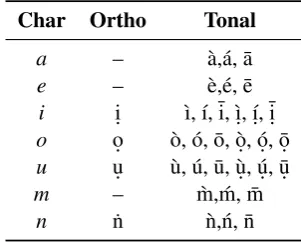
diacritic ambiguities. Besides orthographic dia-critics (i.e. dots below and above), tone marks also impose the actual pronunciation and meaning on different words with the same latinized spelling. Table1shows Igbo diacritic complexity which im-pacts on word meanings and pronunciations1.
Char Ortho Tonal
a – `a,´a, ¯a
e – `e,´e, ¯e
i i. `ı, ´ı, ¯i, `ı., ´ı., ¯i. o o. `o, ´o, ¯o, `o., ´o., ¯o. u u. `u, ´u, ¯u, `u., ´u., ¯u.
m – `m, ´m, ¯m
[image:1.595.338.489.317.438.2]n ˙n `n,´n, ¯n
Table 1: Igbo diacritic complexity
An example of lexical ambiguity caused by the absence of tonal diacritics is the word akwa
which could mean´akw´a(cry),`akw`a(bed/bridge), ´akw`a (cloth) and `akw´a (egg). Another exam-ple of ambiguity due to lack of orthographic di-acritics is the wordugbowhich could mean ´u.gb´o. (craft:car|boat|plane); ´ugb¯o(farm).
1.2 Proposed Approach
As shown in section 2, previous approaches to diacritic restoration techniques depend mostly on existing human annotated resources (e.g. POS-tagged corpora, lexicon, morphological informa-tion). In this work, embedding models were used to restore diacritics in Igbo. For our experiments, models are created by training or projection. The evaluation method is a simple accuracy measure i.e. the average percentage of correctly restored instances over all instance keys. An accuracy of
1In Igbo,mandnarenasal consonantswhich are in some cases treated as tone marked vowels.
82.49%is achieved with theIgboBiblemodel us-ingTweak3confirming our hypothesis that the se-mantic relationships captured in embedding mod-els could be exploited in the restoration of diacrit-ics.
2 Related Works
Some of the key studies in diacritic restoration in-volve word-, grapheme-, and tag-based techniques (Francom and Hulden,2013). Some examples of word-based approaches are the works of Yarowsky (Yarowsky, 1994., 1999) which combined deci-sion list with morphological and collocational in-formation.
Grapheme-based models tend to support low re-source languages better by using character collo-cations. Mihalcea et al (2002) proposed an ap-proach that used character based instances with classification algorithms for Romanian. This later inspired the works of Wagacha et al (2006), De Pauwet al(2011) and Scannell (2011) on a vari-ety of relatively low resourced languages. How-ever, it is a common position that the word-based approach is superior to character-based approach for well resourced languages.
POS-tags and language models have also been applied by Simard (1998) to well resourced lan-guages (French and Spanish) which generally in-volved pre-processing, candidate generation and
disambiguation. Hybrid techniques are common with this task e.g. Yarowsky (1999) used deci-sion list, Bayesian classification and Viterbi de-coding while Crandall (2005) applied Bayesian-and HMM-based methods. Tufis¸ and Chit¸u (1999) used a hybrid approach that backs off to character-based method when dealing with “un-known words”.
Electronic dictionaries, where available, often augment the substitution schemes used (ˇSanti´c
et al.,2009). On Maori, Cocks and Keegan (2011) used na¨ıve Bayes algorithms with wordn-grams to improve on the character based approach by Scan-nell (2011).
For Igbo, however, one major challenge to ap-plying most of the techniques mentioned above that depend on annotated datasets is the lack of these datasets for Igbo e.g tagged corpora, mor-phologically segmented corpora or dictionaries. This work aims at using a resource-light approach that is based on a more generalisable state-of-the-art representation model like word-embeddings
which could be tested on other tasks.
2.1 Igbo Diacritic Restoration
Igbo was among the languages in a previous work (Scannell, 2011) with 89.5% accuracy on web-crawled Igbo data (31k tokens with a vocabulary size of 4.3k). Theirlexicon lookup methods, LL
and LL2 used the most frequent word and a bi-gram model to determine the right replacement. However, their training corpus was too little to be representative and there was no language speaker in their team to validate their results.
Ezeaniet al (2016) implemented a more com-plex set ofn–gram models with similar techniques
on a larger corpus and reported better results but their evaluation method assumed a closed-world by training and testing on the same dataset. Bet-ter results were achieved with the approach re-ported in (Ezeani et al.,2017) but it used a non-standard data representation model which assigns a sequence of real values to the words in the vo-cabulary. This method is not only inefficient but does not capture any relationship that may exist between words in the vocabulary.
Also, for Igbo, diacritic restoration does not al-ways eliminate the need for sense disambiguation. For example, the restored word `akw`acould be re-ferring to eitherbedorbridge. Ezeaniet al(2017) had earlier shown that with proper diacritics on ambiguous wordkeys2(e.g. akwa), a translation system likeGoogle Translatemay perform better at translating Igbo sentences to other languages. This strategy, therefore, could be more easily ex-tended to sense disambiguation in future.
Table 2: Disambiguation challenge forGoogle Trans-late
3 Embedding Projection
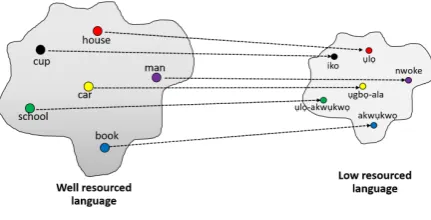
[image:3.595.73.289.191.301.2]Embedding models are very generalisable and therefore will be a good resource for Igbo which has limited resources. We intend to use both trained and projected embeddings for the task. The intuition for embedding projection, illustrated in Figure1, is hinged on the concept of the univer-sality of meaning and representation.
Figure 1: Embedding Projection
We adopt an alignment-based projection method similar to the one described in (Guo et al., 2015). It uses an Igbo-English alignment dictionary AI|E with a function f(wiI) that maps
each Igbo word wiI to all its co-aligned English
words wE
i,j and their counts ci,j as defined in
Equation 1. |VI|is the vocabulary size of Igbo andnis the number of co-aligned English words.
AI|E ={wiI,f(wIi)};i= 1..|VI| f(wIi) ={wi,jE, ci,j};j= 1..n
(1)
The projection is formalised as assigning the weighted average of the embeddings of the co-aligned English words wi,jE to the Igbo word
em-beddingsvec(wIi)(Guo et al.,2015):
vec(wIi)← 1
C
X
wE
i,j),ci,j∈f(wIi)
vec(wi,jE)·ci,j (2)
whereC← X ci,j∈f(wIi)
ci,j
4 Experimental Setup 4.1 Experimental Data
We used the English-Igbo parallel bible corpora, available from the Jehova Witness website3, for
3jw.org
our experiments. The basic statistics are presented in Table34.
Item Igbo English
Lines 32416 32416
Words+puncs 1,070,708 1,048,268 Words only 902,429 881,771 Unique words 16,084 15,000 Diacritized words 595,221 – Unique diacritized words 8,750 – All wordkeys 15,476 – Unique wordkeys 14,926 –
Ambiguous wordkeys: 550 – 2 variants 516 – – 3 variants 19 – – 4 variants 9 – – 5 variants 3 – – 6 variants 3 –
Table 3: Corpus statistics
Table3shows that both the total corpus words and its word types constitute over 50% diacritic words i.e. words with at least one diacritic charac-ter. Over 97% of the ambiguous wordkeys have 2 or 3 variants.
4.2 Experimental Datasets
We chose 29 wordkeys which have several vari-ants occurring in our corpus, the wordkey itself oc-curring too5. For each wordkey, we keep a list of sentences (excluding punctuations and numbers), each with a blank (see Table 5) to be filled with the correct variant of the wordkey.
4.3 Experimental Procedure
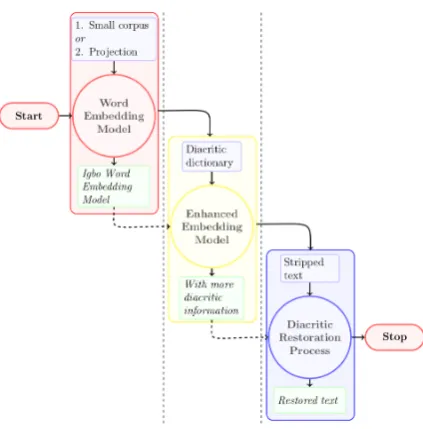
The experimental pipeline, as illustrated in Figure
2, follows three fundamental stages: 4.3.1 Creating embedding model
Four embedding models, two trained and two pro-jected, were created for Igbo in the first stage of the pipeline:
Trained: The first model, IgboBible, is pro-duced from the data described in Table
3 using the Gensim word2vec Python li-braries (ˇReh˚uˇrek and Sojka, 2010). Default 4In these counts, the case of words is preserved e.g.O.tu.tu. ando.tu.tu.have different counts
Figure 2: Pipeline for Igbo Diacritic Restoration using Word Embedding
configurations were used apart from opti-mizing dimension(def ault = 100) and
window size(def ault = 5) parameters to
140 and 2 respectively on theBasic restora-tion method described in secrestora-tion4.3.3.
We also used IgboWiki, a pre-trained Igbo model from fastText Wiki word vectors6 project (Bojanowski et al.,2016).
Projected Using the projection method defined above, we created the IgboGNews model from the pre-trainedGoogle News7word2vec model while the IgboEnBbl is projected from a model we trained on the English bible.
Table4shows the vocabulary sizes (#|V|L) for
embedding models of each languageL, as well as
the dimensions (#vecs) of each of the models used in our experiments. While the pre-trained models and their projections have vector sizes of 300, our trainedIgboBibleperformed best with vector size of 140 and so we trained theIgboEnBblwith the same dimension.
6Pre-trained on 294 different languages of Wikipedia 7https://code.google.com/archive/p/word2vec/
Model #|V|I #vecs #|V|E #data
IgboBible 4968 140 – 902.5k
IgboWiki 3111 300 – (unknown)
IgboGNews 3046 300 3m 100bn
[image:4.595.311.537.61.130.2]IgboEnBbl 4057 140 6.3k 881.8k
Table 4: Igbo and English models: vocabulary, vector and training data sizes
IgboGNewshas a lot ofholesi.e. 1101 out of 4057, (24.92%) entries in the alignment dictionary words were not represented in the Google News embedding model. A quick look at the list re-vealed that they are mostly bible names that do not exist in the Google News model and so have no vectors for their Igbo equivalents e.g. ko.ri.nt,
nimshai., manase, peletai.t, go.g, pileg, abi.shag, aro.na, franki.nsens.
The projection process removes8 these words thereby stripping the model of a quarter of its vocabulary with any linguistic information from them.
4.3.2 Derivingdiacriticembedding models In both training and projection of the embedding model, vectors are assigned to each word in the dictionary, and that includes each diacritic variant of a wordkey. TheBasicrestoration process ( sec-tion 4.3.3) uses this initial embedding model as-is. The models are then refined by “tweaking” the variant vectors to get new ones that correlate more with context embeddings.
For example, letmcwv contain the topnof the
most co-occurring words of a certain variant, v
and their counts,c. The following threetweaking
methods are applied:
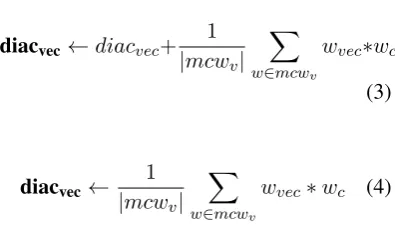
• Tweak1: adds to each diacritic variant
vec-tor the weighted average of the vecvec-tors of its most co-occurring words (see Equation (3)). At restoration time,allthe words in the sen-tence are used to build the context vector.
• Tweak2: updates each variant vector as in
Tweak1but its restoration process usesonly
the vectors of co-occurring words with each of the contesting variants excluding common words.
• Tweak3: is similar to the previous methods
Variant Left context Placeholder Right context Meaning `akw´a ka okwa nke kpokotara o na-eyighi eyi otu egg ´akw`a a kpara akpa mee ngebichi nke onye na-ekwe cloth
[image:5.595.94.292.190.308.2]´akw´a ozugbo m nuru mkpu ha na ihe ndi a cry
Table 5: Instances of the wordkeyakwain context
vectors (see Equation (4)).
diacvec ←diacvec+ 1
|mcwv|
X
w∈mcwv
wvec∗wc
(3)
diacvec ← 1 |mcwv|
X
w∈mcwv
wvec∗wc (4)
wherewcis the ‘weight’ ofwi.e. the
proba-bility distribution of the count ofwinmcwv.
4.3.3 Diacritic restoration process
Algorithm 1 sketches the steps followed to ap-ply the diacritic embedding vectors to the diacritic restoration task. This algorithm is based on the as-sumption that combining the vectors of words in context is likely to yield a vector that is more sim-ilar to the correct diacritic variant. In this process, a set of candidate vectors,Dwk ={d1, ..., dn}for
each wordkey,wk, are extracted from the
embed-ding model. Cis defined as the list of the context words of a sentence containing a placeholder (ex-amples are shown in Table5) to be filled andvecC
is the context vector ofC(Equation (5)).
Algorithm 1Diacritic Restoration Process Require: Embedding & instances with blanks Ensure: Blanks filled with variants
1: load embeddings and instances 2: foreach instancedo
3: Get candidate vectors:Dwk
4: vecC← |C1| X w∈C
embed[w] (5)
5: diacbest←argmax di∈Dwk
sim(vecC, di) (6)
6: end for
5 Evaluation Strategies
A major subtask of this project is building the dataset for training the embedding and other
lan-guage models. For all of the 29 wordkeys9 used in the project, we extracted 38,911 instances each with the correct variant and no diacritics on all words in context. The dataset was used to optimise the parameters in the training of theBasic embed-ding model. Simple unigram and bigram methods were were used as the baseline for the restoration task. 10-fold cross-validation was applied in the evaluation of each of the models.
6 Results and Discussion
Our results (Table 6) indicate that with respect to the n-gram models, the embedding based di-acritic restoration techniques perform compar-atively well. Though the projected models (IgboGNews and IgboEnBbl) appear to have struggled a bit compared to theIgboBible, one can infer that having been trained originally with the same dataset and language of the task may have given the latter some advantage. It also captures all the necessary linguistic information for Igbo better than the projected models.
Again,IgboEnBbldid better thanIgboGNews possibly because it was trained on a corpus that directly aligns with the Igbo data used in the ex-periment. The pre-trained IgboWiki model was abysmally poor possibly because, out of the 3111 entries in its vocabulary, 1,930 (62.04%) were En-glish words while only 345 (11.09%) were found in our Igbo dictionary10 used. It is not clear yet why all the results are the same across the meth-ods. The best restoration technique across the models is theTweak3which suggests that very fre-quent common words may have introduced some noise in the training process.
9The average number of instances is 1341 with the min-imum and maxmin-imum numbers being 38 and 14,157 respec-tively.
Baselines:n-gram models
Unigram Bigram
72.25% 80.84%
Embedding models
Trained Projected
[image:6.595.149.448.61.203.2]IgboBible IgboWiki IgboGNews IgboEnBbl Basic 69.28 18.94 57.57 64.72 Tweak1 74.11 18.94 61.10 69.88 Tweak2 78.75 18.94 67.28 74.84 Tweak3 82.49 18.94 72.98 76.34
Table 6: Accuracy Scores for the Baselines,TrainedandProjectedembedding models [Bolds indicate best tweak-ing method].
7 Conclusion and Future Research Direction
This work contributes to the IgboNLP11 (Onyenwe et al., 2018) project with the ulti-mately goal to build a framework that can adapt, in an effective and efficient way, existing NLP tools to support the development of Igbo. This pa-per addresses the issue of building and projecting embedding models for Igbo as well as applying the models to diacritic restoration.
We have shown that word embeddings can be used to restore diacritics. However, there is still room for further exploration of the techniques pre-sented here. For instance, we can investigate how generalizable the models produced are with re-gards to other tasks e.g. sense disambiguation, word similarity and analogy tasks. On the restora-tion task, the design here appear to be more sim-plistic than in real life as one may want to restore an entire sentence, and by extension a document, and not just fill a blank. Also, with Igbo being a morphologically rich language, the impact of char-acter and sub-word embeddings as compared to word embeddings could be investigated.
References
Piotr Bojanowski, Edouard Grave, Armand Joulin, and Tomas Mikolov. 2016. Enriching word vectors with subword information.CoRR, abs/1607.04606. John Cocks and Te-Taka Keegan. 2011. A
Word-based Approach for Diacritic Restoration in M¯aori. In Proceedings of the Australasian Lan-guage Technology Association Workshop 2011, pages 126–130, Canberra, Australia. Url = http://www.aclweb.org/anthology/U/U11/U11-2016.
11Seeigbonlp.org
David Crandall. 2005. Automatic Accent Restoration in Spanish text. [Online; accessed 7-January-2016].
Guy De Pauw, Gilles-Maurice De Schryver, L. Preto-rius, and L. Levin. 2011. Introduction to the Special Issue on African Language Technology. Language Resources and Evaluation, 45:263–269.
Guy De Pauw, Peter W Wagacha, and Gilles-Maurice De Schryver. 2007. Automatic Diacritic Restoration for Resource-Scarce Language. In International Conference on Text, Speech and Dialogue, pages 170–179. Springer.
Ignatius Ezeani, Mark Hepple, and Ikechukwu Onyenwe. 2016. Automatic Restoration of Diacrit-ics for Igbo Language. In Text, Speech, and Dia-logue: 19th International Conference, TSD 2016, Brno , Czech Republic, September 12-16, 2016, Pro-ceedings, pages 198–205, Cham. Springer Interna-tional Publishing.
Ignatius Ezeani, Mark Hepple, and Ikechukwu Onyenwe. 2017. Lexical Disambiguation of Igbo using Diacritic Restoration.SENSE 2017, page 53.
Jerid Francom and Mans Hulden. 2013. Diacritic er-ror detection and restoration via part-of-speech tags. Proceedings of the 6th Language and Technology Conference.
Jiang Guo, Wanxiang Che, David Yarowsky, Haifeng Wang, and Ting Liu. 2015. Cross-lingual depen-dency parsing based on distributed representations. In Proceedings of the 53rd Annual Meeting of the Association for Computational Linguistics and the 7th International Joint Conference on Natural Lan-guage Processing (Volume 1: Long Papers), vol-ume 1, pages 1234–1244.
Ikechukwu E Onyenwe, Mark Hepple, Uchechukwu Chinedu, and Ignatius Ezeani. 2018. A Basic Lan-guage Resource Kit Implementation for the Igbonlp Project. ACM Trans. Asian Low-Resour. Lang. Inf. Process., 17(2):10:1–10:23.
Radim ˇReh˚uˇrek and Petr Sojka. 2010. Software Frame-work for Topic Modelling with Large Corpora. In Proceedings of the LREC 2010 Workshop on New Challenges for NLP Frameworks, pages 45–50, Val-letta, Malta. ELRA. http://is.muni.cz/
publication/884893/en.
Kevin P. Scannell. 2011. Statistical unicodification of african languages. Language Resource Evaluation, 45(3):375–386.
Michel Simard. 1998. Automatic Insertion of Accents in French texts. Proceedings of the Third Confer-ence on Empirical Methods in Natural Language Processing, pages 27–35.
Udemmadu Thecla-Obiora. 2012. The issue of ambi-guity in the igbo language. AFRREV LALIGENS: An International Journal of Language, Literature and Gender Studies, 1(1):109–123.
Dan Tufis¸ and Adrian Chit¸u. 1999. Automatic Dia-critics Insertion in Romanian Texts. Proceedings of the International Conference on Computational Lex-icography, pages 185–194.
Nikola ˇSanti´c, Jan ˇSnajder, and Bojana Dalbelo Baˇsi´c. 2009. Automatic Diacritics Restoration in Croatian Texts. InThe Future of Information Sciences, Dig-ital Resources and Knowledge Sharing, pages 126– 130. Dept of Info Sci, Faculty of Humanities and Social Sciences, University of Zagreb , 2009. ISBN: 978-953-175-355-5.
Peter W. Wagacha, Guy De Pauw, and Pauline W. Githinji. 2006. A Grapheme-based Approach to Ac-cent Restoration in G˜ik˜uy˜u. InIn Proceedings of the fifth international conference on language resources and evaluation.
David Yarowsky. 1994. A Comparison of Corpus-based Techniques for Restoring Accents in Spanish and French Text. InProceedings, 2nd Annual Work-shop on Very Large Corpora, pages 19–32, Kyoto.
![Table 6: Accuracy Scores for the Baselines, Trained and Projected embedding models [Bolds indicate best tweak-ing method].](https://thumb-us.123doks.com/thumbv2/123dok_us/1398569.674693/6.595.149.448.61.203/table-accuracy-scores-baselines-trained-projected-embedding-indicate.webp)
