Proceedings of NAACL-HLT 2018, pages 687–692
Higher-order Coreference Resolution with Coarse-to-fine Inference
Kenton Lee Luheng He Luke Zettlemoyer
Paul G. Allen School of Computer Science & Engineering University of Washington, Seattle WA
{kentonl, luheng, lsz}@cs.washington.edu
Abstract
We introduce a fully differentiable approxima-tion to higher-order inference for coreference resolution. Our approach uses the antecedent distribution from a span-ranking architecture as an attention mechanism to iteratively re-fine span representations. This enables the model to softly consider multiple hops in the predicted clusters. To alleviate the computa-tional cost of this iterative process, we intro-duce a coarse-to-fine approach that incorpo-rates a less accurate but more efficient bilin-ear factor, enabling more aggressive pruning without hurting accuracy. Compared to the ex-isting state-of-the-art span-ranking approach, our model significantly improves accuracy on the English OntoNotes benchmark, while be-ing far more computationally efficient.
1 Introduction
Recent coreference resolution systems have heav-ily relied on first order models (Clark and Man-ning,2016a;Lee et al.,2017), where only pairs of entity mentions are scored by the model. These models are computationally efficient and scalable to long documents. However, because they make independent decisions about coreference links, they are susceptible to predicting clusters that are locally consistent but globally inconsistent. Fig-ure 1 shows an example from Wiseman et al.
(2016) that illustrates this failure case. The plu-rality of[you]is underspecified, making it locally compatible with both [I] and [all of you], while the full cluster would have mixed plurality, result-ing in global inconsistency.
We introduce an approximation of higher-order inference that uses the span-ranking architecture fromLee et al.(2017) in an iterative manner. At each iteration, the antecedent distribution is used as an attention mechanism to optionally update ex-isting span representations, enabling later
corefer-Speaker 1: Um and [I] think that is what’s - Go ahead Linda.
Speaker 2: Well and uh thanks goes to
[you]and to the media to help us... So our hat is off to[all of you]as well.
Figure 1: Example of consistency errors to which first-order span-ranking models are susceptible. Span pairs (I,you) and (you,all of you) are locally consistent, but the span triplet (I,you,all of you) is globally incon-sistent. Avoiding this error requires modeling higher-order structures.
ence decisions to softly condition on earlier coref-erence decisions. For the example in Figure1, this enables the linking of[you]and[all of you]to de-pend on the linking of[I]and[you].
To alleviate computational challenges from this higher-order inference, we also propose a coarse-to-fine approach that is learned with a single end-to-end objective. We introduce a less accurate but more efficient coarse factor in the pairwise scor-ing function. This additional factor enables an extra pruning step during inference that reduces the number of antecedents considered by the more accurate but inefficient fine factor. Intuitively, the model cheaply computes a rough sketch of likelyantecedents before applying a more expen-sive scoring function.
Our experiments show that both of the above contributions improve the performance of corefer-ence resolution on the English OntoNotes bench-mark. We observe a significant increase in av-erage F1 with a second-order model, but returns quickly diminish with a third-order model. Addi-tionally, our analysis shows that the coarse-to-fine approach makes the model performance relatively insensitive to more aggressive antecedent pruning, compared to the distance-based heuristic pruning from previous work.
2 Background
Task definition We formulate the coreference resolution task as a set of antecedent assignments
yi for each of spaniin the given document, fol-lowingLee et al. (2017). The set of possible as-signments for each yi is Y(i) = {,1, . . . , i − 1}, a dummy antecedent and all preceding
spans. Non-dummy antecedents represent coref-erence links between i and yi. The dummy an-tecedent represents two possible scenarios: (1)
the span is not an entity mention or (2) the span is an entity mention but it is not coreferent with any previous span. These decisions implicitly define a final clustering, which can be recovered by group-ing together all spans that are connected by the set of antecedent predictions.
Baseline We describe the baseline model (Lee et al., 2017), which we will improve to address the modeling and computational limitations dis-cussed previously. The goal is to learn a distri-butionP(yi)over antecedents for each spani:
P(yi) =
es(i,yi) P
y0∈Y(i)es(i,y0)
(1)
where s(i, j) is a pairwise score for a corefer-ence link between span i and span j. The
base-line model includes three factors for this pairwise coreference score: (1)sm(i), whether span iis a
mention, (2)sm(j), whether spanj is a mention,
and (3)sa(i, j)whetherjis an antecedent ofi:
s(i, j) =sm(i) +sm(j) +sa(i, j) (2)
In the special case of the dummy antecedent, the score s(i, ) is instead fixed to 0. A com-mon component used throughout the model is the vector representations gi for each possible span i. These are computed via bidirectional
LSTMs (Hochreiter and Schmidhuber,1997) that learn context-dependent boundary and head repre-sentations. The scoring functionssm andsa take
these span representations as input:
sm(i) =wm>FFNNm(gi) (3)
sa(i, j) =wa>FFNNa([gi,gj,gi◦gj, φ(i, j)])(4) where ◦ denotes element-wise multiplication,
FFNNdenotes a feed-forward neural network, and
the antecedent scoring function sa(i, j) includes
explicit element-wise similarity of each spangi◦ gj and a feature vector φ(i, j) encoding speaker
and genre information from the metadata and the distance between the two spans.
The model above is factored to enable a two-stage beam search. A beam of up toM potential
mentions is computed (whereMis proportional to
the document length) based on the spans with the highest mention scores sm(i). Pairwise
corefer-ence scores are only computed between surviving mentions during both training and inference.
Given supervision of gold coreference clusters, the model is learned by optimizing the marginal log-likelihood of the possibly correct antecedents. This marginalization is required since the best an-tecedent for each span is a latent variable.
3 Higher-order Coreference Resolution
The baseline above is a first-order model, since it only considers pairs of spans. First-order mod-els are susceptible to consistency errors as demon-strated in Figure 1. Unlike in sentence-level se-mantics, where higher-order decisions can be im-plicitly modeled by the LSTMs, modeling these decisions at the document-level requires explicit inference due to the potentially very large surface distance between mentions.
We propose an inference procedure that allows the model to condition on higher-order structures, while being fully differentiable. This inference involvesN iterations of refining span
representa-tions, denoted asgn
i for the representation of span
i at iteration n. At iteration n, gin is computed with an attention mechanism that averages over previous representationsgnj−1weighted according to how likely each mentionjis to be an antecedent
fori, as defined below.
The baseline model is used to initialize the span representation atgi1. The refined span representa-tions allow the model to also iteratively refine the antecedent distributionsPn(yi):
Pn(yi) =
es(gni,gyin) P
y∈Y(i)es(g
n
i,gyn)) (5)
wheresis the coreference scoring function of the
baseline architecture. The scoring function uses the same parameters at every iteration, but it is given different span representations.
At each iteration, we first compute the expected antecedent representationani of each spaniby
an attention mechanism: ani = X
yi∈Y(i)
Pn(yi)·gnyi (6)
The current span representation gn
i is then updated via interpolation with its expected an-tecedent representationani:
fin=σ(Wf[gin,ani]) (7) gin+1 =fin◦gin+ (1−fin)◦ani (8) The learned gate vector fin determines for each dimension whether to keep the current span in-formation or to integrate new inin-formation from its expected antecedent. At iteration n, gin is an element-wise weighted average of approxi-mately n span representations (assuming Pn(yi) is peaked), allowingPn(yi)to softly condition on up tonother spans in the predicted cluster.
Span-ranking can be viewed as predicting latent antecedent trees (Fernandes et al.,2012;Martschat and Strube,2015), where the predicted antecedent is the parent of a span and each tree is a predicted cluster. By iteratively refining the span represen-tations and antecedent distributions, another way to interpret this model is that the joint distribution
Q
iPN(yi) implicitly models every directed path of up to lengthN+ 1in the latent antecedent tree.
4 Coarse-to-fine Inference
The model described above scales poorly to long documents. Despite heavy pruning of potential mentions, the space of possible antecedents for ev-ery surviving span is still too large to fully con-sider. The bottleneck is in the antecedent score
sa(i, j), which requires computing a tensor of size
M×M×(3|g|+|φ|).
This computational challenge is even more problematic with the iterative inference from Sec-tion 3, which requires recomputing this tensor at every iteration.
4.1 Heuristic antecedent pruning
To reduce computation, Lee et al. (2017) heuris-tically consider only the nearest K antecedents
of each span, resulting in a smaller input of size
M×K×(3|g|+|φ|).
The main drawback to this solution is that it im-poses an a priori limit on the maximum distance of a coreference link. The previous work only con-siders up to K = 250nearest mentions, whereas coreference links can reach much further in natu-ral language discourse.
50 100 150 200 250 68
70 72
Antecedents per spanK
De
v.
A
vg.
F1
(%)
Coarse-to-fine (variousK) Coarse-to-fine (chosenK)
[image:3.595.311.512.59.197.2]Heuristic (variousK) Heuristic (chosenK)
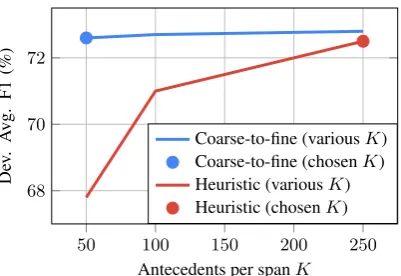
Figure 2: Comparison of accuracy on the development set for the two antecedent pruning strategies with vari-ous beams sizesK. The distance-based heuristic
prun-ing performance drops by almost 5 F1 when reducprun-ing
Kfrom 250 to 50, while the coarse-to-fine pruning
re-sults in an insignificant drop of less than 0.2 F1.
4.2 Coarse-to-fine antecedent pruning
We instead propose a coarse-to-fine approach that can be learned end-to-end and does not establish an a priori maximum coreference distance. The key component of this coarse-to-fine approach is an alternate bilinear scoring function:
sc(i, j) =gi>Wcgj (9)
whereWc is a learned weight matrix. In contrast
to the concatenation-based sa(i, j), the bilinear
sc(i, j)is far less accurate. A direct replacement
of sa(i, j) with sc(i, j) results in a performance
loss of over 3 F1 in our experiments. However,
sc(i, j)is much more efficient to compute.
Com-puting sc(i, j) only requires manipulating
matri-ces of sizeM× |g|andM ×M.
Therefore, we instead propose to usesc(i, j)to
compute a rough sketch oflikelyantecedents. This is accomplished by including it as an additional factor in the model:
s(i, j) =sm(i) +sm(j) +sc(i, j) +sa(i, j)(10)
Similar to the baseline model, we leverage this ad-ditional factor to perform an adad-ditional beam prun-ing step. The final inference procedure involves a three-stage beam search:
First stage Keep the topM spans based on the
mention scoresm(i)of each span.
Second stage Keep the top K antecedents of
each remaining spanibased on the first three
MUC B3 CEAF φ4
Prec. Rec. F1 Prec. Rec. F1 Prec. Rec. F1 Avg. F1
Martschat and Strube(2015) 76.7 68.1 72.2 66.1 54.2 59.6 59.5 52.3 55.7 62.5
Clark and Manning(2015) 76.1 69.4 72.6 65.6 56.0 60.4 59.4 53.0 56.0 63.0
Wiseman et al.(2015) 76.2 69.3 72.6 66.2 55.8 60.5 59.4 54.9 57.1 63.4
Wiseman et al.(2016) 77.5 69.8 73.4 66.8 57.0 61.5 62.1 53.9 57.7 64.2
Clark and Manning(2016b) 79.9 69.3 74.2 71.0 56.5 63.0 63.8 54.3 58.7 65.3
Clark and Manning(2016a) 79.2 70.4 74.6 69.9 58.0 63.4 63.5 55.5 59.2 65.7
Lee et al.(2017) 78.4 73.4 75.8 68.6 61.8 65.0 62.7 59.0 60.8 67.2
+ELMo(Peters et al.,2018) 80.1 77.2 78.6 69.8 66.5 68.1 66.4 62.9 64.6 70.4 + hyperparameter tuning 80.7 78.8 79.8 71.7 68.7 70.2 67.2 66.8 67.0 72.3 + coarse-to-fine inference 80.4 79.9 80.1 71.0 70.0 70.5 67.5 67.2 67.3 72.6 + second-order inference 81.4 79.5 80.4 72.2 69.5 70.8 68.2 67.1 67.6 73.0
Table 1: Results on the test set on the English CoNLL-2012 shared task. The average F1 of MUC, B3, and CEAFφ4is the main evaluation metric. We show only non-ensembled models for fair comparison.
Third stage The overall coreference s(i, j) is computed based on the remaining span pairs. The soft higher-order inference from Section3is com-puted in this final stage.
While the maximum-likelihood objective is computed over only the span pairs from this final stage, this coarse-to-fine approach expands the set of coreference links that the model is capable of learning. It achieves better performance while us-ing a much smallerK(see Figure2).
5 Experimental Setup
We use the English coreference resolution data from the CoNLL-2012 shared task (Pradhan et al.,
2012) in our experiments. The code for replicating these results is publicly available.1
Our models reuse the hyperparameters from
Lee et al.(2017), with a few exceptions mentioned below. In our results, we report two improvements that are orthogonal to our contributions.
• We used embedding representations from a
language model (Peters et al.,2018) at the in-put to the LSTMs (ELMoin the results).
• We changed several hyperparameters: 1. increasing the maximum span width
from 10 to 30 words.
2. using 3 highway LSTMs instead of 1. 3. using GloVe word embeddings (
Pen-nington et al.,2014) with a window size
1https://github.com/kentonl/e2e-coref
of 2 for the head word embeddings and a window size of 10 for the LSTM inputs.
The baseline model considers up to 250 an-tecedents per span. As shown in Figure 2, the coarse-to-fine model is quite insensitive to more aggressive pruning. Therefore, our final model considers only 50 antecedents per span.
On the development set, the second-order model (N = 2) outperforms the first-order model by 0.8 F1, but the third order model only pro-vides an additional 0.1 F1 improvement. There-fore, we only compute test results for the second-order model.
6 Results
We report the precision, recall, and F1 of the the MUC, B3, and CEAF
φ4metrics using the official
CoNLL-2012 evaluation scripts. The main evalu-ation is the average F1 of the three metrics.
Results on the test set are shown in Table1. We include performance of systems proposed in the past 3 years for reference. The baseline relative to our contributions is the span-ranking model from
Lee et al.(2017) augmented with bothELMoand hyperparameter tuning, which achieves 72.3 F1. Our full approach achieves 73.0 F1, setting a new state of the art for coreference resolution.
Compared to the heuristic pruning with up to 250 antecedents, our coarse-to-fine model only computes the expensive scoressa(i, j) for 50
sc(i, j) can be computed for all antecedents,
en-abling the model to potentially predict a corefer-ence link between any two spans in the document. As a result, we observe a much higher recall when adopting the coarse-to-fine approach.
We also observe further improvement by in-cluding the second-order inference (Section 3). The improvement is largely driven by the over-all increase in precision, which is expected since the higher-order inference mainly serves to rule out inconsistent clusters. It is also consistent with findings from Martschat and Strube (2015) who report mainly improvements in precision when modeling latent trees to achieve a similar goal.
7 Related Work
In addition to the end-to-end span-ranking model (Lee et al.,2017) that our proposed model builds upon, there is a large body of literature on coreference resolvers that fundamentally rely on scoring span pairs (Ng and Cardie, 2002; Bengt-son and Roth,2008;Denis and Baldridge, 2008;
Fernandes et al., 2012; Durrett and Klein, 2013;
Wiseman et al.,2015;Clark and Manning,2016a). Motivated by structural consistency issues dis-cussed above, significant effort has also been devoted towards cluster-level modeling. Since global features are notoriously difficult to de-fine (Wiseman et al., 2016), they often depend heavily on existing pairwise features or archi-tectures (Bj¨orkelund and Kuhn, 2014;Clark and Manning, 2015, 2016b). We similarly use an existing pairwise span-ranking architecture as a building block for modeling more complex struc-tures. In contrast to Wiseman et al.(2016) who use highly expressive recurrent neural networks to model clusters, we show that the addition of a rel-atively lightweight gating mechanism is sufficient to effectively model higher-order structures.
8 Conclusion
We presented a state-of-the-art coreference resolu-tion system that models higher order interacresolu-tions between spans in predicted clusters. Addition-ally, our proposed coarse-to-fine approach allevi-ates the additional computational cost of higher-order inference, while maintaining the end-to-end learnability of the entire model.
Acknowledgements
The research was supported in part by DARPA under the DEFT program (FA8750-13-2-0019), the ARO (W911NF-16-1-0121), the NSF (IIS-1252835, IIS-1562364), gifts from Google and Tencent, and an Allen Distinguished Investigator Award. We also thank the UW NLP group for helpful conversations and comments on the work.
References
Eric Bengtson and Dan Roth. 2008. Understanding the value of features for coreference resolution. In EMNLP.
Anders Bj¨orkelund and Jonas Kuhn. 2014. Learn-ing structured perceptrons for coreference resolution with latent antecedents and non-local features. In ACL.
Kevin Clark and Christopher D. Manning. 2015. Entity-centric coreference resolution with model stacking. InACL.
Kevin Clark and Christopher D. Manning. 2016a. Deep reinforcement learning for mention-ranking coreference models. InEMNLP.
Kevin Clark and Christopher D. Manning. 2016b. Im-proving coreference resolution by learning entity-level distributed representations. InACL.
Pascal Denis and Jason Baldridge. 2008. Specialized models and ranking for coreference resolution. In EMNLP.
Greg Durrett and Dan Klein. 2013. Easy victories and uphill battles in coreference resolution. InEMNLP.
Eraldo Rezende Fernandes, C´ıcero Nogueira Dos San-tos, and Ruy Luiz Milidi´u. 2012. Latent structure perceptron with feature induction for unrestricted coreference resolution. InCoNLL.
Sepp Hochreiter and J¨urgen Schmidhuber. 1997. Long Short-term Memory.Neural computation.
Kenton Lee, Luheng He, Mike Lewis, and Luke S. Zettlemoyer. 2017. End-to-end neural coreference resolution. InEMNLP.
Sebastian Martschat and Michael Strube. 2015. Latent structures for coreference resolution. TACL.
Vincent Ng and Claire Cardie. 2002. Identifying anaphoric and non-anaphoric noun phrases to im-prove coreference resolution. Computational lin-guistics.
Matthew E. Peters, Mark Neumann, Mohit Iyyer, Matt Gardner, Christopher Clark, Kenton Lee, and Luke Zettlemoyer. 2018. Deep contextualized word rep-resentations. InHLT-NAACL.
Sameer Pradhan, Alessandro Moschitti, Nianwen Xue, Olga Uryupina, and Yuchen Zhang. 2012. Conll-2012 shared task: Modeling multilingual unre-stricted coreference in ontonotes. InCoNLL.
Sam Wiseman, Alexander M Rush, and Stuart M Shieber. 2016. Learning global features for coref-erence resolution. InNAACL-HLT.