Proceedings of the Thirteenth Workshop on Innovative Use of NLP for Building Educational Applications, pages 247–253
Language Model Based Grammatical Error Correction
without Annotated Training Data
Christopher Bryant Ted Briscoe ALTA Institute
Department of Computer Science and Technology University of Cambridge
Cambridge, UK
{cjb255, ejb1}@cl.cam.ac.uk
Abstract
Since the end of the CoNLL-2014 shared task on grammatical error correction (GEC), re-search into language model (LM) based ap-proaches to GEC has largely stagnated. In this paper, we re-examine LMs in GEC and show that it is entirely possible to build a simple sys-tem that not only requires minimal annotated data (∼1000 sentences), but is also fairly com-petitive with several state-of-the-art systems. This approach should be of particular interest for languages where very little annotated train-ing data exists, although we also hope to use it as a baseline to motivate future research. 1 Introduction
In the CoNLL-2014 shared task on Grammatical Error Correction (GEC) (Ng et al.,2014), the top three teams all employed a combination of sta-tistical machine translation (SMT) or classifier-based approaches (Junczys-Dowmunt and Grund-kiewicz, 2014; Felice et al., 2014; Rozovskaya et al.,2014). These approaches have since come to dominate the field, and a lot of recent research has focused on fine-tuning SMT systems ( Junczys-Dowmunt and Grundkiewicz, 2016), reranking SMT output (Hoang et al., 2016; Yuan et al., 2016), combining SMT and classifier systems ( Su-santo et al., 2014; Rozovskaya and Roth, 2016), and developing various neural architectures ( Chol-lampatt et al., 2016; Xie et al., 2016; Yuan and Briscoe, 2016; Chollampatt and Ng, 2017; Sak-aguchi et al.,2017;Yannakoudakis et al.,2017).
Despite coming a fairly competitive fourth in the shared task however (Lee and Lee, 2014), research into language model (LM) based ap-proaches to GEC has largely stagnated. The main aim of this paper is hence to re-examine language modelling in the context of GEC and show that it is still possible to achieve competitive results even with very simple systems. In fact, a notable
strength of LM-based approaches is that they rely on very little annotated data (purely for tuning pur-poses), and so it is entirely possible to build a rea-sonable correction system for any language given enough native text. In contrast, this is simply not possible with SMT and other popular approaches which always require (lots of) labelled data.
2 Methodology
The core idea behind language modelling in GEC is that low probability sequences are more likely to contain grammatical errors than high probabil-ity sequences. For example, *discuss about the problem is expected to be a low probability se-quence because it contains an error whilediscuss the problemortalk about the problemare expected to be higher probability sequences because they do not contain errors. The goal of LM-based GEC is hence to determine how to transform the former into the latter based on LM probabilities.1
With this in mind, our approach is fundamen-tally a simplification of the algorithm proposed by Dahlmeier and Ng(2012a). It consists of 5 steps and is illustrated in Table1:
1. Calculate the normalised log probability of an input sentence.
2. Build a confusion set, if any, for each token in that sentence.
3. Re-score the sentence substituting each can-didate in each confusion set.
4. Apply the single best correction that in-creases the probability above a threshold. 5. Iterate steps 1-4.
One of the main contributions of this paper is hence to re-evaluate the LM approach in relation to the latest state-of-the-art systems on several benchmark datasets.
1SeeChelba et al.(2014) for more information about pop-ular approaches to language modelling.
Step Sentence Probability
1 I am looking forway to see you soon . -2.71
2 and 3 I
was -2.67 look -2.91 forward -1.80 of -2.98 seeing -3.09 you
sooner -3.05
.
-be -3.09 looks -2.93 Norway -2.36 in -2.99 saw -3.25 soonest -3.20 are -3.10 looked -2.95 foray -2.70 -3.00 sees -3.39
. . . .
4 I am looking forward to see you soon . -1.80
[image:2.595.72.530.60.149.2]5 I am looking forward to seeing you soon . -1.65
Table 1: A step-by-step example of our approach as described in Section2. All scores are log probabilities.
2.1 Sequence Probabilities
We evaluate hypothesis corrections in terms of normalised log probabilities at the sentence level. Normalisation by sentence length is necessary to overcome the tendency for shorter sequences to have higher probabilities than longer sequences. Dahlmeier and Ng (2012a) similarly used nor-malised log probabilities to evaluate hypotheses, but did so as part of a more complex combination of other features. In contrast,Lee and Lee(2014) evaluated hypotheses in terms of sliding five word windows (5-grams).
2.2 Confusion Sets
One of the defining characteristics of LM-based GEC is that the approach does not necessarily require annotated training data. For example, spellcheckers and rules both formed key parts of Dahlmeier and Ng’s and Lee and Lee’s systems. WhileLee and Leeultimately did make use of an-notated training data however,Dahlmeier and Ng instead employed separate classifiers for articles, prepositions and noun number errors trained only on native text.
In this work, we focus on correcting the follow-ing error types in English: non-words, morphol-ogy, and articles and prepositions.2
Non-words: We use CyHunspell3 v1.2.1 with
the latest British English Hunspell dictionaries4to
generate correction candidates for non-word er-rors. Non-words include genuine misspellings, such as [freind →friend], and inflectional errors,
such as [advices→advice]. Although CyHunspell is not a context sensitive spell checker, the pro-posed corrections are evaluated in a context sensi-tive manner by the language model.
2Note that targeting other error types may be more appro-priate in other languages; e.g. Mandarin Chinese contains very little morphology.
3https://pypi.python.org/pypi/
CyHunspell
4https://sourceforge.net/projects/
wordlist/files/speller/2017.08.24/
Morphology: Examples of morphological er-rors include noun number [cat→cats], verb tense [eat → ate] and adjective form [big → bigger],
amongst others. To generate correction candi-dates for morphological errors, we use an Auto-matically Generated Inflection Database (AGID),5
which contains all the morphological forms of many English words. The confusion set for a word is hence derived from this database.
Articles and Prepositions: Since articles and prepositions are closed class words, we defined confusion sets for these error types manually. Specifically, the article confusion set consists of
{, a, an, the}, while the preposition confusion set consists of the top ten most frequent prepositions:
{, about, at, by, for, from, in, of, on, to, with}. Both sets also contain a null character which rep-resents a deletion.
UnlikeDahlmeier and NgandLee and Lee, we do not yet handle missing words (∼20% of all
er-rors) because it is often difficult to know where to insert them.
2.3 Iteration
The main reason to iteratively correct only one word at a time is because errors sometimes inter-act. For example, correcting [see→seeing] in Ta-ble 1 initially reduces the log probability of the input sentence from -2.71 to -3.09. After correct-ing [foray → forward] however, [see → seeing] subsequently increases the probability of the sen-tence from -1.80 to -1.65 in the second iteration. Consequently, correcting the most serious errors first, in terms of language model probability in-crease, often helps facilitate the correction of less serious errors later. Dahlmeier and Ng and Lee and Leeboth also used iterative correction strate-gies in their systems, but did so as part of a beam search or pipeline approach respectively.
Dataset Tokenizer Sents Coders Edits
CoNLL-2013 NLTK 1381 1 3404
CoNLL-2014 NLTK 1312 2 6104
FCE-dev spaCy 2371 1 4419
FCE-test spaCy 2805 1 5556
JFLEG-dev NLTK 754 4 10576
[image:3.595.309.522.60.280.2]JFLEG-test NLTK 747 4 10082
Table 2: Various stats about the learner corpora we use.
3 Data and Resources
In all our experiments, we used a 5-gram language model trained on the One Billion Word Bench-mark dataset (Chelba et al., 2014) with KenLM (Heafield, 2011). While a neural model would likely result in better performance, efficient train-ing on such a large amount of data is still an active area of research (Grave et al.,2017).
Although LM-based GEC does not require an-notated training data, a small amount of anan-notated data is still required for development and testing. We hence make use of several popular GEC cor-pora, including: CoNLL-2013 and CoNLL-2014 (Ng et al.,2013,2014), the public First Certificate in English (FCE) (Yannakoudakis et al., 2011), and JFLEG (Napoles et al.,2017).
Since the FCE was not originally released with an official development set, we use the same split asRei and Yannakoudakis(2016),6 which we
to-kenize with spaCy7 v1.9.0. We also reprocess all
the datasets with the ERRor ANnotation Toolkit (ERRANT) (Bryant et al., 2017) in an effort to standardise them. This standardisation is espe-cially important for JFLEG which is not explicitly annotated and so otherwise cannot be evaluated in terms of F-score. Note that results on CoNLL-2014 and JFLEG are typically higher than on other datasets because they contain more than one refer-ence. See Table2for more information about each of the development and test sets.
4 Tuning
The goal of tuning in our LM-based approach is to determine a probability threshold that optimises F0.5. For example, although the edit [am→was]
in Table 1 increases the normalised sentence log probability from -2.71 to -2.67, this is such a small improvement that it is likely to be a false positive. In order to minimise false positives, we hence set 6https://ilexir.co.uk/datasets/index.
html
7https://spacy.io/
0 2 4 6 8 10
0 10 20 30 40 50 60
Improvement Threshold (%)
ERRANT
F0.5
[image:3.595.72.291.62.147.2]CoNLL-2013 FCE-dev JFLEG-dev
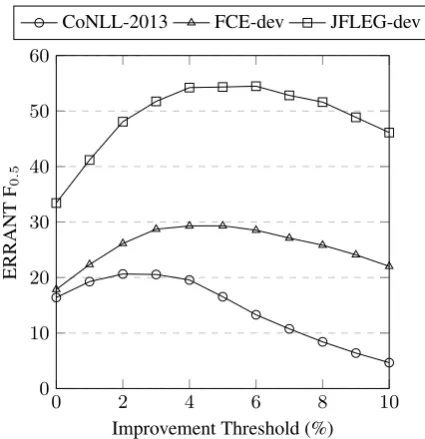
Figure 1: The effect of changing the sentence probabil-ity improvement threshold (%) on ERRANT F0.5 for each of the development sets.
a threshold such that a candidate correction must improve the average token probability of the sen-tence by at least X% before it is applied. Although it may be unusual to use percentages in log space, this is just one way to compare the difference be-tween two sentences which we found worked well in practice.
The results of this tuning are shown in Figure1, where we tried thresholds in the range of 0-10% on three different development sets. It is notable that the optimum threshold for CoNLL-2013 (2%) is very different from that of FCE-dev (4%) and JFLEG-dev (5%), which we suspect is because each dataset has a different error type distribution. For example, spelling errors make up just 0.3% of all errors in CoNLL-2013, but closer to 10% in FCE-dev and JFLEG-dev.
Finally, it should be noted that this threshold is an approximation and it is certainly possible to op-timise further. For example, in future, thresholds could be set based on error types rather than glob-ally.
5 Results and Discussion
Before evaluating performance on the test sets, a final post-processing step changed the first alpha-betical character of every sentence to upper case if necessary. This improved the scores by about 0.3 F0.5in CoNLL-2014 and FCE-test, but by over
ERRANT M2 Scorer
Test Set System P R F0.5 P R F0.5 GLEU
CoNLL-2014
Lee and Lee(2014) 30.60 20.95 28.02 34.51 21.73 30.88 59.50
AMU16SM T+LSTM - - - 58.79 30.63 49.66 68.26
CAMB16SM T+LSTM - - - 49.58 21.84 39.53 65.68
Our work 36.62 19.93 31.37 40.56 20.81 34.09 59.35
FCE-test
AMU16SM T + LSTM - - - 40.67 17.36 32.06 63.57
CAMB16SM T + LSTM - - - 65.03 32.45 54.15 70.72
Our work 41.92 13.62 29.61 44.78 14.12 31.22 60.04
JFLEG-test
AMU16SM T + LSTM - - - 60.68 22.65 45.43 42.65
CAMB16SM T + LSTM - - - 65.86 30.56 53.50 46.74
Sakaguchi et al.(2017) - - - 65.80 40.96 58.68 53.98
[image:4.595.71.528.61.216.2]Our work 73.76 27.61 55.28 76.23 28.48 57.08 48.75
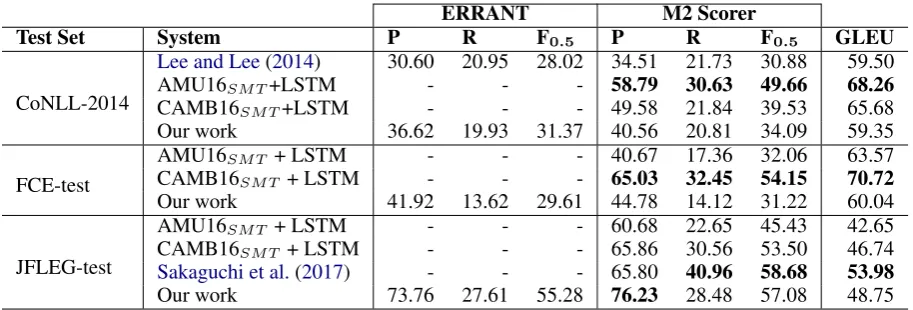
Table 3: Our LM-based approach is compared against several state-of-the-art results. AMU16SM T+LSTM and
CAMB16SM T+LSTM were both originally reported byYannakoudakis et al.(2017), whileLee and Lee(2014) is
the system entered by POST in CoNLL-2014. Only our approach doesnotuse annotated training data.
again shows that different test sets have very dif-ferent error type distributions and that even the simplest of correction strategies can significantly affect results.
Our final scores are shown in Table 3 where they are compared with several state-of-the-art systems. Unfortunately, we cannot compare re-sults withDahlmeier and Ng(2012a) because this system is neither publicly available nor has pre-viously been evaluated on these test sets. Results are reported in terms of M2 F0.5 (Dahlmeier and
Ng,2012b), the de facto standard of GEC evalu-ation; ERRANT F0.5 (Bryant et al.,2017), an
im-proved version of M2 which we used to develop our system; and GLEU (Napoles et al.,2015), an ngram-based metric designed to correlate with hu-man judgements. Results for ERRANT are not available in all cases because system output is not available.
At this point, it is worth reiterating that our main intention was not to necessarily improve upon the state-of-the-art, but rather quantify the extent to which a simple LM-based approach with mini-mal annotated data could compete against a much more sophisticated model trained on millions of words of annotated text. This is especially rele-vant for languages where annotated training data may not be available.
With this in mind, we were firstly pleased to im-prove upon the previous best LM-based approach byLee and Lee(2014) in the CoNLL-2014 shared task. This is especially significant given we also did so without any annotated training data (un-like them). Although our system would still have placed fourth overall, the gap between third and
fourth decreased from 3 F0.5to less than 1 F0.5.
We were also surprised by the high perfor-mance on JFLEG-test, where we not only outper-formed two state-of-the-art systems, but also came to within 2 F0.5 of the top system. This is
espe-cially surprising given our system only corrects a limited number of error types (roughly 14 out of the 55 in ERRANT8), and so can maximally
correct only 40-60% of all errors in each test set. One possible explanation for this is that unlike CoNLL-2014 and FCE-test, which were only cor-rected with minimal edits, JFLEG was corcor-rected for fluency (Sakaguchi et al.,2016), and so it in-tuitively makes sense that LM-based approaches perform better with fluent references.
Although we did not perform as well on CoNLL-2014 or FCE-test, most likely for the same reason, we also note a large discrep-ancy between state-of-the-art systems tuned on different datasets. For example, while AMU16SM T+LSTM tuned for CoNLL achieves the highest result on CoNLL-2014 (49.66 F0.5),
its equivalent performance on FCE-test (32.06 F0.5) is only marginally better than our own
(31.22 F0.5). We observe a similar effect with
CAMB16SM T+LSTM tuned for the FCE, and so are wary of approaches that might be overfitting to their training corpora.
We make all our code and system output avail-able online.9
8R:ADJ:FORM, R:DET, R:MORPH, R:NOUN:INFL, R:NOUN:NUM, R:ORTH, R:PREP, R:SPELL, R:VERB:FORM, R:VERB:INFL, R:VERB:SVA, R:VERB:TENSE, U:DET, U:PREP
9https://github.com/chrisjbryant/
6 Conclusion
In this paper, we have shown that a simple lan-guage model approach to grammatical error cor-rection with minimal annotated data can still be competitive with the latest neural and machine translation approaches that rely on large quantities of annotated training data. This is especially sig-nificant given that our system is also limited by the range of error types it can correct. In the future, we hope to improve our system by adding the ca-pability to correct other error types, such as miss-ing words, and also make use of neural language modelling techniques.
We have demonstrated that LM-based GEC is not only still a promising area of research, but one that may be of particular interest to researchers working on languages where annotated training corpora are not yet available. We released all our code and system output with this paper.
References
Christopher Bryant, Mariano Felice, and Ted Briscoe. 2017. Automatic annotation and evaluation of er-ror types for grammatical erer-ror correction. In Pro-ceedings of the 55th Annual Meeting of the Associa-tion for ComputaAssocia-tional Linguistics (Volume 1: Long Papers). Association for Computational Linguistics, Vancouver, Canada, pages 793–805. http://
aclweb.org/anthology/P17-1074.
Ciprian Chelba, Tomas Mikolov, Mike Schuster, Qi Ge, Thorsten Brants, Phillipp Koehn, and Tony Robinson. 2014. One billion word benchmark for measuring progress in statistical language modeling. In INTERSPEECH 2014, 15th An-nual Conference of the International Speech Communication Association, Singapore,
Septem-ber 14-18, 2014. pages 2635–2639. http:
//www.isca-speech.org/archive/
interspeech_2014/i14_2635.html.
Shamil Chollampatt, Duc Tam Hoang, and Hwee Tou Ng. 2016. Adapting grammatical error correction based on the native language of writers with neu-ral network joint models. In Proceedings of the 2016 Conference on Empirical Methods in Natu-ral Language Processing. Association for Compu-tational Linguistics, Austin, Texas, pages 1901–
1911. https://aclweb.org/anthology/
D16-1195.
Shamil Chollampatt and Hwee Tou Ng. 2017. Con-necting the dots: Towards human-level gram-matical error correction. In Proceedings of the 12th Workshop on Innovative Use of NLP for Building Educational Applications. Association for Computational Linguistics, Copenhagen, Denmark,
pages 327–333. http://www.aclweb.org/
anthology/W17-5037.
Daniel Dahlmeier and Hwee Tou Ng. 2012a. A beam-search decoder for grammatical error correction. In Proceedings of the 2012 Joint Conference on Empir-ical Methods in Natural Language Processing and Computational Natural Language Learning. Asso-ciation for Computational Linguistics, Jeju Island, Korea, pages 568–578. http://www.aclweb.
org/anthology/D12-1052.
Daniel Dahlmeier and Hwee Tou Ng. 2012b. Bet-ter evaluation for grammatical error correction. In Proceedings of the 2012 Conference of the North American Chapter of the Association for Compu-tational Linguistics: Human Language Technolo-gies. Association for Computational Linguistics, Montr´eal, Canada, pages 568–572. http://www.
aclweb.org/anthology/N12-1067.
Mariano Felice, Zheng Yuan, Øistein E. Andersen, He-len Yannakoudakis, and Ekaterina Kochmar. 2014.
Grammatical error correction using hybrid systems and type filtering. InProceedings of the Eighteenth Conference on Computational Natural Language Learning: Shared Task. Association for Computa-tional Linguistics, Baltimore, Maryland, pages 15–
24.http://www.aclweb.org/anthology/
W14-1702.
´Edouard Grave, Armand Joulin, Moustapha Ciss´e, David Grangier, and Herv´e J´egou. 2017. Effi-cient softmax approximation for GPUs. In Doina Precup and Yee Whye Teh, editors, Proceedings of the 34th International Conference on Machine Learning. PMLR, International Convention Cen-tre, Sydney, Australia, volume 70 of Proceed-ings of Machine Learning Research, pages 1302–
1310. http://proceedings.mlr.press/
v70/grave17a.html.
Kenneth Heafield. 2011. KenLM: faster and smaller language model queries. In Proceed-ings of the EMNLP 2011 Sixth Workshop on Statistical Machine Translation. Edinburgh, Scotland, United Kingdom, pages 187–197. https://kheafield.com/papers/
avenue/kenlm.pdf.
Duc Tam Hoang, Shamil Chollampatt, and Hwee Tou Ng. 2016. Exploiting n-best hypotheses to improve an smt approach to grammatical error correction. In Proceedings of the Twenty-Fifth International Joint Conference on Artificial Intelligence (IJCAI-16). AAAI Press / International Joint Conferences on Ar-tificial Intelligence, New York, New York, USA, pages 2803–2809. https://www.ijcai.org/
Proceedings/16/Papers/398.pdf.
Proceedings of the Eighteenth Conference on Com-putational Natural Language Learning: Shared Task. Association for Computational Linguistics, Baltimore, Maryland, pages 25–33. http://
www.aclweb.org/anthology/W14-1703.
Marcin Junczys-Dowmunt and Roman Grundkiewicz. 2016. Phrase-based machine translation is state-of-the-art for automatic grammatical error correc-tion. InProceedings of the 2016 Conference on Em-pirical Methods in Natural Language Processing. Association for Computational Linguistics, Austin, Texas, pages 1546–1556. https://aclweb.
org/anthology/D16-1161.
Kyusong Lee and Gary Geunbae Lee. 2014. Postech grammatical error correction system in the conll-2014 shared task. InProceedings of the Eighteenth Conference on Computational Natural Language Learning: Shared Task. Association for Computa-tional Linguistics, Baltimore, Maryland, pages 65–
73.http://www.aclweb.org/anthology/
W14-1709.
Courtney Napoles, Keisuke Sakaguchi, Matt Post, and Joel Tetreault. 2015. Ground truth for gram-matical error correction metrics. In Proceedings of the 53rd Annual Meeting of the Association for Computational Linguistics and the 7th Inter-national Joint Conference on Natural Language Processing (Volume 2: Short Papers). Associa-tion for ComputaAssocia-tional Linguistics, Beijing, China, pages 588–593. http://www.aclweb.org/
anthology/P15-2097.
Courtney Napoles, Keisuke Sakaguchi, and Joel Tetreault. 2017. Jfleg: A fluency corpus and benchmark for grammatical error correction. In Proceedings of the 15th Conference of the Eu-ropean Chapter of the Association for Computa-tional Linguistics: Volume 2, Short Papers. Associa-tion for ComputaAssocia-tional Linguistics, Valencia, Spain, pages 229–234. http://www.aclweb.org/
anthology/E17-2037.
Hwee Tou Ng, Siew Mei Wu, Ted Briscoe, Christian Hadiwinoto, Raymond Hendy Susanto, and Christo-pher Bryant. 2014. The CoNLL-2014 shared task on grammatical error correction. InProceedings of the Eighteenth Conference on Computational Natural Language Learning: Shared Task. ACL, Baltimore, Maryland, USA, pages 1–14. http://aclweb.
org/anthology/W/W14/W14-1701.pdf.
Hwee Tou Ng, Siew Mei Wu, Yuanbin Wu, Chris-tian Hadiwinoto, and Joel R. Tetreault. 2013. The CoNLL-2013 shared task on grammatical error cor-rection. InProceedings of the Seventeenth Confer-ence on Computational Natural Language Learn-ing: Shared Task. ACL, Sofia, Bulgaria, pages 1–12.
Marek Rei and Helen Yannakoudakis. 2016. Composi-tional sequence labeling models for error detection in learner writing. In Proceedings of the 54th An-nual Meeting of the Association for Computational
Linguistics (Volume 1: Long Papers). Association for Computational Linguistics, Berlin, Germany, pages 1181–1191. http://www.aclweb.org/
anthology/P16-1112.
Alla Rozovskaya, Kai-Wei Chang, Mark Sammons, Dan Roth, and Nizar Habash. 2014. The illinois-columbia system in the conll-2014 shared task. In Proceedings of the Eighteenth Conference on Computational Natural Language Learning: Shared Task. Association for Computational Linguistics, Baltimore, Maryland, pages 34–42. http://
www.aclweb.org/anthology/W14-1704.
Alla Rozovskaya and Dan Roth. 2016. Grammati-cal error correction: Machine translation and clas-sifiers. InProceedings of the 54th Annual Meeting of the Association for Computational Linguistics. Association for Computational Linguistics, Berlin, Germany, pages 2205–2215. http://aclweb.
org/anthology/P16-1208.
Keisuke Sakaguchi, Courtney Napoles, Matt Post, and Joel Tetreault. 2016. Reassessing the goals of grammatical error correction: Fluency instead of grammaticality. Transactions of the Association for Computational Linguistics 4:169–182. https: //tacl2013.cs.columbia.edu/ojs/
index.php/tacl/article/view/800.
Keisuke Sakaguchi, Matt Post, and Benjamin Van Durme. 2017. Grammatical error correction with neural reinforcement learning. InProceedings of the Eighth International Joint Conference on Natural Language Processing (Volume 2: Short Papers). Asian Federation of Natural Language Pro-cessing, Taipei, Taiwan, pages 366–372. http://
www.aclweb.org/anthology/I17-2062.
Raymond Hendy Susanto, Peter Phandi, and Hwee Tou Ng. 2014. System combination for grammat-ical error correction. In Proceedings of the 2014 Conference on Empirical Methods in Nat-ural Language Processing (EMNLP). Associa-tion for ComputaAssocia-tional Linguistics, Doha, Qatar, pages 951–962. http://www.aclweb.org/
anthology/D14-1102.
Ziang Xie, Anand Avati, Naveen Arivazhagan, Dan Ju-rafsky, and Andrew Y. Ng. 2016. Neural language correction with character-based attention. CoRR abs/1603.09727. http://arxiv.org/abs/ 1603.09727.
Helen Yannakoudakis, Ted Briscoe, and Ben Medlock. 2011. A new dataset and method for automatically grading esol texts. InProceedings of the 49th An-nual Meeting of the Association for Computational Linguistics: Human Language Technologies. As-sociation for Computational Linguistics, Portland, Oregon, USA, pages 180–189. http://www.
aclweb.org/anthology/P11-1019.
In Proceedings of the 2017 Conference on Em-pirical Methods in Natural Language Processing. Association for Computational Linguistics, Copen-hagen, Denmark, pages 2795–2806. https://
www.aclweb.org/anthology/D17-1297.
Zheng Yuan and Ted Briscoe. 2016. Grammatical er-ror correction using neural machine translation. In Proceedings of the 2016 Conference of the North American Chapter of the Association for Compu-tational Linguistics: Human Language Technolo-gies. Association for Computational Linguistics, San Diego, California, pages 380–386. http://
www.aclweb.org/anthology/N16-1042.
Zheng Yuan, Ted Briscoe, and Mariano Felice. 2016.
Candidate re-ranking for smt-based grammatical er-ror correction. InProceedings of the 11th Workshop on Innovative Use of NLP for Building Educational Applications. Association for Computational Lin-guistics, San Diego, CA, pages 256–266. http://