SemEval-2007 Task 12: Turkish Lexical Sample Task
Zeynep Orhan Department of Computer Engineering, Fatih University 34500,
Büyükçekmece, Istanbul, Turkey
Emine Çelik Department of Computer Engineering, Fatih University 34500,
Büyükçekmece, Istanbul, Turkey
Neslihan Demirgüç Department of Computer Engineering, Fatih University 34500,
Büyükçekmece, Istanbul, Turkey
Abstract
This paper presents the task definition, re-sources, and the single participant system for Task 12: Turkish Lexical Sample Task (TLST), which was organized in the Se-mEval-2007 evaluation exercise. The methodology followed for developing the specific linguistic resources necessary for the task has been described in this context. A language-specific feature set was defined for Turkish. TLST consists of three pieces of data: The dictionary, the training data, and the evaluation data. Finally, a single system that utilizes a simple statistical method was submitted for the task and evaluated.
1 Introduction
Effective parameters for word sense disambigua-tion (WSD) may vary for different languages and word types. Although, some parameters are com-mon in many languages, some others may be lan-guage specific. Turkish is an interesting lanlan-guage that deserves being examined semantically. Turk-ish is based upon suffixation, which differentiates it sharply from the majority of European languages, and many others. Like all Turkic languages, Turk-ish is agglutinative, that is, grammatical functions are indicated by adding various suffixes to stems. Turkish has a SOV (Subject-Object-Verb) sentence structure but other orders are possible under certain discourse situations. As a SOV language where objects precede the verb, Turkish has postpositions rather than prepositions, and relative clauses that
precede the verb. Turkish, as a widely-spoken lan-guage, is appropriate for semantic researches.
TLST utilizes some resources that are explained in Section 2-5. In Section 6 evaluation of the sys-tem is provided. In section 7 some concluding re-marks and future work are discussed.
2 Corpus
Lesser studied languages, such as Turkish suffer from the lack of wide coverage electronic re-sources or other language processing tools like on-tologies, dictionaries, morphological analyzers, parsers etc. There are some projects for providing data for NLP applications in Turkish like METU Corpus Project (Oflazer et al., 2003). It has two parts, the main corpus and the treebank that con-sists of parsed, morphologically analyzed and dis-ambiguated sentences selected from the main cor-pus, respectively. The sentences are given in XML format and provide many syntactic features that can be helpful for WSD. This corpus and treebank can be used for academic purposes by contract.
Figure 1: XML file structure of the Treebank
Words
Main English translation
#
Senses MFS
Train size
Test size
Total #of instances
Nouns
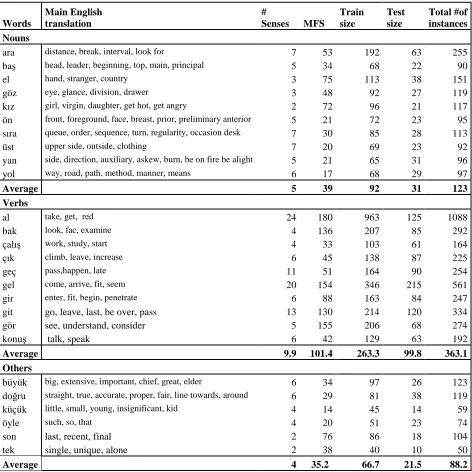
ara distance, break, interval, look for 7 53 192 63 255 baş head, leader, beginning, top, main, principal 5 34 68 22 90 el hand, stranger, country 3 75 113 38 151 göz eye, glance, division, drawer 3 48 92 27 119 kız girl, virgin, daughter, get hot, get angry 2 72 96 21 117 ön front, foreground, face, breast, prior, preliminary anterior 5 21 72 23 95 sıra queue, order, sequence, turn, regularity, occasion desk 7 30 85 28 113 üst upper side, outside, clothing 7 20 69 23 92 yan side, direction, auxiliary, askew, burn, be on fire be alight 5 21 65 31 96 yol way, road, path, method, manner, means 6 17 68 29 97
Average 5 39 92 31 123
Verbs
al take, get, red 24 180 963 125 1088 bak look, fac, examine 4 136 207 85 292 çalış work, study, start 4 33 103 61 164 çık climb, leave, increase 6 45 138 87 225 geç pass,happen, late 11 51 164 90 254 gel come, arrive, fit, seem 20 154 346 215 561 gir enter, fit, begin, penetrate 6 88 163 84 247
git go, leave, last, be over, pass 13 130 214 120 334
gör see, understand, consider 5 155 206 68 274
konuş talk, speak 6 42 129 63 192
Average 9.9 101.4 263.3 99.8 363.1
Others
büyük big, extensive, important, chief, great, elder 6 34 97 26 123
doğru straight, true, accurate, proper, fair, line towards, around 6 29 81 38 119
küçük little, small, young, insignificant, kid 4 14 45 14 59
öyle such, so, that 4 20 51 23 74
son last, recent, final 2 76 86 18 104
tek single, unique, alone 2 38 40 10 50
Average 4 35.2 66.7 21.5 88.2
Table 1: Target words in the SEMEVAL-1 Turkish Lexical Sample task
<?xml version="1.0" encoding="windows-1254" ?> -<Set sentences="1">
-<S No="1">
<W IX="1" LEM="" MORPH="" IG="[(1,"soğuk+Adj")(2,"Adv+Ly")]" REL="[2,1,(MODIFIER)]">Soğukça</W>
<W IX="2" LEM="" MORPH="" IG="[(1,"yanıtla+Verb+Pos+Past+A1sg")]" REL="[3,1,(SENTENCE)]">yanıtladım</W>
<W IX="3" LEM="" MORPH="" IG="[(1,".+Punc")]" REL="[,( )]">.</W> </S>
[image:2.612.71.543.205.677.2]Frequencies of the words have been found as it is necessary to select appropriate ambiguous words for WSD. There are 5356 different root words and 627 of these words have 15 or more occurrences, and the rest have less.
The XML files contains tagging information in the word (morphological analysis) and sentence level as a parse tree as shown in Figure 1. In the word level, inflectional forms are provided. And in the sentence level relations among words are given. The S tag is for sentence and W tag is for the word. IX is used for index of the word in the sentence, LEM is left as blank and lemma is given in the MORPH tag as a part of it with the morpho-logical analysis of the word. REL is for parsing information. It consists of three parts, two numbers and a relation. For example REL="[2, 1, (MODI-FIER)]" means this word is modifying the first in-flectional group of the second word in the sen-tence. The structure of the treebank data was de-signed by METU. Initially lemmas were decided to be provided as a tag by itself, however, lemmas are left as blank. This does not mean that lemmas are not available in the treebank; the lemmas are given as a part of “IG” tag. Programs are available for extracting this information for the time being. All participants can get these programs and thereby the lemmas easily and instantly.
The sense tags were not included in the treebank and had to be added manually. Sense tagging has been checked in order to obtain gold standard data. Initial tagging process has been finished by a sin-gle tagger and controlled. Two other native speaker in the team tagged and controlled the examples. That is, this step was completed by three taggers. Problematic cases were handled by a commission and the decision was finalized when about 90% agreement has been reached.
3 Dictionary
The dictionary is the one that is published by TDK1 (Turkish Language Foundation) and it is open to public via internet. This dictionary lists the senses along with their definitions and example sentences that are provided for some senses. The dictionary is used only for sense tagging and enumeration of the senses for standardization. No specific information other than the sense numbers
1
http://tdk.org.tr/tdksozluk/sozara.htm
is taken from the dictionary; therefore there is no need for linguistic processing of the dictionary.
4 Training and Evaluation Data
In Table 1 statistical information about the final training and testing sets of TLST is summarized. The data have been provided for 3 words in the trial set and 26 words in the final training and test-ing sets (10 nouns, 10 verbs and 6 other POS for the rest of POS including adjectives and adverbs). It has been tagged about 100 examples per word, but the number of samples is incremented or dec-remented depending on the number of senses that specific word has. For a few words, however, fewer examples exist due to the sparse distribution of the data. Some ambiguous words had fewer ex-amples in the corpus, therefore they were either eliminated or some other examples drawn from external resources were added in the same format. On the average, the selected words have 6.7 senses, verbs, however, have more. Approximately 70% of the examples for each word were delivered as training data, whereas approximately 30% was reserved as evaluation data. The distribution of the senses in training and evaluation data has been kept proportional. The sets are given as plain text files for each word under each POS. The samples for the words that can belong to more than one POS are listed under the majority class. POS is provided for each sample.
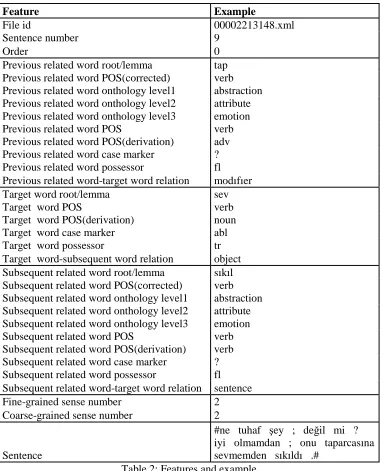
Feature Example
File id 00002213148.xml
Sentence number 9
Order 0
Previous related word root/lemma tap
Previous related word POS(corrected) verb
Previous related word onthology level1 abstraction Previous related word onthology level2 attribute Previous related word onthology level3 emotion
Previous related word POS verb
Previous related word POS(derivation) adv
Previous related word case marker ?
Previous related word possessor fl
Previous related word-target word relation modıfıer
Target word root/lemma sev
Target word POS verb
Target word POS(derivation) noun
Target word case marker abl
Target word possessor tr
Target word-subsequent word relation object
Subsequent related word root/lemma sıkıl
Subsequent related word POS(corrected) verb Subsequent related word onthology level1 abstraction Subsequent related word onthology level2 attribute Subsequent related word onthology level3 emotion
Subsequent related word POS verb
Subsequent related word POS(derivation) verb
Subsequent related word case marker ?
Subsequent related word possessor fl
Subsequent related word-target word relation sentence
Fine-grained sense number 2
Coarse-grained sense number 2
Sentence
[image:4.612.117.498.52.523.2]#ne tuhaf şey ; değil mi ? iyi olmamdan ; onu taparcasına sevmemden sıkıldı .#
Table 2: Features and example In the treebank relational structure, there can be
more than one word in the previous context related to the target, however there is only a single word in the subsequent one. Therefore the data for all words in the previous context is provided sepa-rately. The features that are employed for previous and the subsequent words are the same and they are the root word, POS(corrected), tags for ontol-ogy level 1, level 2 and level 3, POS, inflected POS, case marker, possessor and relation. How-ever for the target word only the root word, POS, inflected POS, case marker, possessor and relation are taken into consideration. Fine and
line that corresponds to this entry will be the fol-lowing line (as tab delimited):
00002213148.xml 9 0 tap verb abstraction attribute emotion verb adv ? fl modıfıer sev verb noun abl tr object sıkıl verb abstraction attribute emotion verb verb ? fl sentence 2 2 #ne tuhaf şey ; değil mi ?iyi olmamdan ; onu taparcasına sevmemden sıkıldı .#
5 Ontology
A small scale ontology for the target words and their context was constructed. The Turkish Word-Net developed at Sabancı University2 is somehow insufficient. Only the verbs have some levels of relations similar to English WordNet. The nouns, adjectives, adverbs and other words that are fre-quently used in Turkish and in the context of the ambiguous words were not included. This is not a suitable resource for fulfilling the requirements of TLST and an ontology specific to this task was required. The ontology covers the examples that are selected and has three levels of relations that are supposed to be effective in the disambiguation process. We tried to be consistent with the Word-Net tags; additionally we constructed the ontology not only for nouns and verbs but for all the words that are in the context of the ambiguous words se-lected. Additionally we tried to strengthen the rela-tion among the context words by using the same tags for all POS in the ontology. This is somehow deviating from WordNet methodology, since each word category has its own set of classification in it.
6 Evaluation
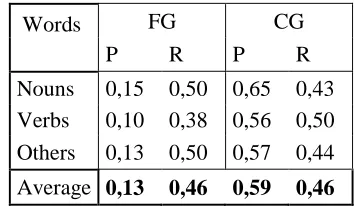
WSD is a new area of research in Turkish. The sense tagged data provided in TLST are the first resources for this specific domain in Turkish. Due to the limited and brand new resources available and the time restrictions the participation was less. We submitted a very simple system that utilizes statistical information. It is similar to the Naïve Bayes approach. The features in the training data was used individually and the probababilities of the senses are calculated. Then in the test phase the probabilities of each sense is calculated with the given features and the three highest-scored senses are selected as the answer. The average precision and recall values for each word category are given
2
http://www.hlst.sabanciuniv.edu/TL/
in Table 3. The values are not so high, as it can be expected. The size of the training data is limited, but the size is the highest possible under these cir-cumstances, but it should be incremented in the near future. The number of senses is high and pro-viding enough instances is difficult. The data and the methodology for WSD will be improved by the experience obtained in SemEval evaluation exer-cise.
The evaluation is done only for FG and CG senses. For FG senses no partial points are as-signed and 1 point is asas-signed for a correct match. On the other hand, the CG senses are evaluated partially. If the answer tags are matching with any of the answer tags they are given points.
FG CG
Words
P R P R
Nouns 0,15 0,50 0,65 0,43 Verbs 0,10 0,38 0,56 0,50 Others 0,13 0,50 0,57 0,44
[image:5.612.336.513.256.359.2]Average 0,13 0,46 0,59 0,46 Table 3: Average Precision and Recall values
7 Conclusion
In TLST we have prepared the first resources for WSD researches in Turkish. Therefore it has sig-nificance in Turkish WSD studies. Although the resources and methodology have some deficien-cies, a valuable effort was invested during the de-velopment of them. The resources and the method-ology for Turkish WSD will be improved by the experience obtained in SemEval and will be open to public in the very near future from http://www.fatih.edu.tr/~zorhan/senseval/senseval.htm.
References
Orhan, Z. and Altan, Z. 2006. Impact of Feature Selec-tion for Corpus-Based WSD in Turkish, LNAI, Springer-Verlag, Vol. 4293: 868-878
Orhan Z. and Altan Z. 2005. Effective Features for Dis-ambiguation of Turkish Verbs, IEC'05, Prague, Czech Republic: 182-186