Parsing Writings of Non-Native Czech
Jirka Hana and Barbora Hladk´a Charles University
Malostransk´e n´am. 25 118 00 Prague 1 Czech Republic
{hana, hladka}@ufal.mff.cuni.cz
Abstract
We present a pilot study on parsing non-native texts written by learners of Czech. We performed experiments that have shown that at least high-level syntac-tic functions, like subject, predicate, and object, can be assigned based on a parser trained on standard native language.
1 Introduction
Texts written by non-native speakers pose a chal-lenge for natural language processing. In this pa-per, we focus on parsing texts written by learners of Czech. There is no syntactically annotated cor-pus of non-native Czech. Therefore, we are ex-ploring a question whether it is possible to use the parser trained a traditional newspaper corpus.
In our experiments we use three main com-ponents: the Prague Dependency Treebank, the CzeSL corpus, and the maximum-spanning tree parser.
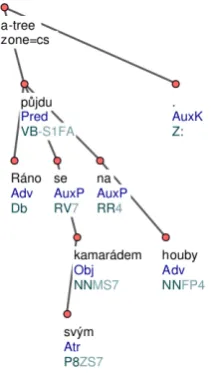
ThePrague Dependency Treebank(PDT)1is a corpus of newspaper texts with rich linguistic an-notation. As an illustration, consider the sentence in (1) and the corresponding labeled dependency tree in Figure1:
(1) R´ano
in-the-morningp˚ujduI-will-gosewithsv´ymmy kamar´adem
friend na houby.mushrooming.
‘I will go mushrooming with my friend in the morning.’
The CzeSL corpus includes essays written by non-native speakers of Czech (Rosen et al.,
2013). Finally, themaximum-spanning tree (MST) parseris a non-projective dependency parser that
[image:1.595.365.471.221.408.2]1https://ufal.mff.cuni.cz/pdt3.0
Figure 1: A sample of PDT tree
searches for maximum spanning trees over di-rected graphs (McDonald et al.,2005).
Given these data and tool components we spec-ify the following initial steps to address our re-search question:
1. Create a testing corpus, by annotating CzeSL according to the PDT annotation guidelines
2. Parse CzeSL by the MST parser trained on PDT or its subset and evaluate its perfor-mance
2 Related work
Research on parsing has mostly concentrated on parsing the traditional treebanks. Therefore most parsers have statistical models that are optimized for the syntactic annotations in these treebanks and more generally for their language. This means that such parsers will show a degradation in perfor-mance when used for parsing data from another domain. Thus research has started on adapting parsers to new domains. One of the first venues
at which domain adaptation was targeted was the 2007 CoNLL shared task on dependency parsing, see (Nivre et al.,2007).
One of the challenges in domain adaptation for parsing is the lack of annotated data in the target domain that could be used for evaluation. Focus-ing on the domain of learner texts and their pars-ing, the great majority of works concern texts of English learners. We support this fact with a list of learner corpora in Table1where their basic char-acteristics are provided.
Dickinson and Ragheb (2015) consider very carefully the SALLE annotation scheme for syn-tactically annotating learner English.2 Napoles
et al.(2016) studied the effect of grammatical er-rors on the dependency parse. As the source of the data, they used the NUCLE corpus. Berzak et al. (2016) benchmarked POS tagging and de-pendency parsing performance on the TLE dataset and measure the effect of grammatical errors on parsing accuracy. Cahill et al. (2014) used self-training parsing technique with both native and non-native training texts. They found that both training sets performed at about the same level, but that both significantly outperformed the baseline parser trained on traditional labeled data.
3 Syntactic annotation of CzeSL
The CzeSL corpus includes transcriptions of es-says written by non-native speakers of Czech. It is focused on native speakers of three main language groups: Slavic, other Indo-European, and non-Indo-European. The hand-written texts cover all language levels, from real beginners to advanced learners.
In this paper, the CzeSL corpus refers to the CzeSL-mancorpus that consists of 645 texts writ-ten by 262 different authors who are native speak-ers of 32 different languages. As shown in Table
2, the texts belong mostly to A2-B2 CEFR.3 Its annotation scheme consists of three intercon-nected layers:
• the T0 layer contains anonymised transcripts of the originals,
• the T1 layer corrects non-existing word forms ignoring context,
2http://cl.indiana.edu/˜salle/
3The Common European Framework of Reference for
Languages; seehttps://en.wikipedia.org/wiki/ Common_European_Framework_of_Reference_ for_Languages.
Level Documents Level Documents
A1 57 B1 176
A1+ 3 B2 124
A2 111 C1 12
A2+ 145 Unknown 17
Table 2: Composition of CzeSL according to CEFR levels.
Jmenujese Adam. Ja jsem Mongolska. Mon-golska ma 21 kraji. Moje rodina je hezka jeˇste velka. Mongolska je 3000 million lidi. Ma tradiˇcni p´ıseˇnka, taneˇcn´ı. Mongolska tradiˇcni p´ısenka je hezka. Jeˇste ma ”Morin khuur”. Morin Khuur to je muzika. Ten hezka tradiˇcni poh´adka, p´ıseˇn. Mongolska m´a mnoho tradiˇcn´ı sv´at´ık. Tˇriba Naadam, Tsagaarsur. Jeˇste mnoho Velbloud, K˚un, Krav´a, Koza, Ovce. Mongolsky lidi dobr´y. Mongolsko ma mnoho hor´y a nemam ocean. Mongolska hlavn´ı namˇesto. Ulaanbaatar. ADAM, 18 Let
Bydlim v ˇCechagh uˇz 6 mˇes´ıc. 1. AHOJ
Figure 2: An essay written by a 16+ male student of the non Indo-European language group staying in the Czech Republic less than a year. The essay is on My family.
• the T2 layer corrects all other types of errors, including syntactic errors.
In our experiment, we focus on learner language, therefore we use only the T0 layer, disregarding any corrections made on the T1 and T2 layers.
Learner texts typically differ from newspaper corpora, i.e., highly edited texts written by native speakers, in two aspects: first, they contain er-rors in spelling, grammar, vocabulary, and collo-cations; second, they have a different distribution of vocabulary and syntactic constructions.
[image:2.595.307.523.65.143.2]TLE NUCLE SALLE CzeSL
Berzak et al.(2016)Dahlmeier et al.(2013)Dickinson and Ragheb(2013)Rosen et al.(2013)
L2 English English English Czech
entity corpus corpus framework corpus
volume 5,124 sentences 1,414 texts NA 645 texts
error annotation • • NA •
POS tags • ◦ NA ◦
[image:3.595.76.522.96.182.2]Universal Dependencies • ◦ NA ◦
Table 1: A number of learner corpora (•annotation present,◦annotation not-present, Not Applicable).
am from Mongolia’. The non-existent word Mon-golskacan be interpreted in at least the following three ways:
1. it is an adjective (mongolsk´aor mongolsk´y) and thus syntactically a predicative nominal; 2. it is a name of an inhabitant (Mongol), a
noun, syntactically a predicative nominal; 3. a place (z Mongolska), a noun, syntactically
an adverbial (adjunct).
It is not clear, whether the language of the speaker actually distinguishes all of these categories.
Learner language is challenging not just for NLP tools, but for human annotation as well. We decided to start partial syntactic analysis. Instead of building a complete dependency tree and la-belling each node, we opted to perform a linear an-notation of subjects, objects, predicates and pred-icative nominals.
Two high-level annotation instructions were for-mulated:
1. Use the PDT guidelines4 to mark subjects, objects, predicates and nominals with the corresponding PDT syntactic functions Sb,
Obj,Pred,Pnom, resp.
2. Annotate the language of the learner, not the target hypothesis (a standard Czech expres-sion with the same meaning). For example, if the learner uses the phrase (2), the word m´ıstnost ‘room’ is annotated as an object, even though a native speaker would use an adverbialdo m´ıstnosti‘into room’.
(2) vstoupit
enter m´ıstnostroom . ‘intended: enter a room.’
4https://ufal.mff.cuni.cz/pdt2.0/doc/ manuals/en/a-layer/pdf/a-man-en.pdf
(3) vstoupit
enter dointom´ıstnostiroom . ‘enter a room.’
In this, we are consistent with other an-notation projects, for example the SALLE project: Try to assume as little as possible about the intended meaning of the learner. (Dickinson and Ragheb,2013)
Unlike a traditional treebanking project, which is a very expensive activity, the CzeSL corpus was annotated in three months by one annotator with a philological education. Instead of intensive train-ing, the annotator annotated the data and studied the guidelines in parallel. When she was in doubt, she consulted the problem with an experienced lin-guist who annotated the Prague Dependency Tree-bank. The annotator used the Brat editor.5
4 Experiments
We experimented with two different parsers: (i) a traditional parser trained on PDT (ii) a parser trained on a simpler subset of Czech. In both cases, we used the MST parser.
4.1 STYX – Training on simpler language On average, sentences in newspapers have a more complicated structure than sentences found in a typical non-native text. This motivated us to ex-periment with a parser that would be trained on a corpus using simpler syntax than that of PDT.
Hladk´a and Kuˇcera (2008) present the STYX, an electronic corpus-based exercise book of Czech grammar.6 The STYX corpus is based on PDT, but contains only ”simple” sentences.
5http://brat.nlplab.org/
syntactic # tokens
function P R F1 in the test data
1.parser: MSTP DT test data: CzeSL
Pred 0.87 0.80 0.83 13,762
Sb 0.60 0.37 0.46 8,119
Obj 0.44 0.61 0.51 12,615
Pnom 0.38 0.50 0.43 2,870
avg / total 0.63 0.62 0.61 37,366
2.parser: MSTStyx test data: CzeSL
Pred 0.70 0.83 0.76 13,762
Sb 0.41 0.31 0.35 8,119
Obj 0.51 0.50 0.51 12,615
Pnom 0.40 0.23 0.29 2,870
avg / total 0.55 0.56 0.55 37,366
3.parser: MSTP DT test data: Styxetest
Pred 0.99 0.98 0.98 1,220
Sb 0.58 0.34 0.42 1,059
Obj 0.34 0.60 0.43 1,066
Pnom 0.37 0.52 0.43 198
avg / total 0.64 0.65 0.62 3,543
4.parser: MSTStyx test data: Styxetest
Pred 0.95 0.96 0.95 1,220
Sb 0.62 0.37 0.47 1,059
Obj 0.58 0.49 0.53 1,066
Pnom 0.49 0.34 0.40 198
[image:4.595.73.294.63.468.2]avg / total 0.71 0.61 0.65 3,543
Table 3: We measure the performance of the MST parser using the following performance measures: Precision, Recall, and F1 measure.
4.2 Results
We have evaluated the two parsers against the manual annotation of CzeSL. For comparison, we have also evaluated them on Styx, i.e. a corpus of native Czech. The results are summarized in Ta-ble 3. The subscript indicates which corpus was used for training (MSTP DT vs MSTStyx). The re-sults are surprising in two ways:
1. the performance on the learner language is nearly comparable to the performance on na-tive Czech.
[image:4.595.311.521.66.288.2]2. training the parser on a simpler language not only does not help, but actually hurts the per-formance
Figure 3: Performance of the parsers on CzeSL: F1-measure CEFR levels. (A1+ and C1 are omit-ted due to low number of documents)
Figure3shows performance of the parsers on the CzeSL corpus by syntactic category and CEFR level. For the PDT parser, the performance is worst for A1 and better on more advanced levels, as expected. However, starting with A2+ level, the performance does not improve with CEFR levels. One of the explanations might be that on the one hand those advanced texts contain less “low-level” errors (errors in spelling and morphology), but on the other hand the sentences get longer and get a more complicated syntax structure.
5 Conclusion and future work
Our experiments have shown that at least high-level syntactic functions, non-native text can be assigned based on a parser trained on standard na-tive language. It has also shown, that training the parser on a subset of standard language limited to simpler construction provided no benefit. Cur-rently, we focus on two main tasks:
• Repeating the annotation of a part of the CzeSL corpus with a second annotator, to be able to calculate inter-annotator agreement
[image:4.595.75.291.66.468.2]Acknowledgments
We gratefully acknowledge support from the Grant Agency of the Czech Republic, grant No. ID 16-10185S.
References
Yevgeni Berzak, Jessica Kenney, Carolyn Spadine, Jing Xian Wang, Lucia Lam, Keiko Sophie Mori,
Sebastian Garza, and Boris Katz. 2016.
Uni-versal Dependencies for Learner English. CoRR, abs/1605.04278.
Aoife Cahill, Binod Gyawali, and James Bruno. 2014.
Self-training for parsing learner text. InProceedings of the First Joint Workshop on Statistical Parsing of Morphologically Rich Languages and Syntactic Analysis of Non-Canonical Languages, pages 66– 73, Dublin, Ireland. Dublin City University.
Daniel Dahlmeier, Hwee Tou Ng, and Siew Mei Wu.
2013. Building a large annotated corpus of learner
english: The nus corpus of learner english. In
Proceedings of the Eighth Workshop on Innova-tive Use of NLP for Building Educational Applica-tions, pages 22–31, Atlanta, Georgia. Association for Computational Linguistics.
Markus Dickinson and Marwa Ragheb. 2013.
An-notation for learner english guidelines, v. 0.1 (june 2013).
Markus Dickinson and Marwa Ragheb. 2015. On
Grammaticality in the Syntactic Annotation of Learner Language. InProceedings of The 9th Lin-guistic Annotation Workshop, pages 158–167, Den-ver, CO.
Barbora Hladk´a and Ondˇrej Kuˇcera. 2008. An anno-tated corpus outside its original context: A
corpus-based exercise book. In ACL 2008: Proceedings
of the Third Workshop on Innovative Use of NLP for Building Educational Applications, pages 36– 43, Columbus, OH, USA. Association for Compu-tational Linguistics (ACL).
Ryan McDonald, Fernando Pereira, Kiril Ribarov, and
Jan Hajiˇc. 2005. Non-projective dependency
pars-ing uspars-ing spannpars-ing tree algorithms. InProceedings of the Conference on Human Language Technology and Empirical Methods in Natural Language Pro-cessing, HLT ’05, pages 523–530, Stroudsburg, PA, USA. Association for Computational Linguistics.
Courtney Napoles, Aoife Cahill, and Nitin Madnani.
2016. The effect of multiple grammatical errors on
processing non-native writing. In Proceedings of the 11th Workshop on Innovative Use of NLP for Building Educational Applications, pages 1–11, San Diego, CA. Association for Computational Linguis-tics.
Joakim Nivre, Johan Hall, Sandra K¨ubler, Ryan Mc-Donald, Jens Nilsson, Sebastian Riedel, and Deniz
Yuret. 2007. The conll 2007 shared task on
depen-dency parsing. InProceedings of the CoNLL Shared Task Session of EMNLP-CoNLL 2007, pages 915– 932, Prague, Czech Republic. Association for Com-putational Linguistics.
Alexandr Rosen, Jirka Hana, Barbora ˇStindlov´a, and
Anna Feldman. 2013. Evaluating and automating