63
CODAH: An Adversarially-Authored Question Answering Dataset for
Common Sense
Michael Chen Mike D’Arcy Alisa Liu Jared Fernandez Doug Downey Department of Computer Science
Northwestern University Evanston, IL 60208
{y-chen, m.m.darcy, alisa, jared.fern}@u.northwestern.edu
Abstract
Commonsense reasoning is a critical AI capa-bility, but it is difficult to construct challenging datasets that test common sense. Recent neu-ral question answering systems, based on large pre-trained models of language, have already achieved near-human-level performance on commonsense knowledge benchmarks. These systems do not possess human-level common sense, but are able to exploit limitations of the datasets to achieve human-level scores.
We introduce the CODAH dataset, an adversarially-constructed evaluation dataset for testing common sense. CODAH forms a challenging extension to the recently-proposed SWAG dataset, which tests commonsense knowledge using sentence-completion ques-tions that describe situaques-tions observed in video. To produce a more difficult dataset, we introduce a novel procedure for question acquisition in which workers author questions designed to target weaknesses of state-of-the-art neural question answering systems. Workers are rewarded for submissions that models fail to answer correctly both before andafter fine-tuning (in cross-validation). We create 2.8k questions via this procedure and evaluate the performance of multiple state-of-the-art question answering systems on our dataset. We observe a significant gap between human performance, which is 95.3%, and the performance of the best baseline accuracy of 65.3% by the OpenAI GPT model.
1 Introduction
Enabling commonsense reasoning in machines is a longstanding challenge in AI. The rise of data-driven methods has led to interest in developing large datasets for commonsense reasoning over text.
The Situations With Adversarial Generations (SWAG) dataset (Zellers et al.,2018) introduced
a large-scale benchmark for commonsense ques-tion answering in the form of multiple choice sen-tence completion questions describing situations as observed in video. However, while SWAG was constructed to be resistant to certain baseline al-gorithms, powerful subsequent methods were able to perform very well on the dataset. In partic-ular, the development of the transformer archi-tecture (Vaswani et al., 2017) has led to power-ful pre-trained language model representations, in-cluding the OpenAI Transformer Language Model (Radford et al., 2018) and the Bidirectional En-coder Representations from Transformers (BERT) model (Devlin et al., 2018). BERT achieved new state-of-the-art performance on SWAG that exceeded even that of a human expert. How-ever, BERT does not possess human-level com-mon sense in general, as our experiments decom-mon- demon-strate. It is instead able to exploit regularities in the SWAG dataset to score high. This motivates the construction of additional datasets that pose new challenges, and serve as more reliable bench-marks for commonsense reasoning systems.
In this work, we introduce the COmmonsense
Dataset Adversarially-authored by Humans (CODAH) for commonsense question answering in the style of SWAG multiple choice sentence completion. We propose a novel method for question generation, in which human annotators are educated on the workings of a state-of-the-art question answering model, and are asked to submit questions that adversarially target the weaknesses. Annotators are rewarded for sub-missions in which the model fails to identify the correct sentence completion both before and
after fine-tuning on a sample of the submitted questions, encouraging the creation of questions that are not easily learnable.
large gap between system performance and hu-man expert accuracy, even when using state-of-the-art pre-trained language models with and with-out fine-tuning on the large SWAG dataset. Us-ing a model initially fine-tuned on SWAG, we find that the OpenAI GPT-1 and BERT neural ques-tion answering models yield 65.3% and 64.5% accuracy, respectively, on the CODAH dataset in cross-validation. Thus, cross-validating on CO-DAH can form a challenging additional evaluation for SWAG-style commonsense QA systems. Hu-man evaluators achieve 95.3% accuracy, which is substantially higher than the 85.0% (Zellers et al.,
2018) and 87.7% (Ghaeini et al., 2018) human performance on the SWAG and SNLI natural lan-guage inference tasks. The high human perfor-mance suggests that answers to the CODAH ques-tions are in fact commonsense knowledge. Finally, we also analyze differences in performance across questions that target different types of common-sense reasoning, including quantitative, negation, and object reference, showing consistency in per-formance for BERT and GPT on the proposed cat-egories.
2 Related Work
Prior work in question answering has largely focused on the development of reading comprehension-based question answering and resulted in the creation of several large datasets for factoid extraction such as SQuAD (Rajpurkar et al., 2016, 2018) and the Google Natural Questions datasets (Kwiatkowski et al.,2019). In these tasks, extraction of correct answers from the provided context requires little external world knowledge, understanding of intents, or other commonsense knowledge.
Earlier work has established multiple bench-marks for natural language inference and linguis-tic entailment with the release SNLI (Bowman et al., 2015) and MultiNLI datasets (Williams et al., 2018). In these tasks, systems must iden-tify whether a hypothesis agrees with or contra-dicts a provided premise. In these datasets, de-termining entailment solely relies upon the pro-vided premise and does not require a question answering system to utilize external knowledge. More recently, the SWAG dataset (Zellers et al.,
2018) directly targets natural language inference that leverages commonsense knowledge. SWAG multiple choice completion questions are
con-structed using a video caption as the ground truth with incorrect counterfactuals created using adversarially-filtered generations from an LSTM language model. State-of-the-art models for natu-ral language inference have rapidly improved and approach human performance, which leaves lit-tle room for continued improvement on current benchmarks.
Generation of adversarial examples has also been used to increase the robustness of NLP sys-tems as part of the Build it, Break It, The Lan-guage Edition Workshop (Ettinger et al., 2017). In this workshop, builders designed systems for Sentiment Analysis and Question Answer Driven Semantic Role Labeling tasks and were evaluated on the accuracy of their models on adversarial test cases designed by breakers. Whereas Build It Break It adversarial generation required sub-missions to match the format of a starter dataset and offered limited adversarial access to the target NLP systems, the CODAH construction procedure allows for entirely new questions and provide ad-versaries with a target model throughout the sub-mission process, allowing workers to experiment.
3 The CODAH Dataset
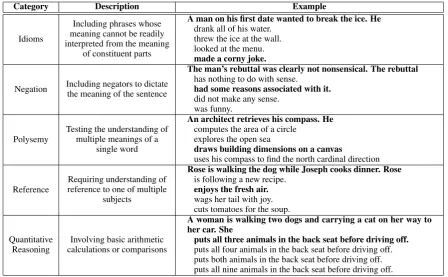
Our dataset contains multiple choice sentence completion questions in the format of the SWAG dataset. Examples of the questions are shown in Table1. Each question consists of a prompt sen-tence, the subject of the subsequent sensen-tence, and four candidate completions, such that exactly one candidate completion is consistent with common sense. This task definition allows for easy eval-uation by many state-of-the-art models, such as BERT and GPT-1, and enables us to utilize the large SWAG dataset for pre-training. The full dataset is available athttps://github.com/ Websail-NU/CODAH.
3.1 Question Production
Category Description Example
Idioms
Including phrases whose meaning cannot be readily interpreted from the meaning
of constituent parts
A man on his first date wanted to break the ice. He drank all of his water.
threw the ice at the wall. looked at the menu. made a corny joke.
Negation Including negators to dictate the meaning of the sentence
The man’s rebuttal was clearly not nonsensical. The rebuttal has nothing to do with sense.
had some reasons associated with it. did not make any sense.
was funny.
Polysemy
Testing the understanding of multiple meanings of a
single word
An architect retrieves his compass. He computes the area of a circle
explores the open sea
draws building dimensions on a canvas
uses his compass to find the north cardinal direction
Reference
Requiring understanding of reference to one of multiple
subjects
Rose is walking the dog while Joseph cooks dinner. Rose is following a new recipe.
enjoys the fresh air. wags her tail with joy. cuts tomatoes for the soup.
Quantitative Reasoning
Involving basic arithmetic calculations or comparisons
A woman is walking two dogs and carrying a cat on her way to her car. She
[image:3.595.75.524.61.338.2]puts all three animals in the back seat before driving off. puts all four animals in the back seat before driving off. puts both animals in the back seat before driving off. puts all nine animals in the back seat before driving off.
Table 1: Question categories, descriptions, and examples
retime feedback about the model’s answers al-lowed participants to explore areas of weakness and design challenging questions. All submitted questions were added to the dataset, whether they fooled the baseline model or not.
Annotators were provided explicit incentives to produce questions that the model answered incor-rectly. The vast majority of submissions were con-tributed by university computer science students, who were familiar with neural network question answering systems. Students were rewarded with extra credit points for submitting valid questions that fooled the baseline model. Further, students could earn an equal number of extra credit points for questions that fooled the model when evalu-ated in cross-validation, after fine-tuning on other submitted questions. This protocol was designed to encourage the creation of challenging and valid commonsense questions that are also free from stylistic annotation artifacts or redundancy, which would reduce the difficulty of the questions after fine-tuning and reduce the returns on their submis-sions. A small portion of the dataset was submit-ted anonymously by other individuals.
We received a total of 4,149 raw questions, which were read and cleaned by four annotators (the authors). During cleaning, the answer choice order was shuffled and model’s output answer
were hidden from the annotator. We removed sub-missions with multiple or no distinctive common-sense answers, spelling or grammatical errors, in-correct answers, as well as duplicate submissions. The remaining questions were judged natural and easily answerable from common sense with min-imal ambiguity and dispute. The cleaning opera-tion produced our current 2,801-quesopera-tion dataset.
Our 2,801-question dataset contains submis-sions from 116 named participants. The median, mean and standard deviation of the number of valid questions submitted by named individuals are 20.00, 21.38, and 13.86. The most prolific con-tributor submitted 86 questions. Anonymous par-ticipants contributed 321 questions, which is 11% of the final dataset.
4 Experiments
un-derstand the impact of the relatively small size of CODAH.
4.1 Question Categorization
One of our goals is to analyze how system and human performance varies across questions in CODAH that employ different types of common sense. Therefore, we identified a small number of unambiguous categories of common sense, such as questions involving quantitative reasoning or negation. These categories only apply to a portion of the questions in our dataset, but have the ad-vantage of being unambiguous and in many cases predictive of low system performance. In earlier attempts to devise categories to cover all ques-tions, similar to analysis performed for textual en-tailment (LoBue and Yates, 2011), we found the inter-annotator agreement on such complete cat-egorizations to be substantially lower (at <0.4), even after iterating on category definitions.
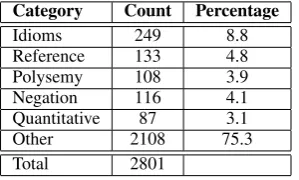
We manually inspected all questions in our dataset and annotated each with one or more cate-gory labels, representing all types of reasoning re-quired to identify the correct answer and eliminate incorrect ones. The descriptions and examples of these categories are found in Table1. Four human annotators (the authors) categorized the questions, and we calculated a Feiss’ Kappa score of 0.63 be-tween the annotators over an additional 50 ques-tions. Table2shows the distribution of labels over the entire dataset.
Category Count Percentage
Idioms 249 8.8
[image:4.595.108.258.495.585.2]Reference 133 4.8 Polysemy 108 3.9 Negation 116 4.1 Quantitative 87 3.1 Other 2108 75.3 Total 2801
Table 2: Distribution of question categories.
4.2 Models
4.2.1 BERT
We evaluate a pre-trained BERT-Large imple-mented in PyTorch on the CODAH dataset. This model consists of a 24-layer network, with 1,024 hidden units per layer, 16-heads and a total of 340M parameters. For fine-tuning, settings were determined as described inDevlin et al.(2018): a batch size of 16, learning rate of 2e-5, and linear
learning rate decay over 3 epochs (with a learning rate warmup over the first 10% of training).
4.2.2 OpenAI GPT-1
We also evaluate a pre-trained GPT model im-plemented in PyTorch. As described in Radford et al. (2018), this model consists of a 12-layer decoder transformer with 12 attention heads and 3,072-dimensional hidden states. Our fine-tuning configuration is the same as described in the orig-inal paper: a batch size of 32, learning rate of 6.25e-5, linear learning rate decay over 3 epochs (with warmup over 0.2% of training), and λ of 0.5 (whereλis a tuning coefficient that balances language-modeling loss and multiple-choice loss).
4.3 Model Evaluation
We evaluate the models on several different train and test configurations described below. The CO-DAH dataset is evaluated in 5-fold stratified cross-validation which balances the distribution of ques-tion categories in each fold.
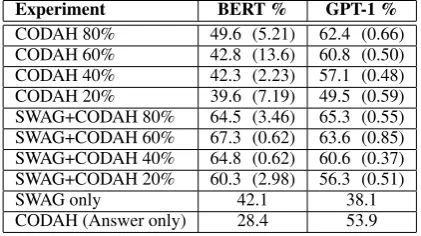
• CODAH:Cross-validation fine-tuning on the CODAH dataset. The CODAH 80% experi-ment represents the standard cross-validation setting on the full dataset, training on 80% of the data in each fold and evaluating on the re-maining 20%. The 60%, 40% and 20% abla-tion experiments are trained on a smaller por-tion of the CODAH dataset for each fold, but are evaluated in on the same test set which consists of 20% of the full dataset. The ques-tion categories are balanced in both training set and test set. This makes the results from the experiments more comparable with each other. Three trials are conducted for all set-tings; the mean and standard deviation of the model accuracy are reported in Table3.
• SWAG+CODAH: Fine-tuned on SWAG first, then fine-tuned again in cross-validation on CODAH. Ablation experiments are con-ducted in the same way as in the CODAH-only setting above, with the same dataset splits for training. The mean and standard de-viation of the three trials are reported in Table
3.
• Answer only: Cross-validation fine-tuning on the full CODAH dataset with the ques-tions left blank (in both training and testing). Only one trial is conducted.
Results for the above configurations are shown in Table3. As a baseline, we evaluate both models on the full SWAG training and validation sets, pro-viding an accuracy of 83.7% on BERT and 80.2% on GPT. To adjust for the difference in size be-tween our dataset and SWAG, we also train the models on a sample of 2,241 SWAG questions (the size of the training set in each of CODAH’s cross-validation folds) and evaluate them on the full SWAG validation set. This produces an accu-racy of 28.7% for BERT and 63.6% for GPT.
Experiment BERT % GPT-1 %
CODAH 80% 49.6 (5.21) 62.4 (0.66) CODAH 60% 42.8 (13.6) 60.8 (0.50) CODAH 40% 42.3 (2.23) 57.1 (0.48) CODAH 20% 39.6 (7.19) 49.5 (0.59) SWAG+CODAH 80% 64.5 (3.46) 65.3 (0.55) SWAG+CODAH 60% 67.3 (0.62) 63.6 (0.85) SWAG+CODAH 40% 64.8 (0.62) 60.6 (0.37) SWAG+CODAH 20% 60.3 (2.98) 56.3 (0.51)
SWAG only 42.1 38.1
[image:5.595.308.523.61.151.2]CODAH (Answer only) 28.4 53.9
Table 3: Accuracy of BERT and GPT on different training settings when tested on CODAH. Numbers in parentheses represent the standard deviation.
4.4 Human Evaluation
For each category, we measure the accuracy of the BERT and GPT models trained on SWAG+CODAH. We also measure human accu-racy as a baseline. Human accuaccu-racy was calcu-lated as the mean accuracy of three human an-notators, covering 707 dataset questions in total. Human annotators answered 95.3% of questions correctly, presenting a 7-fold reduction in error compared to the fine-turned BERT model. Inter-annotator agreement was computed over a set of 50 additional questions with a pairwise average Cohen-Kappa score of 0.89, which is interpreted as almost perfect agreement by some guidelines. Table4displays the accuracy of the human anno-tators and neural networks on each category.
5 Discussion
Based on our experiments, we find that model performance on CODAH is substantially lower
Category Human % BERT % GPT-1 %
Idioms 97.5 69.5 (4.44) 72.6 (1.33) Reference 100 63.1 (4.08) 71.0 (2.04) Polysemy 91.7 62.9 (4.93) 55.2 (3.40) Negation 100 60.0 (5.37) 60.5 (2.14) Quantitative 97.6 51.5 (1.82) 49.5 (3.80) Other 94.9 64.9 (4.33) 65.7 (0.54) Total 95.3 64.5 (3.46) 65.3 (0.55)
Table 4: Class-wise and overall accuracy of human annotators and neural network models, sorted by BERT performance on the proposed categories. Numbers in parentheses represent the standard deviation.
than those seen on SWAG, which has seen mod-els achieve over 85% accuracy. We observed a decrease of 19.2% on BERT and 14.9% on the OpenAI GPT-1 models between the accuracy on SWAG and the accuracy on our SWAG+CODAH setting. This is especially significant since human error on CODAH is 4.7%—less than a third of the 15% expert error on the SWAG dataset. This sug-gests that CODAH is challenging to our QA sys-tems because of the difficult commonsense reason-ing involved, and not because of ambiguity or in-tractability in the dataset.
5.1 Question Categories
The logic categories including Quantitative and Negation are especially difficult for our models, seeing some of the lowest accuracies from both models, in contrast to the 99.0% weighted aver-age human accuracy on these categories. Surpris-ingly, both models performed very well on the Id-ioms category, suggesting that our neural systems may be capable of learning idioms just like other semantic knowledge. Further identification of ad-ditional distinctive and interesting categories that cover the entire dataset may prove very useful in directing our efforts towards aspects of our com-monsense QA systems that require the most atten-tion.
5.2 Annotation Artifacts
[image:5.595.76.287.291.409.2]show that artifacts do not provide sufficient signal for state-of-the-art neural models to come close to human-level accuracy on our data.
5.3 Answer-Only Baseline
In the answer-only experiment (where questions are omitted during training and testing), we found that BERT achieves 28.4% accuracy, only slightly above random, whereas GPT-1 achieves 53.9% ac-curacy, which is the equivalent of narrowing four random options down to two. By comparing this to the CODAH experiment setting, we can inter-pret these results as an indication of the extent to which the signal was in the answers. While this could be due to artifacts, such as the right answer commonly being of a certain length, we also ob-served that in many cases, distinguishing between reasonable and ridiculous answers (without seeing the premise) is a part of commonsense reasoning. For example, a commonsense reasoner would be able to rule out the choice “picks up his phone and calls his mom to tell her he doesn’t have his phone” without seeing the premise, as a contradic-tion is contained in the answer. Similarly, “kicks a field goal, celebrates by transforming into a fish, and then quits football” is unlikely to be veracious regardless of the hidden subject.
5.4 Dataset Size
Our experiments show that CODAH forms a chal-lenging extension to the existing SWAG dataset. Even when we train a system to perform near human-level on SWAG, and then fine-tune on DAH, the system still struggles to answer CO-DAH questions correctly. However, COCO-DAH is also smaller than SWAG. Our results donot sug-gest that CODAH questions are more difficult than SWAG questions if dataset size is equalized. When we restrict to a subset of SWAG of the same number of questions as CODAH, we find that SWAG has comparable accuracy for GPT (63.6% on reduced-size SWAG vs 62.4% for CODAH) and much lower accuracy for BERT (28.7% vs 49.6%). This shows that CODAH questions are distinct from and complementary to SWAG ques-tions, but taken in isolation are not necessarily more challenging.
Our results suggest two recommendations for dataset construction which we hope to evaluate in future work. The first is, rather than using a single protocol to collect one monolithic dataset, the community may be able to obtain more
chal-lenging data by aggregating a variety of distinct, independently-gathered datasets that follow a sim-ilar format. For example, pre-training on SWAG and evaluating on CODAH forms a more challeng-ing benchmark than trainchalleng-ing and testchalleng-ing on SWAG alone. Secondly, if we wish to use our adversar-ial collection approach to grow CODAH to tens of thousands of examples, we should update our sys-tem as new data arrives, so that contributors are able to tune their questions to remain difficult for the strongest, most up-to-date version of the sys-tem. Under such a data collection scheme, we may need to increase the reward for fooling the model in cross-validation compared to that for fooling the current model (whereas, these two rewards were equal in CODAH), in order to disincentivize ad-versarial attacks that manipulate the current model to make it easy to fool on subsequent questions.
Our experiments on different sizes of CO-DAH produce very different results for BERT and GPT. Unsurprisingly, GPT performance im-proves with more data on both the CODAH-only and SWAG+CODAH experiments, with the rate of improvement slowing down as data size in-creases. However, the BERT results are more chal-lenging to interpret. On the CODAH-only set-ting, BERT appears to improve with data size, but the extremely high variance prevents us from be-ing certain of any trend in BERT’s performance on this setting. The variance is lower in the SWAG+CODAH setting and accuracy increases as data size goes from 20% to 60%, but ac-curacy decreases between SWAG+CODAH-60% and SWAG+CODAH-80% settings (although the SWAG+CODAH-80% setting has high variance and the true mean may be higher). The incon-sistency in improvement with more CODAH data after training on SWAG+CODAH-60% for BERT and the reduced rate of performance gain for GPT suggest that it is unclear whether the performance of all models will improve dramatically with an even larger CODAH dataset size.
6 Conclusion
SWAG dataset, testing additional modes of com-mon sense.
We identify specific categories of commonsense questions to determine types of reasoning that are more challenging for existing models. In partic-ular, we note that Quantitative questions have low accuracy for both BERT and GPT. A more detailed analysis into why models struggle to reason about numbers as well as development of more detailed categories of commonsense reasoning are items for future work.
Acknowledgments
We thank the anonymous reviewers, Yiben Yang, and Chandra Bhagavatula for helpful comments and feedback. We also thank the students of Northwestern EECS 349 Fall 2018, whose creativ-ity and insight made this work possible. This work was supported in part by NSF Grant IIS-1351029 and the Allen Institute for Artificial Intelligence.
References
Samuel R Bowman, Gabor Angeli, Christopher Potts, and Christopher D Manning. 2015. A large anno-tated corpus for learning natural language inference. In Proceedings of the 2015 Conference on Empiri-cal Methods in Natural Language Processing, pages 632–642.
Jacob Devlin, Ming-Wei Chang, Kenton Lee, and Kristina Toutanova. 2018. Bert: Pre-training of deep bidirectional transformers for language understand-ing. arXiv preprint arXiv:1810.04805.
Allyson Ettinger, Sudha Rao, Hal Daum´e III, and Emily M Bender. 2017. Towards linguistically gen-eralizable nlp systems: A workshop and shared task. In Proceedings of the First Workshop on Building Linguistically Generalizable NLP Systems, pages 1– 10.
Reza Ghaeini, Sadid A Hasan, Vivek Datla, Joey Liu, Kathy Lee, Ashequl Qadir, Yuan Ling, Aaditya Prakash, Xiaoli Fern, and Oladimeji Farri. 2018. Dr-bilstm: Dependent reading bidirectional lstm for natural language inference. In Proceedings of the 2018 Conference of the North American Chapter of the Association for Computational Linguistics: Hu-man Language Technologies, Volume 1 (Long Pa-pers), volume 1, pages 1460–1469.
Suchin Gururangan, Swabha Swayamdipta, Omer Levy, Roy Schwartz, Samuel Bowman, and Noah A Smith. 2018. Annotation artifacts in natural lan-guage inference data. In Proceedings of the 2018 Conference of the North American Chapter of the Association for Computational Linguistics: Human
Language Technologies, Volume 2 (Short Papers), pages 107–112.
Tom Kwiatkowski, Jennimaria Palomaki, Olivia Red-field, Michael Collins, Ankur Parikh, Chris Alberti, Danielle Epstein, Illia Polosukhin, Matthew Kelcey, Jacob Devlin, Kenton Lee, Kristina N. Toutanova, Llion Jones, Ming-Wei Chang, Andrew Dai, Jakob Uszkoreit, Quoc Le, and Slav Petrov. 2019. Natu-ral questions: a benchmark for question answering research. Transactions of the Association of Com-putational Linguistics.
Peter LoBue and Alexander Yates. 2011. Types of common-sense knowledge needed for recognizing textual entailment. InProceedings of the 49th An-nual Meeting of the Association for Computational Linguistics: Human Language Technologies, pages 329–334.
Alec Radford, Karthik Narasimhan, Tim Salimans, and Ilya Sutskever. 2018. Improving language under-standing by generative pre-training.
Pranav Rajpurkar, Robin Jia, and Percy Liang. 2018. Know what you don’t know: Unanswerable ques-tions for squad. InProceedings of the 56th Annual Meeting of the Association for Computational Lin-guistics (Volume 2: Short Papers), pages 784–789.
Pranav Rajpurkar, Jian Zhang, Konstantin Lopyrev, and Percy Liang. 2016. Squad: 100,000+ questions for machine comprehension of text. InProceedings of the 2016 Conference on Empirical Methods in Nat-ural Language Processing, pages 2383–2392.
Ashish Vaswani, Noam Shazeer, Niki Parmar, Jakob Uszkoreit, Llion Jones, Aidan N Gomez, Łukasz Kaiser, and Illia Polosukhin. 2017. Attention is all you need. InAdvances in Neural Information Pro-cessing Systems, pages 5998–6008.
Adina Williams, Nikita Nangia, and Samuel Bowman. 2018. A broad-coverage challenge corpus for sen-tence understanding through inference. In Proceed-ings of the 2018 Conference of the North American Chapter of the Association for Computational Lin-guistics: Human Language Technologies, Volume 1 (Long Papers), volume 1, pages 1112–1122.