15
Entity Decisions in Neural Language Modelling:
Approaches and Problems
Jenny KunzandChristian Hardmeier Department of Linguistics and Philology
Uppsala University 752 36 Uppsala, Sweden
[email protected] [email protected]
Abstract
We explore different approaches to explicit en-tity modelling in language models (LM). We independently replicate two existing models in a controlled setup, introduce a simplified vari-ant of one of the models and analyze their per-formance in direct comparison. Our results suggest that today’s models are limited as sev-eral stochastic variables make learning diffi-cult. We show that the most challenging point in the systems is the decision if the next token is an entity token. The low precision and recall for this variable will lead to severe cascading errors. Our own simplified approach dispenses with the need for latent variables and improves the performance in the entity yes/no decision. A standard well-tuned baseline RNN-LM with a larger number of hidden units outperforms all entity-enabled LMs in terms of perplexity.
1 Introduction
Reference to entities in the world is a core fea-ture of human language, and coreference between different mentions in a text is a fundamental prop-erty of coherent communication. Computational approaches to reference have long been studied in the area of coreference resolution (Ng, 2017). Very recently, explicit models of reference have also been studied in the context of language mod-elling. The usual approach is to introduce latent variables modelling whether the next token is part of an entity mention, and which of the previously seen entities it refers to.
In this work, we present a comparative study of three language modelling approaches with ex-plicit representations of entity coreference: Yang-LM, the entity-enabled language model (LM) of
Yang et al. (2016), the EntityNLM model of Ji et al.(2017), and SetLM, our own extension of the latter. YangLM and EntityNLM differ in the pa-rameterization of the latent variables and the order
in which decisions are made. SetLM is a simpler architecture with fewer loss functions. It replaces the latent variable modelling the decision whether to produce an entity with two extra embeddings, one for a new entity (similar to the other models) and one for the case that the token does not be-long to an entity. We replicate the results ofYang et al.(2016) andJi et al.(2017) with an indepen-dent reimplementation of their models in a com-parable experimental setup and evaluate the mod-els in terms of overall language modelling perfor-mance perforperfor-mance in comparison with a simple RNN-LM. We also study the accuracy and pre-cision/recall in each individual decision step and look at the convergence of variables. We find that YangLM outperforms the other models in terms of perplexity, whereas SetLM achieves the best re-sults for the entity yes/no prediction. None of the entity-enabled LMs is competitive with a simple RNN-LM having a higher number of hidden units, and we do not achieve similar gains by enlarging the hidden sizes of the entity LMs.
2 Approaches
RNNs for language modelling have been state of the art for a few years (Mikolov et al., 2013), mostly using LSTMs (Hochreiter and Schmidhu-ber,1997;Sundermeyer et al.,2012). They model each token in a document based on their previous context:
ht=LST M(xtht−1). (1)
for each position t with an attention mechanism (Bahdanau et al., 2014) with the LSTM hidden state over the set of observed entitieshe that also contains a learnable embeddingenewfor a new
en-tity that has not been observed yet. They estimate the probability distribution over the known entities and use the weighted sum for the decision whether the token is part of an entity mention.
pcoref(vt|he, ht−1) =AT T N(he, ht−1) (2)
dt=
X
vt
p(vt)hevt (3)
p(zt|ht−1) =sigmoid(W[ht−1, dt]) (4)
Ifzt = 1(i.e. the word is an entity mention), the
probability for the next word is calculated based on vt (see Equation2), the previous hidden state
of the LSTM and the set he. Ifzt = 0 then the
next word is predicted based on the previous hid-den state of the LSTM only.
EntityNLM (Ji et al.,2017) handles (1) with the variableRt, corresponding tozt, but in contrast to
YangLM solely based on the LSTM hidden state, using a parametrized embedding associated with
r∈ {0,1}. The decision which entity it refers to is handled with the variableEtthat denotes the index
of the current entity in the set of known entitiesEt
in caseRt = 1, using the LSTM hidden state, the
set of entities and a distance feature vector. The prediction of the next tokenxis always based on the LSTM hidden statehi1 and the representation
of the current entityeeven if it is not an entity. In this point EntityNLM also differs from YangLM that only uses the entity representation in the case that the token is predicted to be an entity token.
Ji et al. also introduce a length prediction vari-able Lt that is predicted when a new mention is
started, using the last hidden state ht−1 and the
most recent embedding of the entityet.
Clark et al.(2018) build onJi et al.(2017) and track entities to use them as contextual informa-tion when generating narrative text. They evaluate their model in mention generation, sentence selec-tion and sentence generaselec-tion tasks, but not in the perplexity metric so that we cannot use their model for quantitative comparison.
Our SetLM model builds on YangLM and mod-els each token in a document with an LSTM as above. It also saves the previously seen entities in a set, but instead of introducing a variable that con-trols if the next token is part of an entity mention or not, we include a learned embedding for the case
that the token is not an entity token to the set, in-spired by approaches in Question Answering with Answer Triggering (Zhao et al.,2017). The setE
with the previously seen entitiese1, ..., enhas,
be-sidesenew for the detection of a new entity, also
contains the learnable embeddingenoentity for the
case that the token is not an entity. This makes it possible to dismiss the decision in Equation 4
in YangLM while keeping its remaining decision structure (Equation1,2and3).
The decision on the next token is, as in Yang et al.’s model, based onht−1 and the corresponding
embedding with the highest attention score in the set of entities if the token is part of a mention, and solely based onht−1otherwise.
3 Data
We train, optimize and evaluate the three mod-els on the English subset of the OntoNotes 5.0 corpus (Weischedel et al., 2013) with 1.5 mil-lion words and anaphoric coreference annotation within a document, and use the CoNLL-2012 split into train, development and test set. We lower-cased all tokens, replaced all numbers by a special symbol and all tokens with less than 5 occurrences with a special token for rare words, resulting in a vocabulary size of 11539. Like Ji et al. (2017), we keep only the embedding mentions where men-tions are nested and removed all mention annota-tion where the menannota-tion length is higher than 25.
We did not reduce the length of the mentions in the data for YangLM to one as in the original model but use the setting as described above.
4 Implementation
We implemented all models in Python using the PyTorch deep learning library (Paszke et al.,
2017). As candidate hyperparameters for the hid-den size of the LSTM and word embedding layer, we tried the values 32, 48, 64, 128, 256, 512. We employ dropout (Srivastava et al.,2014) with can-didate rates of 0.0, 0.1 or 0.2 and for the Adam op-timizer (Kingma and Ba,2014), we tried the learn-ing rates 0.01, 0.005 and 0.001. We tried the mod-els with GloVe (Pennington et al.,2014) and with randomly initialized, learnable word embeddings. We also experimented with a weighted loss with the intention to force the models to produce more entity mentions.
for the model based on Yang et al. (2016) with 64 hidden units for both LSTM hidden size and word embedding size, Adam optimizer with λ= 0.005, a dropout rate of 0.2 and randomly initial-ized word embeddings. The model was trained for 20 epochs.
The best hyperparameter setting for the model based on EntityNLM was very similar and only differs in having a hidden size of 128 and being trained for 22 epochs. For SetLM, we chose a hid-den size of 48 and 16 epochs.
For the evaluation of our main metric that is the token perplexity, we implement two baseline models that are purely LSTM-based LMs. We use the same architecture in two settings: one in the same hyperparameter setting as the best Yang et al. model with a hidden size of 64, trained for twelve epochs, and one optimized model with a hidden size of 512, trained for three epochs.
5 Evaluation
As the main metric for the language models gen-eral performance, we measure the perplexity. We also evaluate the entity prediction process quali-tatively by measuring precision and recall for the question if the next token is part of an entity men-tion and the accuracy for the choice of the entity from the set, and evaluate the length prediction in the model based on EntityNLM. For our model, we regard the choice ofenoentity as theEntity
No-decision and the choice for either of the entities as theEntity Yes-decision. For the accuracy of the choice of the entity from the set, we only looked at the choices in theEntity Yes-case.
5.1 Perplexity
We report the results for our models and baselines on the test set along with the original results from
Ji et al.(2017) in table1.1
Based on these results, we cannot confirm that the models outperform a simple RNN-LM on the OntoNotes data set. Both RNN-LM baselines eas-ily outperform both the re-implemented and the reported results of Ji et al. (2017), and the op-timized baseline (RNN-512) also performs much
1
Please note that we give the two re-implementations ac-cess to the correct entity lists at test time in order to be able to evaluate each of the decision steps independently. The origi-nal results byJi et al.(2017) did not have this access to gold entity information, so that the results are not directly compa-rable. SetLM also comes without access to this information as the mention decisions are made in one step.
All Ent. Non-Ent.
RNN-64 121 177 114
RNN-512 96 126 88
EntityNLM (rep.) 132 -
-EntityNLM (own) 131 154 127
YangLM (own) 107 132 101
[image:3.595.312.521.62.159.2]SetLM 114 154 108
Table 1: Token perplexity results
better than the model based onYang et al.(2016) and our model which though both outperform the RNN that has same hidden size as itself (RNN-64). The model based on Yang et al. clearly performs best among all entity-predicting models.
Perplexity Ratio
RNN-64 0.68
RNN-512 0.76
YangLM (own) 0.81
EntityNLM (own) 0.85
SetLM 0.74
Table 2: Relation Perplexity All Tokens / Entity Tokens
The decision how to select a token seems to be generally harder on entity tokens in the data set as they generally and for all models have a higher perplexity than non-entity tokens. But measured by their overall performance, the entity tokens in the re-implemented EntityNLM and YangLM models are relatively better than in the other els, while SetLM lies between the baseline mod-els. Table2shows the perplexity of all tokens di-vided by the perplexity of entity tokens only, giv-ing a measure for the relative performance of the models on entity tokens. But these results must be seen with the constraint that EntityNLM and YangLM get access to gold entity lists, and that the perplexity is a metric that grows exponentially, which limits the comparability of the ratio. The fact that our model does not improve on entity tokens suggests that the improvements of the re-implemented EntityNLM and YangLM models are caused by the gold information.
5.2 Entity Prediction
[image:3.595.326.507.280.365.2]epochs which makes it hard to interpret specific re-sults.
Prec. Recall F1
YangLM (own) 60.9% 30.2% 40.3%
EntityNLM (own) 39.0% 53.9% 45.3%
[image:4.595.74.291.99.158.2]SetLM 41.0% 58.1% 48.1%
Table 3: Entity Yes/No Prediction
Precision and recall of both models are low, suggesting that the question if the next word is an entity is highly challenging in a LM. SetLM has the highest F1 score, suggesting that the En-tity Yes/No prediction is best handled without a discrete decision.
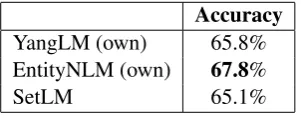
Accuracy
YangLM (own) 65.8%
EntityNLM (own) 67.8%
SetLM 65.1%
Table 4: Entity Choice
The accuracy for the decision which entity to choose is comparatively high. The EntityNLM re-implementation obtains the best value with a sub-stantial margin.
5.3 Length Prediction
The re-implementation of EntityNLM’s length prediction is correct in 59.4% of all cases, with the average distance of the false predictions to the gold mention length being 2.85 tokens. The av-erage lengths of the mentions in all three mod-els differ only slightly, being 1.53 for the Enti-tyNLM re-implementation, 1.43 for the Yang et al. re-implementation and 1.78 for SetLM. The aver-age length in the Gold data is 2.25 tokens.
6 Discussion
While we cannot confirm that the incorporation of explicit entity information is helpful in a general language modelling task, and the models’ abilities especially to predict where to form entities have shown to be limited, we see a potential for the con-tinuous representations for entities to become bet-ter and to be useful in certain situations where en-tities re-appear over long distances, like in the nar-rative texts that were subject toClark et al.(2018). For short texts like in the OntoNotes data set, an RNN-based LM implicitly seems to learn enough
information about entities and the error propaga-tion caused by wrongly detected entities in the set and erroneous decisions in the prediction process outweigh the information gain compared to basing the decision on the hidden state only.
The models’ results for the decision steps in the entity prediction process suggest that handling the question if the word belongs to an entity mention and which entity it is jointly with information from the set of entities is preferable over first deciding if the word belongs to an entity mention. The list of entities seems to be very helpful context for the question if the next word is an entity. As the question if the next token is an entity is by far the biggest error source, it will lead to relevant error propagation in real-world applications. Therefore and because the F1 score is best for SetLM we sug-gest that it is best handled implicitly. We note that with left-side context only, the decision if the next token belongs to an entity mention is extremely hard for a LM.
We suggest that mention length prediction is not crucial for a well-performing model. All systems tend to create shorter mentions than in the gold predictions to a similar extent and the EntityNLM re-implementation did not perform notably better than the other models without length prediction.
A main challenge in the models is the difficulty to find a good training setting. Unsatisfactorily, our models did not profit from more hidden units without pre-training, while a high number of hid-den units was the modification that lead to the greatest performance boost for the baseline RNN-LM. We find it promising that with 64 hidden units, the Yang et al. re-implementation performs better than the RNN-LM, but this effect does not scale to larger hidden sizes.
7 Conclusion
Our evaluation of three LMs that explicitly model coreference decisions in comparison to standard RNN-LMs suggests that these procedures do not improve a LM in a general language modelling task in perplexity.
The overall performance and the entity predic-tion results suggest that the decision if the next to-ken is an entity should be handled with a probabil-ity distribution over the set of entities rather than with the current hidden state alone.
[image:4.595.107.258.284.343.2]possibly improve the prediction process with left context only, and for evaluations on other genres. Short texts that are mostly news texts are probably not the genre that takes most profit of explicit en-tity information. It is possible that in longer texts or texts with complexly interacting characters that develop in the text, a language model would take greater profit from explicit entity modeling.
Despite the limitations of the current models, we regard it as worthwhile to invest in improve-ments, especially in the development of models that are less prone to error propagation, and to ex-plore these models’ potential.
Acknowledgements
This work was supported by the Swedish Research Council under grant 2017-930. We thank all anonymous reviewers for their constructive com-ments.
References
Dzmitry Bahdanau, Kyunghyun Cho, and Yoshua Ben-gio. 2014. Neural machine translation by jointly learning to align and translate. arXiv preprint arXiv:1409.0473.
Elizabeth Clark, Yangfeng Ji, and Noah A Smith. 2018. Neural text generation in stories using entity repre-sentations as context. In Proceedings of the 2018 Conference of the North American Chapter of the Association for Computational Linguistics: Human Language Technologies, Volume 1 (Long Papers), pages 2250–2260.
Sepp Hochreiter and J¨urgen Schmidhuber. 1997. Long short-term memory. Neural Computation, 9(8):1735–1780.
Yangfeng Ji, Chenhao Tan, Sebastian Martschat, Yejin Choi, and Noah A Smith. 2017. Dynamic entity representations in neural language models. arXiv preprint arXiv:1708.00781.
Diederik P Kingma and Jimmy Ba. 2014. Adam: A method for stochastic optimization. arXiv preprint arXiv:1412.6980.
Tomas Mikolov, Kai Chen, Greg Corrado, and Jef-frey Dean. 2013. Efficient estimation of word representations in vector space. arXiv preprint arXiv:1301.3781.
Vincent Ng. 2017. Machine learning for entity corefer-ence resolution: A retrospective look at two decades of research. InAAAI, pages 4877–4884.
Adam Paszke, Sam Gross, Soumith Chintala, Gre-gory Chanan, Edward Yang, Zachary DeVito, Zem-ing Lin, Alban Desmaison, Luca Antiga, and Adam Lerer. 2017. Automatic differentiation in PyTorch.
Jeffrey Pennington, Richard Socher, and Christopher Manning. 2014. Glove: Global vectors for word representation. In Proceedings of the 2014 Con-ference on Empirical Methods in Natural Language Processing (EMNLP), pages 1532–1543.
Nitish Srivastava, Geoffrey Hinton, Alex Krizhevsky, Ilya Sutskever, and Ruslan Salakhutdinov. 2014. Dropout: a simple way to prevent neural networks from overfitting. The Journal of Machine Learning Research, 15(1):1929–1958.
Martin Sundermeyer, Ralf Schl¨uter, and Hermann Ney. 2012. LSTM neural networks for language model-ing. InThirteenth Annual Conference of the Inter-national Speech Communication Association.
Ralph Weischedel, Martha Palmer, Mitchell Marcus, Eduard Hovy, Sameer Pradhan, Lance Ramshaw, Nianwen Xue, Ann Taylor, Jeff Kaufman, Michelle Franchini, et al. 2013. OntoNotes release 5.0 ldc2013t19. Linguistic Data Consortium, Philadel-phia, PA.
Zichao Yang, Phil Blunsom, Chris Dyer, and Wang Ling. 2016. Reference-aware language models.
arXiv preprint arXiv:1611.01628.