Learning Knowledge Graphs for Question Answering
through Conversational Dialog
Ben Hixon
University of Washington Computer Science & Engineering
Seattle, WA, USA
Peter Clark Allen Institute for AI
Seattle, WA, USA [email protected]
Hannaneh Hajishirzi University of Washington
Electrical Engineering Seattle, WA, USA
Abstract
We describe how a question-answering sys-tem can learn about its domain from conver-sational dialogs. Our system learns to relate concepts in science questions to propositions in a fact corpus, stores new concepts and re-lations in a knowledge graph (KG), and uses the graph to solve questions. We are the first to acquire knowledge for question-answering from open, natural language dialogs without a fixed ontology or domain model that predeter-mines what users can say. Our relation-based strategies complete more successful dialogs than a query expansion baseline, our task-driven relations are more effective for solving science questions than relations from general knowledge sources, and our method is practi-cal enough to generalize to other domains.
1 Introduction
Our goal is a question-answering (QA) system that learns about its domain from users in open, nat-ural language dialogs. Dialog learning interfaces built on top of existing QA systems can complement and refine knowledge acquired from other sources. Even large QA systems such as Watson (Ferrucci et al., 2010) that utilize heavy domain engineering could benefit from focused dialogs to dynamically improve their knowledge.
A successful QA system requires domain knowl-edge. For example, 4th grade science questions are difficult since they often exclude knowledge neces-sary to relate answers to known facts. The question in Figure 1 asks if aniron nailconducts electricity;
S1: Here’s the question: Which object is the best conductor of electricity? (A) a wax crayon (B) a plastic spoon (C) a rubber eraser (D) an iron nail. I’m not sure of the answer. What do you think the answer is?
U1: iron nail
S2: Why do you think the answer is (D) an iron nail?
U2: electricity goes through metal
S3: I know “metals are shiny and good conductors of electricity and heat,” does that mean that the answer is (D) an iron nail?
U3: yeah
S4: Okay, great. What’s the relationship between ‘electricity’ and ‘iron’, if any?
U4: iron conducts electricity because its metal
[image:1.612.320.547.242.473.2]S5: Okay, great, I get it! The answer is (D) an iron nail
Figure 1: Top: A successful real user dialog. Open-ended prompts (S1&S2) encourage conversational explanations. Focused prompts (S4) target particular relations. Bottom: Corresponding knowledge graph consisting of relations between concepts.
the system only knows thatmetalconducts electric-ity, and it needs to learn thatironis ametalin order to answer the question with the relevant fact.
Our dialog system, KNOWBOT, conducts dialogs
about science questions and learns how concepts in each question relate to propositions in a corpus of science facts. KNOWBOTpresents its user with
a question (line S1 in Figure 1), prompts them to choose and explain their answer, and extracts rela-tions– any semantic relationship between two
cepts, such asmetaltoiron(line U4 in Figure 1) – that increase its confidence in the user’s answer.
Relation extraction systems such as NELL (Carl-son et al., 2010) use ontologies to predetermine valid relation types and arguments, then scan text to fill the ontology with facts. Open Information Extrac-tion (Etzioni et al., 2011) avoids fixed ontologies with domain-independent linguistic features, distant supervision, and redundancy, but requires web-scale text and doesn’t improve with interaction. Like Open IE, we extract relations without predetermined types, but are the first to do so from dialog.
KNOWBOT is an open dialog system, which
means a user utterance may progress the dialog task even if its underlying action is not explicitly rep-resented in a dialog model. This lets KNOWBOT
quickly bootstrap domain knowledge from users without significant engineering overhead. Dialog-driven extraction produces effective relations with-out annotation, improves after each interaction, ac-quires relations useful on a particular task, and em-beds relations in a rich dialog context.
Users successfully correct the system in approxi-mately 50% of dialogs even without a predetermined dialog model. A baseline query expansion (Bast et al., 2007) strategy that bases decisions on the acqui-sition of new keywords instead of new relations re-sults in only a 5% success rate. In comparison to paraphrase relations from general knowledge bases, relations acquired by our method are more effective as domain knowledge, demonstrating that we suc-cessfully learn from real users.
Our contributions include:
1. The first end-to-end system to construct knowl-edge graphs for question-answering through conversational dialog.
2. A generalizable method to represent the mean-ing of user utterances without a dialog model when task progression can be computed as a function of extracted relations.
3. A novel data set of real user dialogs in which users correct a QA system’s answer, together with knowledge graphs representing the impor-tant concepts and relations in each question, la-beled with rich dialog features.
2 Conversational extraction for QA
Our QA task consists of 107 science questions from the 4th grade New York Regents exam (Clark et al., 2014).1 Each question has four possible answers.
We convert each of the four question-answer pairs into a true/false question-answer statement using a small number of pattern-based transformation rules. Just as 4th graders read their textbooks for an-swers, we collect SCITEXT (Clark et al., 2014), a
corpus of unlabeled true-false natural language sen-tences from science textbooks, study guides, and Wikipedia Science. Each question-answer statement is associated with a subset of true/false support sen-tences from SCITEXTbased on positive word
over-lap between the question-answer pair and the sup-port sentence. The degree to which a SCITEXT
tence supports a question-answer pair is the sen-tence’salignment score(section 2.3).
Initially, the alignment score depends on keyword overlap alone, but SCITEXT needs domain
knowl-edge to answer our questions. For example, the cor-rect question-answer statement toWhat form of en-ergy causes an ice cube to melt? (A) mechanical (B) magnetic (C) sound (D) heatisQ(D), “Heat is a form of energy and heat causes an ice cube to melt.” To better align Q(D) to the SCITEXT sentence “A
snowball melting in your hand is an example of heat energy,” we need to know that snowballsare made ofice. Figure 2 illustrates this example.
To construct a knowledge base with which to use SCITEXT, we extract concepts (section 2.1) from
questions and SCITEXTsentences, then userelations
(section 2.2) between concepts to determine which question-answer statementQiis most highly aligned
with a supporting SCITEXTsentence.
2.1 Concepts
A concept keyword in a sentence or user utter-ance is any non-stopword of at least three char-acters. Stopwords are domain-independent, low-information words such as “the.”
A concept is a set of concept keywords with a common root, e.g. {melts, melted, melting} or {heat, heats, heated}. We use the Porter algorithm for stemming (Porter, 1997). Question concepts
pear in a question-answer statement, and support conceptsappear in a SCITEXTsupport sentence.
2.2 Relations
Arelation is any pair of concepts that represents a semantic correspondence. In general, relations can be labeled with any feature that describes the corre-spondence, such as a particulartype. For example, the relation betweenObamaandHawaii can be la-beled with the typeborn-in.
A predetermined ontology is typically required to label relations with their type. In this work we la-bel acquired relations with dialog-specific features. Our thesis is that user explanations intend to relate concepts together, and the system’s task is to deter-mine the user’s intent. For example, the user
utter-ance U: it’s melting because of heat
relates the concepts represented by melt[ing] and
heat, with the words because of appearing be-tween the two concept keywords. We refer to
because ofas the relation’sintext.
Relations can be intuitively arranged as a knowl-edge graph, which in this work is any graph whose nodes are concepts and whose edges are relations between those concepts, in the spirit of semantic net-works such as ConceptNet (Havasi et al., 2007).
2.3 Sentence alignment
We calculate the alignment scoreαbetween theith question-answer statementQiand itsjth supporting SCITEXTsentenceSi,j as the normalized number of
relations between their concepts,
α(Qi, Si,j) = kCkRQi,Si,jk Qi∪CSi,jk
, (1)
whereCQi is the set of concepts inQi,CSi,j is the
set of concepts inSi,j, andkRQi,Si,jkis the number
of relations betweenCQi andCSi,j.
Normalized relation count is a practical semantic similarity score that generalizes to different knowl-edge representations. The dialog in Figure 2 aligns
Q(D)with the SCITEXTfactS by learning from the user that, for example,heatis related tomelting. 3 The KNOWBOTdialog system
KNOWBOT grows a knowledge graph of
common-sense semantic relations in open, conversational dia-log. Figure 2 traces the growth of a knowledge graph
over a single dialog. Section 3.1 details how knowl-edge is extracted from user explanations without a dialog model. Section 3.2 describes dialog strate-gies that elicit natural language explanations.
KNOWBOTuses task progress to drive natural
lan-guage understanding. It assumes the user intends to provide one or more novel relations, and uses the constraints described in section 3.1.1 to disam-biguate noisy relations. This way, KNOWBOTknows
when the dialog progresses because its confidence in the user’s chosen answer increases.
3.1 Building knowledge graphs from dialog
KNOWBOT builds KGs at three levels: per
utter-ance, per dialog, and globally over all dialogs. An
utterance-level knowledge graph(uKG) (Figure 2a) is a fully connected graph whose nodes are all con-cepts in an utterance. After aggressive pruning (sec-tion 3.1.1), remaining edges update a dialog-level knowledge graph(dKG) (Figure 2b; section 3.1.2).
Upon dialog termination, the dKG updates the
global knowledge graph (gKG), which stores rela-tions acquired from all dialogs (section 3.1.3).
3.1.1 Utterance-level KGs
KNOWBOTinitially relates every pair of concepts in
an utterance, then prunes them based on two con-straints:alignmentandadjacency.
Each user explanation is first converted into a fully-connected utterance-level knowledge graph. This uKG is noisy because users don’t intend relations between every pair of keywords in their utterance. For example, a typical utterance
U: freezes means it changes water
from a liquid to a solid mentions six
concepts, freezing, meaning, change, water, liquid, solid, with 62potential binary relations. Not every relation is salient to the question. To remove noisy relations, edges in the uKG are aggressively pruned with two simple, rational constraints:
1. Alignment. An edge can only relate a question concept to a support concept.
2. Adjacency. Edges can’t relate concepts whose keywords are adjacent in the utterance.
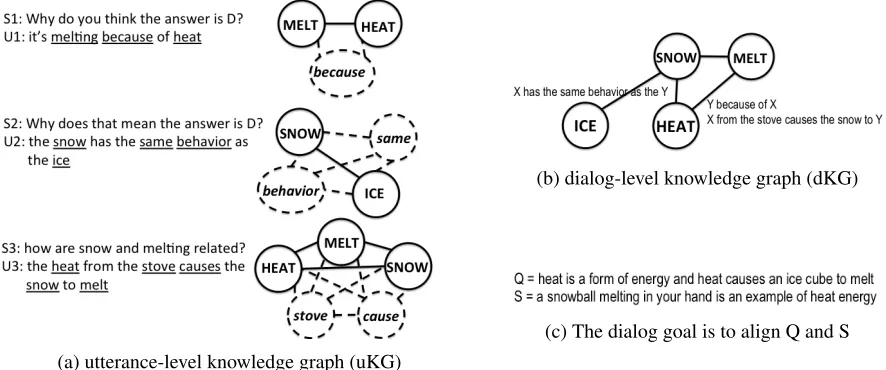
(a) utterance-level knowledge graph (uKG)
(b) dialog-level knowledge graph (dKG)
[image:4.612.86.529.59.244.2](c) The dialog goal is to align Q and S
Figure 2: Every pair of concepts in each user utterance is related then aggressively pruned. (a) Utterance-level knowledge graphs represent individual utterances. Concepts (underlined, inset in nodes) are obtained by removing stopwords and stemming. An edge that either doesn’t connect a question and support concept or else which connects concepts whose keywords in the user utterance have no intervening words (intexts) are pruned, indicated here with dashed lines. (b) The four remaining relations are stored in a dialog-level dKG.
to a known fact, and other relations in the utter-ance are unintentional. For example, in the uKG for the first utterance in Figure 2(a), the edge between
melt[ing]andheatis an alignment relation because
melt[ing]is a concept in S andheat is a concept in Q. But the edge betweenbecauseandheatis pruned (dashed lines) sincebecauseis not a concept in S.
Adjacency is a simple, practical syntactic fea-ture to reduce spurious relations. Users typically put words or intexts between concepts they in-tend to relate. The edge between melt[ing] and
because is pruned since their keywords are ad-jacent in U1: it’s melting because of heat, whileU2relatessnowandicewith the intext
has the same behavior as the.
We find these constraints effective in practice, but at this point other pruning constraints can be de-ployed. A strength of our approach is that it wel-comes aggressive pruning: just as in human-human interaction, users who initially fail to communicate their intention can try again later in the dialog.
3.1.2 Dialog-level KGs
Each dialog focuses on a single question. KNOW -BOT starts with an empty dialog-level knowledge
graph (dKG). After each user turn, edges from that turn’s uKG are added to the dKG, and KNOWBOT
rescores each of the four answers according to equa-tion (1) where the set of relaequa-tionsRQi,Si,j is exactly
the set of edges in the dKG. The dialog successfully terminates when the user’s answer has the high-est alignment score, indicating the “missing knowl-edge” has been successfully provided by the user.
3.1.3 The global knowledge graph
Theglobal knowledge graph (gKG) includes every relation learned from every KNOWBOTdialog.
Because we do not use a fixed ontology or com-prehensive dialog model, individual dialogs can re-sult in noisy relations even after aggressive prun-ing. However, as KNOWBOTconducts more dialogs
about the same problem, relations that more often re-occur are more likely to be salient to the problem. In this work, KNOWBOT takes advantage of
re-dundancy with a simple filter: it ignores singleton
relations originating in a single user utterance. We find even this simple filter increases performance. As KNOWBOTaccumulates more dialogs, frequency
can be incorporated in more sophisticated models.
3.2 Dialog strategies for knowledge acquisition
prompt. A dialog system’sdialog managerchooses the prompt to say next according to itsdialog strat-egy, which maps each system state to an action. An effective dialog strategy guides users to informative explanations that provide novel relations which let KNOWBOTsuccessfully answer the question.
We compare two different strategies. A user-initiativestrategy always asks open-ended questions to prompt the user for new explanations, e.g. line S2 in Figure 1. These prompts let users introduce salient concepts on their own.
In contrast, amixed-initiativestrategy utilizes fo-cused prompts (line S4 in Figure 1) to introduce po-tentially related concepts. KNOWBOTchooses what
pair of concepts to ask about based on how discrim-inativethey are. The most discriminative concepts are the pair of question and support concepts that (1) don’t already have an edge between them, (2) satisfies the alignment constraint for the user’s an-swer, and (3) satisfies the alignment constraint for the fewest alternative answers. By proposing rela-tions that would lead to a swift completion of the dialog task, KNOWBOTshares the burden of
knowl-edge acquisition with the user.
Both dialog strategies are question-independent, but because we don’t use a comprehensive dialog model to represent the state space, we rely on hand built rules instead of optimizing with respect to a reward function. For example, KNOWBOT always
starts by asking the user for their answer, and if a new support sentence is found will always immedi-ately present it to the user for confirmation.
4 Evaluation of dialog strategies
Our first experiment compares mixed-initiative and user-initiative strategies (section 3.2) to a baseline interactive query expansion (section 4.1). The pur-pose of this experiment is to investigate whether users can successfully complete our complex dialog task even though we don’t use a trained semantic parser for natural language understanding.
Dialogs were conducted through a web browser. Users were colleagues and interns at the Allen Insti-tute for Artificial Intelligence, and so were familiar with the question-answering task but were not ex-pert annotators. Users were invited to converse with the system of their choice, and to move on to a new
question if they felt the dialog was not progressing. Individual dialog sessions were anonymous.
The system starts each dialog with an empty knowledge graph, using onlyidentityrelations to se-lect its answer. This default answer is correct on 44 of the 107 questions, and an additional 10 ques-tions have no associated supporting sentence for the correct answer in SCITEXT. We run dialogs for the
remaining 53 questions, for which each answer can-didate has 80 supporting sentences in SCITEXT on
average. A successful dialog terminates when the system extracts enough novel relations from the user that the correct answer has the highest alignment score with one of its supporting sentences.
4.1 Baseline: Interactive query expansion
To evaluate whether task-driven relation extraction is an effective method for knowledge acquisition in the absence of an explicit dialog model, we also im-plement a baseline dialog strategy based on interac-tivequery expansion(IQE). This baseline is similar to the recent knowledge acquisition dialog system of Rudnicky and Pappu (2014a; 2014b).
In IQE, new knowledge is learned in the form of novel keywords that are appended to the question-answer statement. For example, the dialog in Figure 1 shows the user teaching KNOWBOThowmetal
re-lates toelectricity. KNOWBOTunderstands that the
user intends that relation because it drives the dia-log forward. IQE, in contrast, treats the user ut-terance as an unstructured bag of keywords. The unrecognized word “metal” is added to the bag of keywords representing each of the four alternative answers to form four augmented queries, and new overlap scores against sentences from SCITEXTare
computed. The dialog progresses whenever a new vocabulary word increases the score for the aug-mented query for the user’s chosen answer.
The intuition behind query expansion is that users will explain their answers with salient keywords missing from the original question sentence. The ex-panded query will overlap with and uprank a support sentence that contains the acquired keywords.
4.2 Performance metrics
acquir-ing enough knowledge by the end of the dialog to change its answer from incorrect to correct.
Dialog length is the number of system and user turns. Shorter dialogs are more efficient.
Acquisition rate is the number of edges in the dKG at the end of each dialog. Acquisition rate mea-sures two contrasting system features:
(1) how much new knowledge is acquired, and (2) how muchexplanatory effortusers expend. From the perspective of raw knowledge acquisition, higher acquisition rate is better because each dialog adds more edges to the knowledge graph. From the perspective of usability, lower acquisition rate is bet-ter provided it doesn’t negatively affect dialog suc-cess, because it indicates the user is able to success-fully correct the system’s answer with a fewer num-ber of explanatory relations.
4.3 Results
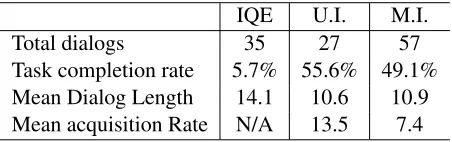
Our results (Table 1) show both strategies dramati-cally outperform the baseline and have comparable success rate and dialog length to each other. User-initiative strategies acquire more knowledge per di-alog but require more user effort.
IQE U.I. M.I.
Total dialogs 35 27 57
[image:6.612.73.299.391.462.2]Task completion rate 5.7% 55.6% 49.1% Mean Dialog Length 14.1 10.6 10.9 Mean acquisition Rate N/A 13.5 7.4
Table 1: Comparison of knowledge acquisition strate-gies. Interactive query expansion (IQE)’s poor task com-pletion indicates keywords can’t bridge the knowledge gap. Relations are more successful. User-initiative (U.I.) and mixed-initiative (M.I.) strategies have comparable task completion and dialog length, but U.I. extracts twice the relations before getting the correct answer: more knowledge acquired but at the cost of more explanatory effort. User comments indicate M.I. is more satisfying.
We find that the baseline has a very low comple-tion rate of 5%, and longer dialog lengths of 14 turns on average. Interactive query expansion is a poor knowledge acquisition dialog strategy for our task.
In contrast, users were able to successfully correct our system using both strategies about 50% of the time, even though no in-domain ontology guides ex-tractions and no comprehensive dialog model
clas-sifies explanations. The average dialog lengths and completion rate for User Initiative (U.I.) and Mixed Initiative (M.I.) strategies was approximately the same, so that choice of strategy had little impact on overall task success. However, strategy has a great effect on acquisition rate. M.I. cuts the knowl-edge acquisition rate nearly in half when compared to U.I (7.4 novel relations per dialog to 13.5). M.I. learns fewer new relations per dialog with compara-ble task success, which means each dialog succeeds with much less explanatory effort by the user but also contributes less to the knowledge graph.
User comments indicated that the mixed-initiative strategy was the most enjoyable system to use. We find that open-ended, user-initiative strategies can acquire more helpful relations in a single dialog but guided, mixed-initiative strategies may be more ap-propriate when usability is taken into account. Be-cause our goal is lifelong interactive knowledge ac-quisition, the impact of a single dialog on the total knowledge graph is less important than the individ-ual user effort required, and we conclude that the mixed-initiative strategy is preferable.
5 Evaluation of knowledge quality
Experiment 1 evaluated whether users could suc-cessfully complete our dialog task. Next, we eval-uate whether the total output of our system, all rela-tions acquired during all 431 conducted dialogs, rep-resents useful domain knowledge on this task. We evaluate on questions for which dialogs have been held to investigate whether it’s possible to learn any domain knowledge from natural language conversa-tion without a dialog model, irrespective of overfit-ting. We then use cross-validation to test if knowl-edge transfers between questions.
As described in section 2, our QA system de-composes each question/answer pair into a true/false statement and chooses as its answer the statement among the four that has the best supporting sentence in a text corpus. Equation (1) scores each question-answer statement by using domain relations to align question concepts to support concepts. The next sec-tion describes sources of domain relasec-tions.
5.1 Sources of domain knowledge
IDENTITY: An edgeless knowledge graph. The
only relations are between identical concepts, equiv-alent to Jaccard overlap of concept keyword roots.
WORDNET: Paraphrase relations from Wordnet.
Wordnet (Fellbaum, 1998) is a lexical database of synonyms and hypernyms common in NLP tasks. For example, Snow et al (2006) use Wordnet as training data for ontology induction. To build WORDNET, we draw an edge between every pair
of Wordnet concepts (ws, wq) for which the
Wu-Palmer Similarity (WUP) (Wu and Wu-Palmer, 1994) of the first sense in each concept’s synset exceeds 0.9, the best-performing WUP threshold we found. Concepts in the Wordnet hierarchy have a higher WUP when they have a closer common ancestor. If a known fact isHeat energy causes snow to melt, but a question asks ificemelts, then Wordnet should pro-vide the missing knowledge thaticeacts likesnow.
PPDB: Paraphrase relations from PPDB (Gan-itkevitch et al., 2013) are derived by aligning bilin-gual parallel texts. PPDB is divided into subsets where the larger subsets have more paraphrases with less precision. We tried all subsets and found the smallest to give the best results, which we report here. The largest performed the worst of all rela-tion sets we tested. We use the lexical paraphrases, which relates unigrams. Concepts are related when at least one concept keyword for each are para-phrases in PPDB. We obtained better performance by stemming PPDB words: for example, if snows
andicedare paraphrases in PPDB then we also con-sideredsnowingandicyto be in PPDB.
KNOWBOT: Each question is answered using
re-lations pooled from all dialogs about all questions. The goal in each dialog is to acquire knowledge helpful to answer the question. If KNOWBOTleads
to an increase in QA accuracy over IDENTITY, then
we can successfully use open dialog with a human in the loop to learn knowledge that solves a question.
LEAVE-ONE-OUT: Each question is answered
only with relations learned during dialogs for ev-ery other question. While KNOWBOT uses
re-lations learned from dialogs about the questions on those same questions, LEAVE-ONE-OUT tests
whether knowledge generalizes to questions without dialogs. Generalization is only possible when there are at least two questions involving the same con-cepts. Due to our small number of questions, in the
best case we expect only slight improvement.
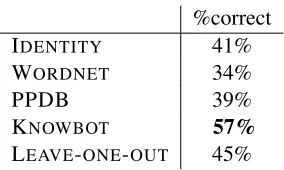
%correct
IDENTITY 41%
WORDNET 34%
PPDB 39%
KNOWBOT 57%
[image:7.612.356.498.77.162.2]LEAVE-ONE-OUT 45%
Table 2: QA accuracy on the 107 questions with dif-ferent sources of domain knowledge. IDENTITY: iden-tity relations only, e.g. “heats” to “heating.” WORD
-NET: Wordnet-derived pseudo-synonyms, e.g. “eagle” to “owl.” KNOWBOT: the full, unablated global KG.
LEAVE-ONE-OUT: answers each question while ignoring
relations acquired during dialogs on that question.
5.2 Results
The results of QA using the different domain knowl-edge is shown in Table 2. IDENTITY achieves
41% accuracy on this difficult reasoning task, show-ing that some questions are answerable by search-ing SCITEXT for supporting sentences with the
same concepts as in the question-answer statement. WORDNETworks surprisingly poorly. Examination
found WORDNET’s relations to be of good quality,
yet underperform IDENTITY. PPDB performed
bet-ter but still underperformed IDENTITY. We
con-clude that general paraphrase bases introduce too much noise to apply directly without manual cura-tion to our science domain, underscoring the need for domain-specific knowledge acquisition.
KNOWBOTachieves accuracy of 57%, a dramatic
improvement over both baselines. Importantly, this value does not test generalization to unseen ques-tions, since KNOWBOT has held dialogs on these
questions. However, it does show that our system can effectively learn about its domain: a poor dia-log extraction system will fail to extract any helpful knowledge from users during a training dialog. This is a significant result because it shows that we suc-cessfully acquire knowledge to solve many question through conversational interaction without the over-head of a closed dialog model or fixed ontology.
We also tested how well knowledge generalizes with LEAVE-ONE-OUT. Our question set is less
questions. We still found LEAVE-ONE-OUT to be
the second-best performer with accuracy of 45%, a 10% relative improvement versus IDENTITY.
Re-dundancy is an effective noise reduction constraint: when LEAVE-ONE-OUTignores redundancy and
in-cludes singleton relations (those originating in a sin-gle dialog utterance), its accuracy reduces to 32%.
6 Related work
Knowledge acquisition in dialog has long been a central goal of AI research. Early dialog systems acquired knowledge through ambitious interaction, but were brittle, required hand-defined dialog mod-els and did not scale. Terry Winograd (1972) pre-sented the first dialog system that acquires knowl-edge about the block world. TEIRESIAS (Davis, 1977) refines inference rules from terse interaction with experts. CONVINCE (Kim and Pearl, 1987) and its prototypes (Leal and Pearl, 1977) learn de-cision structures through stylized but conversational dialogs. An interactive interface for CYC (Witbrock et al., 2003) learns from experts but don’t use natural language. Fern´andez et al (2011) argue the impor-tance of interactive language learning for conversa-tional agents. Williams et al (2015) combine active learning and dialog to efficiently label training data for dialog act classifiers.
Relatively little work integrates relation extrac-tion and dialog systems. Attribute-value pairs from restaurant reviews can generate system prompts (Reschke et al., 2013), and single-turn exchanges with search engines can populate a knowledge graph (Hakkani-Tur et al., 2014). Dependency relations extracted from individual dialog utterances by a parser also make effective features for dialog act classification (Kl¨uwer et al., 2010).
The work closest to our own, Pappu and Rudnicky (2014a; 2014b), investigates knowledge acquisition strategies for academic events. Their system asks its users open-ended questions in order to elicit in-formation about academic events of interest. They compare strategies by how many new vocabulary words are acquired, so that the best strategy prompts the user to mention the most OOV words. In their most recent work (2014b), they group the acquired researcher names by their interests to form a bipar-tite graph, and use acquired keywords for query
ex-pansion in a simple information retrieval task. Our present contribution builds on this general idea, but we learn an unlimited number of relations and con-cepts from open dialogs, whereas they learn a small number of relations belonging to a fixed ontology from closed dialogs. We also show the acquired knowledge is objectively useful for QA.
In closed dialog systems, the system’s dialog model explicitly represents the meaning of every po-tential user utterance. Any utterance not represented by this comprehensive model is rejected and the user asked to rephrase. Closed dialog systems work well in practice. For example, in the well-studied slot-fillingorframe-fillingmodel, users fill slots to con-strain their goal, and an NLU module decomposes user utterances to known actions, slots, and val-ues. A slot-filling system to find flights might map the utterance U: Show me a flight from
Nashville to Seattle on Sunday to the
action find-flight and the filled slots origin = Nashville, destination = Seattle, and time = Sun-day. However, for our domain, each distinct ques-tion warrants its own acques-tions, slots, and values. Such a complex model would require abundant training data or laboriously handcrafted interpretation rules.
7 Discussion and Future Work
KNOWBOT acquires helpful, task-driven relations
from conversational dialogs in a difficult QA do-main. A dialog is a success when it produces knowl-edge to solve the question. Extractions increase QA accuracy on questions for which dialogs have been held, indicating that knowledge acquisition dialogs can succeed without a closed dialog model by us-ing task progress and careful prunus-ing to drive natu-ral language understanding. Our method is genenatu-ral enough to scale to any task in which alternative di-alog goals can be presented to a user and the sys-tem’s confidence in each alternative computed from semantic relations between concepts.
Our focus is on facilitated knowledge acquisition rather than question-answering, so we purposefully keep inference simple. The alignment score is a Jac-card overlap modified to use relations, which makes it fast and practical, but results in many ties which we score as incorrect, and also ignores word or-der. For example, the bag-of-keywords is identical for contradicting answers “changing from liquid to solid” and “changing from solid to liquid.” To make this distinction, we could use an alignment score that is sensitive to word order such as an edit distance. We could expand our simple pruning constraints to take more advantage of syntax, for example by us-ing dependency parsers optimized for conversational language (Kong et al., 2014).
The relational model for reasoning is both flexible and powerful (Liu and Singh, 2004). However, in a small number of cases, relations that align known facts with question-answer statements are unlikely to lead to the correct answer. For example, our ques-tion set contains a single math problem, How long does it take for Earth to rotate on its axis seven times? (A) one day (B) one week (C) one month (D) one year. The multiplication operation necessary to infer the answer from the SCITEXTfact “The Earth
rotates, or spins, on its axis once every 24 hours” is not easily represented by our model and requires other techniques (Hosseini et al., 2014).
We observed only slight transfer of knowledge be-tween questions. A larger question set with multiple questions per topic will allow us to better evaluate knowledge transfer. Our long-term goal is learn-ing through any conversational interaction in a
com-pletely open domain, but because the fundamen-tal trick that enables model-free NLU is computing progress towards an explicit dialog goal as a func-tion of possible extracfunc-tions, our current method is limited to tasks with explicit goals.
The simple redundancy filter we use effectively distinguishes salient from noisy relations, but could be improved with a model of relation frequency. We consider all acquired relations equally salient, but future work will examine how to rank relation saliency. We will also examine how dialog fea-tures can help distinguish between paraphrase, en-tailment, and negative relations.
Our open system acquires relations from a wide variety of user explanations without the bottleneck of a hand-built dialog model, but the tradeoff is that we use relatively simple, templated system prompts. However, our collected corpus of real human-system dialogs can be used to improve our system in fur-ther iterations. For example, the knowledge graphs we produce are targeted, question-specific semantic networks, which could be used in lieu of FrameNet to induce domain-specific dialog models (Chen et al., 2014). With a dialog model to represent the state space, reinforcement learning could then be employed to optimize our strategies.
While most question-answering systems focus on factoid questions, reasoning tasks such as ours re-quire different techniques. Our method generalizes to other non-factoid QA tasks which could usefully employ relations, such as arithmetic word problems (Hosseini et al., 2014) and biology reading compre-hension questions (Berant et al., 2014).
Acknowledgments
References
Yoav Artzi and Luke Zettlemoyer. 2011. Bootstrapping semantic parsers from conversations. InProceedings of the 2011 Conference on Empirical Methods in Natu-ral Language Processing, pages 421–432, Edinburgh, Scotland, UK., July. Association for Computational Linguistics.
Holger Bast, Debapriyo Majumdar, and Ingmar Weber. 2007. Efficient interactive query expansion with com-plete search. In Proceedings of the Sixteenth ACM Conference on Conference on Information and Knowl-edge Management, CIKM ’07, pages 857–860, New York, NY, USA. ACM.
Jonathan Berant, Vivek Srikumar, Pei-Chun Chen, Abby Vander Linden, Brittany Harding, Brad Huang, Peter Clark, and Christopher D. Manning. 2014. Modeling biological processes for reading comprehen-sion. InProceedings of EMNLP.
Andrew Carlson, Justin Betteridge, Bryan Kisiel, Burr Settles, Estevam Hruschka, and Tom Mitchell. 2010. Toward an architecture for never-ending language learning. In AAAI Conference on Artificial Intelli-gence.
Yun-Nung Chen, William Yang Wang, and Alexander I. Rudnicky. 2014. Leveraging frame semantics and dis-tributional semantics for unsupervised semantic slot induction in spoken dialogue systems. In2014 IEEE Spoken Language Technology Workshop (SLT 2014). Peter Clark, Niranjan Balasubramanian, Sumithra
Bhak-thavatsalam, Kevin Humphreys, Jesse Kinkead, Ashish Sabharwal, and Oyvind Tajford. 2014. Au-tomatic construction of inference-supporting knowl-edge bases. In 4th Workshop on Automated Knowl-edge Base Construction (AKBC).
Randall Davis. 1977. Interactive transfer of expertise: Acquisition of new inference rules. InProceedings of the 5th International Joint Conference on Artificial In-telligence. Cambridge, MA, August 1977, pages 321– 328.
Oren Etzioni, Anthony Fader, Janara Christensen, Stephen Soderland, and Mausam Mausam. 2011. Open information extraction: The second generation. In Proceedings of the Twenty-Second International Joint Conference on Artificial Intelligence - Volume Volume One, IJCAI’11, pages 3–10. AAAI Press. Christiane Fellbaum. 1998. WordNet: An Electronic
Lexical Database. Bradford Books.
Raquel Fern´andez, Staffan Larsson, Robin Cooper, Jonathan Ginzburg, and David Schlangen. 2011. Re-ciprocal learning via dialogue interaction: Challenges and prospects. Proceedings of the IJCAI 2011 Work-shop on Agents Learning Interactively from Human Teachers (ALIHT 2011).
David Ferrucci, Eric Brown, Jennifer Chu-Carroll, James Fan, David Gondek, Aditya A Kalyanpur, Adam Lally, J William Murdock, Eric Nyberg, John Prager, et al. 2010. Building watson: An overview of the deepqa project. AI magazine, 31(3):59–79.
Juri Ganitkevitch, Benjamin Van Durme, and Chris Callison-Burch. 2013. PPDB: The paraphrase database. InProceedings of NAACL-HLT, pages 758– 764, Atlanta, Georgia, June. Association for Compu-tational Linguistics.
Dilek Hakkani-Tur, Asli Celikyilmaz, Larry Heck, Gokhan Tur, and Geoff Zweig. 2014. Probabilistic en-richment of knowledge graph entities for relation de-tection in conversational understanding. In Proceed-ings of Interspeech. ISCA - International Speech Com-munication Association, September.
Catherine Havasi, Robert Speer, and Jason Alonso. 2007. Conceptnet 3: a flexible, multilingual semantic net-work for common sense knowledge. In Recent Ad-vances in Natural Language Processing, Borovets, Bulgaria, September.
Ben Hixon and Rebecca J. Passonneau. 2013. Open di-alogue management for relational databases. In Pro-ceedings of the 2013 Conference of the North Ameri-can Chapter of the Association for Computational Lin-guistics: Human Language Technologies, pages 1082– 1091, Atlanta, Georgia, June. Association for Compu-tational Linguistics.
Javad Mohammad Hosseini, Hannaneh Hajishirzi, Oren Etzioni, and Nate Kushman. 2014. Learning to solve arithmetic word problems with verb categorization. In Proceedings of the 2014 Conference on Empirical Methods in Natural Language Processing (EMNLP), pages 523–533. Association for Computational Lin-guistics.
Jin H. Kim and Judea Pearl. 1987. Convince: A conver-sational inference consolidation engine. IEEE Trans. Syst. Man Cybern., 17(2):120–132, March.
Tina Kl¨uwer, Hans Uszkoreit, and Feiyu Xu. 2010. Using syntactic and semantic based relations for dia-logue act recognition. InProceedings of the 23rd In-ternational Conference on Computational Linguistics: Posters, COLING ’10, pages 570–578, Stroudsburg, PA, USA.
Lingpeng Kong, Nathan Schneider, Swabha Swayamdipta, Archna Bhatia, Chris Dyer, and A. Noah Smith. 2014. A dependency parser for tweets. In Proceedings of the 2014 Conference on Empirical Methods in Natural Language Process-ing (EMNLP), pages 1001–1012. Association for Computational Linguistics.
struc-tures. IEEE Transactions on Systems, Man, and Cy-bernetics, 7(5):368–376.
Hugo Liu and Push Singh. 2004. Commonsense reason-ing in and over natural language. InProceedings of the 8th International Conference on Knowledge-Based In-telligent Information and Engineering Systems (KES-2004. Springer.
Aasish Pappu and Alexander Rudnicky. 2014a. Knowl-edge acquisition strategies for goal-oriented dialog systems. InProceedings of the 15th Annual Meeting of the Special Interest Group on Discourse and Dialogue (SIGDIAL), pages 194–198, Philadelphia, PA, U.S.A., June.
Aasish Pappu and Alexander Rudnicky. 2014b. Learning situated knowledge bases through dialog. In Proceed-ings of Interspeech, September.
Joseph Polifroni, Grace Chung, and Stephanie Sen-eff. 2003. Towards automatic generation of mixed-initiative dialog systems from web content. In Eu-rospeech.
M. F. Porter. 1997. Readings in information retrieval. chapter An Algorithm for Suffix Stripping, pages 313– 316. Morgan Kaufmann Publishers Inc., San Fran-cisco, CA, USA.
Kevin Reschke, Adam Vogel, and Dan Jurafsky. 2013. Generating recommendation dialogs by extracting in-formation from user reviews. In Proceedings of the 51st Annual Meeting of the Association for Compu-tational Linguistics (Volume 2: Short Papers), pages 499–504, Sofia, Bulgaria, August. Association for Computational Linguistics.
Rion Snow, Daniel Jurafsky, and Andrew Y Ng. 2006. Semantic taxonomy induction from heterogenous evi-dence. InProceedings of the 21st International Con-ference on Computational Linguistics and the 44th annual meeting of the Association for Computational Linguistics, pages 801–808. Association for Computa-tional Linguistics.
Jason D. Williams, Nobal B. Niraula, Pradeep Dasigi, Aparna Lakshmiratan, Carlos Garcia Jurado Suarez, Mouni Reddy, and Geoff Zweig. 2015. Rapidly scal-ing dialog systems with interactive learnscal-ing. In2015 International Workshop Series on Spoken Dialogue Systems Technology (IWSDS), January.
T. Winograd. 1972. Understanding natural language. Academic Press.
Michael Witbrock, David Baxter, Jon Curtis, Dave Schneider, Robert Kahlert, Pierluigi Miraglia, Peter Wagner, Kathy Panton, Gavin Matthews, and Amanda Vizedom. 2003. An interactive dialogue system for knowledge acquisition in cyc. In Proceedings of the IJCAI-2003 Workshop on Mixed-Initiative Intelligent Systems., pages 138–145.