Is Your Anchor Going Up or Down?
Fast and Accurate Supervised Topic Models
Thang Nguyen
iSchool and UMIACS
University of Maryland and National Library of Medicine,
National Institutes of Health [email protected]
Jordan Boyd-Graber
Computer Science University of Colorado Boulder
Jordan.Boyd.Graber @colorado.edu
Jeff Lund,
Kevin Seppi, Eric Ringger
Computer Science Brigham Young University {jefflund,kseppi}@byu.edu
Abstract
Topic models provide insights into document collections, and their supervised extensions also capture associated document-level meta-data such as sentiment. However, inferring such models from data is often slow and cannot scale to big data. We build upon the “anchor” method for learning topic models to capture the relationship between metadata and latent top-ics by extending the vector-space representa-tion of word-cooccurrence to include metadata-specific dimensions. These additional dimen-sions reveal new anchor words that reflect spe-cific combinations of metadata and topic. We show that these new latent representations pre-dict sentiment as accurately as supervised topic models, and we find these representations more quickly without sacrificing interpretability.
Topic models were introduced in an unsupervised setting (Blei et al., 2003), aiding in the discovery of topical structure in text: large corpora can be dis-tilled into human-interpretable themes that facilitate quick understanding. In addition to illuminating doc-ument collections for humans, topic models have increasingly been used for automatic downstream applications such as sentiment analysis (Titov and McDonald, 2008; Paul and Girju, 2010; Nguyen et al., 2013).
Unfortunately, the structure discovered by unsuper-vised topic models does not necessarily constitute the best set of features for tasks such as sentiment analy-sis. Consider a topic model trained on Amazon prod-uct reviews. A topic model might discover a topic about vampire romance. However, we often want to
go deeper, discovering facets of a topic that reflect topic-specific sentiment, e.g., “buffy” and “spike” for positive sentiment vs. “twilight” and “cullen” for negative sentiment. Techniques for discovering such associations, called supervised topic models (Sec-tion 2), both produce interpretable topics and predict metadata values. While unsupervised topic models now have scalable inference strategies (Hoffman et al., 2013; Zhai et al., 2012), supervised topic model inference has not received as much attention and of-ten scales poorly.
The anchor algorithm is a fast, scalable unsuper-vised approach for finding “anchor words”—precise words with unique co-occurrence patterns that can define the topics of a collection of documents. We augment the anchor algorithm to find supervised sentiment-specific anchor words (Section 3). Our algorithm is faster and just as effective as traditional schemes for supervised topic modeling (Section 4).
1 Anchors: Speedy Unsupervised Models The anchor algorithm (Arora et al., 2013) begins with aV ×V matrixQ¯ of word co-occurrences, whereV
is the size of the vocabulary. Each word type defines a vectorQ¯i,·of lengthV so thatQ¯i,jencodes the
con-ditional probability of seeing wordjgiven that word
ihas already been seen. Spectral methods (Anand-kumar et al., 2012) and the anchor algorithm are fast alternatives to traditional topic model inference schemes because they can discover topics via these summary statistics (quadratic in the number oftypes) rather than examining the whole dataset (proportional to the much larger number oftokens).
The anchor algorithm takes its name from the idea
of anchor words—words which unambiguously iden-tify a particular topic. For instance, “wicket” might be an anchor word for the cricket topic. Thus, for any anchor worda, Q¯a,·will look like a topic distribu-tion.Q¯wicket,·will have high probability for “bowl”, “century”, “pitch”, and “bat”; these words are related
to cricket, but they cannot be anchor words because they are also related to other topics.
Because these other non-anchor words could be topically ambiguous, their co-occurrence must be ex-plained through some combination of anchor words; thus for non-anchor wordi,
¯
Qi,·= X
gk∈G
Ci,kQ¯gk,·, (1)
whereG ={g1, g2, . . . , gK}is the set ofK anchor
words. The coefficientsCi,kof this linear
combina-tion correspond to the probability of seeing a topic
given a word, from which we can recover the proba-bility of a wordgiven a topic(represented in a matrix
A) using Bayes’ rule. In our experiments, we follow Arora et al. (2013) to first estimateQ¯ based on the training data and then recover theCmatrix
C∗
i,·=argminCi,·DKL( ¯Qi,·||
X
gk∈G
Ci,kQ¯gk,·),
whereDKL(x, y) denotes the Kullback-Leibler
di-vergence betweenxandy.
In addition to discovering topics from a given set of anchor words as described above, Arora et al. (2013) also provide a geometric interpretation of a process for finding the needed anchor words. If we view the rows ofQ¯ as points in a high-dimensional space, the convex hull of those points provides the anchor words.1
Equation 1 linearly combines anchor words’ co-occurrence vectorsQ¯gk,·to create the representation of other words. The convex hull corresponds to the perimeter of the space of all possible co-occurrence vectors that can be formed from the set of basis an-chor vectors. However, the convex hull only encodes
1As discussed by Arora et al. (2013), this is a slight simpli-fication, since the most extreme points will be words that only appear infrequently. Thus, there is some nuance to choosing the anchor words. For instance, a key step for effective topic modeling is choosing a minimum number of documents a word must appear in before it can be considered an anchor word. (c.f. Figure 3).
lemon Toyota
wonderful
iPad
fleece author
heel
author
antilock cozy
fleece
heel
awful
[image:2.612.342.506.67.282.2]Toyota iPad
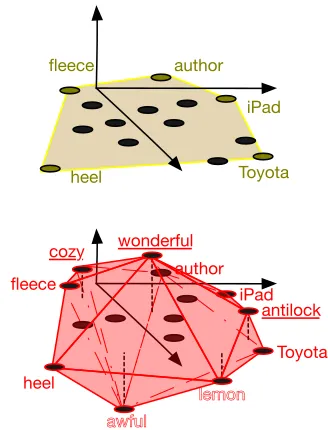
Figure 1: Graphical intuition behind supervised anchor words. Anchor words (in gold) form the convex hull of word co-occurrence probabilities in unsupervised topic modeling (top). Adding an additional dimension to cap-ture metadata, such as sentiment, changes the convex hull: positive words appear above the original 2Dplane
(under-lined) and negative words appear below (in outline).
an unsupervised view of the data. To capture topics informed by metadata such as sentiment, we need to explicitly represent the combination of words and metadata.
¯
Q⌘
New column(s) encoding word-sentiment relationship
p(w1|w1). . .
...
p(wj|wi)
p(w1|w1). . .
...
p(wj|wi)
S⌘
p(y(l)|w 1)
...
[image:3.612.108.264.60.217.2]p(y(l)|wi)
Figure 2: We form a new column to capture the relation-ship between wordsandeach sentiment level: per entry is the conditional probability of observing a sentiment level y(l)given an observation of the wordwi. Adding all of these columns toQ¯to form an augmented matrixS.
2 Supervised Topics: Effective but Slow
Topic models discover a set of topicsA. Each topic is a distribution over the V word types in the cor-pus.Ai,tis the probability of seeing wordiin topic
t. Supervised topic models relate those topics with predictions of document metadata such as sentiment by discovering a vector of regression parameters~µ
that connects topics to per-document observations
yd(Blei and McAuliffe, 2007). Blei and McAuliffe
(2007) treat this as a regression: seeing one word with topickin documentdmeans that prediction of
ydshould be adjusted byµk. Given a document’s
dis-tribution over topicsz¯d, the responseydis normally
distributed with mean~µ>z¯
d.2
Typically, the topics are discovered through a process of probabilistic inference, either variational
EM (Wang et al., 2009) or Gibbs sampling
(Boyd-Graber and Resnik, 2010). However, these meth-ods scale poorly to large datasets. Variational infer-ence requires dozens of expensive passes over the entire dataset, and Gibbs sampling requires multiple Markov chains (Nguyen et al., 2014b).
2We are eliding some details in the interest of a more compact presentation. The topics used by a document, ¯zd, are based
on per-token inference of topic assignments; this detail is not relevant to our contribution, and in Section 4.2 we use existing techniques to discover documents’ topics.
3 Supervised Anchor Words
Because the anchor algorithm scales so well com-pared to traditional probabilistic inference, we now unify the supervised topic models of Section 2 with the anchor algorithm discussed in Section 1. We do so by augmenting the matrixQ¯ with an additional dimension for each metadata attribute, such as senti-ment. We provide the geometric intuition in Figure 1. Picture the anchor words projected down to two dimensions (Lee and Mimno, 2014): each word is a point, and the anchor words are the vertices of a poly-gon encompassing every point. Every non-anchor word can be approximated by a convex combination of the anchor words (Figure 1, top).
Now add an additional dimension as a column to ¯
Q (Figure 2). This column encodes the metadata specific to a word. For example, we have encoded sentiment metadata in a new dimension (Figure 1, bottom). Neutral sentiment words will stay in the plane inhabited by the other words, positive senti-ment words will move up, and negative sentisenti-ment words will move down. For simplicity, we only show a single additional dimension, but in general we can add as many dimensions as needed to encode the metadata.
In this new space some of the original anchor words may still be anchor words (“author”). Other words that were near the convex hull boundary in the unaugmented representation may become an-chor words in the augmented representation because they capture both topic and sentiment (“anti-lock” vs. “lemon”). Finally, extreme sentiment words might
become anchor words in the new higher-dimensional space because they are so important for explaining extreme sentiment values (“wonderful” vs. “awful”).
3.1 Words to Sentiment
Having explained how a word is connected to senti-ment, we now elaborates on how to model that con-nection using the conditional probability of senti-ment given a particular word. Assume that sentisenti-ment is discretized into a finite set ofLsentiment levels
{y(1), y(2), . . . , y(L)}and that each document is as-signed to one of these levels. We define a matrix
level.
For each additional columnl,Si,(V+l) ≡ p(y =
y(l)|w=i)is the conditional probability of observ-ing a sentiment level y(l) given an observation of wordi. We compute the conditional probability of a sentiment levely(l)given wordi
Si,(V+l) ≡
P
d(1[i∈d]·1
yd=y(l))
P
d1[i∈d] , (2)
where the numerator is the number of documents that contain word type iand have sentiment level
y(l)and the denominator is the number of documents containing wordi.
Given this augmented matrix, we again want to find the set of anchor wordsGand coefficientsCi,k
that best capture the relationship between words and sentiment (c.f. Equation 1)
Si,·= X
gk∈G
Ci,kSgk,·. (3)
Because we retain the property that non-anchor words are explained through a linear combination of the anchor words, our method retains the same theoretical guarantees of sampling complexity and robustness as the original anchor algorithm.
To facilitate direct comparisons, we keep the num-ber of anchor words fixed in our experiments. Even so, the introduction of metadata forces the anchor method to select the words that best capture this metadata-augmented view of the data. Consequently, some of the original anchor words will remain, and some will be replaced by sentiment-specific anchor words.
4 Quantitative Comparison of Supervised Topic Models
In this section, we evaluate the effectiveness of our new method on a binary sentiment classification problem. Because the supervised anchor algorithm (SUP ANCHOR) finds anchor words (and thus differ-ent topics) which capture the sdiffer-entimdiffer-ent metadata, we evaluate the degree to which its latent representation improves upon the original unsupervised anchor algo-rithm (Arora et al., 2013,ANCHOR) for classification in terms of both accuracy and speed.
4.1 Sentiment Datasets
We use three common sentiment datasets for eval-uation: AMAZONproduct reviews (Jindal and Liu,
2008),YELPrestaurant reviews (Jo and Oh, 2011),
andTRIPADVISORhotel reviews (Wang et al., 2010).
For each dataset, we preprocess by tokenizing and removing all non-alphanumeric words and stopwords. As very short reviews are often inscrutable and lack cues to connect to the sentiment, we only consider documents with at least thirty words. We also re-duce the vocabulary size by keeping only words that appear in a sufficient number of documents: 50 for
AMAZONandYELPdatasets, and 150 forTRIPADVI -SOR(Table 1).
4.2 Documents to Labels
Our goal is to perform binary classification of sen-timent. Due to a positive skew of the datasets, the median for all datasets is four out of five. All 5-star reviews are assigned toy+and the rest of the reviews are assigned toy−. Table 1 summarizes the composi-tion of each dataset and the percentage of documents with high positive sentiment.3
We compare the effectiveness of different repre-sentations in predicting high-sentiment documents: unsupervised topic models (LDA), traditional su-pervised topic models (SLDA), the unmodified an-chor algorithm (ANCHOR), our supervised anchor algorithm (SUP ANCHOR), and a traditional TF -IDF (Salton, 1968, TF-IDF) representation of the words.
The anchor algorithm only provides the topic dis-tribution over words; it does not provide the per-document assignment of topics needed to represent the document in a low-dimensional space necessary for producing a predictionyd. Fortunately, this
re-quires a very quick—because the topics are fixed— pass over the documents using a traditional topic model inference algorithm. We use the variational in-ference implementation forLDAof Blei et al. (2003)4 to obtainz¯d, the topic distribution for documentd.5
3Multiclass labeling for each sentiment label also works well, but binary classification simplifies the analysis and presentation.
Corpus Train Documents Test Documents Tokens Types Percentage with Positive Sentiment
AMAZON 13,300 3,314 1,031,659 2,662 52.2%
TRIPADVISOR 115,384 28,828 12,752,444 4,867 41.5%
[image:5.612.75.545.62.114.2]YELP 13,955 3,482 1,142,555 2,585 27.7%
Table 1: Statistics for the datasets employed in the experiments.
Classifiers Given a low-dimensional representa-tion of a test document, we predict the document’s sentimentyd. We have already inferred the topic
dis-tributionz¯dfor each document, and we uselog(¯zd)
as the features for a classifier. Feature vectors from training data are used to train the classifiers, and fea-ture vectors from the development or test set are used to evaluate the classifiers.
We run three standard machine learning classi-fiers: decision trees (Quinlan, 1986), logistic regres-sion (Friedman et al., 1998), and a discriminative classifier. For decision trees (henceTREE) and
logis-tic regression (henceLOGISTIC), we use SKLEARN.6
For the discriminative classifier, we use a linear clas-sifier with hinge loss (henceHINGE) in Vowpal
Wab-bit.7 BecauseHINGEoutputs a regression value in
[0,1], we use a threshold 0.5 to make predictions. Parameter Tuning Parameter tuning is important in topic models, so we cross-validate: each sentiment dataset is split randomly into five folds. We used four folds to form the TRAIN set and reserved the
last fold for theTESTset. All cross-validation results
are averaged over the four held out DEV sets; the
best cross-validation result provides the parameter settings we use on theTESTset.
For ANCHOR and SUP ANCHOR, the parame-ter for the document-level Dirichlet prior α is re-quired for inferring document-topic distributions given learned topics. Despite selecting this parameter using grid search,αdoes not affect our final results. The same is also true forSLDA: its predictive perfor-mance does not significantly vary asαvaries, given a fixed number of topicsK.8
Anchor algorithms are sensitive to the value of an-chor thresholdM(the minimum document frequency for a word to be considered an anchor word). For
6http://scikit-learn.org/stable/ 7http://hunch.net/˜vw/
8We use the SLDA implementation by Chong Wang: http:
//www.cs.cmu.edu/˜chongw/slda/to estimateα.
AMAZON TRIPADVISOR YELP
●
● ● ● ● ●
● ●
● ● ●●
● ● ● ● ● ●
● ● ● ● ● ●
● ● ●●●● ●● ●● ●
● ● ●●●● ●● ●● ●
● ● ●●●● ●● ●● ●
● ● ●●●● ● ●● ●
● ● ● ● ● ●
● ● ● ●● ●
● ● ● ● ● ●
● ● ● ● ● ● 0.65
0.70 0.75
0.70 0.72 0.74 0.76 0.78
0.72 0.74 0.76 0.78
0.71 0.73 0.75 0.77
20
40
60
80
100 400 100 400 2400 100 400
M
Accur
acy
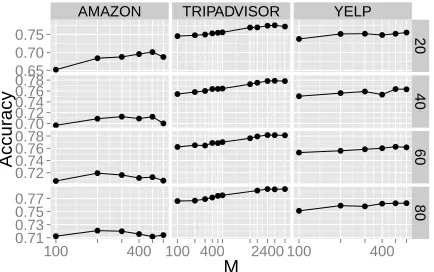
Figure 3: Grid search for selecting the word-document thresholdM forSUP ANCHORbased on development set
accuracy.
each number of topicsK, we perform a grid search to find the best value of M. Figure 3 shows the performance trends.
ForLDA, we use the Gibbs sampling implemen-tation in Mallet.9 For training the model, we run
LDAwith 5,000 iterations; and for inference (onDEV
andTEST) of document topic distribution we iterate
100 times, with lag 5 and 50 burn-in iterations. As Mallet acceptsPαias a parameter, we always
ini-tializePαi = 1and only perform a grid search over
different values ofβ, the hyper-parameter for Dirich-let prior over the per-topic topic-word distribution, starting from0.01and doubling until reaching 0.5.
4.3 SUP ANCHOROutperformsANCHOR
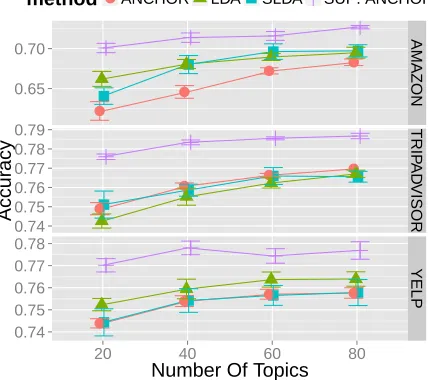
Learning topics that jointly reflect words and meta-data improves subsequent prediction. The results for bothSUP ANCHOR andANCHOR on the TEST set
are shown in Figure 4. SUP ANCHORoutperforms ANCHOR on all datasets. This trend holds consis-tently forLOGISTIC,TREE, andHINGEmethods for
sentiment prediction. For example, with twenty top-ics on theAMAZONdataset,SUP ANCHORgives an
[image:5.612.319.536.163.299.2]●
●
● ●
●
● ●
●
●
● ● ●
0.65 0.70
0.74 0.75 0.76 0.77 0.78 0.79
0.74 0.75 0.76 0.77 0.78
AMAZON
TRIP
AD
VISOR
YELP
20 40 60 80
Number Of Topics
Accur
acy
[image:6.612.319.534.73.165.2]method ●ANCHOR LDA SLDA SUP. ANCHOR
Figure 4: Results onTEST fold, SUP ANCHOR
outper-formsANCHOR,LDA, andSLDAon all three datasets. We
report the results based onLOGISTICas it produces the
best accuracy consistently forANCHOR,SUP ANCHOR,
andLDA.
accuracy of 0.71 in comparison to only 0.62 from ANCHOR. Similarly, with twenty topics on theYELP
dataset,SUP ANCHORhas 0.77 accuracy while AN-CHORhas 0.74. OurSUP ANCHORmodel is able to incorporate metadata to learn better representations for predicting sentiment. Moreover, in Section 5 we show thatSUP ANCHORdoes not need to sacrifice topic quality to gain predictive power.
4.4 SUP ANCHOROutperformsSLDA
More surprising is that SUP ANCHOR also outper-forms SLDA. Like SUP ANCHOR, SLDA jointly learns topics and their relation to metadata such as sentiment. Figure 4 shows that this trend is consistent on all sentiment datasets. On average,SUP ANCHOR is 2.2 percent better thanSLDAonAMAZON, and 2.0
percent better on bothYELPandTRIPADVISOR.
Fur-thermore,SUP ANCHORis much faster thanSLDA. SLDAperforms worse thanSUP ANCHORin part becauseSUP ANCHORis able to jointly find specific lexical terms that improve prediction. Nguyen et al. (2013) show that this improves supervised topic mod-els; forming anchor words around the same strong lexical cues could discover better topics. In con-trast,SLDA must discover the relationship through
● ● ● ● ● ● ● ● ● ●
●
0.60 0.65 0.70
0.75 AMAZON
0 25 50 75 100
Interpolation Percentage
Accur
acy
[image:6.612.79.293.80.270.2]classifier●HINGE LOGISTIC TREE
Figure 5: Accuracy on AMAZON with twenty topics. SUP ANCHORproduces good representations for
senti-ment classification that can be improved by interpolating with lexicalTF-IDFfeatures. The interpolation (x-axis)
ranges from zero (allTF-IDFfeatures) to one hundred (all SUP ANCHORtopic features).
the proxy of topics.
4.5 Lexical Features
Ramage et al. (2010) show that interpolating topic and lexical features often provides better classifica-tion than either alone. Here, we take the same ap-proach and show how different interpolations of topic and lexical features create better classifiers. We first select an interpolation valueλin{0,0.1,0.2, . . . ,1}, and we then form a new feature vector by concatenat-ingλ-weighted topic features with(1−λ)-weighted lexical features. Figure 5 shows the interplay be-tween topic features and TF-IDF features10 as the
weight of topic features increases from zero (all TF-IDF) to one hundred (all SUP ANCHOR topic fea-tures) percent on the AMAZONdataset (other datasets
are similar). Combining both feature sets is better than either alone, although the interpolation depends on the classifier.
4.6 Runtime Analysis
Having shown thatSUP ANCHORoutperforms both ANCHOR and SLDA, in this section we show that SUP ANCHOR also inherits the runtime efficiency from ANCHOR. Table 2 summarizes the runtimes on both AMAZONand TRIPADVISOR; these results
were obtained using a six-core 2.8GHz Intel Xeon X5660. On the small dataset AMAZON, SUP
Dataset Measure SUP ANCHOR LDA SLDA
AMAZON
Preprocessing 32 32 32
GeneratingQ/S¯ 29
Training 33 886 4,762
LDACinference 38 (train), 13 (dev/test)
Classification <5 <5
TRIPADVISOR
Preprocessing 305 305 305
GeneratingQ/S¯ 262
Training 181 8,158 71,967
LDACinference 830 (train), 280 (dev/test)
[image:7.612.139.475.60.201.2]Classification <5 <5
Table 2: Runtime statistics (in seconds) for the AMAZONandTRIPADVISORdatasets. Blank cells indicate a timing
which does not apply to a particular model.SUP ANCHORis significantly faster than conventional methods.
● ● ● ●
●
●
●
●
● ●
● ●
0.045 0.050 0.055
0.05 0.06
0.09 0.11 0.13
AMAZON
TRIP
AD
VISOR
YELP
20 40 60 80
Number Of Topics
T
opic Inter
pretability
method●ANCHOR LDA SLDA SUP. ANCHOR
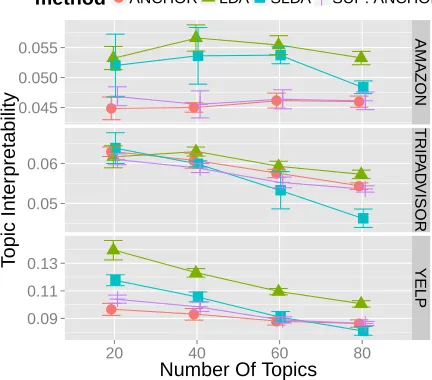
Figure 6:SUP ANCHORandANCHORproduce the same
topic quality.LDAoutperforms all other models and
pro-duces the best topics. Performance of SLDAdegrades
significantly as the number of topic increases.
learning in around three minutes. The main bottle-neck forSUP ANCHORis learning the document dis-tributions over topics, although even this stage is fast for known topic distributions. This result is far better than the twenty hours required bySLDAto train on
TRIPADVISOR.
5 Inspecting Anchors and their Topics
One important evaluation for topic models is how easy it is for a human reader to understand the top-ics. In this section, we evaluate topics produced by
each model using topic interpretability (Chang et al., 2009). Topic interpretability measures how human users understand topics presented by a topic model-ing algorithm. We use an automated approximation of interpretability that uses a reference corpus as a proxy for which words belong together (Newman et al., 2010). Using half a million documents from Wikipedia, we compute the induced normalized pair-wise mutual information (Lau et al., 2014, NPMI)
[image:7.612.77.293.275.465.2]on the top ten words in topics as a proxy for inter-pretability.
Figure 6 shows the NPMIscores for each model.
Unsurprisingly, unsupervised models (LDA) produce the best topic quality. In contrast, supervised mod-els must balance metadata (i.e., response variable) prediction against capturing word meaning. Conse-quently, SLDA does slightly worse with respect to topic interpretability.
SUP ANCHOR and ANCHOR produce the same
topic quality consistently on all datasets. Since SUP ANCHOR and ANCHOR have nearly identical runtime,SUP ANCHORis better suited for supervised tasks because it improves classification without sac-rificing interpretability. It is possible that regulariza-tion would improve the interpretability of these top-ics; Nguyen et al. (2014a) show that adding regular-ization removes overly frequent words from anchor-discovered topics.
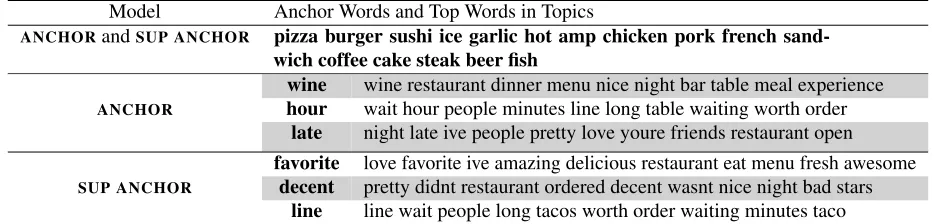
Model Anchor Words and Top Words in Topics
ANCHORandSUP ANCHOR pizza burger sushi ice garlic hot amp chicken pork french sand-wich coffee cake steak beer fish
wine wine restaurant dinner menu nice night bar table meal experience
ANCHOR hour wait hour people minutes line long table waiting worth order late night late ive people pretty love youre friends restaurant open favorite love favorite ive amazing delicious restaurant eat menu fresh awesome
[image:8.612.72.540.63.175.2]SUP ANCHOR decent pretty didnt restaurant ordered decent wasnt nice night bad stars line line wait people long tacos worth order waiting minutes taco
Table 3: Comparing topics generated for theYELPdataset: anchor words shared by bothANCHORandSUP ANCHOR
are listed. Unique anchor words for each algorithm are listed along with the top ten words for that topic. For clarity, we pruned words which appear in more than 3000 documents as these words appear in every topic. The distinct anchor words reflect positive (“favorite”) and negative (“line”) sentiment rather than less sentiment-specific qualities of restaurants (e.g., restaurants open “late”).
“pizza” or “burger”, and characterize theYELPdataset
well. The similarity of these shared topics explains why bothANCHORandSUP ANCHORachieve simi-lar topic interpretability scores.
To explain the predictive power ofSUP ANCHOR we must examine the anchor words and topics unique to both algorithms. The anchor words which are unique to ANCHOR include a general topic about wine, and two somewhat coherent topics related to time. By adding supervision to the model we get three new anchor words which identify sentiment ranging from extremely positive reviews mentioning a favorite restaurant to extremely negative reviews complaining about long waits.
This general trend is seen across each of the datasets. For example,ANCHORandSUP ANCHOR both discover shared topics describing consumer goods, but SUP ANCHOR replaces two topics dis-cussing headphones with topics describing “frustrat-ing” products and “great” products. Similarly, in theTRIPADVISORdata, bothANCHORandSUP AN-CHORshare topics about specific destinations, but onlySUP ANCHORdiscovers a topic describing “dis-gusting” hotel rooms.
6 Related Work
Improving the scalability of statistical learning has taken many forms: creating online approximations of large batch algorithms (Hoffman et al., 2013; Zhai et al., 2014) or improving the efficiency of sam-pling (Yao et al., 2009; Hu and Boyd-Graber, 2012; Li et al., 2014).
These insights have also improved supervised topic models. For example, Zhu et al. (2013) train the max-margin supervised topic modelsMEDLDA (Zhu et al., 2009) by reformulating the model such that the hinge loss is included inside a collapsed Gibbs pler, rather than being applied externally on the sam-pler using costlySVMs. Using insights from Smola
and Narayanamurthy (2010), the samplers run in par-allel to train the model. While these advancements improve the scalability of max-margin supervised topic models, the improvement is limited by the fact that the sampling algorithm grows with the number of tokens.
In contrast, this paper explores a different vein of research that focuses on using efficient represen-tations of summary statistics to estimate statistical models. While this has seen great success in unsu-pervised models (Cohen and Collins, 2014), it has increasingly also been applied to supervised mod-els. Wang and Zhu (2014) show how to use tensor decomposition to estimate the parameters ofSLDA instead of sampling to find maximum likelihood es-timates. In contrast, anchor-based methods rely on non-negative matrix factorization.
We found that a discriminative classifier did not always perform best on the downstream classification task. Zhu et al. (2009) make a comprehensive com-parison between MEDLDA, SLDA, and SVM+LDA,
and they show thatSVM+LDAperforms worse than
Bag-of-words representations are not ideal for sen-timent tasks. Rubin et al. (2012) introduce Depen-dencyLDAwhich associates individual word tokens
with different labels; their model also outperforms linear SVMs on a very large multi-labeled corpus.
Latent variable models that consider grammatical structure (Sayeed et al., 2012; Socher et al., 2011; Iyyer et al., 2014) could also be improved through efficient inference (Cohen and Collins, 2014).
7 Discussion
Supervised anchor word topic modeling provides a general framework for learning better topic rep-resentations by taking advantage of both word-cooccurrence and metadata. Our straightforward ex-tension (Equation 2) places each word in a vector space that not only captures co-occurrence with other terms but also the interaction of the word and its sen-timent, in contrast to algorithms that only consider raw words.
While our experiments focus on binary classifica-tion, the same extension is also applicable to multi-class multi-classification.
Moreover, supervised anchor word topic model-ing is fast: it inherits the polynomial-time efficiency from the original unsupervised anchor word algo-rithm. It is also effective: it is better at providing features for classification than unsupervised topic models and also better than supervised topic models with conventional inference.
Our supervised anchor word algorithm offers the ability to quickly analyze datasets without the over-head of Gibbs sampling or variational inference, al-lowing users to more quickly understand big data and to make decisions. Combining bag-of-words analysis with metadata through efficient, low-latency topic analysis allows users to have deep insights more quickly.
Acknowledgments We thank Daniel Petersen, Jim Martin, and the anonymous reviewers for their in-sightful comments. This work was supported by the collaborativeNSFGrantIIS-1409287 (UMD) andIIS
-1409739 (BYU). Boyd-Graber is also supported by NSFgrantsIIS-1320538 andNCSE-1422492.
References
Anima Anandkumar, Dean P. Foster, Daniel Hsu, Sham Kakade, and Yi-Kai Liu. 2012. A spectral algorithm for latent Dirichlet allocation. InProceedings of Ad-vances in Neural Information Processing Systems. Sanjeev Arora, Rong Ge, Yoni Halpern, David M. Mimno,
Ankur Moitra, David Sontag, Yichen Wu, and Michael Zhu. 2013. A practical algorithm for topic model-ing with provable guarantees. InProceedings of the International Conference of Machine Learning. David M. Blei and Jon D. McAuliffe. 2007. Supervised
topic models. InProceedings of Advances in Neural Information Processing Systems.
David M. Blei, Andrew Ng, and Michael Jordan. 2003. Latent Dirichlet allocation. Journal of Machine Learn-ing Research, 3.
Jordan Boyd-Graber and Philip Resnik. 2010. Holistic sentiment analysis across languages: Multilingual su-pervised latent Dirichlet allocation. InProceedings of Empirical Methods in Natural Language Processing. Jonathan Chang, Jordan Boyd-Graber, Chong Wang, Sean
Gerrish, and David M. Blei. 2009. Reading tea leaves: How humans interpret topic models. InProceedings of Advances in Neural Information Processing Systems. Shay B. Cohen and Michael Collins. 2014. A provably
correct learning algorithm for latent-variable PCFGs. InProceedings of the Association for Computational Linguistics.
Jerome Friedman, Trevor Hastie, and Robert Tibshirani. 1998. Additive logistic regression: a statistical view of boosting. Annals of Statistics, 28:2000.
Matthew Hoffman, David M. Blei, Chong Wang, and John Paisley. 2013. Stochastic variational inference. In Journal of Machine Learning Research.
Yuening Hu and Jordan Boyd-Graber. 2012. Efficient tree-based topic modeling. InProceedings of the Asso-ciation for Computational Linguistics.
Mohit Iyyer, Peter Enns, Jordan Boyd-Graber, and Philip Resnik. 2014. Political ideology detection using recur-sive neural networks. InProceedings of the Association for Computational Linguistics.
Nitin Jindal and Bing Liu. 2008. Opinion spam and analysis. InProceedings of First ACM International Conference on Web Search and Data Mining.
Yohan Jo and Alice H. Oh. 2011. Aspect and senti-ment unification model for online review analysis. In Proceedings of ACM International Conference on Web Search and Data Mining.
Moontae Lee and David Mimno. 2014. Low-dimensional embeddings for interpretable anchor-based topic infer-ence. InProceedings of Empirical Methods in Natural Language Processing.
Aaron Q Li, Amr Ahmed, Sujith Ravi, and Alexander J Smola. 2014. Reducing the sampling complexity of topic models. In Proceedings of the 20th ACM SIGKDD international conference on Knowledge dis-covery and data mining, pages 891–900. ACM. David Newman, Jey Han Lau, Karl Grieser, and Timothy
Baldwin. 2010. Automatic evaluation of topic coher-ence. InConference of the North American Chapter of the Association for Computational Linguistics. Viet-An Nguyen, Jordan Boyd-Graber, and Philip Resnik.
2013. Lexical and hierarchical topic regression. In Pro-ceedings of Advances in Neural Information Processing Systems.
Thang Nguyen, Yuening Hu, and Jordan Boyd-Graber. 2014a. Anchors regularized: Adding robustness and extensibility to scalable topic-modeling algorithms. In Proceedings of the Association for Computational Lin-guistics.
Viet-An Nguyen, Jordan Boyd-Graber, and Philip Resnik. 2014b. Sometimes average is best: The importance of averaging for prediction using MCMC inference in topic modeling. InProceedings of Empirical Methods in Natural Language Processing.
Michael Paul and Roxana Girju. 2010. A two-dimensional topic-aspect model for discovering multi-faceted topics. InAssociation for the Advancement of Artificial Intelligence.
J. R. Quinlan. 1986. Induction of decision trees. 1(1):81– 106, March.
Daniel Ramage, Susan T. Dumais, and Daniel J. Liebling. 2010. Characterizing microblogs with topic models. In International Conference on Weblogs and Social Media.
Timothy N. Rubin, America Chambers, Padhraic Smyth, and Mark Steyvers. 2012. Statistical topic models for multi-label document classification. Journal of Ma-chine Learning Research, 88(1-2):157–208, July. Gerard Salton. 1968. Automatic Information
Organiza-tion and Retrieval. McGraw Hill Text.
Asad B. Sayeed, Jordan Boyd-Graber, Bryan Rusk, and Amy Weinberg. 2012. Grammatical structures for word-level sentiment detection. InNorth American Association of Computational Linguistics.
Alexander Smola and Shravan Narayanamurthy. 2010. An architecture for parallel topic models.International Conference on Very Large Databases, 3(1-2):703–710. Richard Socher, Jeffrey Pennington, Eric H. Huang, An-drew Y. Ng, and Christopher D. Manning. 2011. Semi-supervised recursive autoencoders for predicting
senti-ment distributions. InProceedings of Empirical Meth-ods in Natural Language Processing.
Ivan Titov and Ryan McDonald. 2008. A joint model of text and aspect ratings for sentiment summarization. InProceedings of the Association for Computational Linguistics.
Yining Wang and Jun Zhu. 2014. Spectral methods for supervised topic models. InProceedings of Advances in Neural Information Processing Systems.
Chong Wang, David Blei, and Li Fei-Fei. 2009. Simulta-neous image classification and annotation. InComputer Vision and Pattern Recognition.
Hongning Wang, Yue Lu, and Chengxiang Zhai. 2010. Latent aspect rating analysis on review text data: a rating regression approach. InKnowledge Discovery and Data Mining.
Limin Yao, David Mimno, and Andrew McCallum. 2009. Efficient methods for topic model inference on stream-ing document collections. InKnowledge Discovery and Data Mining.
Ke Zhai, Jordan Boyd-Graber, Nima Asadi, and Mohamad Alkhouja. 2012. Mr. LDA: A flexible large scale topic modeling package using variational inference in mapre-duce. InProceedings of World Wide Web Conference. Ke Zhai, Jordan Boyd-Graber, and Shay B. Cohen. 2014.
Online adaptor grammars with hybrid inference. Jun Zhu, Amr Ahmed, and Eric P. Xing. 2009. MedLDA:
maximum margin supervised topic models for regres-sion and classification. InProceedings of the Interna-tional Conference of Machine Learning.