371
Comprehension Driven Document Planning in Natural Language
Generation Systems
Craig Thomson, Ehud Reiter, and Somayajulu Sripada
Department of Computing Science, University of Aberdeen: {c.thomson, e.reiter, yaji.sripada}@abdn.ac.uk
Abstract
This paper proposes an approach to NLG system design which focuses on generat-ing output text which can be more easily processed by the reader. Ways in which cognitive theory might be combined with existing NLG techniques are discussed and two simple experiments in content or-dering are presented.
1 Introduction
Document Planning is a difficult task for which there has been little research compared with other aspects of NLG. This is evident in the recent sur-vey of NLG (Gatt and Krahmer,2017) which de-votes relatively little space to the problem. Exist-ing approaches focus on human authored corpora as a gold standard, extracting relations from them in order to structure messages.
This paper proposes NLG system design with the guiding principle of producing output text which is optimal input for the human comprehen-sion process. Comprehencomprehen-sion in this context is the readers ability to process text. Construction-Integration (CI) theory (Kintsch,1998) states that the cognitive process of reading is iterative. A highly interconnected knowledge graph based on both the text and the readers prior knowledge forms the readers mental model as text is pro-cessed.
A basic system is presented which orders mes-sages using distributional semantics. The system uses a simple graph database to generate texts de-scribing a products suitability for a task. An ex-ample generated text can be seen in Figure1with message ID’s shown in parentheses.
The Nepal Extreme consists of an out-sole, a rand, an upper and a lining (M0). It has a crampon rating which is re-quired for mountaineering (M1). The outsole is stiff which is good (M3). The outsole and the rand consist of rubber which is durable, this suits mountaineer-ing (M2,M4). The upper consists of syn-thetic leather and synsyn-thetic fabric which are both durable and water-resistant, this is good (M10,M8,M9,M11). The lining has insulation which suits moun-taineering (M5). It also consists of GoTex which is waterproof, this is re-quired for mountaineering (M7). Gore-Tex is breathable as well which is good (M6).
Figure 1: Generated Product Description (mes-sage ID’s in parenthesis)
2 NLG Document Planning
Document Planning within NLG is most often de-fined as the tasks of Content Determination and Document Structuring (Reiter and Dale, 1999). The system must decide what to say, how to say it and in what order. Further, if there is an optimal way to convey the input data such that the reader better comprehends it or is moved to action by it, then text should be generated in this way.
them across domains. They also require much manual work and each relation needs to be defined by annotators who often do not agree even within a domain.
Machine Learning has been investigated as a method for both Content Determination and Doc-ument Structuring (Lapata, 2006), (Barzilay and Lee,2004), (Liang et al.,2009). Such models rely on existing corpora within the domain and often paired data-corpus. If the domain is changed, or if there is disagreement as to what the correct corpus should be within a domain then such approaches experience difficulty.
3 The Construction-Integration Model
RST and Schemata focus on the relations between messages. Focus mechanisms can be used to check if different messages contain identical sub-jects or obsub-jects, utilizing this information when or-dering messages. Focus (Sidner,1979), Centering Theory (Grosz et al., 1995), (Poesio et al.,2004) and Scripts (Schank and Abelson,1975) all offer appealing models for how people read and process text. It has been difficult however to implement any of them in an NLG context, especially in a general fashion. Perhaps this is because structur-ing a narrative is a complex task with many vari-ables, of which individual approaches might only address a subset.
With the CI model (Kintsch,1998) argues that a text is not in itself sufficient to account for the meaning acquired when the reader processes it. The reader’s prior knowledge and experience add to the mental model which is established and iter-atively modified as the text is processed. Whilst relations play a role, it is primarily the argument concepts of a proposition which activate and fil-ter relevant concepts in the reader’s mental model. This has some experimental backing, such as the work of (Schwanenflugel and White,1991) which found that word priming from previous discourse altered the processing of words in future para-graphs.
Long-term memory (LTM) is the complete set of a readers knowledge. We do not have clearly indexed and direct access to this knowledge, even if it is relevant in the current context. Short-term memory (STM) contains our immediate thoughts although it is limited to a small number of con-cepts. The capacity of STM has a long history of study (Murdock Jr,1960) and whilst estimates
vary, they are often in the range of 10-15 terms. This is orders of magnitude lower than the num-ber of terms and inferred concepts present in even short narratives, making STM an unsuitable mech-anism to explain our ability to comprehend text (Ericsson and Kintsch, 1995). Kintsch describes human comprehension as loosely analogous to a computer system. Data is stored in both STM (reg-isters / cache) as well as LTM (a large but slower access storage device). Working memory (WM) is the processor in this analogy. When a reader has expert knowledge of a domain they are able to use STM as an index to LTM, allowing for increased cognitive ability using WM. Expert readers can then create a rich set of inferences in their mental model which can then be used to better compre-hend the text.
Kintsch suggests propositions as a suitable first class concept for modeling meaning in language. A proposition in the context of CI theory is a predicate-argument schema. This is a simplified view of propositions as conceived in formal logics. These simple propositions form complex ones, which in turn can be used to generate the text. CI theory adds additional nodes to this network which are not present in the text. These can be thought of as inferences based on the context of the propo-sitions. Kintsch calls these ‘knowledge elabora-tions’ and relations between them and the propo-sition nodes from the text are added to form a com-plex highly interconnected network in the readers mental model.
4 Operationalization of the CI Model
Whilst a graph representation of data contains all the input information required to generate a given text, CI theory suggests this only forms a sub-set of the complete model of comprehension held by the reader. A system based on CI would re-quire some method of simulating knowledge elab-orations. This additional information would allow for the simulation of inferences, with the complete mental model being a combination of the propo-sitional representation of the text and these infer-ences.
be used if available, either in place of or in some combination with general knowledge. By com-bining a graph representation of propositions with distributional semantics we would appear to have something which at a very basic level fits the CI model proposed by Kintsch. The angle between vector representations of arguments can be used to weight the system knowledge graph.
Knowledge elaborations are not added to the system knowledge base, this is not possible as there is no direct access to the users mental model. If distributional semantics can provide weights for the edges in our system graph, these can be con-sidered when planning content. An assumption is made that when a path has short inter-message distances (lower angles between vectors), readers will be able to construct a richer interconnected network of propositions and knowledge elabora-tions than they would when inter-message distance is high.
Content would be selected from the system graph based on queries which return subsets of the graph. For example all paths between a start node and an end node. With the optional aid of con-tent structuring rules, these subgraphs can be clus-tered and ordered based upon the edge weights as well as the connectivity of propositions, the lat-ter being similar to implementations such as the WISHFUL system (Zukerman and McConachy,
1998). An optimization function would need to be implemented which finds the most appropriate representation of text given the graph data, input queries, distributional semantics and any imposed structural rules.
The bottom-up approach suggested here could be used in combination with existing top-down methods such as RST. A domain expert could inform the writer of the most important factors for a specific NLG system, providing an out-line for the system. The comprehension driven techniques would then provide a sensible default where the narrative structure has not been defined. A convention-over-configuration approach.
5 System
The simple system used for exploratory investiga-tion of NLG motivated by CI theory is outlined here. This is an early version of the system and further work is required to properly assess its ca-pabilities. System input is in the form of messages which are extracted as paths from a knowledge
graph. These messages are then ordered to form a Document Plan, before simple Micro Planning techniques are applied and the text is realized.
5.1 Vector Space Model
The Vector Space Model (VSM) was created using the Python Gensim implementation of Word2Vec. The corpus was stripped of all characters which were not within the alphabet for the given lan-guage. The corpus was lemmatized (using spaCy). The VSM is trained on English Wikipedia using Word2Vec. The training settings were skip-gram with 600 dimensions, a window of 5, negative sampling of 5 and all words with a lower total fre-quency than 5 were discarded.
Whilst Word2Vec has been used as a starting point, it is possible that models generated using systems such as GloVe (Pennington et al., 2014) and ELMo (Peters et al., 2018) would improve an NLG system which relies upon distributional semantics. Vector Space Specialisation (Mrksic et al.,2017) may also be useful.
5.1.1 System Input
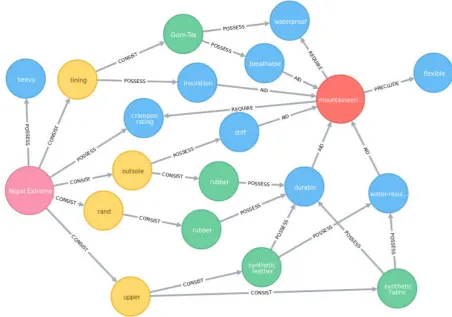
Figure2shows nodes and relations from the graph database (Neo4j) for a Product which consists of Components, with each Component being made of Materials. All Products, Components and Materi-als (collectively Items) may have Attributes which have suitabilities for different Tasks. Items may also have a direct suitability for a Task.
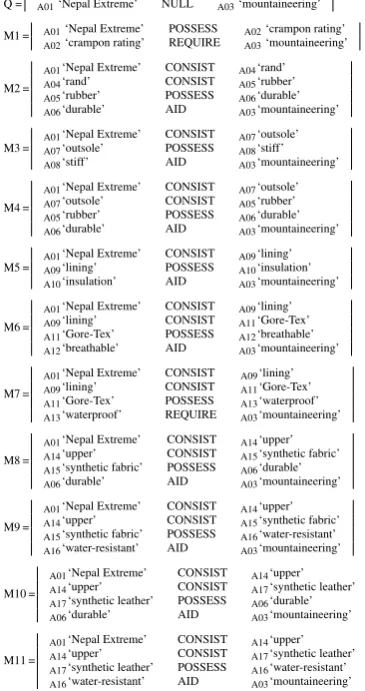
The system will describe the suitability of a product for a task. The input to the system is an unordered list of proposition chains, with each proposition chain itself being an ordered list of proposition triples. All possible paths from the product to the task are extracted from the graph shown in Figure2. Directionality of the edges is ignored at this stage. To generate the text shown in Figure 1 each unique path from the product (Nepal Extreme) to the task (mountaineering) is found and combined to form the list of proposition chains shown in Figure 3. In the special case where a task requires an attribute which is not present on the product or any of its child items, a chain is created to represent it. These proposition chains are messages in the NLG system.
5.1.2 Ordering to form the Document Plan
argu-Figure 2: Product Composition, Attributes and Task.
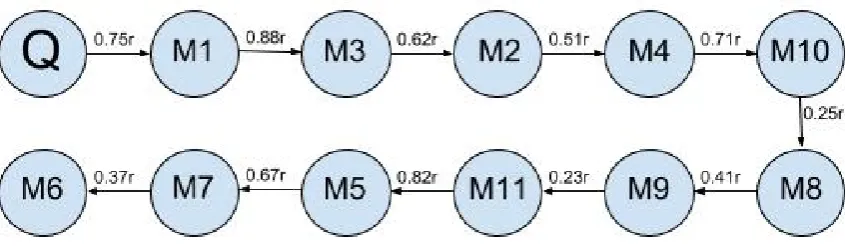
ment. Vectors for individual arguments are taken from the VSM described in 5.1. The document plan is an ordered list of messages. To populate the document plan, messages are ordered using a greedy algorithm which minimizes inter-message distance. Inter-message distance is defined as the angle between the message vectors. The algorithm will stop once all input messages have been added to the document plan. The ordering of messages for the text example shown in Figure1can be seen, with inter-message distance in radians, in Figure4.
5.2 Micro Planning
The focus of this paper is on content ordering at the Document Plan level. More advanced Mi-cro Planning techniques could be used and would probably improve the quality of the text. The Aggregation and Referring Expression techniques (REG) used are far from state of the art and are meant only as a quick means to add variety and remove obvious repetition.
5.2.1 Aggregation
Functions were created to realize different patterns of proposition chains. The system iterates over the Document Plan, adding to a sublist of chains which are to be realized. If at any point the sys-tem determines it would be unable to realize this sublist, it reverts back to the last point at which it could and calls a suitable realizer function for the it. The system then starts from the chain which could not be realized, before continuing until all chains have been realized. It is always possible to realize a sublist of a single chain. Aggregation candidates can be seen on Figure 2 where paths diverge and re-converge, although the specific or-dering means aggregation is not always possible.
[image:4.595.69.522.68.385.2]Q = A01‘Nepal Extreme’ NULL A03‘mountaineering’
M1 = A01‘Nepal Extreme’ POSSESS A02‘crampon rating’
A02‘crampon rating’ REQUIRE A03‘mountaineering’
M2 =
A01‘Nepal Extreme’ CONSIST A04‘rand’ A04‘rand’ CONSIST A05‘rubber’ A05‘rubber’ POSSESS A06‘durable’ A06‘durable’ AID A03‘mountaineering’
M3 =
A01‘Nepal Extreme’ CONSIST A07‘outsole’ A07‘outsole’ POSSESS A08‘stiff’ A08‘stiff’ AID A03‘mountaineering’
M4 =
A01‘Nepal Extreme’ CONSIST A07‘outsole’ A07‘outsole’ CONSIST A05‘rubber’ A05‘rubber’ POSSESS A06‘durable’ A06‘durable’ AID A03‘mountaineering’
M5 =
A01‘Nepal Extreme’ CONSIST A09‘lining’ A09‘lining’ POSSESS A10‘insulation’ A10‘insulation’ AID A03‘mountaineering’
M6 =
A01‘Nepal Extreme’ CONSIST A09‘lining’ A09‘lining’ CONSIST A11‘Gore-Tex’ A11‘Gore-Tex’ POSSESS A12‘breathable’ A12‘breathable’ AID A03‘mountaineering’
M7 =
A01‘Nepal Extreme’ CONSIST A09‘lining’ A09‘lining’ CONSIST A11‘Gore-Tex’ A11‘Gore-Tex’ POSSESS A13‘waterproof’ A13‘waterproof’ REQUIRE A03‘mountaineering’
M8 =
A01‘Nepal Extreme’ CONSIST A14‘upper’ A14‘upper’ CONSIST A15‘synthetic fabric’ A15‘synthetic fabric’ POSSESS A06‘durable’ A06‘durable’ AID A03‘mountaineering’
M9 =
A01‘Nepal Extreme’ CONSIST A14‘upper’ A14‘upper’ CONSIST A15‘synthetic fabric’ A15‘synthetic fabric’ POSSESS A16‘water-resistant’ A16‘water-resistant’ AID A03‘mountaineering’
M10 =
A01‘Nepal Extreme’ CONSIST A14‘upper’ A14‘upper’ CONSIST A17‘synthetic leather’ A17‘synthetic leather’ POSSESS A06‘durable’ A06‘durable’ AID A03‘mountaineering’
M11 =
[image:5.595.92.275.64.410.2]A01‘Nepal Extreme’ CONSIST A14‘upper’ A14‘upper’ CONSIST A17‘synthetic leather’ A17‘synthetic leather’ POSSESS A16‘water-resistant’ A16‘water-resistant’ AID A03‘mountaineering’
Figure 3: Input for text in Figure1.
5.2.2 Referring Expression Generation
REG in the system is very simple. Pronouns are used only when the subject of the sentence is the same as that of the previous sentence. Whilst typ-ically a Micro Planning task, this is done during realization, determined by the specific function which is called to realize the pattern of proposi-tion chains.
5.3 Realization
Realization is performed using SimpleNLG (Gatt and Reiter, 2009). The realizer functions them-selves use helper functions which construct com-monly occurring patterns of text. An introductory sentence (labeled M0 in Figure 1) is included at the beginning of the output text detailing the prod-uct and its components. This is the only fixed or-dering rule. The conjunction of components is re-alized in the order that the components would oth-erwise first be mentioned.
6 Experiments
6.1 Message Ordering
The first experiment evaluates the output of the simple product description system described in Section5. The products within the system are all outdoor footwear. This domain was chosen be-cause outdoor footwear can be broken down into a small number of components and attributes, then explained in broad terms. This would not hold true in a live system as there would be many ambiguity problems. It does however allow for a simple and contained preliminary test. The components of the product are parts of the boot/shoe such as upper, lining, rand and sole. Examples of materials are leather, suede and rubber. Attributes are most of-ten adjectives such as durable or waterproof al-though they can also be concepts such as deep lugs. The tasks in this system are mountaineer-ing, hiking and trail walking. With Item, Product, Component, Material, Attribute and Task being la-bels for nodes on the graph, the relations which are available are CONSIST, POSSESS, AID, HIN-DER, REQUIRE and PRECLUDE. These rela-tionships can be seen on Figure 2. The experi-ment presented the below task descriptions to par-ticipants.
• Mountaineering - Walking and climbing in the mountains, often in the winter time when there is ice and snow.
• Hillwalking - Walking in the hills during ev-ery season except for winter. There may be some rough ground and it may be wet.
• Trail Walking - Walking on forest paths or other well kept trails. Usually in warmer weather although there may be some light rain.
In order to keep the system as simple as possible just four relations were used.
• AID - Attribute aids in the completion of the task, but is not essential. This is realized as ‘is good for’ or ‘suits’.
Figure 4: Ordering of Chains
• REQUIRE - Attribute is essential for the task. This is rendered as ‘is essential for’ or ‘is re-quired for’.
• PRECLUDE - Attribute precludes the item from the task. This was rendered as ‘unsuit-able for’. This was perhaps too close to ‘does not suit’.
6.1.1 Experiment Setup
Participants were recruited for an online survey us-ing email lists and social media. There were 37 re-spondents of which 28 stated English as their na-tive language. Participants were shown 12 scenar-ios of which 6 were system generated narratives (like Figure1) and 6 were hand crafted lists (like Figure5as might be seen on an online retail web-site. Each subset of 6 was equally divided such that participants received 3 product descriptions where the product was designed for the task (a match) and 3 descriptions where the product was not designed for the task (not a match). Partici-pants were shown 4 statements and asked whether they agreed with each as it related to the current description using a five point Likert scale. The statements can be seen on Table1
6.1.2 Hypothesis
Although this was exploratory research, the work-ing hypothesis was that the orderwork-ing of the infor-mation would be evaluated as superior for the nar-rative descriptions, compared to list based descrip-tions. It was also suspected that narratives would outperform lists in the other categories although without a pilot experiment there was no real basis for this.
Attributes:
• Has a crampon rating.
• Upper - Made of synthetic leather and synthetic fabric. Is water-resistant and durable.
• Lining - Made of Gore-Tex. Is wa-terproof and breathable. Has insu-lation.
• Outsole - Made of durable rubber. Is stiff.
• Rand - Made of durable rubber.
Usefulness:
• Crampon rating and waterproof are essential for mountaineering. • Water-resistant, durable,
insula-tion, breathable and stiff are good for mountaineering.
Figure 5: List Based Description of Product Con-struction
6.1.3 Results and Evaluation
de-scription explains the suitability of the product for the task). Lists were more highly rated overall although whether this would hold as the number of propositions increases is unclear and worthy of further examination.
There is a lot of ambiguity with the definitions used for the relations, Items, Attributes and Tasks. The line between Components and Attributes can be blurred, with ‘deep lugs’ being a good exam-ple. This could be a Component of the outsole or an Attribute of it. Ultimately the distinction has little impact on the system as it is the path from the Product to the Task which is important and this is unaffected by a change to the label of a node. Fur-ther, it is the name of the node which is used for word embeddings, not the label itself. The only impact for the final text is that the relation (and therefore verb) used will be CONSIST for a Com-ponent and POSSESS for an Attribute.
Where ambiguity is more of a problem is in the relations and the Tasks. There is a lot of overlap between mountaineering, hiking and trail walking. It is not always the case that these tasks are carried out in isolation. A mountaineer might walk over easier terrain using footwear which is suboptimal in order to approach a technical climb for which the footwear is essential.
6.2 Ordering Different Languages
A second experiment was conducted using the same system, the only difference being that ar-gument concepts were translated to different lan-guages for the purposes of ordering. Vector space models were trained for French and Spanish Wikipedia using almost identical settings as the English model (Section 5.1). The only change in the training pipeline was to allow additional char-acters such as accented vowels. Arguments were translated into French and Spanish by a single na-tive speaker for each language. The domain was explained to each annotator and they were asked to translate arguments to the semantically closest word or phrase, with annotators having the ability to translate from a single term to a short phrase or vice versa.
6.2.1 Results and Evaluation
There were some difficulties in translation. Only one annotator was used per language. Any further work involving the definition of terms based on semantics, whether within English or to another language, should be done with multiple annotators
and their agreement assessed.
Even with allowing annotators to translate into multiple terms, some did not directly translate. Hiking and Trail Walking were difficult to separate in French although ambiguity may exist in English as well. Trail Walking more often refers to walks at lower elevation on well maintained paths. Hik-ing includes walkHik-ing off the path and on steeper, less stable terrain. A cursory Internet search for images based on these terms would appear to back this definition up, although exactly at which point Hiking becomes Trail Walking is ambiguous. The French annotator felt that ‘randonn´ee’ was the best term for both Hiking and Trail Walking although it was closer to Hiking. The phrase ‘sentier de randonn´ee’ is what Google translate returns for Trail Walking although this refers to the actual path which is walked upon, not the task. The con-cept could be expressed as a complex proposition although as this system only allows for simple lists of proposition triples, ‘randonn´ee’ was used for both tasks.
Table 3 shows the mean deviation of the or-dering position of chains in Spanish and French when compared with the original English order-ings. The overline indicates narratives where the stated product was not designed for the given task. It is difficult to evaluate the ordering based on translated proposition arguments as the English or-dering makes for a poor gold standard. It is not clear if when using such a simple data source and such trivial propositions that there is a correct or-dering.
Figure6 shows the English realized text based on ordering using Spanish translations of graph nodes. The French example for the Nepal Extreme boot, used as an example throughout, was almost identical to the original English text in1. There-fore, it has been omitted due to space restrictions.
7 Conclusion and Future Work
Statement N N L L
S1 The description is easy to read and understand 3.61 3.35 4.09 3.94 S2 The description explains the suitability of the product for the task 3.89 3.46 4.05 3.71 S3 The description is presented in a sensible order 3.63 3.29 4.05 3.75 S4 Overall, this is a good description 3.50 3.18 4.01 3.67 N : Narrative (matching Product)
L : List (matching Product)
N: Narrative (non-matching Product)
L: List (non-matching Product)
Table 1: Mean Response
S1 S2 S3 S4
Variable F p F p F p F p
Type 18.237 <0.001 2.135 0.145 18.43 <0.001 20.955 <0.001 Match 8.585 <0.01 22.685 <0.001 13.319 <0.001 15.003 <0.001 Participant 0.009 0.93 0.508 0.477 3.139 0.077 0.176 0.675
Product 1.001 0.44 1.503 0.129 1.376 0.183 1.615 0.093
Table 2: ANOVA Results
Task French Spanish F rench Spanish
Mountaineering 1.58 2.47 2.03 2.37 Hiking 2.60 2.27 2.96 1.67 Trail Walking 2.36 1.93 3.27 2.76
Table 3: Mean Order Variance per Language
stages and much remains to be done.
To fully test Comprehension Driven NLG, richer data sets and more comprehensive genera-tion models will be required. Identifying and eval-uating these are key prerequisites of future work. The qualitative evaluation of the first experiment presented in this paper only investigates the pref-erences of participants. Evaluation of recall and deep understanding will also be required.It is un-clear as to whether the list based summary in its current form is a suitable gold standard to com-pare system generated narrative. Suitable methods of evaluating the Document Plan independently of the downstream system components will also be needed.
Existing approaches to Document Planning look at human authored corpora and attempt to construct narratives based upon patterns identified within them. This is either with hand crafted sys-tems, ML/AI or a combination of the two. Whilst this corpus analysis is useful, it is a limitation of such methods that the text structure is insufficient to explain the comprehension process of reading
The Nepal Extreme consists of an up-per, an outsole, a rand and a lining (M0). It has a crampon rating which is required for mountaineering (M1). The upper consists of synthetic fabric and synthetic leather which are both water-resistant and durable, this is good (M9,M11,M10,M8). The outsole and the rand consist of rubber which is durable, this suits mountaineering (M4,M2). It is also stiff which is good (M3). The lin-ing consists of Gore-Tex which is water-proof (M7), this is required for moun-taineering. Gore-Tex is breathable as well which suits mountaineering (M6). It has insulation which is good (M5).
Figure 6: Example Text (Spanish Order).
it.
Attempting to combine an NLG system’s knowledge base with the mental knowledge base of the reader may appear highly impractical. Both however are processing systems, with the output from the former being the input to the latter. It therefore makes sense to optimize the writers out-put such that it can be more easily processed by the reader.
primary consideration. It is the use of the human comprehension process itself, almost as a special-ist node in a heterogeneous system, which will frame the research.
The most important task is designing an exper-iment which can demonstrate that either recall or deep understanding has been improved using an NLG system designed following comprehension principles. Work is in progress towards a system which will attempt to select optimal paths through a distributional semantical weighted proposition graph to explain a concept. The system will look for paths, with smaller individual edge weights, rather than shorter paths which may be avail-able but have greater inter-message distance.It is hoped this will increase the chance that connected inferences are generated in the reader’s mental model. Continued work on sentence ordering as discussed in this paper will be used to order the content.
As with many NLG systems, what has been dis-cussed so far only operates on a small number of messages which at most would constitute a single paragraph or short communication format. Docu-ment Planning is not however restricted to short texts and more research in the planning of long form documents is required. Whilst this is a very complex task, paragraphs could be identified by clustering based on distributional semantics con-tent. The most prominent propositions within paragraphs could be identified and used to gen-erate top and tail statements, bridging paragraphs and even chapters. All of these techniques would first and foremost be comprehension driven.
Acknowledgments
This work is funded by the Engineering and Physical Sciences Research Council (EPSRC), which funds Craig Thomson under a National Pro-ductivity Investment Fund Doctoral Studentship (EP/R512412/1).
The authors would also like to thank Th´eo Morel and Alejandro Ramos Soto for translating the Argument Concepts to French and Spanish re-spectively.
References
Regina Barzilay and Lillian Lee. 2004. Catching the drift: Probabilistic content models, with appli-cations to generation and summarization. CoRR, cs.CL/0405039.
K Anders Ericsson and Walter Kintsch. 1995. Long-term working memory. Psychological review, 102(2):211.
Albert Gatt and Emiel Krahmer. 2017. Survey of the state of the art in natural language generation: Core tasks, applications and evaluation. CoRR, abs/1703.09902.
Albert Gatt and Ehud Reiter. 2009. Simplenlg: A real-isation engine for practical applications. pages 90– 93.
Barbara J. Grosz, Scott Weinstein, and Aravind K. Joshi. 1995. Centering: A framework for modeling the local coherence of discourse.Comput. Linguist., 21(2):203–225.
Eduard H. Hovy. 1993. Automated discourse gener-ation using discourse structure relgener-ations. Artificial Intelligence, 63(1):341 – 385.
Walter Kintsch. 1998. Comprehension : a paradigm for cognition, 1st edition. Cambridge University Press.
Mirella Lapata. 2006. Automatic evaluation of infor-mation ordering: Kendall’s tau. Comput. Linguist., 32(4):471–484.
Percy Liang, Michael I. Jordan, and Dan Klein. 2009.
Learning semantic correspondences with less super-vision. InProceedings of the Joint Conference of the 47th Annual Meeting of the ACL and the 4th Interna-tional Joint Conference on Natural Language Pro-cessing of the AFNLP: Volume 1 - Volume 1, ACL ’09, pages 91–99, Stroudsburg, PA, USA. Associa-tion for ComputaAssocia-tional Linguistics.
W.C. Mann and S.A. Thompson. 1988. Rhetorical structure theory: Toward a functional theory of text organization.Text, 8(3):243–281. Cited By 820.
K.R. McKeown. 1985. Discourse strategies for gener-ating natural-language text. Artificial Intelligence, 27(1):1–41. Cited By 112.
Tomas Mikolov, Kai Chen, Greg Corrado, and Jeffrey Dean. 2013. Efficient estimation of word represen-tations in vector space.CoRR, abs/1301.3781.
Nikola Mrksic, Ivan Vulic, Diarmuid ´O S´eaghdha, Ira Leviant, Roi Reichart, Milica Gasic, Anna Korho-nen, and Steve J. Young. 2017. Semantic special-isation of distributional word vector spaces using monolingual and cross-lingual constraints. CoRR, abs/1706.00374.
Bennet B Murdock Jr. 1960. The immediate retention of unrelated words. Journal of Experimental Psy-chology, 60(4):222.
Matthew E. Peters, Mark Neumann, Mohit Iyyer, Matt Gardner, Christopher Clark, Kenton Lee, and Luke Zettlemoyer. 2018. Deep contextualized word rep-resentations.CoRR, abs/1802.05365.
Massimo Poesio, Rosemary Stevenson, Barbara Di Eu-genio, and Janet Hitzeman. 2004. Centering: A parametric theory and its instantiations. Comput. Linguist., 30(3):309–363.
Ehud Reiter and Robert Dale. 1999. Building natural language generation systems. Studies in natural lan-guage processing. Cambridge University Press, New York.
Roger C. Schank and Robert P. Abelson. 1975.Scripts, plans, and knowledge. In Proceedings of the 4th International Joint Conference on Artificial Intelli-gence - Volume 1, IJCAI’75, pages 151–157, San Francisco, CA, USA. Morgan Kaufmann Publishers Inc.
Paula J. Schwanenflugel and Calvin R. White. 1991.
The influence of paragraph information on the pro-cessing of upcoming words. Reading Research Quarterly, 26(2):160–177.
Candace L Sidner. 1979. Towards a computational the-ory of definite anaphora comprehension in english discourse. Technical report, Cambridge, MA, USA.