Analyzing Neural MT Search and Model Performance
Jan Niehues, Eunah Cho, Thanh-Le Ha, Alex Waibel Institute for Anthropomatics and Robotics Karlsruhe Institute of Technology, Germany
{jan.niehues,eunah.cho,thanh-le.ha,alex.waibel}@kit.edu
Abstract
In this paper, we offer an in-depth anal-ysis about the modeling and search per-formance. We address the question if a more complex search algorithm is nec-essary. Furthermore, we investigate the question if more complex models which might only be applicable during rescoring are promising.
By separating the search space and the modeling using n-best list reranking, we analyze the influence of both parts of an NMT system independently. By compar-ing differently performcompar-ing NMT systems, we show that the better translation is al-ready in the search space of the translation systems with less performance. This re-sults indicate that the current search algo-rithms are sufficient for the NMT systems. Furthermore, we could show that even a relatively smalln-best list of50 hypothe-ses already contain notably better transla-tions.
1 Introduction
Recent advances in NMT systems (Bahdanau et al., 2014; Cho et al., 2014) have shown im-pressive results in improving machine translation tasks. Not only it performed greatly in recent ma-chine translation campaigns (Cettolo et al.,2015; Bojar et al., 2016) measured in BLEU (Papineni et al.,2002), it is considered to be able to generate sentences with better fluency.
Despite the successful results in translation per-formance, however, the optimality of the search al-gorithm in NMT has been left under-explored. In this work, we analyze the influence of search and modeling of an NMT system by evaluating them
separately. We aim to demonstrate whether fur-ther research on the model development is more promising or the one on the search algorithm would be more beneficial.
We attempt to simulate this by n-best rescor-ing usrescor-ing different models. For this, n-best lists are rescored by different models including the one which generated them. Additionally we build a configuration with alln-best lists joined, in order to see whether rescoring this joinedn-best list us-ing the same model would brus-ing a performance boost.
2 Related Work
There has been a number of works devoted to com-bine different systems from the same or different machine translation (MT) paradigms usingn-best lists of hypotheses (Matusov et al.,2006;Heafield et al., 2009;Macherey and Och, 2007). The hy-potheses are aligned, combined and scored by a model to produce the best candidate according to a metric. There was a thorough analysis on how the size ofn, the diversity of the outputs from dif-ferent systems and performance of individual sys-tems can affect the final translation of the system combination.Hildebrand and Vogel(2008) exam-ine the feature impact and the n-best list size of such a combination of phrase-based, hierarchical and example-based systems. Gimpel et al.(2013) show how diversity of the outputs and the size of then-best lists determine the performance of the combined system.
Costa-Juss`a et al.(2007) analyze the impact of the beam size used in statistical machine transla-tion (SMT) systems.Wisniewski and Yvon(2013) conduct an in-depth analysis over several types of errors. Based on their proposal to effectively cal-culate oracle BLEU score for an SMT system, they can separate the errors due to the restriction of the
search space (search error) from the errors due to models not good enough to cover the best transla-tion (model error). Although this work is the clos-est to our work in terms of analysis methods, our work differs from theirs by addressing the issue focused on the NMT systems.
InNeubig et al.(2015), the size of then-best list produced by a phrase-based SMT and rescored by an NMT is taken into account for an error investi-gation. The work also shows which types of errors from the phrase-based system can be corrected or improved after NMT rescoring. To the best of our knowledge, our work is the first to examine the impact of search and model performance in pure NMT systems.
2.1 Neural Machine Translation
Neural machine translation, whilst considered to be in the same direction with phrase-based SMT from a statistical perspective, is actually separa-ble from traditional SMT in terms of how it mod-els the representation of source and target sen-tences as well as the translation relationship be-tween them. In this section, we describe the gen-eral architecture of a NMT system in order to un-derstand the needs and importance of such an anal-ysis. The NMT architecture described here is sim-ilar to the attention-based NMT from Bahdanau et al.(2014).
An attentional NMT system consists of an encoder representing a source sentence and an attention-aware decoder that produces the trans-lated sentence.
The encoder which is comprised of bidirec-tional recurrent layers reads words from the source sentence and encodes them into annotation vec-tors. Each annotation vector contains the infor-mation of the source sentence related to the corre-sponding word from both forward and backward directions.
A single layer featuring attention mechanism al-lows the decoder to decide which source words should take part in the prediction process of the current target word. Basically, attention layer ex-amines a context vector of the source sentence which is weighted sum of all annotation vectors and normalized, where the weights reflect some relevance between previous target words and all the source words.
The decoder, which is also recurrent-based, re-cursively generates the target candidates with their
probabilities to be selected based on the context vector from the attention layer, the previous re-current state and the embedding of the previously chosen word.
The whole network is then trained in an end-to-end fashion to learn parameters which maximizes the likelihood between the outputs and the refer-ences. In the testing phase, a beam search is uti-lized to find the most probable target sequences giving then-best list from the architecture.
We could see that in NMT, therefore, the model (e.g. the ways the encoder representing a source sentence or the attentional layer modeling atten-tion mechanism) and the search algorithm are one of the most important aspects to be analyzed.
3 Search and Model Performance
In this analysis we evaluate the search and mod-eling performance of NMT. In order to evaluate them individually, we need to separate the mod-eling errors and the search errors of the system. While the search in phrase-based MT was rela-tively complex, the search algorithm in NMT is relatively straightforward. In state-of-the-art sys-tem, a beam search algorithm is used with a small beam between10−50.
The goal of this work is to establish whether improvements on the NMT model itself is more promising or the ones on the search algorithm. If there are many search errors due to the pruning during decoding, a better search algorithm would be promising. In contrast, if there are relatively few search errors, further research on the model is more promising.
3.1 Analysis Setup
A straightforward way would be to evaluate all possible hypotheses. In this case we do not have any search error and can directly measure the mod-eling errors. However this cannot be performed ef-ficiently since the number of all possible hypothe-ses is very large. Therefore, we analyzed the per-formance of two or several systems with different performances.
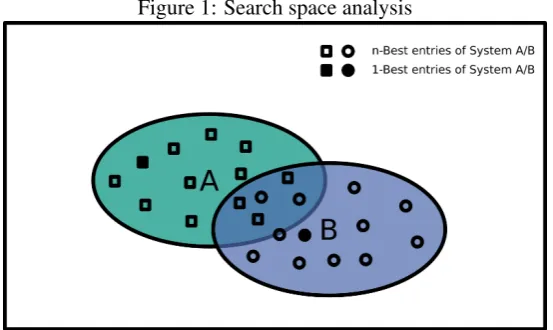
Figure 1: Search space analysis
the highest probability. Figure1shows the search spaces of systemAandB, approximated by their
n-best hypotheses. Their 1-best entries are also marked accordingly.
The question we address is why the system B
did select its best hypothesis and did not select the better-performant hypothesis . One reason might be that is not in the system B’s search space and therefore the system could not find it. The other reason might be that systemB prefers over. In this case, we need to improve the modelling.
If the performance of model B on the n-best list ofAis better than the initial score ofB, it sug-gests that the model B is able to select a better hypothesis and therefore the search is not optimal. On the other hand, if the performance is similar, it means thatBis not able to select a better hypothe-sis, even though there are better ones according to the evaluation metric.
In the experiments, we used two different ways of constructing the modelsAandB. In a first se-ries of experiments, we used the single best sys-tem as well as ensemble syssys-tems. In a second se-ries, we used systems using different ways to gen-erate the translations. Details of the systems will be given in the Section4.
4 System Description
Our German↔English NMT systems are built us-ing an encoder-decoder framework with atten-tion mechanism, nematus.1 Byte pair
encod-ing (BPE) is used in order to generate sub-word units (Sennrich et al., 2015). Long sentences whose sentence length exceeds 50 words are
ex-1https://github.com/rsennrich/nematus
empted from the training. We use minibatch size 80 and sentences are shuffled within every mini-batch. Word embedding of size 500 is applied, with hidden layers of size 1024. Dropout is ap-plied at every layer with the probability 0.2 in the embedding and hidden layers and 0.1 in the input and output layers. Our models are trained with Adadelta (Zeiler, 2012) and the gradient norm is clipped to 1.0. For the single models, we apply the early stopping based on the validation score.
The baseline system is trained on the WMT parallel data, namely EPPS, NC, CommonCrawl and TED corpus. As validation data we used the newstest13 set from IWSLT evaluation campaign. Therefore, this data is from TED talks. Test is applied on two domains. First domain is TED talks, same as the optimization set. We use new-stest14 for this testing. Another domain is tele-phone conversation and we used MSLT (Chris-tian Federmann, 2016) for testing. Since no ex-act genre-matching development data is published for the evaluation campaign (Cettolo et al.,2015), we used the TED-optimized system for the MSLT testing. For each experiment, we also offer oracle BLEU scores on then-best lists, calculated using multeval (Clark et al.,2011).
4.1 Configurations
from a PBMT system following the work in Niehues et al. (2016), which will be referred as
PrePBMT. A configuration using more monolin-gual data for this training is calledPrePBMT.large. InUnion, we use the joined n-best lists from dif-ferent systems.
4.2 n-best list
All n-best lists are generated for n = 50 from a standard beam search. The size of n-best lists are limited due to time and computational limi-tation. In our preliminary experiments where we increasedn-best list from 1 to 50, it did not sig-nificantly change the performance of one model. Therefore, in this work, we approximate the 50 -best lists our search space and conducted the anal-ysis. By doing so, we also aim to give a practical analysis on a model vs. search performance com-parison in NMT and useful guidelines from it.
5 Analysis on the Results
In this section, we discuss the experimental results and detailed analysis. In the first part, we discuss the results of the experiments on the baseline tems. In the second part, we combine NMT sys-tems that use different text representations.
5.1 NMT Baseline Systems
In this section, we analyze the performance of baseline systems. It largely breaks down to two tasks: TED and MSLT translation.
5.1.1 TED translation
Table1shows the baseline system performance on the TED translation task, from German to English. The table is showing translation performance of reranking eachn-best list using different models.
PPPPPP
PPP
n-best Model Single Ensemble Oracle
Single 31.96 32.37 41.81
Ensemble 32.09 32.41 42.31
Union 31.95 32.39 44.55
Table 1: Baseline: TED German→English
For the Single system, we took the best-performantBigVocsystem. TheEnsemblesystem is then generated by combining several training steps of the single system training. TheUnionn -best list is the joinedn-best list of all the individ-ual systems used in the ensemble. For building
aEnsemblesystem, we combine different models from several time steps ofSingletraining. Then in the softmax operation, normalized probabilities of each word are considered. As mentioned earlier, we also offer the oracle BLEU scores given each
n-best list.
Model performance As shown in the table, we can improve the translation performance by 0.5 BLEU point by using the Ensemble system to rescoren-best list generated by the same system, compared to the same case forSinglesystem. The main contribution for this improvement seems to be the better modeling. When we use theSingle
model to rescore the Ensemble or Union n-best list, we get mainly the same performance. Thus, the reason for the relatively lower performance of theSinglesystem is considered to be that it does not model the translation probabilities better, not because it does not find better translations. The oracle scores indicate the similar trend. When the
n-best list is large (Unionsetup), we have better translations in then-best list. However, these hy-potheses were not selected by either of the models.
Search performance The numbers in Table 1 suggests that the search is well-performant in NMT. For example, when we use the Ensemble
model to rescore theSinglen-best list, the transla-tion performance reaches 32.37 BLEU points. At the same time, when we use the same model to rescore theEnsemblen-best list, we achieve a sim-ilar performance.
5.1.2 MSLT translation
The performance on the single system on the MSLT task (Christian Federmann,2016) is shown in Table2.
PPPPPP
PPP
n-best Model Single Ensemble Oracle
Single 34.63 38.35 53.85
Ensemble 35.94 38.80 56.46
Table 2: Baseline: MSLT German→English
In this task, rescoring Single n-best list using the same model itself performs around 4 BLEU worse than rescoring Ensemble n-best list using the Ensemblemodel. Also, we can observe that theSingle model performs better when using the
n-best list of theEnsemblemodel.
better-performing hypotheses that theSingle model did not find during the search. Or alternatively, B) the
Ensemblen-best list does not contain the hypothe-ses that are good according to the Single model but not according to the evaluation metric. In this case, the model would select different hypotheses. In order to locate search error, we evaluated and compared the model score of hypothesis chosen from different n-best lists. Only in 2.5% of the chosen hypotheses, the score of the hypothesis se-lected from theEnsemblen-best list is higher than the one from theSinglen-best list. Thus, we have a search error only in these cases.
In contrast, in 90.7% of the sentences, the score from the Single n-best list is higher. The main reason for the improvement, therefore, is not con-sidered to be better search. Rather, the search space by theEnsemblesystem does not contain the worse-performing translations which are highly ranked by theSinglesystem.
The n-best lists of the Single model contains well-performing translations. For example, the performance achieved when using the Ensemble
model to rescore the Single n-best list is almost similar to the one achieved when applying the same model on the Ensemble n-best list. This performance is nearly 4 BLEU points better than rescoring the same n-best list using the Single
model.
While the performance of the Ensemblemodel on bothn-best lists is similar, interestingly, the or-acle score of the Ensemble n-best list is clearly higher. Therefore, the models seem not able to se-lect better translations in theEnsemblen-best list compared to theSinglen-best list.
5.2 NMT Text Representation Systems
As a next line of experiment, we combine NMT systems that use different text representations.
5.2.1 TED translation
Table 3 lists the systems used in the experiment and their performance on the TED task.
We can observe that the results of Union
rescored by each model is similar to the perfor-mance of the model’s n-best list rescoring, as marked in bold letters in each column. Consid-ering that the Union n-best list is considerably larger, it seems again that the model can find the best hypothesis according to the model.
In contrast, if we use all models (All) by using sum of log probabilities of all models to rescore
the n-best lists, we achieve similar performance for all n-best lists. Thus, it seems that all 50 -best lists contain already very good hypotheses. Only then-best list of thePrePBMTsystem seems to contain relatively worse options. This is also shown by the oracle scores. One reason could be that the pre-translation by the PBMT system is guiding the search and therefore then-best list contains relatively limited variety.
In addition, we observe that the performance of each model on its ownn-best list is considerably worse than the model rescoring othern-best lists. This can be explained by the following phenom-ena: some translations of a systemA are highly-ranked by the model itself, but not by the others. Therefore, they are selected by the systemA but not in then-best lists of the other systems. If they are in then-best list, e.g. in then-best lists of the system Aand in theUnion, they will be selected only when using the system A, leading to worse performance in BLEU. In contrast, if we use dif-ferent n-best lists, the translation performance is better.
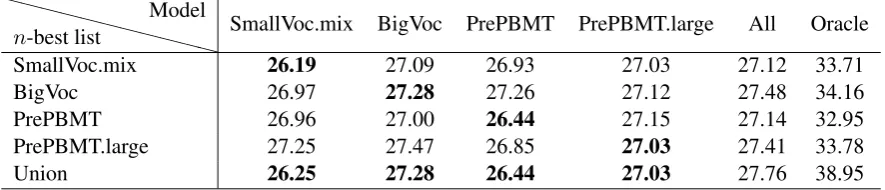
English→German In addition, we extend this experiment to another language direction. Table 4shows the results when the same experiment is applied to En-De TED task.
Here the same phenomena is observed. Again, theUnionn-best list does not improve the transla-tion quality. Nonetheless, the oracle score is sig-nificantly higher indicating that the model finds the better hypotheses. Furthermore, the n-best lists already contain better hypotheses which can be chosen using better models, i.g. the combina-tion of all models.
5.2.2 MSLT translation
Table 5shows the similar results when the same experiments are applied to the MSLT task. The
Unionconfiguration performs similar to rescoring using the same model, while performing consid-erably worse than the case where the samen-best list rescored by other models.
6 Conclusion
XXXXX
XXXXXX
n-best list Model SmallVoc SmallVoc.rev BigVoc PrePBMT All Oracle
SmallVoc 31.74 32.17 32.62 32.55 33.03 41.82
SmallVoc.rev 32.24 31.28 32.58 32.06 32.93 40.97
BigVoc 32.57 32.50 32.41 32.63 33.26 42.31
PrePBMT 32.19 31.97 32.53 31.41 32.65 40.67
[image:6.595.78.521.193.288.2]Union 31.83 31.27 32.42 31.39 33.24 46.58
Table 3: Text representation systems: TED German→English XXXXX
XXXXXX
n-best list Model SmallVoc.mix BigVoc PrePBMT PrePBMT.large All Oracle
SmallVoc.mix 26.19 27.09 26.93 27.03 27.12 33.71
BigVoc 26.97 27.28 27.26 27.12 27.48 34.16
PrePBMT 26.96 27.00 26.44 27.15 27.14 32.95
PrePBMT.large 27.25 27.47 26.85 27.03 27.41 33.78
Union 26.25 27.28 26.44 27.03 27.76 38.95
Table 4: Text representation systems: TED English→German
sufficient.
Furthermore, we showed that a relatively small
n-best list of 50 entries already contains notably better translation hypotheses. This result indicates that improving rescoring models are promising for performance boost. In this work, we showed that it is often sufficient to use a model in rescoring only. This finding also motivates the development of models which are challenging to use directly dur-ing the decoddur-ing, such as bi-directional decoders.
Acknowledgments
The project leading to this application has received funding from the European Union’s Horizon 2020 research and innovation programme under grant agreement n◦ 645452. The research by
Thanh-Le Ha was supported by Ministry of Science, Re-search and the Arts Baden-W¨urttemberg. This work was supported by the Carl-Zeiss-Stiftung.
References
Dzmitry Bahdanau, Kyunghyun Cho, and Yoshua Bengio. 2014. Neural Machine Translation by Jointly Learning to Align and Translate. CoRR abs/1409.0473. http://arxiv.org/abs/1409.0473.
Ondrej Bojar, Rajen Chatterjee, Christian Federmann, Barry Haddow, Philipp Koehn, Johannes Leveling, Christof Monz, Pavel Pecina, Matt Post, Herve Saint-Amand, et al. 2016. Findings of the 2016 Conference on Machine Translation (WMT16). In Proceedings of the First Conference on Machine
Translation (WMT16). Association for Computa-tional Linguistics, Berlin, Germany, pages 12–58.
M Cettolo, J Niehues, S St¨uker, L Bentivogli, and M Federico. 2015. The IWSLT 2016 Evaluation Campaign. InProceedings of the 13th International Workshop on Spoken Language Translation (IWSLT 2015). Seattle, US.
Eunah Cho, Jan Niehues, Thanh-Le Le, Matthias Sper-ber, Mohammed Mediani, and Alex Waibel. 2016. Adaptation and combination of nmt systems: The kit translation systems for iwslt 2016. In IWSLT. Seattle, WA, USA.
Kyunghyun Cho, Bart Van Merri¨enboer, Caglar Gul-cehre, Dzmitry Bahdanau, Fethi Bougares, Holger Schwenk, and Yoshua Bengio. 2014. Learning phrase representations using rnn encoder-decoder for statistical machine translation. InProceedings of the 2014 Conference on Empirical Methods in Nat-ural Language Processing (EMNLP 2014). Doha, Qatar.
William D. Lewis Christian Federmann. 2016. Mi-crosoft speech language translation (mslt) corpus: The iwslt 2016 release for english, french and ger-man. InIWSLT. Seattle, WA, USA.
Jonathan H. Clark, Chris Dyer, Alon Lavie, and Noah A. Smith. 2011. Better hypothesis testing for statistical machine translation: Controlling for optimizer instability. In Proceedings of the 49th Annual Meeting of the Association for Computational Linguistics: Human Lan-guage Technologies: Short Papers - Volume 2. Association for Computational Linguistics, Stroudsburg, PA, USA, HLT ’11, pages 176–181.
XXXXX
XXXXXX
n-best list Model SmallVoc SmallVoc.rev BigVoc PrePBMT All Oracle
SmallVoc 37.90 39.50 39.35 39.05 40.30 56.41
SmallVoc.rev 39.74 38.72 39.92 39.94 40.80 56.82
BigVoc 38.73 39.61 38.80 39.51 40.25 56.46
PrePBMT 38.91 39.68 39.36 38.33 40.24 54.44
Union 37.92 38.65 38.81 38.33 40.66 63.09
Table 5: Text representation systems: MSLT German→English
Marta R Costa-Juss`a, Josep M Crego, David Vi-lar, Jos´e AR Fonollosa, Jos´e B Mari˜no, and Her-mann Ney. 2007. Analysis and System Combi-nation of Phrase-and N-gram-based Statistical Ma-chine Translation Systems. In The Conference of the North American Chapter of the Association for Computational Linguistics (NAACLT’07). Associa-tion for ComputaAssocia-tional Linguistics, Rochester, NY, USA, pages 137–140.
Kevin Gimpel, Dhruv Batra, Chris Dyer, and Gregory Shakhnarovich. 2013. A Systematic Exploration of Diversity in Machine Translation. InProceedings of the 2013 Conference on Empirical Methods in Natu-ral Language Processing (EMNLP’13). Seattle, WA, USA.
Kenneth Heafield, Greg Hanneman, and Alon Lavie. 2009. Machine translation system combination with flexible word ordering. In Proceedings of the Fourth Workshop on Statistical Machine Translation (WMT’09). Association for Computational Linguis-tics, Athens, Greece, pages 56–60.
Almut Silja Hildebrand and Stephan Vogel. 2008. Combination of Machine Translation Systems via Hypothesis Selection from Combined N-Best Lists. InProceedings of the Eighth Conference of the As-sociation for Machine Translation in the Americas (AMTA’08). Hawaii, USA, pages 254–261.
Wolfgang Macherey and Franz J Och. 2007. An empir-ical study on computing consensus translations from multiple machine translation systems .
Evgeny Matusov, Nicola Ueffing, and Hermann Ney. 2006. Computing Consensus Translation for Mul-tiple Machine Translation Systems Using Enhanced Hypothesis Alignment. InProceedings of the 11th Conference of the European Chapter of Association for Computational Linguistics (EACL 2006). Asso-ciation for Computational Linguistics, Trento, Italy, pages 56–60.
Graham Neubig, Makoto Morishita, and Satoshi Naka-mura. 2015. Neural Reranking Improves Subjec-tive Quality of Machine Translation: NAIST at WAT2015. InProceedings of the 2nd Workshop on Asian Translation (WAT’15). Kyoto, Japan.
Jan Niehues, Eunah Cho, Thanh-Le Ha, and Alex Waibel. 2016. Pre-translation for neural machine
translation. Inthe 26th International Conference on Computational Linguistics (Coling 2016).
Kishore Papineni, Salim Roukos, Todd Ward, and Wei-Jing Zhu. 2002. Bleu: A method for automatic eval-uation of machine translation. InProceedings of the 40th Annual Meeting on Association for Computa-tional Linguistics (ACL 2002). Association for Com-putational Linguistics, Philadelphia, Pennsylvania, USA, pages 311–318.
Rico Sennrich, Barry Haddow, and Alexandra Birch. 2015. Neural machine translation of rare words with subword units. InProceedings of the 54th Annual Meeting of the Association for Computational Lin-guistics. Berlin, Germany.
Guillaume Wisniewski and Franc¸ois Yvon. 2013. Or-acle Decoding as a New Way to Analyze Phrase-based Machine Translation. Machine Translation 27(2):115–138.