The Code2Text Challenge: Text Generation in Source Code Libraries
Kyle Richardson†,Sina Zarrie߇andJonas Kuhn†
†Institute for Natural Language Processing, University of Stuttgart, Germany
‡Dialogue Systems Group // CITEC, Bielefeld University, Germany
Abstract
We propose a new shared task for tactical data-to-text generation in the domain of source code libraries. Specifically, we focus on text generation of function descriptions from ex-ample software projects. Data is drawn from existing resources used for studying the re-lated problem of semantic parser induction (Richardson and Kuhn, 2017b; Richardson and Kuhn, 2017a), and spans a wide variety of both natural languages and programming lan-guages. In this paper, we describe these ex-isting resources, which will serve as training and development data for the task, and discuss plans for building new independent test sets.
1 Introduction
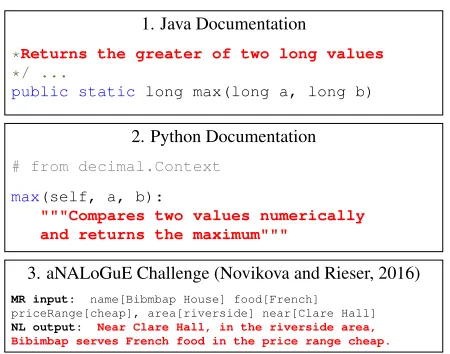
Source code libraries are collections of computer programs/instructions expressed in a target pro-gramming language that aim to solve some set of problems. Within these libraries, the designers of the code often use natural language to describe how var-ious internal components work. For example, Fig-ure 1.1 shows a docstring description (in red) for themaxfunction in the Java standard library, which explains what the function does (i.e., Returns the greater of), and the types of arguments that the func-tion takes (i.e.,two long values). Similarly, a related function and its documentation for the Python pro-gramming language is shown in Figure 1.2.
Given the tight coupling between such high-level text and lower-level representations, automatically extracting parallel datasets in this domain, consist-ing of short text descriptions and code templates, is rather straightforward. Such datasets can then be used to study various translation problems, in-cluding translating text to code templates (i.e.,
se-1. Java Documentation
*Returns the greater of two long values
*/ ...
public static long max(long a, long b)
2. Python Documentation # from decimal.Context
max(self, a, b):
"""Compares two values numerically and returns the maximum"""
3. aNALoGuE Challenge (Novikova and Rieser, 2016)
[image:1.612.311.536.201.378.2]MR input: name[Bibmbap House] food[French] priceRange[cheap], area[riverside] near[Clare Hall] NL output: Near Clare Hall, in the riverside area, Bibimbap serves French food in the price range cheap.
Figure 1: Example source code documentation, ordocstrings in 1-2, and an example MR/text pair.
mantic parsing), or generating representations to text (i.e., data-to-text generation). In previous work (Richardson and Kuhn, 2017b), we looked at us-ing source code libraries to study the first problem, and have collected datasets for 43 software libraries across 7 natural languages. We have also created a tool, calledFunction Assistant, for extract-ing new datasets from arbitrary software projects (Richardson and Kuhn, 2017a).
In this paper, we propose using these resources for studying the second problem. The task can be described as follows: given a source code li-brary dataset or collection of datasets consisting of text and code template pairs, e.g., the textReturns the greater of two.. and the function representa-tionstatic long max(..)in Figure 1.1, cre-ate a model that genercre-ates well-formed natural lan-guage descriptions of these formal code inputs. This task involves solving several sub-tasks, chief among them beinglexicalization, or the problem of how to
verbalize the function name and return value (here using a VP returns the greater of), and the func-tion’s arguments (expressed here as a plural expres-sion,two long values). As shown in Figure 1.3, ex-isting lexicalization tasks tend to involve input rep-resentations that have considerable lexical overlap with the verbal output, which is not the case with our datasets and therefore makes our problem more difficult. In addition, there is the problem of real-ization, or here aggregating the description as a sen-tence with an implied subject containing a transitive verb and a complex object, where the referring ex-pression is attached as a PP.
The available resources make the task highly mul-tilingual, both in terms of the input programming languages and output natural languages. Since pro-gramming languages differ in terms of represen-tation conventions, each formal language provides unique challenges related to these differences. For example, statically-typed languages, such as Java in Figure 1.1., contain more information about argu-ment and return values than dynamically-typed lan-guages, such as Python in Figure 1.2.
In what follows, we motivate this task by dis-cussing related work. We also discuss the current datasets and plans to build new independent test sets.
2 Related Work
Data-to-text generation concerns the problem of generating well-formed, natural language descrip-tions from non-linguistic, formal meaning represen-tations (Gatt and Krahmer, 2017). In our case, the input to a given generation system is a source code representation. In order to learn a natural language generation (NLG) system from data, a parallel cor-pus containing pairs of inputs and outputs must be constructed. In many studies on data-to-text gen-eration, these parallel resources are relatively small, cf. work on sportscasting (Chen and Mooney, 2008), weather reporting (Belz, 2008; Liang et al., 2009), or biology facts (Banik et al., 2013). We follow similar efforts to build automatic parallel resources (Belz and Kow, 2010) by mining example software libraries for (raw) pairs of short text descriptions and function representations.
A recent trend is the use of crowd-sourcing to ob-tain parallel NLG data (Wen et al., 2016; Novikova
et al., 2016; Gardent et al., 2017). Crowd-workers are presented with some meaning representation (MR, e.g., triples from a knowledge base) and asked to verbalize these representations in natural lan-guage. For example, theMR inputin Figure 1.3 in the restaurant domain is verbalized as the NL out-puttext. While this method allows for fast anno-tation, and thus solves the data scarcity problem, it also raises some new issues. For instance, sentences or utterances are produced by crowd-workers with-out much context, which puts to question the natu-ralness of the resulting text. Novikova et al. (2016) compare collecting data from logic-based MRs, of the type shown in Figure 1.3, and pictorial MRs, and find that the former approach leads to less natural and less informative descriptions. This seems to be related to the problem that the natural language sen-tence is a very close verbalization of the “logic” in-put, i.e., many terms in the MR can be simply taken up in the sentence.
Our approach relies on naturally occurring verbal descriptions produced by human developers. Our in-put data (source code representations) seems more abstract than previously used representations e.g. in the restaurant domain where many lexical items in the target utterance already appear in the MR. Thus, our input data is more “naturally occurring” in the sense that it has not been designed specifically for an NLG system (as compared to Wen et al. (2016) who randomly generate input representations) yet it still corresponds to a formal language. We expect that there is relatively little lexical correspondence between source code representations and verbal de-scriptions and that this is an interesting challenge for data-driven NLG, as simple “alignment” meth-ods might fail to predict lexicalization.
the wider availability of new data resources in the technical domain, especially through technical web-sites such as Github and StackOverflow. Rather than focus on unconstrained source code representations, as done in some of these studies, we believe that lim-iting the expressivity of the generation input to func-tion representafunc-tions withinknownsoftware libraries allows for more controlled experimentation.
On the resource side, our datasets are taken from (Richardson and Kuhn, 2017b; Richardson and Kuhn, 2017a). These resources have been used to study the problem of semantic parser induction, which is the inverse of the proposed data-to-text task. Given the close connection between the two tasks, there is often considerable overlap between the techniques used to solve either problem, tech-niques that are largely drawn from work on statisti-cal machine translation (Wong and Mooney, 2006; Belz and Kow, 2009) and parsing (Zettlemoyer and Collins, 2012; Konstas and Lapata, 2012). While some approaches to generation explicitly use se-mantic parsing methods (Wong and Mooney, 2007; Zarrieß and Richardson, 2013), a more systematic investigation into the relation between these two tasks seems missing, which is a topic that we hope to address in this shared task.
3 Task Description
Given a collection of datasets consisting of text
x and function representation z pairs, or D =
{(x, z)i}ni, the goal is to create a generation system
that can produce well-formed, natural language de-scriptions from these representations, orgen:z→
x. As discussed above, such descriptions should not only cover what the associated function does in general, but should also describe the function’s various parameters. As a secondary (optional) task, we will allow generation systems that accommodate processing in the other direction to compete on the task of semantic parsing,sp:x→ z, or generating function representations from text input.
3.1 Main Research Questions
Recent data-driven approaches in NLG have been successful in modeling end-to-end generation from unaligned input-output, cf. (Angeli et al., 2010; Mairesse and Young, 2014; Duˇsek and Jurcicek,
2015; Wen et al., 2016). However, these system have been mostly tested on datasets (e.g., in the restaurant domain) that require describing very similar entities, entities that are encoded in MRs that have consider-able lexical overlap with the target text output. A central research question is whether these end-to-end approaches scale to NLG settings that involve substantially harder lexicalization problems, such as with our datasets where the overlap is considerably less. Similarly, generating source code documenta-tion also involves describing a wide variety of func-tions from many different libraries, meaning that many more lexical concepts need to be learned.
A more general question is the following: to what extent can one build a function to text genera-tion system by relying only on example input-output pairs? This question is partly about the sufficiency of function representations for natural language gen-eration, namely, are these representations detailed enough to serve as a reasonable knowledge represen-tation for natural language? If not, what is missing? How do hybrid approaches, perhaps approaches that rely on linguistically well-founded translation con-straints and information about natural language syn-tax, fare against purely data-driven systems that rely solely on input-output as evidence?
Finally, the semantic parsing task addresses the following questions: what is the precise relationship between semantic parsing and data-to-text genera-tion? Does an improvement in one task lead to an improvement in the other task? Is data-to-text gen-eration simply aninversesemantic parsing task (Gatt and Krahmer, 2017) or are the two tasks fundamen-tally different?
4 Datasets
4.1 Train and Development Sets
Figure 2 shows information about the two datasets that will be available for model development, which were first introduced in (Richardson and Kuhn, 2017b) and (Richardson and Kuhn, 2017a) respec-tively1. None of these datasets have been previously
used for data-to-text generation. The first dataset consists of the standard library documentation for 9 programming languages, including Java, Ruby, PHP,
1Please see the original papers to get more detailed
Dataset # Software Projects # Training Pairs # Programming Languages # Natural Languages
Standard Library Docs 16 38,652 9 7
[image:4.612.73.542.58.92.2]Python 27 27 37,567 1 1
Figure 2:A description of the currently available software datasets for model development.
Python, Elisp, Haskell, Clojure, C, and Scheme. In addition, this resource includes documentation in 7 natural languages, including English, French, Spanish, Russian, Japanese, Turkish, and German. The second resource includes 27 publicly available Python projects, taken from the well-known awe-some Pythonlist of (Chen, 2017).
Each individual standard library documentation set or Python project consists of short text descrip-tions with function representadescrip-tions. While each function representation typically has only a single
text description, background information in the doc-umentation allows one to find related functions, and therefore related descriptions, which can be taken into account for training and evaluation. We note that there is wide variability in the size of each indi-vidual dataset, and some datasets are low-resource. One interesting research question is whether it is feasible to build a NLG system in these low-resource scenarios, and whether training on multiple lan-guages can help. In our previous experiments, we built individual models for each parallel dataset, though participants will be free to build models that are trained on multiple projects if desired.
We also note that these datasets are constructed automatically, and our existing extraction tool does not do extensive text preprocessing. The motiva-tion for this is that we can quickly construct new resources for model development and evaluation, though the result is that some of available text de-scriptions are noisy. We however regard this “noisi-ness” as an interesting technical challenge, and con-trasts with other shared tasks where more carefully curated data is assumed.
4.2 Test Sets
The publicly available test sets will be used for eval-uation (see details of the evaleval-uation below). In or-der to ensure that participants are not fitting their models to these sets, we are proposing to build three additional evaluation sets, each corresponding to a different programming language. These resources will be built using the Function Assistant
toolkit (Richardson and Kuhn, 2017a), which al-ready supports building parallel datasets from ar-bitrary Python source code projects, and will soon have functionality for the Java language.
The first two test sets, or evaluation tracks, will be specific to the Python and Java language, and will consist of unseen function representation-text pairs for each language. By having two separate sets according to language, we can see whether genera-tion quality differs between different types of pro-gramming languages. Taking an idea from the re-cent CoNLL 2017 shared task on dependency pars-ing, the third evaluation track will include examples from asurpriseprogramming language that has not been observed during the training phase. The idea is to see how generation systems generalize to unob-served languages where the inputs vary slightly.
5 Evaluation, Baselines and Scheduling
Following other data-to-text shared tasks (Banik et al., 2013; Colin et al., 2016) and previous work on text generating from code (Iyer et al., 2016), we will use automatic evaluation metrics such as BLEU and METEOR to evaluate system output. We will also perform fluency-based human evaluation on a sub-set of each test sub-set using student volunteers from the Institute for Natural Language Processing (IMS), at the University of Stuttgart, Germany.
To establish baseline results, we have already started a pilot study that uses phrase-based SMT to do generation. Such models have previously been used to establish strong baseline generation results (Belz and Kow, 2009; Wong and Mooney, 2007), and have the advantage of being easy to run using known open-source tools. Since these models only require parallel data, they also show what a purely input-output driven model is capable of achieving on these datasets.
Acknowledgement
This work and the current data collection effort is funded by the German Research Foundation (DFG) via SFB 732, project D2, at the University of Stuttgart. In addition, we acknowledge support by the Cluster of Excellence “Cognitive Interaction Technology” (CITEC; EXC 277) at Bielefeld Uni-versity, which is also funded by the DFG.
References
Miltos Allamanis, Daniel Tarlow, Andrew Gordon, and Yi Wei. 2015. Bimodal modelling of Source Code and Natural Language. InProceedings of ICML. Gabor Angeli, Percy Liang, and Dan Klein. 2010. A
Simple Domain-Independent Probabilistic Approach to Generation. InProceedings of EMNLP.
Eva Banik, Claire Gardent, and Eric Kow. 2013. The KBGen Challenge. InProceedings of ENLG.
Anja Belz and Eric Kow. 2009. System Building Cost vs. Output Quality in Data-to-Text Generation. In
Pro-ceedings of ENLG.
Anja Belz and Eric Kow. 2010. Extracting Parallel Fragments from Comparable Corpora for Data-to-Text Generation. InProceedings of INGL.
Anja Belz. 2008. Automatic Generation of Weather Forecast Texts using Comprehensive Probabilistic Generation-space Models. Natural Language Engi-neering, 14(4):431–455.
David L Chen and Raymond J Mooney. 2008. Learning to Sportscast: a Test of Grounded Language Acquisi-tion. InProceedings of ICML.
Vinta Chen. 2017. Awesome Python: A curated list of awesome Python frameworks, libraries, software and resources. https://github.com/vinta/ awesome-python.
Emilie Colin, Claire Gardent, Yassine Mrabet, Shashi Narayan, and Laura Perez-Beltrachini. 2016. The WebNLG Challenge: Generating Text from DBPedia Data. InProceedings of INLG.
Ondˇrej Duˇsek and Filip Jurcicek. 2015. Training a nat-ural language generator from unaligned data. In
Pro-ceedings of the ACL-IJCNLP.
Claire Gardent, Anastasia Shimorina, Shashi Narayan, and Laura Perez-Beltrachini. 2017. Creating Train-ing Corpora for NLG Micro-PlannTrain-ing. InProceedings of ACL.
Albert Gatt and Emiel Krahmer. 2017. Survey of the State of the Art in Natural Language Generation: Core tasks, applications and evaluation. arXiv preprint
arXiv:1703.09902.
Srinivasan Iyer, Ioannis Konstas, Alvin Cheung, and Luke Zettlemoyer. 2016. Summarizing Source Code using a Neural Attention Model. In Proceedings of ACL.
Ioannis Konstas and Mirella Lapata. 2012. Unsupervised Concept-to-text Generation with Hypergraphs. In
Pro-ceedings of NAACL.
Percy Liang, Michael I Jordan, and Dan Klein. 2009. Learning Semantic Correspondences with Less Super-vision. InProceedings of ACL.
Franc¸ois Mairesse and Steve Young. 2014. Stochastic language generation in dialogue using factored lan-guage models. Computational Linguistics, 40(4). Antonio Valerio Miceli Barone and Rico Sennrich. 2017.
A parallel corpus of Python functions and documen-tation strings for automated code documendocumen-tation and code generation.arXiv preprint arXiv:1707.02275. Jekaterina Novikova and Verena Rieser. 2016. The
aNA-LoGuE Challenge: Non Aligned Language GEnera-tion. InProceedings of INLG.
Jekaterina Novikova, Oliver Lemon, and Verena Rieser. 2016. Crowd-sourcing NLG Data: Pictures Elicit Bet-ter Data. InProceedings of INLG.
Ehud Reiter, Chris Mellish, and John Levine. 1995. Au-tomatic Generation of Technical Documentation. Ap-plied Artificial Intelligence, 9(3):259–287.
Kyle Richardson and Jonas Kuhn. 2017a. Function As-sistant: A Tool for NL Querying of APIs. In
Proceed-ings of EMNLP.
Kyle Richardson and Jonas Kuhn. 2017b. Learning Se-mantic Correspondences in Technical Documentation. InProceedings of ACL.
Tsung-Hsien Wen, Milica Gaˇsic, Nikola Mrkˇsic, Lina M Rojas-Barahona, Pei-Hao Su, David Vandyke, and Steve Young. 2016. Multi-domain Neural Network Language Generation for Spoken Dialogue Systems.
InProceedings of NAACL-HLT.
Yuk Wah Wong and Raymond J Mooney. 2006. Learning for Semantic Parsing with Statistical Machine Transla-tion. InProceedings of NACL.
Yuk Wah Wong and Raymond J Mooney. 2007. Gen-eration by Inverting a Semantic Parser that Uses Sta-tistical Machine Translation. InProceedings of
HLT-NAACL.
Pengcheng Yin and Graham Neubig. 2017. A Syntactic Neural Model for General-Purpose Code Generation. InProceedings of ACL.
Sina Zarrieß and Kyle Richardson. 2013. An Auto-matic Method for Building a Data-to-Text Generator.
InProceedings of ENLG.
Luke S Zettlemoyer and Michael Collins. 2012. Learn-ing to Map Sentences to Logical Form: Structured Classification with Probabilistic Categorial Grammars.