DocTag2Vec: An Embedding Based Multi-label Learning Approach for
Document Tagging
Sheng Chen]∗, Akshay Soni†, Aasish Pappu‡, Yashar Mehdad§
]University of Minnesota-Twin Cities, Minneapolis, MN 55455, USA
†Yahoo Research, Sunnyvale, CA 94089, USA and‡New York, NY 10036, USA §Airbnb, San Francisco, CA 94103, USA
[email protected] {akshaysoni,aasishkp}@yahoo-inc.com [email protected]
Abstract
Tagging news articles or blog posts with relevant tags from a collection of prede-fined ones is coined as document tagging in this work. Accurate tagging of articles can benefit several downstream applica-tions such as recommendation and search. In this work, we propose a novel yet sim-ple approach called DocTag2Vec to ac-complish this task. We substantially ex-tend Word2Vec and Doc2Vec – two pop-ular models for learning distributed rep-resentation of words and documents. In DocTag2Vec, we simultaneously learn the representation of words, documents, and tags in a joint vector space during training, and employ the simple k-nearest neigh-bor search to predict tags for unseen docu-ments. In contrast to previous multi-label learning methods, DocTag2Vec directly deals with raw text instead of provided feature vector, and in addition, enjoys ad-vantages like the learning of tag represen-tation, and the ability of handling newly created tags. To demonstrate the effec-tiveness of our approach, we conduct ex-periments on several datasets and show promising results against state-of-the-art methods.
1 Introduction
Every hour, several thousand blog posts are ac-tively shared on social media; for example, blog-ging sites such as Tumblr1had more than 70 bil-lion posts by January 2014 across different com-munities (Chang et al., 2014). In order to reach ∗This work was done when the author was an intern at Yahoo.
1tumblr.com
right audience or community, authors often as-sign keywords or “#tags” (hashtags) to these blog posts. Besides being topic-markers, it was shown that hashtags also serve as group identities (Bruns and Burgess, 2011), and as brand labels (Page, 2012). On Tumblr, authors are allowed to create their own tags or choose existing tags to label their blog. Creating or choosing tags for maximum out-reach can be a tricky task and authors may not be able to assign all the relevant tags. To allevi-ate this problem, algorithm-driven document tag-ging has emerged as a potential solution in re-cent times. Automatically tagging these blogs has several downstream applications, e.g., blog search, cluster similar blogs, show topics associated with trending tags, and personalization of blog posts. For better user engagement, the personalization al-gorithm could match user interests with the tags associated with a blog post.
From machine learning perspective, document tagging is by nature amulti-label learning(MLL) problem, where the input space is certain feature spaceX of document and the output space is the power set2Y of a finite set of tagsY. Given train-ing dataZ ⊂ X ×2Y, we want to learn a func-tion f : X 7→ 2Y that predicts tags for un-seen documents. As shown in Figure 1a, during training a standard MLL algorithm (big blue box) one typically attempts to fit the prediction func-tion (small blue box) into feature vectors of doc-uments and the corresponding tags. Note that fea-ture vectors are generatedseparatelybefore train-ing, and tags for each document are encoded as a |Y|-dimensional binary vector with one resenting the presence and zero otherwise. In pre-diction phase, the learned prepre-diction function will output relevant tags for the input feature vector of an unseen document. Following such a paradigm, many generic algorithms have been developed for MLL (Weston et al., 2011; Prabhu and Varma,
Prediction Function
Multi-Label Learning
Raw Document
Feature Vector Tags (0-1 vector)
Predicted Tags Training
Prediction
[image:2.595.82.504.62.144.2](a) standard multi-label learning (b) proposed method (DocTag2Vec)
Figure 1: Comparison of standard multi-label learning framework and the proposed method
2014; Bhatia et al., 2015). With a surge of text con-tent created by users online, such as blog posts, Wikipedia entries, etc., the algorithms for docu-ment tagging has many challenges. Firstly, time sensitive news articles are generated on a daily ba-sis, and it is important for an algorithm to assign tags before they loose freshness. Secondly, new tagged documents could be fed into the training system, thus incrementally adapting the system to new training data without re-training from scratch is also critical. Thirdly, we might face a very large set of candidate tags that can change dynamically, as new things are being invented.
In view of the aforementioned challenges, in this paper we propose a new and simple ap-proach for document tagging: DocTag2Vec. Our approach is motivated by the line of works on learning distributed representation of words and documents, e.g., Word2Vec (Mikolov et al., 2013) and Doc2Vec (a.k.a. Paragraph Vector) (Le and Mikolov, 2014). Word2Vec and Doc2Vec aim at learning low-dimensional feature vectors (i.e., em-beddings) for words and documents from large corpus in anunsupervisedmanner, such that sim-ilarity between words (or documents) can be re-flected by some distance metric on their embed-dings. The general assumption behind Word2Vec and Doc2Vec is that more frequent co-occurrence of two words inside a small neighborhood of document should imply higher semantic similar-ity between them (see Section 2.2 for details). The DocTag2Vec extends this idea to document and tag by positing that document and its asso-ciated tags should share high semantic similar-ity, which allows us to learn the embeddings of tags along with documents (see Section 2.3 for details). Our method has two striking differences compared with standard MLL frameworks: firstly, our method directly works with raw text anddoes notneed feature vectors extracted in advance. Sec-ondly, our DocTag2Vec produces tag embeddings, which carry semantic information that are gen-erally not available from standard MLL
frame-work. During training, DocTag2Vec directly takes the raw documents and tags as input and learns their embeddings using stochastic gradient
de-scent (SGD). In terms of prediction, a new
doc-ument will be first embedded using a Doc2Vec component inside the DocTag2Vec, and tags are then assigned by searching for the nearest tags embedded around the document. Overall the pro-posed approach has the following merits.
• The SGD training supports the incremental adjustment of DocTag2Vec to new data.
• The prediction uses the simple k-nearest neighbor search among tags instead of doc-uments, whose running time does not scale up as training data increase.
• Since our method represent each individual tag using its own embedding vector, it it easy to dynamically incorporate new tags.
• The output tag embeddings can be used in other applications.
Related Work: Multi-label learning has found
several applications in social media and web, like sentiment and topic analysis (Huang et al., 2013a), social text stream analysis (Ren et al., 2014), and online advertising (Agrawal et al., 2013). MLL has also been applied to diverse Natural Language Processing (NLP) tasks. However to the best of our knowledge we are the first to propose embed-ding based MLL approach to a NLP task. MLL has been applied to Word Sense Disambiguation (WSD) problem for polysemic adjectives (Boleda et al., 2007). (Huang et al., 2013b) proposed a joint model to predict sentiment and topic for tweets and (Surdeanu et al., 2012) proposed a multi-instance MLL based approach for relation extrac-tion with distant supervision.
et al., 2014; dos Santos and Gatti, 2014) and sum-marization (Kaageback et al., 2014; Rush et al., 2015; Li et al., 2015). Also, vector space modeling has been applied to search re-targeting (Grbovic et al., 2015a) and query rewriting (Grbovic et al., 2015b).
Given many potential applications, document tagging has been a very active research area. In information retrieval, it is often coined as content-basedtag recommendationproblem (Chirita et al., 2007), for which numbers of approaches were proposed, such as (Heymann et al., 2008), (Song et al., 2008b), (Song et al., 2008a) and (Song et al., 2011). Personalized tag recommendation is also studied in the literature (Symeonidis et al., 2008; Rendle et al., 2009). In machine learning com-munity, a lot of general MLL algorithms have been developed, with application to document tagging, including compressed-sensing based ap-proach (Hsu et al., 2009), WSABIE (Weston et al., 2011), ML-CSSP (Bi and Kwok, 2013), LEML (Yu et al., 2014), FastXML (Prabhu and Varma, 2014), SLEEC (Bhatia et al., 2015) to name a few.
Paper Organization: The rest of the paper
is organized as follows. In Section 2, we first give a brief review of Word2Vec and Doc2Vec models, and then present training and prediction step respectively for our proposed extension, Doc-Tag2Vec. In Section 3, we demonstrate the effec-tiveness of our DocTag2Vec approach through ex-periments on several datasets. In the end, Section 4 is dedicated to conclusions and future works.
2 Proposed Approach
In this section, we present details of DocTag2Vec. For the ease of exposition, we first introduce some mathematical notations followed by a brief review for two widely-used embedding models: Word2Vec and Doc2Vec.
2.1 Notation
We let V be the size of vocabulary (i.e., set of unique words),N be the number of documents in the training set,Mbe the size of tag set, andKbe the dimension of the vector space of embedding. We denote the vocabulary asW ={w1, . . . , wV},
set of documents as D = {d1, . . . , dN}, and the
set of tags asT = {t1, . . . , tM}. Each document
d ∈ D is basically a sequence of nd words
rep-resented by(wd
1, w2d, . . . , wdnd), and is associated
withMd tagsTd = {td1, . . . , tdMd}. Here the
sub-script dofnandM suggests that the number of word and tag is different from document to docu-ment. For convenience, we use the shorthandwd
i :
wd
j, i ≤ j, to denote the subsequence of words
wd
i, wid+1, . . . , wdj−1, wdj in document d.
Corre-spondingly, we denote W = [w1, . . . ,wV] ∈ RK×V as the matrix for word embeddings,D =
[d1, . . . ,dN]∈RK×Nas the matrix for document
embeddings, andT = [t1, . . . ,tM] ∈ RK×M as
the matrix for tag embeddings. Sometimes we may use the symbol di interchangeably with the
em-bedding vector di to refer to the i-th document,
and useddto denote the vector representation of
document d. Similar conventions apply to word and tag embeddings. Besides we let σ(·) be the sigmoid function, i.e.,σ(a) = 1/(1 + exp(−a)).
2.2 Word2Vec and Doc2Vec
The proposed approach is inspired by the work of Word2Vec, an unsupervised model for learn-ing embeddlearn-ing of words. Essentially, Word2Vec embeds all words in the training corpus into a low-dimensional vector space, so that the seman-tic similarities between words can be reflected by some distance metric (e.g., cosine distance) de-fined on their vector representations. The way to train Word2Vec model is to minimize the loss function associated with certain classifier with respect to both feature vectors (i.e., word em-beddings) and classifier parameters, such that the nearby words are able to predict each other. For example, incontinuous bag-of-word(CBOW) framework, Word2Vec specifically minimizes the following average negative log probability
X
d∈D
nd
X
i=1
−logp(wid|wdi−c:wid−1, wdi+1:wid+c),
matrix H ∈ RK×(V−1), whose columns are
respectively mapped to a unique non-leaf node of
B. Additionally, we define Path(w) = {(i, j) ∈ B |edge(i, j)is on the path from root to wordw}. Then the negative log probability is given as
−logp(wdi |wdi−c:wdi−1, wid+1 :wdi+c)
=−log Y
(u,v)∈Path(wd i)
σchild(v)· hgdi,hvi
=− X
(u,v)∈Path(wd i)
logσchild(v)· hgdi,hvi
,
gdi = X
−c≤j≤c j6=0
wdi+j ,
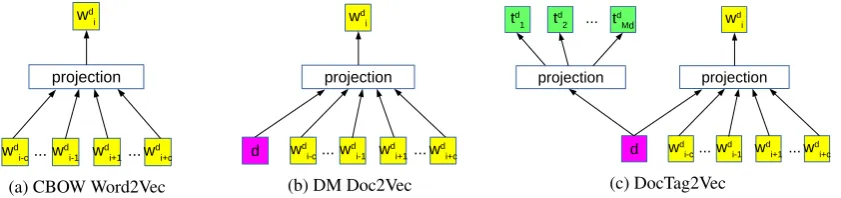
where child(u, v) is equal to 1 if v is the left child of u and 0 otherwise. Figure 2a shows the model architecture of CBOW Word2Vec. Basi-cally gd
i is the input feature for HS classifier
corresponding to projection layer in Figure 2a , which essentially summarizes the feature vectors of context words surrounding wd
i, and other
op-tions like averaging ofwd
i+j can also be applied.
This Word2Vec model can be directly extended to Distributed memory (DM) Doc2Vec model by conditioning the probability ofwd
i ondas well as
wd
i−c, . . . , wid+c, which yields
−logp(wdi |wdi−c:wdi−1, wid+1 :wdi+c, d)
=− X
(u,v)∈Path(wd i)
logσchild(v)· h˜gdi,hvi
,
(1)
˜ gd
i =dd+
X
−c≤j≤c j6=0
wd
i+j . (2)
The architecture of DM Doc2Vec model is il-lustrated in Figure 2b. Instead of optimizing some rigorously defined probability function, both Word2Vec and Doc2Vec can be trained using other objectives, e.g., negative sampling (NEG) (Mikolov et al., 2013).
2.3 Training for DocTag2Vec
Our approach, DocTag2Vec, extends the DM Doc2Vec model by adding another component for learning tag embeddings. In addition to predict-ing target wordwd
i using contextwid−c, . . . , wdi+c,
as shown in Figure 2c, DocTag2Vec also uses the document embedding to predict each associated
tag, with hope that they could be closely embed-ded. The joint objective is given by
X
d∈D
nd
X
i=1
−logp(wid|wid−c:wid−1, wid+1:wdi+c, d)
−αX
t∈Td
logp(t|d),
where α is a tuning parameter. As discussed for Word2Vec, the problem of evaluating costly par-tition function is also faced by the newly intro-duced probabilityp(t|d). Different from the con-ditional probability of wd
i, the probability p(t|d)
cannot be modeled using hierarchical softmax, as the columns of parameter matrix do not have one-to-one correspondence to tags (remember that we need to obtain a vector representation for each tag). Motivated by the idea of negative sampling used in Word2Vec, we come up with the following objective for learning tag embedding rather than stick to a proper probability function,
−X
t∈Td
logσ(hdt,tti) +r·Et∼p[logσ(−hdt,ti)] ,
(3) wherepis a discrete distribution over all tag em-beddings {t1, . . . ,tM} and r is a integer-valued
hyperparameter. The goal of such objective is to differentiate the tagtfrom the draws according to p, which is chosen asuniform distributionfor sim-plicity in our practice. Now the final loss function for DocTag2Vec is the combination of (1) and (3),
`(W,D,T,H) =X
d∈D
nd
X
i=1
− X
(u,v)∈Path(wd i)
logσ child(v)· hg˜id,hvi
| {z }
DM Doc2Vec with hierarchical softmax
−
αX
t∈Td
logσ(hdt,tti) +r·E[logσ(−hdt,ti)]
| {z }
tag embedding with negative sampling
(4) We minimize `(W,D,T,H) using stochastic gradient descent (SGD). To avoid exact calcula-tion of the expectacalcula-tion in negative sampling, at each iteration we sample r i.i.d. instances of t
from distribution p, denoted by {t1
p,t2p, . . . ,trp},
to stochastically approximate the expectation, i.e.,
Pr
wd
i-c w
d
i-1 w
d
i+1 w
d i+c
... ...
projection wd
i
(a) CBOW Word2Vec
d wd
i-c w d
i-1 w d
i+1 w d
i+c
... ...
projection wd
i
(b) DM Doc2Vec
d
td
1 t
d
2 t
d
Md
...
projection
wd
i-c w
d
i-1 w
d
i+1 w
d i+c
... ...
projection
wd
i
[image:5.595.96.517.62.161.2](c) DocTag2Vec Figure 2: Model architectures of different embedding approaches
2.4 Prediction for DocTag2Vec
Unlike Word2Vec and Doc2Vec, which only tar-get on learning high-quality embeddings of words and documents, DocTag2Vec needs to make pre-dictions of relevant tags for new documents. To this end, we first embed the new document via the Doc2Vec component within DocTag2Vec and then performk-nearest neighbor (k-NN) search among tags. To be specific, given a new documentd, we first optimize the objective (1) with respect todd
by fixing W and H. Note that this is the stan-dard inference step for new document embedding in Doc2Vec. Once dd is obtained, we search for
thek-nearest tags to it based on cosine similarity. Hence the prediction function is given as
fk(dd) =i|uiis in the largestkentries
ofu=TTdd ,
(5)
where Tis column-normalized version of T. To boost the prediction performance of DocTag2Vec, we apply the bootstrap aggregation (a.k.a. bag-ging) technique to DocTag2Vec. Essentially we train b DocTag2Vec learners using different ran-domly sampled subset of training data, resulting inbdifferent tag predictorsf1
k0(·), . . . , fkb0(·)along with their tag embedding matricesT1, . . . ,Tb. In
general, the number of nearest neighborsk0for in-dividual learner can be different fromk. In the end, we combine the predictions from different models by selecting fromSbj=1fkj0(dd)thektags with the
largest aggregated similarities withdd,
fkbag(dd) = n
i|uiis in the largestkentries ofu,
whereui = b X
j=1
I{i∈fkj0(dd)} · htji,ddi o
.
3 Experiments
3.1 Datasets
In this subsection, we briefly describe the datasets included in our experiments. It is worth noting that
DocTag2Vec method needs raw texts as input in-stead of extracted features. Therefore many bench-mark datasets for evaluating multi-label learning algorithms are not suitable for our setting. For the experiment, we primarily focus on the diversity of the source of tags, which capture different aspects of documents. The statistics of all datasets are pro-vided in Table 1.
Public datasets:
• Wiki10: The wiki10 dataset contains a subset
of English Wikipedia documents, which are tagged collaboratively by users from the so-cial bookmarking siteDelicious1. We remove the two uninformative tags, “wikipedia” and “wiki”, from the collected data.
• WikiNER: WikiNER has a larger set of
English Wikipedia documents. The tags for each document are the named entities inside it, which is detected automatically by some named entity recognition (NER) algorithm.
Proprietary datasets
• Relevance Modeling (RM): The RM dataset
consists of two sets of financial news article in Chinese and Korean respectively. Each ar-ticle is tagged with related ticker symbols of companies given by editorial judgement.
• News Content Taxonomy (NCT): NCT
dataset is a collection of news articles anno-tated by editors with topical tags from a tax-onomy tree. The closer the tag is to the root, the more general the topic is. For such tags with hierarchical structure, we also evaluate our method separately for tags of general top-ics (depth=2) and specific toptop-ics (depth=3).
3.2 Baselines and Hyperparameter Setting
The baselines include one of the state-of-the-art multi-label learning algorithms called SLEEC
Dataset #training point #testing point #unique tags Avg #tags per document
Wiki10 14095 6600 31177 17.27
WikiNER 89521 10000 67179 22.96
Relevance Modeling (Chinese) 4505 500 391 1.02
Relevance Modeling (Korean) 1292 500 261 1.07
NCT (all) 40305 9546 883 1.88
NCT (general) 39401 9389 294 1.76
[image:6.595.88.504.59.269.2]NCT (specific) 17278 4509 412 1.41
Table 1: Statistics of datasets
0 1 2 3 4 5 6
k
0 0.1 0.2 0.3 0.4 0.5 0.6 0.7 0.8 0.9
precision@k
DocTag2Vec Doc2Vec SLEEC
(a) Wiki10
0 1 2 3 4 5 6
k
0 0.1 0.2 0.3 0.4 0.5 0.6
precision@k
DocTag2Vec Doc2Vec SLEEC FastEL
(b) WikiNER
0 1 2 3 4 5 6
k
0 0.1 0.2 0.3 0.4 0.5 0.6 0.7 0.8 0.9
precision@k
DocTag2Vec Doc2Vec SLEEC
(c) RM (Chinese)
0 1 2 3 4 5 6
k 0
0.1 0.2 0.3 0.4 0.5 0.6 0.7 0.8
precision@k
DocTag2Vec Doc2Vec SLEEC
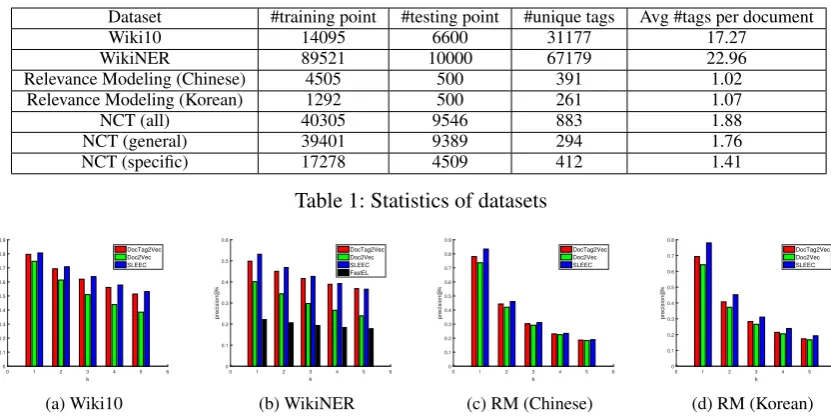
(d) RM (Korean) Figure 3: Precision on Wiki10, WikiNER and Relevance Modeling dataset
(Bhatia et al., 2015), a variant of DM Doc2Vec, and an unsupervised entity linking system, Fas-tEL (Blanco et al., 2015), which is specific to WikiNER dataset. SLEEC is based on non-linear dimensionality reduction of binary tag vectors, and use a sophisticated objective function to learn the prediction function. For comparison, we use the TF-IDF representation of document as the in-put feature vector for SLEEC, as it yields better re-sult than embedding based features like Doc2Vec feature. To extend DM Doc2Vec for tagging pur-pose, basically we replace the documentdshown in Figure 2b with tags td
1, . . . , tdMd, and train the
Doc2Vec to obtain the tag embeddings. During testing, we perform the same steps as DocTag2Vec to predict the tags, i.e., inferring the embedding of test document followed byk-NN search. FastEL is unsupervised appproach for entity linking of web-search queries that walks over a sequence of words in query and aims to maximize the likelihood of linking the text span to an entity in Wikipedia. FastEL model calculates the conditional probabil-ities of an entity given every substring of the input document, however avoid computing entit to en-tity joint dependencies, thus making the process efficient. We built FastEL model using query logs that spanned 12 months and Wikipedia anchor text extracted from Wikipedia dumps dated November 2015. We choose an entity linker baseline because it is a simple way of detecting topics/entities that are semantically associated with a document.
Regarding hyperparameter setting, both SLEEC and DocTag2Vec aggregate multiple learners to enhance the prediction accuracy, and we set the
number of learners to be 15. For SLEEC, we tune the rest of hyperparameters using grid search. For SLEEC and DocTag2Vec, we set the number of epochs for SGD to be 20 and the window sizecto be 8. To train each individual learner, we randomly sample50%training data. In terms of the nearest neighbor search, we setk0 = 10for Wiki10 and WikiNER while keepingk0 = 5for others. For the rest of hyperparameters, we also apply grid search to find the best ones. For DocTag2Vec, we addi-tionally need to set the number of negative tagsr and the weightα in (4). Typically r ranges from 1 to 5, andr = 1gives the best performance on RM and NCT datasets. Empirically good choice forα is between 0.5 and 5. For FastEL, we con-sider a sliding window of size5over the raw-text (no punctuations) of document to generate entity candidates. We limit the number of candidates per document to 50.
3.3 Results
0 1 2 3 4 5 6
k
0 0.1 0.2 0.3 0.4 0.5 0.6 0.7
precision@k
DocTag2Vec DocTag2Vec(incremental) Doc2Vec SLEEC
(a) All tags
0 1 2 3 4 5 6
k
0 0.1 0.2 0.3 0.4 0.5 0.6 0.7 0.8
precision@k
DocTag2Vec DocTag2Vec(incremental) Doc2Vec SLEEC
(b) Specific tags
0 1 2 3 4 5 6
k
0 0.1 0.2 0.3 0.4 0.5 0.6 0.7 0.8
precision@k
DocTag2Vec DocTag2Vec(incremental) Doc2Vec SLEEC
(c) General tags Figure 4: Precision on News Content Taxonomy dataset
DocTag2Vec DocTag2Vec (incremental) Doc2Vec SLEEC
NCT (all tags) 0.6702 0.6173 0.6389 0.6524
NCT (specific tags) 0.8111 0.7678 0.7810 0.7624
NCT (general tags) 0.7911 0.7328 0.7521 0.7810
Table 2: Overall Recall on News Content Taxonomy dataset
0 5 10 15
# learners
0.54 0.56 0.58 0.6 0.62 0.64
precision@1
0 5 10 15
# learners
0.3 0.32 0.34 0.36 0.38
precision@3
0 5 10 15
# learners
0.2 0.22 0.24 0.26 0.28
[image:7.595.78.500.32.730.2]precision@5 DocTag2VecDoc2Vec
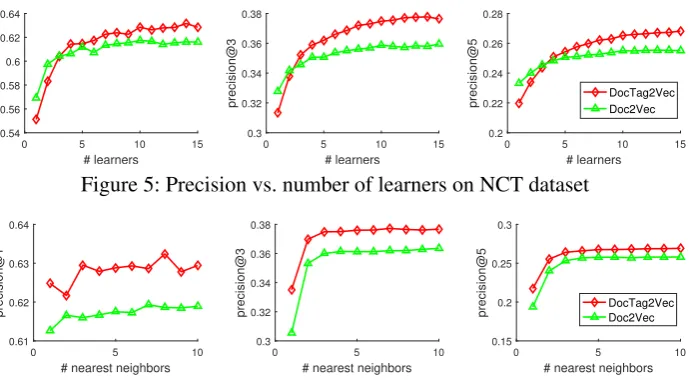
Figure 5: Precision vs. number of learners on NCT dataset
0 5 10
# nearest neighbors
0.61 0.62 0.63 0.64
precision@1
0 5 10
# nearest neighbors
0.3 0.32 0.34 0.36 0.38
precision@3
0 5 10
# nearest neighbors
0.15 0.2 0.25 0.3
precision@5 DocTag2VecDoc2Vec
Figure 6: Precision vs. number of nearest neighbors on NCT dataset
News excerpt Editorial tags Predicted tagsPrediction (top 3)similarity
The world is definitely getting warmer, according to the U.S. National Atmospheric and Oceanic Administration. For its annual ”State of the Climate” report, NOAA for the first time gathered data on 37 climate indicators, such as air and sea temperatures, sea level, humidity, and snow cover in one place, and found that, taken together, the measurements show an ”unmistakable upward trend” in temperature. Three hundred scientists analyzed the information and concluded it’s ”undeniable” that the planet has warmed since 1980, with the last decade taking the record for hottest ever recorded.
/Nature & Environment/ Natural Phenomena
/Nature & Environment/ Environment/Climate
Change 1.99
/Science/ Meteorology 0.64
/Nature & Environ-ment/Natural
Phenom-ena/Weather 0.57
Business software maker Epicor Software Corp. said Thursday that its second-quarter loss narrowed as revenue climbed. For the April-June quarter, Epicor’s loss totaled $1 million, or 2 cents per share, compared with a loss of $6.7 million, or 11 cents per share, in the year-ago quarter. When excluding one-time items, Epicor earned 13 cents per share, which is what analysts polled by Thomson Reuters expected. Revenue rose 9 percent to $109.2 million, beating analyst estimates for $105.2 million.
/Business/Sectors & Industries/ Information Technology/Internet Software & Services
/Finance/Investment & Company Information
/Finance/Investment & Company Information/
Company Earnings 2.25
/Finance/Investment & Company Information 1.23 /Finance/Investment & Company Information/ Stocks & Offerings 0.32
TicketLiquidator, the leading provider of the world’s most extensive ticket inventory for hard-to-find, low priced tickets, today announced that tickets are available for the Orlando Magic vs. Cleveland Cavaliers game on Wednesday, November 11th at Orlando’s Amway Arena. The much-anticipated matchup features LeBron James, who is now in the final year of his contract with the Cavaliers.
/Sports & Recreation/ Baseball
/Sports &
Recre-ation/Basketball 4.07
/Arts & Entertain-ment/Events/Tickets 3.42 /Sports &
Recre-ation/Baseball 0.96
Table 3: Examples of Better Prediction over Editorial Judgement
is to be noted that SLEEC requires proper features as input and does not work directly with raw docu-ments; while DocTag2Vec learns vector
[image:7.595.131.476.283.474.2]detec-tion, and content based recommendation. We have demonstrated improvements in all the above men-tioned use-cases of DocTag2Vec vectors but the discussion on those is out of the scope of this pa-per.
For NCT dataset, we also train the DocTag2Vec incrementally, i.e., each time we only feed 100 documents to DocTag2Vec and let it run SGD, and we keep doing so until all training samples are pre-sented. As shown in Figure 4, our DocTag2Vec outperform Doc2Vec baseline, and delivers com-petitive or even better precision in comparision with SLEEC. Also, the incremental training does not sacrifice too much precision, which makes DocTag2Vec even appealing. The overall recall of DocTag2Vec is also slightly better than SLEEC, as shown in Table 2. Figure 5 and 6 include the precision plot against the number of learnersband the number of nearest neighborsk0 for individual learner, respectively. It is not difficult to see that afterb = 10, adding more learners does not give significant improvement on precision. For nearest neighbor search,k0 = 5would suffice.
3.4 Case Study for NCT dataset
For NCT dataset, when we examine the predic-tion for individual articles, it turns out surpris-ingly that there are a significant number of cases where DocTag2Vec outputs better tags than those by editorial judgement. Among all these cases, we include a few in Table 3 showing the superior-ity of the tags given by DocTag2Vec sometimes. For the first article, we can see that the three pre-dicted tags are all related to the topic, especially the one with highest similarity,/Nature &
Environ-ment/ EnvironEnviron-ment/Climate Change, seems more
pertinent compared with the editor’s. Similarly, we predict/Finance/Investment & Company
Informa-tion/Company Earningsas the most relevant topic
for the second article, which is more precise than its parent /Finance/Investment & Company
Infor-mation. Besides our approach can even find the
wrong tags assigned by the editor. The last piece of news is apparently about NBA, which should have the tag /Sports & Recreation/Basketball as predicted, while the editor annotates them with the incorrect one,/Sports & Recreation/Baseball. On the other hand, by looking at the similarity scores associated with the predicted tags, we can see that higher score in general implies higher aboutness, which can also be used as a quantification of
pre-diction confidence.
4 Conclusions and Future Work
In this paper, we present a simple method for document tagging based on the popular distribu-tional representation learning models, Word2Vec and Doc2Vec. Compared with classical multi-label learning methods, our approach provides several benefits, such as allowing incremental up-date of model, handling the dynamical change of tag set, as well as producing feature representa-tion for tags. The document tagging can benefit a number of applications on social media. If the text content over web is correctly tagged, articles or blog posts can be pushed to the right users who are likely to be interested. And such good personal-ization will potentially improve the users engage-ment. In future, we consider extending our ap-proach in a few directions. Given that tagged doc-uments are often costly to obtain, it would be inter-esting to extend our approach to a semi-supervised setting, where we can incorporate large amounts of unannotated documents to enhance our model. On the other hand, with the recent progress in graph embedding for social network (Yang et al., 2016; Grover and Leskovec, 2016), we may be able to improve the tag embedding by exploiting the rep-resentation of users and interactions between tags and users on social networks.
Acknowledgements
The authors would like to thank the anonymous re-viewers for their encouraging and thoughtful com-ments.
References
R. Agrawal, A. Gupta, Y. Prabhu, and M. Varma. 2013. Multi-label learning with millions of labels: Recom-mending advertiser bid phrases for web pages. In Proceedings of the 22Nd International Conference on World Wide Web. WWW ’13.
K. Bhatia, H. Jain, P. Kar, M. Varma, and P. Jain. 2015. Sparse local embeddings for extreme multi-label classification. InProceedings of the 28th In-ternational Conference on Neural Information Pro-cessing Systems. pages 730–738.
Roi Blanco, Giuseppe Ottaviano, and Edgar Meij. 2015. Fast and space-efficient entity linking for queries. InProceedings of the Eighth ACM Interna-tional Conference on Web Search and Data Mining. ACM, pages 179–188.
Gemma Boleda, Sabine Schulte im Walde, and Toni Badia. 2007. Modelling polysemy in adjective classes by multi-label classification. In EMNLP-CoNLL. pages 171–180.
Axel Bruns and Jean E Burgess. 2011. The use of twit-ter hashtags in the formation of ad hoc publics. In Proceedings of the 6th European Consortium for Po-litical Research (ECPR) General Conference 2011. Yi Chang, Lei Tang, Yoshiyuki Inagaki, and Yan Liu.
2014. What is tumblr: A statistical overview and comparison. ACM SIGKDD Explorations Newslet-ter16(1):21–29.
P.-A. Chirita, S. Costache, W. Nejdl, and S. Handschuh. 2007. P-tag: Large scale automatic generation of personalized annotation tags for the web. In Pro-ceedings of the 16th International Conference on World Wide Web. pages 845–854.
C´ıcero Nogueira dos Santos and Maira Gatti. 2014. Deep convolutional neural networks for sentiment analysis of short texts. InCOLING. pages 69–78. M. Grbovic, N. Djuric, V. Radosavljevic, and
N. Bhamidipati. 2015a. Search retargeting using directed query embeddings. In Proceedings of the 24th International Conference on World Wide Web. pages 37–38.
M. Grbovic, N. Djuric, V. Radosavljevic, F. Silvestri, and N. Bhamidipati. 2015b. Context- and content-aware embeddings for query rewriting in sponsored search. In Proceedings of the 38th International ACM SIGIR Conference on Research and Develop-ment in Information Retrieval. pages 383–392. A. Grover and J. Leskovec. 2016. Node2vec: Scalable
feature learning for networks. InProceedings of the 22Nd ACM SIGKDD International Conference on Knowledge Discovery and Data Mining. KDD ’16. P. Heymann, D. Ramage, and H. Garcia-Molina. 2008.
Social tag prediction. InProceedings of the 31st An-nual International ACM SIGIR Conference on Re-search and Development in Information Retrieval. pages 531–538.
D. J Hsu, S. M Kakade, J. Langford, and T. Zhang. 2009. Multi-label prediction via compressed sens-ing. InAdvances in Neural Information Processing Systems 22, pages 772–780.
S. Huang, W. Peng, J. Li, and D. Lee. 2013a. Sen-timent and topic analysis on social media: A multi-task multi-label classification approach. In Proceed-ings of the 5th Annual ACM Web Science Confer-ence. WebSci ’13.
Shu Huang, Wei Peng, Jingxuan Li, and Dongwon Lee. 2013b. Sentiment and topic analysis on social me-dia: a multi-task multi-label classification approach. In Proceedings of the 5th annual acm web science conference. ACM, pages 172–181.
Mikael Kaageback, Olof Mogren, Nina Tahmasebi, and Devdatt Dubhashi. 2014. Extractive summariza-tion using continuous vector space models. In Pro-ceedings of the 2nd Workshop on Continuous Vector Space Models and their Compositionality (CVSC) EACL. pages 31–39.
Guillaume Lample et al. 2016. Neural architec-tures for named entity recognition. arXiv preprint arXiv:1603.01360.
Q. V. Le and T. Mikolov. 2014. Distributed represen-tations of sentences and documents. InICML. vol-ume 14, pages 1188–1196.
Jiwei Li, Minh-Thang Luong, and Dan Jurafsky. 2015. A hierarchical neural autoencoder for paragraphs and documents.arXiv preprint arXiv:1506.01057. Xuezhe Ma and Eduard Hovy. 2016. End-to-end
sequence labeling via bi-directional LSTM-CNNs-CRF. arXiv preprint arXiv:1603.01354.
T. Mikolov, I. Sutskever, K. Chen, G. S. Corrado, and J. Dean. 2013. Distributed representations of words and phrases and their compositionality. InAdvances in Neural Information Processing Systems 26, pages 3111–3119.
Frederic Morin and Yoshua Bengio. 2005. Hierarchi-cal probabilistic neural network language model. In AISTATS05. pages 246–252.
Ruth Page. 2012. The linguistics of self-branding and micro-celebrity in twitter: The role of hashtags. Dis-course & Communication6(2):181–201.
Alexandre Passos, Vineet Kumar, and Andrew Mc-Callum. 2014. Lexicon infused phrase embed-dings for named entity resolution. arXiv preprint arXiv:1404.5367.
Y. Prabhu and M. Varma. 2014. Fastxml: A fast, accu-rate and stable tree-classifier for extreme multi-label learning. InProceedings of the 20th ACM SIGKDD International Conference on Knowledge Discovery and Data Mining. pages 263–272.
Z. Ren, M.-H. Peetz, S. Liang, W. van Dolen, and M. de Rijke. 2014. Hierarchical multi-label clas-sification of social text streams. In Proceedings of the 37th International ACM SIGIR Conference on Research & Development in Information Re-trieval. SIGIR ’14.
Alexander M Rush, Sumit Chopra, and Jason We-ston. 2015. A neural attention model for ab-stractive sentence summarization. arXiv preprint arXiv:1509.00685.
Richard Socher, Jeffrey Pennington, Eric H Huang, Andrew Y Ng, and Christopher D Manning. 2011. Semi-supervised recursive autoencoders for predict-ing sentiment distributions. In Proceedings of the Conference on Empirical Methods in Natural Lan-guage Processing. Association for Computational Linguistics, pages 151–161.
Y. Song, L. Zhang, and C. L. Giles. 2008a. A sparse gaussian processes classification framework for fast tag suggestions. In Proceedings of the 17th ACM Conference on Information and Knowledge Man-agement. pages 93–102.
Y. Song, L. Zhang, and C. L. Giles. 2011. Automatic tag recommendation algorithms for social recom-mender systems.ACM Trans. Web5(1):4:1–4:31. Y. Song, Z. Zhuang, H. Li, Q. Zhao, J. Li, W.-C. Lee,
and C. L. Giles. 2008b. Real-time automatic tag recommendation. In Proceedings of the 31st An-nual International ACM SIGIR Conference on Re-search and Development in Information Retrieval. pages 515–522.
Mihai Surdeanu, Julie Tibshirani, Ramesh Nallapati, and Christopher D Manning. 2012. Multi-instance multi-label learning for relation extraction. In Pro-ceedings of the 2012 Joint Conference on Empirical Methods in Natural Language Processing and Com-putational Natural Language Learning. Association for Computational Linguistics, pages 455–465. P. Symeonidis, A. Nanopoulos, and Y. Manolopoulos.
2008. Tag recommendations based on tensor di-mensionality reduction. InProceedings of the 2008 ACM Conference on Recommender Systems. pages 43–50.
Duyu Tang, Furu Wei, Nan Yang, Ming Zhou, Ting Liu, and Bing Qin. 2014. Learning sentiment-specific word embedding for twitter sentiment classification. InACL (1). pages 1555–1565.
J. Weston, S. Bengio, and N. Usunier. 2011. Wsabie: Scaling up to large vocabulary image annotation. In Proceedings of the Twenty-Second International Joint Conference on Artificial Intelligence - Volume Volume Three. pages 2764–2770.
Z. Yang, W. W. Cohen, and R. Salakhutdinov. 2016. Revisiting semi-supervised learning with graph em-beddings. InProceedings of the 33nd International Conference on Machine Learning, ICML 2016, New York City, NY, USA, June 19-24, 2016.