COMMIT at SemEval-2017 Task 5: Ontology-based Method for
Sentiment Analysis of Financial Headlines
Kim Schouten Flavius Frasincar
Erasmus University Rotterdam P.O. Box 1738, NL-3000 DR
Rotterdam, The Netherlands
{schouten,frasincar}@ese.eur.nl [email protected]
Franciska de Jong
Abstract
This paper describes our submission to Task 5 of SemEval 2017, Fine-Grained Sentiment Analysis on Financial Mi-croblogs and News, where we limit our-selves to performing sentiment analysis on news headlines only (track 2). The ap-proach presented in this paper uses a Sup-port Vector Machine to do the required regression, and besides unigrams and a sentiment tool, we use various ontology-based features. To this end we created a domain ontology that models various con-cepts from the financial domain. This al-lows us to model the sentiment of actions depending on which entity they are affect-ing (e.g., decreasing debt is positive, but
decreasing profit is negative). The pre-sented approach yielded a cosine distance of 0.6810 on the official test data, resulting in the 12th position.
1 Introduction
Many companies in the financial sector are in the business of gathering and selling information, in-cluding news and sentiment analysis information, because of the profound influence this has on in-vestor behavior (Van de Kauter et al.,2015). The relation between news and movements in the fi-nancial market is intricate, with news influencing the market (Schuster, 2003) as well as the mar-ket being a source of news itself. Price fluctu-ations of financial instruments can be linked to supply and demand and thus to the desirability of that financial product, which changes when new facts related to this product are published. Sen-timent analysis in the context of financial news headlines aims to capture the change in desirabil-ity of a given product. Assigning a negative senti-ment score to a certain news headline for a given
product then represents a decrease in desirabil-ity and thus a decrease in price for that product, while assigning a positive sentiment has the oppo-site meaning.
In track 2 of Task 5 at SemEval 2017 (Cortis et al.,2017), each news headline contains one or more company names, and for a given company name, the sentiment, modeled as a real number between -1 and 1, needs to be determined. When multiple companies are mentioned, the same sen-tence can appear multiple times in the data, each time asking for the sentiment with respect to a dif-ferent company. In financial headlines, there are two reasons why the expressed sentiment can dif-fer for the various companies that are mentioned. The first is that expressed sentiment is often oppo-site for competitors, while the second is that news often reflects on the stock movements of the day mentioning both the biggest winners and biggest losers in the same headline.
Besides directly mentioning the stock move-ments of a company, news headlines often report on changes with respect to a certain aspect of a company (e.g., its profit or debt) or on actions that influence the company (e.g., opening stores or be-ing sued). The expressed sentiment often depends on what particular aspect is in scope. A decrease in profit, for example, is considered negative, while a decrease in debt is generally considered positive.
The issue of aspect-dependent sentiment is ad-dressed in our approach by classifying aspects and actions in such a way that an ontology reasoner, with the help of a set of class axioms, can infer which sentiment is expressed by a given pair of aspect and (increase or decrease) action. Besides aspect-dependent sentiment expressions, there are also sentiment expressions that always convey a positive (e.g., lift or good) or negative sentiment (e.g., drown or bad), and those are also stored in the ontology.
The ontology information is used a source of
features for the Support Vector Regression model that is employed in our approach. Hence, we present an approach that is a hybrid between knowledge-based methods and machine learning methods (Cambria,2016).
This paper is structured as follows. In Sect.2, the method is presented, followed by an extensive evaluation in Sect.3. Conclusions and suggestions for future work are given in Sect.4.
2 Method
At the heart of the method is a Support Vector Regression (SVR) model, for which we use the Weka implementation (Frank et al.,2016;Shevade et al.,2000). To provide features that describe the news headline, all headlines are preprocessed us-ing the Stanford CoreNLP library. This involves tokenization, Part-of-Speech tagging, lemmatiza-tion, dependency parsing, and sentiment annota-tion. Furthermore, after tokenization, the head-lines are scanned for company names that are in the ontology, and all text is set to lowercase. The company field in the annotations is also linked to a URI in the ontology. The sentiment tool (Socher et al.,2013) that is part of the CoreNLP package assigns a sentiment score to various parts of the text (using the parse tree), but for this research we use only the sentiment assigned to the complete headline. This is a number in the range of -2 to 2, but in practice, sentence sentiment tends to be between -1 and 1. Besides the sentiment value, which is a feature for the SVR, we also use the presence or absence of unigrams as features (i.e., classical bag-of-words), denoting presence with 1 and absence with 0. This unigrams plus sentence sentiment forms our baseline method.
2.1 Ontology Design
To the baseline method, we add various ontol-ogy features. To that end, we first designed and manually populated an ontology that models ex-pressions in the financial domain (Schouten et al.,
2017). The ontology contains four main classes: Sentiment, modeling mentions of a certain sen-timent value, Entity, modeling nouns that rep-resent entities like companies or aspects of entities like profit and debt,Property, modeling adjec-tives likelower,better, etc., andAction, repre-senting verbs in the text. Hence, the ontology is a model of mentions or expressions of the concepts in the financial domain rather than a model of the
concepts themselves.
In accordance with the two main polar direc-tions: up or increase, and down or decrease, all subclasses of Entity are split into two groups that correspond to these two directions. The first group consist of positively oriented entities for which an ‘up’ or ‘increase’ movement is positive (e.g., profit). The second group is comprised of negatively oriented entities for which a ‘down’ or ‘decrease’ movement is positive (e.g., debt).
Actions and properties are giving information about some entity and these are divided into four categories. The first two are aspect-dependent, representing an Increase and Decrease ac-tion, while the other two categories repre-sent actions that are inherently Positive and Negative. Actions in the Increase or Decreasecategory can only be assigned a senti-ment if they are linked with an entity from the on-tology, while actions in the two sentiment classes always denote that sentiment value regardless of what entity they affect. A similar reasoning holds for properties. An overview of the main ontology classes is given in Figure1.
2.2 Ontology Features
The presence or absence of subclasses of Entity, Property, and Action, which are the domain components of our ontology, are recorded as additional features for the SVR. To avoid fitting the model on certain companies that occur in predominantly positive (or negative) headlines in this particular set of news headlines, we filter out company name URLs from the set of features. Ontology concepts are linked to the text by means of lexicalizations that have been added to each non-abstract concept in the ontology. Once a concept has been found, all its superclasses are also added as features to the SVR model. Hence, if we find the actionLift, we also add the concepts Action, Positive, and Sentiment, since the conceptLiftalways denotes a positive senti-ment in our domain ontology.
ori-Property
Entity Sentiment
Action
Positive Negative Decrease
Increase
Positive Entity
Negative Entity Decreasing
Property
Positive Property
Negative Property
Increasing Action
Decreasing Action
Positive Action
Negative Action Increasing
[image:3.595.128.472.69.232.2]Property
Figure 1: The main classes of the used ontology ented group) in conjunction with theIncrease
and Decrease classes that contain actions and properties, we can infer the sentiment of the four different combinations that are possible. The class axioms that describe this behavior are:
1. IncreaseuPosEntityvPositive 2. IncreaseuNegEntityvNegative 3. DecreaseuPosEntityvNegative 4. DecreaseuNegEntityvPositive Besides these general class axioms, we also de-fined a number of specific axioms that will allow the reasoner to infer the sentiment for certain par-ticular expressions. For example,closing a dealis considered positive, whileclosing storesgenerally is not. While we could get the right behavior by classifyingStoreas a positively oriented entity, andDealas a negatively oriented entity, this did not match with our intuition that a deal is some-thing positive and more deals is not necessarily bad, which is a conclusion that would follow from classifying Deal as a negatively oriented entity. Hence we have specific axioms that deal with this scenario and the relatedOpenaction:
1. CloseuDealvPositive
2. CloseuCompanyPartvNegative 3. OpenuCompanyPartvPositive
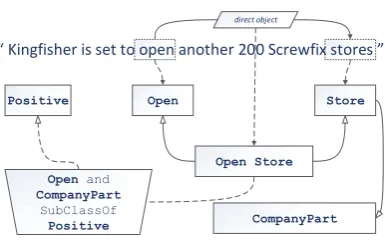
In the above axioms, a CompanyPart is the class that models all parts of a certain company, including things like headquarters, stores, web-shops, departments, etc. An example of the rea-soner in action is visualized in Figure2.
2.3 Company-specific Sentiment
The above model, with all the described ontology features, would still result in a sentence-level sen-timent algorithm that would not be able to give
dif-direct object
“ Kingfisher is set to open another 200 Screwfix stores ”
Open Store
Open Store
CompanyPart Open and
CompanyPart
SubClassOf
Positive Positive
Figure 2: A schematic overview of the given rea-soning example.
ferent sentiment scores for different companies in the same sentence. Since this problem does ap-pear, we add a company-specific sentiment feature to the feature set. This feature denotes a positive (1), neutral (0), or negative (-1) sentiment score for the company that is mentioned in the com-pany field of the annotation. Since we already an-notated this field with a URL, we can locate the company within the headline. After that, we use the grammatical dependencies to find all words di-rectly connected to the company. If these words are either a property or an action, we can use those to compute the company-specific sentiment as we can safely assume that directly connected words in the dependency graph pertain to that company.
[image:3.595.320.513.272.395.2]di-rectly related in the dependency graph to the com-pany mention in the headline.
3 Evaluation
In this section we evaluate our submission on the training data and report the results obtained on the official test data. The data consist of news head-lines in the financial domain, and each headline is annotated with the name of the target company. For the training data the target sentiment score is also provided. Note that the same headline can appear multiple times in the data, each time with a different target company. On the official test data, a cosine distance of 0.6810 is achieved, resulting in the 12th position. The feature set experiments have been performed on the training data by run-ning 5 times a 10-fold cross-validation setup, each time with different random folds, to ensure robust results.
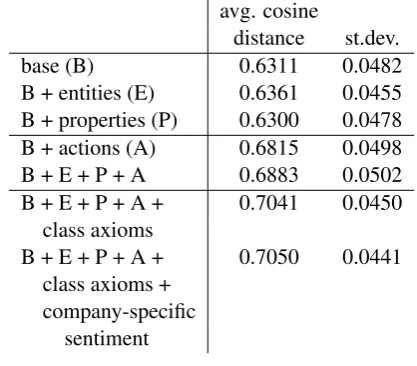
To measure the effect of the various employed ontology features, the method is run with different subsets of all features. The results of this experi-ment are reported in Table1. In this way, we can compare the benefit of adding entities, properties, and actions from the ontology, separately. From the reported results we can see that entities and properties are not particularly useful for sentiment analysis. For entities, this makes sense, as these convey no sentiment information. For properties, it is less intuitive, as adjectives, the word types that usually correspond to a subclass of Property from the ontology, are often strong indicators of sentiment (e.g.,good,bad, etc.).
On the other hand, matching verbs in the text to subclasses ofActionshows a large improve-ment to sentiimprove-ment analysis. We hypothesize that the division into four categories (i.e.,Positive, Negative, Increase, and Decrease) is a meaningful categorization in the domain of finan-cial news. We observe that verbs are often the cen-tral word in conveying information to the reader, and hence, a lot of sentiment information is com-municated using this type of concept.
[image:4.595.309.518.152.335.2]Adding the class axioms to determine the sentiment of combinations with subclasses of Increase andDecrease is also useful, with a 2% increase compared to not using it. Adding the company specific sentiment, however, does not seem to help much.
Table 1: The change in performance when using different feature sets, reporting the average perfor-mance on the training data, using 5 runs with 10-fold cross-validation. Feature sets that are statisti-cally indistinguishable from each other in terms of performance are grouped together
avg. cosine
distance st.dev. base (B) 0.6311 0.0482 B + entities (E) 0.6361 0.0455 B + properties (P) 0.6300 0.0478 B + actions (A) 0.6815 0.0498 B + E + P + A 0.6883 0.0502 B + E + P + A + 0.7041 0.0450
class axioms
B + E + P + A + 0.7050 0.0441 class axioms +
company-specific sentiment
4 Conclusions
In this work we presented our submission to Task 5 of SemEval 2017: fine-grained sentiment anal-ysis on financial news headlines (track 2). We showed that by categorizing entities (nouns), prop-erties (adjectives), and actions (verbs), and link-ing them to concepts in an ontology, we can har-ness the power of the ontology reasoner to in-fer the sentiment of expressions that indicate a typical up/increase or down/decrease movement. This is achieved by defining class axioms within the ontology. In terms of contribution to perfor-mance, we can state that the categorization of ac-tions intoPositive,Negative, Increase, andDecreasegave the highest increase in per-formance, followed by adding class axioms for sentiment inference.
References
Erik Cambria. 2016. Affective Computing and Senti-ment Analysis. IEEE Intelligent Systems31(2):102– 107.
Keith Cortis, Andr´e Freitas, Tobias Dauert, Manuela Huerlimann, Manel Zarrouk, Siegfried Handschuh, and Brian Davis. 2017. SemEval-2017 Task 5: Fine-Grained Sentiment Analysis on Financial Microblogs and News. In Proceedings of the 11th International Workshop on Semantic
Evalu-ation (SemEval-2017). Association for
Computa-tional Linguistics, pages 510–526.
Eibe Frank, Mark A. Hall, and Ian H. Witten. 2016.
The WEKA Workbench. Online Appendix for ”Data Mining: Practical Machine Learning Tools and
Techniques”, Fourth Edition. Morgan Kaufmann.
Kim Schouten, Flavius Frasincar, and Franciska de Jong. 2017. COMMIT at SemEval-2017 Task 5: Ontology-based Method for Senti-ment Analysis of Financial Headlines - On-tology. http://www.kimschouten.com/ publications/#semeval2017.
Thomas Schuster. 2003. Meta-Communication
and Market Dynamics. Reflexive
Interac-tions of Financial Markets and the Mass
Media. Technical report, EconWPA.
http://EconPapers.repec.org/RePEc:wpa:wuwpfi: 0307014.
S.K. Shevade, S.S. Keerthi, C. Bhattacharyya, and K.R.K. Murthy. 2000. Improvements to the SMO Algorithm for SVM Regression.IEEE Transactions
on Neural Networks11(5):188 – 1993.
Richard Socher, Alex Perelygin, Jean Y Wu, Jason Chuang, Christopher D Manning, Andrew Y Ng, and Christopher Potts Potts. 2013. Recursive Deep Models for Semantic Compositionality Over a Sen-timent Treebank. InProceedings of the 2013 Con-ference on Empirical Methods on Natural Language
Processing (EMNLP 2013). Association for
Compu-tational Linguistics, pages 1631–1642.
Marjan Van de Kauter, Diane Breesch, and V´eronique Hoste. 2015. Fine-grained Analysis of Explicit and Implicit Sentiment in Financial News Articles.