IIT-UHH at SemEval-2017 Task 3: Exploring Multiple Features for
Community Question Answering and Implicit Dialogue Identification
Titas Nandi1,Chris Biemann2,Seid Muhie Yimam2,
Deepak Gupta1,Sarah Kohail2,Asif Ekbal1andPushpak Bhattacharyya1 1Indian Institute of Technology Patna
2Universit¨at Hamburg Germany
{titas.ee13,deepak.pcs16,asif,pb}@iitp.ac.in {biemann,yimam,kohail}@informatik.uni-hamburg.de
Abstract
In this paper we present the system for An-swer Selection and Ranking in Commu-nity Question Answering, which we build as part of our participation in SemEval-2017 Task 3. We develop a Support Vector Machine (SVM) based system that makes use of textual, domain-specific, word-embedding and topic-modeling features. In addition, we propose a novel method for dialogue chain identification in com-ment threads. Our primary submission won subtask C, outperforming other sys-tems in all the primary evaluation met-rics. We performed well in other English subtasks, ranking third in subtask A and eighth in subtask B. We also developed open source toolkits for all the three En-glish subtasks by the name cQARank1. 1 Introduction
This paper presents the system built for partic-ipation in the SemEval-2017 Shared Task 3 on Community Question Answering (CQA). The task aims to classify and rank a candidate text c in relevance to a target text t. Based on the na-ture of the candidate and target texts, the main task is subdivided into three subtasks in which the teams are expected to solve the problem of Question-Comment similarity, Question-Question similarity and Question-External Comment simi-larity (Nakov et al.,2017).
In this work, we propose a rich feature-based sys-tem for solving these problems. We create an ar-chitecture which integrates textual, semantic and domain-specific features to achieve good results in the proposed task. Due to the extremely noisy na-ture of the social forum data, we also develop a 1https://github.com/TitasNandi/cQARank
customized preprocessing pipeline, rather than us-ing the standard tools. We use Support Vector Ma-chine (SVM) (Cortes and Vapnik,1995) for clas-sification, and its confidence score for ranking. We initially define a generic set of features to de-velop a robust system for all three subtasks, then include additional features based on the nature of the subtasks. To adapt the system to subtasks B and C, we include features extracted from the scores of the other subtasks, propagating mean-ingful information essential in an incremental set-ting. We propose a novel method for identifica-tion of dialogue groups in the comment thread by constructing a user interaction graph and also in-corporate features from this graph in our system. Our algorithm outputs mutually disjoint groups of users who are involved in conversation with each other in the comment thread.
The rest of the paper is organized as follows: Sec-tion 2 describes the related work. Sections 3, 4, and 5 elucidate the system architecture, features used and algorithms developed. Section 6 pro-vides experimentation details and reports the of-ficial results.
2 Related Work
In Question Answering, answer selection and ranking has been a major research concern in Nat-ural Language Processing (NLP) during the past few years. The problem becomes more interest-ing for Community Question Answerinterest-ing due to the highly unstructured and noisy nature of the data. Also, domain knowledge plays a major role in such an environment, where meta data of users and context based learning can capture trends well. The task on Community Question Answering in SemEval began in 2015, where the objective was to classify comments in a thread asGood,Bad or PotentiallyUseful. In subsequent years, the task
was extended and modified to focus on ranking and duplicate question detection in a cross domain setting.
In their 2015 system, Belinkov (2015) used word vectors of the question and of the comment, various text-based similarities and meta data fea-tures. Nicosia (2015) derived features from a com-ment in the context of the entire thread. They also modelled potential dialogues by identifying interlacing comments between users. Establishing similarity between Questions and External com-ments (subtask C) is quite challenging, which can be tackled by propagating useful context and in-formation from other subtasks. Filice (2016) in-troduced an interesting approach of stacking clas-sifiers across subtasks and Wu & Lan (2016) pro-posed a method of reducing the errors that propa-gated as a result of this stacking.
3 System Description
3.1 System Pipeline
The system architecture of our submission to sub-task A is depicted in Figure 1. We explain the pre-processing pipeline in the next subsection. The cleaned data is fed into our supervised ma-chine learning framework. We train our word-embedding model on the unannotated and train-ing data2 provided by the organizers, and train a
probabilistic topic model on the training data. The detailed description of features is provided in the following section. After obtaining the feature vec-tors, we perform feature selection using wrapper methods to maximize the accuracy on the devel-opment set. We Z-score normalize the feature vec-tors and feed them to a SVM. We tune the hyper-parameters of SVM and and generate classifica-tion labels and probabilities, the latter being used for computing the MAP score.
3.2 Preprocessing Pipeline
Due to the highly unstructured, spelling and gram-matical error-prone nature of the data, adaptation of any standard tokenization pipeline was not well motivated. We customized the preprocessing ac-cording to the nature of the data. We unescaped HTML special characters and removed URLs, e-mails, HTML tags, image description tags, punc-tuations and slang words (from a defined dictio-nary). Finally, we expanded apostrophe words and
2http://alt.qcri.org/semeval2017/
task3/index.php?id=data-and-tools
removed stopwords.
The cleaned data is then used in all further experi-ments.
4 Features
We use a rich set of features to capture the textual and semantic relevance between two snippets of text. These features are categorized into several broad classes:
4.1 String Similarity Features
This set of features makes use of a number of string matching algorithms to compute the string similarity between the question and comment. This generates a continuous set of values for ev-ery comment, and is apt for a baseline system. The bag of algorithms used is a careful combina-tion of various string similarity, metric distances and normalized string distance methods, capturing the overall profiling of texts. The string similar-ity functions used include Longest Common Sub-sequence (LCS), Q-Gram (q = 1,2,3), Weighted Levenshtein and Optimal String Alignment. The normalized similarity algorithms used are Jaro-Winkler, Normalized Levenshtein, n-gram (n = 1,2,3), cosine-similarity (n = 1,2,3), Jaccard Index (n = 1,2,3), and Sorensen-Dice coefficient (n = 1,2,3). The metric distance methods implemented are Levenshtein, Damerau, and Metric LCS.
4.2 Word Embedding Features
Semantic features constitute the core of our fea-ture engineering pipeline. These try to capfea-ture the proximity between the meanings encoded in the word sequences of question and comments. We train word embeddings using Word2Vec (Mikolov et al., 2013) on the unannotated and given train-ing data. The unannotated data is in the same format as the training data, except that the com-ments are not annotated. We performed experi-ments with different vector sizes (N = 100, 200, 300), and finally settled on using 100 dimensional word vectors. We also used a pre-trained model on Google News dataset in order to compare the performance of the two models. Interestingly, the domain-specific model trained on the unannotated and training data proved to be better than the one trained on Google News dataset, hence we used the former in building our final system.
these trained word vectors into sentence vectors. Two approaches were considered for this:
• Construct the sentence vector by taking an average of the vectors of all words that con-stitute the sentence.
• Construct the sentence vector as a weighted average of all the word vectors constituting that sentence. Here the weight corresponds to theInverse Document Frequency(IDF) value of the word in the thread.
Although the first approach has an evident disad-vantage of not assigning importance to the key-words in the sentence (which is why we resorted to the IDF-based weighted averaging), it yielded better results, which is why we included it in our final system.
We extract two sets of features from these sentence vectors:
• The vector subtraction of the comment vector from the vector of the question at the head of the thread is used as the scoring vector for that comment.
• We calculate the cosine similarity, Euclidean and Manhattan distances between question and comment vectors.
4.3 Topic Modeling Features
To capture the thematic similarity between the question and comment texts, we train a LDA topic
model on the training data using Mallet ( McCal-lum,2002). We perform different experiments by varying the number of topics (n = 10, 20, 50, 100) and obtain the best performance with 20 topics. We generate a topic vocabulary of 50 words for each topic class. The following features were en-tailed from these topic distributions and words:
• The vector subtraction of question and com-ment topic vectors, measuring the topical dis-tance between the two snippets of text.
• Cosine, Euclidean and Manhattan distance between the topic vectors.
• We generate a vocabulary for each text by taking the union of topic words of its first 10 most probable topic classes.
Vocabulary(T) = S10
i=1topic words(ti)
where each ti represents one of the top 10
topic classes for comment or questionT. We then determine the word overlap of the topic vocabulary of the question with(i)the entire comment string and(ii) the topic vo-cabulary of the comment.
4.4 Domain Specific Features
acknowl-edge others’ answers or can tease other users. Therefore, as discussed in (Barr´on-Cede˜no et al.,
2015), comments in a common thread are strongly interconnected.
We extract various features from the meta data of the thread and from our surface observation of the thread’s structure and properties. We extract if the comment is written by the asker of the question. In the case of repeated comments by the asker, we monitor if the comment is an acknowledge-ment (thanks, thank you, appreciate) or a further question. With the likely assumption that the com-ments at the beginning of a thread will be more relevant to the question, we have a feature captur-ing the position of comment in the thread. We also compute the coverage (the ratio of the number of tokens) of question by the comment and comment by the question.
We further try to model explicit conversations among users in the thread. We do it in two ways:
• Repeated and interlacing comments by a user in the same thread
• Explicitly mentioning the name of some pre-vious user in the comment
The case of implicit dialogues (where the intent of the conversation has to be inferred solely from the context of the comment by a user) is discussed in a separate section later. These domain-specific fea-tures proved to be quite effective in classification, and thus form an integral part of our system.
4.5 Keyword and Named Entity Features Finding the focus of the question and comment is important in measuring if the comment specifi-cally covers the aspects of the question. We extract keywords from the texts using the RAKE keyword extraction algorithm (Rose et al.,2010), and derive features from the keyword match between ques-tion and comment. We also use the relative impor-tance of common keywords as feature values. In case of factoid questions, or especially in sub-task B, Named Entity Recognition becomes an important tool for computing the relevance of a text. We extract named entities using the Stanford Named Entity Recognizer (Finkel et al., 2005) and classify words into seven entity categories including PERSON, LOCATION, ORGANIZA-TION, DATE, MONEY, PERCENT, and TIME. We compute if both question and comment have named entities, and if these belong to the same
classes, if the named entity is an answer to a Wh-typequestion or not.
4.6 Implicit Dialogue Identification
Data driven error analysis on the Qatar Living Data indicated the presence of implicit dialogue chains. Users were almost always engaging in conversations with each other but this could only be captured by the content of their comment. Here we propose a novel algorithm based on construc-tion of a user interacconstruc-tion graph to model these potential dialogues. The components of our con-struction are as follows:
• Vertices- Users in the comment thread and the Question
• Edges- Directed edges showing interaction
• Edge Weights- Numerical estimate of the in-teraction
Algorithm 1Dialogue Group Detection 1: Initialize:
U →User Graph .Initially Empty D→Dialogue Graph .Initially Empty Q→Question node .Node indexed 0 2: procedureDIALOGUEIDENTIFICATION
3: V(U)←V(U)∪ {Q} .Add Q to vertex set of U 4: foreach commentcxin threaddo
5: uicommentedcx
6: ifuiis a new userthen
7: V(U)←V(U)∪ {ui}
8: V(D)←V(D)∪ {ui}
9: end if
10: forQ and each previous commentcydo
11: ujcommentedcy
12: ifi6=jandeijdoesn’t exist inE(U)then
13: AddeijinE(U) .Addeijin edge set
of U
14: end if
15: w(eij)←Compute Weight(cx, cy,i, j)
16: end for
17: e←maxj w(eij) .Pick max outgoing edge
18: ifj6= 0andedoes not exist inE(D)then 19: AddeinE(D)
20: end if 21: end for
22: Find weakly connected components in D 23: end procedure
who commented. Then we pick the maximum outgoing edge to some previous user from the user who commented, and add that edge in the dialogue graph. Finally, we find the weakly con-nected components(WCCs) in the dialogue graph and the users in each such WCC are in mutual dialogue. Note that the user graph at the end of each iteration depicts the current conversational interaction of the user who commented, with respect to all other users in the thread.
Algorithm 2Compute Weight Function 1: procedureCOMPUTEWEIGHT(cx, cy, i, j)
2: uicommentedcx
3: ujcommentedcy
4: eij←0.0
5: if user ui explicitly mentions user uj in comment
then
6: eij←eij+ 1.0 .Explicit dialogue
7: end if
8: cx→ {w1, w2, ..., wk} . wiis theithword incx
9: cy→ {w01, w
0
2, ..., w
0 l}
10: tr score ←( P
1≤m≤k1≤maxn≤lcos(vw~m, ~vw 0
n))/k
11: ~tx←topic vector forcx
12: ~ty←topic vector forcy
13: to score←cos(~tx, ~ty) .Topic similarity score
14: eij←eij+tr score+to score .Edge weight
15: returneij
16: end procedure
The main part of the algorithm is where we compute the edge weights between a pair of users after some comment, see Algorithm 2 for de-tails. We have three components that constitute the weight:
• if the user mentions the other user explicitly
• we calculate the score of reformulating one comment from the other by closest word match based on cosine scores of word vectors (tr score)
• cosine of the topic vectors of a pair of com-ments(to score)
In addition to identifying latent dialogue groups, we also extract features from this graph and these features prove to be very helpful in classification. 4.7 Classifier
We use an SVM classifier as implemented in Lib-SVM (Chang and Lin, 2011) for classification. We experiment with different kernels (Hsu et al.,
2003), and achieve the best results with the RBF kernel, which we use to train the model for our pri-mary submission. We also achieve comparable
re-sults with the linear kernel and L2-regularized lo-gistic regression. The ranking score for a question-comment pair in subtask A is the calculated prob-ability of the pair to be classified asGood. The ranking score for subtask B is the SVM prob-ability score for the original question-related ques-tion pair multiplied by the reciprocal search engine rank provided in the data.
For subtask C, the scoring value is the sum of the log probabilities of the SVM scores of all subtasks
final score = log (svm A) + log (svm B) + log (svm C)
5 Stacking features for other subtasks We implemented a generic system for tackling se-mantic similarity for any two snippets of text. We further fine tuned it with domain specific features for subtask A. For subtasks B and C, we again adopted this generic system with slight modifica-tions. But, the strong interconnectivity and incre-mental nature of the subtasks motivated the devel-opment of a stacking strategy where we propagate useful information from other subtasks as features for the present subtask and re-run the classifier. Filice (2016) developed a stacking strategy that we adopt with modifications.
For subtask B, we consider the scores for subtasks A and C as probability distributions and calcu-late various features and correlation coefficients (Spearmann, Kendall, Pearson) over these distri-butions.
For subtask C, we calculate feature values from the SVM scores of all three subtasks, and re-run our system with these stacking features. These fea-tures include average, minimum and maximum of subtask A and B scores, and binary features cap-turing if these probability scores are above 0.5. 6 Experimentation and Results
We extensively experimented with a lot of feature engineering. Notable features that were discarded in the feature ablation process are:
• Statistical Paraphrasing: We found the top 10 semantically related words corresponding to every word in the comment, based on word vectors and did an n-gram matching (n = 1,2,3) on the extended wordlist.
Features Development Set 2017
Subtask A MAP AvgRec MRR P R F1 Accuracy
All Features 65.50 84.86 71.96 58.43 62.71 60.50 72.54
All — string features 65.53 84.90 72.19 57.84 62.71 60.18 72.17
All — embedding features 62.11 81.23 69.00 53.03 53.42 53.23 68.52
All — domain features 61.85 81.06 69.80 54.46 54.52 54.49 69.47
All — topic features 65.15 84.79 72.37 59.02 61.98 60.47 72.83
All — keyword features 65.73 84.65 71.94 57.98 62.59 60.20 72.25
IR Baseline 53.84 72.78 63.13 - - -
-Subtask B
All Features 73.03 88.77 78.33 72.39 45.33 55.75 69.20
All — string features 73.46 88.83 78.95 72.87 43.93 54.81 69.00
All — embedding features 73.91 89.11 79.33 71.53 45.79 55.84 69.00
All — domain features 73.07 88.77 78.33 71.77 41.59 52.66 68.00
All — topic features 72.95 88.07 78.17 67.86 44.39 53.67 67.20
All — keyword features 73.55 88.99 79.33 72.93 45.33 55.91 69.40
All — stacking features 72.95 88.64 78.67 71.90 40.65 51.94 67.80
IR Baseline 71.35 86.11 76.67 - - -
-Subtask C
All Features 36.09 41.13 39.89 18.42 37.10 24.62 84.32
All — string features 36.85 40.27 39.72 16.81 35.07 22.72 83.54
All — embedding features 39.39 45.09 45.01 17.48 47.83 25.60 80.82
All — domain features 36.83 40.68 39.69 17.21 35.07 23.09 83.88
All — topic features 35.89 41.18 40.50 16.98 38.84 23.63 82.68
All — keyword features 35.39 41.17 38.57 18.58 37.97 24.95 84.24
All — stacking features 36.57 41.85 40.80 16.80 36.81 23.07 83.06
IR Baseline 30.65 34.55 35.97 - - -
-Runs Test Set 2017
Subtask A MAP AvgRec MRR P R F1 Accuracy
Primary 86.88 92.04 91.20 73.37 74.52 73.94 72.70
Contrastive 1 86.35 91.74 91.40 79.42 51.94 62.80 68.02
Contrastive 2 85.24 91.37 90.38 81.22 57.65 67.43 71.06
IR Baseline 72.61 79.32 82.37 - - -
-Subtask B
Primary 43.12 79.23 47.25 26.85 71.17 38.99 58.75
Contrastive 1 42.29 78.41 46.40 32.66 59.51 42.17 69.77
Contrastive 2 42.38 78.59 46.82 32.99 59.51 42.45 70.11
IR Baseline 41.85 77.59 46.42 - - -
-Subtask C
Primary 15.46 33.42 18.14 08.41 51.22 14.44 83.03
Contrastive 1 15.43 33.78 17.52 09.45 54.07 16.08 84.23
Contrastive 2 14.00 30.53 14.65 05.98 85.37 11.17 62.06
IR Baseline 09.18 21.72 10.11 - - -
-Table 1: Feature Ablation Results on Development Set and Runs on Test Set
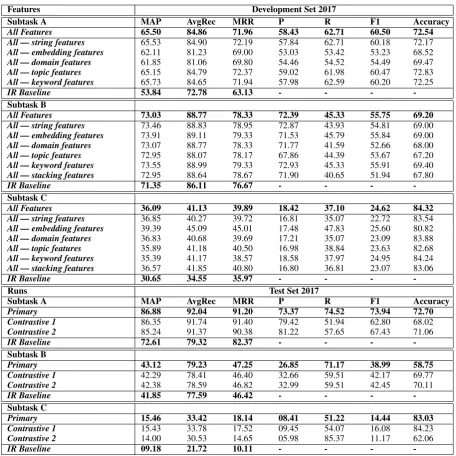
Our primary submission for subtasks A and B uses SVM with an RBF kernel for classification as this yielded the best results on the dev set. We also achieved similar results with the linear and L2-regularized logistic regression classifiers and we use these for our contrastive submissions. All the submissions comprised of same number of fea-tures. For subtask C, we oversample the training data using the SMOTE (Chawla et al.,2002) tech-nique in the ImbalancedLearn3 toolkit, due to the
highly skewed distribution of labels. We use reg-ular SMOTE for our primary and SMOTE SVM for our first contrastive submission. For the
sec-3https://github.com/
scikit-learn-contrib/imbalanced-learn
ond contrastive submission, we integrate the fea-ture sets of subtasks A and B directly in the feafea-ture set of subtask C.
The feature ablation results on the development set and the results of different runs on the test set are presented in Table 1. It reports the system performance on all evaluation metrics including Mean Average Precision (MAP), Average Recall (AvgRec), Mean Reciprocal Rank (MRR), Preci-sion (P), Recall (R), F1-score (F1) and Accuracy.
7 Conclusion
[image:6.595.71.528.58.515.2]fo-cus on extracting more information from inter-comment dependencies. This should improve our algorithm for dialogue group detection and model conversational activity better. We also wish to work on a Deep Learning architecture for handling this, as in (Wu and Lan,2016) and (Guzm´an et al.,
2016). The problem can be modeled as a semi-supervised classification task, where the unanno-tated data can help supervised classification. Sub-task C still presents a challenging research prob-lem and we will investigate novel methods to in-tegrate results from other subtasks to tackle this subtask better.
References
Alberto Barr´on-Cede˜no, Simone Filice, Giovanni Da San Martino, Shafiq Joty, Llu´ıs M`arquez, Preslav Nakov, and Alessandro Moschitti. 2015. Thread-Level Information for Comment Classification in Community Question Answering. In Proceedings of the 53rd Annual Meeting of the Association for Computational Linguistics and the 7th International Joint Conference on Natural Language Processing (Volume 2: Short Papers). Association for Compu-tational Linguistics, Beijing, China, pages 687–693.
http://www.aclweb.org/anthology/P15-2113.
Yonatan Belinkov, Mitra Mohtarami, Scott Cyphers, and James Glass. 2015. VectorSLU: A Continu-ous Word Vector Approach to Answer Selection in Community Question Answering Systems. In Pro-ceedings of the 9th International Workshop on Se-mantic Evaluation (SemEval 2015). Association for Computational Linguistics, Denver, Colorado, pages 282–287. http://www.aclweb.org/anthology/S15-2048.
Chih-Chung Chang and Chih-Jen Lin. 2011.
LIBSVM: A library for support vector machines. ACM TIST 2(3):27:1–27:27.
https://doi.org/10.1145/1961189.1961199.
Nitesh V. Chawla, Kevin W. Bowyer, Lawrence O. Hall, and W. Philip Kegelmeyer. 2002. SMOTE: synthetic minority over-sampling technique. Jour-nal of artificial intelligence research16:321–357.
Corinna Cortes and Vladimir Vapnik. 1995. Support-vector networks. Machine learning20(3):273–297.
Simone Filice, Danilo Croce, Alessandro Moschitti, and Roberto Basili. 2016. KeLP at SemEval-2016 Task 3: Learning Semantic Relations be-tween Questions and Answers. In Proceedings of the 10th International Workshop on Semantic Evaluation (SemEval-2016). Association for Com-putational Linguistics, San Diego, California, pages 1116–1123. http://www.aclweb.org/anthology/S16-1172.
Jenny Rose Finkel, Trond Grenager, and Christopher Manning. 2005. Incorporating Non-local Informa-tion into InformaInforma-tion ExtracInforma-tion Systems by Gibbs Sampling. InProceedings of the 43rd Annual Meet-ing of the Association for Computational LMeet-inguis- Linguis-tics (ACL’05). Association for Computational Lin-guistics, Ann Arbor, Michigan, pages 363–370.
https://doi.org/10.3115/1219840.1219885.
Francisco Guzm´an, Preslav Nakov, and Llu´ıs M`arquez. 2016. MTE-NN at SemEval-2016 Task 3: Can Machine Translation Evaluation Help Community Question Answering? In Proceedings of the 10th International Workshop on Semantic Evalu-ation (SemEval-2016). Association for Computa-tional Linguistics, San Diego, California, pages 887–895. http://www.aclweb.org/anthology/S16-1137.
Chih-Wei Hsu, Chih-Chung Chang, and Chih-Jen Lin. 2003. A practical guide to support vec-tor classification. Technical report, Department of Computer Science, National Taiwan University.
http://www.csie.ntu.edu.tw/ cjlin/papers.html. Quoc V. Le and Tomas Mikolov. 2014.
Dis-tributed Representations of Sentences and Docu-ments. In Proceedings of the 31th International Conference on Machine Learning, ICML 2014, Bei-jing, China, 21-26 June 2014. pages 1188–1196.
http://jmlr.org/proceedings/papers/v32/le14.html. Andrew Kachites McCallum. 2002.
MAL-LET: A Machine Learning for Lan-guage Toolkit. Http://mallet.cs.umass.edu.
http://mallet.cs.umass.edu.
Tomas Mikolov, Ilya Sutskever, Kai Chen, Gregory S. Corrado, and Jeffrey Dean. 2013. Distributed Representations of Words and Phrases and their Compositionality. In Advances in Neural In-formation Processing Systems 26: 27th Annual Conference on Neural Information Processing Sys-tems 2013. Proceedings of a meeting held December 5-8, 2013, Lake Tahoe, Nevada, United States.. pages 3111–3119. http://papers.nips.cc/paper/5021- distributed-representations-of-words-and-phrases-and-their-compositionality.
Preslav Nakov, Doris Hoogeveen, Llu´ıs M`arquez, Alessandro Moschitti, Hamdy Mubarak, Timothy Baldwin, and Karin Verspoor. 2017. SemEval-2017 Task 3: Community Question Answering. In Pro-ceedings of the 11th International Workshop on Se-mantic Evaluation. Association for Computational Linguistics, Vancouver, Canada, SemEval ’17. Massimo Nicosia, Simone Filice, Alberto
Barr´on-Cedeno, Iman Saleh, Hamdy Mubarak, Wei Gao, Preslav Nakov, Giovanni Da San Martino, Alessan-dro Moschitti, Kareem Darwish, et al. 2015. QCRI: Answer selection for community question answering-experiments for Arabic and English. In
Stuart Rose, Dave Engel, Nick Cramer, and Wendy Cowley. 2010. Automatic keyword extraction from individual documents. In Michael W. Berry and Ja-cob Kogan, editors, Text Mining. Applications and Theory, John Wiley and Sons, Ltd, pages 1–20.
https://doi.org/10.1002/9780470689646.ch1. Guoshun Wu and Man Lan. 2016. ECNU at