Original Article
Evaluation of clinical performance of Sciendox 2000R
automatic feces analyzer
Weiye He*, Qionghua Tang*, Weiguo Lu, Xi Li, Yingchun Zhou
Clinical Laboratory, The First Affiliated Hospital of Guangzhou University of Chinese Medicine, Guangzhou 510405, China. *Equal contributors.
Received May 19, 2016; Accepted May 23, 2016; Epub September 15, 2016; Published September 30, 2016
Abstract: Objective: To evaluate the clinical performance of Sciendox 2000R automatic excrement analyzer and to validate whether it is suitable for routine clinical examination of excrement. Methods: 424 copies of excrement specimens were collected randomly from the First Affiliated Hospital of Guangzhou University of Traditional Chinese Medicine, and examined by direct microscopic examination and Sciendox 2000R automatic excrement analyzer. We evaluated the performance of Sciendox 2000R analyzer through accuracy test, blank test, repeatability test and contamination rate test as well as fetal occult blood (FOB) test. Results: The detection rate of red blood cells (RBC), white blood cells (WBC) and parasite ovum by Sciendox 2000R analyzer was 2.12% (9/424), 4.48% (19/424) and 7.31% (31/424) respectively, and detection rate of FOB was 19.81%; Compared with direct smear microscopy meth-od, there was no statistical significance in differences. The background, repeatability and contamination rate of the instrument was good. Conclusions: The results of Sciendox 2000R analyzer were comparable to the results of direct microscopic examination. In addition, the equipment had low background, good repeatability, low contamination rate and good biological safety. The functions could basically satisfy the requirements of clinical excrement analysis.
Keywords: Automatic excrement analyzer, direct microscopic examination, performance
Introduction
Excrement routine examination has great
sig-nificance for the diagnosis of intestinal infec -tious diseases, gastrointestinal diseases and parasitic diseases [1, 2], and is a routine exami-nation for intestinal outpatients and inpatients [3, 4]. At present, the excrement examination mainly uses traditional smear macroscopic observation with naked eyes, which has been used for decades, belonging to the pure
manu-al operation; it could be greatly influenced by
subjective factors that make the examination
difficult to achieve standardization or control
the testing quality [5]. In recent years, in order to overcome the disadvantages of manual operation, many companies have developed fully automatic excrement analyzer to solve the above problems [6]. However, all kinds of instru-ments need to be evaluated in order to ensure the quality of test before being applied in clinic [7]. This study aimed at evaluating the perfor-mance of 2000R Sciendox automatic
excre-ment analyzer in order to evaluate its clinical application value.
Materials and methods
Specimen source
Excrement samples from 424 cases of patients
were randomly collected at the First Affiliated Hospital of Guangzhou University of Chinese
Medicine from March 2015 to September.
Instruments and reagents
Olympus CH20 microscope (Olympus); Sciendox 2000R automatic excrement analyzer,
sam-pling tubes and filtering tubes (Xiamen channel
gold) (Hangzhou ABON biological medicine Co., Ltd.).
Evaluation of the accuracy of instrument in
-spection
Direct smear for microscopic examination (manual method): experienced technicians operated in strict accordance with the National
Clinical Laboratory Operation Rules (3rd Edition)
[9] on the requirements on direct smear for microscopic examination, all specimens
exami-nation finished in 2 hours after collection.
Sciendox 2000R automatic excrement analyzer (instrument method): all specimens were ana-lyzed immediately after manual examination in accordance with the instruction of the instru-ment manual. With the manual method as the reference, the results of both methods were compared, to detect the accuracy of the instru-ment method.
Blank test
The blank sample collector was directly ana-lyzed by instrument method for 3 times, and the results were regarded as the blank control result.
Repeatability evaluation of instrument method
Specimens containing RBC and/or WBC (++ or beyond), RBC and/or WBC (+) were repeatedly measured 10 times by instrument method to observe the repeatability of instrument method.
Evaluation of contamination rate of instrument method
Specimens with RBC and/or WBC (++ or beyond) and positive FOB were selected as positive samples, while the samples with
nega-All excrement specimens were treated with both manual method and instrument method for occult blood test [12, 13] the two methods were in strict accordance with the reagent instructions.
Experiment on improving the detection rate of parasite ovum of instrument method
Instrument method was adopted to detect two samples with positive clonorchis sinensis ovum [14]. Set the number of photo shots of the instrument to 10, and examine the samples for 10 consecutive times; and then set the number of photo shots to 20, 30 and 60 respectively and examine the samples for 10 times of each,
to find out the most suitable shots for increas -ing the detection rate of parasite ovum.
Statistics analysis
SPSS 18.0 software was used for data
collec-tion and statistical analysis. Paired data χ2 test
was used to analyze the data, and P < 0.05 was
considered statistically significant.
Results
The accuracy of the instrument method
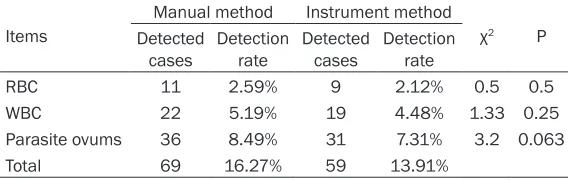
For the randomly selected 424 excrement specimens, the detection rates of instrument method on red blood cells, white blood cells and parasite ovum were 2.12% (9/424), 4.48% (19/424) and 7.31% (31/424), respectively, which were slightly lower than the detection rates of manual method without statistical
[image:2.612.90.374.98.188.2]sig-nificance (P > 0.05). The false negative rate and false positive rate of instrument method on detecting red blood cells, white blood cells and parasite ovum were (18.18%, 0), (13.64%, 0), and (13.89%, 0), respectively. These results showed that the detection results of 2000R Sciendox automatic excrement analyzer were
Table 1. Comparison of detection rate on same sample between two methods
Items
Manual method Instrument method
χ2 P
Detected
cases Detection rate Detected cases Detection rate
RBC 11 2.59% 9 2.12% 0.5 0.5
WBC 22 5.19% 19 4.48% 1.33 0.25
Parasite ovums 36 8.49% 31 7.31% 3.2 0.063
Total 69 16.27% 59 13.91%
tive results were selected as negative specimens; the neg-ative samples were consecu-tively tested for 3 times by instrument method following 3 times examination of posi-tive specimens to evaluate the contamination rate [10, 11].
highly consistent with the manual method, and the accuracy of the instrument was better. See
Table 1.
Results of the blank test by instrument method Blank sample was tested for three times, and the results showed that red blood cells, white blood cells and parasite ovum as well as feces occult blood were all negative for each time, indicating the low detect background of the instrument.
Repeatability of instrument method
Samples with RBC (-) (+) (+++) and WBC (-) (+) (+++) by manual method were select, one sam-ple for each type. Then, the chosen samsam-ples were examined by instrument method for 10 consecutive times, and each detection showed
(-) (+) (+++), indicating good repeatability of instrument method. See Table 2.
Contamination rate of instrument method
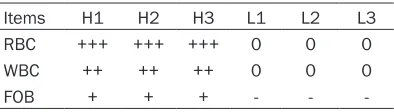
The contamination rates of instrument detec-tion on red and white blood cells and the occult blood were all zero. See Table 3.
Results of FOB test
The detection rate, false negative rate and false positive rate on feces occult blood test by colloidal gold kits used on Sciendox 2000R automatic excrement analyzer were 19.81%, 6.10% and 8.54%, respectively, while the detection rate of manual method was 19.34%.
There was no significant difference between
the two methods. The results suggested that the two methods were comparable on the detection results of feces occult blood test. See Table 4.
The number of photo shots and the detection rate of parasite ovum
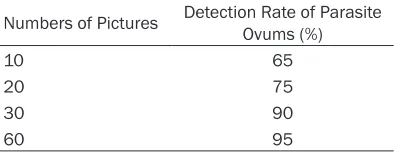
With the increasing in number of photo shots, the detection rate of parasite ovum was improved, which is in favor of reducing the missing rate. See Table 5.
Discussion
Automatic detection, with its advantages in
automation, high efficiency, easy standardiza -tion and manpower saving etc. has become the trend of the development of laboratory detec-tion at home and abroad [15]. With the
continu-Table 2. Results of Instrument Method for red blood cells and white blood cells
Times RBC WBC
Specimen1 Specimen2 Specimen3 Specimen4 Specimen5 Specimen6
1 - + +++ - + +++
2 - + +++ - + +++
3 - + +++ - + +++
4 - + +++ - + +++
5 - + +++ - + +++
6 - + +++ - + +++
7 - + +++ - + +++
8 - + +++ - + +++
9 - + +++ - + +++
10 - + +++ - + +++
[image:3.612.93.523.84.257.2]Coincidence rate 100% 100% 100% 100% 100% 100%
Table 3. Experiment of Contamination Rate
Items H1 H2 H3 L1 L2 L3
RBC +++ +++ +++ 0 0 0
WBC ++ ++ ++ 0 0 0
FOB + + + - -
-Table 4. Results of FOB Test by both methods (case)
Manual Methods
Instrument method
Total Positive Negative
Positive 77 5 82
Negative 7 335 342
Total 84 340 424
[image:3.612.91.288.290.346.2] [image:3.612.91.288.392.461.2]ous progress in science and technology, most of the inspections in laboratory have gradually realized automation [16]. However, the exami-nations of excrement, such as fecal excretion and secretion, are still stuck in the traditional manual methods; the automatic examination instruments haven’t been systematically and thoroughly introduced to clinical application [17]. Because of the particularity of the exami-nation of excrement specimens, most of those are still tested by primitive manual smear [18]. In fact, the automatic detection instruments for excrement examination have emerged. The detection principles are divided into two types: handwork imitation fecal analysis workstation
and filter suspended fecal analysis workstation
[19]. The Sciendox type 2000R automatic
ana-lyzer used in this study adopts suspension fil -tration principle, and uses specialized
excre-ment collection tube and Sciendox full filtration
sample processing technology, so that the process of specimen can be carried out in a safe and relatively closed and fully automatic condition, to ensure the examination quality. In the aspect of morphological detection, the fully automatic microscopy technologies, such as automatic focusing and automatic acquisition of images etc. ensure the accuracy and reliabil-ity of test results. The instrument can also
spe-cifically target the specimen according to pre -set photo shots of high/low power lens to
great-ly improve the efficiency. The four-channel
design greatly improves the detection speed. Centralized treatment of waste gas/liquid and disposable supplies greatly improves biological safety and reduces the contamination on experimental environment and technicians. How is the performance of automatic instru-ment in the clinical application? There is no pro-found performance evaluation at present. In this experiment, we conducted a comparison between direct smear microscopic examination
and instrument examination. The detection rates on red blood cells, white blood cell and parasite ovum by instrument method were slightly lower than that of manual method, but
the difference was not statistically significant,
indicating the two methods are in good agree-ment. Attention needs to be paid on the detec-tion rate on parasite ovums, the P value of instrument method was 0.063, which was close to the critical value (P=0.05), indicating the detection rate on parasite ovum by instru-ment method was lower than that of manual method and need to be further improved. In fact, to improve the detection rate of the para-site ovums, we increased the photo shots of two false negative samples of parasite ovum from the original 10 shots to 20, 30 and 60
shots. The detection rate was improved signifi -cantly, however, the results from 30 shots
and 60 shots were not significant different.
Moreover, 60 shots for each sample will occupy
large stock memory, and significantly reduce
the detection speed. Therefore, appropriate increase of the photo shots could be used as an attempt to improve the detection rate of parasite ovums.
This experiment also carried out blank test, repeatability test and contamination rate valua-tion on the automatic excrement analyzer. The results showed that the instrument has advan-tages of low background, good repeatability and low contamination rate. In addition, the instrument can also detect the fat globulins [20], fungi and spores in the specimen; howev-er, due to the small number of the positive sam-ples, those results were not included in the sta-tistical data.
[image:4.612.91.288.110.186.2]To sum up, Sciendox 2000R automatic excre-ment analyzer, as a sophisticated fecal analysis workstation, its high accuracy, low background, good repeatability, and low contamination rate as well as good biological safety, simple opera-tion and rapid detecopera-tion can satisfy the require-ments of clinical routine excrement examina-tion. However, in actual practice, we still need to work out a set of experience, to optimize the examination results under different characters and different volume of specimens and to con-trol the best proportion of the amount of diluted liquid, to achieve total quality control and stan-dardization, which needs to be explored in the future clinical practice.
Table 5. Correlation between Number of Pictures and the Detection Rate of Parasite Ovums
Numbers of Pictures Detection Rate of Parasite Ovums (%)
10 65
20 75
30 90
Disclosure of conflict of interest
None.
Address correspondence to: Dr. Yingchun Zhou, Clinical Laboratory, The First Affiliated Hospital of Guangzhou University of Chinese Medicine, No. 16 Jichang Road, Guangzhou 510405, China. Tel: +86-20-36591355; Fax: +86-020-36590540; E-mail: [email protected]
References
[1] Liu L. Analysis on 1399 cases of feces routine examination. Clinical Journal of Chinese Medicine 2014; 6: 141-142.
[2] Li Y, He ZH, Li CW, Yao ZG. The study of the relationship between heliconbacter pylori and acute coronary syndrome. International Journal of Laboratory Medicine 2013; 34: 666-667.
[3] Vandenberg O, Peek R, Souayah H, Dediste A, Buset M, Scheen R, Retore P, Zissis G and Van Gool T. Clinical and microbiological features of dientamoebiasis in patients suspected of suf-fering from a parasitic gastrointestinal illness: a comparison of Dientamoeba fragilis and Giardia lamblia infections. Int J Infect Dis 2006; 10: 255-261.
[4] Ding JW. Results Analysis of Detection of 16531 Cases of Stool Routine. Chinese and Foreign Medical Research 2016; 14: 61-62. [5] Van Gool T, Weijts R, Lommerse E and Mank T.
Triple faeces test: an effective tool for detec-tion of intestinal parasites in routine clinical practice. Eur J Clin Microbiol Infect Dis 2003; 22: 284-290.
[6] Zou YG, ChenH, Wu MY, Zhou ZL, Zhang XJ, Ning A. Application of FE-2 Analysis Workstation System insurvey of parasitic diseases. China Schistosomiasis Control 2010; 22: 364-367. [7] Cong YL. About problems of urine-formed
ele-ments examined by automated instruele-ments. Practical Journal of Clinical Medicine 2012; 9: 1-3.
[8] Yang L, Lu RQ, Guo L. Performance analysis on colloidal gold immunoassay for fecal occult blood test kit and its primary evaluation of clinical application. Laboratory Medicine 2012; 27: 671-673.
[9] Ye YW, Wang YS, Shen ZY. National Clinical Laboratory Operation Rules. 3rd Edition. Southeast University; China, Nanjing: 2006. pp. 303-304.
[10] Wang M, Wu Y, Xia Y. To evaluate the perfor-mance of AX-4280 automatic urine dry chem-istry analyzer. Chongqing Medicine 2012; 41: 262-263.
[11] Chen DD, Ye Q, Zhou XS , Chen Y. Clinical evalu-ation of fully automated fecal occult blood ana-lyzer OC-SENSOR μ. Fujian Med J 2009; 31: 97-99.
[12] Huang Y, Xu XR, Zhang J. The Application of Quantitative Detection in Fecal Occult Blood Test. Labeled Immunoassays and Clinical Medicine 2015; 22: 1280-1282.
[13] Li J, Xu Z, Guo ZQ, Jiang F, Li JK. Comparison of two methods of fecal occult blood test to the lower digestive tract diseases. Medical Journal of the Chinese People’s Armed Police Forces 2010; 21: 1051-1055.
[14] Xie WF, Yan HY, Zeng H, Xie XY, Bao YW. Clinical analysis of Clonorchis sinensis infection of the patients in our hospital. J Trop Med 2011; 11: 1043-1045
[15] Huang Y, Zhang J, Yu ZH, Yu XW. The evaluation and comparison on the performance of Comboi-Scan XS automatic urine analyzer (be-fore and, after re-classisfication), Sysmex UF-1000i and microscopic examination. Journal of Diagnostics Concepts & Practice 2011; 10: 557-559.
[16] Ma JL, Peng WH, Li XC, Ma F, Wang L. Automated urine particle analyzer US 2026 in detecting different kinds of cells. Acad J Chin PLA Med Sch Sep 2014; 35: 893-895. [17] Xu J. Standardization and quality management
of excrement examination. Guide of China Medicine 2008; 6: 109-111.
[18] Zhang CH, Ji SJ, Wang QJ. The clinical applica-tion evaluaapplica-tion of LJ -2000 convenapplica-tional ana-lyzer of feces. Medical Laboratory Science and Clinics 2012; 23: 30-31.
[19] Ma F, Che HZ, Xiang DJ, Ma JL, Wang CB. Evaluation on clinical application of stool auto-matic analyzers. Lab Med Clin 2015; 12: 1231-1232.