Exploring Cross-Lingual Transfer of Morphological Knowledge In
Sequence-to-Sequence Models
Huiming Jin Beihang University, China [email protected]
Katharina Kann CIS
LMU Munich, Germany [email protected]
Abstract
Multi-task training is an effective method to mitigate the data sparsity problem. It has recently been applied for cross-lingual transfer learning for paradigm completion—the task of producing in-flected forms of lemmata—with sequence-to-sequence networks. However, it is still vague how the model transfers knowledge across languages, as well as if and which information is shared. To investigate this, we propose a set of data-dependent exper-iments using an existing encoder-decoder recurrent neural network for the task. Our results show that indeed the performance gains surpass a pure regularization effect and that knowledge about language and morphology can be transferred.
1 Introduction
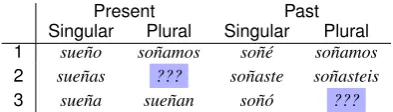
Neural sequence-to-sequence models define the state of the art for paradigm completion (Cotterell et al., 2016,2017;Kann and Sch¨utze,2016), the task of generating inflected forms of a lemma’s paradigm, e.g., filling the empty fields in Table1
using one of the non-empty fields.
However, those models are in general very data-hungry, and do not reach good performances in low-resource settings. Therefore, Kann et al.
(2017) propose to leverage morphological knowl-edge from a high-resource language (source lan-guage) to improve paradigm completion in a closely related language with insufficient re-sources (target language). This is achieved by a form of multi-task learning – they train an encoder-decoder model simultaneously on train-ing examples for both languages. While closer related languages seem to help more than distant ones, the mechanismshowthis transfer works still
Present Past
Singular Plural Singular Plural 1 sue˜no so˜namos so˜n´e so˜namos 2 sue˜nas ??? so˜naste so˜nasteis 3 sue˜na sue˜nan so˜n´o ???
Table 1: Partial inflection table for indicative forms of the Spanish verbso˜nar.
remain largely obscure. Several possibilities exist: (i) learning of target tag specific word transforma-tions from the high-resource language (trans); (ii) training of the character language model of the de-coder (LM); (iii) learning a bias to copy a large part of the input (copy), since members of the same paradigm mostly share the same stem; (iv) a general regularization effect obtained by multi-task training (reg).
In this work, we intend to shed light on the way cross-lingual transfer learning for paradigm com-pletion with an encoder-decoder model works, and will especially focus on the role of the character and tag embeddings. In particular we aim at an-swering the following questions: (i) What does the neural model learn from the tags of a high-resource language for the tags of a low-high-resource language? (ii) Is sharing an alphabet important for the transfer? (iii) How much of the transfer learning can be reduced to a regularization effect achieved by multi-task learning?
For our analysis, we present a set of detailed experiments for the target language Spanish [ES]. Source languages are either members of the Ro-mance language family (Catalan [CA], French [FR], Italian [IT], Portuguese [PT]) of different lev-els of similarity to Spanish, cf. Table2, or an un-related language (Arabic [AR]). We show which parts of the information are learned from the char-acters or tags and discuss where sequences of let-ters or tags from a second language contribute to or restrain performance on the paradigm
[image:1.595.318.515.221.277.2]PT CA IT FR similarity toES 89% 85% 82% 75% Table 2: Lexical similarities of Spanish and the Romance languages used for our experiments (Lewis,2009).
tion task in the low-resource language.
2 Transfer Learning for Paradigm Completion
In this section, we describe cross-lingual transfer learning for morphology and the model used for it.
Cross-lingual transfer. Transfer learning for
paradigm completion is much more language-specific than most semantic natural language pro-cessing tasks, like entity typing or machine trans-lation. An extreme example is the infeasible task of transferring morphological knowledge from Chinese to Portuguese as Chinese does not make use of inflection at all. Even between two morpho-logically rich languages transfer is difficult if they are unrelated, since inflections often mark dissimi-lar subcategories and word forms do not share sim-ilarities.
However, Kann et al. (2017) show that trans-ferring morphological knowledge from Spanish to Portuguese, two languages with similar morphol-ogy and 89% lexical similarity, works well and, more surprisingly, even supposedly very differ-ent languages like Arabic and Spanish can bene-fit from each other. They make this possible by training an encoder-decoder model and appending a special tag (i.e., embedding) for each language to the input of the system, similar to (Johnson et al.,
2016). It is currently unclear, though, what the na-ture of this transfer is, motivating our work which explores this in more detail.
Model description. The model Kann et al.
(2017) use and we explore in more detail here is an encoder-decoder recurrent neural network (RNN) with attention (Bahdanau et al.,2015). It is trained on maximizing the following log-likelihood:
L(θ) = X
(k,w`t)∈Dt
logpθ(fk[w`t]|`t,w`t,tk)
+ X
(k,w`s)∈Ds
logpθ(fk[w`s]|`s,w`s,tk)
(1)
We denote the source training examples asDsand the target training examples asDs.w`s represents
s1 s2 s3 sN
y1=s y2=u y3=e
− →
hi
←h− i
−−→
hi+1
←−−
hi+1
−−→
hi+2
←−−
hi+2
−→
hN
←−
hN −
→
h1
←−
h1
⊕
s o ˜n ... r
... LANG=ES
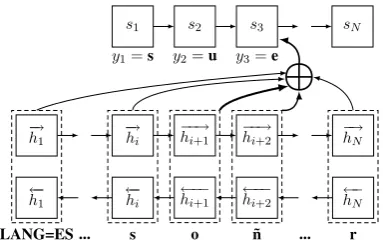
Figure 1: Overview of an encoder-decoder RNN, mapping the Spanish lemma so˜nar to the target formsue˜na. The thickness of the arrows towards the circled plus symbol corresponds to each atten-tion weight. All tags in the input are omitted.
a lemma in a high-resource source language `s andw`t represents a lemma in a low-resource
tar-get language `t. k represents a given slot in the paradigm and fk[w`]is the inflected form of w` corresponding to the morphological tag tk. The parameters θ of the model are tied for both the high-resource language and the low-resource lan-guage to enable transfer learning.
In detail, a bidirectional gated RNN is used to encode the input sequence, which consists of a language tag, morphological tags and characters of the input language. The decoder generates the output sequence from the characters of the same language, and consists of a unidirectional RNN with an attention mechanism over the encoder hid-den states. Notably, the elements of the input and the output are represented by embeddings living in separate spaces.
Hyperparameters. Encoder and decoder RNNs
have 100 hidden units and we use 300-dimensional embeddings. We train using ADADELTA(Zeiler,2012) with minibatch size 20. All models for all experiments are trained for a maximum of 150 epochs. The best model is ap-plied at test time.
3 Exploration of Transfer Learning
In order to answer the questions raised in the in-troduction, we conduct the following experiments.
3.1 Data
trans LM copy reg
l-ciph X X
t-ciph X
l-emb X X X
[image:3.595.107.255.63.114.2]t-emb X
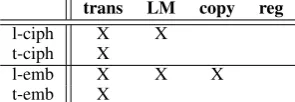
Table 3: Expected effect of different modifications of the high-resource training data. Learning of the marked fields is likely to be influenced, descrip-tions in the text, cf.§1.
use the same development and test files for all ex-periments. Arabic is transcribed into Latin charac-ters.
3.2 Experiments
Letter cipher (l-ciph). Let C = Clow ∪ Chigh
be the union of the sets of all characters in the alphabets of the low-resource language and the high-resource language, respectively.1 We define a bijective cipher function fciph : C 7→ C, map-ping each character to a different character, cho-sen at random. Then, we apply this function to the elements of the input and output words in the high-resource language and train the model on this modified data. The low-resource samples in train, dev and test remain unchanged.
We expect this to have the following effects: (i) languages do not share affixes anymore; (ii) as we use the same embeddings for the changed and un-changed characters, the model might learnwrong affixes for tags; (iii) an incorrect character lan-guage model could be learned; and (iv) a general bias to copy should remain unchanged.
Tag cipher (t-ciph). We further consider the
union of the sets of all morphological tags ex-isting in the low- and high-resource languages:
T = Tlow ∪ Thigh. We define a bijective cipher functionfciph:T 7→ T. We then apply this func-tion to all tags in the high-resource language input and train a new model. The low-resource exam-ples in train, dev and test are not changed.
We expect this to: (i) disturb the learning of cor-respondences between target tags and output char-acters; (ii) not influence anything else.
Language-dependent letter embeddings
(l-emb). We now use different embeddings for the
characters of the two languages. This corresponds to a setting where the source and target languages do not share the same vocabulary.
1Note that for the languages considered in our experi-ments we haveClow≈ Chigh.
This should result in: (i) making it impossible for the model to learn which affixes have to be produced for which tag, maybe resulting in bene-fits for more distant and worse performance for ex-tremely close languages; and (ii) transfer of the de-coder’s character language model getting impossi-ble.
Language-dependent tag embedding (t-emb).
Additionally, we also experiment with different embeddings for the morphological tags in differ-ent languages.
We expect the following to happen: (i) the model can learn a character language model in the output, which might be good for related and bad for more distant languages; (ii) it should not be possible for the model to learn a correspon-dence between tags and characters in the output sequence; and (iii) the model cannot get informa-tion about tags in the low-resource language from the high-resource language’s examples.
We additionally perform two last experiments:
Language-dependent letter embeddings with
separation symbol (l-emb-sep). This is the same
as l-emb, but we introduce a new separation sym-bolSEPbetween the tags and the characters, solv-ing the problem that it is not clear where the tag ends and the word starts. We expect equal or bet-ter performance than for l-emb.
Language-dependent tag embedding with
sepa-ration symbol (t-emb-sep). This is equivalent to
t-emb, but we again insert a new separation sym-bol SEP between the tags and the input word’s characters. We expect equal or better performance than for t-emb.
3.3 Intuition
In Table 3 we display an overview of which of the working mechanisms of cross-lingual trans-fer learning we expect to be effected by which changes to the high-resource training data. De-pending on the relationship between the source and the target language, e.g., whether they use the same affixes to express the same morphosyntac-tic properties, we anmorphosyntac-ticipate stronger or weaker ef-fects. The regularization effect should not be in-fluenced by our changes to the data.
3.4 Results and Analysis
50 200
ES(+0) AR FR IT CA PT ES(+0) AR FR IT CA PT
[image:4.595.78.518.62.131.2]original .0075(.00) .1496(.01) .4277(.02) .5161(.01) .6216(.02) .4755(.01) .5012(.03) .6596(.01) .7080(.01) .7713(.01) .8142(.01) .6885(.01) l-ciph - .1209(.01) .1837(.03) .3207(.02) .2937(.02) .1005(.06) - .6626(.01) .6491(.02) .7032(.02) .7151(.00) .6155(.03) t-ciph - .1208(.02) .3491(.01) .4823(.01) .4963(.02) .3623(.02) - .6405(.01) .7058(.01) .7768(.01) .8040(.01) .6317(.01) l-emb - .1353(.06) .2905(.01) .2842(.09) .4327(.03) .2723(.06) - .7109(.02) .7048(.01) .7412(.01) .7655(.02) .7323(.01) t-emb - .1363(.03) .3941(.02) .5012(.02) .5610(.02) .4300(.02) - .6464(.00) .7364(.01) .7760(.01) .8142(.01) .6690(.01) l-emb-sep - .1312(.03) .3240(.03) .3554(.04) .4282(.03) .2883(.06) - .6464(.00) .7180(.02) .7522(.01) .7757(.01) .7250(.02) t-emb-sep - .1672(.02) .4516(.01) .5138(.01) .5944(.02) .4608(.02) - .6668(.01) .7434(.00) .7946(.01) .8305(.01) .6824(.01)
Table 4: Results for all experiments and all high-resource source languages. ES denotes experiments without transfer. 50 and 200 are the numbers of low-resource training examples. All results are averaged over 5 training runs, standard deviation in parenthesis.
50-original 50-l-ciph 50-t-ciph 50-l-emb 50-t-emb 50-only-ES
50-l-emb-sep 50-t-emb-sep 200-original 200-l-ciph 200-t-ciph 200-l-emb 200-t-emb 200-l-emb-sep 200-t-emb-sep 200-only-ES
0 50 100
43
.
81
20
.
39 36
.
21
28
.
3 40.
45
31
.
2 43.
76
72
.
83
66
.
91
71
.
18
73
.
09
72
.
84
73
.
9
74
.
35
0
.
75
50
.
12
Accurac
y
(%)
AVG Only-ES
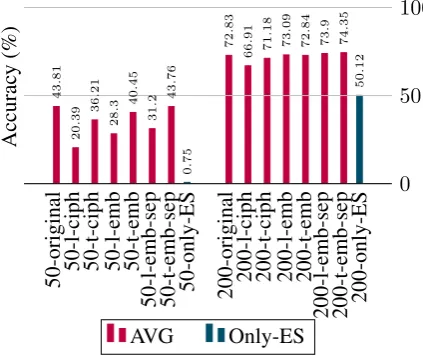
Figure 2: Results for all experiments, averaged over all languages. only-ES denotes a model trained exclusively on 50 or 200 Spanish exam-ples.
for low-resource training size 200, t-emb-sep per-forms best in most case, and without transfer still performs worst. The order of the accuracies av-eraged over all languages can be seen in Figure
2: original > t-emb-sep > t-emb > t-ciph > l-emb-sep > l-emb> l-ciph for 50 and t-emb-sep >l-emb-sep>l-emb>t-emb>original>t-ciph >l-ciph for 200 low-resource examples. The de-tailed results of each language can be found in Ta-ble4.
First, this shows clearly that the character em-beddings are more important for the task than the tag embeddings. Second, l-emb (resp. t-emb) and l-ciph (resp. t-ciph) correspond to a setting with no additional information vs. a setting with po-tentially wronginformation. Generally higher ac-curacies for separate embedding spaces indicate that the model can learn incorrect information via transfer. Thus, the choice of the source language seems to be very important. The differences in performance between original and l-emb represent the influence of shared vs. separate embedding
spaces, i.e., vocabularies in the case of the letters. Sharing a vocabulary seems to influence the final accuracy a lot, and more positively for 50 low-resource examples. We can explain this with the model learning to copy – it has no intrinsic way of knowing which input character equals which out-put character in the vocabulary unless it has seen it at least once. However, for 200 Spanish exam-ples, we can expect all characters to appear in the Spanish training data, such that the character lan-guage model and tag-output correspondence get more important. This explains the unexpected re-sult that l-emb performs best for Arabic (200) and Portuguese (200): both source languages poten-tially confuse the language model; in Portuguese we contribute this to a big overlap of lemmata in the two languages with Portuguese often inflecting in a different way (Kann et al.,2017). Further, the differences in performance between original and t-emb show that the model indeed learns informa-tion from the tags, supposedly which output se-quence is more likely to appear with which tag.
The l-emb-sep and t-emb-sep results show that a separation symbol clearly improves the model’s performance.
4 Related Work
Transfer learning with encoder-decoder
net-works. Encoder-decoder RNNs were introduced
[image:4.595.75.287.203.381.2]Ha et al., 2016). Alonso and Plank (2016) ex-plored multi-task learning empirically, analyzing whenit improves performance. Here, we focus on howtransfer via multi-task learning works.
Paradigm completion. SIGMORPHON
hosted two shared tasks on paradigm completion (Cotterell et al., 2016,2017), in order to encour-age the development of systems for the task. One approach is to treat it as a string transduction problem by applying an alignment model with a semi-Markov model (Durrett and DeNero, 2013;
Nicolai et al., 2015). Recently, neural sequence-to-sequence models are also widely used (Faruqui et al., 2016; Kann and Sch¨utze, 2016; Aharoni and Goldberg,2017;Zhou and Neubig,2017). All the above mentioned work were designed for one single language.
5 Conclusion
We conducted a set of experiments to explore the mechanisms behind cross-lingual transfer learning for morphological reinflection. Our findings in-dicate that knowledge about a language’s typical character sequences and outputs for certain mor-phological tags can be transferred. In particular, this means that the effect cannot be reduced to sole regularization.
Acknowledgments
We would like to thank Hinrich Sch¨utze and the anonymous reviewers for their helpful comments.
References
Roee Aharoni and Yoav Goldberg. 2017. Sequence to sequence transduction with hard monotonic atten-tion. InACL.
H´ector Mart´ınez Alonso and Barbara Plank. 2016. Multitask learning for semantic sequence predic-tion under varying data condipredic-tions. arXiv preprint arXiv:1612.02251.
Dzmitry Bahdanau, Kyunghyun Cho, and Yoshua Ben-gio. 2015. Neural machine translation by jointly learning to align and translate. InICLR.
Kyunghyun Cho, Bart Van Merri¨enboer, Dzmitry Bah-danau, and Yoshua Bengio. 2014. On the properties of neural machine translation: Encoder-decoder ap-proaches. InSSST.
Ryan Cotterell, Christo Kirov, John Sylak-Glassman, G´eraldine Walther, Ekaterina Vylomova, Patrick Xia, Manaal Faruqui, Sandra K¨ubler, David Yarowsky, Jason Eisner, and Mans Hulden. 2017.
The CoNLL-SIGMORPHON 2017 shared task: Universal morphological reinflection in 52 lan-guages. InCoNLL-SIGMORPHON.
Ryan Cotterell, Christo Kirov, John Sylak-Glassman, David Yarowsky, Jason Eisner, and Mans Hulden. 2016. The SIGMORPHON 2016 shared task— morphological reinflection. InSIGMORPHON. Daxiang Dong, Hua Wu, Wei He, Dianhai Yu, and
Haifeng Wang. 2015. Multi-task learning for mul-tiple language translation. InACL.
Greg Durrett and John DeNero. 2013. Supervised learning of complete morphological paradigms. In
HLT-NAACL.
Manaal Faruqui, Yulia Tsvetkov, Graham Neubig, and Chris Dyer. 2016. Morphological inflection genera-tion using character sequence to sequence learning. InNAACL-HLT.
Orhan Firat, Kyunghyun Cho, and Yoshua Ben-gio. 2016. Multi-way, multilingual neural ma-chine translation with a shared attention mechanism.
arXiv preprint arXiv:1601.01073.
Thanh-Le Ha, Jan Niehues, and Alexander Waibel. 2016. Toward multilingual neural machine trans-lation with universal encoder and decoder. arXiv preprint arXiv:1611.04798.
Melvin Johnson, Mike Schuster, Quoc V. Le, Maxim Krikun, Yonghui Wu, Zhifeng Chen, Nikhil Tho-rat, Fernanda Vigas, Martin Wattenberg, Greg Cor-rado, Macduff Hughes, and Jeffrey Dean. 2016. Google’s multilingual neural machine translation system: Enabling zero-shot translation. arXiv preprint arXiv:1611.04558.
Katharina Kann, Ryan Cotterell, and Hinrich Sch¨utze. 2017. One-shot neural cross-lingual transfer for paradigm completion. InACL.
Katharina Kann and Hinrich Sch¨utze. 2016. Single-model encoder-decoder with explicit morphological representation for reinflection. InACL.
M Paul Lewis, editor. 2009. Ethnologue: Languages of the World. SIL International, Dallas, Texas, 16 edition.
Minh-Thang Luong, Quoc V Le, Ilya Sutskever, Oriol Vinyals, and Lukasz Kaiser. 2015. Multi-task sequence to sequence learning. arXiv preprint arXiv:1511.06114.
Garrett Nicolai, Colin Cherry, and Grzegorz Kondrak. 2015. Inflection generation as discriminative string transduction. InHLT-NAACL.
Ilya Sutskever, Oriol Vinyals, and Quoc V Le. 2014. Sequence to sequence learning with neural net-works. InNIPS.
Chunting Zhou and Graham Neubig. 2017. Multi-space variational encoder-decoders for semi-supervised labeled sequence transduction. In