Distractor Generation for Chinese Fill-in-the-blank Items
Shu Jiang
Department of
Computer Science and Engineering Shanghai Jiao Tong University
Shanghai, China [email protected]
John Lee
Department of Linguistics and Translation City University of Hong Kong
Hong Kong SAR, China [email protected]
Abstract
This paper reports the first study on auto-matic generation of distractors for fill-in-the-blank items for learning Chinese vo-cabulary. We investigate the quality of dis-tractors generated by a number of criteria, including part-of-speech, difficulty level, spelling, word co-occurrence and seman-tic similarity. Evaluations show that a se-mantic similarity measure, based on the word2vec model, yields distractors that are significantly more plausible than those generated by baseline methods.
1 Introduction
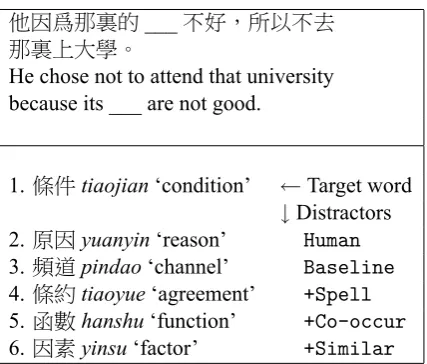
The fill-in-the-blank item is a common form of exercise in computer-assisted language learning (CALL) systems. Also known as a cloze or gap-fill item, a gap-fill-in-the-blank item is constructed on the basis of a carrier sentence. One word in the sentence — called the target word, or key — is blanked out, and the learner attempts to fill it. The top of Table1shows an example carrier sentence whose target word istiaojian‘condition’.1
To enable automatic feedback, a fill-in-the-blank item often specifies choices, including the target word itself and several distractors, as shown at the bottom of Table 1. Distractors need to be carefully chosen: they must be sufficiently plau-sible, but must not be acceptable answers. Litera-ture in language pedagogy generally recommends the following criteria to authors of fill-in-the-blank items: a distractor should belong to the same word class and same difficult level, and have approxi-mately the same length, as the target word (Heaton,
1989); it should collocate strongly with a word in the sentence (Hoshino,2013); and it should be se-mantically related with the target word, ideally a
1This example is taken from (Liu,2004).
他因爲那裏的___不好,所以不去 那裏上大學。
He chose not to attend that university because its ___ are not good.
[image:1.595.311.525.218.400.2]1. 條件tiaojian‘condition’ ←Target word ↓Distractors 2. 原因yuanyin‘reason’ Human 3. 頻道pindao‘channel’ Baseline 4. 條約tiaoyue‘agreement’ +Spell 5. 函數hanshu‘function’ +Co-occur 6. 因素yinsu‘factor’ +Similar
Table 1: An example fill-in-the-blank item, with a carrier sentence with a blank (top); and six choices for the blank (bottom), including the target word (correct answer), and distractors generated by five different methods (see Section4).
“false synonym” (Goodrich,1977). An empirical study confirmed that distractors indeed tend to be syntactically and semantically homogenous (Pho et al.,2014).
To automate the time-consuming process of se-lecting distractors, there has been much interest in developing algorithms that, given a carrier sen-tence and a target word, can find appropriate dis-tractors. To-date, most research effort on distrac-tor generation for language learning has focused on English.
This paper presents the first attempt to automati-cally generate distractors in fill-in-the-blank items for learners of Chinese as a foreign language. In Section 2, we review related research areas. In Section3, we present our datasets. In Section4, we outline our criteria for distractor generation. In Section 5, we describe the evaluation procedure. In Section 6, we report evaluation results,
ing that a semantic similarity measure based on theword2vecmodel yields distractors that are sig-nificantly more plausible than those generated by baseline methods.
2 Previous work
An algorithm for generating distractors must at-tempt a trade-off between two objectives. One objective is plausibility. Most approaches re-quire the distractor and the target word to have the same part-of-speech (POS) and similar level of difficulty, often approximated by word fre-quency (Coniam, 1997;Shei,2001;Brown et al.,
2005). They must also be semantically close, which can be quantified with semantic distance in WordNet (Lin et al.,2007;Pino et al.,2008;Chen et al.,2015;Susanti et al.,2015), thesauri (Sumita et al.,2005;Smith et al.,2010), ontologies ( Kara-manis et al.,2006;Ding and Gu,2010), or hand-crafted rules (Chen et al.,2006). Another approach generates distractors that are semantically simi-lar to the target word in some sense, but not in the particular sense in the carrier sentence (Zesch and Melamud,2014). Others directly extract fre-quent mistakes in learner corpora to serve as dis-tractors (Sakaguchi et al.,2013;Lee et al.,2016). Error-annotated Chinese learner corpora are still not large enough, however, to support broad-coverage distractor generation.
A second, often competing objective is to en-sure that the distractor, however plausible, is not an acceptable answer. Most approaches require that the distractor never, or only rarely, collocate with other words in the carrier sentence. Some de-fine collocation as n-grams in a context window centered on the distractor (Liu et al.,2005). Oth-ers also consider words elsewhere in the carrier sentence, for example those present in the Word Sketch of the distractor (Smith et al.,2010) or those that are grammatically related to the distractor in dependencies (Sakaguchi et al., 2013). Still oth-ers restrict potential distractors to antonyms of the target word, words with the same hypernym, and synonym of synonyms in WordNet (Knoop and Wilske,2013).
To the best of our knowledge, there is not yet any reported attempt to generate distractors for learn-ing Chinese vocabulary. The only previous work on Chinese distractor generation was designed for testing knowledge in the aviation domain, and leveraged a domain-specific ontology (Ding and
Gu,2010).
3 Data
To facilitate our study, we compiled two datasets:
Textbook Corpus We collected 299 fill-in-the-blank items, each with a target word and two to three distractors, from three Chinese text-books (Liu, 2004, 2010; Wang, 2007). An analysis on this corpus confirms many of the criteria proposed in the literature: in 63% of the items, all distractors have the same POS as the target word; and in 45% of the items, at least one distractor shares a common char-acter with the target word.
Wiki Corpus We extracted 14 million sentences from Chinese Wikipedia for calculating word frequency, similarity and co-occurrence statistics in the Candidate Generation step. We then performed word segmentation, POS tagging and dependency analysis on a sub-set of 5.5 million sentences with the Stanford Chinese parser (Levy and Manning,2003) for use in the Candidate Filtering step.
4 Approach
We follow a two-step process where the first step, Candidate Generation, optimizes distractor plau-sibility; and the second step, Candidate Filtering, aims to filter out distractor candidates that are ac-ceptable answers.
4.1 Candidate Generation
We implemented the following criteria for gener-ating a ranked list of distractor candidates:
Baseline (Baseline) The baseline re-implements the criteria proposed by Coniam (1997): the distractor must have the same POS and the similar difficulty level as the target word. We extract all words in the Wiki corpus with the same POS, and then rank them by the prox-imity of their word frequency and that of the target word. In Table 1, for example, pin-dao‘channel’ was chosen because, among all nouns, its word frequency is closest to that of the target wordtiaojian.
in common may be easily confusable for learners. This method requires the candidate to share at least one common character with the target word. In our running example in Table 1, tiaoyue ‘agreement’ was chosen because, among all words that contain the character tiao or jian (which combine to form the target wordtiaojian), it has the most similar word frequency.
Word co-occurrence (+Co-occur) A distractor that often co-occurs with the target word may be easily confusable for learners. We ranked the candidate distractors according to their pointwise mutual information (PMI) score with the target word, as estimated on the Wiki corpus. In our running example in Table1, hanshu‘function’ was chosen because of its frequent co-occurrence withtiaojian ‘condi-tion’.
Word similarity (+Similar) Words that are se-mantically close to the target word tend to be plausible candidates. We ranked candi-date distractors according to their similar-ity score with the target word. We ob-tained these scores by training a word2vec model (Mikolov et al., 2013) on the Wiki corpus.2 We opted forword2vec over the-sauri or Chinese lexical databases such as HowNet because of its broader coverage. In the example in Table 1, the distractor yinsu 因素‘factor’ was chosen because it has the highest similarity score with tiaojian in the word2vecmodel.
4.2 Candidate Filtering
A distractor is called “reliable” if it yields an incor-rect sentence. This step aims to remove those can-didates that are also acceptable answers, leaving only the reliable distractors. We do so by examin-ing whether the distractor can collocate with words in the rest of the carrier sentence. The system ex-amines the candidates in the ranked list produced by the Candidate Generation step (Section 4.1), and removes candidates that are rejected by both filters below:
Trigram The word trigram, formed by the distrac-tor, the previous word and the following word in the carrier sentence, must not appear in the
2We trained a bag-of-words (CBOW) model of 400
di-mensions and window size 5 withword2vec.
... 那裏 的 *因素 不 好 ...
... nali de *yinsu bu hao ... ... ‘there’ GEN ‘factor’ ‘not’ ‘good’ ...
nmod
case
nsubj
neg
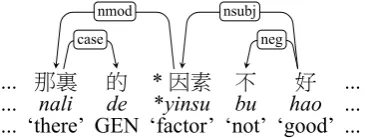
Figure 1: In the Candidate Filtering step (Sec-tion4.2), candidate distractors whose dependency relations are attested in the corpus are rejected. To determine whether yinsu can serve as a dis-tractor in the carrier sentence in Table1, the sys-tem determines whether the dependency relations nmod(yinsu, nali) or nsubj(hao,yinsu) is attested in a large corpus of Chinese texts.
Wiki corpus. In the example in Figure1, the trigram “de yinsu bu” must not be attested.
Dependency The Trigram filter alone might be too strict, since words that are grammatically related to the distractor may be further away. Among dependency relations in the parse tree of the carrier sentence, we extract all those with the distractor as head or child, and re-quire that these relation must not be attested in the Wiki corpus. This filter is similar to the approach by Smith et al. (2010), but in-stead of the grammatical relations in Word Sketches, we consider all dependency rela-tions. In our running example in Table1, the candidate情况qingkuang‘situation’ was re-jected because it is attested to serve as the subject ofhao‘good’. The next distractor in the ranked list,yinsu‘factor’, was chosen in-stead since it never served as the subject of hao‘good’, and was never modified by the nounnali‘there’.
5 Evaluation
5.1 Test data
According to Da (2007), basic ability in Chi-nese news reading require a vocabulary of around 20,000 words. Among the target words in the Text-book Corpus, we selected 37 nouns and verbs such that they were roughly equally spaced among the 20,000 most frequent words in the Wiki Corpus.
[image:3.595.313.496.62.131.2]Method Reliability
Baseline 100% +Co-occur 98.6%
+Spell 93.2%
+Similar 93.2%
[image:4.595.119.244.60.147.2]Human 100%
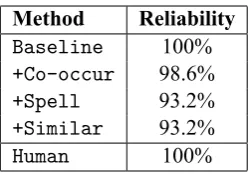
Table 2: Reliability of the various distractor gen-eration methods.
distractor from the corresponding fill-in-the-blank item in the Textbook corpus (Human). We thus have 37 items, each with six choices3: one cor-rect answer, and five distractors. Table1shows an example.
5.2 Human annotation
We asked two human judges, both native Chinese speakers, to annotate these choices, without re-vealing the target word. For each choice in the item, the judges decided whether it was correct or incorrect; they may identify zero, one or multi-ple correct answers. For an incorrect answer, they further assessed its plausibility as a distractor on a three-point scale: “Plausible” (3), “Somewhat plausible’ (2)’, or “Obviously wrong” (1).
The kappa for the human annotation is 0.529, which is considered a “moderate” level of agree-ment (Landis and Koch, 1977). As a annotation quality check, we found that overall, in 6.8% of the times, a judge labels the target word as a dis-tractor.
6 Results
6.1 Reliability
As shown in Table 2, the Baseline and +Co-occurmethods performed best in terms of re-liability: 100% and 98.6% of their respective dis-tractors can be used. The+Spelland+Similar methods, at 93.2%, were more prone to generating distractors that yield correct sentences. This is not unexpected since the+Similarmethod explicitly tries to find distractors that are semantically simi-lar to the target word.
The reliability rate would have been lower if not for the Candidate Filtering step. The Trigram and Dependency filters rejected 16 of the 37 top candi-dates returned by the+Similarmethod. A
post-3Except that in 5 items, the+Co-occurand+Similar
methods generated the same distractor; in another item,
Baselineand+Co-occurgenerated the same distractor.
Method Average Plausible or
score somewhat plausible
Baseline 1.06 5.2%
+Co-occur 1.27 8.6%
+Spell 1.66 39.7%
+Similar 1.76 46.6%
Human 1.68 53.4%
Table 3: Average scores, out of a 3-point scale (see Section 5.2), of distractors generated by the various methods in the human evaluation.
hoc analysis found that 11 of the 16 rejected candi-dates would indeed have been acceptable answers. The filters thus boosted the reliability rate by 30%, at the cost of falsely rejecting 5 top-ranked candi-dates.
6.2 Plausibility
Table3shows the results on plausibility. Both the +Similarmethod4and the+Spellmethod5 out-performed the baseline, both in terms of the aver-age score and the proportion of distractors consid-ered at least somewhat plausible.
Distractors of the+Similarmethod have very competitive quality, scoring on average 1.76, slightly higher than the average score of theHuman method (1.68). A qualitative review found that while the+Similarmethod can sometimes yield distractors that are even more plausible than those given by humans6, they are also more likely overall to be rated “Obviously Wrong”, especially when the model fails to take into account word sense ambiguity: 53.4% of the Human distractors are rated Plausible or Somewhat Plausible, versus only 46.6% for the+Similarmethod.
7 Conclusions
We presented the first study on automatic gener-ation of distractors for fill-in-the-blank items for learning Chinese. Evaluations showed that a se-mantic similarity measure, based on theword2vec model, offers a significant improvement over a baseline that considers only part-of-speech and word frequency, and achieves competitive plausi-bility in comparison to human-crafted items.
4p <0.001
, by McNemar’s test.
5p <0.021
by McNemar’s test.
6Since we randomly selected one distractor out of three
[image:4.595.307.525.62.161.2]Acknowledgments
This work is funded by the Language Fund under Research and Development Projects 2015-2016 of the Standing Committee on Language Education and Research (SCOLAR), Hong Kong SAR.
References
Jonathan C. Brown, Gwen A. Frishkoff, and Maxine Eskenazi. 2005. Automatic Question Generation for Vocabulary Assessment. InProc. HLT-EMNLP.
Chia-Yin Chen, Hsien-Chin Liou, and Jason S. Chang. 2006. FAST: An Automatic Generation System for Grammar Tests. InProc. COLING/ACL Interactive Presentation Sessions.
Tao Chen, Naijia Zheng, Yue Zhao, Muthu Kumar Chandrasekaran, and Min-Yen Kan. 2015. Interac-tive Second Language Learning from News Web-sites. In Proc. 2nd Workshop on Natural Lan-guage Processing Techniques for Educational Appli-cations.
David Coniam. 1997. A Preliminary Inquiry into Using Corpus Word Frequency Data in the Automatic Gen-eration of English Language Cloze Tests. CALICO Journal14(2-4):15–33.
Jun Da. 2007. Reading News for Information: How Much Vocabulary a CFL Learner Should Know. In Andreas Guder, Jiang Xin, and Yexin Wan, editors,
The Cognition, Learning and Teaching of Chinese Characters. Beijing Language and Culture Univer-sity Press, pages 251–277.
Xiangmin Ding and Hongbin Gu. 2010. Automatic Generation Technology of Chinese Multiple-choice Items based on Ontology [in Chinese]. Computer Engineering and Design31(6):1397–1400.
Hubbard C. Goodrich. 1977. Distractor Efficiency in Foreign Language Testing. TESOL Quarterly
11(1):69–78.
J. B. Heaton. 1989. Writing English Language Tests. Longman.
Yuko Hoshino. 2013. Relationship between Types of Distractor and Difficulty of Multiple-Choice Vocab-ulary Tests in Sentential Context. Language Testing in Asia3(16).
Nikiforos Karamanis, Le An Ha, and Ruslan Mitkov. 2006. Generating Multiple-Choice Test Items from Medical Text: A Pilot Study. InProc. 4th Interna-tional Natural Language Generation Conference.
S. Knoop and S. Wilske. 2013. WordGap: Auto-matic Generation of Gap-Filling Vocabulary Ex-ercises for Mobile Learning. In Proc. Second Workshop on NLP for Computer-assisted Language Learning, NODALIDA.
J. Richard Landis and Gary G. Koch. 1977. The Mea-surement of Observer Agreement for Categorical Data. Biometrics33:159–174.
John Lee, Donald Sturgeon, and Mengqi Luo. 2016. A CALL System for Learning Preposition Usage. In
Proc. ACL.
Roger Levy and Christopher D. Manning. 2003. Is it harder to parse Chinese, or the Chinese Treebank? InProc. ACL.
Y.-C. Lin, L.-C. Sung, and M.-C. Chen. 2007. An Auto-matic Multiple-Choice Question Generation Scheme for English Adjective Understanding. In Proc. Workshop on Modeling, Management and Genera-tion of Problems/QuesGenera-tions in eLearning, 15th Inter-national Conference on Computers in Education.
Chao-Lin Liu, Chun-Hung Wang, Zhao-Ming Gao, and Shang-Ming Huang. 2005. Applications of Lexical Information for Algorithmically Composing Multiple-Choice Cloze Items. InProc. 2nd Work-shop on Building Educational Applications Using NLP. pages 1–8.
Jennifer Lichia Liu. 2004. Connections I: a Cognitive Approach to Intermediate Chinese. Indiana Univer-sity Press, Bloomington, IN.
Jennifer Lichia Liu. 2010. Encounters I/II: a Cognitive Approach to Advanced Chinese. Indiana University Press, Bloomington, IN.
Tomas Mikolov, Kai Chen, Greg Corrado, and Jeffrey Dean. 2013. Efficient estimation of word represen-tations in vector space. InProc. ICLR.
Van-Minh Pho, Thibault André, Anne-Laure Ligozat, B. Grau, G. Illouz, and Thomas François. 2014. Multiple Choice Question Corpus Analysis for Dis-tractor Characterization. InProc. LREC.
Juan Pino, M. Heilman, and Maxine Eskenazi. 2008. A Selection Strategy to Improve Cloze Question Quality. InProc. Workshop on Intelligent Tutoring Systems for Ill-Defined Domains., 9th International Conference on Intelligent Tutoring Systems.
Keisuke Sakaguchi, Yuki Arase, and Mamoru Ko-machi. 2013. Discriminative Approach to Fill-in-the-Blank Quiz Generation for Language Learners. InProc. ACL.
Chi-Chiang Shei. 2001. FollowYou!: An Automatic Language Lesson Generation System. Computer As-sisted Language Learning14(2):129–144.
Eiichiro Sumita, Fumiaki Sugaya, and Seiichi Ya-mamoto. 2005. Measuring Non-native Speak-ers’Proficiency of English by Using a Test with Automatically-Generated Fill-in-the-Blank Ques-tions. In Proc. 2nd Workshop on Building Educa-tional Applications using NLP.
Yuni Susanti, Ryu Iida, and Takenobu Tokunaga. 2015. Automatic Generation of English Vocabulary Tests. InProc. 7th International Conference on Computer Supported Education (CSEDU).
Youmin Wang. 2007. 實用商務漢語課本(漢韓版)
準高級篇/高級篇. Commercial Press, Beijing.