273
Addressing Objects and Their Relations:
The Conversational Entity Dialogue Model
Stefan Ultes, Paweł Budzianowski, I ˜nigo Casanueva, Lina Rojas-Barahona, Bo-Hsiang Tseng, Yen-Chen Wu, Steve Young and Milica Gaˇsi´c
Cambridge University Engineering Department Cambridge, United Kingdom
{su259,pfb30,ic340,lmr46,bht26,ycw30,sjy11,mg436}@cam.ac.uk
Abstract
Statistical spoken dialogue systems usu-ally rely on a single- or multi-domain dia-logue model that is restricted in its capabil-ities of modelling complex dialogue struc-tures, e.g., relations. In this work, we pro-pose a novel dialogue model that is cen-tred around entities and is able to model relations as well as multiple entities of the same type. We demonstrate in a prototype implementation benefits of relation mod-elling on the dialogue level and show that a trained policy using these relations out-performs the multi-domain baseline. Fur-thermore, we show that by modelling the relations on the dialogue level, the system is capable of processing relations present in the user input and even learns to address them in the system response.
1 Introduction
Data-driven statistical spoken dialogue systems (SDS) (Lemon and Pietquin, 2012;Young et al.,
2013) are a promising approach for realizing spo-ken dialogue interaction between humans and ma-chines. Up until now, these systems have success-fully been applied to single- or multi-domain task-oriented dialogues (Su et al., 2017; Casanueva et al., 2017;Lison, 2011;Wang et al., 2014; Pa-pangelis and Stylianou, 2017;Gaˇsi´c et al., 2017;
Budzianowski et al., 2017; Peng et al., 2017) where each dialogue is modelled as multiple inde-pendent single-domain sub-dialogues. However, this multi-domain dialogue model (MDDM) does not offer an intuitive way of representing multi-ple objects of the same type (e.g., multimulti-ple restau-rants) or dynamic relations between these objects. To the best of our knowledge, neither problem has yet been addressed in statistical SDS research.
The goal of this paper is to propose a new di-alogue model—the conversational entity didi-alogue model (CEDM)—which offers an intuitive way of modelling dialogues and complex dialogue struc-tures inside the dialogue system. Inspired by
Grosz (1978), the CEDM is centred around ob-jects and relations instead of domains thus offer-ing a fundamental change in how we think about statistical dialogue modelling. The CEDM allows
• to model dynamic relations directly, indepen-dently and persistently so that the relations may be addressed by the userandthe system,
• the system to talk about multiple objects of the same type, e.g., multiple restaurants,
while still allowing feasible policy learning. The remainder of the paper is organized as fol-lows: after presenting a brief motivation and re-lated work in Section2, Section3presents back-ground information on statistical SDSs. Section4
contains the main contribution and describes the conversational entity dialogue model in detail. Looking at one aspect of the CEDM, the mod-elling of relations, Section 5 describes a proto-type implementation and shows the benefits of the CEDM in experiments with a simulated user. Sec-tion6concludes the paper with a list of open ques-tions which need to be addressed in future work.
2 Motivation and Related Work
Restaurant name area food … Entities:
Objects and Relations Object Types Example dialogue
Conversational World
Object 1 (Hotel) name: Royal Camb. area: centre
Object 2 (Restaurant) name: Golden House area: centre
Is type of
Relation 1 (Object 1 with Object 2) area: same
Hotel name area stars …
S1: Hello, howcan I help you?
U1: I need a hotel in Cambridge.
S2: What price range do you have in mind? U2: Expensive.
S3: Royal Camb. is an expensive hotel in the centre. U3: Great, I also need a cheap restaurantin the same area. S4: What type of food would you like?
U4: don’t care.
S5: Golden House is a cheap Chinese restaurant in the centre.
U5: Great, thanks.
[image:2.595.97.498.70.246.2]S6: Do you need anything else? U6: Not for now, bye.
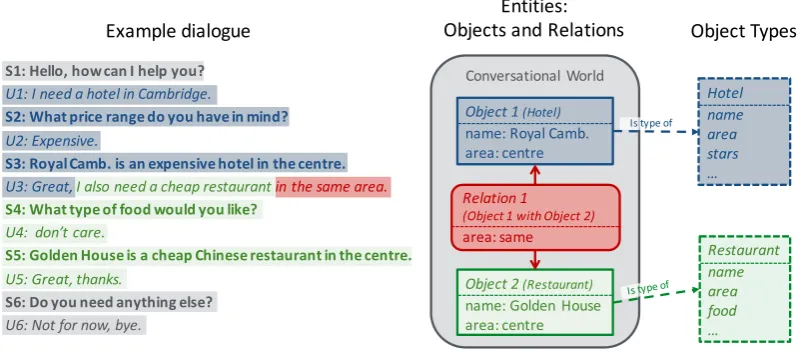
Figure 1: A dialogue between the system (S) and a user (U) about a restaurant and a hotelin the same areaalong with the mapping of fractions of the dialogue to the respective objects (of predefined types) and the relation. All objects and relations reside inside a conversational world.
mapped to an object or a relation in the conver-sational world or may be mapped to the world it-self (grey). In the example, the first part (blue) is about Object 1 of type hotel. When the focus shifts towardsObject 2of typerestaurant(green) at U3, the user also addresses the relation (red)in the same areabetweenObject 1andObject 2.
Addressing a relation in this way could still be captured by the semantic interpretation of the user input as the informationarea=centremay be de-rived from the context. However, if the user saidI need a hotel and a restaurant in Cambridge in the same arearight in the beginning of the dialogue (U1), no context information would be available. To capture these dialogue structures, the dialogue model and the corresponding dialogue state must be able to represent them adequately.
The proposed CEDM achieves this by mod-elling state information about conversational enti-ties instead of domains. More precisely, it models separate states about the objects (e.g., the hotel or restaurant) and the relations. Previous work on di-alogue modelling already incorporated the idea of objects or entities to be the principal component of the dialogue state (Grosz,1977;Bilange,1991;
Montoro et al.,2004;Xu and Seneff,2010; Hein-roth and Minker,2013). However, these dialogue models are not based on statistical dialogue pro-cessing where a probability distribution over all dialogue states needs to be modelled and main-tained. This additional complexity, though, cannot be incorporated in a straight-forward way into the proposed models. In contrast, the CEDM offers
a comprehensive and consistent way of modelling these probabilities by defining and maintaining entity-based states. Work on statistical dialogue state modelling (Young et al.,2010;Lee and Stent,
2016;Schulz et al.,2017) also contain a variant of objects but is still based on the MDDM thus not offering any mechanism to model multiple enti-ties or relations between objects. Ramachandran and Ratnaparkhi (2015) proposed a belief track-ing approach ustrack-ing relational trees. However, they only consider static relations present in the ontol-ogy and are not able to handle dynamic relations.
3 Statistical Spoken Dialogue Systems
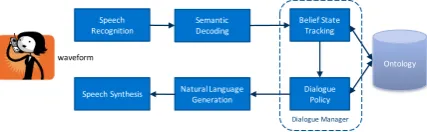
Statistical SDS are model-based approaches1 and usually assume a modular architecture (see Fig.2). The problem of learning the next system action is framed as a partially-observable Markov deci-sion process (POMDP) that accounts for the un-certainty inherent in spoken communication. This uncertainty is modelled in the belief stateb(s) rep-resenting a probability over all statess.
Reinforcement learning (RL) is used in such a sequential decision-making process where the decision-model (the policyπ) is trained based on
1
Speech Synthesis
Semantic Decoding Speech
Recognition
Natural Language Generation
Ontology Belief State
Tracking
Dialogue Policy
waveform
[image:3.595.75.289.65.131.2]Dialogue Manager
Figure 2: The modular statistical dialogue system architecture. The dialogue manager takes the se-mantic interpretation as input to track the belief state. The updated state is then used by the dia-logue policy to decide on the next system action.
sample data and a potentially delayed objective signal (the reward r) (Sutton and Barto, 1998). The policy selects the next action a ∈ A based on the current system belief statebto optimise the accumulated future rewardRtat timet:
Rt= ∞
X
k=0
γkrt+k+1. (1)
Here, k denotes the number of future steps, γ a discount factor andrτ the reward at timeτ.
The Q-function models the expected accumu-lated future rewardRtwhen taking actionain
be-lief stateband then following policyπ:
Qπ(b, a) =Eπ[Rt|bt=b, at=a]. (2)
For most real-world problems, finding the exact optimalQ-values is not feasible. Instead, RL al-gorithms have been proposed for dialogue policy learning based on approximating the Q-function directly or employing the policy gradient theo-rem (Williams and Young,2006;Daubigney et al.,
2012; Gaˇsi´c and Young, 2014; Williams et al.,
2017;Su et al.,2017;Casanueva et al.,2017; Pa-pangelis and Stylianou,2017).
Aside from the policy model, the dialogue model plays an important role: it defines the struc-ture and internal links of the dialogue state as well as the system and user acts (i.e., the semantics the system can understand). Thus, the policy model is only able to learn system behaviour based on what is defined by the dialogue model. By defin-ing the dialogue state, the dialogue model further represents an abstraction over the task ontology or knowledge base restricting the view on the infor-mation that is relevant so that the system is able to converse2. Most current dialogue models are built
2Using the knowledge base directly to model the (noisy)
dialogue state (Pragst et al., 2015;Meditskos et al., 2016) usually results in high access times.
arounddomainswhich encapsulate all relevant in-formation as a section of the dialogue state that belongs to a given topic, e.g., finding arestaurant orhotel. However, the resulting flat state that is widely used (Williams et al., 2005;Young et al.,
2010;Thomson and Young,2010;Lee and Stent,
2016;Schulz et al.,2017, e.g.) is not intuitive to model complex dialogue structures like relations.
To overcome this limitation, we propose the conversational entity dialogue model which will be described in detail in the following section.
4 Conversational Entity Dialogue Model
The conversational entity dialogue model (CEDM) is proposed as an alternative way of statistical dialogue modelling having the concept of entities at the core of the model. Entities being objects or relations offer an intuitive way of modelling complex task-oriented dialogues.
4.1 Objects and Relations
Objects are entities of a certain object type (e.g., Restaurant or Hotel) where each type defines a set of attributes (see Fig.1). This type definition matches the contents of the back-end knowledge base and thus the internal representation of real-world objects. This is similar to the definition of domains. In contrast to domains, though, this no-tion allows the modelling of multiple objects of the same type within a dialogue as well as the mod-elling of a type hierarchy which may be exploited during policy learning.
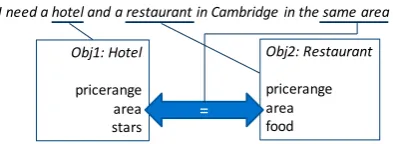
Relations are also entities that connect objects or attributes of objects. An example is shown in Figure3: the two objects obj1andobj2 of types Hotel and Restaurant respectively are connected through the attributeareawith theequalsrelation. Possible relations may directly be derived from the object type definitions, e.g., by allowing only connections for attributes that represent the same concepts like area. Note that these relations are dynamic relations that may be drawn between ob-jects in a conversation. This is different to static relations which are often used in knowledge bases to describe how concepts relate to each other.
4.2 Conversational Entities in a Conversational World
I need a hotel and a restaurant in Cambridge in the same area
Obj1: Hotel
pricerange area stars
Obj2: Restaurant
pricerange area food
[image:4.595.84.281.60.132.2]=
Figure 3: Example mapping of a user utterance to two objects and one relation.
relation. A conversational object may match a real-world entity but does not need to. In fact, the task of a goal-oriented dialogue is often to find a matching real-world entity based on the informa-tion acquired by the system during the dialogue. In the example dialogue (Fig.1), matching entities have already been found for both objects. How-ever, a conversational object exists independently of whether a matching real-world entity has been found yet or even exists.
Derived from the object type definition, a con-versational object comprises an internal state that consists of the user goal belief su and the
con-text statescas shown in the example in Figure4.
There,suis depicted using marginal probabilities
for each slot (which is common in recent work on statistical SDS). While the user goal belief models the system’s belief of what the user wants based on the user input, the context state models infor-mation that the system has shared with the user. In the example of Figure 4, the system has already offered a matching real-world object based on the user goal belief of the conversational object. If no offer has been made yet, the context state is empty. The context state plays an important role as ad-dressed relations usually refer to the object offered by the system instead of search constraints repre-sented by the user goal belief. The context state further allows to relate to attributes that have not been mentioned in the dialogue.
One key aspect of the CEDM is that relations are also modelled as a conversational entity. Thus, these conversational relations also define a user goal belief and a context state as shown in Fig-ure 5. The attributes of the relation are cre-ated out of the attributes of the objects they con-nect. In the given example, the attributes area and pricerange of the two objects are connected resulting in the relation attributes area2area and pricerange2pricerange. The values of these at-tributes are the actual relations, e.g., equals or greater/less than. Similar to the slot belief of
con-Obj2: Restaurant
User goal belief
name pricerange area food requests
Context state
name Golden House
pricerange cheap
area centre
food chinese
post code CB2 1EG phone number 01842 753771
[image:4.595.307.526.62.162.2]address 12 lensfield road city centre
Figure 4: Example of a conversational entity rep-resenting objectobj2of typeRestaurant. The user goal belief models the search constraints the user has provided to the system and the context state represents the most recent real-world match of-fered by the system.
Relation1: obj1 – obj2
Context state
pricerange 2 pricerange >
area 2 area =
User goal belief
pricerange 2 pricerange area 2 area
requests
Figure 5: Example of the conversational entity Re-lation1betweenobj1andobj2. The user goal be-lief models the search constraints the user has pro-vided to the system and the context state represents the relations based on the most recent real-world matches for both objects offered by the system.
versational objects, each attribute is modelled with a marginal probability over all possible relations.
Assigning part of the belief state to the relations enables the system to specifically react to these re-lations and even to address them in a system utter-ance. Furthermore, if the context state of one of the related objects changes (e.g., because the user changed their mind), the relation may still persist. Each conversational entity resides within a con-versational world w (see Fig. 1) that defines the number of objects and the type of each object (re-lations may be derived from this) as well as gen-eral state information. This world may either be predefined or needs to be derived from the user input. In the latter case, the user input is usu-ally noisy and an uncertainty needs to be modelled within the dialogue state. As this work focuses on relation modelling, a predefined conversational world is used leaving the uncertainty modelling of conversational worlds for future work.
4.3 Belief Tracking and Focus of Attention
[image:4.595.312.527.265.335.2]the system actiona, the observationoof the user input and the previous probability distributionb:
b0(s) =P(s|o, a, b). (3)
With the additional complexity of the CEDM hav-ing an unknown number of entities in a conversa-tional world, we propose to decompose the states
in the spirit of work byWilliams et al.(2005). The belief update for each entityeis then defined as
b0e(u, su, sc, he) =P(u, su, sc, he|a, o, be), (4)
wheresu is the user goal state of entity e, scthe
context state ofe,hethe dialogue history ofeand uthe last user action3.
The belief update for the world beliefbwis
b0w(u, sw, hw) =P(u, sw, hw|a, o, bw), (5)
where sw is the world state of world w, hw the
dialogue history anduthe last user action. This multi-part belief allows hierarchical dia-logue processing on the world level and the en-tity level as depicted in Figure6. Each level pro-duces its own belief and based on that, the sys-tem is able to act on each level. On the world level, the system might produce general dialogue behaviour like greetings or engage in a dialogue to adequately identify the entity which is addressed by the user input. On the entity level, the system talks to the user to acquire information about the concrete entity the user is talking about, e.g., to find a matching entity in the knowledge base.
In addition to belief tracking, we would like to introduce another concept called focus of atten-tion. Based on work byGrosz (1978), we define the current focus of attention F for each conver-sational world as a subset of converconver-sational enti-ties in this world F ⊆ W. Hence, the task of focus tracking is to find the new set of conversa-tional entities which is in the current focus of at-tention based on the user input and the updated be-lief state. Even though the concept of focus is not mandatory, it may be helpful when framing the re-inforcement learning problem as it allows to limit the size of the input to the reinforcement learning algorithm as well as the number of actions avail-able to the learning algorithm at a given time. Us-ingF may also prevent the system from acting in parts of the belief state that are completely irrele-vant to the current part of the conversation.
3In case of an unknown number of entities represented
by a probability over worlds, the probability in Equation4
needs to be extended to depend on the conversational world and needs to be multiplied by a probability over all worlds.
world level world general behaviour bw
entity level entity specific behaviour be
Figure 6: The layered model of the CEDM with the respective components of the belief state.
4.4 The Conversational Entity vs. the Multi-Domain Dialogue Model
The functionality and the modelling possibilities of the proposed CEDM go beyond (and thus in-clude) the possibilities of the multi-domain dia-logue model (MDDM). To demonstrate this, we will outline how a dialogue using the MDDM may be modelled using the CEDM. The core concept domain of the MDDM may be mapped to one conversational object of a specific type where the slots of the domain are the attributes of the type. Since the number of domains is predefined, there is only one conversational world with a set num-ber of conversational objects. Relations may not be modelled using the MDDM. Belief update is re-duced to finding the right entity for the user input and updating its state. In the CEDM, the semantic decoding of user input includes the entity (or en-tity type) it refers to, which is similar to the topic tracker of the MDDM where the topic tracker also defines the domain the system acts in. Hence, the focus of attention will always contain only the en-tity that has been addressed by the user. By that, a policy for each conversational object (and thus object type) may be trained which is the same as the domain policies of the MDDM.
5 Relation Modelling Evaluation
To demonstrate the capabilities and benefits of the conversational entity dialogue model (CEDM), the aspect of relation modelling has been selected as it is a core concept of the CEDM. For this, we built upon the mapping to the multi-domain dia-logue model (MDDM) as described in Section4.4
and extend it with conversational relations. After a brief description of the model implementation, the experiments and their results are presented using two conversational objects of different types. Note that only theequalsrelation is considered here due to limitations of the marginal belief state model.
5.1 Model Implementation
used which originally follows the MDDM. The main challenge for policy implementation is to integrate both the state of the object in F as well as the states of all corresponding rela-tions into the dialogue decision. To achieve this, a hierarchical policy model based on feudal re-inforcement learning (Dayan and Hinton, 1993) has been implemented following the approach ofCasanueva et al.(2018). For each object type, a master policy decides whether the next system action addresses a conversational relation or the conversational object. A respective sub-policy is then invoked in a second step where each object type and each relation type are modelled by an in-dividual policy. Thus, the model decomposes the action selection problem to take account for the specificities of the object policy and relation poli-cies respectively and is able to handle a variable number of relations. During training, all policies (master and sub-policies) receive the same reward signal.
Aside from the feudal RL architecture which seems to be intuitive for the proposed CEDM, the main problem is the handling of back-end data-base access. In the MDDM, each domain mod-els all information which is necessary to do the data-base lookup. However, this is not possible in the CEDM as information from different conver-sational objects and relations need to be taken into account. One way of doing this is to apply a rule-based merging of the state of the conversational object in F with the states of all other tional objects that are related through a conversa-tional relation to form the focus stateˆb:
ˆbs(v) =
P
iwibis(v)
P
iwi
, (6)
wheres is the slot,v is the value, and bi the be-lief of thei-th conversational entity involved in the merging process. wi = 1−bis(∅)is the weight of
the i-th conversational entity where bis(∅) repre-sents the probability where no information about slotshas yet been shared with the system. bi ei-ther refers to the belief bo of the conversational objectoinF or to an already weighted belief˜bo0
originating from the conversational relationreloo0
connecting conversational objectowitho0:
˜bo0
s(v) =
(
reloos 0(=)·bso0(v), v6=∅
reloos 0(=)·bos0(v) +reloos 0(∅), v=∅
where bo0 is the belief of object o0. The relation probabilityrel is0 if the slotshas no matching
slot ino0. Please note that forbos0(v), even though we refer to the belief, the context state ofo0is used instead if not empty. The focus state is used as input to the master policy as well as the sub-policy of the conversational object.
As an example, consider bos = [∅ : 0.3, v1 : 0.7, v2 : 0.0], bo
0
s = [∅ : 0.2, v1 : 0.0, v2 : 0.8],
and reloos 0 = [∅ : 0.1,=: 0.9]. This results in ˜bos0 = [∅ : 0.28, v1 : 0.0, v2 : 0.78] and ˆbs = [∅ : 0.29, v1 : 0.35, v2 : 0.36]. This
ex-ample also shows that conflicts which may exists between the state of the conversational object and the state defined by the relation are visible at this level. To help the policy to learn in this situation, an additional conflict bit is added to the focus be-lief state as input to the master policy.
The source code of the CEDM implementation is available athttp://pydial.org/cedm.
5.2 Experimental Setup
To evaluate the relation modelling capabilities of the CEDM, the task of finding a hotel and a restau-rant in Cambridge has been selected (correspond-ing to the CamRestaurants and CamHotels do-mains of PyDial). The corresponding conversa-tional world consists of two conversaconversa-tional objects of types hotel and restaurant and one conversa-tional relation. Based on the object type defini-tions, the conversational relation connects the slots areaandpricerangeof both objects. Using a sim-ulated environment, the goals of the simsim-ulated user were generated so that at least one of these two slots is related (i.e., contains the same value).
To test the influence of the user addressing the relation instead of the correct value (e.g., ”restau-rant in the same area as the hotel” vs. ”restau”restau-rant in the centre”), we have extended the simulated agenda-based user (Schatzmann and Young,2009) with a probabilityr of the user addressing the re-lation instead of the value. The higherr, the more often the user addresses the relation. The user sim-ulator is equipped with an additional error model to simulate the semantic error rate (SER) caused in a real system by the noisy speech channel.
de-coder for the relations is necessary. For training and evaluation of the proposed framework, both the master policy and all sub-policies are mod-elled with the GP-SARSA algorithm (Gaˇsi´c and Young,2014). This is a value-based method that uses a Gaussian process to approximate the state-value function (Eq.2). As it takes into account the uncertainty of the estimate, it is sample-efficient.
To compare the dialogue performance of the CEDM with the MDDM baseline, two experi-ments have been conducted. All dialogues follow the same structure: the user and the system first talk about one conversational object before mov-ing on to the second object. As the user only ad-dresses a relation to an object that has previously been part of the dialogue, relations are only rele-vant when talking about the second object. How-ever, there are times where a relation has been ad-dressed by the user before the goal of the first ob-ject changed which resulted in the addressed rela-tion being wrong. This could only be resolved by the system by addressing the relation itself.
Experiment 1 In the first experiment, the influ-ence ofr on the dialogue performance is investi-gated in a controlled environment. Having a fixed order, only the feudal policy of the second ob-ject (where relations may occur), the restaurant, is learned. To avoid interfering effects of jointly learning both policies at the same time, the first objecthoteluses a handcrafted policy.
Experiment 2 The second experiment focusses on the joint learning effects. Thus, the order of objects is alternated, all objects use the feudal pol-icy model and are trained simultaneously.
5.3 Results
The experiments have been conducted based on the PyDial simulation environments Env. 1 and Env. 3 specified byCasanueva et al.(2017) where Env. 1 operates on a clean communication channel with an SER of 0% and Env. 3 simulates an SER of 15%. For each experiment, a policy for the re-spective object types was trained with 4,000 and tested with 1,000 dialogues. The reward was set to +30/+0 for success/failure and -1 for each turn with a maximum of 25 turns per object. The re-sults were averaged over 5 different random seeds.
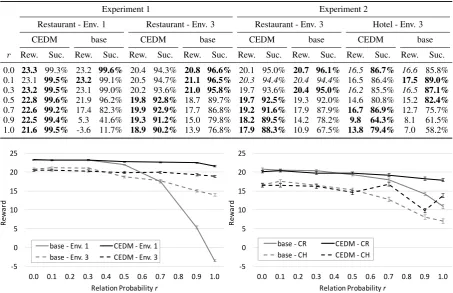
Experiment 1 As can be seen in Table1and Fig-ure7on the left, the proposed CEDM with a feu-dal policy model is easily able to deal with rela-tions addressed by the user for any relation
prob-abilityr in both environments. Success rate and reward achieve similar results for all r. Only for very highr, a small reduction in performance is visible. This can be explained with the added com-plexity of the dialogue itself as well as the system actions that address the relations. A high relation probability for a slot requires the system to address either the relation or the slot value directly. Both actions may have similar or contradicting impact on the dialogue which makes it harder to learn a good policy. In Env. 3, the added noise results in minor fluctuations which may be expected.
In contrast, the baseline (the MDDM) is not able to handle the user addressing relations ade-quately for higher r: while for lowr, the policy is able to compensate by requesting the respec-tive information again, the performance drops at aroundr = 0.5. The reason why the performance of the baseline does not drop as much in Env. 3 as it does in Env. 1 is the way the simulated error model of the simulated user operates. By produc-ing a 3-best-list of user inputs, the chance that the actual correct value is introduced as noise if a rela-tion has originally been uttered is relatively high. As the n-best-list of Env. 1 has the length of one, this does not happen there.
The performance of the hand-crafted hotel pol-icy was similar for all r in Env. 1 with rew =
23.4, suc = 99.7% and in Env. 3 with rew =
20.1, suc= 94.5%.
Analysing the system actions of the dialogues of the CEDM shows that the system learns to address a relation in up to 28% of all dialogues forr= 1.0. Example dialogues for Env. 1 are shown in Fig-ures8and9.
Experiment 2 The results shown in Table1and Figure7on the right show the performance of the conversational object policies when the respective object was the second one in the dialogue (where relations occur). Still, policies of both objects were trained in all dialogues. The effects of this added noise become visible in the results as they seem to be less stable. Furthermore, the over-all performance for therestaurant policy drops a bit, but still shows the same characteristics as in Experiment 1. Learning a hotelpolicy results in worse overall performance (which matches the lit-erature) and in cases where a relation is involved.
Table 1: Reward and success rate of both experiments for different relation probabilitiesrcomparing the proposed CEDM to the MDDM baseline. The measures only show the performance of the second object in the dialogue where the relation is relevant. All results are computed after 4,000/1,000 train/test dialogues and averaged over 5 trials with different random seeds. Boldindicates statistically significant outperformance (p < .05),italicindicates no statistically significant difference.
Experiment 1 Experiment 2
Restaurant - Env. 1 Restaurant - Env. 3 Restaurant - Env. 3 Hotel - Env. 3
CEDM base CEDM base CEDM base CEDM base
r Rew. Suc. Rew. Suc. Rew. Suc. Rew. Suc. Rew. Suc. Rew. Suc. Rew. Suc. Rew. Suc.
0.0 23.3 99.3% 23.2 99.6% 20.4 94.3% 20.8 96.6% 20.1 95.0% 20.7 96.1% 16.5 86.7% 16.6 85.8% 0.1 23.1 99.5% 23.2 99.1% 20.5 94.7% 21.1 96.5% 20.3 94.4% 20.4 94.4% 16.5 86.4% 17.5 89.0%
0.3 23.2 99.5% 23.1 99.0% 20.2 93.6% 21.0 95.8% 19.7 93.6% 20.4 95.0% 16.2 85.5% 16.5 87.1%
0.5 22.8 99.6% 21.9 96.2% 19.8 92.8% 18.7 89.7% 19.7 92.5% 19.3 92.0% 14.6 80.8% 15.2 82.4%
0.7 22.6 99.2% 17.4 82.3% 19.9 92.9% 17.7 86.8% 19.2 91.6% 17.9 87.9% 16.7 86.9% 12.7 75.7%
0.9 22.5 99.4% 5.3 41.6% 19.3 91.2% 15.0 79.8% 18.2 89.5% 14.2 78.2% 9.8 64.3% 8.1 61.5%
1.0 21.6 99.5% -3.6 11.7% 18.9 90.2% 13.9 76.8% 17.9 88.3% 10.9 67.5% 13.8 79.4% 7.0 58.2%
-5 0 5 10 15 20 25
0.0 0.1 0.2 0.3 0.4 0.5 0.6 0.7 0.8 0.9 1.0
Re
w
ar
d
Relation Probability r base - Env. 1 CEDM - Env. 1 base - Env. 3 CEDM - Env. 3
-5 0 5 10 15 20 25
0.0 0.1 0.2 0.3 0.4 0.5 0.6 0.7 0.8 0.9 1.0
Re
w
ar
d
Relation Probability r
base - CR CEDM - CR base - CH CEDM - CH
Figure 7: Reward and confidence interval of Experiment 1 (left) and Experiment 2 (right) for different relation probabilities
rcomparing the proposed CEDM to the MDDM baseline. The measures only show the performance of the second object in the dialogue where the relation is relevant. All results are computed after 4,000/1,000 train/test dialogues and averaged over 5 trials with different random seeds.
policyrew= 18.8, suc= 90.2%.
Analysing the system actions of the dialogues shows that the CEDM learns to address a relation in up to 24.5% of all dialogues forr= 1.0.
6 Conclusion and Future Work
In this paper, we have presented a novel dialogue model for statistical spoken dialogue systems that is centred around objects and relations (instead of domains) thus offering a new way of modelling statistical dialogue. The two major advantages of the new model are the capability of including mul-tiple objects of the same type and the capability of modelling and addressing relations between the objects. By assigning a part of the belief state not only to each object but to each relation as well, the system is able to address the relations in a system response.
We have demonstrated the importance of the as-pect of relation modelling—a core functionality of our proposed model—in simulated experiments showing that by using a hierarchical feudal
pol-icy architecture, adequate policies may be learned that lead to successful dialogues in cases where relations are often mentioned by the user. Further-more, the resulting policies also learned to address the relation itself in the system response.
Acknowledgments
This research was partly funded by the EPSRC grant EP/M018946/1 Open Domain Statistical Spoken Dialogue Systems.
References
Eric Bilange. 1991. An approach to oral dialogue
mod-elling. In The Structure of Multimodal Dialogue;
Second VENACO Workshop.
Paweł Budzianowski, Stefan Ultes, Pei-Hao Su, Nikola Mrkˇsi´c, Tsung-Hsien Wen, I˜nigo Casanueva, Lina
Rojas-Barahona, and Milica Gaˇsi´c. 2017.
Sub-domain modelling for dialogue management with
hi-erarchical reinforcement learning. InProceedings
of the 18th Annual Meeting of the Special Inter-est Group on Discourse and Dialogue (SIGDIAL), pages 86–92. Association for Computational Lin-guistics.
I˜nigo Casanueva, Paweł Budzianowski, Pei-Hao Su, Nikola Mrkˇsi´c, Tsung-Hsien Wen, Stefan Ultes, Lina Rojas-Barahona, Steve Young, and Milica Gaˇsi´c. 2017. A benchmarking environment for re-inforcement learning based task oriented dialogue
management. In Deep Reinforcement Learning
Symposium, 31st Conference on Neural Information Processing Systems (NIPS).
I˜nigo Casanueva, Paweł Budzianowski, Pei-Hao Su, Stefan Ultes, Lina Rojas-Barahona, Bo-Hsiang Tseng, and Milica Gaˇsi´c. 2018. Feudal reinforce-ment learning for dialogue managereinforce-ment in large
do-mains. In Proc. of the Conference of the North
American Chapter of the Association for Computa-tional Linguistics - Human Language Technologies (HLT/NAACL).
Lucie Daubigney, Matthieu Geist, Senthilkumar Chan-dramohan, and Olivier Pietquin. 2012. A compre-hensive reinforcement learning framework for
dia-logue management optimization. IEEE Journal of
Selected Topics in Signal Processing, 6(8):891–902.
Peter Dayan and Geoffrey E Hinton. 1993. Feudal
re-inforcement learning. InAdvances in neural
infor-mation processing systems, pages 271–278.
Mihail Eric and Christopher D. Manning. 2017.
Key-value retrieval networks for task-oriented dialogue. InProceedings of the 18th Annual SIGdial Meeting on Discourse and Dialogue, pages 37–49, Saarbr-cken, Germany. Association for Computational Lin-guistics.
Milica Gaˇsi´c, Nikola Mrkˇsi´c, Lina Rojas-Barahona, Pei-Hao Su, Stefan Ultes, David Vandyke,
Tsung-Hsien Wen, and Steve Young. 2017. Dialogue
man-ager domain adaptation using gaussian process
re-inforcement learning. Computer Speech and
Lan-guage, 45:552–569.
Milica Gaˇsi´c and Steve J. Young. 2014.
Gaus-sian processes for POMDP-based dialogue manager
optimization. IEEEACM Transactions on Audio,
Speech, and Language Processing, 22(1):28–40.
Barbara J. Grosz. 1977. The representation and use of focus in dialogue understanding. Technical report, SRI International Menlo Park United States.
Barbara J. Grosz. 1978. Focusing in dialog. In
Pro-ceedings of the 1978 Workshop on Theoretical Is-sues in Natural Language Processing, TINLAP ’78, pages 96–103, Stroudsburg, PA, USA. Association for Computational Linguistics.
Tobias Heinroth and Wolfgang Minker. 2013.
Intro-ducing Spoken Dialogue Systems into Intelligent En-vironments. Springer, Boston (USA).
Matthew Henderson, Blaise Thomson, and Jason Williams. 2014. The second dialog state tracking
challenge. In 15th Annual Meeting of the Special
Interest Group on Discourse and Dialogue, volume 263.
Sungjin Lee and Amanda Stent. 2016. Task lineages: Dialog state tracking for flexible interaction. In
SIG-Dial, pages 11–21, Los Angeles. ACL.
Oliver Lemon and Olivier Pietquin. 2012.Data-Driven
Methods for Adaptive Spoken Dialogue Systems. Springer New York.
Jiwei Li, Will Monroe, Alan Ritter, Michel Galley, Jianfeng Gao, and Dan Jurafsky. 2016. Deep rein-forcement learning for dialogue generation. In Pro-ceedings of the 2016 Conference on Empirical Meth-ods in Natural Language Processing, pages 1192– 1202. Association for Computational Linguistics.
Pierre Lison. 2011. Multi-policy dialogue
manage-ment. In Proceedings of the SIGDIAL 2011
Con-ference, pages 294–300. Association for Computa-tional Linguistics.
Georgios Meditskos, Stamatia Dasiopoulou, Louisa Pragst, Stefan Ultes, Stefanos Vrochidis, Ioannis Kompatsiaris, and Leo Wanner. 2016. Towards an
ontology-driven adaptive dialogue framework. In
Proceedings of the 1st International Workshop on Multimedia Analysis and Retrieval for Multimodal Interaction, pages 15–20. ACM.
Germ´an Montoro, Xavier Alam´an, and Pablo A Haya. 2004. A plug and play spoken dialogue interface for
smart environments. InInternational Conference on
Intelligent Text Processing and Computational Lin-guistics, pages 360–370. Springer.
Alexandros Papangelis and Yannis Stylianou. 2017. Single-model multi-domain dialogue management
with deep learning. In International Workshop for
Baolin Peng, Xiujun Li, Lihong Li, Jianfeng Gao, Asli Celikyilmaz, Sungjin Lee, and Kam-Fai Wong.
2017. Composite task-completion dialogue policy
learning via hierarchical deep reinforcement
learn-ing. InProceedings of the 2017 Conference on
Em-pirical Methods in Natural Language Processing, pages 2231–2240. Association for Computational Linguistics.
Louisa Pragst, Stefan Ultes, Matthias Kraus, and Wolf-gang Minker. 2015. Adaptive dialogue management in the kristina project for multicultural health care
applications. In Proceedings of the 19thWorkshop
on the Semantics and Pragmatics of Dialogue (SEM-DIAL), pages 202–203.
Deepak Ramachandran and Adwait Ratnaparkhi. 2015. Belief tracking with stacked relational trees. In Pro-ceedings of the 16th Annual Meeting of the Special Interest Group on Discourse and Dialogue, pages 68–76.
Jost Schatzmann and Steve J. Young. 2009. The
hid-den agenda user simulation model. Audio, Speech,
and Language Processing, IEEE Transactions on, 17(4):733–747.
Hannes Schulz, Jeremie Zumer, Layla El Asri, and Shikhar Sharma. 2017. A frame tracking model for
memory-enhanced dialogue systems.arXiv preprint
arXiv:1706.01690.
Iulian Vlad Serban, Alessandro Sordoni, Yoshua Ben-gio, Aaron C Courville, and Joelle Pineau. 2016. Building end-to-end dialogue systems using gener-ative hierarchical neural network models. InAAAI, pages 3776–3784.
Pei-Hao Su, Paweł Budzianowski, Stefan Ultes, Mil-ica Gasic, and Steve Young. 2017. Sample-efficient actor-critic reinforcement learning with supervised
data for dialogue management. In SIGdial, pages
147–157, Saarbrcken, Germany. ACL.
Richard S. Sutton and Andrew G. Barto. 1998.
Re-inforcement Learning: An Introduction, 1st edition. MIT Press, Cambridge, MA, USA.
Blaise Thomson and Steve J. Young. 2010. Bayesian update of dialogue state: A POMDP framework for spoken dialogue systems. Computer Speech & Lan-guage, 24(4):562–588.
Stefan Ultes, Lina M. Rojas-Barahona, Pei-Hao Su, David Vandyke, Dongho Kim, I˜nigo Casanueva, Paweł Budzianowski, Nikola Mrkˇsi´c, Tsung-Hsien Wen, Milica Gaˇsi´c, and Steve J. Young. 2017. Py-dial: A multi-domain statistical dialogue system
toolkit. In ACL Demo. Association of
Computa-tional Linguistics.
Zhuoran Wang, Hongliang Chen, Guanchun Wang, Hao Tian, Hua Wu, and Haifeng Wang. 2014. Policy learning for domain selection in an extensible
multi-domain spoken dialogue system. InProceedings of
the 2014 Conference on Empirical Methods in Nat-ural Language Processing (EMNLP), pages 57–67.
Jason D Williams, Kavosh Asadi, and Geoffrey Zweig. 2017. Hybrid code networks: practical and efficient end-to-end dialog control with supervised and
rein-forcement learning. InProceedings of the 55th
An-nual Meeting of the Association for Computational Linguistics (Volume 1: Long Papers), pages 665– 677, Vancouver, Canada. Association for Computa-tional Linguistics.
Jason D. Williams, Pascal Poupart, and Steve J. Young. 2005. Factored partially observable markov
deci-sion processes for dialogue management. In 4th
Workshop on Knowledge and Reasoning in Practi-cal Dialog Systems, International Joint Conference on Artificial Intelligence (IJCAI), pages 76–82.
Jason D. Williams and Steve J. Young. 2006. Scal-ing pomdps for dialog management with compos-ite summary point-based value compos-iteration (cspbvi). In AAAI Workshop on Statistical and Empirical Ap-proaches for Spoken Dialogue Systems, pages 37– 42.
Yushi Xu and Stephanie Seneff. 2010. Dialogue
man-agement based on entities and constraints. In
Pro-ceedings of the 11th Annual Meeting of the Special Interest Group on Discourse and Dialogue, pages 87–90. Association for Computational Linguistics.
Steve J. Young, Milica Gaˇsi´c, Simon Keizer, Franc¸ois Mairesse, Jost Schatzmann, Blaise Thomson, and Kai Yu. 2010. The hidden information state model: A practical framework for POMDP-based spoken
dialogue management. Computer Speech &
Lan-guage, 24(2):150–174.
Steve J. Young, Milica Gaˇsi´c, Blaise Thomson, and Ja-son D. Williams. 2013. POMDP-based statistical
spoken dialog systems: A review. Proceedings of
A Example Dialogues
1: Sys hello()
2: User inform(CamHotels#type=”placetostay”, CamHotels#area=”west”, CamHotels#pricerange=”moderate”, CamHotels#kind=”guesthouse”)
3: Sys inform(CamHotels#kind=”guesthouse”, CamHotels#pricerange=”moderate”, CamHotels#name=”hobsons house”, CamHotels#area=”west”)
4: User reqalts()
5: Sys inform(CamHotels#name=”none”, CamHotels#name!=”hobsons house”, CamHotels#kind=”guesthouse”, CamHotels#pricerange=”moderate”, CamHotels#area=”west”)
6: User reqalts(CamHotels#area=”north”)
7: Sys inform(CamHotels#kind=”guesthouse”, CamHotels#pricerange=”moderate”, CamHotels#name=”limehouse”, CamHotels#area=”north”)
8: User request(CamHotels#price)
9: Sys inform(CamHotels#name=”limehouse”, CamHotels#price=”a cheapest single room is 40 pounds and a cheapest double room is 75 pounds”)
10: User inform(CamRestaurants#type=”restaurant”, CamRestaurants#food=”british”) 11: Sys request(CamRestaurants#pricerange)
12: User inform(CamRestaurants#pricerange=”moderate”) 13: Sys request(CamRestaurants#area)
14: User inform(CamRestaurants#area=CamHotels#area)
15: Sys inform(CamRestaurants#name=”none”, CamRestaurants#food=”british”, CamRestaurants#pricerange=”moderate”, CamRestaurants#area=”north”) 16: User negate(CamRestaurants#area=”west”)
17: Sys confirm(CamHotels#area=CamRestaurants#area) 18: User negate(CamRestaurants#area=”west”)
19: Sys inform(CamRestaurants#food=”british”, CamRestaurants#pricerange=”moderate”, CamRestaurants#name=”saint johns chop house”, CamRestaurants#area=”west”) 20: User bye()
[image:11.595.76.523.82.360.2]21: Sys bye()
Figure 8: An example simulated dialogue using the proposed CEDM (Experiment 1, Env. 1,r = 0.7) about finding a hotel first (blue) followed by a restaurant (green). The system is able to process user input addressing a relation (Turn 14) as well as to address the relation in a system utterance (Turn 17). The dialogue nicely shows how the system is able to resolve a conflict between the belief of the conversational relation and the belief of the conversational object (i.e., CamRestaurants#area = CamHotels#area vs. CamRestaurants#area = ”west”).
1: Sys hello()
2: User inform(CamHotels#type=”placetostay”, CamHotels#kind=”hotel”, CamHotels#area=”north”, CamHotels#stars=”2”)
3: Sys inform(CamHotels#kind=”hotel”, CamHotels#name=”lovell lodge”, CamHotels#stars=”2”, CamHotels#area=”north”)
4: User confirm(CamHotels#kind=”hotel”)
5: Sys inform(CamHotels#name=”lovell lodge”, CamHotels#kind=”hotel”)
6: User inform(CamRestaurants#type=”restaurant”, CamRestaurants#food=”chinese”, CamRestaurants#pricerange=”expensive”)
7: Sys request(CamRestaurants#area)
8: User inform(CamRestaurants#area=CamHotels#area) 9: Sys request(CamRestaurants#area)
10: User inform(CamRestaurants#area=CamHotels#area) 11: Sys request(CamRestaurants#area)
12: User inform(CamRestaurants#area=CamHotels#area) 13: Sys request(CamRestaurants#area)
14: User inform(CamRestaurants#area=”north”)
15: Sys inform(CamRestaurants#food=”chinese”, CamRestaurants#pricerange=”expensive”, CamRestaurants#name=”hakka”, CamRestaurants#area=”north”)
16: User bye()
17: Sys bye()
[image:11.595.72.529.477.683.2]