Word Embedding and Topic Modeling Enhanced Multiple Features for
Content Linking and Argument/Sentiment Labeling in Online Forums
Lei Li and Liyuan Mao and Moye Chen
Center for Intelligence Science and Technology (CIST) School of Computer Science
Beijing University of Posts and Telecommunications (BUPT) , China
[email protected] [email protected] [email protected]
Abstract
Multiple grammatical and semantic fea-tures are adopted in content linking and argument/sentiment labeling for online fo-rums in this paper. There are mainly two different methods for content link-ing. First, we utilize the deep feature ob-tained from Word Embedding Model in deep learning and compute sentence simi-larity. Second, we use multiple traditional features to locate candidate linking sen-tences, and then adopt a voting method to obtain the final result. LDA topic model-ing is used to mine latent semantic feature and K-means clustering is implemented for argument labeling, while features from sentiment dictionaries and rule-based sen-timent analysis are integrated for senti-ment labeling. Experisenti-mental results have shown that our methods are valid.
1 Introduction
Comments to news and their providers in on-line forums have been increasing rapidly in recent years with a large number of user participants and huge amount of interactive contents. How can we understand the mass of comments effectively? A crucial initial step towards this goal should be con-tent linking, which is to determine what comments link to, be that either specific news snippets or comments by other users. Furthermore, a set of labels for a given link may be articulated to cap-ture phenomena such as agreement and sentiment with respect to the comment target.
Content linking is a relatively new research topic and it has attracted the focus of TAC 2014 (https://tac.nist.gov//2014/KBP/), BIRNDL 2016 (Jaidka et al., 2016) and MultiLing 2015 (Kabadjov et al., 2015) and MultiLing 2017.
The main method is based on the calculation of sentence similarity (Aggarwal and Sharma, 2016; Cao et al., 2016; Jaidka et al., 2016; Saggion et al., 2016; Nomoto, 2016; Moraes et al., 2016; Malen-fant and Lapalme, 2016; Lu et al., 2016; Li et al., 2016; Klampfl et al., 2016), with the key point of mining semantic information better.
Researchers have tried various features and methods for sentiment and argument labeling. The main features are different kinds of sentiment dic-tionaries, while the basic method is the rule-based one. The major method for sentiment and argu-ment labeling is based on statistical machine learn-ing algorithms (Aker et al., 2015; Hristo Tanev, 2015; Maynard and Funk, 2011).
2 Task Description
We work on three tasks for English and Italian in this paper. The first one is content linking, which is to find all the linking pairs for comment sen-tences. In every pair, one sentence belongs to the original article or a former comment by an author, the other belongs to a comment by a later com-mentator. The second and third tasks are to tag two kinds of labels to the linking pairs that were found in the first task. Labels involve argument label and sentiment label. For argument label, it focuses on whether or not a commentator agrees with the commentated author. For sentiment label, it cares about the sentiment of comment sentences. Experiments are implemented on the training data released by MultiLing 2017, including 20 English news (from The Guardian) and 5 Italian (from Le Monde) news with some comments.
3 Methods
For content linking, we adopt the Word Embed-ding Model to dig up word vectors as linking infor-mation of sentence pair with deeper semantic
! !
[image:2.595.72.291.59.307.2]" # " $
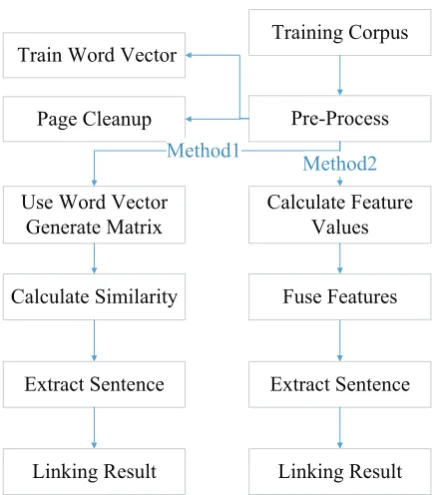
Figure 1: Content linking process
tures. Besides, we also use some traditional fea-tures of sentence similarity which performed well through experiments and explore how to fuse them together with Word Embedding features. For this purpose, first, we try to use every single feature to get one linking sentence, next, we choose the most repetitive sentence as final result via a voting method. Then we mainly use rule-based sentiment analysis to obtain the sentiment label. LDA (La-tent Dirichlet Allocation) (Blei et al., 2003) topic model and K-means (Hartigan and Wong, 1979) are integrated to obtain the argument label.
3.1 Content Linking
Figure 1 shows the process for content linking.
3.1.1 Pre-Processing
We crawl 1.5G data from the English Guardian website to train word vectors for English, and about 1G data from Wikipedia for Italian. Then we use the tool named word2vec (Mikolov et al., 2013) for training.
3.1.2 Method 1-Word Vector Algorithm
After the training of word embedding models, a sentence in the corpus can be expressed as:
Wt= (wt, wt+1,· · ·, wt+k) (1)
Wherewtis the word vector of 300 dimensions
of word t. Then two sentences Wi and Wj can
form a calculating matrixMi,j:
Mi,j =WiWjT =
wtwv · · · wtwv+l
... ... ...
wt+kwv · · · wt+kwv+l
(2) Before the computation of (wt, wv), we need
some processing steps: stemming as well as stop words and punctuation removing. Besides, it is essential to check relations between word t and word v based on WordNet. If they exist in the hy-ponyms/hypernyms part of each other, they can be seen as the same.
The cosine distance can represent(wt, wv), and
the similarity of sentences i and j is:
Simi,j = P
mp=i,n=jmax(Mm,n)
lengthilengthj (3)
Where maxMm,n is obtained through the
fol-lowing concrete steps. First, find out the maxi-mum of Mi,j, then delete the row and column of
the maximum. Next, find the maximum of the re-maining matrix and remove row and column like the former step. Do the same procedure until the matrix is empty. Finally add up all the maximum values. lengthi is the number of word vectors in
the sentence, andplengthilengthj is used to
re-duce the influence of sentence length.
We think that the maximum value in the ma-trix can represent the most matching word pairs in the two sentences. We just choose the maximum value in each step and delete the word pairs in the matrix for next iteration until the matrix is empty. As a result, we can find out all the best matching word pairs in the two sentences. Hence accumula-tion of word similarities of all these best matching word pairs can represent the similarities of the two sentences.
Based on the above sentence similarities, we can extract those sentences with the highest sim-ilarity to a comment sentence as its linking result.
3.1.3 Method 2-Feature Fusion Algorithm
This algorithm is only for English. We have two kinds of features, one is from lexicons, and the other is from sentence similarities.
Sentence Pair
Generate input File for LDA
Construct Model
Utilize K-means to get cluster of every
sentence pair Get the result
[image:3.595.309.523.64.215.2]label of every sentence pair
Figure 2: Argument label process
through WordNet and word vectors, resulting in a lexicon. For Lexicon 2, we use LDA model to train the news and comments to get a lexicon of 25 latent topics in every file independently. For Lexicon 3, we obtain the co-occurrence degree be-tween words by the word frequency statistics of comment and its linked sentence from the training corpus.
As for sentence similarities, we have word vec-tor similarity, jaccard similarity, idf similarity, res similarity, jcn similarity and path similarity. Word vector similarity is calculated through Method 1. We add up the idf values of the same words be-tween two sentences to represent their idf similar-ity. The last three similarities are from WordNet.
For every feature, we can use it to get a sentence with the highest score. Then among these nine sentences chosen by nine features, we use voting method to choose the most repetitive sentence as the final linking result. When some sentences get the same votes, we choose the first one according to sentence order in the input news and comments.
[image:3.595.74.288.64.179.2]3.2 Argument Label
Figure 2 shows the process for argument label. Given a collection of sentences in the input file, we wish to discover topic distribution of every sen-tence through LDA model. We generate the input file for LDA first. For every sentence, we change it into its bag-of-words model representation, which assumes that the order of words can be neglected. During LDA modeling, we set the topic number to 15 according to the experiments. That is to say, later in K-means clustering, our feature is the 15-dimension vector. We run K-means to cluster all sentences into two categories. For every sen-tence pair, if the two sensen-tences belong to the same category, then we set the label to in favour, else, against.
Sentiment Pair
Construct seed sentiment dictionary
Expand dictionary
Utilize rules to get the label of every sentence
pair
Use machine translation
Use DLDA
Figure 3: Sentiment label process
3.3 Sentiment Label
Figure 3 shows the process for sentiment label. There are three kinds of seed sentiment dic-tionaries discovered from OpinionFinder system (MPQA, http://mpqa.cs.pitt.edu/). One is subjec-tivity lexicon, the other two are called Intensi-fier and Valenceshifters lexicon. IntensiIntensi-fier lexi-con involves words which can improve the senti-ment level. Valenceshifters lexicon involves words which can alter the sentiment label.
The original dictionary is in English. We use machine translation to add Italian vocabularies. With DLDA (Chen et al., 2014), we can get all sentiment weights of words in corpus. At last, the word which is not included in seed has the same polarity with a seed word if their sentiment weight distance can be ignored.
Through DLDA, every word gets a sentiment state. We map the sentiment state to a number of word score as in Table 1. We accumulate word score in a sentence to obtain the sentence score, which is then mapped to the sentiment label as in Table 2.
Sentiment state Word score
Weak neg(only) -1 Strong neg(only) -2 Strong pos(only) 2 Weak pos(only) 1
Neutral 0
Intensifier+weak neg -2 Intensifier+weak pos 2
Table 1: Scoring strategy
[image:3.595.333.500.586.700.2]and the score of current word is less than 0, tence score = sentence score * (-1), or current sen-tence score is less than 0 and current word is in Valenceshifters and the score of current word is more than 0, sentence score strategy is the same. For any other conditions, we simply accumulate the word score.
Sentence final score Label
>0 Positive =0 Neutral
[image:4.595.322.512.58.365.2]<0 Negative
Table 2: Mapping sentence score to sentiment la-bel
4 Experiments 4.1 Content Linking
Threshold is used for extracting sentence. We choose the sentence as linking result only when the score (for Method 1) or the vote (for Method 2) is bigger than the threshold.
Thres Linking Thres Linking
hold Precision hold Precision
[image:4.595.103.260.167.222.2]0 77.9 0.5 81.9 0.1 78.2 0.6 80.6 0.2 80.8 0.7 84.2 0.3 80.6 0.8 87.0 0.4 80.8 0.9 87.8
[image:4.595.87.277.386.485.2]Table 3: The performance of Method 1
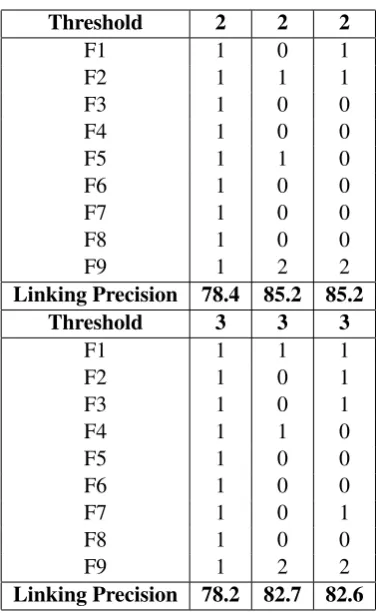
Table 3 and Table 4 show the performance of Method 1 and Method 2 in our experiments re-spectively. The first and third rows in Table 4 are the threshold. F1 to F9 refer to 9 features respec-tively (word vector, jaccard, idf, res, jcn, path, lex-icon 2, lexlex-icon 1 and lexlex-icon 3) and the number means the vote for corresponding feature.
From Table 3, we can find out that, for Method 1, the bigger threshold usually can bring the higher precision. But the sentences we obtain may be fewer, too. This will cause low recall rate. Ac-cording to the precision evaluation method used by MultiLing 2015, precision of 86 is high. Thus we can have good precision here. For Method 2 in Table 4, although its precision is a little lower than that of Method 1, it can also achieve good result. Lexicon 3 shows its good performance, other features like jaccard and idf perform well,
Threshold 2 2 2
F1 1 0 1
F2 1 1 1
F3 1 0 0
F4 1 0 0
F5 1 1 0
F6 1 0 0
F7 1 0 0
F8 1 0 0
F9 1 2 2
Linking Precision 78.4 85.2 85.2
Threshold 3 3 3
F1 1 1 1
F2 1 0 1
F3 1 0 1
F4 1 1 0
F5 1 0 0
F6 1 0 0
F7 1 0 1
F8 1 0 0
F9 1 2 2
Linking Precision 78.2 82.7 82.6
Table 4: The performance of Method 2
too. Hence, how to combine them is important for us in the future. Besides, the linking precision of Italian is 10.1 with the threshold of 0.6 as shown in Table 5.
Thres Linking Thres Linking
hold Precision hold Precision
0.3 8.14 0.5 8.8 0.4 8.25 0.6 10.1
Table 5: The performance for Italian
4.2 Argument and Sentiment Label
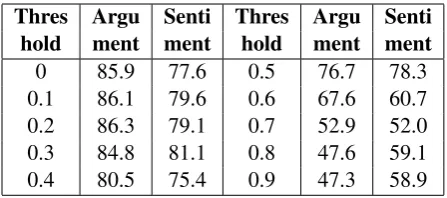
[image:4.595.321.510.480.540.2]Thres Argu Senti Thres Argu Senti
hold ment ment hold ment ment
[image:5.595.71.295.62.161.2]0 85.9 77.6 0.5 76.7 78.3 0.1 86.1 79.6 0.6 67.6 60.7 0.2 86.3 79.1 0.7 52.9 52.0 0.3 84.8 81.1 0.8 47.6 59.1 0.4 80.5 75.4 0.9 47.3 58.9
Table 6: The performance of Labeling
5 Conclusion
For content linking, our system has tried to mine both syntactic and semantic information, and the performances are good. For argument and senti-ment labeling, we focus on machine learning algo-rithm and sentiment dictionaries. And there is still space for us to improve. Our future work is to find some better ways to mine and use more semantic features for both content linking and labeling.
Acknowledgments
This work was supported by the National Nat-ural Science Foundation of China under Grant 91546121, 71231002 and 61202247; National So-cial Science Foundation of China under Grant 16ZDA055; EU FP7 IRSES MobileCloud Project 612212; the 111 Project of China under Grant B08004; Engineering Research Center of Infor-mation Networks, Ministry of Education; the project of Beijing Institute of Science and Tech-nology Information; the project of CapInfo Com-pany Limited.
References
Peeyush Aggarwal and Richa Sharma. 2016. Lexical and syntactic cues to identify reference scope of ci-tance. InBIRNDL@ JCDL, pages 103–112. Ahmet Aker, Fabio Celli, Adam Funk, Emina
Kur-tic, Mark Hepple, and Rob Gaizauskas. 2015. Sheffield-trento system for sentiment and argument structure enhanced comment-to-article linking in the online news domain.
David M Blei, Andrew Y Ng, and Michael I Jordan. 2003. Latent dirichlet allocation. Journal of Ma-chine Learning Research, 3:993–1022.
Ziqiang Cao, Wenjie Li, and Dapeng Wu. 2016. Polyu at cl-scisumm 2016. In BIRNDL@ JCDL, pages 132–138.
Xue Chen, Wenqing Tang, Hao Xu, and Xiaofeng Hu. 2014. Double lda: A sentiment analysis model
based on topic model. InInternational Conference on Semantics, Knowledge and Grids, pages 49–56. J. A. Hartigan and M. A. Wong. 1979. Algorithm
as 136: A k-means clustering algorithm. Applied Statistics, 28(1):100–108.
Alexandra Balahur Hristo Tanev. 2015. Tackling the onforums challenge.
Kokil Jaidka, Muthu Kumar Chandrasekaran, Sajal Rustagi, and Min-Yen Kan. 2016. Overview of the cl-scisumm 2016 shared task. InBIRNDL@ JCDL, pages 93–102.
Mijail Kabadjov, Josef Steinberger, Emma Barker, Udo Kruschwitz, and Massimo Poesio. 2015. Onforums: The shared task on online forum summarisation at multiling’15. In Forum for Information Retrieval Evaluation, pages 21–26.
Stefan Klampfl, Andi Rexha, and Roman Kern. 2016. Identifying referenced text in scientific publications by summarisation and classification techniques. In BIRNDL@ JCDL, pages 122–131.
Lei Li, Liyuan Mao, Yazhao Zhang, Junqi Chi, Tai-wen Huang, Xiaoyue Cong, and Heng Peng. 2016. Cist system for cl-scisumm 2016 shared task. In BIRNDL@ JCDL, pages 156–167.
Kun Lu, Jin Mao, Gang Li, and Jian Xu. 2016. Rec-ognizing reference spans and classifying their dis-course facets. InBIRNDL@ JCDL, pages 139–145. Bruno Malenfant and Guy Lapalme. 2016. Rali sys-tem description for cl-scisumm 2016 shared task. In BIRNDL@ JCDL, pages 146–155.
Diana Maynard and Adam Funk. 2011. Automatic de-tection of political opinions in tweets. InExtended Semantic Web Conference, pages 88–99. Springer. Tomas Mikolov, Kai Chen, Greg Corrado, and Jeffrey
Dean. 2013. Efficient estimation of word represen-tations in vector space.Computer Science.
Luis Moraes, Shahryar Baki, Rakesh Verma, and Daniel Lee. 2016. University of houston at cl-scisumm 2016: Svms with tree kernels and sentence similarity. InBIRNDL@ JCDL, pages 113–121. Tadashi Nomoto. 2016. Neal: A neurally enhanced
approach to linking citation and reference. In BIRNDL@ JCDL, pages 168–174.