Learning to Identify Arabic and German Dialects using Multiple Kernels
Radu Tudor Ionescu and Andrei M. Butnaru
University of Bucharest Department of Computer Science 14 Academiei, Bucharest, Romania [email protected] [email protected]
Abstract
We present a machine learning approach for the Arabic Dialect Identification (ADI) and the German Dialect Identification (GDI) Closed Shared Tasks of the DSL 2017 Challenge. The proposed approach combines several kernels using multiple kernel learning. While most of our ker-nels are based on characterp-grams (also known asn-grams) extracted from speech transcripts, we also use a kernel based on i-vectors, a low-dimensional represen-tation of audio recordings, provided only for the Arabic data. In the learning stage, we independently employ Kernel Discrim-inant Analysis (KDA) and Kernel Ridge Regression (KRR). Our approach is shal-low and simple, but the empirical results obtained in the shared tasks prove that it achieves very good results. Indeed, we ranked on the first place in the ADI Shared Task with a weightedF1score of76.32%
(4.62%above the second place) and on the fifth place in the GDI Shared Task with a weightedF1 score of 63.67%(2.57%
be-low the first place).
1 Introduction
The recent 2016 Challenge on Discriminating be-tween Similar Languages (DSL) (Malmasi et al., 2016) shows that dialect identification is a chal-lenging NLP task, actively studied by researchers in nowadays. For example, a state-of-the-art Ara-bic dialect identification system achieves just over
50%(Ionescu and Popescu, 2016b; Malmasi and Zampieri, 2016), in a 5-way classification setting. In this context, we present a method based on learning with multiple kernels, that we designed for the Arabic Dialect Identification (ADI) and
the German Dialect Identification (GDI) Shared Tasks of the DSL 2017 Challenge (Zampieri et al., 2017). In the ADI Shared Task, the partici-pants had to discriminate between Modern Stan-dard Arabic (MSA) and four Arabic dialects, in a 5-way classification setting. A number of6teams have submitted their results on the test set, and our team (UnibucKernel) ranked on the first place with an accuracy of76.27% and a weightedF1 score
of 76.32%. In the GDI Shared Task, the partic-ipants had to discriminate between four German dialects, in a 4-way classification setting. A num-ber of10 teams have submitted their results, and our team ranked on the fifth place with an accuracy of66.36%and a weightedF1 score of63.67%.
Our best scoring system in both shared tasks combines several kernels using multiple kernel learning. The first kernel that we considered is the p-grams presence bits kernel1, which takes into ac-count only the presence ofp-grams instead of their frequency. The second kernel is the (histogram) intersection string kernel2, which was first used in a text mining task by Ionescu et al. (2014). The third kernel is derrived from Local Rank Distance (LRD)3, a distance measure that was first intro-duced in computational biology (Ionescu, 2013; Dinu et al., 2014), but it has also shown its ap-plication in NLP (Popescu and Ionescu, 2013; Ionescu, 2015). All these string kernels have been previously used for Arabic dialect identi-fication by Ionescu and Popescu (2016b), and they obtained very good results, taking the sec-ond place in the ADI Shared Task of the DSL 2016 Challenge (Malmasi et al., 2016). While
1We computed thep-grams presence bits kernel using the code available at http://string-kernels.herokuapp.com.
2We computed the intersection string kernel using the code available at http://string-kernels.herokuapp.com.
3We computed the Local Rank Distance using the code available at http://lrd.herokuapp.com.
three of our kernels are based on characterp-grams from speech transcrips, we also use an RBF ker-nel (Shawe-Taylor and Cristianini, 2004) based on i-vectors (Ali et al., 2016), a low-dimensional rep-resentation of audio recordings, available only for the Arabic data. To the best of our knowledge, none of the string kernels have been previously combined with a kernel based on i-vectors or used for German dialect identification.
We considered two kernel classifiers (Shawe-Taylor and Cristianini, 2004) for the learning task, namely Kernel Ridge Regression (KRR) and Ker-nel Discriminant Analysis (KDA). In a set of pre-liminary experiments performed on the GDI train-ing set, we found that KDA gives slightly better results than KRR. On the other hand, KRR seems to yield a better performance on the ADI training and development sets. In the end, we decided to submit results using both classifiers. However, our best scoring system in both shared tasks employs Kernel Ridge Regression (KRR) in the learning stage. Before submitting our results, we have also tuned our string kernels for the task. First of all, we tried outp-grams of various lengths, including blended variants of string kernels as well. Second of all, we have evaluated the individual kernels and various kernel combinations. The empirical results indicate that combining kernels can help to improve the accuracy by at least 1%. When we added the kernel base on i-vectors into the mix, we found that it can further improve the perfor-mance, by nearly5%. All these choices played a significant role in obtaining the first place in the final ranking of the ADI Shared Task.
The paper is organized as follows. Work related to Arabic and German dialect identification and to methods based on string kernels is presented in Section 2. Section 3 presents the kernels that we used in our approach. The learning methods used in the experiments are described in Section 4. De-tails about the experiments on Arabic and German dialect identification are provided in Sections 5 and 6, respectively. Finally, we draw our conclu-sion in Section 7.
2 Related Work
2.1 Arabic Dialect Identification
Arabic dialect identification is a relatively new NLP task with only a handful of works to ad-dress it (Biadsy et al., 2009; Zaidan and Callison-Burch, 2011; Elfardy and Diab, 2013; Darwish et
the original audio files and some low-level au-dio features, called i-vectors, along with the ASR transcripts of Arabic speech collected from the Broadcast News domain. Our experiments indi-cate that the audio features produce a much bet-ter performance, probably because there are many ASR errors (perhaps more in the dialectal speech segments) that make Arabic dialect identification from ASR transcripts much more difficult.
2.2 German Dialect Identification
German dialect identification is even less stud-ied than Arabic dialect identification. Scherrer and Rambow (2010) describe a system for writ-ten dialect identification based on an automati-cally generated Swiss German lexicon that asso-ciates word forms with their geographical exten-sions. At test time, they split a sentence into words and look up their geographical extensions in the lexicon. Hollenstein and Aepli (2015) present a Swiss German dialect identification system based on character trigrams. They train a trigram lan-guage model for each dialect and score each test sentence against every model. The predicted di-alect is chosen based on the lowest perplexity. Al-though Samardzic et al. (2016) present a corpus that can be used for GDI, they do not deal with this task in their paper. Nonetheless, their corpus was used to evaluate the participants in the GDI Shared Task of the DSL 2017 Challenge.
2.3 String Kernels
In recent years, methods of handling text at the character level have demonstrated impres-sive performance levels in various text analysis tasks (Lodhi et al., 2002; Sanderson and Guenter, 2006; Kate and Mooney, 2006; Grozea et al., 2009; Popescu, 2011; Escalante et al., 2011; Popescu and Grozea, 2012; Ionescu et al., 2014; Ionescu et al., 2016). String kernels are a com-mon form of using information at the character level. They are a particular case of the more gen-eral convolution kernels (Haussler, 1999). Lodhi et al. (2002) used string kernels for document cat-egorization with very good results. String kernels were also successfully used in authorship identi-fication (Sanderson and Guenter, 2006; Popescu and Grozea, 2012). For example, the system de-scribed by Popescu and Grozea (2012) ranked first in most problems and overall in the PAN 2012 Traditional Authorship Attribution tasks. More recently, various blended string kernels reached
state-of-the-art accuracy rates for native language identification (Ionescu et al., 2016) and Arabic di-alect identification (Ionescu and Popescu, 2016b).
3 Kernels for Dialect Identification
3.1 String Kernels
The kernel function captures the intuitive notion of similarity between objects in a specific domain and can be any function defined on the respec-tive domain that is symmetric and posirespec-tive definite. For strings, many such kernel functions exist with various applications in computational biology and computational linguistics (Shawe-Taylor and Cris-tianini, 2004). String kernels embed the texts in a very large feature space, given by all the substrings of lengthp, and leave it to the learning algorithm to select important features for the specific task, by highly weighting these features.
Perhaps one of the most natural ways to mea-sure the similarity of two strings is to count how many substrings of length p the two strings have in common. This gives rise to thep-spectrum ker-nel. Formally, for two strings over an alphabetΣ, s, t∈Σ∗, thep-spectrum kernel is defined as:
kp(s, t) = X
v∈Σp
numv(s)·numv(t),
where numv(s) is the number of occurrences of string v as a substring in s.4 The feature map defined by this kernel associates to each string a vector of dimension|Σ|pcontaining the histogram of frequencies of all its substrings of lengthp(p -grams). A variant of this kernel can be obtained if the embedding feature map is modified to as-sociate to each string a vector of dimension|Σ|p containing the presence bits (instead of frequen-cies) of all its substrings of length p. Thus, the characterp-grams presence bits kernel is obtained:
k0/1
p (s, t) = X
v∈Σp
inv(s)·inv(t),
where inv(s)is1if stringvoccurs as a substring ins, and0otherwise.
In computer vision, the (histogram) intersec-tion kernel has successfully been used for ob-ject class recognition from images (Maji et al., 2008; Vedaldi and Zisserman, 2010). Ionescu et
al. (2014) have used the intersection kernel as a kernel for strings. The intersection string kernel is defined as follows:
k∩
p(s, t) = X
v∈Σp
min{numv(s),numv(t)},
where numv(s) is the number of occurrences of stringvas a substring ins.
For thep-spectrum kernel, the frequency of ap -gram has a very significant contribution to the ker-nel, since it considers the product of such frequen-cies. On the other hand, the frequency of ap-gram is completely disregarded in thep-grams presence bits kernel. The intersection kernel lies some-where in the middle between thep-grams presence bits kernel andp-spectrum kernel, in the sense that the frequency of ap-gram has a moderate contri-bution to the intersection kernel. In other words, the intersection kernel assigns a high score to ap -gram only if it has a high frequency in both strings, since it considers the minimum of the two frequen-cies. The p-spectrum kernel assigns a high score even when thep-gram has a high frequency in only one of the two strings. Thus, the intersection ker-nel captures something more about the correlation between thep-gram frequencies in the two strings. Based on these comments, we decided to use only thep-grams presence bits kernel and the intersec-tion string kernel for ADI and GDI.
Data normalization helps to improve machine learning performance for various applications. Since the value range of raw data can have large variation, classifier objective functions will not work properly without normalization. After nor-malization, each feature has an approximately equal contribution to the similarity between two samples. To obtain a normalized kernel matrix of pairwise similarities between samples, each com-ponent is divided by the square root of the product of the two corresponding diagonal components:
ˆ
Kij = p Kij Kii·Kjj.
To ensure a fair comparison of strings of differ-ent lengths, normalized versions of the p-grams presence bits kernel and the intersection kernel are being used. Taking into account p-grams of different lengths and summing up the correspond-ing kernels, new kernels, termedblended spectrum kernels, can be obtained. We have used various blended spectrum kernels in the experiments in or-der to find the best combination.
3.2 Kernel based on Local Rank Distance
Local Rank Distance (Ionescu, 2013) is a re-cently introduced distance that measures the non-alingment score between two strings. It has al-ready shown promising results in computational biology (Ionescu, 2013; Dinu et al., 2014) and na-tive language identification (Popescu and Ionescu, 2013; Ionescu, 2015).
In order to describe LRD, we use the following notations. Given a stringxover an alphabetΣ, the length ofx is denoted by|x|. Strings are consid-ered to be indexed starting from position 1, that isx = x[1]x[2]· · ·x[|x|]. Moreover, x[i : j] de-notes its substringx[i]x[i+ 1]· · ·x[j−1]. Given a fixed integer p ≥ 1, a threshold m ≥ 1, and two strings xandy overΣ, theLocal Rank Dis-tance betweenxandy, denoted by ∆LRD(x, y), is defined through the following algorithmic pro-cess. For each positioniinx(1≤i≤ |x|−p+1), the algorithm searches for that positionjiny(1≤
j≤ |y|−p+1) such thatx[i:i+p] =y[j :j+p]
and|i−j|is minimized. Ifjexists and|i−j|< m, then the offset|i−j|is added to the Local Rank Distance. Otherwise, the maximal offset m is added to the Local Rank Distance. LRD is focused on the local phenomenon, and tries to pair identi-calp-grams at a minimum offset. To ensure that LRD is a (symmetric) distance function, the algo-rithm also has to sum up the offsets obtained from the above process by exchanging x andy. LRD is formally defined in (Ionescu, 2013; Dinu et al., 2014; Ionescu and Popescu, 2016a).
The search for matching p-grams is limited within a window of fixed size. The size of this window is determined by the maximum offset pa-rameter m. We set m = 300 in our experi-ments, which is larger than the maximum length of the transcripts provided in both training sets. In the experiments, the efficient algorithm of Ionescu (2015) is used to compute LRD. However, LRD needs to be used as a kernel function. We use the RBF kernel (Shawe-Taylor and Cristianini, 2004) to transform LRD into a similarity measure:
ˆ kLRD
p (s, t) =exp
−∆LRD(s, t)
2σ2
,
in the[0,1]interval to ensure a fair comparison of strings of different length. The resulted similarity matrix is then squared to ensure that it becomes a symmetric and positive definite kernel matrix.
3.3 Kernel based on Audio Features
For the ADI Shared Task, we also build a kernel from the i-vectors provided with the data set (Ali et al., 2016). The i-vector approach is a power-ful speech modeling technique that comprises all the updates happening during the adaptation of a Gaussian mixture model (GMM) mean compo-nents to a given utterance. The provided i-vectors have 400 dimensions. In order to build a kernel from the i-vectors, we first compute the euclidean distance between each pair of i-vectors. We then employ the RBF kernel to transform the distance into a similarity measure:
ˆ
ki-vec(x, y) = exp
− v u u tXj=1
m
(xj−yj)2
2σ2
,
wherexandyare two i-vectors andmrepresents the size of the two i-vectors,400in our case. For optimal results, we have tuned the parameterσ in a set of preliminary experiments. As for the LRD kernel, the similarity matrix is squared to ensure its symmetry and positive definiteness.
4 Learning Methods
Kernel-based learning algorithms work by embed-ding the data into a Hilbert feature space and by searching for linear relations in that space. The embedding is performed implicitly, by specify-ing the inner product between each pair of points rather than by giving their coordinates explicitly. More precisely, a kernel matrix that contains the pairwise similarities between every pair of train-ing samples is used in the learntrain-ing stage to assign a vector of weights to the training samples. Let αdenote this weight vector. In the test stage, the pairwise similarities between a test samplex and all the training samples are computed. Then, the following binary classification function assigns a positive or a negative label to the test sample:
g(x) =Xn
i=1
αi·k(x, xi),
where x is the test sample, n is the number of training samples, X = {x1, x2, ..., xn} is the set of training samples,kis a kernel function, andαi is the weight assigned to the training samplexi.
The advantage of using the dual representation induced by the kernel function becomes clear if the dimension of the feature spacemis taken into consideration. Since string kernels are based on characterp-grams, the feature space is indeed very high. For instance, using 5-grams based only on the28letters of the basic Arabic alphabet will re-sult in a feature space of285 = 17,210,368
fea-tures. However, our best models are based on a feature space that includes 3-grams, 4-grams, 5 -grams,6-grams and7-grams. As long as the num-ber of samples n is much lower than the num-ber of featuresm, it can be more efficient to use the dual representation given by the kernel matrix. This fact is also known as thekernel trick (Shawe-Taylor and Cristianini, 2004).
1 2 3 4 5 6 7 8 50
55 60 65 70
The length of p−grams
The 10
−
[image:6.595.76.284.65.191.2]fold CV accuracy rate
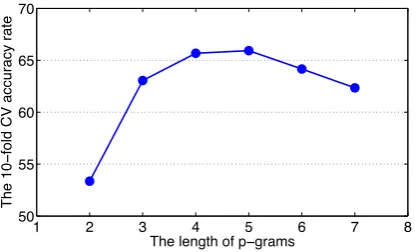
Figure 1: Accuracy rates of the KRR based on the intersection kernel withp-grams in the range
2-7. The results are obtained in a10-fold cross-validation procedure carried out on the ADI train-ing set.
5 Experiments on Arabic Dialects
5.1 Data Set
The ADI Shared Task data set (Ali et al., 2016) contains audio recordings and ASR transcripts of Arabic speech collected from the Broadcast News domain. The task is to discriminate between Modern Standard Arabic (MSA) and four Ara-bic dialects, namely Egyptian (EGY), Gulf (GLF), Levantine (LAV), and North-African or Maghrebi (NOR). As the samples are not very evenly dis-tributed, an accuracy of 23.10%can be obtained with a majority class baseline on the test set. It is worth mentioning that the test set from the 2016 ADI Shared Task was included as a development set in this year’s task.
5.2 Parameter and System Choices
In our approach, we treat ASR transcripts as strings. Because the approach works at the char-acter level, there is no need to split the texts into words, or to do any NLP-specific processing be-fore computing the string kernels. The only edit-ing done to the transcripts was the replacedit-ing of sequences of consecutive space characters (space, tab, and so on) with a single space character. This normalization was needed in order to prevent the artificial increase or decrease of the similarity be-tween texts, as a result of different spacing.
For tuning the parameters, we fixed10folds in order to evaluate each option in a 10-fold cross-validation (CV) procedure on the training set. We first carried out a set of preliminary experiments to determine the optimal range ofp-grams for each kernel using the10-fold CV procedure. We fixed the learning method to KRR based on the
inter-section kernel and we evaluated all thep-grams in the range 2-7. The results are illustrated in Fig-ure 1. Interestingly, the best accuracy (65.93%) is obtained with 5-grams. Furthermore, experi-ments with different blended kernels were con-ducted to see whether combiningp-grams of dif-ferent lengths could improve the accuracy. More precisely, we evaluated combinations of p-grams in five ranges: 3-5, 3-6, 4-6, 4-7 and 3-7. For the intersection kernel and the LRD kernel, the best accuracy rates were obtained when all thep -grams with the length in the range3-7were com-bined. For the presence bits kernel, we obtained better results withp-grams in the range3-5. Fur-ther experiments were also conducted to estab-lish what type of kernel works better, namely the blendedp-grams presence bits kernel (ˆk03/−15), the blended p-grams intersection kernel (ˆk∩
3−7), the
kernel based on LRD (ˆkLRD
3−7 ), or the kernel based
on i-vectors (kˆi-vec). Since these different kernel
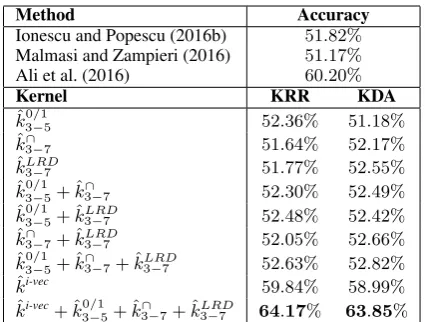
representations are obtained either from ASR tran-scripts or from low-level audio features, a good approach for improving the performance is com-bining the kernels. When multiple kernels are combined, the features are actually embedded in a higher-dimensional space. As a consequence, the search space of linear patterns grows, which helps the classifier to select a better discriminant function. The most natural way of combining two or more kernels is to sum them up. Summing up kernels or kernel matrices is equivalent to feature vector concatenation. The kernels were evaluated alone and in various combinations, by employing either KRR or KDA for the learning task. This time, we used the development set to evaluate the kernel combinations and compare them with the top two systems from the last year’s ADI Shared Task (Ionescu and Popescu, 2016b; Malmasi and Zampieri, 2016) and the state-of-the-art system of Ali et al. (2016). All the results obtained on the development set are given in Table 1.
The empirical results presented in Table 1 re-veal several interesting patterns of the proposed methods. The difference in terms of accuracy be-tween KRR and KDA is almost always less than
Method Accuracy
Ionescu and Popescu (2016b) 51.82%
Malmasi and Zampieri (2016) 51.17%
Ali et al. (2016) 60.20%
Kernel KRR KDA
ˆ
k0/1
3−5 52.36% 51.18%
ˆ
k∩
3−7 51.64% 52.17%
ˆ
kLRD
3−7 51.77% 52.55%
ˆ
k0/1
3−5+ ˆk∩3−7 52.30% 52.49%
ˆ
k0/1
3−5+ ˆkLRD3−7 52.48% 52.42%
ˆ
k∩
3−7+ ˆkLRD3−7 52.05% 52.66%
ˆ
k30/−15+ ˆk∩
3−7+ ˆk3LRD−7 52.63% 52.82%
ˆ
ki-vec 59.84% 58.99%
ˆ
ki-vec+ ˆk0/1
3−5+ ˆk3∩−7+ ˆkLRD3−7 64.17% 63.85%
Table 1: Accuracy rates of various kernels com-bined with either KRR or KDA versus several state-of-the-art methods. The results are obtained on the ADI development set. The submitted sys-tems are highlighted in bold.
Run Accuracy F1(macro) F1(weighted)
1 76.27% 76.40% 76.32%
2 75.54% 75.94% 75.81%
Table 2: Results on the test set of the ADI Shared Task (closed training) of KRR (run 1) and KDA (run 2) based on a combination of three string ker-nels and a kernel based on i-vectors.
when it is combined with KRR, and an accuracy of 58.99% when it is combined with KDA. By contrast, the best individual string kernel yields an accuracy of52.55%. Thus, we may conclude that the i-vector representation extracted from au-dio recordings is much more suitable for the task than the character p-grams extracted from ASR transcripts. This is consistent with the findings of Ali et al. (2016). Interestingly, the best accu-racy is actually obtained when all four kernels are combined together. Indeed, KRR reaches an ac-curacy of64.17%when the blendedp-grams pres-ence bits kernel, the blended intersection kernel, the blended LRD kernel and the kernel based on i-vectors are summed up. With the same kernel combination, KDA yields an accuracy of63.85%. In the end, we decided to submit two models for the test set. The first submission (run 1) is the KRR classifier based on the sum of ˆki-vec, kˆ0/1
3−5, ˆ
k∩
3−7, andkˆLRD3−7 . The second submission (run 2)
is the KDA classifier based on the sum of the same four kernels. For a better generalization, the sub-mitted models are trained on both the provided training and development sets.
Dialects EGY GLF LAV NOR MSA
EGY 244 12 29 6 11
GLF 14 177 43 8 8
LAV 36 26 231 23 18
NOR 10 13 10 222 7
[image:7.595.75.289.60.221.2]MSA 24 16 31 9 264
Table 3: Confusion matrix (on the test set) of KRR based on the sum of three string kernels and a ker-nel based on i-vectors (run 1).
5.3 Results
Table 2 presents our results for the Arabic Di-alect Identification Closed Shared Task of the DSL 2017 Challenge. Among the two classifiers, the best performance is obtained by KRR (run 1). The submitted systems were ranked by their weighted F1 score, and among the 6 participants, our best
model obtained the first place with a weightedF1
score of76.32%. As the development and the test sets are from the same source (distribution), we obtained better performance on the test set by in-cluding the development set in the training. The confusion matrix for our best model is presented in Table 3. The confusion matrix reveals that our system has some difficulties in distinguishing the Levantine dialect from the Egyptian dialect on one hand, and the Levantine dialect from the Gulf di-alect on the other hand. Overall, the results look good, as the main diagonal scores dominate the other matrix components. Remarkably, both of our submitted systems are more than 4% better than the system ranked on the second place.
6 Experiments on German Dialects
6.1 Data Set
The GDI Shared Task data set (Samardzic et al., 2016) contains manually annotated transcripts of Swiss German speech. The task is to discriminate between Swiss German dialects from four differ-ent areas: Basel (BS), Bern (BE), Lucerne (LU), Zurich (ZH). As the samples are almost evenly dis-tributed, an accuracy of 25.80%can be obtained with a majority class baseline on the test set.
6.2 Parameter and System Choices
[image:7.595.313.519.61.124.2]prelim-1 2 3 4 5 6 7 74
76 78 80 82 84
The length of p−grams
The 10
−
[image:8.595.75.284.61.187.2]fold CV accuracy rate
Figure 2: Accuracy rates of the KRR based on the intersection kernel withp-grams in the range2-6. The results are obtained in a5-fold CV procedure carried out on the GDI training set.
Kernel KRR KDA
ˆ
k03/−16 83.99% 84.10%
ˆ
k∩
3−6 83.96% 84.09%
ˆ
kLRD
3−5 83.85% 84.25%
ˆ
k03/−16+ ˆk∩3−6 84.03% 84.15%
ˆ
k03/−16+ ˆkLRD3−5 84.25% 84.33%
ˆ
k∩
3−6+ ˆkLRD3−5 84.22% 84.35%
ˆ
k0/1
3−6+ ˆk∩3−6+ ˆk3LRD−5 84.39% 84.49%
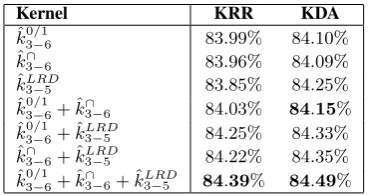
Table 4: Accuracy rates of various kernels com-bined with either KRR or KDA. The results are obtained using5-fold CV on the GDI training set. The submitted systems are highlighted in bold.
inary experiments to determine the optimal range ofp-grams for each kernel. We fixed the learning method to KRR based on the intersection kernel and we evaluated all thep-grams in the range2-6. The results are illustrated in Figure 2. We obtained the best accuracy (82.87%) by using4-grams. We next evaluated combinations of p-grams in three ranges: 3-5,3-6,4-6. For the intersection and the presence bits kernels, the best accuracy rates were obtained when all the p-grams with the length in the range3-6 were combined. For the LRD ker-nel, we obtained better results with p-grams in the range3-5. Further experiments were also per-formed to establish what type of kernel works bet-ter, namely the blendedp-grams presence bits ker-nel, the blendedp-grams intersection kernel or the kernel based on LRD. The kernels were evaluated alone and in various combinations, by employing either KRR or KDA for the learning task. All the results obtained in the 5-fold CV carried out on the training set are given in Table 4. As in the ADI experiments, the empirical results presented in Table 4 show that there are no significant dif-ferences between KRR and KDA. The individual kernels yield fairly similar results. The best
in-Run Accuracy F1(macro) F1(weighted)
1 66.36% 63.76% 63.67%
2 65.81% 63.63% 63.54%
3 65.64% 63.44% 63.36%
Table 5: Results on the test set of the GDI Shared Task (closed training) of KRR (run 1) and KDA (run 2 and 3) based on various combinations of string kernels.
[image:8.595.313.516.62.105.2]Dialects BE BS LU ZH BE 662 53 19 172 BS 76 676 38 149 LU 185 260 249 222 ZH 14 29 7 827
Table 6: Confusion matrix (on the test set) of KRR based on the sum of three string kernels (run 1).
dividual kernel is the kernel based on LRD with an accuracy of84.25%when it is combined with KDA. Each and every kernel combination yields better results than each of its individual compo-nents alone. The best accuracy rates,84.39%for KRR and 84.49% for KDA, are indeed obtained when all three kernels are combined together. In the end, we submitted the following models. The first submission (run 1) is the KRR based on the three kernels sum. Our second submission (run 2) is the KDA based on the sum of ˆk30/−16 andkˆ∩
3−6.
Our third submission (run 3) is the KDA based on the combination of all three kernels.
6.3 Results
Table 5 presents our results for the German Di-alect Identification Closed Shared Task of the DSL 2017 Challenge. Among the three systems, the best performance is obtained by KRR (run 1). Among the 10 participants, our best model ob-tained the fifth place with a weightedF1 score of 63.67%. However, our best performance is only
2.57%below the performance achieved by the sys-tem ranked on the first place. The confusion ma-trix presented in Table 6 indicates that our model is hardly able to distinguish the Lucerne dialect from the others.
7 Conclusion
[image:8.595.343.489.174.227.2] [image:8.595.89.275.257.355.2]References
Ahmed Ali, Najim Dehak, Patrick Cardinal, Sameer Khurana, Sree Harsha Yella, James Glass, Peter Bell, and Steve Renals. 2016. Automatic dialect detection in arabic broadcast speech. Proceedings of Interspeech, pages 2934–2938.
Fadi Biadsy, Julia Hirschberg, and Nizar Habash. 2009. Spoken Arabic Dialect Identification Using Phonotactic Modeling. Proceedings of the EACL 2009 Workshop on Computational Approaches to Semitic Languages, pages 53–61.
Houda Bouamor, Nizar Habash, and Kemal Oflazer. 2014. A Multidialectal Parallel Corpus of Arabic.
Proceedings of LREC, pages 1240–1245, may.
Kareem Darwish, Hassan Sajjad, and Hamdy Mubarak. 2014. Verifiably Effective Arabic Dialect Identifica-tion. Proceedings of EMNLP, pages 1465–1468.
Liviu P. Dinu, Radu Tudor Ionescu, and Alexandru I. Tomescu. 2014. A rank-based sequence aligner with applications in phylogenetic analysis. PLoS ONE, 9(8):e104006, 08.
Heba Elfardy and Mona T. Diab. 2013. Sentence Level Dialect Identification in Arabic. Proceedings of ACL, pages 456–461.
Hugo Jair Escalante, Thamar Solorio, and Manuel Montes-y-G´omez. 2011. Local histograms of char-acter n-grams for authorship attribution. Proceed-ings of ACL: HLT, 1:288–298.
Cristian Grozea, Christian Gehl, and Marius Popescu. 2009. ENCOPLOT: Pairwise Sequence Matching in Linear Time Applied to Plagiarism Detection. Pro-ceedings of 3rd PAN WORKSHOP, page 10.
Trevor Hastie and Robert Tibshirani. 2003. The El-ements of Statistical Learning. Springer, corrected edition, July.
David Haussler. 1999. Convolution Kernels on Dis-crete Structures. Technical Report UCS-CRL-99-10, University of California at Santa Cruz, Santa Cruz, CA, USA.
Nora Hollenstein and No¨emi Aepli. 2015. A Resource for Natural Language Processing of Swiss German Dialects.Proceedings of GSCL, pages 108–109.
Radu Tudor Ionescu and Marius Popescu. 2016a.
Knowledge Transfer between Computer Vision and Text Mining. Advances in Computer Vision and Pat-tern Recognition. Springer InPat-ternational Publishing.
Radu Tudor Ionescu and Marius Popescu. 2016b. UnibucKernel: An Approach for Arabic Dialect Identification based on Multiple String Kernels.
Proceedings of VarDial Workshop of COLING, pages 135–144.
Radu Tudor Ionescu, Marius Popescu, and Aoife Cahill. 2014. Can characters reveal your native lan-guage? A language-independent approach to native language identification. Proceedings of EMNLP, pages 1363–1373, October.
Radu Tudor Ionescu, Marius Popescu, and Aoife Cahill. 2016. String kernels for native language identification: Insights from behind the curtains.
Computational Linguistics, 42(3):491–525.
Radu Tudor Ionescu. 2013. Local Rank Distance.
Proceedings of SYNASC, pages 221–228.
Radu Tudor Ionescu. 2015. A Fast Algorithm for Local Rank Distance: Application to Arabic Native Language Identification. Proceedings of ICONIP, 9490:390–400.
Rohit J. Kate and Raymond J. Mooney. 2006. Using String-kernels for Learning Semantic Parsers. Pro-ceedings of ACL, pages 913–920.
Huma Lodhi, Craig Saunders, John Shawe-Taylor, Nello Cristianini, and Christopher J. C. H. Watkins. 2002. Text Classification using String Kernels.
Journal of Machine Learning Research, 2:419–444.
Subhransu Maji, Alexander C. Berg, and Jitendra Ma-lik. 2008. Classification using intersection kernel support vector machines is efficient. Proceedings of CVPR.
Shervin Malmasi and Marcos Zampieri. 2016. Arabic Dialect Identification in Speech Transcripts. Pro-ceedings of VarDial Workshop of COLING, pages 106–113.
Shervin Malmasi, Eshrag Refaee, and Mark Dras. 2015. Arabic Dialect Identification using a Parallel Multidialectal Corpus. Proceedings of PACLING, pages 209–217, May.
Shervin Malmasi, Marcos Zampieri, Nikola Ljubeˇsi´c, Preslav Nakov, Ahmed Ali, and J¨org Tiedemann. 2016. Discriminating between similar languages and arabic dialect identification: A report on the third dsl shared task. Proceedings of the 3rd Work-shop on Language Technology for Closely Related Languages, Varieties and Dialects (VarDial).
Marius Popescu and Cristian Grozea. 2012. Ker-nel methods and string kerKer-nels for authorship analy-sis. CLEF (Online Working Notes/Labs/Workshop), September.
Marius Popescu and Radu Tudor Ionescu. 2013. The Story of the Characters, the DNA and the Native Language. Proceedings of the Eighth Workshop on Innovative Use of NLP for Building Educational Ap-plications, pages 270–278, June.
Tanja Samardzic, Yves Scherrer, and Elvira Glaser. 2016. ArchiMob–A corpus of spoken Swiss Ger-man. Proceedings of LREC, pages 4061–4066. Conrad Sanderson and Simon Guenter. 2006. Short
text authorship attribution via sequence kernels, markov chains and author unmasking: An investiga-tion. Proceedings of the 2006 Conference on Em-pirical Methods in Natural Language Processing, pages 482–491, July.
Yves Scherrer and Owen Rambow. 2010. Word-based dialect identification with georeferenced rules. Pro-ceedings of EMNLP, pages 1151–1161.
John Shawe-Taylor and Nello Cristianini. 2004. Ker-nel Methods for Pattern Analysis. Cambridge Uni-versity Press.
Andrea Vedaldi and Andrew Zisserman. 2010. Effi-cient additive kernels via explicit feature maps. Pro-ceedings of CVPR, pages 3539–3546.
Omar F. Zaidan and Chris Callison-Burch. 2011. The Arabic Online Commentary Dataset: An Annotated Dataset of Informal Arabic with High Dialectal Con-tent. Proceedings of ACL: HLT, 2:37–41.
Omar F. Zaidan and Chris Callison-Burch. 2014. Ara-bic dialect identification. Computational Linguis-tics, 40(1):171–202.