Normalizing Medieval German Texts: from rules to deep learning
Natalia Korchagina
Institute of Computational Linguistics University of Zurich
Abstract
The application of NLP tools to histori-cal texts is complicated by a high level of spelling variation. Different methods of historical text normalization have been proposed. In this comparative evaluation I test the following three approaches to text canonicalization on historical German texts from 15th–16thcenturies: rule-based,
statistical machine translation, and neural machine translation. Character based neu-ral machine translation, not being previ-ously tested for the task of normalization, showed the best results.
1 Introduction
Due to an increased interest in Digital Humanities, more and more heritage texts are becoming avail-able in digital format. The ever growing amount of these text collections motivates researchers to use automatic methods for its processing. In many cases, automatic processing of historical corpora is complicated by a high level of spelling varia-tion. Non-standardized orthography, resulting in inconsistent data, is a substantial obstacle to the application of the existing NLP tools. Normaliza-tion of historical texts, i.e., the mapping of histor-ical word forms to their modern equivalents (see Figure 1), has proven to be an effective method of improving the quality of the automatic processing of historical corpora.
SOURCE:Witter sy im nitt zu wissen. NORM.: Weiter sei ihm nicht zu wissen .
Figure 1: Sentence in historical German (SOURCE) and its modernised spelling (NORM.).
Various approaches to text normalization have been proposed. For instance, methods based on
the Levenshtein edit distance algorithm and its variations are widely used for text canonicaliza-tion. Bollmann et al. (2011) described a tech-nique performing automatic Levenshtein-based rule derivation from a word-aligned parallel cor-pus. Pettersson et al. (2013a) presented a different string similarity approach, using context-sensitive, weighted edit distance calculations combined with compound splitting. Another approach, apply-ing character-based statistical machine translation (SMT) is documented in (Pettersson et al., 2013b; Scherrer and Erjavec, 2013; S´anchez-Mart´ınez et al., 2013). Pettersson et al. (2014) conducted a comparative evaluation of the following three normalization approaches: filtering, Levenshtein-based and SMT-Levenshtein-based, to show that the latter generally outperformed the former two methods. Bollmann and Søgaard (2016) reported that a deep neural network architecture improves the normal-ization of historical texts, compared to both base-line using conditional random fields and Norma tool (Bollmann, 2012). Deep learning methods are known to work best with large amounts of data, and yet the authors witnessed an improve-ment with only a few thousand tokens of training material.
For this assessment I tested the following normal-ization methods: edit-based, statistical machine translation, and neural machine translation. The first two approaches were previously tested on German texts from the same period, but the ap-plication of neural MT to text normalization has not yet been documented. Section 2 introduces the data used for the experiments. In Section 3, I will describe the normalization methods. Section 4 will present evaluation results. Finally, in Sec-tion 5 I will summarize the outcome of the com-parative evaluation and give some possible direc-tion for future work.
2 Historical Text Corpora
This study is part of a larger project funded by the Swiss Law Sources Foundation, where I use his-torical legal texts1(i.e., decrees, regulations, court
transcripts) kindly provided by the Foundation as material for my research. Therefore, I am par-ticularly interested in finding the best performing method for normalizing these historical texts. The Collection of the Swiss Law Sources is multilin-gual and contains texts issued on Swiss territory from the early Middle Ages up to 1798. In my re-search project I work with texts written between 1450 and 1550, which corresponds to the Early New High German period. Available in digital format as critical editions of the primary sources (i.e., manuscripts), they do not contain any lin-guistic annotation or normalized forms. For this case study, we manually normalized a subset of the corpus, 2500 historical-modern word pairs. This dataset will be referred to as baseline in this paper. The baseline dataset being considerably small, I also augmented it with other historical German data, to observe, if the amount of training data in-fluences normalization results.
First, I added the data from the database of his-torical terms of the Swiss Law Sources Founda-tion. The German part of this database covers the period from 1220 to 1798. The database contains historical terms situated at the end of each printed volume of the Foundation, as well as modern key-words, corresponding to the source terms. I ex-tracted 16,857 historical-modern pairs for normal-ization experiments. This corpus, due to its prove-nance, i.e., dictionary of terms, mostly contains nouns. In the next sections, I will refer to this dataset as LemmData.
1https://www.ssrq-sds-fds.ch/online/
Another corpus to augment the training set, is a manually annotated subset of the GerManC corpus (Scheible et al., 2011), containing 50,310 historical-modern word pairs belonging to the time period 1650–1800 (Early Modern German), and to the following eight genres: drama, news-papers, sermons, personal letters, narrative prose, scholarly, scientific and legal text.
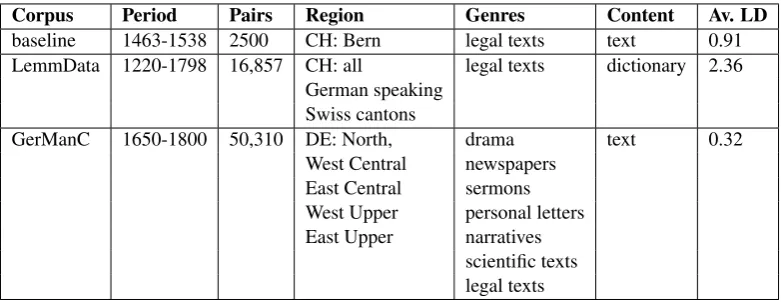
The additional datasets, LemmData and Ger-ManC, are quite different from the baseline. The LemmData corpus is closer to the baseline geo-graphically, being produced on the Swiss terri-tory, but it covers a much larger temporal span. GerManC is the largest corpus of the three, but it belongs to a much later period and was pro-duced mainly on the German territory. Given the areal diversity of historical German, the regional provenance of GerManC contributes to its differ-ence from the baseline. Nevertheless, by now, it is the only publicly available corpus of historical German containing manually produced normaliza-tions. To measure the spelling variance present in the three datasets, I calculated the average string distance. For the baseline corpus, LemmData, and GerManC it corresponds to 0.91, 2.36, and 0.32, respectively. The biggest amount of spelling varia-tion is thus present in the LemmData corpus. This can be explained by the following two facts. First, some of its lexicon belongs to the earliest period of the three texts (13thcentury). Furthermore, in
con-trast to the other two datasets consisting of regular texts, the LemmData corpus is based on a dictio-nary of terms. It mostly contains nouns, and does not include any punctuation marks.
The datasets’ details are summarized in Table 1.
3 Normalization Methods 3.1 The Norma tool
The Norma tool2 was developed for
(semi-)automatic normalization of histori-cal corpora. It was originally created for canonicalization of Early New High German texts, but can be trained on any data. The tool comes with three external modules, “normaliz-ers”, each implementing a normalization method. These modules can be used either separately or combined. The normalizers provide normalization candidates. Depending on how the candidate’s confidence score compares to a pre-defined
Corpus Period Pairs Region Genres Content Av. LD
baseline 1463-1538 2500 CH: Bern legal texts text 0.91 LemmData 1220-1798 16,857 CH: all legal texts dictionary 2.36
German speaking Swiss cantons
GerManC 1650-1800 50,310 DE: North, drama text 0.32 West Central newspapers
East Central sermons West Upper personal letters East Upper narratives
[image:3.595.105.496.61.213.2]scientific texts legal texts
Table 1: Corpora used in this case study.
threshold, Norma decides, whether this candidate is acceptable.
The three normalizers are:Mapper,RuleBased, andWeighted Levenshtein Distance. Mapperuses a simple wordlist mapping method. The Rule-Based normalizer uses context-aware rules auto-matically derived from aligned training data, to rewrite sequences of the input characters. More details on this approach can be found in (Boll-mann et al., 2011). TheWeighted Levenshtein Dis-tancenormalizer finds a candidate with the lowest weighted Levenshtein distance score.
Since the mapping method is conceptually sim-ple, I will not be using it in this case study. For the evaluation, I tested the remaining two normalizers separately and combined, to find out the combina-tion where theRuleBasednormalizer followed by Weighted Levenshtein Distanceworks best. This setup will be referred to asNorma in further sec-tions.
3.2 Statistical Machine Translation
As a second method for this case study, I used character-level statistical machine translation. It differs from word-level machine translation in that it aligns characters occurring in token pairs, in-stead of aligning words. As a result, translation models contain phrases consisting of character se-quences instead of word sentences. Language models, in their turn, are trained on character n-grams instead of word n-n-grams.
For the SMT experiments, I used the Moses toolkit3 with settings as described in (Pettersson
et al., 2013b).
3http://www.statmt.org/moses/
3.3 Neural Machine Translation
The recently proposed approach to machine translation, neural MT (Bahdanau et al., 2014; Sutskever et al., 2014; Luong et al., 2015; Cho et al., 2014) obtained state-of-the-art results for various language pairs. Neural MT systems are generally implemented as an encoder-decoder ar-chitecture. The encoder reads the source sentence and encodes it into a sequence of hidden states, whereas the decoder generates a corresponding translation based on the encoded sequence of hid-den states.
I did not find any reports on the application of neural MT to the task of historical text nor-malization, but the comparative study by Sennrich (2016) proved that a fully character-level neural MT model outperformed a fully subword model at transliterating unknown names. This task is simi-lar to normalization. The fully character-level neu-ral MT approach in these experiments which I fol-lowed in mine, is described in (Lee et al., 2016).
This method maps a source character sequence to a target character sequence without explicit seg-mentation. Due to the fact that this model has no explicitly hard-coded knowledge of word bound-aries, it is possible to use sentence-aligned data for training and testing. Nevertheless, since part of my data, i.e., LemmData is not a set of sen-tences, but a set of historical-modern pairs, I use tokenized, word-aligned datasets for neural MT experiments as well.
The source code implementing the models de-scribed by Lee et al. (2016) is publicly available4.
4 Evaluation
Given the small size of the manually normalized baseline (2500 historical-modern word pairs), I applied 10-fold cross-validation to evaluate the performance of the three normalization methods. First, the experiments were conducted on the base-line, with 2000 pairs (2250 for Norma) of training data, 250 pairs in development set (for SMT and neural MT), and 250 pairs in the test set. Then, the training set was augmented with LemmData and GerManC data, while using both development and test sets in their initial size. Table 2 shows the evaluation results.
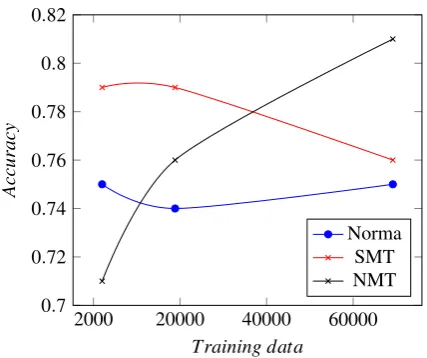
The neural MT system trained on the baseline combined with LemmData and GerManC (69,167 tokens) showed the best accuracy score, 0.81. It is followed by SMT results, 0.79, trained on 18,857 tokens of the baseline augmented with LemmData. To estimate the average variability in the out-put between the folds of test data, I calculated the standard deviation of the accuracy for each system (SDacc in Table 2). This measure demonstrates how close or far away the data is from the mean (average accuracy, ACC in Table 2). It approxi-mates the mean distance between each fold and the arithmetic mean. The majority of the data (68.2% assuming that the distribution is normal) would be located between one standard deviation above and below the mean. For instance, given the average accuracy 0.75 of the Norma baseline system, the standard deviation 0.03 means that the accuracy scores for the majority of the folds vary from 0.72 to 0.78. The standard deviation between different systems changes slightly, from 0.02 to 0.04.
It is interesting to observe, how the systems re-spond to the augmentation of the training set (see Figure 2). While the performance of the rule-based system, Norma, remains rather stable, it changes by the other two systems. The SMT sys-tem first reacts positively to the increase of the training data with LemmData. This data is similar to the baseline in its regional provenance, though is very varied with respect to the covered time pe-riods (see Table 1). When the training set was further augmented with GerManC, belonging to a later period of time, it resulted in a performance decrease. On the other hand, the performance of the neural MT system steadily increased with each addition of data. This observation corresponds to the one made in (Bollmann and Søgaard, 2016) where the normalization accuracy increased with a
2000 20000 40000 60000 0.7
0.72 0.74 0.76
0.78
0.8 0.82
Training data
Accur
acy
[image:4.595.313.527.62.241.2]Norma SMT NMT
Figure 2: Word accuracy averaged over 10 folds for different sizes of the training set.
deep learning normalization method and remained stable or decreased with other methods, including Norma.
The accuracy and character error rate scores of the three normalization systems compared in the best performing configurations does not dif-fer much: from Norma’s 0.75/0.14 to neural MT’s 0.81/0.08. To estimate how different the output of the systems actually is, I conducted a quanti-tative analysis of the output (see Table 3). First, I compared how similar is the output of the sys-tems, i.e., how often the systems agree on a certain normalization. The lowest, 70%, is the agreement between the three systems, and the highest, 80%, between the SMT and the neural MT systems. In addition, based on the amount of the commonly incorrect cases, I calculated the percentage of the “error agreement”, i.e., how often the systems pro-duced the same erroneous normalization. The pair SMT/neural MT leads with 51% of error similar-ity. Thus, the output produced by SMT and neu-ral MT systems is the most similar. It can be ex-plained by the statistical nature of both systems, in contrast to the rule-based Norma.
Table 4 presents contrastive examples of the output, where one system produced the correct normalization, and the other two failed.
5 Conclusion
meth-Training data Pairs ACC CER SDNorma SMT NMT acc ACC CER SDacc ACC CER SDacc baseline 2000 0.75 0.14 0.03 0.79 0.08 0.03 0.71 0.17 0.04 baseline+LemmData 18,857 0.74 0.14 0.03 0.79 0.08 0.03 0.76 0.11 0.04 baseline+LemmData+GerManC 69,167 0.75 0.13 0.02 0.76 0.10 0.04 0.81 0.08 0.03
Table 2: Averaged evaluation results, i.e., accuracy (ACC) and character error rate (CER) over 10 folds.
Systems Agreement Common incorrectnormalizations
Norma & SMT & NMT 70% 46%
Norma & SMT 76% 44%
Norma & NMT 75% 35%
SMT & NMT 80% 51%
Table 3: Analysis of the output: total amount of cases the systems agreed upon (Agreement) and amount of cases where the systems produced the same incorrect normalization, calculated based on the number of common incorrect cases.
SOURCE Norma SMT NMT REF
meyen maien mein mai mai
ander ander andere ander andere
sturen steuern sturen steueren steuern
Table 4: Normalization examples. Correct nor-malizations are highlighted.
ods: rule-based, character-level statistical machine translation, and character-level neural machine translation. In this case study, neural MT outper-formed the other two methods. In contrast to the rule-based method and SMT, it also benefited most from the augmentation of the training set.
Considering the success of the applied neural method, future work may consist in testing other deep learning methods. For instance, I used only one of the systems presented in (Lee et al., 2016), the fully character-based one. The other described a system performing neural machine translation with subword units.
Another direction for future work could consist in adding more training data to observe, if the per-formance of the neural MT system would continue to improve.
More effort could also be invested into the SMT method. The SMT system did not profit from the augmentation of the training set, due to its period and domain differences from the baseline. This is similar to the problem of the out-of-domain data in phrase-based machine translation. Out-of-domain data introduces ambiguity to the translation model, resulting in the translation choices irrelevant for the test set. Translation model domain adaptation
approach was proposed by Sennrich (2012) to deal with the out-of-domain data. This method can po-tentially improve the results of the SMT experi-ments with additional training sets.
Acknowledgments
The author would like to thank Dr. Pascale Sutter and Rebekka Pl¨uss for normalizing the source data used in the experiments as baseline. This work is supported by the Swiss Law Sources Foundation.
References
Dzmitry Bahdanau, Kyunghyun Cho, and Yoshua Bengio. 2014. Neural machine translation by jointly learning to align and translate. CoRR, abs/1409.0473.
Marcel Bollmann and Anders Søgaard. 2016. Im-proving historical spelling normalization with bi-directional LSTMs and multi-task learning. In Pro-ceedings of COLING 2016, the 26th International Conference on Computational Linguistics: Techni-cal Papers, pages 131–139, Osaka, Japan, Decem-ber. The COLING 2016 Organizing Committee.
Marcel Bollmann, Florian Petran, and Stefanie Dipper. 2011. Rule-based normalization of historical texts. In Proceedings of Language Technologies for Dig-ital Humanities and Cultural Heritage Workshop, pages 34–42.
Kyunghyun Cho, Bart van Merrienboer, Dzmitry Bah-danau, and Yoshua Bengio. 2014. On the properties of neural machine translation: Encoder-decoder ap-proaches. CoRR, abs/1409.1259.
Marta R. Costa-Juss`a and Jos´e A. R. Fonollosa. 2016. Character-based neural machine translation. CoRR, abs/1603.00810.
Jason Lee, Kyunghyun Cho, and Thomas Hof-mann. 2016. Fully character-level neural machine translation without explicit segmentation. CoRR, abs/1610.03017.
Minh-Thang Luong, Hieu Pham, and Christopher D. Manning. 2015. Effective approaches to attention-based neural machine translation. CoRR, abs/1508.04025.
Eva Pettersson, Be´ata Megyesi, and Joakim Nivre. 2013a. Normalization of historical text using context-sensitive weighted Levenshtein distance and compound splitting. In Proceedings of the 19th Nordic Conference on Computational Linguistics.
Eva Pettersson, Be´ata Megyesi, and J¨org Tiedemann. 2013b. An SMT approach to automatic annotation of historical text. In Proceedings of the Workshop on Computational Historical Linguistics at NODAL-IDA.
Eva Pettersson, Be´ata Megyesi, and Joakim Nivre. 2014. A multilingual evaluation of three spelling normalisation methods for historical text. In Pro-ceedings of the 8th Workshop on Language Technol-ogy for Cultural Heritage, Social Sciences, and Hu-manities (LaTeCH), pages 32–41, Gothenburg, Swe-den, April. Association for Computational Linguis-tics.
Felipe S´anchez-Mart´ınez, Isabel Mart´ınez-Sempere, Xavier Ivars-Ribes, and Rafael C. Carrasco. 2013. An open diachronic corpus of historical Spanish: annotation criteria and automatic modernisation of spelling. CoRR, abs/1306.3692.
Silke Scheible, Richard J. Whitt, Martin Durrell, and Paul Bennett. 2011. A gold standard corpus of Early Modern German. InProceedings of the 5th Linguis-tic Annotation Workshop, LAW V ’11, pages 124– 128, Stroudsburg, PA, USA. Association for Com-putational Linguistics.
Yves Scherrer and Tomaˇz Erjavec. 2013. Modern-izing historical Slovene words with character-based SMT. InBSNLP 2013 - 4th Biennial Workshop on Balto-Slavic Natural Language Processing, Sofia, Bulgaria, August.
Rico Sennrich. 2012. Perplexity minimization for translation model domain adaptation in statistical machine translation. In EACL 2012, 13th Confer-ence of the European Chapter of the Association for Computational Linguistics, Avignon, France, April 23-27, 2012, pages 539–549.
Rico Sennrich. 2016. How grammatical is character-level neural machine translation? Assessing MT quality with contrastive translation pairs. CoRR, abs/1612.04629.