Three-dimensional multiphase flow
computational fluid dynamics models
for proton exchange membrane fuel
cell: A theoretical development
Jean-Paul Kone
1, Xinyu Zhang
2, Yuying Yan
3, Guilin Hu
4and
Goodarz Ahmadi
5Abstract
A review of published three-dimensional, computational fluid dynamics models for proton exchange membrane fuel cells that accounts for multiphase flow is presented. The models can be categorized as models for transport phenomena, geometry or operating condition effects, and thermal effects. The influences of heat and water management on the fuel cell performance have been repeatedly addressed, and these still remain two central issues in proton exchange mem-brane fuel cell technology. The strengths and weaknesses of the models, the modelling assumptions, and the model validation are discussed. The salient numerical features of the models are examined, and an overview of the most commonly used computational fluid dynamic codes for the numerical modelling of proton exchange membrane fuel cells is given. Comprehensive three-dimensional multiphase flow computational fluid dynamic models accounting for the major transport phenomena inside a complete cell have been developed. However, it has been noted that more research is required to develop models that include among other things, the detailed composition and structure of the catalyst layers, the effects of water droplets movement in the gas flow channels, the consideration of phase change in both the anode and the cathode sides of the fuel cell, and dissolved water transport.
Keywords
Computational fluid dynamics, modelling, multiphase flow, numerical, proton exchange membrane fuel cell, review
Date received: 10 June 2016; accepted: 18 October 2016
Introduction
In recent years, fuel cells have become an important clean energy technology, and thereby a serious conten-der to replacing some of the traditional power systems which rely on fossil fuels. Fossil fuels produce a signifi-cant amount of pollutants and they are rapidly deplet-ing resources. Thus, it is becomdeplet-ing increasdeplet-ingly difficult to ignore the critical role that fuel cells can play in the different energy mix scenarios of many countries.
Besides their environmental advantages, in general, fuel cells offer many other advantages over conven-tional energy conversion devices. They directly convert chemical energy of the fuel into useful work, without requiring any thermodynamic cycle. Thus, their prac-tical efficiency in direct electrical energy conversion can reach as high as 60%.1
1
International Doctoral Innovation Centre, The University of Nottingham Ningbo China, Ningbo, China
2
Research Center of Fluids and Thermal Engineering, The University of Nottingham Ningbo China, Ningbo, China
3
Fluids & Thermal Engineering Research Group, The University of Nottingham, Nottingham, UK
4School of Mechanical and Automotive Engineering, Zhejiang University
of Science and Technology, Hangzhou, China
5Department of Mechanical and Aeronautical Engineering, Clarkson
University, Potsdam, USA
Corresponding author:
Xinyu Zhang, The University of Nottingham Ningbo China, 199 Taikang East Road, University Park, Ningbo, Zhejiang 315100, China.
Email: [email protected]
The Journal of Computational Multiphase Flows
2017, Vol. 9(1) 3–25
!The Author(s) 2017
Reprints and permissions:
sagepub.co.uk/journalsPermissions.nav DOI: 10.1177/1757482X17692341 journals.sagepub.com/home/cmf
Proton exchange membrane (PEM) fuel cells which are the focus of this review article have high power density and operate at relatively low temperatures, which make them well suited for automotive power system, as well as power generation systems for build-ings and portable electronics.
However, despite this, PEM fuel cell economics, especially the high capital and working expenses asso-ciated with their fabrication and testing, constitute a major obstacle to their rapid development. To tackle this issue, computational fluid dynamic (CFD) model-ling and simulation can be used to rapidly gain import-ant insights into PEM fuel cell working processes. These include fluid flow, mass and heat transfers, and chemical reactions inside the fuel cell, which can pro-vide critical information needed for the optimization of PEM fuel cells.
Most reviews on PEM fuel cell CFD modelling provide a general discussion of a wide range of CFD models for PEM fuel cell. This review focuses on published 3D multiphase flow CFD models. The idea is to create a focused review, aiming at critically analysing the quality of the models meeting these criteria by discussing their strengths and weaknesses and identifying outstanding issues instead of conduct-ing a broad historical overview of the published literature.
The review is organized as follows. The next section defines four basic concepts that are essential to under-standing the subsequent sections. ‘Rationale for PEM fuel cell CFD modelling’ section gives the rationale for the use of CFD in PEM fuel cell modelling. ‘Literature 3D multiphase flow CFD models’ section reviews the literature’s PEM fuel cell 3D multiphase flow CFD models according to their areas of investigation. ‘Multiphase flow models and phase change’ section
examines multiphase flow modelling and the implemen-tation of phase change in the reviewed papers. ‘Numerical procedures’ section outlines a number of salient numerical features of the reviewed models. ‘CFD codes for PEM fuel cell modelling’ section pro-vides an overview of the most commonly used CFD codes for PEM fuel cell modelling. ‘Summary and out-look’ section summarizes the review highlighting future trends in the PEM fuel cell modelling.
Essential concepts
Transport phenomena
The study of transport phenomena is a multidisciplin-ary subject that draws on science and engineering concepts as diverse as fluid mechanics, mass transfer, heat transfer, and electromagnetism. Each one of these concepts deals with a specific transport phenomenon. The transport of momentum is dealt with in fluid mech-anics, the transport of mass of various chemical species is considered in mass transfer, the transport of heat is explained in heat transfer, and the transport of charges is depicted in electromagnetism.2
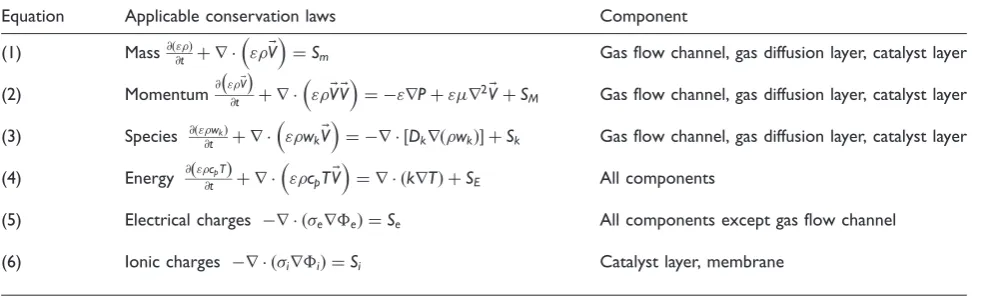
The physical quantities that are transported within a PEM fuel cell are mass, momentum, chemical species, thermal energy, electrical current, and ionic current. To describe the transport of these physical quantities in the different components, the conservation laws in terms of rate of accumulation and generation/con-sumption are used.
[image:2.595.49.543.559.708.2]Thus, the transport phenomena occurring within the cell can be represented by the solution of the conserva-tion equaconserva-tions. The generic governing equaconserva-tions for PEM fuel cell models and applicable component are given in Table 1.
Table 1. Generic governing equations for PEM fuel cell models.3
Equation Applicable conservation laws Component
(1) Mass@ "ð@tÞþ r "~V¼Sm Gas flow channel, gas diffusion layer, catalyst layer
(2) Momentum@ "~@tV þ r "~VV~¼ "rPþ"r2V~þSM Gas flow channel, gas diffusion layer, catalyst layer
(3) Species @ "ð wkÞ
@t þ r "wkV~
¼ r ½DkrðwkÞ þSk Gas flow channel, gas diffusion layer, catalyst layer
(4) Energy @ "ð cpTÞ
@t þ r "cpTV~
¼ r ðkrTÞ þSE All components
(5) Electrical charges r ðereÞ ¼Se All components except gas flow channel
(6) Ionic charges r ðiriÞ ¼Si Catalyst layer, membrane
Multiphase flow
Multiphase flow refers to fluid flows consisting of two or more phases, with a phase being a solid, a liquid, or a gas that coexist with another solid, liquid, or gas.
The most common types of multiphase flows are the phase flows and the three-phase flows. The two-phase flows include gas–liquid flow, gas–solid flow, liquid–liquid flow (e.g. oil–water mixtures in pipelines), and liquid–solid flow. The three-phase flows encountered in engineering applications include gas–liquid–solid flow, gas–liquid–liquid flows (e.g. gas–oil–water flows in oil recovery systems), and solid–liquid–liquid flows (e.g. immiscible liquid–liquid reaction in which a solid phase is formed).
The different phases forming a multiphase flow are usually separated by an identifiable boundary which constitutes the interface between two phases. The inter-faces are where the transfer of material, momentum, and energy may occur between the phases. The model-ling of multiphase flows is immensely challenging and often requires a sound understanding of the various multi-physics phenomena that are involved.
In PEM fuel cells, multiphase transport originates from the production of liquid water by the oxygen reduction reaction and the phase change processes (evaporation and condensation).
CFD
CFD is a sub-discipline of fluid dynamics that employs a set of highly sophisticated numerical methods and algorithms to solve and analyse problems of fluid dynamics and beyond.4 The problem under consider-ation is usually formulated mathematically using par-tial differenpar-tial equations.
Since the CFD method is based on computational analysis, before any of the CFD numerical methods and algorithms can be used to compute practical numerical solutions, these must be translated into a computer program often referred to as CFD codes. CFD codes are usually written in a high-level computer programming language such as C or Cþþ.5
In general, a CFD-based analysis is performed in five major steps: (1) problem definition, (2) mathemat-ical model formulation, (3) pre-processing and mesh generation, (4) solving, and (5) post-processing. Some of these steps must be repeated multiple times in order to obtain the desired results.
The problem is usually defined in its simplest pos-sible form that still accurately describes the actual real world system under consideration. The mathematical model is used to formulate the problem mathematic-ally, describing the details of the flow. The pre-proces-sing and mesh generation sets the various fields of interest before the start of the simulation and discretize
the flow domain into computational mesh consisting of volumes or cells. In the solving step, the differential model gets replaced by a system of linear algebraic equations which are solved using algorithms. Finally, the post-processing offers the means to visualize the simulation data in order to inspect the details of the flow.
PEM fuel cell
The basic operating principle of fuel cells which consist of reversing water electrolysis to generate electricity from hydrogen and oxygen was discovered by William Grove in 1839.6Although the technology has matured significantly, this same principle still defines the operation of current PEM fuel cells.
Thus, simply put, a PEM fuel cell is an electrolytic cell that runs on hydrogen and oxygen. Its working process can be a multiphase reaction process, generat-ing heat while convertgenerat-ing chemical energy into electrical energy without producing any greenhouse gases.
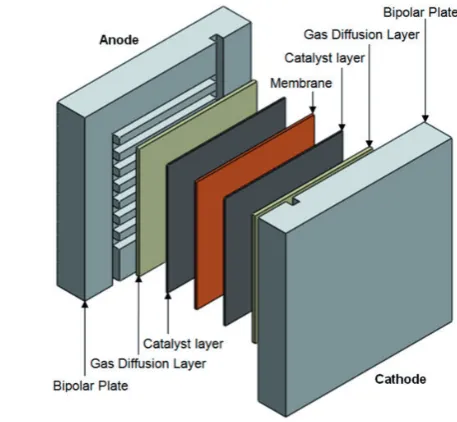
Working principle. There are three key components that form a PEM fuel cell. A solid polymer membrane sand-wiched between two electrodes, a negatively charged electrode (anode), and a positively charged electrode (cathode). Both the anode and the cathode contain a catalyst layer (CL), a gas diffusion layer (GDL) with micro-porous layers, and a bipolar plate (BP) with gas flow channels (GFC). The schematic representation of the operation of a single cell is shown in Figure 1.
[image:3.595.324.530.491.697.2]The cell is fed with hydrogen at the anode side and oxygen at the cathode side. These two gases
subsequently react together to provide chemical energy for conversion to electrical energy. However, due to the inefficiency in the energy conversion, a portion of chem-ical energy is converted to waste heat instead of electricity.7
The overall electrochemical reaction as shown in equation (9) is the sum of the reactions occurring at the electrodes (anode and cathode), given in equations (7) and (8), respectively.
At the anode
H2!2Hþþ2e ð7Þ
At the cathode
1
2O2þ2H
þþ
2e!H2O ð8Þ
Overall
H2þ1
2O2!H2O ð9Þ
Electrical current is created by the movement of elec-trons, resulting from the splitting of hydrogen into pro-tons and electrons at the surface of the catalyst. The electrons travel from the negatively charged anode side to the positively charged cathode side, following an exter-nal circuit that connects the two electrodes through a load, whereas the protons travel through the membrane. At the catalyst of the cathode side, they meet with oxygen that is fed on that side to form water and produce heat.3 The product water may be in vapour or liquid form. Liquid water formation depends on the water vapour saturation pressure and temperature. The presence of excess liquid water can be problematic in PEM fuel cells, as it can create a phenomenon known as flooding. Flooding has a negative effect on mass transfer. Hence, to protect the integrity of the fuel cell, the product water and waste heat generated during the operation must be continuously removed.
Liquid water may be transported out of the cathode CL through the cathode GDL and then the cathode GFCs. Fuel cells may be fitted with cooling units at the BPs to deal with the waste heat.
The operating principle of PEM fuel cells may well be simple and basic, but the phenomena occurring during their operation are highly complex. They involve electrochemical reactions, species and charge transport, mass transfer, heat transfer, and multiphase flows. Sound knowledge of these multi-physics phenomena is therefore critical in PEM fuel cells optimization.
Components. As described in ‘Working principle’ sec-tion, a single cell consists of a polymer electrolyte mem-brane sandwiched between two electrodes. As
illustrated in Figure 2, each electrode has a BP with GFCs, a GDL, and a CL.
BP. The BPs (also known as the collector or separator plate) are electrically conductive plates which separate the gases in adjacent cells in the stack while connecting the individual cells electrically. They provide housing for the GFCs and a structural support for the stack.3The heat generated within the membrane electrode assembly (MEA) is transferred to the cooling system through the BPs. Electrons are transferred from/to the GDLs to/from the BPs.
GFCs. The GFCs in the BPs provide the pathways for the transport of the reactant gases to the GDL and product water out of the electrodes. To ensure an even distribution of the fuel and oxidant within the cell, different flow field designs with different advantages exist. The most commonly seen are straight parallel, serpentine, and interdigitated flow fields.1,8
GDL. The GDLs are porous media located between the BPs and the CLs. Thus, not only they allow uni-form distribution of the reactants across the surface of the CLs, but they also provide an electrical connection (electrons transport) between the CLs and the BPs, as well as creating a structural support for the CLs.1
[image:4.595.287.516.67.278.2]CL. The CLs are the thin layers attached to both sides of the membrane. It is on the surface of the CLs that the electrochemical reactions that convert chemical energy in electrical energy take place within a PEM fuel cell.
Figure 2. Schematic of a single-cell PEM fuel cell with straight channels.
Membrane. The membrane is a solid polymer electrolyte that separates the anode from the cathode in a PEM fuel cell. In other words, it is an electronic insulator that is also impermeable to the reactant gases but allows protons transport. Thus, the desired characteristics of a PEM fuel cell membrane are good electronic insulation, good separation of hydrogen in the anode side and oxygen in the cathode side, and high proton conductivity.
Rationale for PEM fuel cell CFD modelling
As mentioned in ‘CFD’ section, CFD is foremost a numerical method that is used to solve partial tial equations of fluid dynamics. These partial differen-tial equations are non-linear and analytical solutions can only be obtained in a few simple special cases. In order to obtain solutions to most problem of practical interest, a CFD implementation is therefore necessary.5 This is applicable to PEM fuel cells as electrochem-ical devices, because the motion of the reactant gases and product water is governed by non-linear conserva-tion equaconserva-tions derived from first principles of fluid mechanics making analytical solutions only possible in 1D and highly simplified cases.
In addition to the analytical challenge of solving non-linear equations in PEM fuel cell models, the cost of manufacturing fuel cells and the cost associated with their performance testing often render many experimental techniques uneconomical. Thus, much research work on fuel cells tries to improve the cell performance by increasing its efficiency while decreas-ing manufacturdecreas-ing and testdecreas-ing costs, through CFD techniques.
Indeed, over the past decade or so, CFD techniques have been employed extensively to model PEM fuel cells. The approach is based on numerical approxima-tion of the soluapproxima-tions of the conservaapproxima-tion equaapproxima-tions of mass, momentum, energy, current, and species trans-port on a computational domain that is discretized using the volume, difference, or finite-element schemes.
Through CFD analysis, a deeper understanding of the problem under consideration can be obtained. In fact, the importance of CFD modelling and simulation of fuel cell working processes has been repeatedly addressed throughout the literature. For instance, CFD can help understand water management within a PEM fuel cell. Recalling ‘Working principle’ section, water transport is one of the central issues in PEM fuel cell technology.
CFD has many other important applications in PEM fuel cell system analysis and is consequently of immense technological and economic significance. Nevertheless, due to the complexity of the multi-physics
phenomena occurring in a complete fuel cell, some sim-plifying assumptions are still necessary in order to create a numerically tractable model of a complete fuel cell.
Literature 3D multiphase flow CFD
models
The past few decades have seen the number of pub-lished modelling and simulation work on PEM fuel cells increased dramatically. This has essentially been made possible by recent advances in computational techniques and the availability of high-performance computing resources.
The majority of the literature’s 1D computational PEM fuel cell models consider the direction orthogonal to the membrane, with varying degrees of complexity and details. The computational 2D models not only treat the transport phenomena that occur inside the fuel cell in the direction orthogonal to the membrane, but they also con-sider another additional direction, usually either the dimension along the GFC or that perpendicular to it.
Although the pioneering 1D models and subsequent 2D models have significantly contributed to the advancement of PEM fuel cell modelling, these models can only be used for particular phenomena in PEM fuel cells due to the 3D nature of the transport processes occurring in a PEM fuel cell. Consequently, they are not suitable for parametric studies or optimiza-tion of fuel cell designs.9 Moreover, the transports of mass, heat, and charges in porous structures are major issues for these models.
To accurately predict cell performance, a realistic 3D description of the cell geometry is necessary. Thus, 3D computational models have been developed to better understand the phenomena occurring within PEM fuel cells and then predict their performance though a full 3D description of a complete cell or a fuel cell stack requires a considerable computational effort. Three-dimensional models consider effects in both across and along the gas flow channel, in addition to the dir-ection normal to the membrane.
This review intends to examine the majority of the literature’s PEM fuel cell 3D multiphase flow CFD models though it is likely that it may not include all of the published models. The focus is placed on com-prehensive models that are relevant in the context of the present review work. The time frame is set to cover any of such models published through the second quarter of 2016, as of the time the present review has been com-pleted. Thus, only the models that satisfy all criteria of 3D, multiphase flow and CFD-based modelling are included.
complexity to modelling multiphase flow and phase change, as well as their validation methods. Also, one model may be well suited for specific operating condi-tions in a specific region, whereas another one would not be. Therefore, the majority of this review delves into discussing the advantages and potential drawbacks of each model.
The bulk of the models treat phenomena such as water and reactant transport, electrochemical reactions, species and charge transport, mass transfer, heat trans-fer occurring during the cell operation, with the effects of geometry or operating conditions.
Thus, depending on the characteristics of the phe-nomena being investigated, and the level of details included, the models can be divided into three distinct groups: models for transport phenomena, models for geometry or operating condition effects, and models for thermal effects.
The pie chart in Figure 3 shows that transport phe-nomenon is the most studied subject in the reviewed articles followed by geometry or operating condition effects and then thermal effects. This trend can some-how be expected since the 3D architecture of PEM fuel cells makes transport phenomena within them a 3D problem inherently. Moreover, liquid water transport and its effects in the different fuel cell components con-tinue to capture the attention of many PEM fuel cell researchers.
As was pointed out in previous paragraphs, 3D models are more complete and they can be used for design and optimization purposes. The focal point of the literature models for geometry or operating condi-tion effect has been the design of the flow field; namely, the influence of various flow-field designs on cell per-formance. The majority of the models for thermal
effects are concerned with the temperature distribution inside the cell and the effects of this on the fuel cell performance.
Table 2 summarizes the reviewed research papers. It should be mentioned that none of the models listed in Table 2 include all aspects of PEM fuel cell modelling. Overall, the models vary in complexity, because of the modelling of multiphase flow and the implementation of phase change, as well as other modelling assump-tions that are used.
Modelling assumptions
Regardless of the type of multiphase flow model being used, it is often necessary to make some modelling assumptions in order to simplify the problem under consideration and thereby facilitate its numerical imple-mentation without reducing the accuracy of the model. Indeed, these assumptions must be based on well-established theories and practices.
Some commonly used assumptions in PEM fuel cell modelling are steady state, ideal gases, laminar and incompressible gas flow, local thermal equilibrium, and isotropic and homogeneous components materials. For the state of water produced by electrochemical reaction in the cathode CL, both vapour and liquid assumptions are used.
Besides these assumptions, there are many other component and operating condition-specific simplify-ing assumptions that are also used. Some of these may, however, limit the capability of the model or even lead to erroneous results.
An example is the isothermal assumption, which means that the transport of thermal energy given by Table 1, equation (4) is not solved. This can produce results that are not physically representative when phase change is accounted for. In fact, it has been shown that the impact of temperature distribution on the amount of water that undergoes phase change is very significant.41
Another example is considering the CL as an inter-face without thickness. Although this assumption greatly simplifies the CL modelling and facilitates its numerical implementation, it may however introduce inaccuracy due to the neglected contribution of ionic resistance, particularly at low humidity.20Furthermore, experimental results suggest an agglomerate structure for the CL,42,43 and it has been shown that agglomer-ate-type models agree better with the physical picture of reactant transport processes in the CL and they best fit the experimental data.44–46
[image:6.595.79.259.523.695.2]Also, many models neglect the influences of the motion of liquid water in the GFCs. As pointed out in ‘Components’ section, the GFCs in the BPs deliver reactant gases and help remove product water.
T
able
2.
Continued
No
.
Authors
and
year
Ar
eas
of
in
vestigation
Basic
assumptions
Model
validation
19.
Cor
diner
et
al.
28
T
ransport
phenomena
Steady-state Isothermal
Comparison
with
experimental
data
20.
Fink
and
Fouquet
29
T
ransport
phenomena
Steady-state Non-isothermal
Comparison
with
experimental
data
21.
Kang
et
al.
30
Geometr
y/operating
condition
effects
T
ransient Isothermal
Comparison
with
experimental
data
22.
Chiu
et
al.
31
Geometr
y/
operating
condition
effects
Steady-state Isothermal
Comparison
with
experimental
data
23.
Sun
et
al.
32
T
ransport
phenomena
Steady-state Isothermal
Comparison
with
experimental
data
24.
Cao
et
al.
33
Thermal
effects
Steady-state Non-isothermal
Comparison
with
experimental
data
25.
Hossain
et
al.
34
T
ransport
phenomena
Steady-state Isothermal
Comparison
with
experimental
data
26.
Jiang
and
W
ang
35
T
ransport
phenomena
T
ransient Non-isothermal
None
27.
Mancusi
et
al.
36
Geometr
y/operating
condition
effects
Steady-state Non-isothermal
Comparison
with
experimental
data
28.
Choopan
ya
and
Y
ang
37
Geometr
y/operating
condition
effects
T
ransient Non-isothermal
Comparison
with
experimental
data
29.
Ferre
ira
et
al.
38
T
ransport
phenomena
T
ransient Isothermal
Comparison
with
experimental
data
30.
Jo
and
Kim
39
T
ransport
phenomena
T
ransient Isothermal
None
31.
Khazaee
and
Sabadbafan
40
Geometr
y/operating
condition
effects
Steady-state Non-isothermal
Comparison
with
experimental
This results in gas–liquid two-phase flow in the GFCs. Consequently, the reactant gases transport can be hindered when considerable amount of liquid water accumulate in the channels leading to poor cell per-formance. Thus, the effects of liquid water in the GFCs should be accounted for.
Models for transport phenomena
Berning and Djilali11presented a model that accounts for the major transport processes, as well as phase change. The results show that phase change exists in both the anode and cathode sides of the fuel cell. The anode and cathode transports are however decoupled in this model, the CLs are treated as thin interfaces, and liquid water transport by electro-osmotic drag is neglected.
Mazumder and Cole12 modified a model originally proposed by Wang and Cheng47 by adding an add-itional governing equation for the formation and trans-port of liquid water. Although the numerical predictions of the cell performance quantitatively over-predict experimentally measured polarization in the high current density regime, the results nonetheless indicate that at critical current density, the saturation levels can exceed 50% and are highest in the cathode.
Schwarz and Djilali16incorporated the 1D multiple thin-film agglomerate catalyst model of Baschuk and Li48into a comprehensive 3D model to investigate the effects of transport limitations on cell performance in the CLs. It was found that transport limitations and ohmic losses in the CLs have substantial negative effects on the fuel cell performance. The model however does not con-sider the effects of liquid water in the GFCs.
Ren et al.19 developed a gas–liquid two-phase flow and transport model to address the need to account for all major flow and transport phenomena with an emphasis on various factors influencing cell perform-ance. The results show that substituting the air with oxygen and increasing the inlet gas velocity while decreasing the thickness of the membrane and the width of the rib will improve the cell performance. This model assumes isothermal condition and water phase change is only considered in the cathode CL. It has been shown that phase change exists in both the anode and cathode sides of the fuel cell.11
Wang20 investigated multiphase flow, species trans-port, and electrochemical processes and their inter-actions using a two-phase flow model but with the assumption of isothermal condition. The results indi-cate that two-phase flow can occur in both the anode and cathode diffusion media, with the two phases coex-isting at low humidity. This model does not however account for water phase change.
Wang et al.21 implemented a two-phase flow model to understand three critical issues in the channels: liquid water build-up towards the outlets, saturation spike in the vicinity of flow cross-sectional heterogeneity, and two-phase pressure drop. The results reveal that liquid water builds up quickly at the entrance region of the gas channel with the predicted saturation reach-ing as high as 20%. Water trappreach-ing around the geomet-rical heterogeneity was also found. This model is limited to a single channel that is not integrated into a full cell model.
Berning et al.22 presented a multiphase model that describes the flux of liquid water through the porous media and into the GFCs. In this model, the overall level of the predicted liquid saturation depends pre-dominantly on the fraction of hydrophilic pores which can be accounted for in the irreducible satur-ation. This can be a limiting factor for the accuracy of the predictions since the results show that the irre-ducible saturation has an important impact on the lim-iting current density. Also, the interaction between the gas and liquid phases in the GFCs is not considered.
Schwarz and Beale23implemented a comprehensive model to perform multiphase transport calculations and to investigate the effects of ohmic losses and trans-port limitations on current density distributions for the cell design. It was found that the current density in the cathode CL is concentrated near the gas channels inlets due to the resistances of air and flooding to oxygen transport. The model however neglects the effects of liquid water in the gas channels.
Wu et al.27developed a model that fully couples the major transport processes and performed both liquid and vapour production modelling. The results show that the dynamic response of the fuel cell in vapour production modelling is significantly overestimated compared to liquid production modelling. A potential drawback of this model is that it was validated against experimental data that were obtained using a different type of membrane material.
Cordiner et al.28extended the validity of the existing isothermal two-phase model of Cordiner et al.49,50 by implementing a decoupled GDL model into a CFD solver to describe the effect of the representation of liquid water flooding on cell performance. It was con-cluded that flooding must be treated as a 3D phenom-enon, as it has different impacts in different regions of the fuel cell.
influence of liquid water droplet movements on per-formance in the GFCs.
Sun et al.32 introduced Kirchhoff transformation technique and a combined finite element-upwind finite volume approach for efficiently achieving a fast conver-gence and reasonable solutions for a two-phase trans-port model. The results demonstrate the efficiency of the numerical technique used. The model used is, how-ever, isothermal and does not take into account water back diffusion effect through the membrane.
Hossain et al.34 developed a two-phase model to investigate the transport of species in the GDL con-sidering liquid water saturation. It was found that higher cell performance can be achieved by optimizing the permeability of the GDLs. The main limits of this model are the assumption of isothermal condition and 1D water transport in the membrane by back diffusion only.
Jiang and Wang35developed a two-phase flow model by fully coupling species transport, heat transport, and electrochemical processes to investigate the formation and the transport of liquid water. It was found that liquid water build-up in the cathode channel dominates liquid water spreading inside the cell and dictates the performance of the fuel cell.
Ferreira et al.38 used the volume of fluid (VOF) method to numerically investigate two-phase flow in the anode gas channel and analyse water movement. The results reveal that water moves as films for hydro-philic channel walls, whereas it moves as a droplet when the channel walls are hydrophobic. This model is isothermal and phase change or electrochemical reac-tions are not considered.
Jo and Kim39also used the VOF method to numer-ically investigate the dynamics of liquid water emerging from a micro pore on the GDL into the GFC. It was concluded that with decreased GDL surface contact angle, droplets from the outer and inner pores move along the side walls and the movement of droplets from the centre pore shows complex patterns. Furthermore, as the hydrophobicity of the side and top walls increases, the GDL surface water coverage ratio increases while the water volume fraction decreases. This model is isothermal and phase change or electrochemical reactions are not considered.
Models for geometry or operating condition effects
Al-Baghdadi and Al-Janabi15 conducted an optimiza-tion study using a multiphase model that incorporates the significant physical processes and the key param-eters affecting cell performance. The results show that the model is capable of accurately quantifying the impacts of operating, design, and material parameters on the fuel cell performance. The main limits of this
model are the treatment of the CL as a thin interface and the consideration of phase change in the GDLs only.
Jang et al.18 developed a model with conventional flow-field designs to study the influences of flow-field designs on fuel utilization, water removal, and cell per-formance. It was found that the cell performance of the serpentine flow field is the best followed by the Z-type flow field and the parallel flow field. The model assumes isothermal condition and does not account for the motion of liquid water.
Schwarz and Djilali24 used the multiphase flow model of Schwarz and Djilali16 to explore the imple-mentation of spatially distributed catalyst loadings in all three directions for both the anode and the cathode. The results show that at high current densities, the over-potential variations in the anode and the cathode CLs are fairly large. This study does not examine the use of variable composition for the CL.
Berning et al.25 extended a previously published model by Berning et al.22 in order to account for phase change kinetics and to conduct a comparison between the interdigitated flow-field design and a con-ventional straight channel design. It was found that the interdigitated flow field yields higher and more uniform oxygen concentration as well as a lower overall liquid saturation at the CL. The interaction between the gas and liquid phases is, however, not considered in this model.
Yuan et al.26 developed a multiphase model to pre-dict the effects of operating parameters such as operat-ing pressure, cell temperature, relative humidity of reactant gases, and air stoichiometric ratio on cell per-formance. The results indicate that increased operating pressure and temperature can enhance the cell perform-ance. Moreover, it was found that the best performance occurs at moderate air relative humidity while hydro-gen is fully humidified.
Kang et al.30used a multiphase porous cathode side model to study liquid water flooding in an interdigi-tated flow-field design. The results reveal the existence of a so-called liquid water avalanche phenomenon in this type of cathode design. Also, the existence of three distinct phases for liquid water flooding process is found; these are porous layer phase, channel phase, and drainage phase. This model is limited to the cath-ode side only and heat transfer and electrochemical reactions are not considered. Furthermore, the model does not account for water phase change.
height or the width of the channel; of the three flow fields, the interdigitated flow field is the most effective on liquid water removal. Potential drawbacks of this model are the assumption of isothermal condition and the use of a highly simplified multiphase model.
Mancusi et al.36 used a combined multi-fluid and VOF approach to study two-phase flow in a tapered channel design. The results show that tapering the channel downstream enhances water removal due to increased airflow velocity.
Choopanya and Yang37 developed a multiphase model to investigate the effect of the parallel and the serpentine flow-field geometries on the cell performance under both steady-state and transient operations. It was found that in the steady-state run, the average current density increases with the use of a serpentine flow field due to superior water removal ability. For the transient operation, the use of a serpentine flow field combined with dry reactant gases help the removal of product water and accelerate the transport of reacting species to the reaction site. This model does not however account for water phase change, and the dynamics and movement of liquid water are not studied.
Khazaee and Sabadbafan40 developed a two-phase model to investigate water management and the per-formance of PEM fuel cell with 1-serpentine and 4-ser-pentine channels flow-field configurations at different operating conditions. The results show that under iden-tical conditions, the 4-serpentine configuration outper-forms 1-serpentine configuration. However, the effects of liquid water in the channels are not studied in detail.
Models for thermal effects
Shimpalee and Dutta10 modified a model already pre-sented by Dutta et al.51 by including the energy equa-tion to predict the temperature distribuequa-tion inside a straight channel and the effect of heat produced by the electrochemical reactions on cell performance. The predictions show that the cell performance depends not merely on geometric or operating condition parameters but also on the temperature rise inside the fuel cell. A shortcoming of this model is that it neglects the heat generated by ohmic resistance in the porous media and the membrane.
Coppo et al.13used the 3D implementation of a pre-viously developed 2D model by Siegel et al.44,52to ana-lyse the effects of temperature on the cell operation. It was found that higher temperature positively affects the reaction kinetics. However, only the heat source due to phase change in the cathode CLs is added in the energy equation.
Matamoros and Bruggemann14 developed a model that specifically computes water and heat management. The simulation results show that the operating
temperature has negative effects on the hydrating prop-erties of the membrane. The only heat sources included in the model are Joule heating in the membrane and latent heat in the cathode.
Shimpalee et al.17 extended the existing model of Shimpalee et al.53,54 to include energy and water phase change equations for studying phase change and heat transfer. It was found that a single-phase and isothermal model shows higher current overshoot than a water phase change and non-isothermal model. The model does not account for the heat sources due to ohmic resistance in the porous media and the membrane.
Cao et al.33presented a two-phase model to investi-gate amongst other things the interaction between water and thermal transport processes, and different boundary temperature of flow plate. The results show that the boundary temperature greatly affects the cell temperature distribution and indirectly influences water saturation distribution. The model however neglects liquid saturation in the channels.
Model validation
Validation is an essential aspect of any CFD-based ana-lysis. During the validation process, the simulation results are compared with known experimental data or the results from previous numerical models.
Almost all of the models listed in Table 2 have been validated using some kind of experimental data. These include a detailed comparison of the predicted polar-ization curve or V–I curve with experimentally mea-sured one. A comparison of the simulation results with the results from previous models was also per-formed in a few cases. Overall, the results were found to be in good agreement with either experimental or previous model results.
Multiphase flow models and phase change
As described in ‘Multiphase flow’ section, in PEM fuel cells, the production of liquid water by the oxygen reduction reaction and the phase change process are the origin of two-phase transport. The gas phase has multi-components (hydrogen and water vapour in the anode side; oxygen, nitrogen, and water vapour in the cathode side), while the liquid phase consists of only pure water.
things, the multi-fluid model requires the specification of phase change kinetics, whereas local equilibrium between the gas phase and the liquid phase is inherently assumed in the multiphase mixture model. For more details on these topics, the reader is referred to the ref-erence texts by Sunden and Faghri55and Wang et al.7 In this section, a brief overview of two-phase flow modelling is presented with a summarized outline of the selected multiphase flow models given in Table 3. The main water phase change mechanisms used are conden-sation of water vapour to liquid water and evaporation of liquid water to water vapour.
Multi-fluid model
The multi-fluid approach of multiphase flow modelling consists of solving a set of conservation equations for mass and momentum for each phase separately. The two phases are usually coupled through the relative permeability and the phase change terms. The following are generic steady-state mass and momentum conserva-tion equaconserva-tions in the porous media
Mass
r "gV~g
¼SPC ð10Þ
r "lV~l
¼SPC ð11Þ
Momentum
~
Vg¼ ð1sÞ
Kg
g
rPg ð12Þ
~
Vl¼ s
Kl
l
rPgD sð Þrs ð13Þ
The multi-fluid approach best suits high saturation conditions, as these demand a greater liquid resolution. The model can resolve complex liquid motion and accounts for the convection of liquid by the gas. As for the disadvantages, the multi-fluid model requires a high number of variables and the coupling of the phases can lead to unstable models.55
Multiphase mixture model
As its name suggests, in the multiphase mixture model, the phases are considered to be mixed; and thus, a single set of conservation equations for the phase mix-ture is solved. Phase equilibrium is assumed and the mixture quantities such as density and so forth, as well as the relative velocity among different phases
are evaluated subsequently. The mass conservation and momentum equations for the mixture read7
Mass
r ~V
¼0 ð14Þ
Momentum
~
V¼ K
rP ð15Þ
The mixture density and velocity are defined as7
¼slþð1sÞg ð16Þ
and
~V¼V~llþV~gg ð17Þ
The mixture species conservation equation is expressed as7
r kVc~ k
¼ r Dkg,effrckg
r wkl
Mk
ckg
g
~
jl
þSk
ð18Þ
where the convection correction factor is a function of the liquid saturation.
The multiphase mixture approach is best used when the gas phase pressure dominates the liquid phase pres-sure or when high capillary numbers are encountered. This approach reduces the number of variables and can effectively model the influence of the gas pressure on the liquid. However, large number of mixture quantities need to be calculated and the model may have conver-gence issues at higher saturations.55
Moisture diffusion model
The moisture diffusion model is based on the unsatur-ated flow theory. It is used to determine the transport of liquid water when the only driving force is the capillary pressure.
The transport equation of liquid water in the mois-ture diffusion model is written as55
r ðD sð Þrl slÞ þS_l¼0 ð19Þ
where the capillary diffusion coefficient D(sl) and the mass source due to phase change S_lare given by55
D sð Þ ¼l
lkl
l
@pc
@sl
T able 3. Summar y o f multiphase flow models and implementation of phase change. Ref. Multiphase flow model Implementation of phase change (e vaporation/condensation) Shimpalee and Dutta 10 Liquid phase is a component of gas phase Swv p ¼ MH 2 O P no f v mass no f v = Mno f v I P
sat wv P
P sat wp Pwv P C Berning and Djilali 11 Multi-fluid
_NW
¼ ND , CV kxm D 2 xw 0 xw 1 1
xw0
, RH 100 % _ mcond ¼ C
xw0
xw
1
1
xw0
, RH 4 100 % Mazumder and Cole 12 Multiphase mixtur e _ ml ¼ Ml kc " xW RT xW P Psat ðÞ if xW P 4 Psat Ml ke " s l Ml xW P Psat ðÞ if xW P 5 Psat ( Coppo et al. 13 Multi-fluid SLV ¼ s LV 1 s ðÞ 1 LV ðÞ Matamor os and Bruggemann 14 Multi-fluid _ nGLH 2 O ¼ KGL MH 2 O
ALG VL
PH 2 OG ðÞ P
Sat H2
O RT Al-Baghdadi and Al-Janabi 15 Multi-fluid _ mevap ¼ MH 2 O $ ND kxm Ddrop xw0
xw
1
1
xw0
, RH 100 % _ mcond ¼ $ C
xw0
xw
1
1
xw0
T able 3. Continued Ref. Multiphase flow model Implementation of phase change (ev aporation/condensation) Shimpalee et al. 17 Liquid phase is a component of gas phase Swv p ¼ MH 2 O P no f v mass no f v = Mno f v 1 P sat wv = P P sat wp Pwv P C Jang et al. 18 P o rosity corr ection SL ¼ Mk c "eff CH 2 O RT PH 2 O Psat if PH 2 O 4 Psat ke "eff sP H2 O Psat if
PH2
O 5 Psat ( Ren et al. 19 Liquid phase is a component of gas phase Swvp ¼ pwv p sat wv RT MH 2 O kc W ang 20 Multiphase mixtur e None W ang et al. 21 Multiphase mixtur e _ mfg ¼ l @
s þr @t
l ~ ul Berning et al. 22 Multi-fluid None Schwarz and Beale 23 Multi-fluid Sw ¼ Cmax 1 s ðÞ PH 2 O Psat RT MH 2 O , s w Schwarz and Djilali 24 Multi-fluid r jw ¼ Cmax 1 s ðÞ xH 2 O P Psat RT MH 2 O , s w Berning et al. 25 Multi-fluid _ mH 2 O , evap ¼ kxm D 2M H2 O
xA0
xA1
1
xA0
, RH 5 100 % _ m
00 H2
O
,
cond
¼
1 u 4
m
m MH
2
O
pg,H
T able 3. Continued Ref. Multiphase flow model Implementation of phase change (e vaporation/condensation) W u et al. 27 Multi-fluid Svl ¼ Apore Sh c
Dw d
1 s ðÞ v sat ðÞ , if v sat Apore Sh e
Dw d
v sat ðÞ , if v 5 sat ( Cord iner et al. 28 Multi-fluid _ mgas to liquid ¼ MW , H2 O
PV, H2 O Psat , H2 O T ðÞ Rg T Fink and Fouquet 29 Multi-fluid
_Mpc
,
H2
O
¼
Alg V
g DH 2 O , g eSh H2 O , g d ln 1 Bm ðÞ Kang et al. 30 Multiphase mixtur e and volume of fluid None Chiu et al. 31 P o rosity corr ection SL ¼ Mw kc "eff CW RT Pw Psat ðÞ if PW 4 Psat ke "eff sP W Psat ðÞ if PW 5 Psat Sun et al. 32 Multiphase mixtur e None Cao et al. 33 Moistur e diffusion Sl ¼ Apore Shc
Dw d
1 s ðÞ w sat ðÞ q þ Apore Sh e
Dw d
s w sat ðÞ 1 q ðÞ Hossain et al. 34 Liquid phase is a component of gas phase Swlp ¼ Swvp ¼ pwv p sat wv RT MH 2 O kc Jiang and W ang 35 Multiphase mixtur e _ mgl ¼ l @
s þr @t
_
Sl¼ S_g,H2O ð21Þ
The moisture diffusion model is well suited for low capillary numbers and when surface tension is the dom-inant force on the liquid. It only requires one additional equation to an existing single-phase model. A limitation of this approach is that the influence of the gas pressure on the liquid is not accounted for.55
Porosity correction model
In the porosity correction model, the transport of liquid water is not modelled. Instead, it is assumed that liquid water fully occupy some pores of the porous media, meaning that no pore presents coexistence of gas and liquid water. Thus, the volume fraction open to the gas phase is determined by55
"g¼"ð1sÞ ð22Þ
This approach is best used in low relative humidity, very small pores, and low current density conditions. It does not require any additional transport equations over the single-phase model. A major drawback of this model is that it does not account for the motion of liquid water.55
VOF model
VOF is a method for locating and advecting the inter-face in a gas–liquid two-phase flow. The method pro-ceeds by reconstruction of the interface shape and then advection of the reconstructed interface in a given vel-ocity field.56A single momentum equation such as the one given by Table 1, equation (2) is solved and the volume fraction of each of the fluids is tracked through-out the domain.
The VOF method can capture the effects of surface tension making it well suited for micro-channel flows in which surface tension is an important and sometimes dominant force. A limitation of the VOF technique for multiphase flow modelling is that it only deals with the interface of the liquid and gas. The entire fuel cell multiphase flow computation is still dealt with by a CFD package using the multi-fluid or the multiphase mixture model.
Phase change
In a thermodynamic system, the state of matter can change from one phase to another. This transformation process is known as phase change.
In PEM fuel cells, water may exist as three different phases: water vapour, liquid water, and dissolved water. Since this type of fuel cell operates at relatively
T
able
3.
Continued
Ref.
Multiphase
flow
model
Implementation
of
phase
change
(ev
aporation/condensation)
Choopan
ya
and
Y
ang
37
P
o
rosity
corr
ection
rw
¼
Cr
max
1
s
ðÞ
pWV
psat
RT
MW
,
H2
O
hi
,
s
l
½
F
err
eira
et
al.
38
V
olume
of
fluid
None
Jo
and
Kim
39
V
olume
of
fluid
None
Khazaee
and
Sabadbafan
40
Multiphase
mixture
Spc
¼
_
mpc
¼
kcond
1
sl
ðÞ
MH
2
O
RT
PX
H2
O
g
X
H2
O
sat
if
X
H2
O
g
X
H2
O
sat
Spc
¼
_
mpc
¼
kevap sl l
PX
H2
O
g
X
H2
O
sat
if
X
H2
O
g
X
H2
O
low temperatures (50–100C), phase change is thus fre-quently encountered.
In fact, liquid water present within the cell can evap-orate into water vapour, and conversely, water vapour can condense into liquid water. Also, phase change occurs from water vapour to dissolved water (water uptake into the polymer phase of the CL) and from dissolved water to liquid water (water released from the polymer phase of the CL). In many phase change models, the occurrence of water phase change is deter-mined by the gas-phase humidity.
In the selected papers, phase change kinetics is mainly implemented in the form of evaporation and condensation. The total amount of water undergoing evaporation depends on the level of undersaturation and the surface area of the liquid phase. Condensation is fundamentally different from evapor-ation as it can occur on any hydrophilic surface. Water vapour condenses into liquid water droplets when the local water vapour pressure exceeds the local saturation pressure.
In the majority of the articles reviewed, dissolved water resulting from the transport of protons in the CLs and the membrane is not considered as a separate water phase. Consequently, dissolved water related-phase change processes are neglected; dissolved water is simply treated as part of the liquid phase.
However, since the protons produced in the CL are assumed to be dissolved in water and are transported along with the water molecules through diffusion, due to a concentration gradient between the anode and the cathode, and electro-osmotic drag; dissolved water should be considered as a separate water phase, and thus dissolved water-related phase change processes should be treated separately. The governing equation of dissolved water transport is written as52
DDW,effðr rcDWÞ þ
nd
Fi,effðr riÞ ¼SPC ð23Þ
The total rate of water vapour transfer into dissolved water is calculated as follows46
Svapor to dissolved ¼adso cWcDW
if cDW5cW
ð24Þ
The total rate of dissolved water transfer into liquid water is calculated as follows46
Sdissolved to liquid¼deso cDWcLW
if cDW4cW
ð25Þ
where c
W represents the equilibrium water
concentra-tion and adso and deso are water adsorption and desorption mass transfer coefficient, respectively.
Numerical procedures
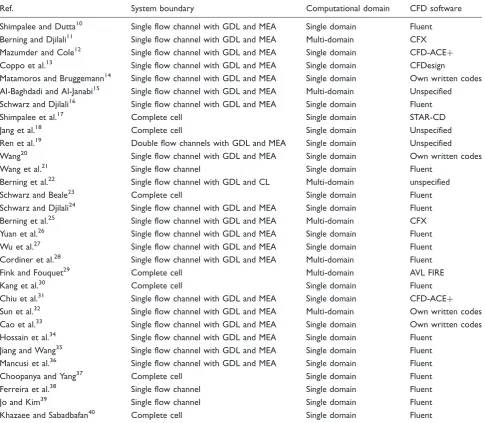
In this section, salient numerical features of the reviewed articles, such as system boundary, compu-tational domain, and CFD solvers used are discussed. A summary of this information is given in Table 4.
System boundary
In PEM fuel cell modelling, defining a manageable system boundary in order to reduce computational efforts without compromising accuracy is often necessary.
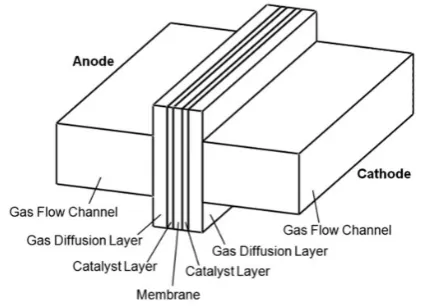
From Table 4, it is very apparent that the vast majority of the models analysed take advantage of the symmetric layout of the fuel cell geometry to only model a single GFC on both anode and cathode sides with the corresponding GDLs and CLs and the mem-brane as illustrated in Figure 4. This reduces the com-putational efforts considerably. A full 3D description of a complete cell or a fuel cell stack would require very large computing resources and overly long simulation time. Thus, a complete cell is only computed in five cases (in the models for geometry or operating condi-tion effects mainly) and the simulacondi-tion of a complete fuel cell stack is not performed.
Computational domain
In terms of modelling domain (computational domain), two distinct approaches are used in the reviewed papers for computing the numerical solutions of PEM fuel cell mathematical models according to the different regions within the cell. These are single-domain and multi-domain approaches, with a greater number of the models reviewed adopting the single-domain approach (see Table 4).
In the single-domain approach, the generic conser-vation law equations are used for the entire modelling domain and only the source terms vary according to each region or component, whereas in the multi-domain approach different forms of the same equations are solved in each region or component within the cell, and boundary or initial conditions may be required on internal interfaces.
The advantage to the single-domain approach is that it does not require the specification of interface condi-tions between the individual fuel cell components and aid in parallel computing. It may however involve a careful numerical manipulation of the equations to retain a model that is physically realistic since all of the equations are solved at once over the entire model which can also be wasteful in terms of memory and speed.
coupling dominates and it does not readily facilitate parallelization.
Solvers
As explained in ‘CFD’ section, for a CFD solver to solve a non-linear differential model, this must first be converted into a system of linear algebraic equations. In most CFD software, this conversion is performed by means of the finite volume method (FVM), which dis-cretizes both the computational domain and the con-servation equations using highly sophisticated algorithms.
For the coupling of velocity and pressure, the major-ity of the available CFD codes use the semi-implicit method for pressure-linked equations algorithm
although the pressure-implicit split-operator algorithm is also used.
Based on the literature model overview, one can say that Fluent is well suited for 3D PEM fuel cell model-ling. More details on the most frequently used CFD codes for PEM fuel cell simulation is provided in ‘CFD codes for PEM fuel cell modelling’ section.
CFD codes for PEM fuel cell modelling
There are several CFD codes that can be used for PEM fuel cell model simulation ranging from commercial software through open source free codes to own written programs.
[image:18.595.50.536.85.508.2]Although most of these software use similar tech-niques for the discretization of both the computational
Table 4. Summarized numerical features of the reviewed papers.
Ref. System boundary Computational domain CFD software
Shimpalee and Dutta10 Single flow channel with GDL and MEA Single domain Fluent
Berning and Djilali11 Single flow channel with GDL and MEA Multi-domain CFX Mazumder and Cole12 Single flow channel with GDL and MEA Single domain CFD-ACEþ
Coppo et al.13 Single flow channel with GDL and MEA Single domain CFDesign
Matamoros and Bruggemann14 Single flow channel with GDL and MEA Single domain Own written codes Al-Baghdadi and Al-Janabi15 Single flow channel with GDL and MEA Multi-domain Unspecified Schwarz and Djilali16 Single flow channel with GDL and MEA Single domain Fluent Shimpalee et al.17 Complete cell Single domain STAR-CD
Jang et al.18 Complete cell Single domain Unspecified Ren et al.19 Double flow channels with GDL and MEA Single domain Unspecified Wang20 Single flow channel with GDL and MEA Single domain Own written codes Wang et al.21 Single flow channel Single domain Fluent
Berning et al.22 Single flow channel with GDL and CL Multi-domain unspecified Schwarz and Beale23 Complete cell Single domain Fluent Schwarz and Djilali24 Single flow channel with GDL and MEA Single domain Fluent Berning et al.25 Single flow channel with GDL and MEA Multi-domain CFX Yuan et al.26 Single flow channel with GDL and MEA Single domain Fluent Wu et al.27 Single flow channel with GDL and MEA Single domain Fluent Cordiner et al.28 Single flow channel with GDL and MEA Multi-domain Fluent Fink and Fouquet29 Complete cell Multi-domain AVL FIRE Kang et al.30 Complete cell Single domain Fluent Chiu et al.31 Single flow channel with GDL and MEA Single domain CFD-ACEþ
Sun et al.32 Single flow channel with GDL and MEA Multi-domain Own written codes Cao et al.33 Single flow channel with GDL and MEA Single domain Own written codes Hossain et al.34 Single flow channel with GDL and MEA Single domain Fluent
Jiang and Wang35 Single flow channel with GDL and MEA Single domain Fluent Mancusi et al.36 Single flow channel with GDL and MEA Single domain Fluent Choopanya and Yang37 Complete cell Single domain Fluent Ferreira et al.38 Single flow channel Single domain Fluent
Jo and Kim39 Single flow channel Single domain Fluent Khazaee and Sabadbafan40 Complete cell Single domain Fluent
domain and the partial differential equations (e.g. FVM) and have similar capabilities to deal with the multidimensional effects of the phenomena taking place in the fuel cell, they occasionally differ in their approach to modelling multiphase flow and the phase change processes.
This section gives a brief overview of the most com-monly used CFD software for the numerical modelling and simulation of PEM fuel cells.
Commercial codes
AVL FIRETM. AVL FIRE is a multi-purpose thermo-fluid CFD software package that is capable of simulating fluid dynamics problems involving complex geometries and the interplay of advanced physics and chemistry.57 The multiphase flow modules consist of Eulerian and Lagrangian multiphase modules. The Eulerian multi-phase module uses the multi-fluid modelling approach of multiphase flow and thus allows the calculation of the volume fraction distribution for each phase in add-ition to all other flow variable. The Lagrangian multi-phase module accounts for droplet break-up, turbulence dispersion, collision and coalescence, distor-tion and drag, evaporadistor-tion as well as droplet/wall inter-action. It thus allows a detailed study of the movements of the droplet.57
CFD-ACEþ. CFD-ACEþ is an advanced CFD and multi-physics software that enables coupled simulations of fluid, thermal, chemical, etc. phenomena. It is spe-cifically designed for parallel computing on high per-formance workstations and clusters but it also works on normal computer systems.58
The software provides built-in models for the mod-elling of electrochemistry and flow through porous media and small channels. The PEM fuel cell module accounts for the fundamental physics of PEM fuel cell.
It includes a model for water transport through the membrane, a model for transport of liquid water saturation through the porous media, and the liquid saturation model for two-phase flow in the channels.58
CFX. ANSYS CFX is a general purpose fluid dynamics program that offers an abundant choice of physical models, capturing any type of phenomena related to fluid flow. Its highly parallelized solver supports the simulation of flow in porous media, multiphase flow, phase change, and so forth.59
Two distinct multiphase flow models are provided, Eulerian–Eulerian multiphase model and a Lagrangian particle tracking multiphase model. The Eulerian– Eulerian multiphase model allows the modelling of multiphase flow using either the multiphase mixture or the multi-fluid modelling approaches. The Lagrangian particle tracking multiphase model models the total flow of the particle phase by tracking a small number of particles through the continuum fluid. The particles could be solid particles, drops, or bubbles.60
COMSOL MultiphysicsÕ. COMSOL Multiphysics is a very versatile software platform for various coupled phenomena.61
A battery and fuel cell module that can be used to model the underlying electrochemical phenomena in the electrodes and electrolytes of batteries and fuel cells is provided. The CFD module allows the model-ling of multiphase flows as well as flow in porous media. Multiphase flow is modelled using the bubbly flow, multiphase mixture, or Eulerian–Eulerian multiphase models. Phase changes are described using built-in step functions.61
Fluent. ANSYS Fluent is a general purpose fluid analysis software package with broad physical model-ling capabilities for modelmodel-ling flow, turbulence, heat transfer, and reactions for industrial applications.62
It provides a fuel cell module that can be used for the modelling of electrochemistry, current and mass trans-port, heat source, liquid water formation, and transport in PEM fuel cells.63
[image:19.595.74.286.68.221.2]Two distinct approaches are used for the numerical calculation of multiphase flows: the Eulerian– Lagrangian approach and the Eulerian–Eulerian approach. In the Eulerian–Lagrangian approach the fluid phase is treated as a continuum by solving the Navier–Stokes equations, while the dispersed phase is solved by tracking a large number of particles, bubbles, or droplets through the calculated flow field. In the Eulerian–Eulerian approach, the different phases are treated mathematically as inter-penetrating continua. Three different Eulerian–Eulerian multiphase models
Figure 4. A single straight channel with corresponding GDL and MEA.
are available in Fluent: VOF model, the mixture model, and the Eulerian model.64
STAR-CDÕ. CD-adapco STAR-CD and STAR-CCMþ are well-established software platforms for industrial CFD simulation that are capable of solving complex multidimensional and multi-physics models.
STAR-CD has been used with a specialized PEM fuel cell module (es-pemfc) to gain a better understand-ing of water management as well as electrochemistry in PEM fuel cell, leading to optimized cell performance.65 STAR-CCMþ can perform comprehensive simula-tions involving electrochemistry allowing fuel cell modelling. Multiphase flow modelling is completed using Eulerian multiphase model, with other models within the Eulerian framework, such as the Eulerian multiphase mixture model, VOF, fluid film, and the dispersed multiphase model.66
Free codes
OpenFOAMÕ. OpenFOAM is an open source CFD code that can solve anything from complex fluid flows invol-ving chemical reactions, turbulence, and heat transfer, to solid dynamics and electromagnetics.67
The object-oriented design of the software which is written in Cþþ allows the implementation of own models and numerical algorithms. Thus, the user has complete freedom to customize and extend any existing functionality.67
A wide range of solvers is provided for the simula-tion of flow in porous media and multiphase flows. The approaches available for the modelling of multiphase flows range from a system of two fluid phases model with one phase dispersed, through VOF phase fraction-based interface capturing approach, to multiphase mix-ture and multi-fluid models.67
Other codes
Besides the conventional CFD codes outlined above, there exist other CFD codes which are also capable of performing the same numerical modelling and simula-tion of PEM fuel cells, and often with equal results. These are usually highly specialized own written pro-grams developed by individual academic or industrial research groups. Multiphase flow is modelled using either the multiphase mixture or the multi-fluid model-ling approaches mainly.
Summary and outlook
A comprehensive review of the open literature 3D multiphase CFD models for PEM fuel cell was con-ducted. This revealed the large volume of published
work dealing with the modelling and simulation of transport phenomena in PEM fuel cells, as well as ther-mal management and the influence of geometry or operating conditions on the cell performance.
It is difficult to directly compare the published models because of the modelling of multiphase flow, phase change, and other modelling assumptions, as well as model validation methods used by the authors. Nevertheless, it appears that 1D and 2D models are only suitable when focusing on particular phenomena, whereas 3D models allow multi-physics simulations of a single component, a complete cell, or even a fuel cell stack and they can be used for design purposes.
Thus, the 3D PEM fuel cell models presented in a selection of journal papers were thoroughly analysed. This revealed that comprehensive 3D multiphase flow CFD models that elucidate the complex couplings of electrochemical kinetics and multiphase transport are still greatly in need though significant advances have been made in PEM fuel cell modelling.
Indeed, truly functional and predictive capabilities remain a challenge due to deficiencies in models for two-phase transport in the GFCs and the porous media. A further limitation of many of the existing comprehensive 3D models is that they do not consider the detailed composition and structure of the CLs, des-pite the important role of the CLs in determining the cell performance.
Therefore, more research is required to develop models that include the detailed composition and struc-ture of the CLs. Such comprehensive models should also consider the effects of the movement of water droplet in the GFCs, the existence of phase change in both the anode and cathode sides of the fuel cell, as well as dissolved water transport and related phase change mechanisms. These matters have thus far received little attention.