Alexander Streltsov,1, 2, 3, 4,∗Gerardo Adesso,5,†and Martin B. Plenio6,‡
1Faculty of Applied Physics and Mathematics, Gda ´nsk University of Technology, 80-233 Gda ´nsk, Poland 2National Quantum Information Centre in Gda ´nsk, 81-824 Sopot, Poland
3Dahlem Center for Complex Quantum Systems, Freie Universität Berlin, D-14195 Berlin, Germany
4ICFO – Institut de Ciències Fotòniques, The Barcelona Institute of Science and Technology, ES-08860 Castelldefels, Spain 5Centre for the Mathematics and Theoretical Physics of Quantum Non-Equilibrium Systems (CQNE),
School of Mathematical Sciences, The University of Nottingham, University Park, Nottingham NG7 2RD, United Kingdom 6Institute of Theoretical Physics & IQST, University of Ulm, Albert-Einstein-Allee 11, D-89069 Ulm, Germany
(Dated: July 10, 2017)
The coherent superposition of states, in combination with the quantization of observables, represents one of the most fundamental features that mark the departure of quantum mechanics from the classical realm. Quantum coherence in many-body systems embodies the essence of entanglement and is an essential ingredient for a plethora of physical phenomena in quantum optics, quantum information, solid state physics, and nanoscale thermodynamics. In recent years, research on the presence and functional role of quantum coherence in biological systems has also attracted a considerable interest. Despite the fundamental importance of quantum coherence, the development of a rigorous theory of quantum coherence as a physical resource has only been initiated recently. In this Colloquium we discuss and review the development of this rapidly growing research field that encompasses the characterization, quantification, manipulation, dynamical evolution, and operational application of quantum coherence.
CONTENTS
I. Introduction 2
II. Resource theories of quantum coherence 3
A. Constraints, operations and resources 3
1. Incoherent states 4
2. Classes of incoherent operations 4
B. Coherence as a resource 6
1. Maximally coherent states and state transformations via
incoherent operations 6
2. States and maps 7
C. Quantum coherence in distributed scenarios 7
D. Connection between coherence and entanglement theory 8
III. Quantifying quantum coherence 9
A. Postulates for coherence monotones and measures 9
B. Distillable coherence and coherence cost 10
C. Distance-based quantifiers of coherence 11
1. Relative entropy of coherence 11
2. Coherence quantifiers based on matrix norms 11
3. Geometric coherence 12
D. Convex roof quantifiers of coherence 12
E. Coherence monotones from entanglement 13
F. Robustness of coherence 13
G. Coherence quantifiers from interferometric visibility 14
H. Coherence of assistance 14
I. Coherence and quantum correlations beyond entanglement 15
J. Coherence in continuous variable systems 15
K. Coherence, asymmetry and nonclassicality 16
1. Asymmetry monotones 16
2. Quantifying superpositions 17
3. Coherence rank and general quantifiers of nonclassicality 17
4. Optical coherence and nonclassicality 18
L. Multipartite settings 18
1. General distance-based coherence quantifiers 18
∗[email protected] †[email protected] ‡
2. Quantum-incoherent relative entropy 19
3. Distillable coherence of collaboration 19
4. Recoverable coherence 19
5. Uncertainty relations and monogamy of coherence 20
IV. Dynamics of quantum coherence 20
A. Freezing of coherence 20
B. Coherence in non-Markovian evolutions 21
C. Cohering power of quantum channels and evolutions 21
D. Average coherence of random states and typicality 22
1. Average relative entropy of coherence 23
2. Averagel1-norm of coherence 23
3. Average recoverable coherence 23
E. Quantum speed limits 23
V. Applications of quantum coherence 24
A. Quantum thermodynamics 24
1. Thermal operations 24
2. State transformations via thermal operations 25
3. Work extraction and quantum thermal machines 26
B. Quantum algorithms 26
C. Quantum metrology 27
D. Quantum channel discrimination 27
E. Witnessing quantum correlations 28
F. Quantum biology and transport phenomena 28
G. Quantum phase transitions 29
VI. Conclusions 29
Acknowledgments 30
References 30
I. INTRODUCTION
Coherence marks the departure of today’s theories of the physical world from the principles of classical physics. The theory of electro-magnetic waves, which may exhibit opti-cal coherence and interference, represents a radiopti-cal departure from classical ray optics. Energy quantisation and the rise of quantum mechanics as a unified picture of waves and particles in the early part of the 20thcentury has further amplified the prominent role of coherence in physics. Indeed, by combina-tion of energy quantizacombina-tion and the tensor product structure of the state space, coherence underlies phenomena such as quantum interference and multipartite entanglement, that play a central role in applications of quantum physics and quantum information science.
The investigation and exploitation of coherence of quantum
optical fieldshas a longstanding history. It has enabled the re-alization of now mature technologies, such as the laser and its applications, that are often classified as ‘Quantum Technolo-gies 1.0’ as they rely mainly on single particle coherence. At the mathematical level the coherence of quantum optical fields is described in terms of phase space distributions and multi-point correlation functions, approaches that find their roots in classical electromagnetic theory (Glauber,1963;Mandel and Wolf,1965;Sudarshan,1963).
However, quantum coherence is not restricted to optical fields. More importantly, as the key ingredient that drives quantum technologies, it would be highly desirable to be able to precisely quantify the usefulness ofcoherence as a resource
for such applications. These pressing questions are calling for a further development of the theory of quantum coherence.
The emergence of quantum information science over the last three decades has, amongst other insights, led to a re-assessment of quantum physical phenomena as resources that may be exploited to achieve tasks that are otherwise not possi-ble within the realm of classical physics. This resource-driven viewpoint has motivated the development of a quantitative theory that captures the resource character of physical traits in a mathematically rigorous fashion.
In a nutshell, any such theory first considers constraints that are imposed on us in a specific physical situation (e.g. the in-ability to perform joint quantum operations between distant laboratories due the impossibility to transfer quantum systems from one location to the other while preserving their quan-tum coherence, and thus restricting us to local operations and classical communication). Executing general quantum oper-ations under such a constraint then requires quantum states that contain a relevant resource (e.g. entangled states that are provided to us at a certain cost) and can be consumed in the process. The formulation of such resource theories was in fact initially pursued with the quantitative theory of entanglement (Horodecki et al.,2009; Plenio and Virmani,2007) but has since spread to encompass a wider range of operational set-tings (Coeckeet al.,2016;del Rioet al.,2015;Horodecki and Oppenheim,2013b).
The theory of quantum coherence as a resource is a case in
point. Following an early approach to quantifying superposi-tionsof orthogonal quantum states by (Åberg,2006), and pro-gressing alongside the independent yet related resource theory ofasymmetry(Gouret al.,2009;Gour and Spekkens,2008; Marvian and Spekkens,2014a,b;Vaccaroet al.,2008), a re-source theory of coherencehas been primarily proposed in (Baumgratzet al.,2014;Levi and Mintert,2014) and further developed in (Chitambar and Gour,2016a,b,2017;Winter and Yang,2016;Yadinet al.,2016). Such a theory asks the ques-tion what can be achieved and at what resource cost when the devices that are available to us are essentially classical, that is, they cannot create coherence in a preferred basis. This analy-sis, currently still under development, endeavors to provide a rigorous framework to describe quantum coherence, in anal-ogy with what has been done for quantum entanglement and other nonclassical resources (Adessoet al.,2016;Horodecki and Oppenheim,2013b;Horodeckiet al.,2009;Modiet al., 2012; Plenio and Virmani,2007; Sperling and Vogel,2015; Streltsov,2015). Within such a framework, recent progress has shown that a growing number of applications can be cer-tified to rely on various incarnations of quantum coherence as a primary ingredient, and appropriate figures of merit for such applications can be precisely linked back to specific co-herence monotones, providing operational interpretations for the latter.
These applications include so-called ‘Quantum Technolo-gies 2.0’, such as quantum-enhanced metrology and commu-nication protocols, and extend further into other fields, like thermodynamics and even certain branches of biology. Be-yond such application-driven viewpoint, which may provide new insights into all these areas, one can also consider the theory of coherence as a resource as a novel approach towards the demarcation of the fundamental difference between classi-cal and quantum physics in a quantitative manner: a goal that may eventually lead to a better understanding of the classical-quantum boundary.
The present Colloquium collects the most up-to-date knowledge on coherence in single and composite quantum systems, from a modern information theory perspective. We set to review this fascinating and fundamental subject in an accessible manner, yet without compromising any rigor.
coher-Section II
Resource Theories
PIO
Section IV
Dynamics
Section III
Quantification
Section V
Applications
? ✓
Quantum
Coherence
incoherent operation coherent incoherent
entangled S:A A S
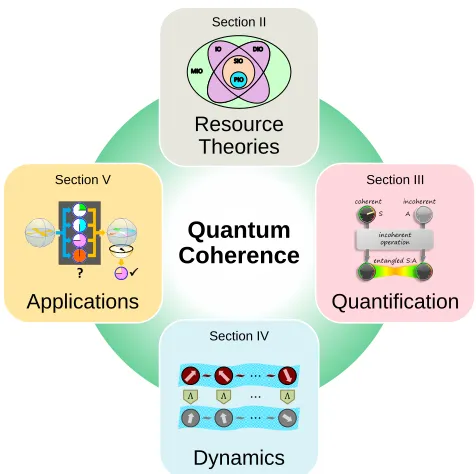
Figure 1 (Color online) Plan of the Colloquium. (Top) SectionII: Resource theories of quantum coherence; the inset depicts a com-parison between some classes of incoherent operations, adapted and reproduced with permission from (Chitambar and Gour, 2016b). (Right) Section III:Quantifying quantum coherence; the inset de-picts the construction of coherence monotones from entanglement, adapted and reproduced with permission from (Streltsovet al.,2015). (Bottom) SectionIV:Dynamics of quantum coherence; the inset depicts an illustration of coherence freezing under local incoherent channels, adapted and reproduced with permission from (Bromley
et al.,2015). (Left) SectionV:Applications of quantum coherence;
the insets depicts a schematic of a quantum phase discrimination pro-tocol, adapted and reproduced with permission from (Napoliet al.,
2016). Introduction(SectionI) andConclusions(SectionVI)
com-plete the Colloquium.
ence of random states, and on the cohering power of quantum channels. SectionVfocuses on the plethora of applications and operational interpretations highlighted so far for quan-tum coherence in thermodynamics, interference phenomena, quantum algorithms, metrology and discrimination, quantum biology, many-body physics and the detection of quantum cor-relations. SectionVIconcludes the Colloquium with a sum-mary and a discussion of some currently open issues in the theoretical description of coherence and its role in quantum physics and beyond.
We emphasize that, due to limitations in space and focus, this Colloquium cannot cover all ramifications of the concept of quantum coherence. It is nevertheless our expectation that this Colloquium, while being self-contained, can stimulate the reader to undertake further research towards achieving a fully satisfactory and physically consistent characterization of the wide-interest topic of coherence as a resource in quantum sys-tems of arbitrary dimensions. This, we hope, may also lead to the formulation of novel direct applications of coherence (or an optimization of existing ones) in a variety of physical and biological contexts of high technological interest.
II. RESOURCE THEORIES OF QUANTUM COHERENCE
Coherence is a property of the physical world that is used to drive a wide variety of phenomena and devices. Hence co-herence adopts the quality of a resource, as it may be pro-vided at a certain cost, manipulated by otherwise incoherent means, and consumed to achieve useful tasks. The quantita-tive study of these processes and their attainable efficiencies requires careful definitions of the accessible operations and gives rise to a framework that has become known as aresource theory. In line with earlier developments in quantum infor-mation science, for example in the context of entanglement (Brandão and Plenio,2008,2010;Horodeckiet al.,2009; Ple-nio and Virmani,2007; Vedral and Plenio, 1998), quantum thermodynamics (Brandão et al.,2013; Goold et al., 2016; Gouret al.,2015; Janzinget al.,2000;Ruch,1975), purity (Horodecki et al.,2003), and reference frames (Gouret al., 2009; Gour and Spekkens, 2008; Marvian and Spekkens, 2014a), the formulation of the resource theory of coherence (Åberg,2006;Baumgratzet al.,2014;Levi and Mintert,2014; Winter and Yang,2016) extends the family of resources theo-ries of knowledge (del Rioet al.,2015).
A. Constraints, operations and resources
A resource theory is fundamentally determined by con-straints that are imposed on us and which determine the set of the freely accessible quantum operationsF. These con-straints may be due to either fundamental conservation laws, such as superselection rules and energy conservation, or con-straints due to the practical difficulty of executing certain op-erations, e.g. the restriction to local operations and classical communication (LOCC) which gives rise to the resource the-ory of entanglement (Horodeckiet al.,2009;Plenio and Vir-mani,2007).
The states that can be generated from the maximally mixed state1 by the application of free operations inF alone, are considered to be available free of charge, forming the setI
of free states. All the other states attain the status of a re-source, whose provision carries a cost. These resource states may be used to achieve operations that cannot be realized by using only members ofF. Alternatively, one may also begin by defining the set of free statesI, and then consider classes of operations that map this set into itself and use this to define
F. For the purposes of the present exposition of the resource theory of coherence, we begin by adopting the latter point of view and then proceed to require additional desirable proper-ties of our classes of free operations.
[image:3.612.57.295.51.288.2]1. Incoherent states
Coherence is naturally a basis dependent concept, which is why we first need to fix the preferred, orreference basis in which to formulate our resource theory. The reference basis may be dictated by the physics of the problem under inves-tigation (e.g. one may focus on the energy eigenbasis when addressing coherence in transport phenomena and thermody-namics) or by a task for which coherence is required (e.g. the estimation of a magnetic field in a certain direction within a quantum metrology setting). Given ad-dimensional Hilbert space H (with d assumed finite, even though some exten-sions to infinited can be considered), we will denote its ref-erence orthonormal basis by{|ii}i=0,...,d−1. The density matri-ces that are diagonal in this specific basis are called incoher-ent, i.e., they are accessible free of charge, and form the set
I ⊂ B(H), whereB(H) denotes the set of all bounded trace class operators onH. Hence, all incoherent density operators %∈ Iare of the form
%=
d−1 X
i=0
pi|iihi| (1)
with probabilitiespi.
In the case of more than one party, the preferred basis with respect to which coherence is studied will be constructed as the tensor product of the corresponding local reference ba-sis states for each subsystem. General multipartite incoher-ent states are then defined as convex combinations of such in-coherent pure product states (Bromleyet al.,2015;Streltsov et al.,2015;Winter and Yang,2016).
For example, if the reference basis for a single qubit is taken to be the computational basis{|0i,|1i}, i.e., the eigenbasis of the Pauliσzoperator, then any density matrix with a nonzero offdiagonal element|%01| =|h0|%|1i| ,0 is outside the setI
of incoherent states, hence has a resource content. Similarly, for anN-qubit system, the set of incoherent statesIis formed by all and only the density matrices%diagonal in the compos-ite computational basis{|0i,|1i}⊗N, with any other state being coherent, that is, resourceful.
We also note that some frameworks of coherence may al-low for a larger set of free states. This is in particular the case for the resource theory of asymmetry (Gouret al.,2009;Gour and Spekkens,2008;Marvian and Spekkens,2014a,b), where the set of free states is defined by all states which commute with a given HamiltonianH. If the Hamiltonian is nondegen-erate, the corresponding set of free states is exactly the set of incoherent states described above, where the incoherent ba-sis is defined by the eigenbaba-sis of the Hamiltonian. However, the situation changes if the Hamiltonian has degeneracies, in which case also any superposition of the eigenstates corre-sponding to the degenerate subspaces is also considered as free. This has important implications in quantum thermody-namics, as is described in more detail in SectionV.A. In the following, whenever we refer to incoherent states, we explic-itly mean states of the form (1).
2. Classes of incoherent operations
The definition of free operations for the resource theory of coherence is not unique and different choices, often motivated by suitable practical considerations, are being examined in the literature. Here, we present the most important classes and briefly discuss their properties and relations among each other. We start with the largest class, the maximally incoherent operations(MIO) (Åberg,2006) (also known as incoherence preserving operations), which are defined as any trace preserv-ing completely positive and non-selective quantum operations
Λ:B(H)7→ B(H) such that
Λ[I]⊆ I. (2)
As with every quantum operation, also this mathematically natural set of operations can always be obtained by a Stine-spring dilation, i.e. the provision of an ancillary environment in some stateσ, a subsequent unitary operationU between system and environment, followed by the tracing out of the environment,
Λ[%]=TrE[U(%⊗σ)U†]. (3)
If an operation can be implemented as in Eq. (3) by using an incoherent stateσof the environment and a global incoherent unitaryU(a unitary that is diagonal in the preferred basis), we say that the operation has afree dilation. It should be noted that despite the fact that MIO cannot create coherence, these operations in general do not have a free dilation2(Chitambar and Gour,2016a,b,2017;Marvian and Spekkens,2016).
A smaller and more relevant class of free operations for the theory of coherence is that ofincoherent operations(IO) (Baumgratzet al.,2014) which are characterized as the set of trace preserving completely positive mapsΛ:B(H)7→ B(H) admitting a set ofKraus operators{Kn}3such thatPnK
† nKn= 1(trace preservation) and, for allnand%∈ I,
Kn%Kn†
Tr[Kn%Kn†]
∈ I. (4)
This definition of IO ensures that, in any of the possible out-comes of such an operation, coherence can never be generated from an incoherent input state, not even probabilistically4.
Also this class of operations does not admit a free dilation in general (Chitambar and Gour,2016a,b,2017;Marvian and Spekkens,2016).
In the previous two definitions, the focus was placed on the inability of incoherent operations to generate coherence. One
2This mirrors the situation in entanglement theory where separable opera-tions cannot create entanglement but in general cannot be implemented via LOCC (Bennettet al.,1999).
3According to the Kraus decomposition, the maps act asΛ[%]=P
may however be more stringent by adding further desirable properties to the set of free operations. One such approach requires that admissible operations are not capable of making use of coherence in the input state. Defining the dephasing operation
∆[%]= d−1 X
i=0
|iihi|%|iihi|, (5)
an operationΛis calledstrictly incoherent(SIO) (Winter and Yang,2016;Yadinet al.,2016) if it can be written in terms of a set of incoherent Kraus operators{Kn}, such that the outcomes of a measurement in the reference basis applied to the output are independent of the coherence of the input state, i.e.,
hi|Kn%Kn†|ii=hi|Kn∆[%]Kn†|ii (6)
for allnandi. Equivalently, SIO can be characterized as those operations which have an incoherent Kraus decomposition
{Kn} such that the operators K†n are also incoherent (Winter and Yang,2016;Yadinet al.,2016). As was shown by (Chita-mbar and Gour,2016a,b,2017), SIO in general do not admit a free dilation either. Nevertheless, a special type of dilation for SIO of the form (3) was provided in (Yadinet al.,2016), which consists of: (i) unitary operations on the environment controlled by the incoherent basis of the system:P
j|jihj|⊗Uj; (ii) measurements on the environment in any basis; (iii) inco-herent unitary operations on the system conditioned on the measurement outcome:P
jeiθj|π(j)ihj|, with{|π(j)i}denoting a permutation of the reference basis of the system.
The classes of operations defined so far include permuta-tions of the reference basis states for free. This is natural when any such operation is considered from a passive point of view, amounting to a relabeling of the states. Viewed from an active point of view instead, i.e. asking for a unitary op-eration that realizes this permutation, it may be argued that such an operation does in fact cost coherence resources in or-der to be performed in laboratory. This suggests that, from an operational point of view, permutations should be excluded from the free operations, as is done in the more stringent set of translationally-invariant operations(TIO). The latter are defined as those commuting with phase randomization (Gouret al.,2009;Gour and Spekkens, 2008; Marvian and Spekkens,2013,2014a,b,2016;Marvianet al.,2016). More precisely, given a HamiltonianH, an operationΛis transla-tionally invariant with respect toHif it fulfills the condition (Gouret al.,2009;Marvian and Spekkens,2014a; Marvian et al.,2016)
e−iHtΛ[%]eiHt= Λ[e−iHt%eiHt]. (7)
TIO play an important role in the resource theory of asym-metry (see Sec.III.K.1) and quantum thermodynamics (see Sec. V.A). Interestingly, (Marvian and Spekkens, 2016) showed that TIO have a free dilation if one additionally allows postselection with an incoherent measurement on the environ-ment.
As already mentioned above, the sets MIO, IO, and SIO in general do not have a free dilation, i.e., they cannot be im-plemented by coupling the system to an environment in an incoherent state followed by a global incoherent unitary. Mo-tivated by this observation, (Chitambar and Gour, 2016a,b, 2017) introduced the set of physical incoherent operations
(PIO). These are all operations which can instead be imple-mented in the aforementioned way, additionally allowing for incoherent measurements on the environment and classical postprocessing of the measurement outcomes.
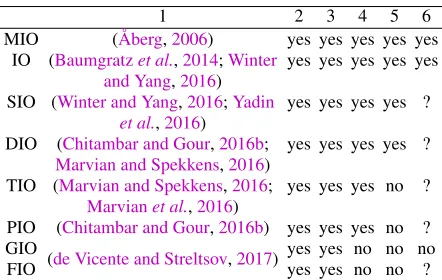
Clearly, MIO is the largest set of free operations for a re-source theory of coherence, and all other sets listed above are strict subsets of it. Inclusion relations between each of these sets are nontrivial in general. Here, we mention that (see also Fig.1, top panel)
PIO⊂SIO⊂IO⊂MIO, (8)
and refer to (Chitambar and Gour,2016a,b,2017;de Vicente and Streltsov,2017) for a more detailed discussion.
Another interesting set is given bydephasing-covariant in-coherent operations(DIO), which were introduced indepen-dently by (Chitambar and Gour,2016a,b,2017) and (Marvian and Spekkens,2016). These are all operationsΛwhich com-mute with the dephasing map Eq. (5), i.e.,Λ∆[%]= ∆Λ[%]. It is an interesting open question whether DIO have a free di-lation.
We also mention genuinely incoherent operations (GIO) and fully incoherent operations (FIO) (de Vicente and Streltsov, 2017). GIO are operations which preserve all in-coherent states, i.e.,Λ[%] = %for any incoherent state%. In particular, every GIO is incoherent regardless of the particu-lar Kraus decomposition, i.e., for every experimental realiza-tion of the operarealiza-tion. Since GIO do not allow for transforma-tions between different incoherent states, notably for example between the energy eigenstates (when coherence is measured with respect to the eigenbasis of the Hamiltonian of the sys-tem), they capture the framework of coherence in the presence of additional constraints, such as energy conservation. FIO is in turn the most general set of operations which is incoher-ent for every Kraus decomposition (de Vicincoher-ente and Streltsov, 2017). The GIO framework is closely related to the concept ofresource destroying mapsintroduced by (Liuet al.,2017). The latter studies quantum operations which transform any quantum state onto a free state, and moreover preserve all free states. If the set of free states is taken to be incoherent, any such coherence destroying map is also GIO.
The role of energy in the context of coherence has also been investigated by (Chiribella and Yang,2015). In partic-ular, (Chiribella and Yang,2015) defined the class ofenergy preserving operations(EPO) as all operations which have a free dilation as in Eq. (3), with the additional requirement that the unitary commutes with the Hamiltonian of the system and environment individually. Note that the set of EPO is a strict subset of TIO (Chiribella and Yang,2015).
Sets of free operations
Speakable coherence FIO PIO SIO IO DIO MIO
Unspeakable coherence GIO EPO TIO
Table I Classification of different frameworks of coherence into speakable and unspeakable type (Marvian and Spekkens,2016).
is operationally well-defined, though mathematically cumber-some, while larger sets such as separable operations (Vedral and Plenio,1998) and positive partial transpose preserving op-erations (Rains,2001) have mathematically very convenient properties, but in general do require a finite amount of free entanglement for their implementation (Bennettet al.,1999). Nevertheless, they are very useful as they provide bounds on achievable efficiencies for transformations under the difficult to handle LOCC constraints. Equally, the wealth of definitions for alternative incoherent operations can be expected to pro-vide both conceptual and quantitative insights into the proper-ties of coherence as a resource.
A classification of the different frameworks of coherence, motivated by the notion of speakable and unspeakable infor-mation (Bartlettet al.,2007;Peres and Scudo,2002), has been proposed by (Marvian and Spekkens,2016). Speakable infor-mation includes any type of inforinfor-mation for which the means of encoding is not relevant, while unspeakable information de-pends on the way of encoding. In general, a framework of coherence is speakable, if it allows for a free transformation between the states (|0i+|1i)/√2 and (|0i+|2i)/√2. Oth-erwise, the framework of coherence is unspeakable (Marvian and Spekkens,2016). In TableIwe summarize the aforemen-tioned frameworks of coherence according to this classifica-tion.
Before we move on, we would like to discuss two possi-ble extensions of incoherent operations which also apply to other classes that have been presented above. First, motivated by observations in entanglement theory (Jonathan and Plenio, 1999) one might define the set ofcatalytic incoherent opera-tions(Baumgratzet al.,2014) by allowing for the use of an additional physical system of arbitrary dimension, the cata-lyst, in a stateηwhich has to be returned unchanged after the transformation. That is, for arbitrary states % andσ of the system and (bipartite) incoherent operationsΛwe require
Λ[%⊗η]=σ⊗η. (9)
Indeed, in the theory of entanglement the addition of catalysts is known to confer additional power in that it makes possible state transformations that would otherwise be impossible un-der LOCC alone (Jonathan and Plenio,1999). As was shown by (Bu et al.,2016), these results also hold in the resource theory of coherence: catalytic incoherent operations allow for pure state transformations which cannot be achieved with in-coherent operations alone. The role of catalysts for the class TIO has also been discussed in (Marvian and Lloyd, 2016; Marvian and Spekkens,2013).
Concerning the second possible extension, up until this point we have considered only exact state transformations, an
idealization which, arguably, cannot be achieved in the real world. Hence, already from this practical consideration, one should also permit approximate state transformations such that, instead of the exact mapΛ[%] = σ, one would be sat-isfied with achieving||Λ[%]−σ||1≤for some small, where
||M||1 =Tr
√
M†Mdenotes the trace norm. Beyond the mere practical motivation, allowing for approximate transforma-tions has some relevance because it can considerably change the set of available state transformations. In particular, when permitting small errors to occur in catalysts their power may increase further, in fact so much that any state transformation may potentially become possible through embezzling of quan-tum states (van Dam and Hayden,2003). Stronger constraints such as substitutingby/logDwhereD=dim[η] andηis the state of the catalyst can prevent embezzling (see (Brandão et al.,2015a) for examples in quantum thermodynamics). On the other hand, the class ofasymptotically exact incoherent operationsbecomes particularly relevant when one wishes to consider the mapping% 7→σnot for a single copy, but start-ing fromNcopies,%⊗N. In this case, one typically asks for the minimal ratersuch that limN→∞{infΛ||Λ[%⊗brNc]−σ⊗N||1}=0, whereris the asymptotic cost ofσin terms of%, andbxc de-notes the largest integer lower than or equal to the real num-berx. Indeed, (Winter and Yang,2016) have carried out such a program defining the appropriate quantities and obtaining results that will be presented in more detail in Sec.III.B. Ap-proximate transformations for the class TIO have also been investigated recently by (Marvian and Lloyd,2016).
B. Coherence as a resource
We now proceed to explore the use of coherence as a re-source for enabling operations that would not otherwise be possible if only incoherent operations were accessible to the experimenter.
1. Maximally coherent states and state transformations via incoherent operations
We start by identifying ad-dimensional maximally coher-ent state as a state that allows for thedeterministicgeneration ofallotherd-dimensional quantum states by means of the free operations. Note that this definition is independent of a spe-cific coherence quantifier and allows to identify a unit for co-herence (coco-herence bit, orcobit)5 to which all measures may
be normalized; see also Sec.IIIfor more details on quantify-ing coherence. The canonical example of a maximally coher-ent state is
|Ψdi= √1 d
d−1 X
i=0
|ii (10)
5The name “cobit” for a unit of coherence has been first used in (Chitambar
as it is easy to see that by IO, anyd-dimensional state%may be prepared from|Ψdiwith certainty (Baumgratzet al.,2014). We note that not all frameworks of coherence that were dis-cussed in Sec.II.A.2have a maximally coherent state, i.e., a state from which all other states can be created via the corre-sponding set of operations. In particular, such a state does not exist for PIO (Chitambar and Gour,2016a,b,2017), GIO, and FIO (de Vicente and Streltsov,2017).
The full set of maximally coherent states is obtained as the orbit of|Ψdiunder all incoherent unitaries (Bai and Du,2015). For coherence theory the maximally coherent state|Ψdiplays a role analogous to the maximally entangled state in entan-glement theory. As we shall see later, both concepts are very closely related. One may also determine maximally coherent states under certain additional constraints, such as the degree of mixedness, which gives rise to the class ofmaximally co-herent mixed states(Singhet al.,2015a). For ad-dimensional system and any fixed spectrum {pn}dn=1, (Streltsov et al., 2016b) have proven that the state %max = Pdn=1pn|n+ihn+|, where{|n+i} denotes a mutually unbiased basis with respect to the incoherent basis{|ii}(that is,|hi|n+i|2= d1), is a univer-sal maximally coherent mixed state with respect to any coher-ence monotone under the set MIO. Complementarity relations between measures of purity and coherence have been further investigated in (Cheng and Hall, 2015;Giorda and Allegra, 2016a;Kumar,2017;Streltsovet al.,2016b;Xiet al.,2015b). The interconversion of pure states via incoherent operations has been studied by (Chitambar and Gour,2016a,b,2017;Du et al.,2015,2017;Winter and Yang,2016;Zhuet al.,2017). In particular, a pure state |φi can be converted into another pure state|ψivia IO or SIO if and only if∆[|ψihψ|] majorizes
∆[|φihφ|] (Winter and Yang,2016;Zhuet al.,2017), i.e.,
∆[|ψihψ|]∆[|φihφ|] (11)
is a necessary and sufficient condition for the transformation
|φi 7→ |ψivia IO or SIO6. Here, the majorization relation for
density matrices % σmeans that their spectra spec(%) =
(p1 ≥ . . . ≥ pd) and spec(σ) = (q1 ≥ . . . ≥ qd) fulfill the relationPt
i=1pi≥Ptj=1qjfor allt<d, andPdi=1pi=Pdj=1qj. Note that a similar majorization condition is also known in entanglement theory (Nielsen,1999).
Less progress has been made for the single copy transfor-mations of mixed coherent states and only isolated results are known. A notable result in this context was provided by (Chi-tambar and Gour, 2016a,b,2017), who gave a full charac-terization of single-qubit state conversion via SIO, DIO, IO, or MIO. In particular, a single-qubit state with Bloch vector
r = (rx,ry,rz)T can be converted into another single-qubit
6For IO, this result was first claimed by (Duet al.,2015), however the proof turned out to be incomplete (Chitambar and Gour,2016a,b,2017;Winter and Yang,2016). In a recent erratum, (Duet al.,2017) addressed the criti-cism of (Chitambar and Gour,2016a,b), and presented an alternative proof for systems of dimension 3. A complete proof for IO in any dimension was presented recently by (Zhuet al.,2017).
state with Bloch vector s = (sx,sy,sz)T via SIO, DIO, IO or MIO if and only if the following inequalities are fulfilled (Streltsovet al.,2017):
s2x+s
2
y≤r
2
x+r
2
y, (12)
1−s2z
s2
x+s2y
≥ 1−r
2
z r2
x+r2y
. (13)
In the asymptotic setting, any state which is not incoher-ent allows for the distillation of maximally coherincoher-ent states via IO (Winter and Yang,2016). The optimal rate for this pro-cess can be evaluated analytically. We refer to Sec.III.Bfor more details, where also the asymptotic state formation from maximally coherent states is discussed.
2. States and maps
A more complex task beyond state preparation is that of the generation of a general quantum operation from a supply of coherent states and incoherent operations. Just as the maxi-mally entangled state allows for the generation of all quantum operations (Eisertet al.,2000) via LOCC, so does the maxi-mally coherent state allow for the generation of all quantum operations via IO. The explicit construction for an arbitrary single-qubit unitary can be found in (Baumgratzet al.,2014), and the extension to general quantum operations of arbitrary dimension was studied by (Ben Dana et al.,2017; Chitam-bar and Hsieh,2016). In particular, it was shown by (Ben Danaet al., 2017) that any quantum operation acting on a Hilbert space of dimensiondcan be implemented via IO by consuming a maximally coherent state of dimensiond. The corresponding construction makes use of maximally coher-ent states even if the targeted quantum operation may only be very slightly coherent. It is an open question how much coherence is required for creating an arbitrary unitary, or an arbitrary quantum operation in general. However, by virtue of the monotonicity of coherence quantifiers under incoherent operations, lower bounds to the amount of coherence required to implement a quantum operation can be provided (Ben Dana et al.,2017;Buet al.,2017;Mani and Karimipour,2015).
C. Quantum coherence in distributed scenarios
parties are restricted to local incoherent operations only7.
While LICC operations in general have a difficult mathe-matical structure, it is possible to introduce the more general class ofseparable incoherent(SI) operations which has a sim-ple mathematical form (Streltsovet al.,2017):
Λ[%AB]=X i
(Ai⊗Bi)%AB(A†i ⊗B†i), (14)
whereAiandBiare local incoherent operators. General quan-tum operations of the form (14), but without the incoherence restriction, have been studied extensively in entanglement the-ory, where they are called separable operations (Vedral and Plenio,1998). It is an interesting open question whether the intersection of LOCC and SI operations is equal to LICC op-erations (Streltsovet al.,2017).
Asymmetric scenarios where only one of the parties is re-stricted to IO locally have also been considered (Chitambar et al., 2016; Streltsov et al., 2017). In the case where the second party (Bob) is restricted to incoherent operations, the corresponding sets of operations are called local quantum-incoherent operations and classical communication(LQICC) andseparable quantum-incoherent operations(SQI) respec-tively. LQICC operations are in particular important for the tasks of incoherent quantum state merging (Streltsovet al., 2016a) (see also next Section) and assisted coherence distil-lation (Chitambar et al.,2016; Streltsov et al.,2017). The latter task has also been performed experimentally (Wuet al., 2017), and will be discussed in more detail in Sec.III.L.3.
A related set of operations has been presented by (Matera et al.,2016) in the context of a resource theory of control of quantum systems, and calledglobal operations incoherent on B(GOIB). Those operations allow for incoherent operations on the subsystem B, and moreover they also allow for con-trolled operations in the incoherent reference basis fromBto
A. The latter amount to arbitrary control unitaries of the form
UC = PiUiA ⊗ |iihi|
B (Matera et al., 2016). Moreover, the
framework also allows to attach or discard subsystems ofA, and to perform measurements with postselection on this sub-system (Materaet al.,2016).
The sets LQICC, SQI, and GOIBlead to the same setQIof free states, which are calledquantum-incoherent states (Chi-tambaret al.,2016;Materaet al.,2016;Streltsovet al.,2017) and take the form
%=X
i
piσAi ⊗ |iihi|
B. (15)
Here,σA
i are arbitrary states on the subsystemA, while|ii Bare
incoherent states on the subsystemB. Moreover, LQICC is a strict subset of SQI (Streltsovet al.,2017) and GOIB(Matera et al.,2016). In turn, the latter is a strict subset of the maxi-mal set of operations mapping the set of quantum-incoherent
7In the frameworks studied in (Chitambar and Hsieh,2016;Streltsovet al.,
2017) local operations were restricted to the IO class, but other classes of local free operations can also be considered.
states onto itself, defined in (Maet al.,2016). We also note that GOIBcan create entanglement whilst using up coherence (Matera et al.,2016), which is not possible for LQICC and SQI operations. Finally, we note that the free states under LICC and SI operations are bipartite incoherent states, i.e., convex combinations of incoherent product states (Streltsov et al.,2017).
D. Connection between coherence and entanglement theory
The resource theory of coherence exhibits several connec-tions to the resource theory of entanglement. One of the first approaches in this direction was presented in (Streltsovet al., 2015), where it was shown that any state with nonzero co-herence can be used for entanglement creation via bipartite incoherent operations; we refer to Sec.III.Efor a detailed dis-cussion. These results were generalized to quantum discord (Maet al.,2016) and general types of nonclassicality (Killo-ranet al.,2016); see Secs.III.IandIII.K.3for more details.
The interplay between coherence and entanglement in dis-tributed scenarios has been first studied by (Chitambar and Hsieh,2016), who investigated state formation and distillation of entanglement and local coherence via LICC operations. In-terestingly, it was shown that a bipartite state has distillable entanglement if and only if entanglement can be distilled via LICC (Chitambar and Hsieh,2016).
Another relation between entanglement and coherence was provided in (Streltsovet al.,2016a), where the authors intro-duced and studied the task ofincoherent quantum state merg-ing. The latter is an incoherent version of standard quan-tum state merging (Horodeckiet al.,2005,2007), where two parties aim to merge their parts of a tripartite quantum state while preserving correlations with a third party. While stan-dard quantum state merging can lead to a gain of entangle-ment (Horodeckiet al.,2005,2007), no merging protocol can lead to a gain of entanglement and coherence simultaneously (Streltsovet al.,2016a).
Finally, we mention that the resource theory of coherence shares many similarities with the resource theory of entangle-ment, if the latter is restricted to maximally correlated states (Chitambaret al.,2016;Winter and Yang,2016). In particu-lar, given a quantum state%=P
i j%i j|iihj|, we can assign to it a bipartite maximally correlated state as%mc=Pi j%i j|iiihj j|. An important open question in this context is whether any of the aforementioned classes of incoherent operationsΛiis equivalent to LOCC operationsΛLOCC on maximally corre-lated states, i.e.,
σ= Λi[%] ?
⇔σmc= ΛLOCC[%mc]. (16)
III. QUANTIFYING QUANTUM COHERENCE
A. Postulates for coherence monotones and measures
The first axiomatic approach to quantify coherence has been presented by (Åberg,2006), and an alternative frame-work has been developed more recently by (Baumgratzet al., 2014). The latter approach can be seen as parallel to the ax-iomatic quantification of entanglement, first introduced two decades ago (Vedral and Plenio,1998; Vedralet al.,1997). The basis of the axiomatic approach consists of the follow-ing postulates that any quantifier of coherenceCshould ful-fill (Åberg,2006;Baumgratzet al.,2014; Levi and Mintert, 2014):
(C1) Nonnegativity:
C(%)≥0 (17)
in general, with equality if and only if%is inco-herent.
(C2) Monotonicity: Cdoes not increase under the ac-tion of incoherent operaac-tions8, i.e.,
C(Λ[%])≤C(%) (18)
for any incoherent operationΛ.
(C3) Strong monotonicity: Cdoes not increase on av-erage under selective incoherent operations, i.e.,
X
i
qiC(σi)≤C(%) (19)
with probabilities qi = Tr[Ki%Ki†], post-measurement statesσi=Ki%K
†
i/qi, and incoher-ent Kraus operatorsKi.
(C4) Convexity:Cis a convex function of the state, i.e.,
X
i
piC(%i)≥C
X
i pi%i
. (20)
At this point it is instrumental to compare conditions C2 and C3 to the corresponding conditions in entanglement theory (Horodeckiet al.,2009;Plenio and Virmani,2007;Vedral and Plenio,1998;Vedralet al.,1997). There, C2 is equivalent to the requirement that an entanglement quantifierEshould not increase under LOCC. Similarly, C3 is equivalent to the re-quirement thatEshould not increase on average under selec-tive LOCC operations, i.e., when the communicating parties are able to store their measurement outcomes.
8While this condition was originally proposed for the set IO (Baumgratz
et al.,2014), it can be generalized in a straightforward way to any set of operations discussed in Sec.II.A.2
Conditions C1 and C2 can be seen as minimal require-ments: any quantityCshould at least fulfill these two condi-tions in order to be a meaningful resource quantifier for some coherence-based task. Condition C3 quantifies the intuition that coherence should not increase under incoherent measure-ments even if one has access to the individual measurement outcomes. This condition C3, when combined with convex-ity C4, implies monotonicconvex-ity C2 (Baumgratz et al., 2014). The reason for this overcompleteness comes from entangle-ment theory: there are meaningful quantifiers of entangleentangle-ment which satisfy only some of the above conditions (Horodecki et al.,2009;Plenio and Virmani,2007).
Following standard notions from entanglement theory (Ple-nio and Virmani,2007), we call a quantityC which fulfills condition C1 and either condition C2 or C3 (or both) a coher-ence monotone. A quantityCwill be further called a coher-ence measureif it fulfills C1–C4 together with the following two additional conditions:
(C5) Uniquenessfor pure states: For any pure state|ψi Ctakes the form
C(|ψihψ|)=S(∆[|ψihψ|]), (21)
whereS(%) =−Tr[%log2%] is the von Neumann entropy9.
(C6) Additivity: C is additive under tensor products, i.e.,
C(%⊗σ)=C(%)+C(σ). (22)
We wish to remark that the terminology adopted here differs from the one used in some recent literature, which is mainly based on (Baumgratzet al.,2014). In particular, several au-thors require that a coherence measure only fulfills conditions C1–C4. With the more stringent approach presented here, in-spired from entanglement theory, we aim to distinguish two important coherence quantifiers: distillable coherence (which is equal to the relative entropy of coherence) and coherence cost (which is equal to the coherence of formation). As we will see in the following, these two quantities fulfill all condi-tions C1–C6 and are thus elevated to the status of measures. Most of the other coherence quantifiers presented in this Col-loquium remain coherence monotones, in the sense that they fulfill conditions C1 and C2; several of them also turn out to fulfill C3 and C4, however most violate C5 and C6.
Finally, we note that alternative or additional desirable re-quirements for coherence monotones may be proposed. In
9Note that this condition may be considered too strong in view of the fact that the quantity in the right-hand side of Eq. (21), i.e. the relative en-tropy of coherence (discussed in Sec.III.C.1), adopts its operational mean-ing in terms of coherence distillation and dilution only in the asymptotic limit. In a weaker form, postulate C5 might read instead:∀ >0 there ex-ists a family of statesΦ(n)∈ B(|ψihψ|⊗n) such that lim
particular, as was shown by (Yuet al.,2016b), for the set IO the conditions C3 and C4 can be replaced by the following single requirement of additivity on block-diagonal states:
C p%⊕(1−p)σ=pC(%)+(1−p)C(σ). (23)
When combining Eq. (23) with C1 and C2, these three condi-tions are equivalent to C1–C4 (Yuet al.,2016b). Furthermore, (Penget al.,2016a) postulated that any valid coherence quan-tifier should be maximal only on the set of pure maximally coherent states|Ψdi, a property satisfied in particular by the two coherence measures mentioned just above; however, such states do not represent a golden unit in all versions of the re-source theory of coherence, as remarked in Sec.II.B.1.
In the following Sections, we review the most relevant co-herence monotones and measures defined in current literature, as well as other recent quantitative studies of coherence — and nonclassicality more broadly — in single and multipartite quantum systems.
B. Distillable coherence and coherence cost
Thedistillable coherence is the optimal number of maxi-mally coherent single-qubit states|Ψ2iwhich can be obtained per copy of a given state %via incoherent operations in the asymptotic limit. The formal definition of distillable coher-ence can be given as follows (Winter and Yang,2016;Yuan et al.,2015):
Cd(%)=sup
(
R: lim n→∞ infΛi
Λi[%
⊗n]− |Ψ
2ihΨ2|⊗bnRc 1
!
=0 )
.
(24) From this definition it is tempting to believe that exact evalua-tion of distillable coherence is out of reach. Surprisingly, this is not the case, and a simple expression for distillable coher-ence of an arbitrary mixed state, withΛibelonging to the set IO, was given in (Winter and Yang,2016):
Cd(%)=S(∆[%])−S(%). (25)
For pure states this result was independently found by (Yuan et al.,2015). Interestingly, the distillable coherence also co-incides with the relative entropy of coherence which was in-troduced in (Baumgratzet al.,2014) and will be discussed in Sec.III.C.1. Since the relative entropy of coherence is a co-herence measure (Baumgratzet al.,2014), the same is true for the distillable coherence, i.e., it fulfills all requirements C1– C6.
Another important quantifier is thecoherence cost(Winter and Yang,2016;Yuanet al.,2015): it quantifies the minimal rate of maximally coherent single-qubit states|Ψ2i required to produce a given state % via incoherent operations in the asymptotic limit. Its formal definition is similar to that of en-tanglement cost, and can be given as follows:
Cc(%)=inf
(
R: lim n→∞ infΛi
%
⊗n−Λ
i h
|Ψ2ihΨ2|⊗bnRc i
1
!
=0 )
.
(26)
Interestingly, restricting againΛito the set IO, the coherence cost admits a single-letter expression. In particular, it is equal to the coherence of formation (Winter and Yang,2016):
Cc(%)=Cf(%). (27)
The coherence of formation will be defined and discussed in detail in Sec.III.D. The result in Eq. (27) can be seen as par-allel to the well known fact that the entanglement cost is equal to the regularized entanglement of formation (Hayden et al., 2001). However, in the case of coherence no regularization is required, which significantly simplifies the evaluation ofCc.
The coherence cost is a coherence measure, i.e., it ful-fills all conditions C1–C6. Conditions C1–C4 follow from Eq. (27) and the fact that the coherence of formation fulfills C1–C4 (Yuanet al.,2015). Condition C5 also follows from Eq. (27) and the definition of coherence of formation, see Sec-tionIII.D. Moreover, the coherence cost is additive, i.e., con-dition C6 is also satisfied (Winter and Yang,2016).
In general, the distillable coherence cannot be larger than the coherence cost:
Cd(%)≤Cc(%). (28)
For pure states this inequality becomes an equality, which im-plies that the resource theory of coherence is reversible for pure states. In particular, any state|ψ1iwith a distillable co-herence ofc1cobits can be asymptotically converted into any other state|ψ2iwith a distillable coherence ofc2 cobits at a ratec1/c2. However, there exist mixed states withCd strictly smaller thanCc(Winter and Yang,2016). Nevertheless, this phenomenon does not appear in its extremal form, i.e., there are no states with zero distillable coherence but nonzero co-herence cost (Winter and Yang,2016). Therefore, in contrast to entanglement theory (Horodeckiet al.,1998), there is no ‘bound coherence’ within the resource theory of coherence based on the set IO (Winter and Yang,2016).
Notice instead that, if one considers the maximal set MIO of incoherent operations, the corresponding resource theory of coherence becomes reversible also for mixed states, as the general framework of (Brandão and Gour, 2015) applies in this case (Winter and Yang,2016). This means that the distil-lable coherence under MIO remains equal to the relative en-tropy of coherence, i.e. Eq. (25) still holds under the largest set of free operations, while the coherence cost under MIO also reduces to the same quantity,Cc(%)=Cd(%), thus closing the irreversibility gap10. We further note that not all sets of operations presented in Sec.II.A.2allow for free coherence distillation; this is further discussed in Sec.VI.
C. Distance-based quantifiers of coherence
A general distance-based coherence quantifier is defined as (Baumgratzet al.,2014)
CD(%)=inf
σ∈ID(%, σ), (29)
whereDis a distance and the infimum is taken over the set of incoherent statesI. Clearly, any quantity defined in this way fulfills C1 for any distanceD(%, σ) which is nonnegative and
zero if and only if%=σ. Monotonicity C2 is also fulfilled for any set of operations discussed in Sec.II.A.2if the distance is contractive (Baumgratzet al.,2014),
D(Λ[%],Λ[σ])≤D(%, σ) (30)
for any quantum operationΛ.
Moreover, any distance-based coherence quantifier fulfills convexity C4 whenever the corresponding distance is jointly convex (Baumgratzet al.,2014),
D X
i pi%i,
X
j pjσj
≤X
i
piD(%i, σi). (31)
In the following, we will discuss explicitly three important distance-based coherence quantifiers.
1. Relative entropy of coherence
If the distance is chosen to be the quantum relative entropy
S(%||σ)=Tr[%log2%]−Tr[%log2σ], (32)
the corresponding quantifier is known as therelative entropy of coherence11(Baumgratzet al.,2014):
Cr(%)=min σ∈IS(%
||σ). (33)
The relative entropy of coherence fulfills conditions C1, C4, and C2 for any set of operations discussed in Sec.II.A.2. For the set IO it also fulfills C3 (Baumgratzet al.,2014). More-over, it is equal to the distillable coherenceCd, therefore both quantities admit the same closed expression (Baumgratzet al., 2014;Gouret al.,2009;Winter and Yang,2016)
Cr(%)=Cd(%)=S(∆[%])−S(%), (34)
where∆[%] is the dephasing operation defined in Eq. (5). The proof of this equality is remarkably simple: it is enough to
11The relative entropy of coherence defined in Eq. (33) coincides with a spe-cial instance of therelative entropy of superposition(Åberg,2006) and of therelative entropy of asymmetry(Gouret al.,2009;Vaccaroet al.,2008), which will be discussed in Sec.III.K. Furthermore, the quantity in the right-hand side of Eq. (34) was independently proposed as a coherence quantifier by (Herbut,2005) under the namecoherence information.
note that the relative entropy between an arbitrary state%and another incoherent stateσ∈ Ican be written as
S(%||σ)=S(∆[%])−S(%)+S(∆[%]||σ), (35)
which is straightforward to prove using the relation Tr[%log2σ] = Tr[∆[%] log2σ]. Minimizing the right-hand side of Eq. (35) over all incoherent statesσ ∈ I we imme-diately see that the minimum is achieved forσ= ∆[%], which completes the proof of Eq. (34). From Eq. (34) it also fol-lows that the relative entropy of coherence fulfills conditions C5 and C6.
As was further shown by (Singhet al., 2015b), the rela-tive entropy of coherence can also be interpreted as the mini-mal amount of noise required for fully decohering the state%. Moreover, it was shown in (Rodríguez-Rosarioet al.,2013) that the relative entropy of coherence is related to the devia-tion of the state from thermal equilibrium.
Possible extensions of the relative entropy of coherence to quantifiers based on the relative Rényi and Tsallis entropies have also been discussed (Chitambar and Gour, 2016a,b, 2017;Rastegin,2016).
2. Coherence quantifiers based on matrix norms
We will now consider coherence quantifiers based on ma-trix norms, i.e., such that the corresponding distance has the form D(%, σ) = ||%−σ|| with some matrix norm || · ||. We first note that any such distance is jointly convex, i.e., fulfills Eq. (31), as long as the corresponding norm|| · ||fulfills the triangle inequality and absolute homogeneity12 (Baumgratz et al.,2014). Thus, any matrix norm with the aforementioned properties gives rise to a convex coherence quantifier. Rele-vant norms with these properties are thelp-norm|| · ||lpand the
Schattenp-norm|| · ||p:
kMkl
p=
X
i,j
Mi j
p
1/p
, (36)
kMkp=
Tr
M†Mp/2
1/p
(37)
withp ≥1. The corresponding coherence quantifiers will be denoted byClpandCprespectively.
Thel1-norm of coherence Cl1was first introduced and stud-ied in (Baumgratzet al.,2014). In particular,Cl1 fulfills the conditions C1–C4 for the set IO and has the following simple expression (Baumgratzet al.,2014):
Cl1(%)=minσ
∈I
k%−σkl
1= X
i,j
|%i j|. (38)
For the maximally coherent state Cl1 takes the value
Cl1(|Ψdi) = d −1, which also means thatCl1 does not ful-fill conditions C5 and C6. It has also been shown in (Bu and Xiong,2016) thatCl1is a DIO and MIO monotone ford=2, while it violates the monotonicity condition C2 for DIO and MIO ford>2.
Forp=1 the corresponding Schatten norm reduces to the trace norm. Since the trace norm is contractive under quantum operations, the corresponding coherence quantifierC1 satis-fies the conditions C1, C4, and C2 for any set of operations discussed in Sec.II.A.2. However,C1violates the condition C3 for the set IO, as was shown in (Yuet al.,2016b) based on the violation of property in Eq. (23). Nevertheless, for single-qubit statesC1is equivalent toCl1, and thus the condition C3 is fulfilled in this case (Shaoet al.,2015). Similar results were obtained for generalX-states: also in this caseC1 is equiva-lent toCl1, and condition C3 is fulfilled for the set IO (Rana et al.,2016). The characterization of the closest incoherent state with respect to the trace norm is nontrivial in general, and partial results for pure states andX-states have been ob-tained in (Chenet al.,2016a;Ranaet al.,2016).
Forp = 2 the Schatten norm is equivalent to the Hilbert-Schmidt norm, and also equal to the l2-norm. In this con-text, (Baumgratzet al.,2014) studied the case where coher-ence is quantified via the squared Hilbert-Schmidt norm. They found that the coherence quantifier obtained in this way vio-lates strong monotonicity C3 for the set IO. For any p ≥ 1,
Cpis a convex coherence monotone for all single-qubit states, i.e., it fulfills C1, C4, and C2 for the set IO (Ranaet al.,2016). However, in generalClpandCpviolate conditions C2 and C3
for the set IO for all p > 1 in higher-dimensional systems (Ranaet al.,2016). Interestingly,Cpis a coherence monotone for the set GIO for allp≥1 (de Vicente and Streltsov,2017).
3. Geometric coherence
Here we will consider thegeometric coherencedefined in (Streltsovet al.,2015) as follows:
Cg(%)=1−max
σ∈I F(%, σ) (39)
with the fidelityF(%, σ)= ||√%√σ||21. The geometric coher-ence fulfills conditions C1, C4, and C2 for any set of opera-tions discussed in Sec.II.A.2. Additionally, it also fulfills C3 for the set IO (Streltsovet al.,2015). For pure states, the ge-ometric coherence takes the formCg(|ψi)=1−maxi|hi|ψi|2, which means thatCgdoes not meet conditions C5 and C6.
If% is a single-qubit state,Cg admits the following closed expression (Streltsovet al.,2015):
Cg(%)= 1 2 1−
q
1−4|%01|2 !
, (40)
where%01 =h0|%|1iis the offdiagonal element of%in the in-coherent basis. Note that for all single-qubit states we have
C1 =Cl1 =2|%01|, and thusCg is a simple function of these
quantities in the single-qubit case. As we will see in the fol-lowing subsections,Cg can also be considered as a convex roof quantifier of coherence, and is also closely related to the geometric entanglement. Upper and lower bounds on the ge-ometric coherence have been investigated in (Zhang et al., 2017a).
Another related quantity was introduced by (Baumgratz et al.,2014) and studied in (Shaoet al.,2015) where it was calledfidelity of coherence: CF(%) = 1−maxσ∈I
p
F(%, σ).
WhileCFfulfills conditions C1, C4, and C2 for any set of op-erations discussed in Sec.II.A.2, it violates the strong mono-tonicity condition C3 for IO (Shaoet al.,2015).
D. Convex roof quantifiers of coherence
Provided that a quantifier of coherence has been defined for all pure states, it can be extended to mixed states via the standard convex roof construction (Yuanet al.,2015):
C(%)= inf {pi,|ψii}
X
i
piC(|ψii), (41)
where the infimum is taken over all pure state decompositions of%=P
ipi|ψiihψi|. Constructions of this type have been pre-viously introduced and widely studied in entanglement theory (Bennettet al.,1996;Uhlmann,1998).
If for pure states the amount of coherence is quantified by the distillable coherence Cd(|ψi) = S(∆[|ψihψ|]), as in Eq. (21), the corresponding convex roof quantifier is known as thecoherence of formation(Åberg,2006;Winter and Yang, 2016;Yuanet al.,2015):
Cf(%)= inf {pi,|ψii}
X
i
piS(∆[|ψiihψi|]). (42)
As already noted in Sec.III.B,Cf is equal to the coherence cost under IO. As was shown by (Yuanet al.,2015), the co-herence of formation13 fulfills conditions C1–C4 for the set
IO. By definition,Cf also fulfills C5, and additivity C6 was proven in (Winter and Yang,2016). Remarkably,Cf violates monotonicity C2 for the class MIO (Hu,2016).
For a general state % = P
i j%i j|iihj|, the coherence of for-mation is equal to the entanglement of forfor-mation (Bennett et al.,1996) of the corresponding maximally correlated state %mc=Pi j%i j|iiihj j|(Winter and Yang,2016):
Cf(%)=Ef(%mc). (43)
Using the formula for the entanglement of formation of two-qubit states (Wootters,1998), Eq. (43) implies that the coher-ence of formation can be evaluated exactly for all single-qubit states (Yuanet al.,2015):
Cf(%)=h
1+p1−4|%01|2 2
, (44)
whereh(x) = −xlog2x−(1 −x) log2(1− x) is the binary entropy. If we compare this expression with the expression for the geometric coherence in Eq. (40), it follows thatCf = h(1−Cg) holds for any single-qubit state. Thus,Cf is also a simple function ofC1andCl1in this case.
Thecoherence concurrencewas defined in (Qiet al.,2016) as the convex roof of thel1-norm of coherence,
Cc1(%)= inf
{pi,|ψii}
X
i
piCl1(|ψiihψi|). (45)
It follows by definition thatCc1(|ψihψ|)=Cl1(|ψihψ|) for any pure state |ψi, whileCc1(%) ≥ Cl1(%) for an arbitrary mixed state %. The coherence concurrence satisfies properties C1– C4 for the set IO as proven in (Qiet al.,2016), but it violates C5 and C6. The relation between coherence concurrence and entanglement concurrence (Wootters,1998) was also investi-gated in (Qiet al.,2016). In particular, for a single-qubit state %,Cc1(%) = Cl1(%) = 2|%01|, which means that the coherence concurrence of%is equal to the entanglement concurrence of the corresponding maximally correlated two-qubit state%mc, and that the functional relation betweenCfandCc1for a qubit, obtained from Eq. (44), is the same as that between the entan-glement of formation and the entanentan-glement concurrence for two qubits, established in (Wootters,1998).
The geometric coherenceCgintroduced in Eq. (39) can also be regarded as a convex roof quantifier:
Cg(%)= inf {pi,|ψii}
X
i
piCg(|ψii). (46)
This can be proven using a general theorem in (Streltsovet al., 2010) (see Theorem 2 in the appendix there). Moreover, Eq. (43) also holds for the geometric coherence and entan-glement:Cg(%)=Eg(%mc), where the geometric entanglement is defined as Eg(%) = 1−maxσ∈SF(%, σ), andS is the set of separable states (Streltsovet al.,2010;Wei and Goldbart, 2003).
E. Coherence monotones from entanglement
An alternative approach to quantify coherence has been in-troduced in (Streltsovet al.,2015). In particular, the authors showed that any entanglement monotoneEgives rise to a co-herence monotoneCEvia the following relation:
CE(%S)= lim dA→∞
( sup
Λi
ES:AΛi h
%S ⊗ |0i h0|Ai)
. (47)
Here, %S is a state of the systemS, and Ais an additional ancilla of dimensiondA. The supremum is performed over all bipartite incoherent operationsΛi ∈IO, i.e., such that the corresponding Kraus operators map the product basis |ki |li
onto itself.
The intuition behind the entanglement-based coherence quantifiers CE is the following: if the state%S is incoherent, then the total stateΛi[%S ⊗ |0i h0|A] will remain separable for any bipartite incoherent operationΛi. However, if the state
%S has nonzero coherence, some incoherent operationΛ
ican in fact create entanglement between the systemS and the an-cillaA(see also Fig.1, right panel). This finding is quantified in Eq. (47): CE is a coherence monotone whenever E is an entanglement monotone. In particular,CE fulfills conditions C1–C4 for the set IO wheneverE fulfills the corresponding conditions in entanglement theory (Streltsovet al.,2015).
In various situationsCEadmits an explicit formula. In par-ticular, ifEis the distillable entanglement,CEamounts to the distillable coherence (Streltsovet al.,2015):
CEd(%)=Cd(%). (48)
IfEis the relative entropy of entanglement,CE is the relative entropy of coherence, which again is equal toCd. A simi-lar relation can be found for the geometric entanglement and the geometric coherence: CEg(%) = Cg(%) (Streltsovet al.,
2015). For distillable entanglement, relative entropy of en-tanglement, and geometric enen-tanglement, the supremum in Eq. (47) is achieved when Λi is the generalized CNOT op-eration, i.e., the optimal incoherent operation is the unitary
UCNOT|ii |0i=|ii |ii. (49)
It is not known if this unitary is the optimal incoherent opera-tion for all entanglement monotonesE.
If entanglement is quantified via the distance-based ap-proach (Vedralet al.,1997),
ED(%)=inf
σ∈SD(%, σ) (50)
with a contractive distance D, it was further shown in (Streltsovet al.,2015) that the creation of entanglement from a state%S via incoherent operations is bounded above by its distance-based coherence:
ESD:AΛi h
%S ⊗ |0i h0|Ai
≤CD
%S
. (51)
While this result was originally proven for Λi ∈ IO in (Streltsov et al.,2015), it generalizes to any set of incoher-ent operations presincoher-ented in Sec.II.A.2. In case the distanceD
is chosen to be the quantum relative entropy, there exists an incoherent operation saturating the bound for any state%S as long asdA ≥dS. The same is true if the distance is chosen as D(%, σ)=1−F(%, σ). In both cases, the bound is saturated by
the generalized CNOT operation, see Eq. (49). These results also imply that a state%S can be used to create entanglement via incoherent operations if and only if%S has nonzero coher-ence (Streltsovet al.,2015).
F. Robustness of coherence
Another coherence monotone was introduced by (Napoli et al.,2016;Pianiet al.,2016), and termedrobustness of co-herence. For a given state%, it quantifies the minimal mixing required to make the state incoherent:
RC(%)=minτ
s≥0
%+sτ
1+s ∈ I
where the minimum is taken over all quantum statesτ. A sim-ilar quantity was studied earlier in entanglement theory un-der the name robustness of entanglement (Steiner,2003;Vidal and Tarrach,1999). The robustness of coherence fulfills C1, C4, and C2 for all sets of operations discussed in Sec.II.A.2, and additionally it also fulfills C3 for IO (Napoliet al.,2016; Pianiet al.,2016). Moreover,RC coincides with thel1-norm of coherence for all single-qubit states, all X-states, and all pure states. The latter result also implies thatRC does not comply with C5 and C6.
The robustness of coherence has an operational interpreta-tion which is related to the nointerpreta-tion ofcoherence witnesses. A coherence witness is defined in a similar way as an entangle-ment witness in entangleentangle-ment theory: it is a Hermitian oper-atorW such that Tr[Wσ]≥0 is true for all incoherent states σ ∈ I. Under the additional constraintW ≤11 it was shown in (Napoliet al.,2016;Pianiet al.,2016) that the following inequality holds true:
RC(%)≥max{0,−Tr[%W]}. (53)
Interestingly, for any state%there exists a witnessW saturat-ing this inequality. On the one hand, this result means that the robustness of coherence is accessible in laboratory by measur-ing the expectation value of a suitable witnessW, as recently demonstrated in a photonic experiment (Wang et al.,2017). On the other hand, it also means that RC can be evaluated via a semidefinite program. The robustness of coherence is moreover a figure of merit in the task of quantum phase dis-crimination; we refer to Sec.V.Dfor its definition and detailed discussion. Moreover, the results presented in (Napoliet al., 2016;Pianiet al.,2016) also carry over to the resource theory of asymmetry, which is discussed in Sec.III.K.1.
G. Coherence quantifiers from interferometric visibility
Clearly, quantum coherence is required for the observation of interference patterns, e.g. in the double slit experiment. Re-cently, this idea was formalized in (von Prillwitzet al.,2015), where the authors studied the problem to determine coherence properties from interference patterns. Similar ideas were also put forth in (Beraet al.,2015), where the authors studied the role of thel1-norm of coherence in general multislit experi-ments. The authors of (Bagan et al.,2016) derived two ex-act complementarity relations between quantifiers of coher-ence and path information in a multipath interferometer, us-ing respectively the l1-norm and the relative entropy of co-herence. Studies on the quantification of interference and its relationship with coherence have also been performed earlier, see e.g. (Braun and Georgeot,2006).
The authors of (Biswaset al.,2017) recently presented a general framework to quantify coherence from visibility in in-terference phenomena. Consider a multi-path interferometer, in which a single particle can be in one of d paths, denot-ing the path variable by a set of orthogonal vectors {|ji}d−1
j=0 which define the reference basis. If a local phase shiftϕj is
applied in each arm, the output state of the particle can be written as%(~ϕ)=U(~ϕ)%U†(~ϕ), where%is the input state and
U(~ϕ) = P
jeiϕj|jihj|. Then, by placing an output detector which implements a measurement described by a positive-operator valued measureM=(Mω), one observes outcomesω sampled from the Born probabilitypM|%(ω|~ϕ) =Tr[%(~ϕ)Mω], which constitute the interference pattern. One can then de-fine suitablevisibility functionals V[pM|%], which intuitively capture the degree of variability of the interference pattern as a function of the phases{ϕj}. It was then shown in (Biswas et al.,2017) that, for any visibility functionalVsatisfying cer-tain physical requirements, the corresponding optimal visibil-ity (maximized over all output measurements M), defines a validinterference-based coherence quantifier,
CV(%)=sup M
V[pM|%], (54)
which satisfies properties C1–C3 for the set SIO, and also C4 ifV is convex in p. Various examples of visibility function-als and the corresponding coherence monotones were further discussed in (Biswaset al.,2017), showing in particular that the robustness of coherence presented in Sec. III.F can be alternatively interpreted (up to a normalization factor) as an interference-based quantifier of the form (54) for a suitableV, and that one can also obtain variants of the asymmetry mono-tones such as the Wigner-Yanase skew information discussed in Sec.III.K.1, which satisfy the necessary monotonicity re-quirements for coherence (with respect to the set SIO). These results establish important links between the somehow more abstract aspects in the resource theory of coherence and oper-ational notions in the physics of interferometers.
H. Coherence of assistance
Thecoherence of assistancewas introduced by (Chitambar et al.,2016) as follows:
Ca(%)= sup {pi,|ψii}
X
i
piS(∆[|ψiihψi|]), (55)
where the maximum is taken over all pure state decomposi-tions of%=P
ipi|ψiihψi|. This quantity is dual to the coher-ence of formation defined in Eq. (42) as the minimum over all decompositions. If the state%is the maximally mixed single-qubit state, it can be written as a mixture of the maximally coherent states|±i=(|0i ± |1i)/
√
2 with equal probabilities. For this reason we getCa(11/2) =1, i.e., the coherence of as-sistance is maximal for the maximally mixed state. On the one hand, this means that the coherence of assistance is not a co-herence monotone, as it indeed violates condition C1. On the other hand, the coherence of assistance plays an important role for the task of assisted coherence distillation, see Sec.III.L.3 for a detailed discussion.