* Corresponding author. Tel.: +44 (0)115 9514178
E-mail address: [email protected] (Buddhi Hewakandamby).
Fluid structure behaviour in gas-oil two-phase flow in a moderately large
diameter vertical pipe
Rajab Omar 1, Buddhika Hewakandamby 1,*, Abdelwahid Azzi 2 and Barry Azzopardi 1
1 Faculty of Engineering, University of Nottingham, University Park, Nottingham NG7 2RD, United Kingdom
2 Université des Sciences et de la Technologie Houari Boumedien, LTPMP/FGMGP, BP 32 El Alia, Algiers
16111, Algeria
Abstract
Intermittent flows in vertical pipes occur in many industrial settings including power
generation and downstream oil-and gas production. This type of flows include cap bubble, slug
and churn flow regimes. These regimes are of interest as downstream processes and control
may heavily depend on the intermittency of the inflow. There are a number of correlations that
predicts the features in such flows in vertical pipes. Most of the correlations were developed
for air and water fluid pair for slug flow regime in vertical pipes with 25 to 50 mm inner
diameter. In this paper, an attempt has been made to assess the suitability of several of these
correlations specific to slug flow regime for a fluid pair that is different to air-water system. In
this work, air-silicone oil flow development was experimentally investigated in a vertical pipe
with an inner diameter of 68mm. A Wire Mesh Sensor (WMS) and an Electrical Capacitance
Tomography (ECT) sensor were installed in series at four locations (15D, 30D, 45D and 65D)
downstream of the mixing section. The flow was visually observed using a high speed camera.
The void fraction time series obtained from the WMS and the ECT were used to establish the
flow characteristics such as slug length, slug frequency, void fraction in liquid slugs and Taylor
bubble velocity. A comparison showed that the void fraction measurements using ECT and
WMS are in good agreement. Axial measurements shows that the flow development beyond
2
deviation associated with the existing slug flow models, particularly those developed to predict
the gas holdup in liquid slugs.
3 1 Introduction
Situations where gas and liquid flowing simultaneously in vertical pipes are of importance to
many process industries due to the flow patterns they produce depending on pipe diameters,
flow rates and fluid properties. This poses a considerable challenge not only in designing such
plants but also in controlling the processes. The intermittency in phases at the receiving end
influences the choice of equipment as well as downstream process conditions. Over the time
there have been many investigations focussed on developing robust models to predict the
intermittent nature of gas liquid two phase flows (Khatib and Richardson, 1984; Barnea and
Brauner, 1985; and Brauner and Ullmann, 2004). Most of the correlations were developed from
data gathered using air and water as the fluids and pipe diameters around 25 or 38 mm pipes.
This paper presents an attempt to assess the applicability of several of these correlations on
larger pipe diameter with a liquid phase different to water.
Co-flowing gas and liquid in a pipe would arrange themselves depending on the flow rates,
fluid properties and pipe geometries such as diameter and the inclination angle of the pipe. For
the vertically upward flow, these configurations are mainly, bubbly, slug, churn and annular
flows. Transition from one flow regime to another, which is due to the variation of the flow
parameters and pipe layout geometry and the forces acting on the phases are of primary interest.
Local measurements of flow parameter at different locations in co-current gas-liquid flow are
desirable for development and validation of computational fluid dynamics (CFD) codes.
Reliable two-phase flow data is required for developing flow models and confirming the
existing models. The characterisation of axial flow evolution has a crucial industrial
application, especially in gas and oil industry where the transition between flow patterns has a
4
Among the flow regimes, it is important to investigate the intermittent slug flow as it can cause
severe damage to the installation. This is due the cyclic forces it could exert on the pipe and
the structural supports that hold the pipes. In vertical upward flow, the intermittency appears
as periodic units. Each unit is formed by a bullet gas bubble with a diameter almost equal to
that of the pipe; the remaining space is filled with liquid. This bubble called Taylor bubble is
followed by a small gas bubbles lying in the continuous liquid phase.
Since the early studies of Dumitrescu (1943) and Davies and Taylor (1950), a large volume of
work, both experimental and numerical, has been carried out to analyse and characterize the
slug flow regime (Taitel and Barnea, 1990; and Fabre, 2003). An analysis of the available
literature shows that, with very few exceptions, all the investigations were achieved using
air-water mixture and on laboratory size scale.
The models developed based on such data are devoid of the dependency on the physical
properties of the process fluids used in many industrial settings. This has raised the demand of
experiments that employ fluids with viscosity, density and surface tension different to that of
water. Thereby the experiments presented in this work were designed to provide a more
accurate and high-resolution database of measurements made utilising advanced
instrumentations on an oil with physical properties close to that of industrial fluids. This data
will expand the range of published results and could be used to evaluate the available flow
transition models.
In this work, the axial flow development in 4.5 m long riser with 68 mm internal diameter (ID)
is examined along with the characterisation of slug flow regime. The results describe how the
flow structures in the vertical section develop as it moves downstream of the mixer. It also
5
silicone oil experiments were conducted at ambient pressure and temperature for 60 different
flow combinations.
2 Experimental arrangement and procedure
2.1 Flow facility description
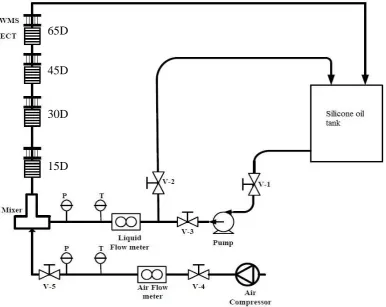
The two-phase air-silicone oil flow experiments were conducted in the flow rig illustrated in
Figure 1. The flow facility consists mainly of a liquid tank, a centrifugal pump, a mixing
section, a vertical riser, a cyclone separator. Furthermore, air and liquid flow meters, electronic
temperature sensors and pressure transmitters were implemented on the rig for measurements.
The main Perspex pipe section has an average internal diameter of 68mm, while the air and the
liquid inlets to the mixing section are 28 mm and 42 mm diameter respectively.
During the experiments, the silicone oil is pumped from the storage tank using the centrifugal
pump into the mixing section. A bypass line is installed for a better liquid flow control and also
to boost the flow stability. The air is supplied from a central compressed air line. Temperature
and pressure of both the liquid and the gas streams are measured prior to the mixing section by
electronic temperature sensors and pressure transmitters respectively. The silicone oil and air
are well mixed within the mixing section and then the mixture flows along a vertical riser of
4.5 m length before it reaches the horizontal section. This offers 66 pipe diameter length which
can be enough for the flow development (Azzi and Friedel, 2005; Benbella et al., 2009; and
Abdulkadir et al., 2012). The two-phase flow in the vertical section is passed into the horizontal
test section before it is returned to the holding tank where the phases are separated. The air is
vented into the atmosphere while the silicone oil is returned to the bottom of the storage tank
prior to its reuse.
The time series of the averaged void fraction was obtained at four different locations (15, 30,
6
mainly presented in this paper, since there was intangible change in the void fraction signal at
45 and 65 pipe diameter. For all experiments, the Wire Mesh Sensor (WMS) was placed
immediately after the Electrical Capacitance Tomography (ECT) sensor to eliminate the impact
of the intrusive nature of the former. It should be noted that the WMS is an intrusive technique
that might cause distortion of the flow structures and bubble fragmentation, thus it is usually
[image:6.595.76.463.252.559.2]installed downstream of the non-intrusive ECT system.
Figure 1: The schematic diagram of the flow facility.
2.2 Measurement techniques
Electrical Capacitance Tomography (ECT) which is described in detail by Hammer (1983)
and Huang (1986) and the Wire Mesh Sensor tomography (WMS), that introduced by Prasser
et al. (1998) and developed for capacitance measurement by Da Silva et al. (2007), were used
to obtain real-time void fraction measurements in these experiments. These measurements 15D
7
techniques have been extensively tested over the last decade and proved to be accurate within
acceptable margins (Azzopardi et al., 2010; Sharaf et al., 2011; and Banowski et al., 2016).
To investigate the two-phase flow evolution, experiments are designed using ten gas superficial
velocities in conjunction with six liquid phase superficial velocities giving a total of 60
conditions. The gas and liquid superficial velocities were varied from 0.045 to 3.2 m s-1 and from 0.15 to 0.53 m s-1 respectively. A data acquisition system using LabVIEW software was developed for simultaneous acquisition of data from all devices. A trigger signal from the WMS
is used to initialise the ECT and the other measuring devices including flowmeters.
During each experiment, the flow rate, pressure, temperature and void fraction were measured
after allowing the flow to stabilise. The process was repeated for each run until the full set of
experiments was completed.
The consistency of the results was checked through data analysis process which included
computing the probability density functions (PDF), frequency and structure velocities.
Detailed analysis of the void fraction time series signal (as described in section 3) was
performed. The characteristic parameters are reported including, cross-sectional averaged void
fraction, probability density functions, structure frequency and velocity, slug length, Taylor
bubble velocity, and the void fraction in the body of slugs. The available flow models and
existing empirical correlations were tested using the experimental data at 45D downstream of
the mixer, where the flow is considered developed.
3 Data processing
The instrumentations that were used in this work such as capacitance WMS and ECT system
8
along the vertical pipe. Real-time measurements in the form of void fraction time series were
obtained from both sensors.
The obtained voltage signals from WMS and ECT system were converted to void fraction data
utilising a calibration routine. The time series of the void fraction distribution was used to
estimate several flow parameters including the probability density functions (PDFs), radial
void fraction, bubble size distribution, structure frequency and structure velocity.
3.1 Probability density function
Probability density functions (PDF) shows how often each value of void fraction occurs within
a particular range. PDFs plots show the rate of change of probability with void fraction values,
where the total area under PDFs plot should be equal to one. The PDFs has been widely used
to identify the relevance flow patterns. The work of Jones and Zuber (1975) demonstrates the
ability of this statistical property to discriminate between the main flow patterns. In addition,
PDFs can also be used to estimate different flow parameters such as film thickness, slug length
and bubble length in slug flow (Costigan and Whalley, 1997).
The PDFs plots of the cross-sectional averaged void fraction are used to categorise the
corresponding flow patterns based on the work of Jones and Zuber (1975) and Costigan and
Whalley (1997) in which they pointed out that the PDFs of the void fraction data can be used
to quantitatively discriminate the main flow patterns. Bubbly flow is associated with a single
peak at low void fraction, while a broad single peak at high void fraction and a tail stretched to
low void fraction represents churn flow. Slug flow, the intermittent flow pattern between
bubbly and churn flow, is identified by a twin peak PDF, one at low void fraction corresponding
to the void fraction in liquid slug and the other at high void fraction representing Taylor bubble.
The PDF of the cross-sectional averaged void fraction was computed by taking into account
9
measurement period. For this paper, we have considered 100 bins between 0 and 1 for the void
fraction data.
3.2 Structure Frequency
The power spectral density (PSD) method was applied to obtain the frequency of the time series
data that describe the periodicity of the flow structures such as slugs. The PSD was estimated
through discrete Fourier transform of the autocorrelation of the time series. Fourier analysis
transforms the void fraction data form its time domain to the frequency domain as shown in
equation Error! Reference source not found..
𝑆𝑥𝑥(𝑓) = ∫−∞+∞𝑅𝑥𝑥(𝜏)𝑒−𝑗2𝜋𝑓𝜏𝑑𝜏 (1)
where; 𝑅𝑥𝑥 is the autocorrelation function of the void fraction time series while 𝑆𝑥𝑥(𝑓) is the
power spectral density as reported by Bendat and Piersol (1980).
The frequency of the structures was also estimated using the method proposed by Hazuku et
al. (2008) for large disturbance waves. The void fraction signal from the WMS and ECT was
used to estimate the front and the tail of Taylor bubble. A Taylor bubble is defined as a part of
the void fraction signal whose peak is higher than the upper average of the void fraction and
both ends are lower than the average of the void fraction as described by Hazuku et al. (2008).
The part of the signal between two trailing Taylor bubbles represents liquid slug. The results
were in a good agreement with the manual counting and the PSD method.
3.3 Structure velocity
The structure velocity was determined by cross correlating the void fraction time series
obtained from the twin-plane ECT sensor. Cross correlation function is simply the sliding dot
product of the two time series from the two ECT planes to estimate the time delay 𝜏 between
10
represent the signal at the first and second plane of the ECT system respectively. Thus the
cross-correlation is given by
𝑅𝑥𝑦(𝑡, 𝑡 + 𝜏) =𝑁1 ∑𝑁𝑖=1𝑥(𝑡𝑖)𝑦(𝑡𝑖+ 𝜏) (2)
where N is the number of samples in each time series. It produces the time delay of a signal
which is equal to the distance divided by the propagation velocity. Since the distance between
the planes of the sensors is known, the structure velocity is merely equal to the distance between
the two sensors divided by the time delay estimated from the cross-correlation.
3.4 Slug length
The length of slugs was estimated using the averaged transitional velocity of slugs and the
resident time of slugs at the measuring plane. The velocity was assumed to be constant
throughout the test section and the following equation was used to determine the slug length.
𝐿𝑠 = 𝛥𝑡 . 𝑈𝑠 (3)
Where; 𝐿𝑠 is the slug length, 𝛥𝑡 is the resident time of slugs at the sensor and 𝑈𝑠 is the velocity
of slugs.
All mathematical operations are implemented in MATLAB, is some cases, using embedded
routines within the software.
4 Results and discussion
4.1 Comparison between WMS and ECT performance
Electrical Capacitance Tomography (ECT) and Wire Mesh Sensor (WMS) tomography have
been widely tested for multiphase flow applications over the last decade. For instance WMS
measurements showed good agreement with X-ray tomography and Gamma radiography for
void fraction measurements as reported by Prasser et al. (2005) and Prasser (2000). Whereas
11
they also highlighted the advantage of each technique. For all experiments reported in this
work, the WMS was placed downstream of the ECT sensor in order to minimise the intrusive
nature of the WMS and also to limit the change in the vertical distribution of the void fraction
between the two measuring planes.
The void fraction data gathered from both sensors showed a reasonable agreement for all
experiments. Figure 2shows PDFs of the cross section averaged void fraction time series data
simultaneously collected using WMS and ECT at the given flow conditions. The comparison
illustrates that at liquid superficial velocity, Uls, 0.22 m s-1 and gas superficial velocities, Ugs, 0.045 m s-1 and 0.18 m s-1, the PDF corresponds to bubbly flow (Figure 2-a) and cap bubble (Figure 2-b) respectively. For these flow patterns, the WMS seems to give higher void fraction
which might be due to the drag effects triggered by the intrusive nature of the sensor, where at
low flow rates the bubbles decelerate at the measuring plane causing an increase in average
[image:11.595.91.504.447.694.2]void fraction.
Figure 2: PDF plots of the cross-sectional averaged void fraction for ECT and WMS at 45 ID downstream the mixer. The liquid superficial velocity = 0.22 m s-1.
(a) Ugs=0.045 m/s (b) Ugs=0.18 m/s
(c) Ugs=0.55 m/s (d) U
gs=3.21 m/s Bubbly
Cap bubble
12
At gas superficial velocity, Ugs 0.55m s-1 (Figure 2-c), both sensors show almost similar PDF plots which indicate slug flow. For the maximum flow condition achievable in these
experiments (Uls=0. 22m s-1, Ugs=3.21m s-1) (Figure 2-d), the PDF signatures for ECT and WMS characterise churn flow, where ECT provides a higher peak at slightly higher void
fraction than the WMS. It is obvious that the difference between the PDF plots created using
the two sensors reduces as the gas superficial velocity increases. Generally, the PDF signature
for both devices indicates similar flow patterns. The results showed a good agreement between
both sensors, for the full range of flow conditions, with an average percentage error of 5% and
standard deviation of 1.02, while the averaged absolute percentage error is 6.7% in void
[image:12.595.88.507.354.635.2]fraction measurements.
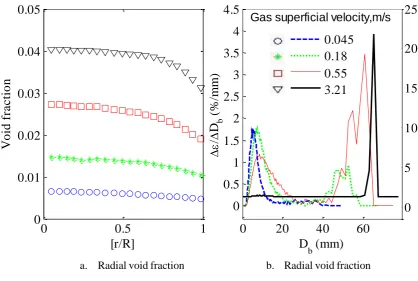
Figure 3: Radial void fraction profile and bubble size distribution obtained from WMS at 45D downstream of the mixer. Liquid superficial velocity = 0.22 m.s-1.
The radial void fraction profiles and bubble size distributions at different gas superficial
velocities are illustrated inFigure 3. The radial distribution of gas fraction shows a flat profile
0 0.5 1
0 0.01 0.02 0.03 0.04 0.05 [r/R] V o id f ra c ti o n 0 5 10 15 20 25
0 20 40 60
0 0.5 1 1.5 2 2.5 3 3.5 4 4.5 D
b (mm)
/ D b ( % /m m ) 0.045 0.18 0.55 3.21
Gas superficial velocity,m/s
13
at low gas superficial velocity (Ugs=0.045 m s-1). This corresponds to a dispersed bubbly flow, in which small gas bubbles are uniformly distributed throughout the cross section of the pipe.
As the gas superficial velocity increases, the uniform distribution disappear and the radial void
profile tends to indicate a local maxima at the core of the pipe. At these conditions large bubbles
are formed and rapidly shifted to the centre of the pipe. At Ugs = 0.18 m s-1 and 0.55 m s-1 the bubble size distribution switched from single to bimodal, indicating the transition to cap bubble
and slug flow regime respectively. The most significant observation from these results is that
the bubble sizes at the measuring plane are greater than the wire spacing of the WMS and hence
the error due to the sub-resolution bubble sizes is considered to be minimum. This is expected
since the initial bubble size is 3mm while the spatial resolution of the sensor is 2.8 mm. It
seems that small bubbles are deaccelerated at the sensor wires while the large bubbles are
accelerated as reported by Ito et al. (2011). This hypothesis explains the reduction in the
difference between the two sensors as the gas superficial velocity increases.
Banowski et al. (2016) suggested the best working range for the WMS. They also reported that
the sensor insensitiveness of small bubbles could be overcompensated by the deceleration of
bubbles at the crossing point. Therefore, in this case, the WMS is expected to overestimate the
averaged void fraction at a low gas flow rate. On the other hand, the limited spatial resolution
of the ECT sensor should not be ignored. It is a non-invasive sensor and hence the void fraction
at the core of the pipe may not be accurately represented, especially when the gas phase is not
uniformly distributed. On the other hand, a twin plane ECT system can provide velocity
information without altering the flow structure.
In conclusion, it can be said that both sensors can give an acceptable and comparable estimation
of the cross-sectional average void fraction. The high temporal and spatial resolution of the
WMS in comparison to ECT sensor can provide detailed information of the flow and can detect
14
structure velocity without disturbance of the flow. Both sensors have strengths and weaknesses
due to the limitations in their respective designs and it is difficult to select one over the other.
It is obvious that if both sensors are integrated, a considerable amount of flow information can
be obtained.
[image:14.595.116.483.385.629.2]4.2 Cross-sectional averaged void fraction
Figure 4 illustrates the cross-sectional averaged void fraction at Uls = 0.3 m s-1 at four axial locations along the test section. It should be noted that the difference in averaged void fraction
at 45D and 65D is small and within the uncertainty margin for the measurements. The PDF
plots at 45D and 65D are identical in shape and no change in the flow structures was observed.
Therefore, the changes due to flow development are considered to be insignificant at those
locations.
Figure 4: Mean void fraction at four axial locations at liquid superficial velocity, Uls = 0.3 m s-1.
The superficial gas velocity has a significant influence on the subsequent flow development in
the riser. Figure 5 shows the mean void fraction for the range of gas and liquid flow rates 45D
downstream of the gas injection point. The curves indicate a continuous increase in the void
0 0.5 1 1.5 2 2.5 3 3.5
0 0.2 0.4 0.6 0.8 1
Gas superficial velocity(m/s)
V
o
id
f
ra
c
ti
o
n
15
fraction with increasing superficial gas velocity. It can be seen that the void fraction is sensitive
to the change of superficial gas velocity at low values. Figure 5 clearly indicates that the curves
tend to level off beyond the superficial gas velocity 1.5 m s-1. This trend can be interpreted as the change in flow patterns with the increase of superficial gas velocity. The transition from
bubbly to slug flow is associated with a considerable shift in the rate of change of the void
fraction, w.r.t. the superficial gas velocity. The higher gradient up to Ugs = 0.55 m s-1 explains bubbly flow, whereas the transition from slug to churn incorporates a slight change in the rate
[image:15.595.80.447.301.541.2]of change of void fraction beyond Ugs > 0.91 m s-1.
Figure 5: Variation of the averaged void fraction with superficial gas velocity for several liquid superficial velocities at 45D.
The influence of superficial liquid velocity on the mean void fraction shows a decrease in the
void fraction as the liquid superficial velocity increases. However, it can be mentioned that the
superficial liquid velocity has a weak influence on the void fraction comparing to that of
superficial gas velocity.
0 0.5 1 1.5 2 2.5 3 3.5
0 0.2 0.4 0.6 0.8
Gas superficial velocity(m/s)
V
o
id
f
ra
c
ti
o
n
0.15 0.22 0.30 0.38 0.45 0.53
16 4.2.1 Void fraction estimation
Void fraction is a crucial parameter in characterising two-phase flow. Therefore an accurate
prediction of void fraction is of great interest in industrial applications. In this work, Drift-flux
model was used to estimate the void fraction in the region of slug flow. Drift-flux model
considers the mixture as whole, instead the two-phase separately. The one-dimensional
drift-flux model, that was introduced by Zuber and Findlay (1965) and developed by Wallis (1969)
and Ishii (1977), is widely used to estimate the averaged void fraction. It is usually preferred
over the two-fluid models for its simplicity and applicability in a wide range of flow conditions.
The general form of the one-dimensional drift-flux model is represented by equation Error! Reference source not found..
𝜀𝑑 = 𝐶 𝑈𝑔𝑠
0𝑈𝑚+𝑈𝑑 (4)
Average void fraction is given by 𝜀𝑑while 𝑈𝑑 and 𝐶0 are the drift velocity and distribution
parameter respectively. The drift velocity is the relative velocity between the gas phase and
mixture velocity at the centreline. The distribution parameter represents the relative velocity of
the gas phase in Taylor bubble to the mixture velocity of slug unit. The drift velocity is
estimated by the equation proposed experimentally by Nicklin et al. (1962) which is given by
the equation Error! Reference source not found. which is in agreement with the theoretical work of Dumitrescu (1943) and Davies and Taylor (1950).
𝑈𝑑 = 0.35√𝑔𝐷 (5)
where g is the gravitational constant and D is the internal diameter of the pipe. The distribution
parameter 𝐶0 was found to have different values with respect to the corresponding flow
patterns. For slug flow it is widely acceptable that 𝐶0 is equal to 1.2, however in this work the
17
𝐶0 = (1.2 − 0.2√𝜌𝑔
𝜌𝑙) (6)
The symbols 𝜌𝑔 and 𝜌𝑔 represent the density of gas and liquid respectively. The Drift-flux
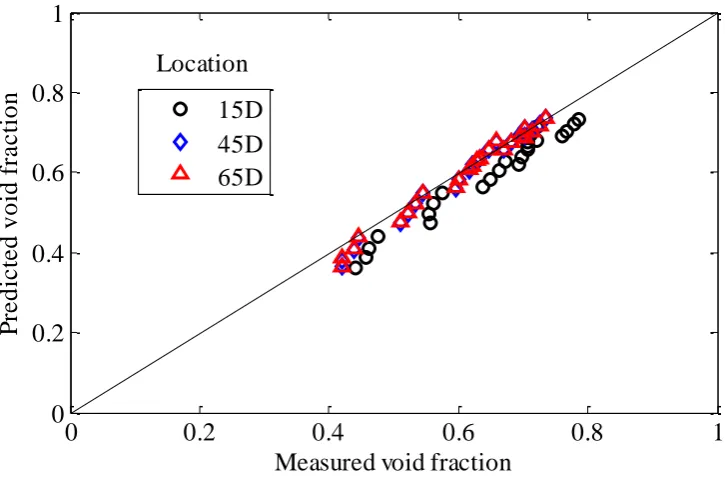
model results were compared to the experimentally measured averaged void fractions at 15D,
45D, and 65D downstream of the mixing section as presented in Figure 6. The predicted void
fraction at 45D and 65D is almost identical. The figure shows a reasonable agreement between
the predicted and experimental data with an average percentage error of -2.38 and standard
deviation of 0.6. The accuracy of the model decreases for data obtain closer to the mixing
section. For instance, at 15D, the cross-sectional void fraction data was visibly under predicted
with an average percentage error of -8.5 and standard deviation of 0.6. It is evident that highly
aerated underdeveloped slugs were more dominant at 15D from the mixing section leading to
underestimation of the void fraction. As the slugs move upward towards 45D and 65D
downstream of the mixer, developed slugs become more frequent leading to improved accuracy
of the predicted data. Since the change in the averaged void fraction and the flow structure at
45D and 65 D was insignificant, and also there is no recognisable difference in the flow
structures at 45D and 65 D, The flow is considered as developed at 45D and beyond. Therefore,
to minimise the number of experiments and to minimize the experimental costs, measurements
18
Figure 6: Comparison of experimentally measured void fraction and predicted void fraction using drift flux model at 15D and 45D downstream of the mixer.
4.3 Flow patterns identification
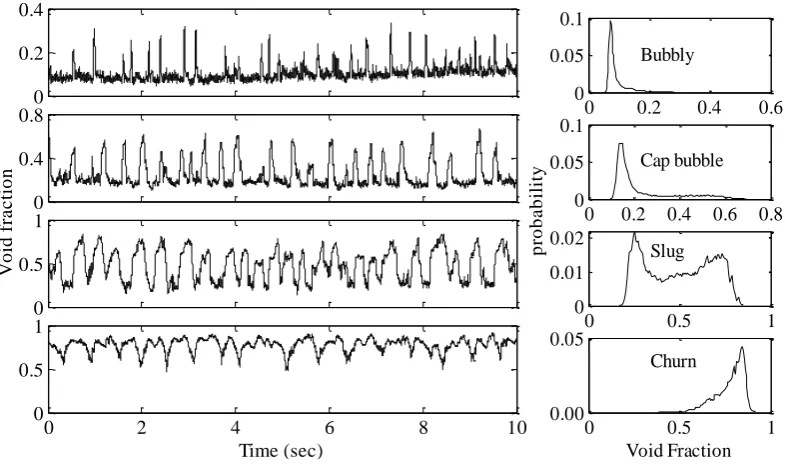
The PDF signatures of the cross-sectional averaged void fraction, obtained from the WMS and
ECT, are used to identify the corresponding flow patterns. Visual observations corroborated
the statistical analysis and have been widely used to discriminate the main flow patterns
qualitatively. The main flow patterns observed in the riser are bubbly, cap bubbles, slug and
churn. Figure 7 shows the time series of the main flow pattern and their PDFs for gas superficial
velocity ranges from 0.45 to 3.21 m.s-1 and liquid superficial velocities from 0.15 to 0.53 m.s -1. The results show that each flow regime has a unique probability density function distribution comparable to those reported in the literature.
0 0.2 0.4 0.6 0.8 1
0 0.2 0.4 0.6 0.8 1
P
re
d
ic
te
d
v
o
id
f
ra
c
ti
o
n
Measured void fraction 15D
19
Figure 7: Cross-sectional averaged time series of void fraction and the corresponding PDFs for each flow pattern.
According to Costigan and Whalley (1997), slug flow is identified by twin peak PDF, one at
low void fraction corresponding to the smaller bubbles in the liquid slug, while the other at
high void fraction corresponding to the Taylor bubble. The most remarkable observation in
the riser was the non-developed slugs; they are short and highly aerated slugs, similar to those
reported by Nydal et al. (1992) in horizontal pipes. Non-developed slugs in the riser are more
likely to occur near the transition to churn flow at high gas flow rates. This type of slug is
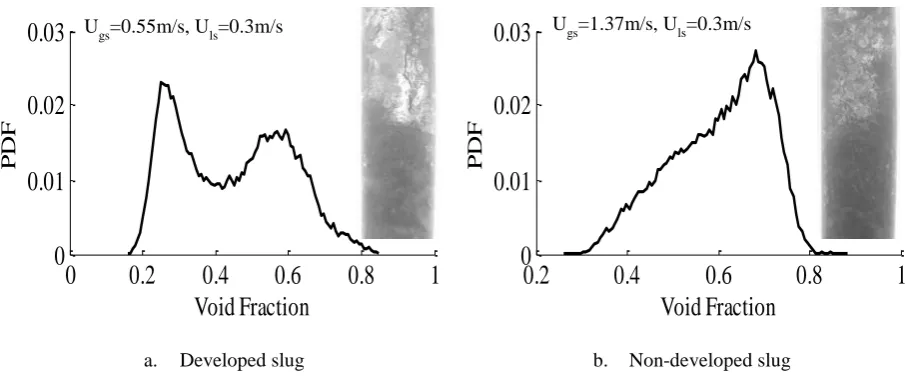
characterised by a single wide peaked PDF. Therefore it can be inaccurately identified as churn
flow. Figure 8 illustrates the difference between developed slugs and non-developed slugs.
0 0.2 0.4 0 0.4 0.8 0 0.5 1
0 2 4 6 8 10
0 0.5 1 Time (sec) V o id f ra c ti o n
0 0.2 0.4 0.6
0 0.05 0.1
Bubbly
0 0.2 0.4 0.6 0.8
0 0.05 0.1
Cap bubble
0 0.5 1
0 0.01 0.02
Slug
0 0.5 1
20
Figure 8: Probability density function of a developed slug and a non-developed slug.
4.4 Flow transition along the axial direction
Void fraction measurements at three different locations downstream of the mixing section were
conducted. Void fraction information at each location is obtained using the ECT and the WMS
measurement probes.
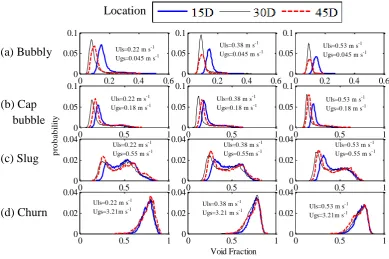
It can be seen from Figure 9 that at lowest gas superficial velocity (case (a)), the averaged void
fraction near the mixer (at 15D) is the highest, while at the second location, 30D, it records the
lowest void fraction before increasing again at 45D downstream the mixer. Since the PDF plots,
as well as the visual observation, indicate bubbly and cap bubble flow, it can be reasoned that
at low gas superficial velocity, finer bubbles form near the mixer resulting dispersed bubbly
flow. Furthermore, the bubble density is high making the mixture to appear like a foam. As
the bubbles move up to the second position, 30D, larger ellipsoidal bubbles formed due to
coalescence and these bubbles moves to the centre of the pipe occupying a smaller area of the
cross section of the pipe. The observation is in agreement with Prasser et al. (2002) and Lucas
et al. (2005) for multi-disperse bubbles and Tomiyama (1998) for a single bubble. As the large
bubbles move upward at relatively higher velocity, more coalescence occurs forming larger
cap bubbles and hence the void fraction increases again.
0
0.2
0.4
0.6
0.8
1
0
0.01
0.02
0.03
Void Fraction
P
D
F
0.2
0.4
0.6
0.8
1
0
0.01
0.02
0.03
Void Fraction
P
D
F
Ugs=0.55m/s, Uls=0.3m/s Ugs=1.37m/s, Uls=0.3m/s
21
Figure 9: PDF plots for different flow condition at 15D, 30D and 45D downstream the mixer.
PDF plots were generated for superficial gas velocities 0.045 m s-1, 0.18 m s-1, 0.55 m s-1, and 3.21 m s-1 and superficial liquid velocities 0.22 m s-1, 0.38 m s-1, 0.53 m s-1 at selected axial positions. The flow pattern changes with different combinations of the liquid and gas
superficial velocities as shown in Figure 9 (a-d). Several flow patterns such as bubbly (Figure
6-a), cap bubbles (Figure 6-b), slug (Figure6-c) and churn (Figure 6-d) could be attained in the
riser. As the gas superficial velocity increases, the PDFs produced for the three measurement
locations are almost similar. It seems that at high gas flow rates, the change in the averaged
void fraction along the axial length is insignificant thus the required length for flow
development is expected to be shorter under these conditions. However, the interaction
between phases is considered to continue in risers, regardless their length, due to the change in
pressure and forces acting on bubbles.
0 0.2 0.4 0.6
0 0.05 0.1
Uls=0.22 m s-1
Ugs=0.045 m s-1
0 0.2 0.4 0.6
0 0.05 0.1
Uls=0.38 m s-1 Ugs=0.045 m s-1
0 0.2 0.4 0.6
0 0.05 0.1
Uls=0.53 m s-1 Ugs=0.045 m s-1
0 0.5 1
0 0.05 0.1
Uls=0.22 m s-1 Ugs=0.18 m s-1
0 0.5 1
0 0.05 0.1
Uls=0.38 m s-1 Ugs=0.18 m s-1
0 0.5 1
0 0.05 0.1
Uls=0.53 m s-1 Ugs=0.18 m s-1
0 0.5 1
0 0.02 0.04
Uls=0.22 m s-1 Ugs=0.55 m s-1
0 0.5 1
0 0.02 0.04
Uls=0.38 m s-1 Ugs=0.55m s-1
0 0.5 1
0 0.02 0.04
Uls=0.53 m s-1 Ugs=0.55 m s-1
0 0.5 1
0 0.02 0.04 Void Fraction p ro b a b il it y
Uls=0.22 m s-1
Ugs=3.21m s-1
0 0.5 1
0 0.02 0.04
Uls=0.38 m s-1
Ugs=3.21 m s-1
0 0.5 1
0 0.02 0.04
22
4.4.1 Bubble size distribution and radial void fraction
Bubble size distribution is obtained from WMS data using the algorithm developed by Prasser
et al. (2001). It is based on the gas volume fraction contained in each class of bubbles instead
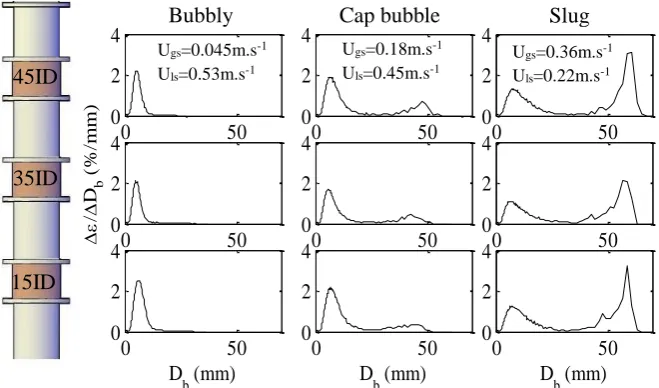
of the number of bubbles. Figure 10 illustrates the bubble size distribution at three different
flow conditions. The x-axis denotes the volume equivalent bubble diameter (Db) and the y-axis denotes the ratio of the gas fraction per bubble class (Δ) to the equivalent diameter of the
[image:22.595.133.463.272.466.2]bubble class (ΔDb).
Figure 10: Bubble size distribution for different flow patterns at three axial locations along the test section.
It is obvious that in the bubbly flow region the distribution displays a single peak at small
bubble size, this peak is shifted to the right as the bubbles move upwards in the column
indicating the bubble coalescence. At bubble/cap bubble transition, the distribution for the first
location shows a single peak indicating small bubble sizes and a long tail extended to relatively
large bubble sizes. This represents a nonhomogeneous bubbly flow. As the flow develops in
the axial direction, a second peak becomes apparent. This peak shows that large cap bubbles
become more frequent. It is clear that the estimated diameter of these bubbles is around 50 mm,
slightly below the pipe diameter. In slug flow region, the bubble size distribution is
45ID 35ID 15ID 0 50 0 2 4 D
b (mm)
/ Db ( % /m m ) 0 50 0 2
40 50
0 2 4 0 50 0 2 4 D
b (mm)
0 50
0 2
40 50
0 2 4 0 50 0 2 4 D
b (mm)
0 50
0 2
40 50
0 2 4
Ugs=0.36m.s-1
Uls=0.22m.s-1
Ugs=0.18m.s-1
Uls=0.45m.s-1
Ugs=0.045m.s-1
Uls=0.53m.s-1
23
characterised by double peaks; one at small bubble size, similar to that of bubbly flow, and the
other for bubble diameters equivalent to the size of the pipe representing Taylor bubbles.
Similar to PDFs, it is possible to use the bubble size distribution to discriminate between flow
patterns such as bubbly (disperse/cap bubbles) and slug flow. However, bubble size distribution
does not provide discrimination for the transition from slug to churn flow since both regimes
are represented by a dual peak distribution. There is usually an agreement between the bubble
size distribution and PDFs results, both plots could give a clearer image of the axial evolution
of the flow.
4.5 Slug Unit Characterisation
A slug unit consists of an elongated bubble called Taylor bubble followed by a liquid slug
which usually contains dispersed bubbles. In this work, a distorted gas bubble was observed;
which is the case for relatively large diameter pipes as shown in Figure 11.
Figure 11 indicates that slug like structures can be observed in relatively large diameter pipes.
The only difference is that instead of bullet shape Taylor bubble, a distorted large gas structure
24
Figure 11: Cross-sectional images obtained from the WMS for slug flow structure.
One dimensional model is commonly used to model slug flow, in which the slug phenomenon
is simplified to a sequence of identical units flowing at constant velocity (Wallis, 1969;
Fernandes et al., 1983; and Taitel and Barnea, 1990). Due to the intermittency of the slugging
phenomenon, the estimation of slug characteristics, such as slug frequency and the length, is a
crucial factor for industrial design and operation. For instance, the maximum length of liquid
slugs is important for the design of slug catchers and two-phase separators. These flow
characteristics vary in time and space, therefore several correlations were proposed in order to
predict the main features of slugs in vertical pipes, such as Taylor bubble velocity, gas hold up
within the body of liquid slugs, length of liquid slugs and the frequency of slugs (Nicklin et al.,
1962; Sylvester, 1987; Khatib and Richardson, 1984; and Legius et al., 1997).
In the following subsections, the development of slug flow is investigated; the effects of
superficial gas velocity and axial flow position are examined. The experimental results were
compared to the available correlations, which are originally proposed for fully developed flow.
Dis
to
rted
lar
g
e
g
as s
tr
u
ct
u
re
L
iq
u
id
slu
25 4.5.1 Slug length
Slugs consist of two parts; the Taylor bubble and the liquid slug. The length of liquid slugs was
estimated using the averaged transitional velocity and the resident time of the liquid slugs at
the measurement plane as explained in Section 3. Figure 12 shows the axial development of
the averaged liquid slug length at three different locations in the riser. It can be clearly seen
that the averaged liquid slug length increases along the pipe. The rate of increase in liquid slug
length is smaller near the pipe exit and at high gas superficial velocities. This increase of the
liquid slug length in the axial direction is due to the coalescence of Taylor bubbles. At the first
location (15D) the slugs are not fully developed, and the distance between consecutive Taylor
bubbles is small. The trailing bubble is influenced by the flow within the preceding liquid slug.
As a result, the trailing bubble travels faster than the leading bubble and as a consequence, the
rate of slug growth is higher around this location. As the liquid slugs move further upward, the
merging process decreases due to the increase in the length of liquid slugs. At 45D, the length
of liquid slugs is almost double the size of the slugs at 15D downstream of the mixing section.
This indicates clearly the coalescence of slug units. It can be stated that near 45D, the slugs
are almost developed, regardless the infrequent observation of short slugs. However, it could
be argued that the merging process may continue in extremely long pipes, due to the energy
26
Figure 12: The axial development of the mean liquid slug length in the riser at liquid superficial velocity = 0.3 ms-1.
It was observed that the length of slugs and Taylor bubbles increase with the increase of
superficial gas velocity as shown in Figure 13. The slug length, at 45D downstream of the
mixing section, was found to vary between 6D and 12D. This is still within the range of the
reported minimum stable slug length, about 8 to 16 D (Moissis and Griffith, 1962; Taitel et al.,
1980).
Slug length correlation developed by Khatib and Richardson (1984) was used to estimate the
experimental results of slug lengths as given in Equation Error! Reference source not found.. The predicted slug length was in an acceptable agreement with experimental data as shown in
Figure 14.
0 0.5 1 1.5 2
2 4 6 8 10 12
Gas superficial velocity(m/s)
L
iq
u
id
s
lu
g
l
e
n
g
th
(P
ip
e
d
ia
m
e
te
rs
)
27
Figure 13: Liquid slug variation at different flow conditions.
Figure 14: Comparison of experimentally measured slug length and predicted slug length using Khatib and Richardson (1984) correlation.
It is clear from Figure 14 that Khatib and Richardson correlation slightly underpredicts the
mean length of the slug body, especially at low gas superficial velocities. The whole data was
predicted with an average absolute error of 20.70% and standard deviation of 1.92.
0 0.5 1 1.5 2
4 6 8 10 12 14
Gas superficial velocity(m/s)
L iq u id s lu g l e n g th (p ip e d ia m e te rs )
0.30 0.38 0.45 0.53
Liquid superficial velocity(m/s)
0 0.2 0.4 0.6 0.8 1
0 0.2 0.4 0.6 0.8 1
Measured liquid slug length(m)
[image:27.595.115.480.363.609.2]28 Khatib and Richardson correlation is given by
𝐿𝑆 = 𝐶0𝑈𝑓𝑚+𝑈0
𝑆 [
𝜀−𝜀𝑔𝑇𝐵
𝜀𝑔𝑠𝑙−𝜀𝑔𝑇𝐵] (7)
where Um is the mixture velocities, 𝑓𝑆 is the slug frequency 𝜀 is the averaged void fraction, the
𝜀𝑔𝑠𝑙 void fraction in liquid slug, and 𝜀𝑔𝑇𝐵 Void fraction in Taylor bubble. The discrepancy
between the experimental and predicted values could be attributed to the assumptions made by
Khatib and Richardson (1984). The correlation was proposed through a simple mass balance
around a slug unit, in which the slug unit was assumed to travel at a constant velocity. The
effect of physical properties was not included.
It was noticed that the error in estimating slug length can be higher at a high gas flow rate;
where Taylor bubbles are distorted and it becomes difficult to distinguish between the Taylor
bubble and the wake zone within the liquid slug due to the increase in dispersed gas
concentration within the liquid slug.
4.5.2 Slug Frequency
The frequency of the slug was estimated using the modified method of Hazuku et al. (2008)
for large structures as detailed in section3. The results were compared with the PSD method
and good agreement was obtained. The frequency of liquid slugs was estimated at three
different locations in the riser for all the liquid velocities considered. Figure 15 illustrates how
the frequency of slugs varies along the riser. It is clear that the slug frequency decreases along
the pipe and also with the increase of superficial gas velocity. It is generally agreed that bubbles
behind short liquid slugs moves faster than the leading one and hence merging process occurs.
In the riser, the slug and Taylor bubble length increase along the pipe due to the merge of two
consecutive Taylor bubbles. Therefore, the frequency decreases in the axial direction. Figure
29
increasing gas superficial velocity indicating rapid development of the flow at higher gas flow
[image:29.595.121.480.138.375.2]rates.
Figure 15: Frequency variation with increasing gas superficial velocity at three axial locations in the riser for constant liquid superficial velocity, Uls=0.3ms-1.
Figure 16: Slug frequency variation with air and oil superficial velocity in the riser.
0 0.5 1 1.5 2
1.5 2 2.5 3 3.5 4
Gas superficial velocity(m/s)
S lu g f re q u e n c y (H z ) 15D 30D 45D Location
0 0.5 1 1.5 2
1.5 2 2.5 3 3.5 4
Gas superficial velocity(m/s)
S lu g f re q u e n c y (H z )
0.30 0.38 0.45 0.53
[image:29.595.125.485.454.689.2]30
Figure 16 shows the effect of the superficial liquid velocity on the frequency of the periodic
structure of slugs at 45D. It can be clearly seen that the slug frequency increases with the
increase of the superficial liquid velocity while continue to decrease with the increasing
superficial gas velocity.
Several empirical correlations have been proposed to estimate the frequency of slugs, most of
which are for horizontal or near horizontal flows. Some of the reported correlations, namely Sylvester (1987), Legius et al. (1997) and Zabaras (2000), were used to predict the frequency
obtained experimentally as illustrated in Figure 17.
It is remarkable that Sylvester’s (1987) correlation showed strong agreement with the
experimental results. He presented a simple mathematical correlation given as Equation Error! Reference source not found. that requires the knowledge of slug unit velocity and length in order to predict the slug frequency.
𝑓𝑠 =𝑈𝑡𝑏(1−𝛽)
𝐿𝑙𝑠 (8)
Slug unit velocity and the length are indicated by 𝑈𝑡𝑏 and 𝐿𝑙𝑠 respectively while 𝛽 represents
the ratio between the length of the Taylor bubble and the length of the slug unit. It should be
noted that this equation need three independent variables to establish the slug frequency.
Zabaras (2000) correlation has underestimated the experimental frequency. This is not
surprising since, it is a modified version of Gregory and Scott (1969) correlation for horizontal
flow, except that the effect of a small inclination up to 9 degrees was included. Legius et al.
(1997) correlation has also dramatically under-predicted the experimental data. This clear
discrepancy is due to the inherent limitation of this correlation. It is absolute replica of
Heywood and Richardson (1979) correlation, for horizontal flow with a slightly modified
31
It seems that most of the available correlations for predicting slug frequency in vertical flow
are either mathematical models that include several unknown variables or simple empirical
correlations that originally proposed for horizontal flow for a limited range of flow conditions.
In order to develop a more general correlation, several parameters should be considered such
as the physical properties of phases and pipe geometry in addition to the variables already
[image:31.595.126.481.246.489.2]considered.
Figure 17: Comparison of the experimental slug frequency with the available correlation.
4.5.3 Void fraction in liquid slug
Void fraction in liquid slug (𝜀𝑔𝑆𝐿) is a crucial parameter in characterising slug flow which has
a direct influence on the average void fraction. The knowledge of gas hold up within the body
of the liquid slug has been considered as an input parameter for the several physical models
developed to study slug flow such as Fernandes et al. (1983). It also can be used to determine
the transition from slug to churn flow. In this work, the evolution of void fraction within the
body of slugs was studied.
0 0.5 1 1.5 2 2.5 3 3.5 4
0 1 2 3 4
P
re
d
ic
te
d
s
lu
g
f
re
q
u
e
n
c
y
Measured slug frequency Sylvester (1987)
32
It is acknowledged that the gas phase is dynamically exchanged between the Taylor bubble and
liquid slug. Gas bubbles at the rear of liquid slug coalesce with Taylor bubble while small
bubbles are entrained into the liquid slug behind it due to the jet effect of the falling liquid film
(Fernandes et al., 1983).
The liquid slug can be divided into three main regions based on the voidage profiles. The wake
region which is a region of high turbulence and high local gas fraction, it extends to few pipe
diameters downstream of the Taylor bubble. The translational region is an intermediate region
that separates the wake and the developed region. The developed region starts at around 10D
behind the Taylor bubble, It has a void fraction profile similar to that of dispersed bubbly flow
(Van Hout et al., 1992).
Figure 18 illustrates the change in 𝜀𝑔𝑆𝐿 at three axial positions 15D, 30D and 45D downstream
of the mixing section. The figure shows no significant change along the axial direction,
particularly between 30D and 45D, however, it is clear that the averaged 𝜀𝑔𝑆𝐿 at 15D is slightly
higher than the other two axial locations. This is more likely due to the nature of the flow near
the entrance being more chaotic where slugs are still developing. The wake region within liquid
slug is expected to be longer at this location and hence the overall gas holdup. It should also be
noted that with increasing gas superficial velocity the gas hold up is higher in the silicon oil
slugs.
The effect of liquid superficial velocity on the void fraction in liquid slugs is shown in Figure
19. Void fraction in the liquid slug follows the same trend discussed under Figure 18. However,
it should be noted that with the increase of the liquid superficial velocity, the void fraction
within the liquid slug decreases as shown in Figure 19. Similar observation is reported by other
33
Figure 18: Void fraction in the liquid slug with increasing gas superficial velocity at three axial locations downstream of the gas injection point.
Figure 19: Effect of superficial gas velocity on the void fraction within the body of slugs.
It is expected that at high gas flow rate, the turbulence becomes dominant and hence more air
is entrained into liquid slugs as a fine dispersion of bubbles. The averaged void fraction within
the liquid slug varied from 0.23 to 0.63 over the range of the gas superficial velocities used in
0 0.5 1 1.5 2
0.2 0.3 0.4 0.5 0.6 0.7
Gas superficial velocity(m/s)
V o id f ra c ti o n i n l iq u id s lu g 15D 30D 45D Location
0 0.5 1 1.5 2
0.2 0.3 0.4 0.5 0.6 0.7
Gas superficial velocity(m/s)
V o id f ra c ti o n i n l iq u id s lu g 0.30 0.38 0.45 0.53
[image:33.595.118.479.389.619.2]34
this investigation. The lower value corresponds to the transition border for the bubbly flow
while the higher value corresponds to the transition border for churn flow. Similar observation
reported by Barnea and Shemer (1989). The lower value of 0.23 is almost equal to the suggested
value of bubbly to slug transition (0.25) by Taitel et al. (1980). The upper value of 0.63
represents the maximum packing of bubbles in the liquid slug, hence the transition from slug
to churn flow as suggested by Brauner and Barnea (1986).
It is acceptable that the liquid slugs can be treated as fully developed bubbly flow. Therefore
liquid slugs can only accommodate maximum gas fraction equal to that of fully developed
bubbly flow (Barnea and Brauner, 1985). Barnea and Shemer (1989), for air-water flow in
50mm ID pipe, reported that the void fraction in the liquid slug was 0.25 for Ugs below 1 m.s -1. Beyond U
gs = 1 m.s-1 the void fraction increased up to 0.6 which was considered the upper limit before the onset of the churn flow. Schmidt (1977) indicated that the void fraction in
liquid slug varies from 0.2 to 0.8 for a wide range of Ugs andUls for air and kerosene mixture in 50 mm ID pipe.
In this work, the voidage in liquid slug continuously increases for the whole range of Ugs in slug flow region, and hence it eventually exceeds the value suggested for fully developed
bubbly flow by Barnea and Brauner (1985). This behaviour is similar to Schmidt’s (1977)
observation for the air-kerosene system. It appears that void fraction in liquid slug is constant,
i.e. can be equal to the value of dispersed bubbly flow, only for a limited range of superficial
gas velocities. Beyond a critical value of Ugs, the air entrainment in the body of the slug increases until slug/churn transition occurs. This value of Ugs might vary for different pipe configuration and flow conditions. Silicone oil has the ability entrain more bubbles in
comparison to water. This can be confirmed by the observation of Schmidt (1977) for
35
diameter may also have an effect on slug characteristics since slugs appear more aerated in
large pipes.
Figure 20 illustrates the predicted value of void fraction of liquid slugs by the available
correlations reported in the literature, namely; Akagawa and Sakaguchi (1966), Sylvester
(1987) and Mori et al. (1999) as shown respectively in the following equations:
𝜀𝑔𝑠𝑙 = 𝜀𝑔1.8 (9)
𝜀𝑔𝑆𝐿 = 𝑢𝑔𝑠
𝐶2+𝐶3(𝑢𝑔𝑠+𝑢𝑙𝑠) (10)
Where 𝐶2 =0.425 and 𝐶3 = 2.65
[image:35.595.107.490.225.636.2]𝜀𝑔𝑠𝑙 = 0.523𝜀𝑔 (11)
Figure 20: Comparison of void fraction in liquid slugs with empirical correlations.
The theoretical model of Brauner and Ullmann (2004), which is named as TBW model, was
also used to predict the gas holdup in liquid slugs. It is clear that Brauner and Ullmann (2004)
36
absolute error of 24.05% and standard deviation of 1.03. The TBW model is theoretically
derived and it is based on energy balance at the wake of Taylor bubble. Although it overpredicts
the void fraction in liquid slugs, it seems to provide good estimation at high gas flowrates. Most
of the estimated data, using TBW model, fall within 10% error margin.
Akagawa and Sakaguchi (1966) correlation underpredicts the experimental results with an
average absolute error of 26.05% and standard deviation of 1.38. Correlations of Sylvester
(1987) and Mori et al. (1999) showed larger drift from the experimental results with an average
absolute error of 46.6% and 47.7% respectively. In fact, this was not surprising since
correlations Error! Reference source not found. and Error! Reference source not found. were pure empirical fits for experimental results that were obtained for air-water system at
pipes with smaller diameters (27.6mm ID and 25.8mmID). The equation Error! Reference source not found. was theoretically derived while the constants of the equation are based on the experimental work of Fernandes (1981). It is obvious that the silicone oil has a higher
tendency to entrain more gas bubbles than water, especially at the high gas superficial
velocities. These two empirical models predict the void fraction in liquid slugs closer to the
measured values at low superficial gas velocity and continuously deviate as Ugs increases. However the model by Akagawa and Sakaguchi (1966) given in equation Error! Reference source not found. showed a consistent prediction for the whole range of gas superficial velocities used in our experiments. The performance of Akagawa and Sakaguchi correlation
can be significantly improved if the exponent is set to 1.3 instead of 1.8. The prediction of the improved constant was in perfect agreement with the current experimental results with
averaged absolute error of 2.02% and averaged standard deviation of 0.43. This suggests that
this exponent would be a function of pipe diameter and the physical properties of the fluids.
However, to establish such a relationship data for widely varied pipe geometries and fluid pairs
37
It seems that there is no general correlation that predicts the void fraction within the liquid
slugs for a wide range of operating conditions. Most of the available correlations were simple
fits of experimental data for a limited range of operating conditions. Theoretical models such
as Brauner and Ullmann (2004) seems to offer better prediction than any other experimental
semiempirical correlations. Therefore, it can be said that the collective effect of different flow
parameters such as pipe diameter and fluid properties should be carefully considered in order
to develop more robust theoretical models.
4.5.4 Taylor bubble velocity
The Signals from the dual plane ECT sensor were cross-correlated to estimate the time delay
of slugs between the sensor planes. The velocity is simply equal to the distance between the
two planes divided by the time delay. The slug velocity was measured at three axial locations
along the riser, in order to see how the axial velocity influences the evolution of slugs.
Figure 21 demonstrates the difference in the slug velocity in the axial direction. It can clearly
be seen that the velocity increases with the increase of superficial gas velocity. It also increases
in the axial direction under constant superficial gas velocities. This increase is significant from
the first (15D) to the second location (30D), whereas at the third location (45D) the slug
velocity showed only a small increase over that of 30D. This is due to the increase of bubble
size as a subsequent merging process between two slug units since larger bubbles travel faster.
The slugs are more stabilised at 45D location, where velocity profile within the slug unit is
expected to be fully developed.
In addition, the change in static head with height can also enhance the velocity of Taylor
bubbles. The effect of the gas and liquid superficial velocities on the slug unit at 45D
downstream of the mixing section is presented in the Figure 22. It shows, as expected, an
38
superficial velocities. In these experiments, it was assumed that both the slug and the Taylor
bubble are traveling at the same velocity. However, in reality, the Taylor bubble and liquid slug
may travel at different velocities, which is usually considered to be small and has a negligible
effect since the gas entrainment into and out of the Taylor bubble should be equal (Fernandes
et al., 1983). It is noticeable that the superficial liquid velocity has a weaker effect on the slug
[image:38.595.114.479.252.488.2]velocity in comparison to that of the superficial gas velocity.
Figure 21: Taylor bubble velocity variation as a function of the axial distance in the riser at liquid superficial velocity = 0.3 ms-1.
Taylor bubble velocity has been investigated extensively over years. The transitional velocity
is considered to be a combination of the slug mixture velocity and the velocity of a bubble in a
stagnant liquid, namely drift velocity and Nicklin et al. (1962) has suggested the following
expression for the velocity of the Taylor bubble.
𝑢𝑔𝑇𝐵 = 𝐶0(𝑢𝑔𝑠+ 𝑢𝑙𝑠) + 𝑈𝑑 (12)
Where; 𝑈𝑑 is the drift velocity given by equation Error! Reference source not found. and 𝐶0
is the distribution parameter. 𝐶0 is equal to the relative maximum velocity at the nose of the
0 0.5 1 1.5 2
1 1.5 2 2.5 3 3.5
Gas superficial velocity(m/s)
T
a
y
lo
r
b
u
b
b
le
V
e
lo
c
it
y
(m
/s
)
39
bubble to the mixture velocity(𝑈𝑚𝑎𝑥⁄𝑈𝑚). It has been found to vary from 1.2 (Nicklin et al.,
[image:39.595.117.481.141.380.2]1962) to 1.29 (Fernandes et al., 1983) for developed slug flow.
Figure 22: Taylor bubble velocity variation at 45D downstream of the mixer.
Figure 23 illustrates the comparison between the experimental and the estimated values of
Taylor bubble velocity. The results are within an acceptable agreement. Taylor bubble velocity
is underestimated by Nicklin et al. (1962) correlation with an average absolute error of 17.12%
and standard deviation of 2.07. The discrepancy is more likely to be attributed to the effect of
entrained bubbles within the liquid slug.
The rise velocity of Taylor bubble increases in the presence of bubbles in liquid slug (Mao and
Dukler, 1985). It is evident that at the high superficial gas velocity, the Taylor bubble velocity
is closely predicted. This could be a result of high gas entrainment in liquid slugs at these
conditions. Mao and Dukler (1985) correlation has slightly improved the velocity prediction at
low gas superficial velocity since it takes into consideration the effect of entrained bubbles on
the transitional velocity of Taylor bubble. However, it overestimated the rise velocity
0 0.5 1 1.5 2
1.5 2 2.5 3 3.5 4
Gas superficial velocity(m/s)
T
a
y
lo
r
b
u
b
b
le
V
e
lo
c
it
y
(m
/s
)
0.30 0.38 0.45 0.53
40
significantly at high gas flow. This is possibly due to the overcompensation of dispersed
[image:40.595.125.481.136.376.2]bubbles effect at high gas superficial velocity.
Figure 23: Experimental Taylor bubble velocity against the predicted values.
It could be thought that at the low superficial gas velocity, the entrained bubbles in liquid slugs
are relatively large to flow down in the liquid film. Thus, these bubbles will merge with the
front of Taylor bubble causing an increase in the rise velocity of Taylor bubble. As the gas
superficial velocity increases, the gas holdup within the slug body increases. In this case, a
swarm of tiny bubbles is entrained, and the liquid slug can be treated as a turbulent bubbly flow
in which buoyancy decreases with the increase of void fraction as reported by Zuber and Hench
(1962). The relative velocity of the entrained bubbles in the liquid is negligible; therefore the
effect of entrained bubbles on the Taylor bubble velocity is expected to be negligible.
It must be mentioned that the distribution parameter (𝐶0) is highly dependent on the flow
patterns and is a function of the inclination angle as well as other parameters, such as pipe
diameter and mixture velocity. It is expected to increase with pipe diameter due to the effect of
0 1 2 3 4 5 6 7 8
0 2 4 6 8
P
re
d
ic
te
d
T
a
y
lo
r
b
u
b
b
le
v
e
lo
c
it
y
(m
/s
)
Measured Taylor bubble velocity (m/s)
41
gas expansion as reported by Fernandes et al. (1983). Therefore in the current study, the value
1.3 showed better prediction than the common value of 1.2.
4.6 Conclusion
Experiments in a 68mm ID vertical riser section are conducted using air-silicone oil mixture.
Wire Mesh Sensor (WMS) and Electrical Capacitance Tomography (ECT) were used to
provide cross-sectional averaged void fraction at three locations downstream of the mixing
section. The experimental results were then compared to the predicted values of the available
correlations. The key findings are concluded below:
The flow structure showed an insignificant change between 45D and 65 D downstream
of the mixing section, particularly at high gas superficial velocities. The liquid slugs
are almost developed at 45 pipe diameter length, regardless the infrequent appearance
of short slugs. It could be argued that the change in the flow structure may continue in
extremely long pipes, due to the energy dissipation and pressure difference, however,
this variation would be small on average.
Developed slug flow occurs in vertical 68 mm ID pipes for gas superficial velocities
between 0.36 m.s-1 and 1.83 m.s-1 and liquid superficial velocities up to 0.53 m.s-1. Slug length increases in the axial direction and with the rise of gas superficial velocity.
This increase is due to the emerging process between two consecutive slug units.
The frequency of liquid slugs decreases along the axial direction and with the increase
in gas superficial velocity. The reduction of slug frequency is due to slug coalescence.
Void fraction within the liquid slug continuously increases with the increase of Ugs. The lowest and highest value within slug flow range corresponds to the transition from
bubble to slug and from slug to churn respectively. Silicone oil seems to have higher
void fraction than water, due to the difference in physical properties such as viscosity
42
Taylor bubble tends to accelerate with the increase in superficial gas velocity and rise
in the height of the vertical pipe. This is mainly due to the emerging process of two slug
units, in addition to gas expansion and decrease in pressure with altitude.
The available correlations for gas-liquid flow in vertical pipes are essentially based on
air-water experiments. Most of them are empirical correlations that were developed by
simply data fitting for a limited range of flow rates. Therefore the accuracy of these
available models was diverse. The statistical performance comparison of the two-phase