©2018. Accepted by Arts & Health, An International Journal for Research, Policy and Practice. “Write Here, Sanctuary”
Creative writing for refugees and people seeking asylum
T. Stickley, A. Hui, M. Stubley, F. Baker & M. C. Watson
ABSTRACT
Background
There are few research studies reporting findings from creative writing groups amongst refugees and people seeking asylum. This study evaluates the
educational, wellbeing, social and satisfaction outcomes of writing groups across three cities in the UK.
Methods
This study employs a mixed-method design comprising: a thematic analysis of writers’ (facilitators) diaries, demographic and satisfaction survey and 14 qualitative interviews.
Results
The project delivered a creative writing programme for refugees and people seeking asylum in three UK cities. This evaluation has determined that it provided both educational and wellbeing outcomes for 144 attendees. Participants asserted that they had improved their English language and wellbeing. Satisfaction was extremely high across the cities. Participants reported increased confidence and an increased sense of hope.
Conclusions
Professionally-led creative writing groups may be effective in enabling people to help come to terms with past experiences and find ways of coping for the future.
Keywords: asylum seekers, creative writing, refugees, wellbeing
INTRODUCTION
©2018. Accepted by Arts & Health, An International Journal for Research, Policy and Practice. political expediency, local communities are often able to take local action to help manage potentially challenging situations and provide short or longer-term solutions to some of these challenges. In the UK, several cities have declared themselves “Cities of Sanctuary”1. In such cities, communities of people
collaborate to provide various ways of supporting refugees and people seeking asylum. One response has been the provision of participatory arts activities; these are occasionally reported in the press, but rarely researched. A search of the current literature reveals that there are few published studies on creative writing interventions with refugees and people seeking asylum although studies exist where creative approaches have been used (e.g. Ely et al., 2017; Gould, 2005; McColl, 2004; O’Neill, 2004; Quinlan et al., 2017; Taylor, Leigh-Phippard and Grant 2014). This study evaluates such an intervention by eliciting the views of people engaging with a creative writing project across three cities in the East Midlands of the UK. It also seeks to learn from the experiences of the
professional writers who facilitated the workshops. For every workshop (in each of the three cities), there were two professional writers present to facilitate the groups, one a lead writer and the other an assistant (therefore six professional writers in total). The study is conceptualised with reference to Maslow’s (1954) hierarchies of needs illustrating the importance of basic physiological and safety needs being met before those of a more creative or aesthetic nature amongst people who are displaced.
BACKGROUND
At the end of 2015 the number of forcibly displaced people worldwide had risen to 65.3 million, a 9% increase on the previous year (UNHCR, 2017). A total of 16.1 million were classified as refugees and 3.2 million asylum seekers (UNHCR, 2017a). The number of asylum seekers per 1000 population in 2015 in the UK was 0.60, compared with a European average of 2.48, and well below that of Sweden at 16.62.
Centuries of immigration have shown the value that newcomers can bring in terms of skills, culture, and resources to host countries. To maximise this
advantage, it may be necessary to provide the tools, infrastructure and facilitate the learning of all those concerned. Language can be one of the biggest barriers
©2018. Accepted by Arts & Health, An International Journal for Research, Policy and Practice. to integration, and communication is necessary to build connections with
communities, and enable co-operation with others. O’Neill (2004) describes the value of creating work and sharing it to challenge stereotypes and produce positive representations that speak of the rich cultural contributions refugees and asylum seekers can make. There is a wealth of wider literature that supports creative writing for personal growth (Haertl and Ero-Phillips, 2017), mental health (Bolton, 2004; Dingle et al., 2017; Johnstone et al., 2010) and
connectedness with others (Hilse, Griffiths and Corr, 2007; López-Bech, and Zúñiga, 2017).
To date, arts projects supporting refugee or asylum seeker communities have been largely through visual, performance or participatory arts methods. In 2008 one report found that there were over 200 arts organisations working in this sphere in the UK (Kidd et al., 2008). Published research and evaluation report significant improvements in social participation (Sunderland et al., 2015) wellbeing through creative expression (Ely et al., 2017), confidence-building (O’Neill, 2004) and use of English language through spoken word, , and literacy skills ((Gould, 2005; McColl, 2004) feelings of increased safety (Ely et al., 2017), emotional resolution amongst young people (Quinlan et al., 2017) and identity formation (Taylor, Leigh-Phippard and Grant 2014). Creative contributions to local communities also may challenge negative stereotypes and produce positive representations (O’Neill, 2004). Others have reported the positive benefits of community arts activities for those who have experienced trauma (Barak & Leichtentritt, 2016; Kalmanowitz and Ho 2016; Ely et al., 2017; Stockton, Joseph and Hunt, 2014; Williams, 2015). The most successful writing initiatives are those in which change occurs for the individuals, artists and in host
communities (Sotor, 2016).
METHODS
The project was designed to help refugees feel welcome and socially included by creating safe spaces for creative expression. The aims of the project were to:
©2018. Accepted by Arts & Health, An International Journal for Research, Policy and Practice. Encourage experienced and aspiring writers from local communities to
share in spoken word, story-telling and creative writing activities with refugee groups
Produce events for public audiences
Produce new creative work made accessible online Produce an anthology of new work for public distribution
Working in partnership with the Cities of Sanctuary and other refugee support groups in Derby, Nottingham and Leicester, refugees from Eastern Europe, the Middle East and North Africa were engaged in spoken word, storytelling and creative writing activities to enable them to tell their stories, articulate their identities and provide a platform for their creative self-expression. Each of the three cities already had Sanctuary programmes of work, and those attending programmes were invited to the creative writing workshops.
Process
Bespoke writer-led programmes took place across 36 sessions over 10 months in the three cities with a mean attendance of 12 people. In total 144 adults
attended the sessions, they were all either refugees or people seeking-asylum. The creative writing workshops, enabled participants to draw upon experiences, changing environments and literary cultures to build their confidence in using English. The programme was not formulaic in its design and each lead writer who facilitated the workshops brought their own unique style and method to the sessions. Sessions were aimed at drawing upon the participants’ literary
cultures, own stories and changing sense of place, to generate new content, freestyle writing, spoken word and composition. Each session was facilitated by a lead writer and an assistant (both were professional writers).
Various methods were used for gathering information for this evaluation (Green and Smith, 2006) and focused upon the educational, wellbeing, social and
satisfaction outcomes. It was decided not to attempt a before-and-after measure amongst participants because of the small numbers and the potential for
©2018. Accepted by Arts & Health, An International Journal for Research, Policy and Practice.
The lead writers who facilitated the sessions and their assistants kept diaries. These were structured requesting reflections upon four questions: What did you do in today’s session? What went well? What were thechallenges? What have you learnt from today’s session? These were usually written immediately after each session was concluded and agreed by both the lead writer and assistant.
A registration document was maintained to enumerate attendance and elicit basic demographic data.In order to protect and encourage participation,
we were careful however, not to make too many demands on participants to disclose personal information; it was agreed that people need not for example use their real names during the registration process. Evaluative questionnaires were also distributed to all participants at the end of each session. Fourteen participants were interviewed (out of a possible 144 attendees) by the researchers and these interviews were recorded, transcribed and analysed. Interviews were conducted towards the end of the
programme. All attendees were invited to be interviewed and fourteen self-selected.
Lead Writers’ diaries
Both writers (the lead writer and the assistant writer) in each group conferred each week to make a single diary entry. To control the amount of data from the writers, they were asked to limit each entry to 500 words following each session. Once all the diaries were completed, a content analysis process was conducted on the data by one of the members of the research team and the findings were verified by other members of the team.
Satisfaction survey
At the start of each session, participants were requested to complete a registration form. Questions covered demographic details: age, gender and ethnic background. At the end of the session, participants were asked to
©2018. Accepted by Arts & Health, An International Journal for Research, Policy and Practice. four-point Likert scale ranging from very dissatisfied to very satisfied and asked about: enjoyment, a sense of belonging to the group, confidence and to what extent had participants’ writing improved that day.
Qualitative interviews
Two members of the research team attended each of the three cities to conduct qualitative interviews towards the end of the programme. Facilitators informed participants of the opportunity to be interviewed by the researchers. People self-selected and interviews were conducted in the buildings where the groups were delivered. The researchers talked through the Information Sheet and Consent Form with each participant to enable informed consent to take place;
interpreters were used when needed. Because of language differences, some of the interviews were relatively short and three interviews involved the help of intepreters. The interviews involving interpreters were shorter than those conducted in English. The average length of an interview was 25 minutes. Because of the nature of the programme, it was inevitable that some
participants were vulnerable and had previously experienced trauma. During the course of the evaluation, there was no pressure put upon participants to engage with the evaluation. In total, 14 interviews were conducted, audio-recorded, transcribed and checked for accuracy by members of the research team; five in Nottingham, three in Derby,and six in Leicester. A thematic analysis approach as described by Braun and Clarke (2006) was used on the interview data. The transcripts were read and notes taken, sentences highlighted and observations made, with the question “How did participants experience the writing course?” in mind. A five stage framework approach was used to organise the themes as suggested by Braun and Clarke (2006):
1. Familiarisation with the data. Once the data were anonymised, reading, re-reading and checking against the original recording was done by two researchers in the team. A third researcher within the team read the transcripts a number of times and produced the intial ‘start codes’. 2. Producing initial ‘start codes’. All transcripts were referenced by
©2018. Accepted by Arts & Health, An International Journal for Research, Policy and Practice. 3. Developing these initial start codes into broader or overarching themes;
the ‘broad themes’. Firstly broad themes were identified, followed by sub-themes in each category.
4. Refining and reviewing the final themes. The research team reviewed the broad and sub-themes.
5. Naming the final themes. We then named the themes and looked at all of them together, and asked what story do they tell about how participants experienced the writing course and why is this important? (Box 1
contains the themes).
Ethical approval for the evaluation was acquired from the University of Nottingham, Faculty of Medicine and Health Sciences Research Ethics Committee.
RESULTS
We firstly present the results from the survey, then the findings from the facilitating writers’ journals and then the qualitative findings.
Survey results
Registration data
The writer-led programmes took place across 36 sessions in the three cities. A total of 144 different people attended at least once. Participants could attend as many or as few sessions as they wished. The mean attendance was 12 across all sessions (ranging from a mean of 7 in Nottingham to 17 in Leicester).
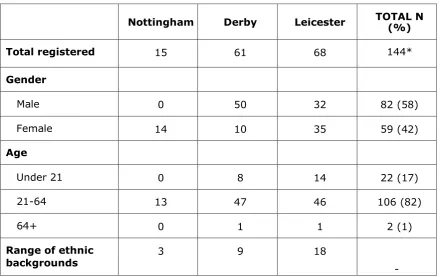
Attendance at the sessions in the different cities are listed in Table 1. The total number of attendances was highest in Leicester (N=209, 46.6%) and lowest in Nottingham (N=93, 20.7%). In comparison 147 (32.7%) was the total number of attendances in Derby.
TABLE 1 ABOUT HERE
TABLE 2 ABOUT HERE
©2018. Accepted by Arts & Health, An International Journal for Research, Policy and Practice. male and 42% (N=59) were female. The Nottingham group was only open to women and was based upon an existing women’s group established in
Nottingham prior to the Write Here Project. This explains the variation in gender comparing Nottingham with the other cities. By comparison, the Leicester and Derby groups were start-up groups open to all who attended the respective centres at the time. Although limited information was collected on age groups it shows that: 82% (N=106) were 21-64 years of age; 17% (N=22) were under 21; and 1% (N=2) was over 64 years of age.
It is also noteworthy that the Nottingham group had the lowest ethnic diversity. Both the Derby and Leicester groups have people from very mixed backgrounds whereas the Nottingham group was drawn from an existing group of women who were largely of African origin.
Results from questionnaires
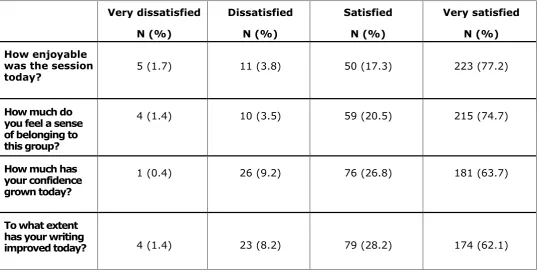
A total of 289 questionnaires were completed from 449 individual attendances, giving a response rate of 64.4% (289/449). Table 3 shows the satisfaction scores for participants from all the cities. Satisfaction levels were high for all questions, the majority were either “satisfied” or “very satisfied”. On combining the two groups the scores ranged from 90.3% to 95.2%. Very few participants were “dissatisfied” or “very dissatisfied”.
TABLE 3 ABOUT HERE
Themes across the professional writers’ journals
Because there were 36 diary entries across the three cities (10 sessions for each city), a great deal of rich, reflective data were produced. In their journals, the professional writers considered if they had fulfilled their roles according to the aims of the project, which were to stimulate creativity, engage with participants and help them develop their language skills. There were six themes from the professional writers’ journals and these are as follows:
Language
©2018. Accepted by Arts & Health, An International Journal for Research, Policy and Practice. Performance
Sanctuary and identity Community connection Outcomes
These six themes are presented in turn:
Language
Language ability differed greatly within and between groups. Even where English language was good, creative thinking could be difficult for some participants and the writers observed that although some people appeared anxious expressing themselves in front of strangers however, people often challenged themselves and were willing to try something new. Although facilitators had to be
consistently aware of language and potential communication difficulties, improvement in English language skills was observed by the facilitators in all three groups.
Literary techniques
Acknowledging the different ways in which people learn and engage, facilitators used multiple techniques to stimulate imagination and creativity including recordings, readings, images, list poems, collaborative writing and discussion based exercises. Activities that incorporated writing, movement, sharing, listening and images were used and helped to generate a multi-sensory and connective experience. Using the cultural heritage of global literature and
drawing on Shakespearean sonnets, Ted Hughes poems, and Asian folktales was found to help in Nottingham and make the participants ‘…culturally connected’ with one another. Metaphors and similes offered ways for people to express themselves and on occasions helped to express potentially difficult memories in an easier way. For example, ‘mountains to climb’ enabled people to identify with their own journeys and difficulties.
Performance
©2018. Accepted by Arts & Health, An International Journal for Research, Policy and Practice. work, an opportunity to share with the community, and a way for participants to confirm to themselves just how much progress had been made. There was a familiarity with oral storytelling across the respective cultures that ‘…could be valued equally with story writing’.
Sanctuary & Identity
The theme of place, home and identity was explicitly addressed through group activities. This was a complex subject for individuals who may have experienced instability and danger in terms of location. The potential existed for difficult and traumatic experiences to be articulated. However, the main expression was pride and fond memories of their homes.
Community connection
Sharing the aims of the project and inviting the participants to consider their own objectives gave a sense of agency to participants. Rather than the project being something done ‘for’ or ‘to’ them, it became something that was built ‘with’ them. The participants developed language skills and social confidence that may help with connecting with local people and being able to feel at ease in new communities, and articulating a positive representation of their home. Ultimately the sense of sanctuary resulted not from the creative writing, but the friendships built amongst participants.
Outcomes
Whilst all facilitating writers started with the aims of producing work and
teaching creative writing skills, by the end it was clear the most valuable outputs were the enjoyment of sessions and collaborative efforts and discussion that formed. Being in a community centre may have stimulated a freedom from normative social expectations and routines and allowed for space to create something new and for that creation to be shared. It was not important for the writers that the creative work of participants had to be accurate or true; neither should it need be cathartic or explicitly therapeutic.
Qualitative interview data
©2018. Accepted by Arts & Health, An International Journal for Research, Policy and Practice. The transcripts analysed are from interviews with 14 refugees or asylum seekers from three different creative writing groups based in three cities in the East Midlands (five in Nottingham, three in Derby,and six in Leicester). Participants identified with an “L” are from the Leicester group, “N” from the Nottingham group and “D” from the Derby group. There is a sense that many were lonely or isolated within their own homes and had found themselves living in places where they had few connections in terms of community or family.
“…but since they sent me here, it’s difficult, I am feeling lonely, yeah” (D1)
“I didn’t know any other people … when I came here...” (N4)
Some spoke of attending college, being involved in voluntary work or campaigning for human rights.
“So, my first day of coming to refuge here, because I want to volunteer, yeah, even now I am volunteering, I am working there, just came out from there, so I like helping- I like helping others, you know, yeah, I like to help people who are in need… I can even go to college – there to college to study my English, yeah, yeah.” (N1)
“I’m also human rights campaigner so a lot of the time it involves using social media platforms and writing articles and blogging as well. So by looking at different – exploring writing skills also improved the technique that I use when doing that and getting my message across, which I think is very valuable.” (N2)
Some also mentioned not being able to work because they did not have legal status.
“I am still waiting for my status as well. The home office just gave me their last decision or to give me a status, as I am still an asylum seeker here, yes.” (D1)
©2018. Accepted by Arts & Health, An International Journal for Research, Policy and Practice. for example volunteering, where others spoke of being more newly relocated, for example some people had recently moved from London. A variety of languages were mentioned as being interviewee’s first languages and also various religions and home countries. Interviewees were mixed in terms of their English-speaking abilities.
The Nottingham group was a women’s only group and the five interviewees were all known to one another and recruited from an existing group run for women who are refugees. This group of women expressed themselves confidently, coming across as mostly being eloquent English speakers. They also gave the impression of being well-settled within their communities. This group also perhaps seemed more politicised in terms of the way they spoke about their status as women, of human rights and of the desire to share their experiences and stories.
Thematic findings
We present the thematic analysis findings as two broad categories:
communication skills and learning the English language and secondly, mental health and wellbeing. Box 1 contains the themes from the qualitative interviews. In spite of asking a question about how the programme might be improved, there were only positive comments within the interviews about the creative writing groups and the findings from the thematic analysis illustrate how it was beneficial to the participants from all three groups in various ways.
Broad Theme 1: Communication Skills and learning the English language Attending the groups increased participants’ abilities and confidence to
communicate and this was one of the most important aspects of attendance as reported by the interviewees.
“And all of us we are foreigner. We are not English people. We love to learn English… and it is helpful.” L1
©2018. Accepted by Arts & Health, An International Journal for Research, Policy and Practice. “The most important thing has been language. I really enjoy
learning, I really like socialising with other people, that is really helpful to me.” D2
Interviewees expressed enthusiasm and gratitude for the opportunity. Improving their English language skills was seen as a tool that they could use to assimilate themselves within the communities within which they now lived and gave them hopes beyond this.
Extending vocabulary
For many, attendance at the groups helped to increase people’s vocabularies. “…You know as a foreigner our vocabulary is so tight like very few vocabulary, but now I am learning more vocabularies and it really give me a chance to express myself...” L1
It is possible that there were few opportunities for people to have their English corrected by native English speakers and the groups gave plenty of opportunity for participants to learn helpful English phrases and to feel more understood:
“It’s helped me a lot. It’s helped me to, you know, to know how to put a word in a proper place, to write properly….” N5
Speaking in front of other people
A specific factor that interviewees valued highly from attending the creative writing groups was their newfound confidence to speak English in front of other people. Reading their work aloud and getting feedback on it from group
members was an effective way of learning to speak with others and to improve their spoken English.
“Sometimes I feel proud because I am reading in front of so many people.” L5
Group learning
©2018. Accepted by Arts & Health, An International Journal for Research, Policy and Practice. “It is really interesting, and if I am alone, I can’t do it, but as a
group we can do.” L1
Learning about British culture and way of life
Learning about British culture and way of life was an element of the course that was highly regarded. The participants interviewed appreciated the opportunity to gain knowledge about British culture, laws, “how things are done” and people’s expectations. This new knowledge gained from the class made people feel better about the future and more comfortable.
“Actually I have not been long time so I don’t remember actually I learn from here about this country, how the people are thinking, the culture, regulations…” L3
Learning for the future
When interviewees talked about how they had benefited from the creative writing course this was often closely tied in with people’s hopes for the future. The impact the creative writing group had on the interviewees in terms of giving them a sense of hope for the future was powerful and moving. They talked of the knowledge they learned and the skills they had gained as valuable in many ways. Respondents spoke of their new language skills as providing possibility of “taking them anywhere”, the ability to help others, skills that might help them to get work and the possibility of “a better position in life”.
“So, maybe in future if I have any meeting to go to attend, I am free to stand up and talk – to be bold and confidence in me.” N5
Broad Theme 2: Mental health and wellbeing
Getting out of the house
©2018. Accepted by Arts & Health, An International Journal for Research, Policy and Practice. transcripts, read collectively, gave a sense of isolation within their daily lives and a lack of confidence in communicating with the “outside” world.
“I found this creative group helpful … every Tuesday I am here” D1
“…It gets me up from my house every morning.” N2
Happiness
The creative writing group provided participants with a time of enjoyment and happiness. They felt welcome, they met new people and there was a mutual desire to enjoy the time they spent together.
“In here, that’s good for me. … I am so happy. I am really happy if I came in here. I am meeting some people, some different people.” L4
“… and we don’t care about your religion, your skin or anything… you are human, come to our humanity and welcome to our
company. We give you laugh, you give us laugh and that’s it.” L2
Sharing and feeling heard
The chance to share their experiences and to “feel heard” was another feature of the writing group that the participants valued highly. There was gratitude
expressed for the chance to be listened to, to feel recognised and to feel a sense of belonging that the asylum seekers may have not experienced
elsewhere/everywhere. The freedom to talk and share gave them a sense of peace as well and they described feeling lighter or better after the group.
“Knowing that someone wants to listen to what you have to say” N2
“You think we are having an issue that makes you feel depressed when you are staying in a home, but when you come out and see your fellow asylum seeker chatting together, you know, you relief.” N1
Self-esteem
©2018. Accepted by Arts & Health, An International Journal for Research, Policy and Practice. confidence, both in their ability to speak and write and, in more subtle ways, it improved their overall sense of wellbeing because they were better able to communicate.
“…coming through these workshops and I've been inspired, I'm not afraid anymore, … So it also develops yourself... I’m more confident in my writing… and in presenting my work ….” N2
Distraction from worries
The group provided a welcome distraction from the participants’ worries, difficult memories and despairing thoughts about what the future might bring. As
asylum seekers and refugees, these participants had uncertain futures and sometimes spoke of difficult pasts to contend with but attending the creative writing group provided respite from worries, sad memories of past ordeals or current hardships. As one participant put it so well, when she was there she felt;
“…when I am on my own, I feel like my life doesn’t make sense, but when I am in the creative group, I feel like I still got hope that I can do something better in the future.” D1
“Yeah, then I go home, I am so happy I have nothing to worry.” N4
Past and present
Sharing the stories of their lives in their home countries and contrasting them with their lives now, reflecting on their families who they had lost or left behind, seemed to have been a very important and maybe even a ‘healing’ element to the groups. The way the participants described this aspect suggest that being able to put into words that those transitions and changes helped them to connect the past and present in a way that helped them make sense of it and come to terms with it. Furthermore, the sharing of these stories and listening to others seemed cathartic and mutually beneficial.
“And in poem we are sharing our emotions, how we are feeling… It’s safe to do that … But for us, it’s like everything what we feel inside my heart I am expressing.” L5
©2018. Accepted by Arts & Health, An International Journal for Research, Policy and Practice. Being able to share their stories, problems and situations enabled participants to find new perspectives on their own stories and learning about other’s
experiences was comforting and could give them hope.
“Because we all have problems and when we hear each other’s problem, we all of the time feeling thinking negative. But here we’re learning something and we have hope.” L5
It is inevitable that people who have become displaced in another country will draw comparisons between their adopted country and their home country. By comparing cultures, helps participants to make sense of their new lives and find hope.
Relationships
Participants described the relationships they had formed because of attending the creative writing group as meaningful and positive; “family-like”, there was a sense of recognition and belonging. Despite the multicultural nature of the groups, linguistic, cultural and religious differences were not mentioned. The groups were spoken about very much as close-knit gatherings. The groups provided a sense of belonging and community and a space that was mutually supportive.
“Yeah, I know a few more people when I am coming here
because I am a bit shy. From beginning I don’t speak much with people, but once I know a person then I can start talking with the person… So I feel happy when I talk with them.” L5
Quality of the teaching
The interviewees spoke about their teachers in a very respectful and grateful manner. They appreciated qualities in the teachers some described as
experienced and kind.
“Yeah, it’s good, very experienced, it is good, helpful as well and good people to help us. Good teacher, everything good.” L3
©2018. Accepted by Arts & Health, An International Journal for Research, Policy and Practice. DISCUSSION
This mixed methods study has evaluated the implementation of a creative writing project in three cities in the East Midlands of the UK. Participant
satisfaction was high and the quality of the programme was highly regarded by participants. However, it is important to identify what it is about the groups that participants value in order to inform future interventions. Common features across the groups that participants appear to value are competency of the professional writers; the opportunity to express themselves; space for fun, a warm and accepting atmosphere. These factors enabled confidence-building, a sense of belonging and feeling valued; improvement in self-esteem; a sense of hope. According to the professional writers, the workshops offered an enjoyable and non-judgemental outlet to be creative, improving sense of wellbeing through creative expression. New creative work and events were produced. They
perceived that what was apparently most important to the participants was having fun and building friendships. The data reveal a poignancy and depth of the shared experiences of participating in a creative writing group. Every culture has a history of storytelling and the centrality of sharing stories and ideas across the project has enabled a respect and connectedness across the participants; similar to the study by Goncalves et al., (2015) who assert that: “Creative writing gives a voice to marginal groups in society, allowing them tell their stories.” (page 71). It is likely that each of the participants in one way or another misses their home and it is also likely that the connection that people experience with one another, is reminiscent of family and friends from home. Furthermore, creating new friendships may help to forge future communities which in turn may mediate the process of integration (Zetter et al., 2005). Displaced people may lack the valuable mental health benefits of social connectedness (Alegria et al., 2017; Zhang and Ta, 2009).
©2018. Accepted by Arts & Health, An International Journal for Research, Policy and Practice. There was much praise from participants for the writers who led the sessions. Arguably, the success of the entire project was dependent upon the
professionalism and skill of the writers. All six were carefully selected as most suited for this type of work. Being asked to complete reflective diaries, not only facilitated a sense of accountability, but it also set the tone for the evaluation, one of care and thoughtfulness. As such, the professional writers were being asked to “practice what they preach”. From a learning perspective, these diaries are of great importance. The writers’ perceptions of the need for fun, enjoyment and relationship-building was strongly echoed in the interviews with participants. It was the atmosphere created by the professional writers that enabled the fun and friendships to emerge and develop. Maslow’s (1954) hierarchy of needs and motivation illustrates this well when satisfaction outcomes are mapped against the framework in Box 2:
BOX 2 ABOUT HERE
Achievements within the groups however should not be over-stated. It is perhaps the case that the groups offered an oasis in people’s lives as the possible trauma of displacement might take years to heal and resolve.
The fact that attending the creative writing groups improved participants’ English language and literacy skills enabled them to feel more confident about
communicating. This was extremely important to the participants in their daily lives and suggested that they may be more likely to become better integrated into their communities because they were more confident to speak to people and to help navigate bureaucratic systems. This confidence however gave people a renewed sense of hope for the future. They felt able to share their life-stories freely and sharing these experiences and making sense of them within a group setting seemed to have the double benefit of helping them come to terms with their histories and having some faith in the present and future.
©2018. Accepted by Arts & Health, An International Journal for Research, Policy and Practice. and lack of language skills created limitations on how they might spend their time.
Given that 144 people attended the sessions and only 14 were interviewed and were self-selecting, there is the potential for selection bias and this is a
weakness of the evaluation. Nevertheless, from 449 attendances, there were 289 evaluation surveys returned and this represents a return rate of 64.4%, which is a strength of the study.
CONCLUSION
This evaluation has illustrated the potential benefits for refugees and people seeking asylum attending creative writing groups led by professional writers. By triangulating data, this study has generated new knowledge primarily from writers’ diaries, satisfaction surveys and qualitative interviews. It has also recognised the limitations of such group activities for people who may have experienced trauma and loss. The study may also provide learning for future work of this nature. Future programmes could benefit from being closed groups where a sense of belonging could be greater and opportunities for friendships could be greater. This might enable the positive outcomes to be more
sustainable. Safeguarding and supervision for facilitators and volunteers is important. Facilitators expressed anxiety that exercises could bring up difficult feelings, and support and training on dealing with difficult revelations would help ensure that worry about such outcomes did not create barriers to the work that they felt able to deliver as well as to help them when such events occurred. A place where people feel safe to express themselves is imperative (the term ‘sanctuary’ is extremely apt). The groups offered a creative and enjoyable experience, enabling self-expression and confidence building. Creative writing groups therefore may offer one way to enable people who have experienced trauma and displacement to move-on, grow, and envision a brighter future.
REFERENCES
Alegría, M., Álvarez, K., & DiMarzio, K. (2017). Immigration and Mental
©2018. Accepted by Arts & Health, An International Journal for Research, Policy and Practice. Angus, L.E. and McLeod, J., 2004. The handbook of narrative and
psychotherapy: Practice, theory and research. Sage. London
Barak, A., & Leichtentritt, R. D. (2016). Creative Writing after Traumatic Loss:
Towards a Generative Writing Approach. British Journal of Social Work, 47(3),
936-954. DOI
https://doi.org/10.1093/bjsw/bcw030
Bolton, G. (Ed.). (2004). Writing cures: an introductory handbook of writing in
counselling and psychotherapy. Psychology Press.
Braun, V. and Clarke (2006) Using thematic analysis in psychology. Qualitative
Research in Psychology, 3 (2). 77-101 DOI: 10.1191/1478088706qp063oa
Dingle, G. A., Williams, E., Jetten, J., & Welch, J. (2017). Choir singing and
creative writing enhance emotion regulation in adults with chronic mental health conditions. British Journal of Clinical Psychology, 56(4), 443-457.
Ely, G. E., Koury, S., Bennett, K., Hartinger, C., Green, S., & Nochajski, T. (2017). “I Feel Like I Am Finding Peace”: Exploring the Use of a Combined Art
Therapy and Adapted Seeking Safety Program with Refugee Support
Groups. Advances in Social Work, 18(1), 103-115.
Gonçalves, F., Campos, P., Hanna, J., & Ashby, S. (2015, June). You're the
Voice: Evaluating user interfaces for encouraging underserved youths to express
themselves through creative writing. In Proceedings of the 2015 ACM SIGCHI
Conference on Creativity and Cognition (pp. 63-72). ACM.
Gould, H. G. (2005). A sense of belonging: arts and culture in the integration of
refugees and asylum seekers. Creative Exchange. London
©2018. Accepted by Arts & Health, An International Journal for Research, Policy and Practice. Haertl, K. L., & Ero-Phillips, A. M. (2017). The healing properties of writing for
persons with mental health conditions. Arts & Health, 1-12.
Hilse, C., Griffiths, S., & Corr, S. (2007). The impact of participating in a poetry
workshop. British Journal of Occupational Therapy, 70(10), 431-438.
Johnston, O., Startup, H., Lavender, A., Godfrey, E., & Schmidt, U. (2010).
Therapeutic writing as an intervention for symptoms of bulimia nervosa: effects
and mechanism of change. International Journal of Eating Disorders, 43(5), 405-419.
Kalmanowitz, D., & Ho, R. T. (2016). Out of our mind. Art therapy and
mindfulness with refugees, political violence and trauma. The Arts in
Psychotherapy, 49, 57-65.
López-Bech, L., & Zúñiga, R. (2017). Digital storytelling: Putting young asylum seekers at the heart of the story. Intercultural Education, 28(2), 224-228.
McColl, I. (2004). The Back Pages. The British Journal of General Practice, 145.
Maslow, A (1954). Motivation and personality. New York: Harper.
O'Neill, M. (2004). Global Refugees: Forced Migration, Diaspora and Belonging.
University of Huddersfield.
Quinlan, R., Schweitzer, R. D., Khawaja, N., & Griffin, J. (2016). Evaluation of a
school-based creative arts therapy program for adolescents from refugee
backgrounds. The Arts in Psychotherapy, 47, 72-78.
Soter, A. O. (2016). Reading and writing poetically for wellbeing: language as a
field of energy in practice. Journal of Poetry Therapy, 29(3), 161-174. DOI:
©2018. Accepted by Arts & Health, An International Journal for Research, Policy and Practice. Stockton, H., Joseph, S., & Hunt, N. (2014). Expressive writing and
posttraumatic growth: An Internet-based study. Traumatology: An International
Journal, 20(2), 75.
Sunderland, N., Istvandity, L., Lakhani, A., Lenette, C., Procopis, B., &
Caballero, P. (2015). They [do more than] interrupt us from sadness: Exploring
the impact of participatory music making on social determinants of health and
wellbeing for refugees in Australia. Health, Culture and Society, 8(1), 1.
Taylor, S., Leigh-Phippard, H., & Grant, A. (2014). Writing for recovery: a
practice development project for mental health service users, carers and
survivors. International Practice Development Journal, 4(1). SOI:
https://www.fons.org/library/journal/volume4-issue1/article5
UNHCR (2017) http://popstats.unhcr.org/en/overview (accessed 03/08/17)
UNHCR (2017a)
http://www.unhcr.org/uk/protection/basic/526a22cb6/mandate-high-commissioner-refugees-office.html (accessed 03/08/17)
Williams J (2015) Framing asylum seekers and refugees: creative writing choices
in a context of disbelief, paranoia and malicious rumour. Migration and
Marginalities Conference, Brighton. Available at:
http://arts.brighton.ac.uk/__data/assets/pdf_file/0003/194430/M-and-M-Full-Schedule_final-v2.pdf (accessed 03/08/17)
Zhang, W., & Ta, V. M. (2009). Social connections, immigration-related factors,
and self-rated physical and mental health among Asian Americans. Social
©2018. Accepted by Arts & Health, An International Journal for Research, Policy and Practice. Zetter, R., Griffiths, D., & Sigona, N. (2005). Social capital or social exclusion?
The impact of asylum-seeker dispersal on UK refugee community
[image:24.595.72.544.201.377.2]organizations. Community Development Journal, 40(2), 169-181.
Table 1: Number of sessions and attendance
Nottingham
N (%) N (%) Derby Leicester N (%) Total
The total number of
sessions 13 (36.1) 11 (30.6) 12 (33.3) 36
The number of different people who attended at least once
15 (10.4) 61 (42.4) 68 (47.2) 144
Total number of
attendances 93 (20.7) 147 (32.7) 209 (46.6) 449
Mean number of
attendances each week 7 13 17 -
Table 2: Demographic data of the participants
Nottingham Derby Leicester TOTAL N (%)
N (%)
Total registered 15 61 68 144*
Gender
Male 0 50 32 82 (58)
Female 14 10 35 59 (42)
Age
Under 21 0 8 14 22 (17)
21-64 13 47 46 106 (82)
64+ 0 1 1 2 (1)
Range of ethnic
backgrounds 3 9 18 -
[image:24.595.74.515.449.726.2]©2018. Accepted by Arts & Health, An International Journal for Research, Policy and Practice.
Table 3: Participants' satisfaction
Very dissatisfied
N (%)
Dissatisfied
N (%)
Satisfied
N (%)
Very satisfied
N (%)
How enjoyable was the session
today? 5 (1.7) 11 (3.8) 50 (17.3) 223 (77.2)
How much do you feel a sense of belonging to this group?
4 (1.4) 10 (3.5) 59 (20.5) 215 (74.7)
How much has your confidence grown today?
1 (0.4) 26 (9.2) 76 (26.8) 181 (63.7)
To what extent has your writing
improved today? 4 (1.4) 23 (8.2) 79 (28.2) 174 (62.1)
Box 1 – themes from interviews
Broad themes Themes Initial codes
Communication skills and learning the English
language
Communication and learning English
Extending vocabulary
Speaking in front of other people Group learning
Future Learning about British culture and way of life
Learning for the future Mental Health and
Well-being
Feeling good Getting out of the house Happiness
Sharing and feeling heard Self-esteem
©2018. Accepted by Arts & Health, An International Journal for Research, Policy and Practice. Relationships
Past and present Finding hope
Relationships: family, within the group
Quality of the teaching
BOX 2 : Project activities mapped against “Maslow’s Hierarchy of
Needs”
Maslow’s identified needs How these were satisfied in the
project
1. Biological and Physiological needs. 2. Safety needs - protection from
elements, security, order, law, limits, stability, freedom from fear.
3. Venues were community-based, accessible and already being used by refugees and people seeking asylum. 4. Drinks and biscuits were provided.
5. Social Needs - belongingness,
affection and love, - from work group, family, friends, romantic relationships.
6. Writers were welcoming and non-judgemental. Staff at each of the centres were also welcoming. Social time for each of the groups was facilitated. Participants claimed a sense of belonging and friendships were forged.
7. Esteem needs - achievement, mastery, independence, status, dominance, prestige, self-respect, respect from others.
8. Each participant was encouraged to participate and each were given frequent opportunities to share their work with others in the group.
Individual’s writings were shared and celebrated and some contributed to “final showcase events”.
9. Self-Actualization needs - realizing personal potential, self-fulfilment, seeking personal growth and peak experiences.
Participants claimed increased