For Peer Review
Mementos from Boots multisensory boxes - qualitative evaluation of an intervention for people with dementia:
innovative practice
Journal: Dementia: the international journal of social research and practice Manuscript ID DEM-16-0073.R1
Origin of Contribution: UK/Europe and the rest of the world Manuscript Type: Innovative Practice
Keywords: care homes, dementia, multisensory interventions, olfactory stimuli, people with dementia
Abstract:
This qualitative study explored a multi-sensory (including olfactory) intervention for people with dementia. Six themed boxes (e.g. Childhood) containing items chosen from the Boots archive designed to encourage conversation were used in weekly group sessions. Session participants were people with dementia and care staff from a local care home, a trained facilitator and archivists from Boots UK. Semi-structured interviews
explored participants’ experiences of the sessions. Interviews were analysed using Thematic Analysis. The three major themes Engagement (subthemes: Inclusiveness; Emotional involvement; Factors that supported engagement), What’s in the box (subthemes: Contents stimulate
memories; Mystery, variety and age of items; Value of olfactory stimuli), and A conversation starter (subtheme: Opportunity for self-expression) reveal the success of the intervention and the value of olfactory stimuli. Multisensory boxes including olfactory stimulation can be an engaging intervention with scope to refine it for people with dementia and their carers in the wider community.
For Peer Review
Mementos from Boots multisensory boxes - qualitative evaluation of an
intervention for people with dementia: innovative practice
Abstract
This qualitative study explored a multisensory (including olfactory) intervention for people with
dementia. Six themed boxes (e.g. Childhood) containing items chosen from the Boots archive
designed to encourage conversation were used in weekly group sessions. Session participants
were people with dementia and care staff from a local care home, a trained facilitator and
archivists from Boots UK. Semi-structured interviews explored participants’ experiences of the
sessions. Interviews were analysed using Thematic Analysis. The three major themes
Engagement (subthemes: Inclusiveness; Emotional involvement; Factors that supported
engagement), What’s in the box (subthemes: Contents stimulate memories; Mystery, variety
and age of items; Value of olfactory stimuli), and A conversation starter (subtheme: Opportunity
for self-expression) reveal the success of the intervention and the value of olfactory stimuli.
Multisensory boxes including olfactory stimulation can be an engaging intervention with scope
to refine it for people with dementia and their carers in the wider community.
For Peer Review
Dementia is characterised by memory loss, impaired cognitive function and behavioural and
psychological symptoms (BPSD), but it can also cause impairments in hearing, vision and olfaction
(Behrman, Chouliaras, & Ebmeier, 2014). Olfaction has been relatively little explored in psychosocial
research although it is closely associated with memory. Deficits in olfaction are not unusual in elderly
people generally (Corbin & Eastwood, 1986), but while it remains unclear whether olfactory
dysfunction is linked to dementia itself or is merely a marker for advanced age, it is important to
explore the potential of olfactory stimuli in multisensory interventions for people with dementia .
Most published studies using olfactory stimuli in dementia have involved aromatherapy. A Cochrane
review (Forrester et al., 2014) included seven randomised controlled trials (RCTs) of aromatherapy
usually for the management of agitation in care home residents with dementia. Only two trials
provided sufficient data for meta-analysis, one with results favouring aromatherapy (Ballard,
O'Brien, Reichelt, & Perry, 2002) and the other showing no significant difference (Burns et al., 2011).
Other non-RCT studies have also reported mixed findings (Forrester et al, 2014), mainly in relation to
agitation, difficult behaviour and sleep.
Multisensory interventions combine activities with therapies, e.g. music, painting and reality
orientation (Ozdemir & Akdemir, 2009), or use stimulation rooms (Snoezelen) (Sánchez,
Millán-Calenti, Lorenzo-López, & Maseda, 2013). Such interventions often include olfactory elements.
Multisensory interventions may be perceived as less cognitively demanding (Milev et al., 2008) than
therapies such as reminiscence, as they involve passive stimulation and creative expression, rather
than factual recall and memory retrieval. Again, research findings are mixed: for example a Cochrane
review of Snoezelen (Chung, Lai, Chung, & French, 2002) found no evidence for its efficacy.
Research into olfactory and multisensory therapies has various shortcomings, including the
difficulties of conducting adequate RCTs and choosing the most appropriate outcome measures.
Despite the limitations of research findings, it is clear, at an individual and anecdotal level, that
sensory-based activities can bring great pleasure, even if it is difficult to demonstrate longer term
effects. Qualitative approaches may be more sensitive in detecting individual level effects.
This exploratory qualitative study had the following aims:
• Develop a set of themed multisensory boxes for a series of weekly groups in a care home
• Investigate multisensory (including olfactory) stimulation in the psychosocial care of people
with dementia
• Explore the responses of people with dementia, and all participants at the sessions, to the
multisensory boxes.
For Peer Review
Method
Participants were (a) residents and (b) staff at a home specialising in dementia care; as well as (c)
archivists from Boots UK who had been involved in constructing the multisensory boxes. Care home
staff recommended residents to take part in the intervention. Residents who participated were aged
60 or over, with mild to moderate dementia, and English-speaking. . The main exclusion criterion
was if a resident was incapable of participating in group activities, e.g. being too ill or restless.
The sessions were run by an experienced facilitator, a male artist with experience in working with
dementia and arts-related activities. One of the Boots archivists who helped develop the boxes also
attended each session.
Ethical approval was obtained from Nottingham University Medical School Research Ethics
Committee before the start of the study (G10072014). Informed consent was obtained from those
participants with capacity to give consent. In the absence of capacity, a personal or professional
consultee was approached. All individual data were pseudonymised.
Groups were held weekly in the care home for 6 consecutive weeks. Each session lasted 1-2 hours
and focused on a series of themed boxes, named Mementos from Boots. The multisensory materials
used in the boxes were supplied by the archive collection of Boots UK. Boots is an international
retailer with roots as a high street chemist in the UK. The company’s archive contains a large range
of documents and artefacts related to the trade over much of the 20th Century. In collaboration
with Boots’ archivists, the facilitator and researcher (SG) chose items to stimulate multiple senses
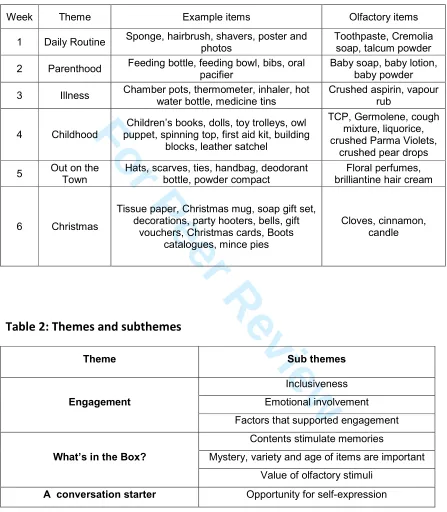
and meaningful interactions between people with dementia and their carers. Six themed boxes
were created: Daily Routine; Parenthood; Illness; Childhood; On the Town; and Christmas. At least
one olfactory item was included in each box (Table 1).
--Table 1 about here--
During the sessions, the facilitator introduced the box and passed round the items. Whilst objects
were handled, the facilitator asked questions about the contents and encouraged conversation
between the participants. This continued until all the items had been examined. The researcher (SG)
attended each session, and made field notes recording the group’s participation and engagement.
After each of the six sessions, semi-structured interviews were conducted with the facilitator, and
one of the archivists who had attended. Interviews with two staff carers and two residents were
conducted midway through the sessions, using a semi-structured schedule to explore issues
For Peer Review
including emotional responses, engagement, items used, and facilitator role. Interviews were
audio-recorded and transcribed.
Interview transcripts were analysed using Thematic Analysis as this approach derives data and
themes that are grounded in participants’ experiences and reflections (Braun & Clarke, 2006).
Analysis proceeded iteratively, and was refined in collaboration with another qualitative researcher
(CB). Themes were defined and named, following accepted guidance (Boyatzis, 1998). Inter-rater
reliability of coding was also assessed: 79% inter-rater reliability was achieved: scores >70% are
considered acceptable (Boyatzis, 1998).
Results and Discussion
Over the six weekly sessions 19 participants took part: 13 residents (5 men, 8 women), 3 staff
(female), 2 archivists (female) and the facilitator (male). Residents attended between two and all six
sessions, and each staff member attended between four and six sessions. Interviews were
completed with two residents, two staff carers, the two archivists and the facilitator.
Findings
Three major themes with seven supporting or underpinning subthemes were identified (Table 2).
--Table 2 about here--
Engagement
All the participants were extremely positive about the sessions and the Mementos from Boots
boxes. One resident, although initially reluctant to participate, described improved well-being:
“I think that I felt a lot better”
and
“I’d like to come next week” (Sally, resident)
Staff participants also enjoyed the sessions:
“It’s been lovely for me too” (Pamela, staff)
Inclusiveness
High engagement resulted from the inclusive nature of the Mementos from Boots intervention.
Other activities and interventions for people with dementia may require more active involvement,
e.g. singing or arts projects (Bannan & Montgomery-Smith, 2008). Participants could contribute here
regardless of ability and participate at varying levels, depending on how they felt:
For Peer Review
“in another activity you might go round the room singing, but not everybody wants to do that and it
depends what mood you’re in. And even if you’re not in a great mood you can still sit and observe in
this activity and listen to people” (Samantha, staff)
This inclusiveness is important, as it leads people with dementia to feel part of a group,
strengthening relationships and improving mental wellbeing. Other research has stressed how
interventions need to be accessible to people with varying levels of cognitive decline (Baker et al.,
2001).
Emotional involvement
The intervention involved people at an affective level, with interviewees describing a full spectrum
of emotions:
“I found it emotional and I found it uplifting and I found it… warm and welcoming are the words that
I would use” (Kathy, archivist)
The researcher’s field notes also provide evidence of the resident and staff participants’ active
engagement during the sessions. Residents and staff were interacting with each other, with the
facilitator, and also responding and engaging with items from the Mementos from Boots boxes.
Factors supporting engagement
Engagement was underpinned by having a skilled facilitator, staff actively engaging in the
intervention and multiple sessions. The importance of a good facilitator was mentioned here:
“They just have to be the right things, delivered by someone who’s experienced in doing it” (Kathy,
archivist)
and has been noted elsewhere too (Kasl-Godley & Gatz, 2000).
Other studies have reported how arts activities can improve the quality of care provided by care
home staff (Bailey, Cook, & Machin, 2013) Here, staff actively assisted participants during the
sessions, and became immersed in the intervention themselves:
“the staff were excellent… I like the extent to which they’re participating sort of on an equal footing
with everyone else who’s in the room and they’re enjoying it and that’s good." (Jacob, facilitator)
Running a series of linked sessions also appears to have been valuable:
For Peer Review
“they sort of become more and more accustomed to what we’re doing and some of them do
remember from the previous week, so that means that their engagement is more significant and
that’s just as a consequence of relaxing into the structure that we’ve provided”( Jacob, facilitator).
What’s in the Box?
This theme refers to the contents of the boxes and their multisensory elements.
The value of olfactory stimuli
Participants discussed the benefits of olfactory stimulation:
“a couple seemed to get a good feel for what they were smelling, they could definitely smell
something, which I thought was quite impressive “(Kathy, archivist)
Although olfaction is often regarded as impaired in people with dementia (Kjelvik, Sando, Aasly,
Engedal, & White, 2007), this was evidence that fragrance was important for the residents. However,
people with dementia could not always identify smells:
“ we assumed that lots of smells would be very instantly resonant and a lot of them are not really
responding in the way we had anticipated. So last week for instance it took …. eight or nine people
before anyone said ‘toothpaste’. The same happened with baby cream – it took a long long time and
that’s not an argument for not doing it, I think it’s an argument for doing it more, but it’s interesting
that they don’t really respond in the way we anticipated” (Jacob, facilitator)
He speculated that visual information might also be needed for identification:
“it’s hard, if everything is in the same jar, it’s a bigger ask for them to visualise that scent’s usual
context” (Jacob, facilitator)
The intensity of the olfactory stimulus appeared important:
“Carbolic soap definitely sparked something, umm possibly because it was the strongest smell”
(Eleanor, archivist).
How best to present olfactory stimuli remains unclear. A standard container may lack visual
information that could help trigger recognition of the smell. It may therefore be helpful to include
packaging. Further research in this area is warranted.
Contents stimulate memories
Respondents discussed how the Mementos from Boots boxes stimulated memories in various ways,
obviously of potential use in dementia care:
For Peer Review
“Oh it brought back lots of memories” (Sally, resident)Also, the sessions were:
“stimulating their memories of times gone by, and I think they can remember perhaps more in the
past than they can at present time” (Pamela, staff)
The Mementos from Boots boxes encouraged indirect recall of past events through the presentation
of familiar objects. However, the Mementos from Boots sessions put less direct emphasis on
remembering, in contrast to reminiscence therapy (James & Fossey, 2013) for example, where the
focus is upon recall. In that sense, the Mementos from Boots sessions may be less cognitively
demanding but more suitable for a severely impaired group.
Mystery, variety and age of items are important
The inclusion of objects which were not immediately identifiable was an important feature of the
Mementos from Boots boxes. These items captured the participants’ interest and imagination:
“they were quite intriguing beautiful objects that people wanted to investigate and as you noticed
with William [resident], his investigation wasn’t necessarily just about its function as a powder
compact, it was because it was a beautiful object” (Jacob, facilitator)
This theme was supported by the researcher’s field notes which recorded that residents explored
more and engaged for longer with the more unusual items.
A conversation starter
A notable effect of the Mementos from Boots sessions was how the participants were encouraged to
talk:
“There’s more conversation. I feel more conversation amongst the older people is key” (Samantha,
staff).
This increase in verbal communication was striking:
“I think I was surprised at how much conversation was generated and how on topic it kept” (Eleanor,
archivist).
(Hope, 1998) reported a positive impact on the spontaneity and coherence of speech produced by a
multisensory intervention. Care home residents with dementia often have severe language
impairments and may have limited opportunities to express themselves; this intervention also
provided a platform for more meaningful interactions:
For Peer Review
“I think things like this work, because it gives people space in which to speak, listen, be listened to
and to listen, and that’s really valuable, and they feel better as a consequence of that space.” (Jacob,
facilitator)
Strengths and limitations
This study reports the effects of a series of purposely designed, themed, multisensory boxes in a
care home setting. The sessions were well attended and the contents of the boxes were important in
engaging participants, with robust effects observed within the groups as reflected in the themes we
derived from our data.
The research included a single time-limited group. We have not investigated behaviour change
outside the group, so whether there is any persisting effect is not known. However, this was beyond
the scope of this study. The number of interviews with participants, especially people with
dementia, was limited. However support for themes was found in all the participants’ comments and
the study field notes. The facilitator was skilled and experienced, someone less skilled may not have
achieved the same results; this raises a challenge as to how a similar intervention could be delivered
more widely and warrants further investigation.
Conclusions
Multisensory Mementos from Boots boxes, with a focus on olfactory stimulation, can be an
engaging, enjoyable and effective psychosocial intervention for people with dementia. The olfactory
stimuli attracted much interest in the sessions partly because identifying them was a challenge.
People with dementia are not necessarily anosmic and they are able to engage with interventions
across sensory domains.
There is scope both for future use of Mementos from Boots multisensory boxes in care homes, and
using the findings of this study to refine the intervention to benefit other people with dementia and
their carers.
For Peer Review
References:
Bailey, C., Cook, G., & Machin, A. (2013). A ‘Room for the Imagination”: Workforce Development In creative ageing in Dementia Care. Gateshead, UK: Equality Arts & NHS South of Tyne and Wear
Baker, R., Bell, S., Baker, E., Holloway, J., Pearce, R., Dowling, Z., . . . Wareing, L.-A. (2001). A
randomized controlled trial of the effects of multi-sensory stimulation (MSS) for people with dementia. British Journal of Clinical Psychology, 40(1), 81-96. doi:10.1348/014466501163508 Ballard, C. G., O'Brien, J. T., Reichelt, K., & Perry, E. K. (2002). Aromatherapy as a safe and effective
treatment for the management of agitation in severe dementia: the results of a double-blind, placebo-controlled trial with Melissa. J Clin Psychiatry, 63(7), 553-558.
Bannan, N., & Montgomery-Smith, C. (2008). `Singing for the Brain': reflections on the human capacity for music arising from a pilot study of group singing with Alzheimer's patients. The Journal of the Royal Society for the Promotion of Health, 128(2), 73-78.
Behrman, S., Chouliaras, L., & Ebmeier, K. P. (2014). Considering the senses in the diagnosis and management of dementia. Maturitas, 77(4), 305-310.
doi:http://dx.doi.org/10.1016/j.maturitas.2014.01.003
Boyatzis, R. E. (1998). Transforming Qualitative Information: Thematic Analysis and Code Development: SAGE Publications.
Braun, V., & Clarke, V. (2006). Using thematic analysis in psychology. Qualitative Research in Psychology, 3(2), 77-101.
Burns, A., Perry, E., Holmes, C., Francis, P., Morris, J., Howes, M. J., . . . Ballard, C. (2011). A double-blind placebo-controlled randomized trial of Melissa officinalis oil and donepezil for the treatment of agitation in Alzheimer's disease. Dement Geriatr Cogn Disord, 31(2), 158-164. doi:10.1159/000324438
Chung, J. C., Lai, C. K., Chung, P. M., & French, H. P. (2002). Snoezelen for dementia. Cochrane Database Syst Rev(4), CD003152. doi:10.1002/14651858.CD003152
Corbin, S. L., & Eastwood, M. R. (1986). Sensory deficits and mental disorders of old age: causal or coincidental associations? Psychological Medicine, 16(02), 251-256.
Forrester, L. T., Maayan, N., Orrell, M., Spector, A. E., Buchan, L. D., & Soares-Weiser, K. (2014). Aromatherapy for dementia. Cochrane Database Syst Rev, 2, CD003150.
doi:10.1002/14651858.CD003150.pub2
Hope. (1998). The effects of multisensory environments on older people with dementia. Journal of Psychiatric and Mental Health Nursing, 5(5), 377-385.
doi:10.1046/j.1365-2850.1998.00143.x
James, I. A., & Fossey, J. (2013). Nonpharmalogical interventions in care homes. In T. a. T. Dening, A. (Ed.), Oxford Textbook of Old Age Psychiatry (2nd ed., pp. 269-281). Oxford: Oxford
University Press.
Kasl-Godley, J., & Gatz, M. (2000). Psychosocial interventions for individuals with dementia: an integration of theory, therapy, and a clinical understanding of dementia. Clin Psychol Rev, 20(6), 755-782.
Kjelvik, G., Sando, S. B., Aasly, J., Engedal, K. A., & White, L. R. (2007). Use of the Brief Smell Identification Test for olfactory deficit in a Norwegian population with Alzheimer's disease. Int J Geriatr Psychiatry, 22(10), 1020-1024. doi:10.1002/gps.1783
Milev, R. V., Kellar, T., McLean, M., Mileva, V., Luthra, V., Thompson, S., & Peever, L. (2008). Multisensory stimulation for elderly with dementia: a 24-week single-blind randomized controlled pilot study. Am J Alzheimers Dis Other Demen, 23(4), 372-376.
doi:10.1177/1533317508316681
For Peer Review
Ozdemir, L., & Akdemir, N. (2009). Effects of multisensory stimulation on cognition, depression and anxiety levels of mildly-affected Alzheimer's patients. J Neurol Sci, 283(1-2), 211-213. doi:10.1016/j.jns.2009.02.367
Sánchez, A., Millán-Calenti, J. C., Lorenzo-López, L., & Maseda, A. (2013). Multisensory stimulation for people with dementia: a review of the literature. Am J Alzheimers Dis Other Demen, 28(1), 7-14. doi:10.1177/1533317512466693
For Peer Review
Table 1: Session themes and box contents
Week Theme Example items Olfactory items
1 Daily Routine Sponge, hairbrush, shavers, poster and photos
Toothpaste, Cremolia soap, talcum powder
2 Parenthood Feeding bottle, feeding bowl, bibs, oral pacifier
Baby soap, baby lotion, baby powder
3 Illness Chamber pots, thermometer, inhaler, hot water bottle, medicine tins Crushed aspirin, vapour rub
4 Childhood
Children’s books, dolls, toy trolleys, owl puppet, spinning top, first aid kit, building
blocks, leather satchel
TCP, Germolene, cough mixture, liquorice, crushed Parma Violets,
crushed pear drops
5 Out on the Town
Hats, scarves, ties, handbag, deodorant bottle, powder compact
Floral perfumes, brilliantine hair cream
6 Christmas
Tissue paper, Christmas mug, soap gift set, decorations, party hooters, bells, gift
vouchers, Christmas cards, Boots catalogues, mince pies
Cloves, cinnamon, candle
Table 2: Themes and subthemes
Theme Sub themes
Engagement
Inclusiveness
Emotional involvement
Factors that supported engagement
What’s in the Box?
Contents stimulate memories
Mystery, variety and age of items are important
Value of olfactory stimuli
A conversation starter Opportunity for self-expression