The final publication is available at Springer via http://dx.doi.org/10.1007/s10111-016-0364-4
Span of control in supervision of rail track work
Robert J. Houghton 1
Chris White 1,2
David Golightly 1
John R. Wilson 1,2
1 Human Factors Research Group, University of Nottingham, UK
2 Network Rail Ergonomics Team, Milton Keynes, UK
Corresponding author: Robert J. Houghton
Email: [email protected]
Telephone: +44 01159514061
Fax: +44 01158232551
Room A32, Coates Building
Department of Mechanical, Materials and Manufacturing Engineering,
Faculty of Engineering, University of Nottingham, NG7 2RD
Abstract
The supervision of engineering work on the railways has received relatively little
examination despite being both safety-critical in its own right and having wider
implications for the successful running of the railways. The present paper is
concerned with understanding the factors that make different engineering works
perceived as easier or harder to manage. We describe an approach building on notions
of ‘span of control’, through which we developed the TOECAP inventory (Team,
Organisation, Environment, Communication, Activity and Personal). This tool was
validated through both interviews and questionnaires. As well as identifying the
physical factors involved, the work also emphasised the importance of collaborative
and attitudinal factors. We conclude by discussing limitations of the present work and
future directions for development.
1. Introduction
A major activity in operating a rail network is to inspect, maintain and
upgrade its infrastructure as required, an activity that typically requires tightly
controlling a stretch of line (establishing an ‘engineering possession’) while work is
carried out. It is difficult to overstate the sheer scale of this work: between 2002 and
2008 Network Rail in the UK renewed rails on 1,614 km of track, sleepers on 4,468
km of track, ballast on 4,647 km of track and 2,627 switches and crossing units
(Network Rail, 2011), with such figures predicted to rise in response to the demand
for greater utilisation of the rail network for both passenger and freight journeys.
Efficient and safe engineering possessions are therefore vital to the running of the
railway and must be planned, managed and supervised as carefully as possible.
Research dealing with the workload in rail operations, and the development of
tools to measure and predict it, has mainly concentrated on signalling and train
driving (Mitchell et al., 2005; Pickup et al., 2005a; Pickup et al., 2005b; Pickup et al.,
2005c; Wilson et al., 2001; Wilson et al., 2005). However, recent studies have
identified concerns with the work stresses, pressures and load felt by staff involved in
the planning, management and execution of engineering works (Ryan et al., 2007,
Farrington-Darby et al., 2005), particularly important because the behaviour and
performance of track workers can impact not only on their own safety but that of the
whole network, drivers, staff and passengers alike (Wilson & Norris, 2006). While
some research has focussed on various performance and safety aspects of rail
engineering and maintenance (den Hertog et al., 2005; Golightly et al., 2013; Schock
et al., 2010; Wilson et al., 2009) little has been done to directly examine measuring
The work reported here identified and assessed the factors which impact upon
the management of engineering possessions, and particularly on the Engineering
Supervisor (ES). The methodology employed was based on the notion of ‘span of
control’ which led to the identification of factors that could be rated in terms of their
contribution to perceived difficulty in the management of engineering work. These
factors was then used to develop an inventory tool called TOECAP (based upon and
named for constituent top level factor groups of Team, Organisation, Environment,
Communications, Activity, Personal) which was evaluated both qualitatively and
quantitatively. The paper starts by describing how engineering possessions and rail
maintenance occur in the UK, and then some background on span of control is
explored. The methods used to develop TOECAP are described in the following
section, and then those used to test its validity. Results are presented referring to the
validity of TOECAP and the wider understanding the role of the Engineering
Supervisor in rail possessions.
2. Background
2.1. Engineering possessions and worksites
When workers go out onto the railway they are required to do so under strictly
controlled conditions. From small teams carrying out day-to-day maintenance of the
track or routine inspections to large-scale renewals teams, this work has to be
carefully planned and scheduled (Schock et al., 2010), often planned as engineering possessions, giving workers access to the track without the presence of passenger or freight traffic. Within a possession are worksites, within each worksite are located
work groups, each work group usually being a gang of maintenance workers carrying
having one worksite and one work group carrying out a simple maintenance task, but
a large complex possession could be several miles in length and include multiple
worksites containing upwards of 50 work groups carrying out a vast array of different
renewal and maintenance tasks. Possessions also vary widely in duration, with some
spanning a few hours over night and others lasting several days.
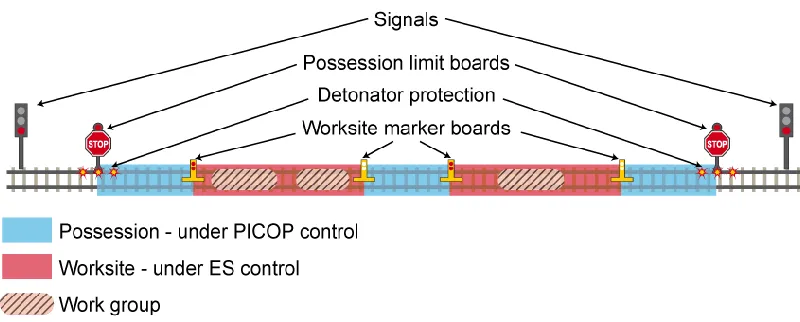
Physically, within a standard possession on the British railway, workers are
protected at both ends of the designated area by red signals and physical demarcations
in the form of possession limit boards and often detonators, providing auditory
[image:5.595.102.502.344.505.2]warning should a vehicle move over them (see Figure 1).
Figure 1. A schematic diagram of the protection measures in a typical engineering possession.
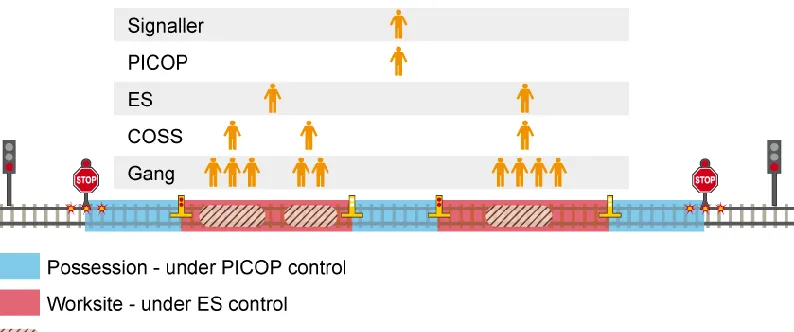
Whilst there are a variety of types of possession and protection, the key roles
commonly involved are: Signaller, PICOP (Person In Charge Of Possession),
Engineering Supervisor (ES) and COSS1 (Controller of Site Safety). Figure 2 shows
1 Subsequent to the completion of the present work, the role of the COSS is currently under review by
how this forms a hierarchical management structure and how those structures relate to
[image:6.595.108.505.179.345.2]the physical space of possession.
Figure 2. The relationship between the physical space of possession and the hierarchical organisational structure of maintenance teams.
The signaller for that area of track will confirm with the PICOP when the last
train has left the possession area and when the relevant signals are red so the area is
safe. At that point, the PICOP will arrange for the possession limit boards and
protection to be placed. Once this is done the PICOP will confirm that the ESs can set
up their worksites and begin the process of signing in COSSs, each of whom will be
associated with a work group or machine and usually a gang of track workers. This is
a simplified version of a standard maintenance possession and does not fully represent
all the possible permutations but the tasks required of an ES are defined in the RSSB
(Rail Safety and Standards Board) Rule Book - Handbook 12 (GE/RT8000/HB12), a
Setting up the worksite, including contacting the PICOP to confirm exact
positioning and limits of the worksite.
Arranging the placement of marker boards at the end of the agreed worksite
and confirming the completion of this with the PICOP.
Briefing and signing-in the COSS for each work group and any individual
working alone (IWA), agreeing what work they will be doing and where this
work will take place.
Confirming with the PICOP any arrangements for work and train movements
around level crossings in the worksite.
Authorising train movements within the worksite and recording the details of
that movement.
Liaising with the PICOP to organise train and plant movements in and out of
the worksite.
Giving up the worksite at the end of the possession ensuring the track is fit for
the passage of trains.
The Rule Book also states that to perform in the role, the individual must hold
a valid ES certificate of competence. This means that any track worker can perform
the ES role provided they have been certified (and that certification is up-to-date). In
summary, the ES role in any given specific setting is dependent on a number of
factors, including the type of activity occurring, the size of the worksite and
complexity of the track, the amount and type of machinery being used and the
duration of the work (Ryan et al., 2007).
Management of engineering works are challenging for myriad reasons (see
Golightly et al., 2013). Arrangements can be complex and include a range of issues
and site access). Management of engineering works are of sustained complexity
throughout their life cycle, from initial planning, through to short-term replanning
when underway through to managing safe hand-back of the line. Thus, there is a
requirement for a way of structuring the understanding the complexities of work of
this type.
2.2. Span of control
Span of control has also been referred to as span of command, span of management,
span of responsibility and span of authority, but generally equates to the extent of
supervisory capability (Meyer, 2008). Early investigations into span of control (e.g.,
Graicunas, 1937) sought an optimal management structure/strategy that would lead to
the highest level of control and coordination over subordinates with initial estimates
being behaviourally based in terms of the typical memory or attention span of a
manager. Various simple metrics and ratios were developed to quantify the
relationship between the number of employees and managers or between the number
of size of teams and the manager’s available time. However, as this research agenda
developed it became widely recognised that the ‘optimum span of control’ would not
have one value defined by the unchanging human characteristics of managers but
rather would vary with the nature of the activities and types of employees being
managed (Kootz, O’Donnel & Weilhrich, 1980).
Span of control appears to have declined somewhat as a topic of research
interest in management studies proper, most probably because of a general move to
‘collapsing’ management structures to make them more ‘horizontal’ rather than
seeking out optimal ways to structure hierarchies. In recent years however there has
healthcare, possibly because these are areas where formerly procedure-based work
has given way to far more diverse types of activity as healthcare technology has
developed, professions like nursing have become more recognised as diverse and
skilled and managerial restructuring has also placed pressures on pre-existing
structures (e.g., Cathcart, et al., 2004; Doran et al., 2004; McCutcheon et al., 2009;
Meyer, 2008; New, 2009; Wong et al., 2009)
The modern way to view Span of control is therefore not in terms of trying to
design the ‘perfect organisation’ once and for all, but in using the concept to
understand under which circumstances work is easier and harder to manage and to
answer questions concerning the nature of a managerial role, what kinds of support
are required, how many lines of report a manager can handle and how much time a
manager can spend on supervision (Meyer, 2008). It may be the case for example that
a team that can be easily managed in normal circumstances may become far more
challenging to oversee when moved to a different site, given different tasks to do or
perhaps working under unusual forms of disruption. Therefore, given the nature of
rail maintenance as described earlier and its diverse nature, we took the view the
concept could also be useful, if tailored somewhat, to the rail domain.
The starting assumption for our work was that the factors impacting
performance for an Engineering Supervisor might be broadly mapped to those that are
shown to affect span of control during army operations (Wenzel & Christ, 1993, Ford
et al., 1998). Both scenarios of work involve teams working in a planned,
goal-directed manner outdoors. The framework developed by Wenzel & Christ (1993) was
therefore used as an initial template for the TOECAP inventory. There are six factors
that Wenzel & Christ (1993) suggest influence span of control: Tradition (in this
Technology, Subordinate’s Task Characteristics, Leadership Behaviour and Leader’s
Workload, though with the caveat that these factors are not “exhaustive nor mutually exclusive”(p.887). Meyer (2008), reviewing span of control concepts in the healthcare
literature, identified a list of factors believed to contribute to span of control in the
healthcare field. These factors are split into six categories, namely: Region (inc. local
policies, cultures and structures), Organization (inc. size, stage of development,
degree of decentralisation of support services), Manager (inc. leadership skills, scope
of role, experience), Work Group (inc. delivery model, team size, distance/location,
task interdependence) , Employee (education, experience, stability) and Healthcare
Consumers (acuity, care, complexity). Given the fundamental differences between the
fields of study, Meyer’s (2008) list bears striking similarities to that of Wenzel &
Christ’s (1993), albeit there are slightly different groupings of sub-factors. Both are
concerned with the organisation, the individual leaders and their teams, and the
features specific to the environment of work.
3. Investigating factors for span of control in the rail
maintenance domain
The approach taken was to first investigate key constructs in span of control in
managing possessions and worksites. We began with initial familiarisation interviews
and then progressed through to more focused Subject Matter Expert interviews and
the administration of a questionnaire to verify the inventory.
3.1 Development of Initial Rail Factors
In order to gain an initial understanding of the ES role, four formal interviews (two
formal open discussions held with members of the Network Rail Ergonomics Team
where two of the authors were ‘embedded’ throughout the data collection phase.
Following this, an interview with a senior maintenance manager at Network Rail, who
had recently investigated a serious on-track incident, was conducted. The knowledge
gained from these familiarisation interviews, as well as reviews of incident reports
and existing literature in this area, were used to adapt the factors proposed by Ford et
al. (1998) into a set of Initial Rail Factors. The only initial change in categories was to
rename ‘unit continuity’ as ‘team history’ to fit better with the language of British
industries. Then a list of factors specific to the role of ES was developed from these
categories; this initial rail factors list can be seen in Figure 3. The intent of this phase
was to build on the work of Ford et al. (1998) by taking their military-specific items
and converting them into both more generic and railway-oriented items to use as a
basis for discussion with a view to then adding detail specific to the ES role and the
rail maintenance setting. This intermediate step was carried out as it has been our
experience in past work that some effort towards domain-specific language counts for
a lot in terms of engaging informants and persuading them of the relevance of the
work.
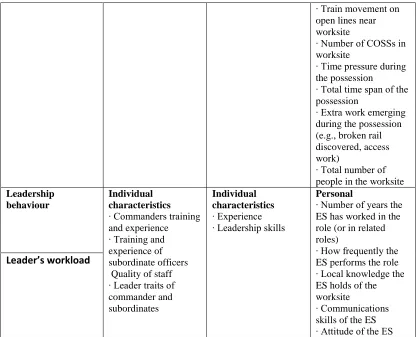
Wenzel & Christ (1993)
Ford et al. (1998) “Initial Rail Factors” TOECAP Factors
n/a (no category) External
organisations
∙ Military commands outside normal channels ∙ Government organisations ∙ Non-government organisations External organisations
∙ Machine/train drivers ∙ Contractors
∙ Other NR Teams
Team
∙ Attitude of others in the worksite
∙ Respect amongst workers in the worksite ∙ Confidence the ES has in others in the worksite
∙ Familiarity amongst the workers in the worksite
∙ Pressure from others to perform
Tradition Unit continuity
∙ Members experience with organisational structure
∙ Members experience with operation procedures
Team history
∙ Experience
∙ Shared experience amongst team ∙ Experience with similar mission
Organisational structure
∙ Number of units controlled ∙ Types of units ∙ Composition of units ∙ Structure of staff
Organisational structure
∙ Volume of communications ∙ Pressure from management
∙ Planning and briefing ∙ Size of teams ∙ Consistency of language
Organisation
∙ Quality of planning and briefings ∙ Quality of training, mentoring and assessment ∙ Performing other roles as well as ES (e.g., PICOP) ∙ Shift patterns
∙ Amount of paperwork required of the ES ∙ Changes to planning/access documents ∙ Accuracy and availability of track diagrams
Environmental uncertainty
Complexity of environment
∙ Mission, enemy terrain, troop and time factors
∙ Ambiguities ∙ Constraints
Environment
∙ Day/Night ∙ Weather and temperature
Environment
∙ Physical length of the worksite
∙ Number of rail lines in the worksite ∙ Number of level crossings in the worksite
∙ Other features of the worksite (e.g., tunnels) ∙ Weather conditions ∙ Quality of light available (e.g., day/night or lamps)
Technology Technology
∙ Communications equipment
∙ Tactical command and control systems
Technology
∙ Communications ∙ Equipment and machinery
Communications
∙ Clarity of
communications to and from the ES
∙ Communication technology availability ∙ Amount of
unnecessary communications ∙ Consistency of language used (e.g., use of head-codes)
Subordinate’s task characteristics
Task characteristics
∙ Mission essential tasks
∙ Amount of
coordination between units
∙ Specialised knowledge required
Task characteristics
∙ Time span ∙ Size of worksite ∙ Type of tasks ∙ Number of tasks ∙ Complexity of tasks ∙ Level of protection ∙ Number of train movements
Activity
∙ Type of
activity/activities in worksite
∙ Number of different activities in worksite ∙ Amount of vehicle movement
∙ Train movement on open lines near worksite
∙ Number of COSSs in worksite
∙ Time pressure during the possession
∙ Total time span of the possession
∙ Extra work emerging during the possession (e.g., broken rail discovered, access work)
∙ Total number of people in the worksite
Leadership behaviour
Individual characteristics
∙ Commanders training and experience ∙ Training and experience of subordinate officers Quality of staff ∙ Leader traits of commander and subordinates
Individual characteristics
∙ Experience ∙ Leadership skills
Personal
∙ Number of years the ES has worked in the role (or in related roles)
∙ How frequently the ES performs the role ∙ Local knowledge the ES holds of the worksite
∙ Communications skills of the ES ∙ Attitude of the ES
[image:13.595.90.508.70.407.2]Leader’s workload
Figure 3. The migration from Span of Control factors from Wenzel & Christ (1993) to Ford et al. (1998) through “Initial Rail Factors” and the final TOECAP factors.
3.2 Development of the TOECAP inventory
To further develop the factor list, Network Rail and University of Nottingham Subject
Matter Experts (SMEs hereafter) were consulted. Interviews took place in two stages,
the first being two open interviews with Network Rail Ergonomics Team members
discussing understanding of the human factors of rail maintenance and engineering
and possible approaches to the measurement of span of control and task loading. The
Initial Rail Factors list (see third column, Figure 3) was also discussed in detail, such
that the list of factors was reviewed and edited and an interview structure for the
The second stage of the Subject Matter Expert interviews acted as a pilot for
the proposed interview structure, completed with two more SMEs chosen for their
direct experience of the ES role. The interview started with open questions like “What
do you feel affects your performance as an ES?” and “When have you felt at your
limit?” (Full list given in Appendix A).Secondly, the respondents were shown the
Initial Rail Factors list and asked to discuss each factor in turn and rate each on a
summated scale of 1 to 5, 1 being low or no impact and 5 being high impact (Preece
et al., 2007; Robson, 2011). The interviews were semi-structured and designed to be
discursive (Schober & Conrad,1997), they led to significant alterations of the factors
list.
Figure 3 shows the migration from Ford et al.’s (1998) categories to the final
list of factors in the TOECAP inventory. The name TOECAP was derived from the
initial letters of the six factor categories, Team, Organisation, Environment,
Communication, Activity and Personal. The development process then can be
understood as taking Ford et al.’s military domain-specific list, rendering it generic
provide cues for discussion with the rail industry, and then using that input to
re-specify in detail once more for the rail maintenance domain. Changes were generally
made on the basis of fit with the distinctive features of the rail setting or effective
operationalisation of concepts that would make the tool easier to use where an
obvious or more specific indicator existed to replace a more generic idea. For
example, it was felt that there were different types of experience that were relevant;
how long a person had been an ES, how frequently they fulfilled that role
(engineering managers may undertake a range of different roles across different
projects and were not necessarily ESs on a regular basis despite having a
knowledge of a given line or area on the network. The latter is particularly important
in the British railway system as it has had a long and complicated history leading to
different lines sometimes having distinctive (and perhaps undocumented) practices or
legacy engineering features. Similarly, issues of team experience/continuity became
“familiarity amongst workers in the worksite” in recognition of the fact that while in
the military setting, continuity is very much a feature of military organisation (e.g.,
regiment and unit tradition and organisation), in the rail setting teams are more likely
to be reconstituted as required from the project to project. None the less, it would not
be untypical for workers to have carried out prior projects with different subsets of
their present team leading to a shared cultural and personal understanding throughout
the team and thus the item was adjusted to better reflect the reality of the situation.
4. Initial validation of the TOECAP inventory
In order to validate and refine the TOECAP tool, ten expert participants were found
by approaching maintenance managers within Network Rail; all were employed in
one of four maintenance depots: Newport, Cardiff, Aber or Westbury. Each of the
participants had been working on the railway for at least 7 years with the longest
serving for 36 years and a mean of 19 years. All respondents held the required
qualification to work as an ES but performed the role with varying regularity.
Each session involved asking the participant to complete the TOECAP
inventory, rating the impact on ES performance of each item from 1 (lowest level of
importance) to 5 (highest level of importance) followed by an interview (initially
guided by the items in Appendix A) and a discussion of the factors. The intention was
open discussion of the ES role. At the beginning of each session the participants were
asked to read and sign a consent form as the interviews were to be recorded; one
participant, whilst agreeing verbally to be interviewed, did not want to be recorded
and so data collected from this interview are not included in the template analysis.
The participant was happy to rate the TOECAP list and so these data were included.
The interviews took the form described in Appendix A together with a guided
discussion of the TOECAP inventory itself.
The interview recordings were transcribed and analysed for themes. As a list
of factors had already been defined, we took an analytical approach known as
‘template analysis’, a method falling between content analysis and grounded theory
(King, 1998). This approach allowed the researcher to code the data using the
TOECAP list as a framework with a flexibility to add new codes if necessary.
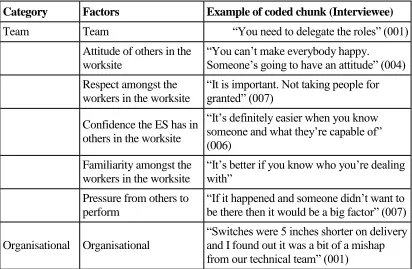
[image:16.595.94.506.486.755.2]Examples are given in Table 1.
Table 1. Examples of template analysis coding.
Category Factors Example of coded chunk (Interviewee)
Team Team “You need to delegate the roles” (001)
Attitude of others in the
worksite
“You can’t make everybody happy.
Someone’s going to have an attitude” (004)
Respect amongst the
workers in the worksite
“It is important. Not taking people for granted” (007)
Confidence the ES has in
others in the worksite
“It’s definitely easier when you know someone and what they’re capable of” (006)
Familiarity amongst the
workers in the worksite
“It’s better if you know who you’re dealing with”
Pressure from others to
perform
“If it happened and someone didn’t want to be there then it would be a big factor” (007)
Organisational Organisational
Quality of planning and briefings
“The planning stages are crucial, I suppose, to the smooth running of it.” (005)
Quality of training, mentoring and assessment for the ES role
“It’s important to be trained at a high level too and not to cut corners” (001)
Performing other roles as well as ES
(e.g. PICOP)
“In my opinion, an ES should just do his ES duties and that’s it” (004)
Shift patterns “Sometimes it’s easier, I think, to work nights” (001)
Amount of paperwork
required
“ES is worse than PICOP with all the paperwork they have to do” (003)
Changes to planning/access documents
“I could fill them all out and things could have changed when I come back in and I’d have to do it all again” (003)
Accuracy and availability
of track diagrams
“You need them, I wouldn’t go too far without that.” (008)
Environmental Environment “Yeah it’s easier because you can gain access at certain locations.” (001)
Physical length of the
worksite
“It is more difficult because it’s the logistics, depending on the size of your worksite, everyone’s got to come to you first and come back to you, you need to be available for those people” (009)
Number of lines in the
worksite
“If you’ve got a single line and its blocked and it’s blocked there and there, that’s quite simple” (010)
Number of level
crossings in the worksite
“There are more people to brief as it goes along . There’s a different man at each one” (007)
Other features in the worksite (e.g. tunnels, viaducts etc)
“One of the main things for us is the new axel counters” (006)
Weather conditions “Nobody likes working in the rain - it can cut visibility” (005)
Quality of light available
(e.g. daylight or lamps)
“I’d rather do it at night as long as it’s well lit.” (005)
Communication Communication “The phone doesn’t stop ringing, you can’t do anything else” (006)
Clarity of
communications to and from the ES
Communication technology availability
“The communication is the worst thing, sometimes you’ve got areas where you’ve got no phone signals” (004)
Amount of unnecessary communications during the possession
“There can be a large amount of
unnecessary ones, especially if you’re going to over-run and that can have a huge effect” (008)
Consistency of language used (e.g. use of head-codes)
“It’s important, most issues that arise are through communication problems” (009)
Activity Activity “If it’s got to come out, it’s got to come out” (001)
Type of activity/activities
in your worksite
“It depends on what you’ve got in the worksite and why you’re in there” (004)
Number of different
activities in your worksite
“As an ES if you’re on your own little job and you’re on that site and it’s not spread out over a long distance, it’s very easy to do” (006)
Amount of vehicle movement
within/through your worksite
“You’ve got to be switched on about movements and that. You’ve got to think a bit more” (004)
Train movement on open
lines near the worksite
“Sometimes it takes a lot of time and effort to put a fence up when you’re on a moving site.” (001)
Number of COSSs in the
worksite
“More people to sign in, more people to brief, more people to check on” (007)
Time pressure during the
possession
“You don’t want to overrun because people will want to know” (007)
Total time span of the
possession
“Obviously, the shorter possessions, you’ve got to be on the ball” (005)
Extra work emerging
during the possession
“If a weld goes wrong, for arguments sake, they’ve had a runout, that’s beyond an ESs powers” (010)
Total number of people
in the worksite
“The more people the more work so there’s generally a bit more pressure.” (007)
Personal Personal “I enjoy a lot of the work out on the
ground” (001)
Number of years the ES
has worked in the role
“Guys who’ve been around a long time aren’t necessarily better than new ones” (004)
How frequently the ES
performs the role
that wouldn’t be acceptable. You need some work experience” (009)
Local knowledge the ES
holds of his worksite
“It’d be pretty silly to be put in charge of a job when you don’t know the track layout” (007)
Communication skills of
the ES
“Yeah, especially on the radio, over and out and all that” (003)
Attitude of the ES “You’ve got to have the correct attitude” (010)
Miscellaneous Contractors (Non-NR staff)
“Contractors might phone and ask “where’s the nearest place for this” and you know he hasn’t been here before” (007)
Fear of or pressure from
senior management
“The ramifications, you know the come backs from it. People are on your back straight away” (005)
Possessions not locally
managed
“If NDS is taken from us and we have to go back to doing the PICOPing of our
possessions. We’d be not to geared up for it then” (001)
4.1. TOECAP factor rating results
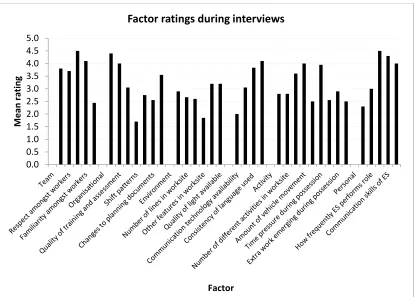
The ratings given to each item are shown below in Figure 4, The highest rated factors
were (in order): confidence the ES has in others in the worksite (1st=), local
knowledge of the worksite (1st=), quality of planning and briefings (3rd),
communication skills of the ES (4th), familiarity amongst workers (5th=), clarity of
Figure 4. Mean interview factor ratings from the interviews.
4.2. TOECAP interview results
In the analysis of the transcripts, the researcher coded sentences and phrases (chunks)
in which a factor was mentioned in association with participants’ experience of the ES
role, initially cued with the items in Appendix A. However, if a participant referred to
a factor in a dismissive way, such as “Taking on other roles isn't really a big deal” (Interviewee 001), this chunk was not coded. In total 831 chunks were identified with
751 (90.3%) of those chucks falling within the original factors list. A further 46
chunks, while not relating directly to one of the original factors could be assigned to
one of the categories. Just three other categories were added during the template
analysis; contractors (non-Network Rail staff), managerial pressure, and possessions
not locally managed. In total there were 34 chunks coded to these additional 0.0
0.5 1.0 1.5 2.0 2.5 3.0 3.5 4.0 4.5 5.0
M
e
an
r
ating
Factor
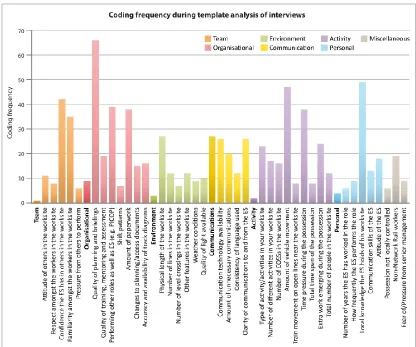
categories. Figure 5 shows a bar chart of the number of interview chunks coded to
[image:21.595.89.505.152.499.2]each factor.
Figure 5. Results of information chunks within factors from the interview template analysis.
As can be seen in Figure 4, the factors with the highest frequency are (in
order): quality of planning and briefings, local knowledge of the worksite, amount of
vehicle movement, confidence in others in the worksite, taking on other roles as well
as ES, amount of paperwork, time pressure during possession and familiarity amongst
the team. These eight factors were the most commonly talked about and were
4.2.1. Quality of planning and briefing
With 66 references during the interview process, quality of planning and briefing is
reported as the most frequently mentioned factor affecting performance for an ES. It
was clear from the interviews that planning was seen as crucial to the safe and
efficient running of engineering possessions:
“It’s more the planning really, around the possession, actually doing the work is nothing really.”
(Interviewee 001)
The workers place considerable trust in the planners that the work is feasible and all
potential issues are considered. Eight interviewees suggested that the impact of one or
more of the other listed factors is reduced for an ES when the planning is adequate.
Four of the ESs also revealed that they often do their own additional planning prior to
works beginning; from filling out some of the paperwork in advance to actually
drawing out extra plans of the worksite. There was a consensus that current planning
was adequate for possessions, although one interviewee suggested that the ES should
be included more in local planning meetings.
Alongside planning, the quality of briefing received and given by the ES is important.
Before work commences, the ES receives a briefing and in most cases will go on a
site visit with a supervisor to discuss what work needs to be done. The ES is then
responsible for briefing the other workers in the site.
The majority of the ESs interviewed had worked in the same area for several years
and so felt they had a good understanding of their respective patches with some
suggesting that they would find it difficult to perform as an ES in an area they did not
know so well. It is clearly beneficial to have a site visit prior to starting work,
particularly a day visit before night works. The local knowledge of the work group
members is also important to the ES when, for example, the presence of new workers
or visiting contractors potentially increases the level of vigilance required of the ES.
4.2.3. Vehicle movements in the worksite
The amount of vehicle movement depends on the number of vehicles, the types of
vehicles and the tasks undertaken; all the interviewees felt that as vehicle movements
through and within the worksite increased this added to the task load.
“I would have said road-railers are one of the biggest hazards. Trains are
not too bad because, the thing is with a train, it doesn’t slew about, it’s in one line, you know where it’s going to be.”
(Interviewee 001)
The impact of vehicle movements is magnified on larger worksites, especially
when the machines or vehicles are out of the ES’s line of sight. Other factors
link closely with the amount of vehicle movement, namely the volume of
paperwork, the number of people in the worksite and the number of level
crossings in the worksite.
4.2.4. Confidence in and familiarity with others in the worksite
Two closely related and important factors are the ESs’ confidence in and professional
they are working with but also to have an awareness of their individual capabilities.
This is particularly important concerning the COSS in the worksite; the ES needs to
be able to rely on the COSSs to control the people they’re working with and also
provide information, especially when the worksite is large.
“You’re relying on the COSSs to give you information; where and what they’re doing, are they near finished, are they on their way to the access point, are they clear? You have to know that all the time.”
(Interviewee 001)
4.2.5. Taking on other roles alongside ES
During maintenance tasks, any track worker with an ES certificate can perform the ES
role but, on occasion, they may also be asked to perform another role in tandem such
as PICOP or COSS. Opinions were split on this subject with some ESs believing that,
especially for a small worksite, there are benefits with performing more than one role,
such as a reduction in the amount of necessary communications. Others, however, feel
that attention on the ES role must not be diluted by having other tasks to carry out.
4.2.6. Time pressure during possession
Time pressure clearly makes the ES role more stressful, and this is often
apparent in shorter (i.e. overnight) possessions. This pressure can be alleviated
by good planning and organisation by the ES.
4.2.7. Amount of paperwork
Filling in paperwork takes up a considerable portion of the ES’s time. Some ESs
“Yeah and the amount of paperwork they have to carry. To be honest with you, he needs a table and chair on the track!”
(Interviewee 010)
Although the ESs are provided with weather protection for their paperwork,
respondents suggested that bad weather added to the workload and stress associated
with filling out paperwork.
4.3. Agreement between rating and interviews
We carried out a combination of collecting ratings of importance with interviews in
order to attempt to triangulate between what respondents report as most important
based on the items we developed and what they actually discuss most frequently in
conversation about what characterises their work or makes it challenging. There is
reasonable agreement as the most highly rated factors were also among the most
frequently coded as being discussed in the interviews (namely local knowledge of the
worksite, quality of planning and briefings and familiarity amongst workers). The
exceptions were items related to communication specifically. However, during the
interviews, communication was commonly discussed and as can be seen in Figure 5,
it was the most common category coded (i.e. interviewees were well aware of
communication in general as an important variable but their comments could not be matched to one of the more specific factors). The most likely explanation for this,
taken from our interview corpus as a whole, was that although recognised as
important in and of itself, communication was otherwise discussed in the context of
other issues (e.g., communication as a part of the planning process or communication
as aided by teams familiar with each other). In summary, although drawn from a
obtained from the interviews and the opinions reflected by the factor ratings
suggesting that the TOECAP factors capture the major issues of concern to ESs. This
suggests in turn that using the factors list as an interview structure or in questionnaire
format should reveal useful information on the attitudes of ESs.
5. Deployment of the TOECAP questionnaire
In the next stage of development, we deployed the TOECAP factors in inventory form
to a wider community of ESs who had not been part of the earlier stages of
development. Questionnaire respondents were asked to rate each factor on the same
5-point scale as in the interviews. In the explanatory text at the beginning of the
questionnaire, respondents were told that they could leave blank any factors they did
not fully understand or that they felt were not relevant in their experience. Alongside
the rating boxes for each factor a comments box allowed respondents to comment on
any of the factors; an open comments area was also included at the end of the
questionnaire.
5.1. Questionnaire results
In total, 22 responses were received, 15 from Network Rail employees and 7 from
employees of a contractor. The respondents all work as ESs and have a mean of 15
years of experience on the railway (lowest 3.5 years, highest 33 years). The
respondents represent a variety of jobs, from those who are an ES only to those who
Figure 6. Mean factor ratings from the questionnaire respondents
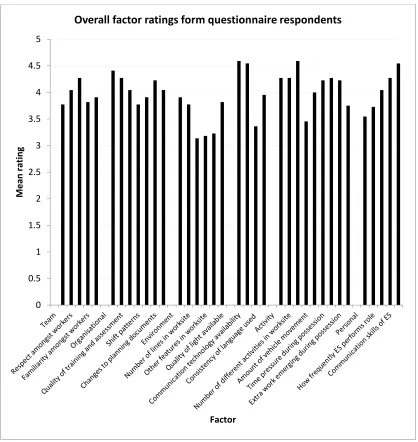
From Figure 6, it can be seen that the respondents rated the number of COSSs in the
worksite and the availability of communications technology as having the highest
potential impact, and close behind are unnecessary communications and the attitude
of the ES. Other factors that received high mean ratings were quality of planning and
briefing, quality of training and mentoring, performing other roles, type of activity in
the worksite, number of different activities in the worksite, confidence the ES has in
others, communication skills of the ES and total time span of the possession. 0
0.5 1 1.5 2 2.5 3 3.5 4 4.5 5
M
e
an
r
ating
Factor
5.1.1. Differences between NR employees and contractors
Time and personnel availability restrictions precluded a large enough sample to
compare geographical locations, but it was possible to look at the difference between
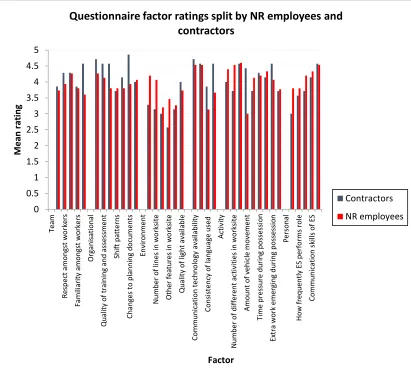
contractors and Network Rail employees on the TOECAP inventory. Figure 7 shows
[image:28.595.92.503.265.640.2]the mean factor ratings for each group.
Figure 7. Mean factor ratings split by NR employees and Contractors.
Some of the mean ratings show considerable consistency in opinion between ESs
regardless of their employer. However, there are some interesting discrepancies such 0 0.5 1 1.5 2 2.5 3 3.5 4 4.5 5 Te am Re sp ec t amo ng st w or ker s Fam ili ar it y a m o ng st wo rk e rs O rg an isa ti o na l Qu al it y o f t rai ni ng a nd a ss e ss m ent Shi ft p at te rns C ha ng es to p lan ni n g d o cum ent s Env ir o nm ent N um be r o f l ine s in wo rk si te O th er f e at u re s i n w o rk si te Qu al it y o f l ig ht a vai la b le C o m m un ic at io n te chn o lo gy a vai lab ili ty C o ns ist enc y o f l an gua ge u se d A ct iv it y N um be r o f d if fe re nt a ct iv it ie s i n wo rk si te A m o un t o f v ehi cl e m o ve m e nt Ti m e pr essur e d uri ng possessi on Ex tr a wo rk e m er gi n g d u ri n g p o ss es si o n P e rso na l H o w f re qu en tl y ES p er fo rm s ro le C o m m un ic at io n sk ill s o f E S M e an r ating Factor
Questionnaire factor ratings split by NR employees and contractors
Contractors
as the rating for changes to planning and access documents, which was the highest
rated factor for contractors (mean of 4.9) but only received a mean rating of 3.9 by
Network Rail employees. It is suspected that, when changes occur to planning and
access documents, contractors might find out about them later than those ESs working
within a Network Rail depot and they would have less time to reorganise their own
plans for the possession.
There was also a discrepancy between the ratings for physical length of the worksite,
considered very important by Network Rail staff ( =4.5) but less so by contractors (
=3.3). More research needs to be done to find out why this is so but it may be because
of differences in the type of work contractors usually get involved with compared to
those employed full-time by Network Rail.
The largest difference was found in the mean rating for amount of vehicle
movements, with Network Rail staff rating it much lower ( =3.0) than contractors (
=4.4). Once again, the type of work carried out and thus the type of machines usually
used by each party is the most likely explanation for this difference, particularly as
part of the reason for hiring contractors is, in itself, to access specialist vehicles.
5.2. Questionnaire results compared to validation results
Multiple issues could have differently affected the responses from the questionnaires
and the interviews. One noticeable difference is that the overall mean of all the factor
ratings is higher from the questionnaires (4.0) than from the interviews (3.2). This
could be because of the difference in presentation of the factors list; validation
interview respondents were asked to discuss the potential of each item to impact
performance before rating them, whereas for questionnaire respondents the list was
presence of the researcher affected scoring in the validation phase (Hawthorne
Effect). However, the most likely account is probably that the two groups differed as
populations because their local circumstances. In this research, most of the
interviewees work in South Wales and the majority of the questionnaires were
returned from the East Midlands. Each area has different forms of electrification, train
detection and other features of the track.. A much wider circulation of the
questionnaire is therefore needed to get a balanced view across the country.
With those caveats in place, there were some interesting differences between the
validation responses and those received from the more widely distributed
questionnaire. For example, the largest discord between the two was the rating for the
availability of communications technology; interviewee mean rating for this was just
2.0 whereas the questionnaire respondents rated it at a mean of 4.6. When this item
was discussed with validation respondents, they noted a local issue with mobile phone
reception: black spots and communications in tunnels were often mentioned, but
respondents usually said that these issues were well known and caused no real
problems.
“We've got black spots down the Vale of Glamorgan, we use the back-to-back radios. It doesn't make it harder.”
(Interviewee 005)
It is suspected therefore that the difference in geographical location could be a strong
influence on the rating of this factor.
5.3. Results by category
The TOECAP inventory is structured around six categories: Team, Organisational,
the interviews for the impact of factors in each of these categories can be seen in
Figure 8.
Figure 8. Mean ratings of the factors in each category given during ES interviews.
This shows that the factors associated with the physical environment are on average
not considered to impact performance as much as others. It is the factors associated
with the team surrounding the ES and the personal attributes of the ES that were rated
as the most important. Figure 9 shows the comparable output from the TOECAP
Figure 9. Mean ratings of the factors in each category from the TOECAP questionnaire.
Once again, the factors associated with the physical environment are rated slightly
lower on average than the others. There are a number of possible explanations for
this, for example, ESs may feel that the environment is difficult to change and simply
an element of the role that they have learned to accept. However, the lower ratings for
the physical environment could also be because questionnaire respondents had
worked on the railway for nearly 15 years on average and their surroundings are very
familiar to them. With a greater number of respondents it might be interesting to
6. Discussion
6.1. Further questionnaire development and deployment
The TOECAP questionnaire has provided useful data such that the study reported
here can be viewed as a pilot exercise justifying a wider administration in the future,
to ESs across Network Rail and contractors, and perhaps with small alterations to
other supervisory employee groups on track. This will allow exploration of
differences between ESs working in different areas of the country, on different
projects, with varying levels of experience and working for a wider range of projects.
The output from the questionnaire can be used to highlight the elements that targeted
work groups consider impact their performance as an ES the most. The ratings could
also be used to weight factors in future iterations of the tool.
Use of the TOECAP inventory has identified differences in attitude between
different individuals qualified to perform as an ES and the importance of
understanding these; a particular example concerns differences in views between ESs
employed by Network Rail and those supplied by contractors. Also highlighted is the
variation in type of tasks required of the ES, and thus potential load, dependent on the
nature of the track, the work to be carried out and extent of the possession. The
railway infrastructure varies dramatically across the UK and this means that the work
requirements during an engineering possession are different from place to place,
especially in terms of setting up and giving back possession. For example, some areas
of the country have electrification systems and others do not. Compared to
non-electrified track, extra measures, taking more time, need to be carried out to make an
electrified track safe for workers. Further, train detection systems vary from area to
area; some have track circuits, others have axle counters, each with different
example, in order to reset some axle counters a sweep vehicle is required to move
from one end of the possession to the other, meaning that time has to be built into the
possession to allow for this. Further study of issues of both geographical area and the
interactions of different groups (contractors and rail staff) would be questions worth
probing with future iterations of the tool.
6.2. Further categorisation of TOECAP items
The TOECAP inventory is likely not to be a complete list of all factors impacting
track staff performance but appears to include all of the most influential factors for
the ES role as validated against expert interviews and discussions. Concepts such as
workload and span of control can be conceptualised in different ways, from the
presence of potentially loading factors imposed by the task and environment to the
cognitive or physical demands and effects felt by the worker, and thus may be
measured in a variety of ways. To make better use of the TOECAP inventory, each
factor can be categorised into one of four groups (although several factors could fall
into more than one category. The groups are described below and shown in Figure 10:
Factors that are physically or controversially quantifiable: e.g. the physical length of the worksite (measured in miles). Values for these should already be
available at the planning stage of the work and therefore easily used in
assessment tools.
Factors that can be categorised: e.g. type of activity in the worksite
(vegetation clearance, replacing rails etc). These factors are easily defined but
impacts could lead to some ordinal scaling for this type of factor, allowing
their inclusion in a scoring-based assessment tool.
Factors that need specialist investigation and measurement: e.g. for unnecessary communications recorded conversations during a possession
could be analysed and used to reveal how much time unnecessary calls take up
and how detrimental this is to the load on and performance of the ES). Factors
such as this could then be incorporated into a tool or else used separately to
make recommendations for improving the role of ES.
Attitudinal factors. The remaining factors, such as confidence the ES has in
others, fall into the category of being attitudinal. All could be assessed with
subjective rating scale and combined with the measures of the other factor
groups to assess (or possibly even predict) span of control and task loads
during track possessions. Team factors in general fall under this category as
they constitute interpersonal relationship issues that would be challenging to
quantify in an uncontroversial manner.
Quantifiable Categorisable Measurable Micellaneous
Amount of paperwork Performing other roles Unnecessary communications
Attitude of others in worksite
Physical length of worksite
Changes to planning documents
Consistency of language used
Respect amongst workers
Number of lines in worksite
Availability of track diagrams
Clarity of communications
Confidence the ES in others
Number of level crossings
Shift patterns Time pressure during
possession
Familiarity amongst workers
Other features in worksite
Weather conditions Extra work emerging
during possession
Pressure from others to perform
activities in worksite available of ES and briefings
Number of COSSs in worksite
Communication technology availability
Quality of training and assessment
Amount of vehicle movement
Type of activity in worksite
Attitude of ES
Train movement on open lines nearby
Local knowledge ES holds of worksite
Total time span of possession
Total number of people in worksite
Number of years worked in role
How frequently ES performs role
Key:
Team Communications
Organisational Activity
[image:36.595.93.476.70.385.2]Environment Personal
Figure 10. Factors list categorised by their potential style of measurement and assessment
6.3 Relationship of TOECAP factors to Performance Shaping
Factors
The present work began with the established notion of span of control and explored
how it could be interpreted and made applicable to the specific setting of UK rail
has been a set of factors at least in part broadly similar to those found in lists of
Performance Shaping Factors (PSFs) commonly cited in the context of Human
Reliability Analysis and used in the calculation of Human Error Probabilities. There
are a wide range of PSFs available to the analyst depending on the method employed
(e.g., THERP, Swain & Guttman, 1983; CREAM, Hollngael, 1998; HEART,
Williams, 1988) and while a detailed review is outside the scope of the present paper,
some sort of cognate of Team, Organisation, Environment, Communications, Activity
and Personal (experience and attitudes) can be found to a greater or lesser extent in
most lists of PSFs (see Bell & Holyroyd, 2009). This is perhaps not entirely surprising
as indeed, most descriptions of the subject matter of Human Factors and Ergonomics
itself would encompass these categories in some way or other (see, Wilson, 2005).
The present work is distinct in that even in the outcome is on the surface similar, it
began from a very different starting point with a different set of intentions (albeit that
PSFs and span of control both ultimately converge on the core ergonomics question of
what features of work affect that work and what should be done about them). The
TOECAP factors are not intended to be used to calculate the probability of error in
executing a given task but rather describes the overall scope of a specific managerial
role (Engineering Supervisor in track work possessions). This specificity is
demonstrated in the fact that many of the factors involved are either directly
quantifiable or can at least be clearly categorised as the system of organisation is
based on abstracting upward from the detail of the situation. Task-level factors are
also not present, for example there is no consideration given to cognitive processes as
such or (explicitly) the design or physical form of equipment, the factors are instead
based on the scope and size of the engineering possession itself (the to-be-managed
strands of development and traditions only and it would not be inappropriate to
describe the TOECAP factors as a set of PSFs albeit ones that apply to a specific role
at a specific level of abstraction (that which concerns the manager rather than the
worker). The approach demonstrated here could be used to generate other domain
specific PSFs particularly as they apply to managerial roles that are not necessarily
well-addressed by task-based approaches from HRA that are intended for slightly
different purposes primarily within the rubric of Probabilistic Safety Analysis.
Conversely, it may also suggest that span of control itself might ultimately be
reconceptualised not in terms of the number of subordinates as Graicunas (1937)
originally suggested but rather in terms of a tolerable level of risk associated with the
act of managing an activity. That the definition of what constitutes a tolerable risk
may itself change across different situations presenting their own distinct
characteristics might explain why the quantification of span of control remains such
7. Conclusions
In this paper we have revisited the notion of span of control and applied it to the novel
context of rail possession management. While an established idea within management
science dating back nearly 80 years (i.e., Graicunas, 1937), arguably, the currency of
the concept was damaged when it became apparent that it was unlikely that any
simple universal principles would be identified to explain “how much management
work is too much”. In the present work we demonstrate the value of at least
continuing to ask this question and that reasonable answers can be generated and
factors identified, albeit through close investigation of a specific work domain and
role (see also Meyer, 2008 for a similar investigation in nursing work). We also
outline a process for the adaptation and development of rail engineering management
specific span of control measures based on initial factors suggested by Ford et al.,
(1998) drawn from a military setting. This process could presumably be used in future
to expand consideration of span of control in other work domains.
One view of the utility of taking a span of control approach to understanding work is
that it offers a participant-centric framework for characterising a form of work beyond
task analyses in terms of what actual workers feel is challenging. In the present study
we found that a range of factors impact on the perception of management difficulty in
possessions. These range from objectively observable variables concerning the
physical layout of the worksite through to shift patterns and communication skills.
Those factors are easily quantified could lend themselves to a future tool for
predictive assessment of demands on ESs, this would be broadly similar to the
approach taken in the ODEC (Operator Demand Evaluation Checklist) tool that is
However, attitudinal and personal factors including communication abilities which
are arguably amongst the hardest measure or anticipate a priori were actually amongst the most important in determining management difficulty terms of their
ranking. This supports the emerging view in the industry of the importance of training
and procedures for communication within rail (e.g., RSSB, 2012a, b) as has been
already noted in other domains such as medicine (e.g., Fletcher et al., 2003) and
aviation (e.g., Flin et al., 2003).
Author note
The fourth author, John R. Wilson, is deceased.
Robert J. Houghton & David Golightly were supported by the RCUK Horizon Digital
Economy Research grant [EP/G065802/1].
Appendix A: Semi-structured interview
The aim of this research to identify and ultimately help mitigate stressing and loading factors associated with on track maintenance work. This will help reduce the chance of errors and improve the efficiency and safety of this work. This interview will help me understand the role of Engineering Supervisor and begin to identify those loading factors.
Interviewee data
Job Title
Duration in post
Route to post (through ranks, from other industry etc)
Exploratory interview items
1. What is like being an ES/PICOP?
2. How do you feel about the ES/PICOP role? 3. What aspects of the ES/PICOP role do you enjoy? 4. What have you felt at your limit?
References
Bell, J. & Holroyd, J. (2009). Review of human reliability assessment methods. Norwich, UK: Her Majesty’s Stationary Office (HMSO).
Cathcart, D., Jeska, S., Karnas, J., Miller, S., Pechacek, J. & Rheault, L. (2004). Span
of control matters. Journal of Nursing Administration, 34, (9), 359-395. Doran, D., McCutcheon, A., Evans, M., et al. (2004). Impact of leader’s span of
control on leadership and performance. Ottawa, Ontario: Canadian Health Services Research Foundation.
Farrington-Darby, T., Pickup, L, & Wilson, J.R. (2005). Safety culture in railway
maintenance. Safety Science, 43 (1), 39-60.
Fletcher, G., Flin, R., George, P., Glavin, R., Maran, N. & Patey, R. (2003).
Anesthetists’ non-technical skills (ANTS): evaluation of a behavioural marker
system. British Journal of Anesthesia, 90 (5), 580-588.
Flin, R., Martin, L., Goeters, K-M, Hormann, H-J, Amalberti, R., Valot, C. & Nijhuis,
H. (2003). Development of the NOTECHS (non-technical skills) systems for
assessing pilots’ CRM skills. Human Factors and Aerospace Safety, 3 (2),
95-117.
Ford, J. P., Mullen, W. J., & Christ, R. E. (1998). Effective Span of Command and Control by Echelon in Training and Operational Environments. ARI Research Note 99-03. Alexandria, VA: U.S. Army Research Institute for the Behavioral
and Social Sciences.
Golightly, D., Ryan, B., Dadashi, N., Pickup, L. & Wilson, J.R. (2013). Use of
scenarios and function analyses to understand the impact of situation
(Eds.), Papers on the science of administration, pp. 181-188. New York: Institute for Public Administration, Columbia University.
den Hertog, D., van Zante-de Fokkert, J. I., Sjamaar, S. A, & Beusmans, R. (2005).
Optimal working zone division for safe track maintenance in The Netherlands.
Accident; analysis and prevention, 37 (5), 890-893.
Hollnagel, E. (1998). Cognitive reliability and error analysis – CREAM. Elsevier. Koontz, H., O'Donnell, C., & Weihrich, H. (1980). Management (7th ed.). New York:
McGrawHill.
McCutcheon, A.S., Doran, D., Evans, M., Hall, L.M., & Pringle, D. (2009). Effects of
leadership and span of control on nurses’ job satisfaction and patient
satisfaction. Nursing Leadership, 22 (3), 48-67.
Meyer, R. M. (2008). Span of management: Concept analysis. Journal of Advanced Nursing, 63 (1), 104-112.
Mitchell, L., Pickup, L., Thomas, S., & Watts, D. (2005). Assessment of New
Workload Tools for the Rail Industry. In: Wilson, J. R., Norris, B. J., Clarke,
T., & Mills, A. (Eds.), Rail Human Factors: Supporting the integrated railway, pp. 330-340. London: Ashgate Publishing
Network Rail (2011). Network Rail - Our History. Retrieved 02/09/11 from
http://www.networkrail.co.uk/aspx/729.aspx
New, N. (2009). Optimizing nurse manager span of control. Nurse Leader, 7 (6), 45- 48.
Pickup, L., Wilson, J. R., Nichols, S. & Smith, S. (2005a). A Conceptual Framework
of Mental Workload and the Development of a Self-reporting Integrated
T., & Mills, A. (Eds.), Rail Human Factors: Supporting the integrated railway, pp. 319-329. London: Ashgate Publishing,
Pickup, L., Wilson, J. R., Sharples, S., Norris, B. J., Clarke, T. & Young, M. S.
(2005b). Fundamental examination of mental workload in the rail industry.
Theoretical Issues in Ergonomic Science, 6 (6), 463-482.
Pickup, L., Wilson, J.R., Norris, B.J., Mitchell, L. & Morrisroe, G., 2005c. The
Integrated Workload Scale (IWS): A new self report tool to assess railway
signaller workload. Applied Ergonomics, 36 (6), 681-693.
Pickup, L, Wilson, J.R. and Lowe, E, (2010). The operational demand evaluation
checklist (ODEC) of workload for railway signaling. Applied Ergonomics,
41(3), 393-402.
Preece, J., Rogers, Y., & Sharp, H. (2007). Interaction Design. Interaction Design: beyond human computer interaction (2nd ed.), Chichester: John Wiley & Sons.
Robson, C. (2011). Real World Research (3rd ed.). Chichester: John Wiley & Sons Ltd.
RSSB (2012a). Operations and Management - Non-technical skills for rail: A list of
skills and behavioural markers for drivers, with guidance notes.
RSSB (2012b). Operations and Management - Non-technical skills required in train
driver role: Developing an integrated approach to NTS training and
investment
Ryan, B., Wilson, J. R., Schock, A., Lowe, E., & Kenvyn, F. (2007). Human Factors
in the Management of Engineering Possessions: Roles of the
& Mills, A. (Eds.), People and rail systems: human factors at the heart of the railway, pp. 331-342. London: Ashgate Publishing.
Schock, A., Ryan, B., Wilson, J. R., Clarke, T., & Sharples, S. (2010). Visual scenario
analysis: understanding human factors of planning in rail engineering.
Production Planning & Control, 21(4), pp. 386-398.
Swain, A. D. & Guttmann, H. E. (1983). Handbook of human reliability analysis with emphasis on nuclear power plant operations. Washington DC, US Nuclear Regulatory Commission,
Wenzel, B. M., & Christ, R. E. (1993). The resurrection of Span of Control.
Proceedings of the Human Factors and Ergonomics Society 37th Annual Meeting. Santa Monica, CA.: Human Factors and Ergonomics Society. Williams, J. C. (1988). A data-based method for assessing and reducing human error
to improve operational performance. IEEE Fourth Conference on Human Factors and Power Plants, pp. 346-350, NY: Institute of Electronic and Electrical Engineers.
Wilson, J. R. (2005). Methods in the understanding of human factors. In J. R. Wilson & N. Corlett (Eds.) The Evaluation of Human Work, 3rd Edition, pp. 1-32.
Boca Raton, FL, CRC Press.
Wilson, J. R., & Norris, B. J. (2006). Human factors in support of a successful
railway: a review. Cognition, Technology & Work, 8 (1), 4-14.
Wilson, J. R., Cordiner, L., Nichols, S., Norton, L., Bristol, N., Clarke, T. & Roberts,
S. (2001). On the Right Track: Systematic Implementation of Ergonomics in