#Scanners: Exploring the Control of Adaptive Films using
Brain-Computer Interaction
Matthew Pike
1,3, Richard Ramchurn
2, Steve Benford
1and Max L. Wilson
11
The Mixed Reality Lab (MRL)
University of Nottingham
Nottingham, UK
2
Horizon Doctoral Training Centre
University of Nottingham
Nottingham, UK
3
Department of Computer Science
University of Nottingham
Ningbo, China
[pike, richard.ramchurn, steve.benford, max.wilson]@nottingham.ac.uk
ABSTRACT
This paper explores the design space of bio-responsive enter-tainment, in this case using a film that responds to the brain and blink data of users. A film was created with four paral-lel channels of footage, where blinking and levels of atten-tion and meditaatten-tion, as recorded by a commercially available EEG device, affected which footage participants saw. As a performance-led piece of research in the wild, this experience, named #Scanners, was presented at a week long national exhi-bition in the UK. We examined the experiences of 35 viewers, and found that these forms of partially-involuntary control created engaging and enjoyable, but sometimes distracting, experiences. We translate our findings into a two-dimensional design space between the extent of voluntary control that a physiological measure can provide against the level of con-scious awareness that the user has of that control. This high-lights that novel design opportunities exist when deviating from these two-dimensions - when giving up conscious con-trol and when abstracting the affect of concon-trol. Reflection on of how viewers negotiated this space during an experience reveals novel design tactics.
ACM Classification Keywords
H.5.m [Information Interfaces and Presentation] Miscella-neous
Author Keywords
Control; BCI; TV & Film; Interactive Multimedia.
INTRODUCTION
Building on research into Brain Computer Interfaces (BCI) [39], commercial products have been emerging into the main-stream as a new form of control; moving from research into affordable commercial products for the home1. BCI is increas-ingly being adopted by the entertainment industry [5] both as a tool to understand people’s emotional experience [13] and now as a way of controlling emotionally engaging experiences [8, 9].
Permission to make digital or hard copies of all or part of this work for personal or classroom use is granted without fee provided that copies are not made or distributed for profit or commercial advantage and that copies bear this notice and the full citation on the first page. Copyrights for components of this work owned by others than the author(s) must be honored. Abstracting with credit is permitted. To copy otherwise, or republish, to post on servers or to redistribute to lists, requires prior specific permission and/or a fee. Request permissions from [email protected].
CHI’16, May 07 - 12, 2016, San Jose, CA, USA
© 2016 Copyright held by the owner/author(s). Publication rights licensed to ACM. ISBN 978-1-4503-3362-7/16/05. . . $15.00.
http://dx.doi.org/10.1145/2858036.2858276
While entertainment may benefit from BCI, it could also con-tribute to its development, offering ways of engaging main-stream audiences with the technology and contributing to our understanding of what can and cannot be controlled and how to design for the benefits and limitations of the new technolo-gies. Against this broad backdrop, we report an exploration of using BCI to create an interactive entertainment experience. Following an exploratory ‘Performance-led Research in the Wild’ methodology [2], we worked with an artist to design and deliver a public experience that was then studied in-situ, qualitatively, in order to reveal wider issues and principles.
In this case the artist created an interactive film which is con-trolled by levels of Attention and Meditation (provided by a commercial Neurosky EEG1), and partially controlled by
blinking. The Neurosky device suited this form of artistic installation due to it being minimally intrusive, quick and “dry” to set-up as well as being wireless. In the following sections, we document the artist’s rationale behind the work and then report on how 35 people experienced the film when exhibited at a public arts venue. Our study reveals the different ways in which viewers experienced control through BCI, the various tactics they established, and how they experienced tensions between voluntary and involuntary control of the film, versus being aware of their own attempts to control it. We translate these findings into a two-dimensional design space, exploring partial control, that is - not fully understanding control and not thinking about control.
RELATED WORK
Two main areas of related work are pertinent to this project: 1) the interplay of BCI and film-based entertainment, and 2) work on understanding the locus of control within systems.
BCI and Film
Research into Brain Computer Interaction (BCI) typically fo-cuses on one of three main threads: Active, Reactive, and Passive [46]. Active BCI research focuses on systems that try to directly interpret brain data into the active control of an interface. Yuksel et al, for example, interpreted EEG data to allow users to select objects on an interactive tabletop [44]. Reactive BCI focuses on systems that respond indirectly to user control, depending on the situation or external stimuli. Grierson, for example, created a musical instrument, where choice of musical note depended on the selective attention
of the user [10]. Similarly, Yuksel et al presents a musical instrument that adapts implicitly to users’ changing cognitive state during musical improvisation [43]. Zander et al further propose Passive BCI, in which a system autonomously mon-itors user’s brain activity to take independent action, in this case creating a system that identified when users noticed a typing error [46].
As BCI is typically focused on a form of control, most ap-plication of BCI in entertainment has focused on interactive experiences like gaming [12]. Yoh et al, for example, created a EEG controller for a storyline-based Hanzel and Grettel game [42]. In a different form of interactive entertainment, Grierson, mentioned above, investigated BCI for control dur-ing the creation of music [10]. Very little work has focused on BCI in the context of typically passive entertainment expe-riences like film [4]. Hasson et al for example, used BCI to evaluate people’s reactions to scenes [15], as a passive BCI evaluation of movies. Likewise, Im et al interpreted EEG data to analyse emotional response to film scenes [19]. Marchesi proposed a system that used EEG signals to create an selecting scene while editing a movie - a form of reactive control [25]. In the realm of active control, the BBC recently investigated BCI for control of their digital TV player [40], but their focus is on selecting shows to watch, rather than on experiencing the shows themselves. In this work, we explore a notion of using BCI to create control over a film, where film is typically static in concept and passively watched. The most closely related work to our own, was formative work by Hillard et al, who used neurofeedback to adapt a film experience within focus and attention training for people with ADHD [16].
Traditional control in HCI
It is a central tenet of usability that the locus of control shall remain with the user, to the extent that this is one of Shnei-derman’s eight golden rules [36]. Direct Manipulation, as a core principle that underpinned the design of graphical user interfaces of HCI, emphasises that, wherever possible, a user should be able to use an interaction that directly maps to what they are trying to achieve [37]. Using a mouse to move an ob-ject, for example, provides more direct manipulation over the object than entering desired x and y locations into text boxes. The consideration of Reactive and Active BCI above, however, highlights that HCI is also often concerned with monitoring or modelling the behaviour of users such that they do not have to exert direct control over something. Even in 1992, researchers like Rubine were considering mixing direct manipulation with reactive indirect gesture control [35].
One interesting thread of recent work has focused on forms of partial control that lie somewhere between direct and in-direct. Nagashima, for example, investigated the use of bio-sensing techniques within media arts [30], whilst many others have used bio-feedback to control gaming, such as using heart rate in fitness games [27, 38], relaxation within a shooting game [31], and breathing rate to control the speed of amuse-ment rides [26]. Marshall et al’s breathing-controlled bucking bronco [26] directly utilised this limited amount of control; riders had to try to overcome their autonomically-controlled in-creasing breathing rate associated with the thrilling experience.
Their paper further discusses the importance of surrendering control, a topic that also discussed in other areas, such as auto-piloted vehicles [22] and home automation for those observing the Jewish Sabbath [41].
Höök called this interplay between physiological response and physiological control an affect loop [17], in which a user is affected by a system, which is affected by the user, and so on. In this paper, we explore the notion of partial control and affect loops by creating and studying a film that responds to three forms of control: attention, meditation and blinking.
THE #SCANNERS FILM
We worked with an artist to create #Scanners, an interactive film that attempts to deliver a unique immersive viewing ex-perience by having the composition and rhythms of the film match up to the viewers internal rhythms of thought and/or emotion. The artist’s inspiration for the experience came from the work of S. Nishimoto et.al and Walter Murch. S. Nishi-moto demonstrated the possibility of reconstructing visual experiences from brain activity evoked by natural films using an fMRI machine and advanced machine learning algorithms [32]. Walter Murch postulated that blinking is an automatic re-sponse that can reveal rhythms of thought and likens blinking to cuts in film [29]:“If it is true that our rates and rhythms of blinking refer directly to the rhythm and sequence of our inner emotions and thoughts, then those rates and rhythms are insights to our inner selves and therefore as characteristic of each of us as our signatures.”. In addition to stating the role of blinking in expressing our inner emotions and thoughts, Murch also likens film to dream; thoughts to a shot; and a blink to a cut - a set of relationships we were interested in exploring with #Scanners. More recent research, published since #Scanners began, has directly linked blinking to ‘chang-ing scenes’ within dreams [1], which is a concept that closely mirrors the experience that the artist envisaged.
Inspired by these ideas, our artist shot and edited an unusual film structure that consciously played with the notions of dreams and reality. The overall film ran for 16 minutes, pro-gressing through 18 scenes. However, each scene was filmed as four distinct layers, two showing different views of the cen-tral protagonist’s external Reality and the other two showing different views of their internal dream-world. The structure of 18 scenes in 4 layers is shown in Figure 1.
BCI control was then used to move the viewer back and forth between Reality and Dream as the film progressed and also to control the mix of the two layers within each of these. This utilised 3 predefined outputs from the Neurosky EEG device: 1) Blinking2, 2) Attention and 3) Meditation. Beyond pre-product research [24], the suitability and accuracy of these outputs for HCI have been discussed by others [11, 23], how-ever our research is not focused on these concerns, but on how adaptive multimedia might be controlled by commercially available tools, with the Neurosky being most suitable for the #Scanners experience.
These controls were mapped onto the film’s structure as shown in Figure 2. Blinking triggers transitions between the Reality
Figure 1: The #Scanners film shot as four layers synchronized through 18 scenes, with scene cuts aligned between layers
Figure 2: A #Scanners concept diagram, showing how a user moves between and within Dream and Reality layers.
and Dream layers. Each time the viewer blinks they move from Reality to Dream or vice versa. When the viewer is watching Reality, their level of measured Attention controls the mix of the two sub-layers. Paying high Attention mixes in more of what is termed the Reality-Active footage layer (Active because the viewer is presumed to be actively attend-ing) whereas low Attention mixes in more of a second layer, the Reality-Passive footage. When the viewer is experiencing the Dream footage, it is the measure of Meditation that con-trols the mix if the two layers which are corresponding called Dream-Active footage and Dream-Passive footage. Thus, in line with the inspirational sources for the film, Meditation is associated with the control of Dreams, and Concentration with the control of Reality, while Blinking triggers major transitions between them.
Technically, the film is designed such that 2 of the 4 layers are always playing at any one time. The clips are presented such that one clip is always present (opacity = 100%) whereas the second clip varies on e.g. how high their Attention is (0% < opacity < 100%). However, the storyline and number and timings of scenes remain the same regardless of which layers are shown. Thus, each viewer experiences their own unique version of a common story according to their BCI control.
Thematically, the film tackles the topic of bullying, being based on repressed memories of the artist, such that the system could mirror the internal process of recalling childhood mem-ories, repressed memories and dream memories. Memories are not an actual record of what happened, they do not stay the same, and are malleable. Likewise the film is designed to
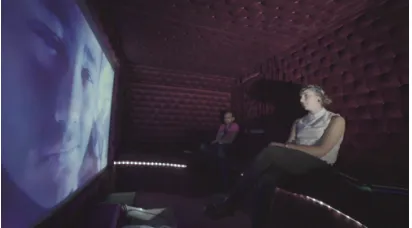
Figure 3: A participant wearing the EEG device, experiencing #Scanners inside the caravan.
be changed by viewing it, both consciously and unconsciously. Each layer of the film is told from a different point of con-sciousness, be it from a dream state, impartial matter of fact, day dreaming or high anxiety.
The script was then written over the course of 6 months be-fore being shot at the artist’s home town of Stoneyburn, West Lothian, Scotland. The film production consisted of a 10-day shoot with 6 crew members and around 30 actors. The artist and actors explored the themes of bullying and racism in dis-cussions and by work-shopping scenes. In order to create the different layers, several scenes were shot with multiple cam-eras, whilst others were filmed asynchronously. Each layer had its own set of rules; for example, Dream Passive was shot using a tilt-shift lens in slow motion with a heightened colour palette. In contrast Reality Active was shot with a wide angle at normal speed in realistic colours. Likewise, layers within scenes were thematically separated, antagonism would be set to Reality Active, fantasy to Dream Active.
[image:3.612.64.289.233.331.2]STUDYING #SCANNERS
Having made the film, we set about studying it using ‘Performance-Led Research in the Wild’ as described by Ben-ford et al [2]. As opposed to a scientific experimental method-ology, this involves presenting the novel technological expe-rience in an open public space with the aim of gaining rich insights into how people interacted with it. Consequently, we worked with the artist to stage the film at a high-profile pub-lic arts venue, and conducted a naturalistic study of pubpub-lic participants who acquired tickets and came along to try it out.
Method and Approach
The film was presented at one of the UK’s leading organisa-tions for the development, support and exhibition of video, film and new and emerging media: the Foundation for Art and Creative Technology (FACT) in Liverpool. FACT attracts more than 3000 attendees and showcases more than 350 new media art from across the world, each year. The installation ran from the 14-19th of July 2015 between 10:30 and 17:30 each day. #Scanners was presented in an intimate 6 person capacity cinema, within a caravan (shown in Figure 3) to emu-late a rich cinematic experience. The space had no windows, low lighting, plush seating, an eight foot projected image, and stereo speakers.
Participants were recruited in-situ, with advertising placed outside the caravan and through word of mouth, with a number of viewers viewing the experience on the recommendation of a friend. The experience was also advertised on the FACT website. In total, around 75 people had the opportunity to experience #Scanners as the main viewer, sometimes with up to 5 additional spectators. All viewers were told that data, and their unique version of #Scanners, would be recorded for later analysis and were given a chance to opt-out. 35 of these agreed to participate in our study and provided informed consent. Active viewers were fitted with the headset which took on average about 2-3 minutes to set up. Their film experience lasted approximately 16 minutes. Each participant’s unique version of the film and brain data was recorded. The session concluded with a semi-structured debriefing interview, focused on people’s experiences and feelings whilst using #Scanners, which typically lasted around 10 minutes. Unfortunately, log data for 13 of these participants was incomplete. As such our study focuses on the 24 who had agreed to be interviewed and for whom we have complete logs of BCI data.
Overall Response to #Scanners
We begin by looking at the participants perceived experience on a macro level, identifying that overall, participants were generally positive about #Scanners:“Yeah it was quite crazy.” -P35,“I felt like I could slow it down, speed it up and I could
move on.” -P33, whilstP29went so far as to say -“It’d be great to watch on drugs.”
The experience did feature some challenging subject matter, specifically around the subject of bullying -“[I didn’t enjoy] the section where the child is bullied because I got bullied in school when I was a kid and I remember thinking... I didn’t actually want to watch that.” -P33.P15noted that the film “induced or sort of sense of unease.”Considering the switch
between reality and dream footage,P1said“I found it, I don’t know if scary is the word, but perhaps a little unnerving in places because usually when you see a film you see outside the character but because you could move to see from inside the characters perspective it was a bit like: oh, I don’t want to pick that brick up.”
Figure 4 shows the collective experience of our 24 participants. The bars above zero (X-axis), indicate the number of viewers in the reality state at a given moment, whilst the bars below indicate the number of viewers in the dream state. The graph bars denote the number of viewers in each group at 15 second intervals. The line plots indicate the scaled average intensity of attention (blue) and meditation (green) across all participants. The vertical red lines indicate the timing of synchronised scene changes in the footage. The graph confirms that the control mechanism was reasonably balanced, showing that people did flip between dream and reality and that levels of attention and meditation varied in apparently sensible ways. It gives a first impression that the control mechanism was reasonably well behaved as we might have hoped.
While clearly not a controlled experiment, we have calculated some statistics to help characterise the overall nature of the experience in terms of how much people were deemed to be blinking, attending and meditating and how this shaped the overall viewing patterns of the film. Attention and Meditation values were provided directly from the EEG headset and range from 0 (low) to 100 (high). The average attention level was 53.23 (stdev 5.38), while the average meditation level was 57.75 (stdev 5.09), with a correlation (r=0.07) confirming the independence of the two measures. We examined whether Attention and Meditation levels varied between scenes, using a repeated-measures ANOVA. Only Attention varied signif-icantly (F(17,6)=4.125, p<0.0001), indicating that people’s Attention did vary from scene to scene, but their Meditation, or calmness, did not. Pairwise comparisons highlighted that Scenes 3 and 4 drew the highest levels of Attention, during which the primary character in the film experiences an intense and anxious nightmare. Conversely, scenes 17 and 18 drew the lowest levels of attention, which could be explained by decline in interest as time progresses. The focus of scenes 17 and 18, however, is on the main character resolving some of their problems towards a positive ending, involving a calm cycle ride through their neighbourhood. This may have sim-ply commanded less attention than an intense nightmare, or perhaps viewers consciously withdrew attention from a less interesting scene.
Figure 4: Visualisation of Attention (blue line), Meditation (green line) and state (Reality = purple bars, Dream = red bars).
(a) P2 blinked 28 times
(b) P16 blinked 158 times
Figure 5: Visualisations of viewer’s journeys through #Scanners. Above the X-Axis is attention, below it is meditation.
their blinking carefully. P2, for example, said“I definitely had control over the way it was edited as I’d seen that version before I kind of knew I could change the footage that I hadn’t seen and see the other version.”. P2 blinked only 28 times, or approximately two times per minute, including a break from blinking for more than two minutes between scenes for 7-11, as shown in Figure 5a (Note - a blink is indicated by the graph line crossing the X-Axis). Others, however, blinked many times throughout the film, as shown byP16in Figure 5b who blinked 158 times, or 10 times per minute.P2, who had just watched their friend using #Scanners, said“I think because
I watched it before, there was some scenes I didn’t want to see or I wanted to see the other side of the scene. So that I found really interesting, so I wasn’t passive it was nice to have control over it.”- confirming how they deliberately refrained from blinking as a control tactic
[image:5.612.101.515.307.547.2]basis, that the low-blinking group tended to have higher levels of Attention (Shown in Figure 6).
Figure 6: Attention levels of High (red) and Low Blink-ers(blue) by scene.
Discovering Control
Having presented some general observations across the whole group of viewers we now turn to looking at the finer details of control as described by the viewers in the subsequent in-terviews. Many who experienced #Scanners began without knowing how it could be controlled, and the amount that they discovered whilst watching the film varied; some quickly came to understand aspects of the control, even if they did not in-terpret its effect correctly. Aside from knowing they were wearing a brain scanner, however, a few participants remained unaware that they could have some control over #Scanners: “I didn’t realize there was anything to control”-P19and“I thought it was just how it was”-P16. Some, during the ex-perience, realised that they had some control:“It did feel like something else was controlling. There was something more kind of [transient] in the edits, you know. It didn’t flow in the same way that it would do if you were watching something else...” -P15. P28discovered, during the experience, that blinking was having an effect:“I noticed that when I blinked, it changed between blue and red, and green and white. And I liked the blue and red so I tried to keep on that as long as I can.”
People didn’t necessarily understand how they were control-ling it, nor what impact their control was having. P6said: “[I tried to] alter my breathing”and“I tried messing about with my hands in front of my eyes”. P7believed they were altering the storyline, saying“there were little bits where I could control wither people were being aggressive or not.”. SimilarlyP10said“I did [think I could control characters] near the beginning, especially when I thought: pick that brick up and hit them.”.P33thought perhaps they were controlling the temporal flow of the film, saying“I thought, if I really, really focus on what’s going on, it will travel quickly and I will get through this section that I don’t really like, if that makes sense and it seemed to do that.”
Some participants knew at the start how the system worked, because they had watched a friend experience, or had spoken to a previous participant. P5said“I enjoyed concentrating
because I had the control of the concentrating”. While some had control over their attention levels, it wasn’t always easy for others to so:“my meditation, I tried to play with that but I wasn’t sure if I was having much effect”-P6. Participants seemed happy, however, with this limited control: “I was happy with the amount of control, because I didn’t know the parameters of how to affect it and trying to manually affect how your brain is reacting is really difficult” - P1.
Exerting Control
For those that exerted a level of control, some found that this increased their engagement with the film:“more immersive definitely, I’m used to going along with a storyline and having no control over what’s happening and feeling not-connected to the film whereas, that I felt more involved with it, more connected to the film, and to the characters as well”. Others, likeP2above, used this control to manage their exposure to difficult material;P18said“The audio became really, really annoying and very abrasive. I was using the opportunity to just switch to a less abrasive... I mean, both were still abrasive but I was switching to the less abrasive at that point and checking in, every so often”. Using control wasn’t always easy due to its semi-autonomic nature:“yeah I tried to play with [blinking] but sometimes I blinked involuntary, so sometimes where I didn’t want it to change it would change”-P6. Similarly P22said“I think sometimes like I was stopping myself from blinking and then my eyes will get dry.”
Conversely, thinking about control meant that some partici-pants found it hard to fully enjoy the film:“A lot of the time I found it difficult to remove myself from the thought of the fact that I was changing it and I was controlling it, and I kept thinking like why is my mind doing that pace like what’s going on in the film?”-P23. Similarly,P31said“sometimes you notice that you have the agency, and that flipped you out of flow. But sometimes you’ve really added to the dramatic ef-fect.” P28worried that even more control might reduced the enjoyment of the experience“I think any more control maybe I think that, maybe more control would have taken away from the immersive elements of the film.”
Figure 7: Meditation levels for those that self-identified as trying to Control (Red) and those who did not (Blue).
Releasing Control
Understanding and using control did not mean, however, that users retained control over the film throughout. Some enjoyed giving up the control, withP31saying“So you try not to blink. So that was, I think it did add to it, yeah feels good. I mean I could have let it go as well a little bit, but that was nice. Sometimes I just let go. It’s good.”. Some participants even forgot about their control for periods of time, withP1saying “I completely forgot, I was concentrating on the film then a couple of minutes the pressure point there started aching and yeah I’m wearing a headset.”.
In reflection, some said that it would have been better not to know exactly how to control the film.P13said“I wish you hadn’t told me before, its not as authentic if you know before” andP14said“I would have liked to have done it, not knowing anything”. When asked ifP10(who did not figure out how to control the system) would have liked to have known in advance, they said“No [because] then I’d be blinking like anything, and its our observation that changes what happens anyway. I’d have liked to be told that I would be told [how it worked] afterwards. Maybe I would have thrown myself into it more.”
Summary of Findings
Our findings reveals the diverse ways in which viewers expe-rienced #Scanners. No single experience of the film was the same and viewers engaged with the possibilities of BCI con-trol in many different ways. Some actively employed concon-trol, adopting deliberate tactics such as not blinking, whilst others did not or were not aware that they could exert control. Some subsequently relinquished control as they became immersed in the film or as their autonomic responses reasserted themselves. Some learned about control for themselves, by experimenting or watching others, while others were told about it. Taken together, these findings present a complex, even bewildering picture. How are we to understand what is happening here? What lessons might filmmakers and other “designers” of inter-active entertainment draw from our findings? The following section attempts to answer these questions by setting out a structured design space for BCI control to systematically relate various findings to one another.
DISCUSSION
We now reflect on both the design and viewer experience of #Scanners in order to draw out more general lessons for HCI about the use of BCIs in interactive entertainment. Our discussion takes the form of a gradually building conceptual framework to explain the subtleties of control when using BCI as this - in various guises - emerged as the central issue from our experience. The aim of establishing a conceptual framework is to 1) Define concepts to explain our findings; 2) Ground them in HCI related literature; 3) Reveal unusual strategies and tactics for designing future entertainment.
Our framework involves the definition and comparison of two key dimensions of control - the extent to which control when using BCI can be considered to be voluntary and the extent to which the user is aware or trying to control the system.
Extent of voluntary control
A key motivation for some BCI research, is that people are not fully or directly in control of their interactions, but that systems respond reactively to their behaviour [45], such as with the control of artificial limbs [28]. To be more precise, we would argue that their control of the system is not entirely voluntary. Thus, while we have seen examples that viewers can learn to voluntarily control their blinking in order to try and prolong or break away from scenes in the film, we have also seen how blinking is also an semi-autonomic bodily response to drying eyes, dust and other factors. In short, one cannot refrain from blinking forever. Our findings suggest that our interpretations of attention and meditation were perhaps subject to even more tenuous voluntary control. While viewers often wanted to control them - and some claimed that they could - control was exerted through indirect means such as trying to slow breathing in order to calm down and be more meditative. Whilst users were more able to influence their Attention levels, and we saw a significant difference in Attention levels between different scenes, Meditation levels did not vary significantly throughout the film.
Figure 8: Extent of Voluntary Control as a dimension
[image:7.612.341.542.493.569.2]voluntary. Similar to Marshall et al’s breath-controlled buck-ing bronco [26], the user can choose to blink at certain points, but cannot avoid blinking at others. The user can try to relax, but may be affected by surprise or fear during the film. The user can choose to be more attentive, but may struggle to main-tain attention during less action-oriented scenes. The user’s position on this spectrum can vary during an experience. Our findings revealed both deliberate and accidental triggers that might cause movement along this spectrum (see Figure 9).
Figure 9: Triggers affecting voluntary control
Extent of Self-Awareness
[image:8.612.77.272.173.315.2]Our second dimension, shown in Figure 10, concerns the extent to which one is self-aware of one’s level of control over one’s body, including thinking about controlling the system. ThisExtent of Self-Awarenesscan vary between being fully conscious of what one is doing, such as when manipulating a mouse or keyboard, to when our attention is focused elsewhere, such when we are deeply immersed in a state of flow when watching a film [6]; like riding a bike without thinking about how to ride it. Our findings reveal that our particular treatments
Figure 10: Extent of Self-Awareness of control as a dimension
of BCI in terms of blinking, attention and meditation span various points along this dimension. Users can be consciously aware of trying to control their blinking or unaware of their everyday blinking behaviour. They can be deliberately trying to play close attention, whilst some became immersed in the film and forgot about trying to influence it. Moreover, we have seen how this level of consciousness may vary dynamically throughout an experience as a result of various internal and external triggers that are shown in Figure 11. We noted, for example, how changes in content such as a scene transition in a film might potentially move the user in either direction,
[image:8.612.340.542.426.586.2]re-engaging their attention with the film or causing them to reflect on whether the transition was caused by their blinking.
Figure 11: Triggers affecting Self-Awareness of control
A Design Space for Entertaining BCIs
Combining these two dimensions reveals an important design space for the control of BCIs (and possibly other modalities too). Our experience revealed something of a tension in the use of BCIs where users move back and forth between voluntary and involuntary and between conscious and unconscious with different effects. Beyond helping explain our findings, we might also put this taxonomy to use as a design space for BCIs, especially for entertainment. The green diagonal line in Figure 12 represents the traditional locus of control in HCI [36]. This moves between internal locus of control (e.g., direct manipulation) and external locus of control (e.g., autonomous, context-aware and ubicomp sensing systems).
Figure 12: A design space for entertaining BCIs
[image:8.612.74.276.472.564.2]Our results already suggest some general strategies that in-volvethinking off the line:Fully-conscious and involuntary
- where we explore physiological measures that people have even less understanding or voluntary control over, such as skin temperature, andVoluntary but unconscious- which encourage people into states, perhaps like experiencing flow [6], where people could use voluntary control, but do not need to consciously think about doing it.
Journeys through Control
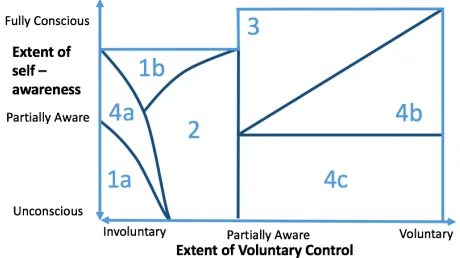
[image:9.612.320.574.80.245.2]We return to the idea that this is a dynamic picture - that participants can make various transitions around this space. In an attempt to characterise the many paths taken by those who experienced #Scanners, we developed the state diagram seen in Figure 13. The diagram provides a visualisation of the potential state and transfer of state a viewer may experience during #Scanners. Reflecting on the interview data led us to propose the following states.
Figure 13: Major states participants travelled through whilst experiencing #Scanners
State (1) indicates one of two entry points into the experience. In (1a), viewers have zero prior knowledge of the system’s operation. There may be some awareness of the possibility of some control, since they are wearing the headset, but there is no explicit knowledge. Conversely, (1b) represents the state of knowing. Viewers in (1b) will posses varying degrees of knowledge of the system’s operation but have yet to exert any elements of control.
State (2) represents the state of pre-discovery. For viewers transitioning from (1a), this will be the beginning of their discovery, they will begin to notice certain associations be-tween their physiology and manipulation of the experience. Transition from (1b), will begin the process of confirming existing knowledge. Discovery is then witnessed in (3). This is the “ah-ha” moment where viewers figure out some/all el-ements of control associated with the film. Within this state, participants were typically thinking more about how they were controlling, than they understand how it worked; people tried different ways to relax and tried focusing on different things, like controlling the storyline or the actors.
[image:9.612.61.291.271.400.2]Post discovery occurs in (4). (4a) represents the viewer that never discovers more of the control (partial knowledge). They remain aware that something is effecting the experience but do not discover more. In (4b), some participants enter a stage of
Table 1: Unique identified journeys whilst using #Scanners
ID Path Participant Total
J1 1a 16, 19, 29 3
J2 1b 21 1
J3 1a→ 2 →4a 10, 11, 15, 26 4
J4 1a→ 2 →4b 33, 35 2
J5 1a→ 2 12 1
J6 1a→ 2 →3 →4b 18 1
J7 1a→ 2 →3 →4b→ 4c 1, 28, 30, 31 4
J8 1a→ 2 →3→4c 3, 8 2
J9 1a→ 3 →4b 22 1
J10 1b→3 → 4b 2, 5, 6, 13 4 J11 1b→2→3 →4b 23,25 2
J12 1b→2→3 →4c 20 1
J13 1b→2 →3 →4b →4c 7 1
understanding with the system control, and begin to use it to control the system. Similarly, those that understand elements of control (e.g. blinking effects the cutting of scenes in some way), may simply slowly relinquish explicit control and fall back into immersion, where their knowledge of control has increased, but they no longer think about doing it (4c).
From detailed analysis of each viewer’s interview and video data we were able to identify 13 unique paths through the experience. Table 1 allows us identify some of the interesting characteristics associated with the experience. J1 and J2, for example, shows individuals that never moved beyond the ini-tial state (1). For (1a) this experience would be analogous with watching a standard film (e.g. P16). Perhaps more interesting is P21 who remained in (1b) i.e. they have prior knowledge of some of the systems control, but chose not to explore what exactly they could do with it.
J3 and J4 was the most common journey taken by viewers who did not have prior knowledge of the system’s control. The journey indicates that they discovered, based on the system’s responses, behaviours that might create a change. Those that never quite work it out, then return to (4a), whilst those that do typically moved to (4b), where they begin to use control. Some, however, went as far as (4c), where in J7 they then forget about control and enter a state of immersion, where they know what is controlling the system but stop thinking it.
quite passive. I was very aware of my emotional responses watching it. I was kind of..quite...I guess I was monitoring my emotional responses quite...and allowing them to be quite strong because I kind of had some vague idea that, that might, you know, provide more information for the feedback thing”.
Putting the Framework to Future Work
We now consider the utility of our framework - how might it be useful. The first possibility is a “sensitising concept” to assist in the design or analysis stages of future studies. We might for example, design future studies to explore in greater detail the relationships between voluntary and involuntary control or be-tween conscious and unconscious control, or to explore some of the specific transitions that we have identified in greater depth. Our concepts might also prove useful for analysis data captured from other BCI controlled entertainment experiences. This latter point raises two questions about the generality of our framework:
• To what extent might it apply to other kinds of control that have similar characteristics to BCI?
With much other work looking at interactions via other phys-iological data, our framework might equally apply to other forms of broadly physiological control such as breathing and heart rate, but might also be expanded by them.
• To what extent might it apply to applications other than entertainment and non-entertainment?
Our framework might apply to interactive entertainment like gaming and music creation, but might also apply simply to the control of non-entertainment control concerns such as controlling prosthetics or to help “locked out” users control computers.
The second possibility is as a framework for generating new design ideas. Here we follow Höök and Lowgren’s notion of strong concept [18], a form of “intermediate design knowledge” that embodies a core design idea; bridges between specific instances and generalized theory; concerns interactivity; and can help generate new designs. With this in mind, we suggest three ways in which our framework might enable the design of future experiences.
First is the design of interactive content - can the structure of interactive media respond to these transitions. In this paper, we have documented how one film-maker scripted, shot and edited a film. Even this single example reveals various creative strategies, but different types of films might be suitable to different types of physiological control. Suspense thrillers, for example, might monitor users for a difference between being bored and enthralled in order to shorted or extend the scene, where stress is detected from EEG and blink rates [14]. Similarly, designers may ask how to respond to a user that voluntarily closes their eyes for sustained periods of time. During horror films, this could be used as an active controller to skip scenes, or passively to make the filmsoundscarier.
Second is the repeat screening or staging of experiences. Our recognition of inter-experience transitions suggests that more attention needs to be paid to the screening of experiences. Of particular importance here is developing strategies for moving
people between different modes of engagement as they re-encounter the experience anew. Should their first experience be a “naive” one before they then find out how it learns? Should they move between spectating and driving as argued by Reeve el al’s in their proposals for designing spectator interfaces [34]? What might be the best orders for combining all of these? The notion of varying repeat experiences in this is unusual in film where film-makers are not usually directly concerned whether we enjoy it differently on subsequent viewings. It is perhaps more common to consider the longetivty of enjoying games, but even then the focus is more on progressing through levels than on systematically varying the experience each time.
Third is to explore collective experiences. In its current imple-mentation #Scanners is controlled by an individual user, but films are often watched in groups, whether at the cinema or at home. Within our installation, even, the #Scanners experience can be - and was - witnessed by many viewers concurrently. There is a large opportunity, therefore, to investigate how multimedia might respond to the biological responses of a collective audience. Experiences might monitor the average response across an audience, where Kirke et al, for example, have recently explored the use of audience arousal to vary a film experience with multiple possible endings [21]. Con-versely, different people could control different aspects of the experience, where Leslie and Mullen, for example, provided separate control over music streams to each participant [23].
CONCLUSIONS
By creating an interactive film, where the scenes seen by view-ers varied depending on their levels of meditation and attention, we have explored a novel design area for including BCI in multimedia experiences. The experience was explored with members of general public as an installation at a week-long national arts exhibition. Most notable, amongst our findings, was that while the BCI based adaptation made the experience more immersive for many viewers, thinking about control of-ten brought them out of the experience. This led us to propose a two-dimensional taxonomy of control, considering both the understanding of the control, and how much users think about control. A traditional belief in HCI is that Direct Manipulation (being able to control exactly what you want to control) sits at the top of both these dimensions. We examined, however, how users deviate from line, and enjoyed the experience more by either not knowing exactly how it worked, or by giving up control and becoming re-immersed in the experience. We con-clude that these deviations from the line between knowledge and conscious control over interaction are most interesting design opportunities to explore within future BCI adaptive multimedia experiences.
ACKNOWLEDGEMENTS
This work was supported by the EPSRC ORCHID project (EP/I011587/1), the Horizon Centre for Doctoral Training (EP/G037574/1), the FAST Project (EP/L019981/1), the Arts Council England (27369977) and the International Doctoral Innovation Centre (IDIC), University of Nottingham, Ningbo.
REFERENCES
1. Thomas Andrillon, Yuval Nir, Chiara Cirelli, Giulio Tononi, and Itzhak Fried. 2015. Single-neuron activity and eye movements during human REM sleep and awake vision.Nature communications6 (08 2015).
http://dx.doi.org/10.1038/ncomms8884
2. Steve Benford, Chris Greenhalgh, Andy Crabtree, Martin Flintham, Brendan Walker, Joe Marshall, Boriana Koleva, Stefan Rennick Egglestone, Gabriella Giannachi, Matt Adams, and others. 2013. Performance-led research in the wild.ACM Transactions on Computer-Human Interaction (TOCHI)20, 3 (2013), 14.
http://doi.acm.org/10.1145/2491500.2491502
3. Steve Benford, Chris Greenhalgh, Gabriella Giannachi, Brendan Walker, Joe Marshall, and Tom Rodden. 2012. Uncomfortable Interactions. InProceedings of the SIGCHI Conference on Human Factors in Computing Systems (CHI ’12). ACM, New York, NY, USA, 2005–2014.DOI:
http://dx.doi.org/10.1145/2207676.2208347
4. Jon Boorstin. 1995.Making movies work: Thinking like a filmmaker. Silman-James Pr.
5. Danny Plass-Oude Bos, Boris Reuderink, Bram van de Laar, Hayrettin Gürkök, Christian Mühl, Mannes Poel, Anton Nijholt, and Dirk Heylen. 2010. In
Brain-Computer Interfaces(1st ed.). Springer, UK, 149–178.
6. Mihaly Csikszentmihalyi and Mihaly Csikzentmihaly. 1991.Flow: The psychology of optimal experience. Vol. 41. HarperPerennial New York.
7. Michael J Doughty. 2002. Further assessment of gender-and blink pattern-related differences in the spontaneous eyeblink activity in primary gaze in young adult humans.Optometry & Vision Science79, 7 (2002), 439–447.
8. Raffaella Folgieri and Roberto Zampolini. 2015. BCI promises in emotional involvement in music and games. Computers in Entertainment (CIE)11, 4 (2015), 4.
9. Gary Garcia-Molina, Tsvetomira Tsoneva, and Anton Nijholt. 2013. Emotional brain–computer interfaces. International journal of autonomous and adaptive communications systems6, 1 (2013), 9–25.
10. Mick Grierson. 2008. Composing with brainwaves: minimal trial P300b recognition as an indication of subjective preference for the control of a musical instrument. InProceedings of the ICMC.
11. Mick Grierson and Chris Kiefer. 2011. Better Brain Interfacing for the Masses: Progress in Event-related Potential Detection Using Commercial Brain Computer Interfaces. InCHI ’11 Extended Abstracts on Human Factors in Computing Systems (CHI EA ’11). ACM, New York, NY, USA, 1681–1686.
http://doi.acm.org/10.1145/1979742.1979828
12. Hayrettin Gürkök, Anton Nijholt, and Mannes Poel. 2012. Brain-computer interface games: Towards a framework. InEntertainment Computing-ICEC 2012. Springer, 373–380.
13. Hayrettin Gürkök, D Plass-Oude Bos, van der BLA Laar, Femke Nijboer, and Anton Nijholt. 2011. User experience evaluation in BCI: Filling the gap.International Journal of Bioelectromagnetism13, 1 (2011), 54–55.
14. M Haak, S Bos, S Panic, and LJM Rothkrantz. 2009. Detecting stress using eye blinks and brain activity from EEG signals.Proceeding of the 1st driver car interaction and interface (DCII 2008)(2009).
15. Uri Hasson, Ohad Landesman, Barbara Knappmeyer, Ignacio Vallines, Nava Rubin, and David J Heeger. 2008. Neurocinematics: The neuroscience of film.Projections 2, 1 (2008), 1–26.
16. Brent Hillard, Ayman S El-Baz, Lonnie Sears, Allan Tasman, and Estate M Sokhadze. 2013. Neurofeedback Training Aimed to Improve Focused Attention and Alertness in Children With ADHD A Study of Relative Power of EEG Rhythms Using Custom-Made Software Application.Clinical EEG and neuroscience44, 3 (2013), 193–202.
17. Kristina Höök. 2008. Affective Loop Experiences–What Are They? InPersuasive Technology. Springer, 1–12.
18. Kristina Höök and Jonas Löwgren. 2012. Strong concepts: Intermediate-level knowledge in interaction design research.ACM Transactions on Computer-Human Interaction (TOCHI)19, 3 (2012), 23.
http://doi.acm.org/10.1145/2362364.2362371
19. Chang-Hwan Im, Jun-Hak Lee, and Jeong-Hwan Lim. 2015. Neurocinematics based on passive BCI: Decoding temporal change of emotional arousal during video watching from multi-channel EEG. InControl Conference (ASCC), 2015 10th Asian. IEEE, 1–3.
20. Shoya Ishimaru, Kai Kunze, Koichi Kise, Jens Weppner, Andreas Dengel, Paul Lukowicz, and Andreas Bulling. 2014. In the blink of an eye: combining head motion and eye blink frequency for activity recognition with google glass. InProceedings of the 5th Augmented Human International Conference. ACM, 15.
http://doi.acm.org/10.1145/2582051.2582066
21. Alexis Kirke, Duncan Williams, Eduardo Mir, A Bluglass, Craig Whyte, and Pruthi Andrew Eccleston. 2013. Technical Report on a Short Live-action Film whose Story with Soundtrack is selected in Real-time based on Audience Arousal during Performance. (2013).
22. John D Lee and Katrina A See. 2004. Trust in automation: Designing for appropriate reliance.Human Factors: The Journal of the Human Factors and Ergonomics Society 46, 1 (2004), 50–80.
24. An Luo and Thomas J Sullivan. 2010. A user-friendly SSVEP-based brainâ ˘A ¸Scomputer interface using a time-domain classifier.Journal of Neural Engineering7, 2 (2010), 026010.
http://stacks.iop.org/1741-2552/7/i=2/a=026010
25. Marco Marchesi, Elisabetta Farella, Bruno Riccò, and Antonella Guidazzoli. 2011. MOBIE: A Movie Brain Interactive Editor. InSIGGRAPH Asia 2011 Emerging Technologies (SA ’11). ACM, New York, NY, USA, Article 16, 1 pages.DOI:
http://dx.doi.org/10.1145/2073370.2073385
26. Joe Marshall, Duncan Rowland, Stefan
Rennick Egglestone, Steve Benford, Brendan Walker, and Derek McAuley. 2011. Breath Control of Amusement Rides. InProceedings of the SIGCHI Conference on Human Factors in Computing Systems (CHI ’11). ACM, New York, NY, USA, 73–82.DOI:
http://dx.doi.org/10.1145/1978942.1978955
27. Soh Masuko and Junichi Hoshino. 2006. A Fitness Game Reflecting Heart Rate. InProceedings of the 2006 ACM SIGCHI International Conference on Advances in Computer Entertainment Technology (ACE ’06). ACM, New York, NY, USA, Article 53.DOI:
http://dx.doi.org/10.1145/1178823.1178886
28. Gernot R Müller-Putz and Gert Pfurtscheller. 2008. Control of an electrical prosthesis with an SSVEP-based BCI.Biomedical Engineering, IEEE Transactions on55, 1 (2008), 361–364.
29. Walter Murch. 2001.In the blink of an eye: A perspective on film editing. Silman-James Press.
30. Yoichi Nagashima. 2003. Bio-sensing Systems and Bio-feedback Systems for Interactive Media Arts. In Proceedings of the 2003 Conference on New Interfaces for Musical Expression (NIME ’03). National University of Singapore, Singapore, Singapore, 48–53.
http://dl.acm.org/citation.cfm?id=1085714.1085726
31. Ville Nenonen, Aleksi Lindblad, Ville Häkkinen, Toni Laitinen, Mikko Jouhtio, and Perttu Hämäläinen. 2007. Using Heart Rate to Control an Interactive Game. In Proceedings of the SIGCHI Conference on Human Factors in Computing Systems (CHI ’07). ACM, New York, NY, USA, 853–856.DOI:
http://dx.doi.org/10.1145/1240624.1240752
32. Shinji Nishimoto, An T Vu, Thomas Naselaris, Yuval Benjamini, Bin Yu, and Jack L Gallant. 2011. Reconstructing visual experiences from brain activity evoked by natural movies.Current Biology21, 19 (2011), 1641–1646.
http://dx.doi.org/10.1016/j.cub.2011.08.031
33. S Patel, R Henderson, L Bradley, B Galloway, and L Hunter. 1991. Effect of visual display unit use on blink rate and tear stability.Optometry & Vision Science68, 11 (1991), 888–892.
34. Stuart Reeves. 2005. Designing the Spectator Experience Stuart Reeves, Steve Benford, Claire O’Malley, Mike Fraser. (2005).
35. Dean Rubine. 1992. Combining Gestures and Direct Manipulation. InProceedings of the SIGCHI Conference on Human Factors in Computing Systems (CHI ’92). ACM, New York, NY, USA, 659–660.DOI:
http://dx.doi.org/10.1145/142750.143072
36. Ben Shneiderman. 1986.Designing the user interface: strategies for effective human-computer interaction. Addison-Wesley Reading, MA.
37. Ben Shneiderman. 1997. Direct Manipulation for Comprehensible, Predictable and Controllable User Interfaces. InProceedings of the 2Nd International Conference on Intelligent User Interfaces (IUI ’97). ACM, New York, NY, USA, 33–39.DOI:
http://dx.doi.org/10.1145/238218.238281
38. Tadeusz Stach, T. C. Nicholas Graham, Jeffrey Yim, and Ryan E. Rhodes. 2009. Heart Rate Control of Exercise Video Games. InProceedings of Graphics Interface 2009 (GI ’09). Canadian Information Processing Society, Toronto, Ont., Canada, Canada, 125–132.
http://dl.acm.org/citation.cfm?id=1555880.1555912
39. Desney Tan and Anton Nijholt. 2010.Brain-computer interfaces and human-computer interaction(1st ed.). Springer, UK.
40. BBC Technology. 2015. BBC develops ’mind-control TV’ headset for iPlayer app. (June 2015).
http://www.bbc.co.uk/news/technology-33163593
41. Allison Woodruff, Sally Augustin, and Brooke Foucault. 2007. Sabbath Day Home Automation: "It’s Like Mixing Technology and Religion". InProceedings of the SIGCHI Conference on Human Factors in Computing Systems (CHI ’07). ACM, New York, NY, USA, 527–536.DOI:
http://dx.doi.org/10.1145/1240624.1240710
42. Myeung-Sook Yoh, Joonho Kwon, and Sunghoon Kim. 2010. NeuroWander: A BCI Game in the Form of Interactive Fairy Tale. InProceedings of the 12th ACM International Conference Adjunct Papers on Ubiquitous Computing - Adjunct (UbiComp ’10 Adjunct). ACM, New York, NY, USA, 389–390.DOI:
http://dx.doi.org/10.1145/1864431.1864450
43. Beste F Yuksel, Daniel Afergan, Evan M Peck, Garth Griffin, Lane Harrison, Nick WB Chen, Remco Chang, and Robert JK Jacob. 2015.Implicit Brain-Computer Interaction Applied to a Novel Adaptive Musical Interface. Technical Report. Technical Report TR-2015-01, Department of Computer Science, Tufts University, 2015. www. cs. tufts. edu/Technical-Reports. html.
Systems (CHI ’10). ACM, New York, NY, USA, 855–858.
DOI:http://dx.doi.org/10.1145/1753326.1753452
45. Thorsten O Zander and Christian Kothe. 2011. Towards passive brain–computer interfaces: applying
brain–computer interface technology to human–machine systems in general.Journal of neural engineering8, 2 (2011), 025005.
46. Thorsten O Zander, Christian Kothe, Sabine Jatzev, and Matti Gaertner. 2010. Enhancing human-computer interaction with input from active and passive