Based Multicasting
Huanlai Xing1(&), Ying Xu2, Rong Qu3, and Lexi Xu4
1
School of Information Science and Technology,
Southwest Jiaotong University, Chengdu, People’s Republic of China [email protected]
2
College of Computer Science and Electronic Engineering, Hunan University, Changsha, People’s Republic of China 3
School of Computer Science, University of Nottingham, Nottingham, UK 4
Department of Network Optimisation and Management, China Unicom Network Technology Research Institute,
Beijing, People’s Republic of China
Abstract. One of the most important issues in multicast is how to achieve a balanced traffic load within a communications network. This paper formulates a load balancing optimization problem in the context of multicast with network coding and proposes a modified population based incremental learning (PBIL) algorithm for tackling it. A novel probability vector update scheme is developed to enhance the global exploration of the stochastic search by introducing extra
flexibility when guiding the search towards promising areas in the search space. Experimental results demonstrate that the proposed PBIL outperforms a number of the state-of-the-art evolutionary algorithms in terms of the quality of the best solution obtained.
Keywords: Load balancing
MulticastNetwork codingPopulation based incremental learning1
Introduction
With the popularity of the Internet, network traffic has been dominated by a dramati-cally increasing number of multimedia applications, e.g. online games, IPTV, VoD, remote education, and video conferencing. It has been reported that over 90 % of the Internet traffic comes from multimedia. Multicast is one of the efficient technologies developed for supporting one-to-many multimedia applications with stringent quality-of-service (QoS). Therefore, this technology has drawn significant amount of research attention from both academia and industry [1]. Unfortunately, multicast with store-and-forward strategy cannot guarantee that a theoretical maximal throughput is always obtained. Network coding allows intermediate nodes to perform mathematical operations to incoming information if necessary. When incorporated into multicast, it can always guarantee the theoretical maximal throughput and hence becomes an ideal technique for point-to-multipoint data transmission [2].
©Springer International Publishing Switzerland 2016
Load balancing is an issue in network resource allocation. Network service pro-viders are eager to make use of the network infrastructure as fully as possible so as to accommodate more users with different QoS guarantees. Undoubtedly, a more bal-anced traffic load helps to make use of the remaining network resources to function more efficiently. Hence, load balancing has been a hot spot in thefield of communi-cations for many years [3].
There are some research efforts dedicated to the load balancing in network coding based multicast (NCM). A NCM algorithm was presented and compared with two traditional multicast routing algorithms with respect to the achievable throughput and load balancing in [4]. A reliable data dissemination protocol, which adapts network coding for decreasing the broadcast traffic in code updates, was developed in [5]. In [6], the problem of exploiting the abilities of next generation terminals in satellite systems with network coding was investigated. In multi-hop wireless networks, a flexible energy-efficient multicast routing algorithm with network coding was put forward [7]. However, all work above assumes that coding recombination has to be executed at all coding-possible nodes within a network, which would consume serious network computational and buffering resources, as coding incurs expensive computational overhead [8–10]. Since coding might only be necessarily performed at a limited number of coding-possible nodes, it is of vital importance to consider the load bal-ancing issue in NCM, where coding is to be performed when needed. However, this issue has received little attention.
Population based incremental learning (PBIL) is an estimation of distribution algorithm, incorporating competitive learning concept into evolutionary algorithm. PBIL builds a probability model and evolves it to lead the search towards promising areas in the search space. Due to the simplicity and efficiency, the algorithm has been applied to a wide range of optimization problems, including the stabilizer design problem in power system [11], the dynamic optimization problem [12], the robot soccer system optimization [13], the antenna design problem [14], and the network coding resource minimization problem [15,16], etc.
In this paper, a load balancing optimization problem in the context of NCM is formulated, where coding is performed only when necessary. A modified PBIL with a new probability vector update scheme is adopted to optimize the problem. The new scheme maintains a set of best-so-far samples obtained during the evolution. At each generation, a proportion of samples in the set are randomly selected and used to update the probability vector, which to a certain extent helps improve the global exploration. Performance comparisons show that the proposed PBIL is superior to a number of state-of-the-art evolutionary algorithms (EAs) with respect to the solution quality.
2
Problem Formulation
Bmax
i Bcsmdi . There is a source node s2V, a set of receivers T ¼ft1;. . .;tdg; tk2V;k¼1;. . .;d, and an expected bandwidthRs→Tfromsto each receiver inT[8,9]. We call an intermediate node in G as a merging node if it is non-source, non-receiver and has multiple incoming links. Only merging nodes can perform coding operations. So, all coding-possible nodes in G are merging nodes. Given a NCM request, the task is tofind a connected subgraph (i.e. sub-network) inGto deliver NCM data traffic [9]. We refer to such subgraph as NCM subgraph and denote it byGs→T. A NCM subgraph consists of multiple paths, where each path originates from source sand terminates at a receiver. We refer tolink-disjointpaths as paths which do not have any common link. More details can be found in [9].
In this paper, identical bandwidth consumption, denoted by Bs→T, incurs in each link occupied by the NCM subgraph. So,Rlink-disjoint paths to the same receiver will incurRBs→Tbandwidth consumption, whereRis an integer. Letωibe the bandwidth utilization ratio inei2E, Φ be the number of link-disjoint paths to each receiver in Gs→T, andΩz(s→tk) be pathzfromstotkinGs→T,z= 1,…,Φ, respectively. Let ρz(s→tk) andr(s→tk) denote the link set of Ωz(s→ tk) and the achievable band-width fromstotk2TinGs→T, respectively.
In a communications network, each link is associated with a bandwidth utilization ratio (BUR) which reflects the percentage of how much bandwidth has been used. The task of this work is tofind a NCM subgraph inG, with the average BUR minimized and a number of constraints met. A smaller average BUR implies a more balanced traffic load inG.
Minimize:
x ð1Þ
where,
x¼ Xi2jEjxi
=j jE ð2Þ
xi¼ Bs!TciþBcsmdi
=Bmaxi ð3Þ
ci¼
1; ei2Gs!T 0; otherwise
ð4Þ
Subject to:
Bs!TþBcsmdi B max
i ; 8i¼f1;. . .;j jEg ð5Þ
r sð !tkÞ ¼UBs!T; 8tk2T ð6Þ
qmðs!tkÞ \qnðs!tkÞ ¼ ;; 8m;n2f1;. . .;Ug;m6¼n ð7Þ
Constraint (5) explains the bandwidth constraint. The achievable bandwidthr(s→tk) is Φtimes larger thanBs→TbecauseΦlink-disjoint paths from the source to each receiver are to be constructed, which is shown in Constraint (6). Constraint (7) reflects that any two paths in Gs→T cannot have common link, as long as they terminate at the same receiver.
3
The Proposed PBIL
This sectionfirst introduces the new probability vector (PV) update scheme and then describes the overall procedure of the proposed PBIL in detail.
3.1 New PV Update Scheme
In the original PBIL, best-so-far sample (i.e. solution/individual) is used to update PV. But this update scheme may cause serious prematurity very easily, which is because depending on a single sample might lead the search to local optima quickly. A number of improved PV update schemes are thus developed including the famous Hebbian-inspired rule [17]. This rule defines that PV should be updated by a set of samples obtained during the evolution rather than a single sample and to some extent helps maintain a relatively high level of diversity.
The new PV update scheme is based on the Hebbian-inspired rule. Different from other variants, the proposed scheme operates an external population (EP) which only records the best-so-far samples obtained during the evolution. At each generation, a subset of samples is randomly selected from EP and their statistical information is then extracted and used to update PV.
LetP(t) andNdenote the PV at generationtand the number of samples generated at each generation, respectively. LetSSEP= {B1,…,BM} be the subset of samples ran-domly selected from EP, whereMis smaller thanNandBiis thei-th selected sample, i= 1,…,M. Denote the probability distribution of all samples inSSEPand the learning rate byPSSandα, respectively. The update ofP(t) is defined in Eqs. (8) and (9).
Pð Þ ¼t ð1:0aÞ Pðt1Þ þaPSS ð8Þ
PSS ¼ 1 M
XM
k¼1Bk ð9Þ
By introducing extra uncertainty to the PV update process, the proposed scheme helps guide the search exploring unknown areas in the search space as much as possible where optimum may reside. With a certain level of diversity preserved, it helps to prevent the search getting stuck at local optima and hence improves global exploration.
3.2 The Overall Procedure of the Proposed PBIL
Assume there is an individual (sample)X. In terms offitness evaluation, wefirst check the feasibility ofX. We callXfeasible if it results into a valid NCM subgraph Gs→T(X) and infeasible otherwise. IfXis feasible, itsfitness value is set to the average BUR inG; otherwise, itsfitness value is set to a sufficiently large number (100 % in this paper since BUR is in the range [0, 100 %]). Note that a feasible individual requires more time than infeasible ones for evaluation since those feasible not only undergo feasibility checking but also NCM subgraph construction. And constructing a NCM subgraph consumes more time than feasibility checking.
The overall procedure of the proposed PBIL is shown in Fig.1. PVP(t) is ini-tialized as {0.7,…,0.7}, meaning the probability of generating‘1’at each position in
P(t) is 0.7. This helps guide the search to explore promising areas in the search space. SetH(t) is the sampling set generated by PV at each generation. Note that an all-one individual is inserted into H(t) to guarantee that the search begins with a feasible sample [10]. The initialNsamples are copied intoEPto form the external population. In the main loop, each sample inH(t−1) is evaluated and associated with a fitness value. Then,EPis updated. Later on,Mrandom samples are picked up fromEPand used to updateP(t) (M =N/2 in this paper).
[image:5.439.44.384.180.374.2]Mutation operation is implemented to add probability disturbance to PV so that prematurity is alleviated. Let the mutation probability and the amount of mutation at each position in PV, Pk, denoted by pm and σ, respectively. LetRNDk be a random
number (either 0.1 or 1.0, both with a probability of 0.5). IfRNDk<pm,Pkis mutated by Eq. (10)
Pk¼ð1:0rÞ PkþRNDkr ð10Þ
The termination criterion is that the evolution reaches a predefined number of generations.
4
Performance Evaluation
This section evaluates the proposed PBIL by comparing it with a number of state-of-the-art EAs with respect to the solution quality.
4.1 Test Instances
First of all, test instances are introduced briefly. We consider 12 benchmark instances including 2fixed and 10 randomly generated directed networks. These instances have been widely adopted for performance evaluation when handling with network coding related optimization problems [8–10,15,16,18–20]. The two fixed networks are F1 (i.e. 7-copy) and F2 (i.e. 15-copy) networks, where each copy is a modified butterfly network and x-copy network is constructed by cascading a number of identical copies [18]. As for the random instances, the network scale is from 20 to 60 nodes.
Table1shows all instances for performance comparison. In all experiments, each link is with an identical maximum bandwidth, i.e. 100 Mbps. The consumed band-width of linkei2E prior to NCM is randomly generated in the range [1, 50] Mbps with a uniform distribution. The bandwidth consumption of each link in NCM sub-graph is set to 30 Mbps. As mentioned in Sect.2, the single objective of the problem concerned in the paper is to minimize the average BUR. A smaller average BUR represents a better network load balancing performance. All experiments were run on a Windows XP computer with Intel(R) Core(TM) E8400 3.0 GHz, 2G RAM. For per-formance comparison, each algorithm is run 20 times on each instance.
4.2 Overall Performance Evaluation
In this subsection, performance comparison is carried out among a number of state-of-the-art EAs on 12 benchmark instances. The following lists all algorithms for comparison.
– GA1: GA with BLS representation [9].
– GA2: GA with block transmission state (BTS) representation [10].
– UMDA: univariate marginal distribution algorithm (UMDA) in [21]. Different from PBIL, UMDA utilizes statistics of the last generation to generate a new generation of samples.
– QEA2: Another variant of QEA [23]. Different from QEA1, QEA2 modifies the values of RAS and QMP according to the current and previousfitness values of the associated individual.
– PBIL1: PBIL devised for the network coding resource minimization problem [16]. – PBIL2: The proposed PBIL with the novel PV update scheme in Sect.3.
All EAs above uses BLS representation except GA2. The population size and the number of iterations are set to 20 and 200 for each algorithm, respectively. We adopt suggested parameter settings for GA1, GA2, UMDA, QEA1, QEA2, and PBIL1 [9,10, 16, 21–23]. In PBIL2, we set the learning rate α= 0.1, the mutation probability pm= 0.02, and the probability variance at each position σ = 0.05, respectively. The number of random samples selected at each generation from EP is 10. All results are collected by running each algorithm 20 times.
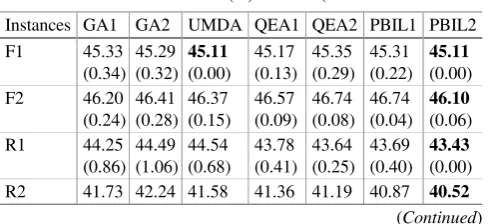
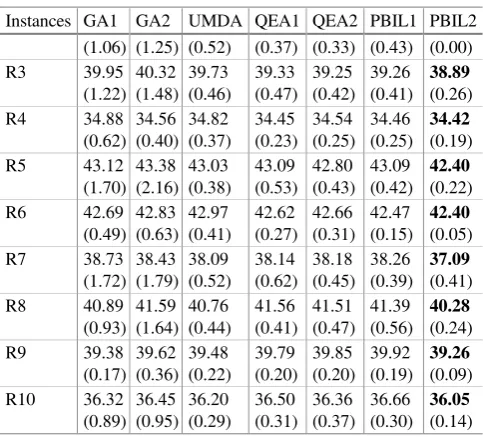
[image:7.439.132.291.68.238.2]Table2 shows the results of mean value (%) and standard deviation (SD). It is clearly seen that the proposed algorithm, PBIL2, performs the best if considering all test instances. For each instance, PBIL2 obtains the smallest mean value and promising SD, indicating that PBIL2 has a stabilized and outstanding optimization performance in
Table 1. Benchmark instances for performance comparison
Instances Nodes Links Receivers Rate
F1 57 84 8 2
F2 121 180 16 2
R1 20 37 5 3
R2 20 39 5 3
R3 30 60 6 3
R4 30 69 6 3
R5 40 78 9 3
R6 40 85 9 4
R7 50 101 8 3
R8 50 118 10 4
R9 60 150 11 5
[image:7.439.91.337.481.593.2]R10 60 156 10 4
Table 2. Results of mean value (%) and SD (Best results are in bold)
Instances GA1 GA2 UMDA QEA1 QEA2 PBIL1 PBIL2 F1 45.33 (0.34) 45.29 (0.32) 45.11 (0.00) 45.17 (0.13) 45.35 (0.29) 45.31 (0.22) 45.11 (0.00) F2 46.20 (0.24) 46.41 (0.28) 46.37 (0.15) 46.57 (0.09) 46.74 (0.08) 46.74 (0.04) 46.10 (0.06) R1 44.25 (0.86) 44.49 (1.06) 44.54 (0.68) 43.78 (0.41) 43.64 (0.25) 43.69 (0.40) 43.43 (0.00) R2 41.73 42.24 41.58 41.36 41.19 40.87 40.52
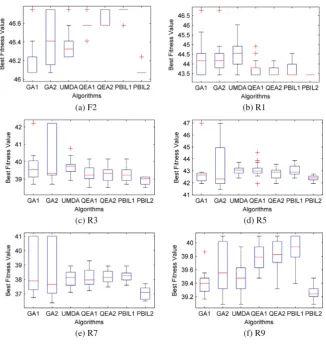
finding near-optimal solutions. By building an evolving probabilistic model, PBIL2 can generate promising samples from the PV at a relatively high probability, which to a certain extent guides the search towards promising areas in the search space. The novel PV update scheme helps PBIL2 gain better global exploration ability and avoid pre-maturity since the PV update is no longer dependent on a single sample but a random set of samples at each generation. With global exploration enhanced, PBIL2 has more opportunity to reach the global optima and thus obtains the best performance. Figure2 shows the box plots of the seven algorithms in six selected instances including F2, R1, R3, R5, R7, and R9. One canfind that PBIL2 always outperforms the rest of the EAs for comparison.
[image:8.439.105.347.70.291.2]The average computational time (ACT) is another important performance indicator when evaluating EAs. Table3 shows ACT values of all algorithms in all instances. On the one hand, it can be observed that PBIL2 obtains a relatively large ACT, which means it takes long time for navigating each evolutionary search. This is because PBIL2 does well in global exploration and feasible samples are generated at a high probability. As mentioned in Subsect.3.2, feasible samples consume more time than infeasible ones. If more feasible samples are generated during the evolution, an algo-rithm definitely incurs more computational cost and hence more ACT. With the novel PV update scheme integrated, PBIL2 generates significant number of feasible samples and hence consumes relatively large amount of ACT. On the other hand, PBIL2 is not the one with the largest ACT either, compared with the others. One may dramatically reduce ACT of PBIL2 by using parallel computation techniques.
Table 2. (Continued)
(a) F2 (b) R1
(c) R3 (d) R5
[image:9.439.51.378.54.400.2](e) R7 (f) R9
Fig. 2. Box plot of 6 selected instances
Table 3. Results of ACTs (sec.)
[image:9.439.88.332.426.606.2]5
Conclusions
This paper formulates a load balancing optimization problem in network coding based multicast (NCM), where the objective is to keep the network traffic load as balanced as possible when supporting data transmission of NCM. Average bandwidth utilization ratio is used to measure to what extent network traffic load is balanced. To handle with the problem above, we present a modified PBIL with a novel probability vector (PV) update scheme. This scheme introduces additionalflexibility in guiding the search by updating the PV by a number of random best samples, which helps enhance the global exploration capability and prevent the search from local optima. Experimental results show that the proposed PBIL gains the best optimization performance compared with a number of state-of-the-art evolutionary algorithms regarding the quality of the solution obtained. Due to the advantages of the proposed algorithm, it can be applied to a number of optimization problems in wireless communications, e.g. traffic control and network configuration in Long Term Evolution (LTE) cellular systems [24,25].
Acknowledgements. This research was supported in part by NSFC (No.61401374), the Fun-damental Research Funds for the Central Universities (No. 2682014RC23), the Project-sponsored by SRF for ROCS, SEM, P. R. China and University of Nottingham, UK.
References
1. Benslimane, A.: Multimedia Multicast on the Internet. ISTE, Norwood (2007)
2. Li, S.Y.R., Yeung, R.W., Cai, N.: Linear network coding. IEEE Trans. Inform. Theory
49(2), 371–381 (2003)
3. Wang, N., Pavlou, G.: Traffic engineered multicast content delivery without MPLS overlay. IEEE Trans. Multimedia9(3), 619–628 (2007)
4. Chi, K., Yang, C., Wang, X.: Performance of network coding based multicast. IEE Proc. Commun.153(3), 399–404 (2006)
5. Hou, I.H., Tsai, Y.E., Abdelzaher, T.F., Gupta, I.: AdapCode: adaptive network coding for code updates in wireless sensor networks. In: Proceedings of the INFOCOM (2008) 6. Vieira, F., Lucani, D.E., Alagha, N.: Codes and balances: multibeam satellite load balancing
with coded packets. In: Proceedings of the ICC (2012)
7. Jiang, D., Xu, Z., Li, W., Chen, Z.: Network coding-based energy-efficient multicast routing algorithm for multi-hop wireless networks. J. Syst. Softw.104, 152–165 (2015)
8. Kim, M., Ahn, C.W., Médard, M., Effros, M.: On minimizing network coding resources: an evolutionary approach. In: Proceedings of the NetCod (2006)
9. Kim, M., Médard, M., Aggarwal, V., O’Reilly, V., Kim, W., Ahn, C.W., Effros, M.: Evolutionary approaches to minimizing network coding resources. In: Proceedings of the INFOCOM (2007)
10. Kim, M., Aggarwal, V., O’Reilly, V., Médard, M., Kim, W.: Genetic representations for evolutionary minimization of network coding resources. In: Proceedings of the EvoCOMNET (2007)
12. Yang, S., Yao, X.: Population-based incremental learning with associative memory for dynamic environments. IEEE Trans. Evolut. Comput.12(5), 542–561 (2008)
13. Kim, J.H., Kim, Y.H., Choi, S.H., Park, I.W.: Evolutionary multi-objective optimization in robot soccer system for education. IEEE Comput. Intell. Mag.4(1), 31–41 (2009)
14. Ho, S.L., Yang, S., Bai, Y., Huang, J.: A robust metaheuristic combing clonal colony optimization and population-based incremental learning methods. IEEE Trans. Magn.50(2) (2014). DOI:10.1109/TMAG.2013.2283886
15. Xing, H., Qu, R.: A population based incremental learning for network coding resources minimization. IEEE Commun. Lett.15(7), 698–700 (2011)
16. Xing, H., Qu, R.: A population based incremental learning for delay constrained network coding resource minimization. In: Di Chio, C., et al. (eds.) EvoApplications 2011, Part II. LNCS, vol. 6625, pp. 51–60. Springer, Heidelberg (2011)
17. Gonzalez, C., Lozano, J.A., Larranaga, P.: Analyzing the population based incremental learning algorithm by means of discrete dynamical systems. Complex Syst. 12, 465–479 (2000)
18. Ahn, C.W., Yoo, J.C.: Multi-objective evolutionary approach to coding-link cost trade-offs in network coding. Electron. Lett.48(25), 1595–1596 (2012)
19. Xing, H., Qu, R.: A nondominated sorting genetic algorithm for bi-objective network coding based multicast routing problems. Inform. Sci.233, 36–53 (2013)
20. Xing, H., Qu, R., Bai, L., Ji, Y.: On minimizing coding operations in network coding based multicast: an evolutionary algorithm. Appl. Intell.41(3), 820–836 (2014)
21. Lozada-Chang, L.V., Santana, R.: Univariate marginal distribution algorithm dynamics for a class of parametric functions with unitation constraints. Inform. Sci. 181(11), 2340–2355 (2011)
22. Xing, H., Ji, Y., Bai, L., Sun, Y.: An improved quantum-inspired evolutionary algorithm for coding resource optimization based network coding multicast scheme. AEUE64(12), 1105–
1113 (2010)
23. Ji, Y., Xing, H.: A memory-storable quantum-inspired evolutionary algorithm for network coding resource minimization. In: Kita, E. (Ed.) Evolutionary Algorithm, InTech, pp. 363– 380 (2011)
24. Xu, L., Chen, Y., Chai, K.K., Schormans, J., Cuthbert, L.: Self-organising cluster-based cooperative load balancing in OFDMA cellular networks. Wiley Wirel. Commun. Mobile Comput.15(7), 1171–1187 (2015)