www.wjpr.net Vol 4, Issue 07, 2015
710
ANTI-INFLAMMATORY ACTIVITY AND FTIR ANALYSIS ON THE
ETHANOLIC EXTRACT OF
MUSA SAPIENTUM
ON EXPERIMENTAL
PEPTIC ULCERS IN RATS
*1
C.Sumathy and 2Dr.N.Vijayakumar
1
Research Scholar, PG Research Centre in Botany, S.T.Hindu College, Nagercoil-629002, Tamil Nadu, India.
2
Research Supervisor, Associate Professor, PG Research Centre in Botany, S.T.Hindu College, Nagercoil-629002, Tamil Nadu, India.
ABSTRACT
Banana belongs to the family of Musaceae. Ethanolic Extract of unripe
Musa sapientum(EEMS) was subjected to FTIR(Fourier transform infrared spectrophotometer) analysis and anti-inflammatory activity. The anti-inflammatory activity of EEMS was evaluated using Carrageenan-induced rat paw oedema,Formalin induced rat paw oedema and Cotton pellet granuloma test at doses of 100,200,400 and 600mg/kg bw. Carrageenan is widely used to induce acute inflammation and it is a suitable test for determining anti-inflammatory action of drugs and have been used to assess the anti-oedematous effect of natural products. Formalin causes peripheral tissue inflammation. The cotton pellet model is an indication for the proliferative phase of inflammation.In the present study,EEMS showed the presence of various functional groups present and significant dose dependent anti-inflammatory effect in both Formalin-induced rat paw oedema and Cotton pellet granuloma model.
KEYWORDS: Carrageenan,Formalin,oedema,cotton-pellet,granuloma,anti-inflammatory.
INTRODUCTION
Inflammation is a pathophysiological response of living tissue to injuries that leads to the local accumulation of plasmatic fluid and blood cells. Although it is a defense mechanism, the complex events and mediators involved in the inflammatory reaction can be induced,
Volume 4, Issue 7, 710-721. Research Article ISSN 2277– 7105
Article Received on 20 April 2015,
Revised on 10 May 2015, Accepted on 31 May 2015
*Correspondence for Author
C. Sumathy
Research Scholar, PG
Research Centre in
www.wjpr.net Vol 4, Issue 07, 2015
711 maintain or aggravate many diseases(Sosa et al., 2002). Inflammation can be classified as either acute or chronic. Anti-inflammatory drugs refer to the substances that reduce inflammation and pain (Bao et al., 2006).
Superficial injury to the gastric mucosa triggers an acute inflammatory response, characterized by increase in blood flow, as well as by plasma exudation and recruitment into the mucosa of leukocytes. The objective of this response is to minimize tissue injury, facilitate repair of damaged tissue, and prevent entry into the systemic circulation of foreign substances, including microbes and microbial products. This inflammatory response is coordinated via the release of an array of soluble mediators, from cells such as mucosal mast cells that act as “sentinels” within the mucosa (Martin and Wallace, 2006).
Acute inflammatory response reduces mucosal injury, but there are circumstances in which this response can be deregulated and can contribute to mucosal injury. Ulcer develops as a sore on the inside lining of the stomach (a gastric ulcer) or the small intestine (a duodenal ulcer) and characterized by inflamed lesions or excavations of the mucosa and tissue that protect the gastrointestinal tract.
A peptic ulcer may arise at various locations such as Esophagus /Esophageal ulcer,Stomach/ gastric ulcer,Duodenum/ duodenal ulcer,Meckel’s Diverticulum/ Meckel’s Diverticulum ulcer.The general symptoms of peptic ulcers are known collectively as dyspepsia and they encompass a variety of problems in the upper abdomen, including pain, discomfort, bloating, fullness, nausea, heart burn, regurgitation and belching. Dyspepsia may be persistent or recurrent. Water brash, vomiting, loss of appetite and weight loss are the symptoms of peptic ulcer. The most common symptom of a peptic ulcer is a burning or gnawing pain in the center of the abdomen (Vyawahare et al.,2009).
www.wjpr.net Vol 4, Issue 07, 2015
712 Hydrochloric acid (HCl) is produced and secreted by the parietal cells located in the gastric glands in the corpus of the stomach. When stimulated, the parietal cells can secrete acid at a concentration of 155 mM (pH 0.8) (Niv and Fraser, 2002). Chief cells in the glands secrete digestive enzymes into the gastric lumen for degrading ingested proteins. An effective barrier against the luminal contents will prevent the mucosa from digesting itself.
The defense consists of different mechanisms at different levels and under normal physiological conditions these mechanisms maintain an effective protective barrier. The first line of defense is pre-epithelium with an adherent mucus layer that covers the entire mucosa, the second line of defense is a tight epithelium and the third line is the gastric mucosal blood flow.
Currently, researchers are in the search for new drugs of plant origin with effective activity to fight several diseases that today present a limited treatment, including gastrointestinal ailments. In the case of gastric ulcers, several plant extracts described in the specific cultural context are being investigated in search for sources of effective biomolecules in reducing the damage to gastric mucosa.
Nearly 240 medicinal plants and 21 plants based compounds were identified as anti-ulcer worldwide so far (Duke, 2009). To save the natural population of medicinal plant, harvesting and usage of renewable parts like leaf, fruit is to be adapted. Plant extracts are some of the most attractive sources of new drugs and have been shown to produce promising results for the treatment of gastric ulcer.
www.wjpr.net Vol 4, Issue 07, 2015
713 diarrhoea, dysentery, cholera, otalgia, hemoptysis and. blood disorders, venereal diseases (Ghani, 2003). The plant is also used in inflammation, pain and snakebite (Coe and Anderson, 1999).
MATERIALS AND METHODS
Unripe fruits of Musa sapientum were collected from Musiri district, Tamilnadu, India. The Skin from each fruit was peeled off and pulp was cut into thin slices, shade dried. The dried slices were milled to get the powder. The powder was extracted with solvent like ethanol, nearly 85% of the solvent was recovered by distillation over the boiling water bath at atmospheric pressure and the remaining under reduced pressure in rotavapour. The sample (Musa sapientum) was characterized using a Fourier transform infrared spectrophotometer (FTIR) by ( Nyquist and Kagel (1997).Drugs such as indomethacin and esomeprazole used in the experiment were procured from Micro Labs Ltd. and Glenmark Pvt.Ltd.respectively and other chemicals used were of analytical grade.Carrageenan-induced rat paw oedema was evaluated by Suleyman et al., 1999 and Formaldehyde-induced paw oedema by Dharmasiri et al., 2003 and cotton pellet granuloma test as suggested by Haiping Li et al., 2008.
RESULTS AND DISCUSSION
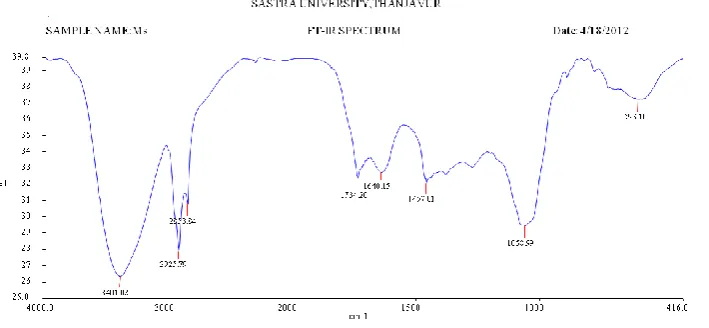
Fourier transform infra red spectroscopy (FTIR) involves the study of the interaction of electromagnetic radiation with matter. Due to this interaction, electromagnetic radiation characteristic of the interacting system may be absorbed (or emitted). The experimental data consist of the nature (frequency of wave length) and the amount (intensity) of the characteristic radiation absorbed or emitted. These data are correlated with the molecular and electronic structure of the substance and with intra- and inter molecular interactions.
www.wjpr.net Vol 4, Issue 07, 2015
714
x axis - Wave length (4000-400)cm-1
y axis - Intensity (abundance) of the signal
Figure I FTIR spectrum of ethanolic extract of (unripe fruit) Musa sapientum
[image:5.595.109.464.90.254.2]Table 1–Functional compounds in FTIR spectrum of ethanolic extract of (unripefruit) Musa sapientum
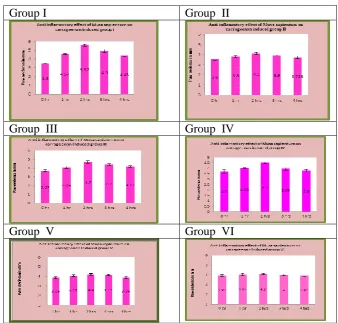
Table 2 shows the ethanolic extract of Musa sapientum produced inhibition of carrageenan-induced paw edema.. The inhibition of paw edema for standard drug treated rats (Group II - treated with indomethacin) at fourth hour after the induction of inflammation with carrageenan was 15 % when compared to negative control (Group I - treated with 0.9% saline) while the other group had inhibition of paw edema by 5.22%, 13.63%, 12.5% and 10.22% respectively for various concentrations of Musa sapientum (100, 200,400, 600 mg/kg b.w). The 200 mg/kg b.w of Musa sapientum exhibited most significant anti-inflammatory effect in Carrageenan induced paw oedema when compared with other concentrations.
S.NO wave length (cm -1) Vibration Type Functional compound
1 3401.02 Hydrogen-bonded O-H
Stretch Phenols & Alcohols
2 2925.79 Hydrogen-bonded O-H
Stretch Carboxylic acids
3 2853.84 Hydrogen-bonded O-H
Stretch Carboxylic acids
5 1734.20 C=O Stretch Ketones
6 1457.01 N- H Bend Amines - Secondary
7 1058.99 C-O Stretch Esters and Ethers
www.wjpr.net Vol 4, Issue 07, 2015
715 Table 2 - Inhibition of inflammation by the ethanolic extract of (unripfruit) Musa sapientum on Carrageenan induced left hind rat paw oedema.
Data expressed as mean ± SE(n=6). Statistical analysis by One-way ANOVA followed by
Dunnet's Multiple Comparison P*<0.05, P** <0.01 compared to Group I (Negative
Control).Group I – Negative control; Group II- indomethacin treated control; Group
III-Musa sapientum 100 mg/kg bw; Group IV- III-Musa sapientum 200 mg/kg bw; Group V- III-Musa
[image:6.595.66.535.115.261.2]sapientum 400 mg/kg bw; Group VI- Musa sapientum 600 mg/kg bw.
Figure II Anti-inflammatory effect of Musa sapientum on carrageenan induced groups Treatment Dosage mg/kg
Reaction time in mm for 4 hours
0 hour 1 hour 2 hour 3 hour 4 hour
Group-I - 3.52±0.05 4.57±0.17 5.57±0.17 4.9±0.07 4.4±0.02 Group-II 10 3.60±0.08* 3.8±0.08* 4.1±0.08* 3.9±0.08* 3.72±0.12* Group-III 100 3.67±0.12* 4.05±0.12* 4.7±0.14* 4.4±0.08* 4.17±0.05* Group-IV 200 3.70±0.18* 4.05±0.05* 4.5±0.08* 3.95±0.12* 3.8±0.08* Group- V 400 3.85±0.1* 4.05±0.12* 4.2±0.08* 4.12±0.09* 3.85±0.12* Group - VI 600 3.95±0.12* 4.05±0.012* 4.1±0.08* 4.0±0.08* 3.95±0.19*
Group I Group II
Group III Group IV
[image:6.595.127.466.392.715.2]www.wjpr.net Vol 4, Issue 07, 2015
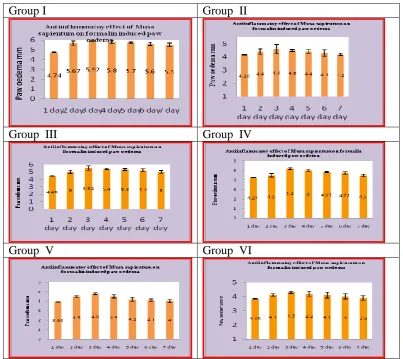
716 Table 3 shows the ethanolic extract of Musa sapientum produced inhibition of formalin induced paw edema both in acute and chronic inflammation. On third day the inflammatory inhibition for ethanolic extract of Musa sapientum at the dosage of 100,200,400,600 mg/kg b.w was 6.75%, 12%, 18.9%, 27.36% respectively. At the end of the experiment, on seventh day the inhibition at the dosage of 100,200.400,600 mg/kg b.w was 9%, 18.18%, 27.27% and 29.09% respectively while standard drug indomethacin treated rats exhibited 23.63% of inhibition. 600 mg/kg b.w of Musa sapientum exhibited most significant anti-inflammatory effect in formalin induced paw edema both in acute and chronic inflammation.
Table 3 - Inhibition of inflammation by the ethanolic extract of (unripefruit) Musa sapientum on Formalin induced groups
Group I – Negative control; Group II- indomethacin treated control; Group III-Musa
sapientum 100 mg/kg bw; Group IV- Musa sapientum 200 mg/kg bw; Group V- Musa
sapientum 400 mg/kg bw; Group VI- Musa sapientum 600 mg/kg bw
Data expressed as mean ± SE(n=6). Statistical analysis by One-way ANOVA followed by
Dunnet's Multiple Comparison P*<0.05, P** <0.01 compared to Group I (Negative
Control).
Treatment Dosage mg/Kg
Reaction time in mm for 7 Days
1 2 3 4 5 6 7
www.wjpr.net Vol 4, Issue 07, 2015
[image:8.595.96.500.77.436.2]717 Figure III Anti- inflammatory effect of ethanolic extract of (unripe fruit) Musa sapientum on Formalin induced groups
Table 4 - Inhibition of inflammation by the ethanolic extract of (unripefruit) Musa sapientum on Cotton pellet granuloma in rats
Group I – Negative control; Group II- indomethacin treated control; Group III-Musa
sapientum 100 mg/kg bw; Group IV- Musa sapientum 200 mg/kg bw; Group V- Musa
sapientum 400 mg/kg bw; Group VI- Musa sapientum 600 mg/kg bw.
Group I Group II
Group III Group IV
Group V Group VI
Control Dose mg/Kg Granuloma Tissue
Weight (mg)
Inhibition %
Group 1 - 21.5 ± 1.3 -
Group 2 10 15.25 ± 0.95* 29
Group 3 100 21 ± 0.8* 2.3
Group 4 200 18 ± 1.4* 16.2
Group 5 400 16.75 ± 0.95* 22
[image:8.595.117.484.547.675.2]www.wjpr.net Vol 4, Issue 07, 2015
718
Data expressed as mean ± SE(n=6). Statistical analysis by One-way ANOVA followed by
Dunnet's Multiple Comparison P*<0.05, P** <0.01 compared to Group I (Negative
Control).
Fig IV Anti-inflammatory effect of ethanolic extract of Musa sapientum on cotton pellet granuloma in rats
The anti-inflammatory effect of Musa sapientum was calculated depending on the wet and dry weight of cotton pellets. The different dosage of plant extracts (100,200,400, 600 mg/kg b.w) showed inhibition in wet and dry weights of cotton pellet granuloma. Musa sapientum
exhibited 29%, 2.3% 16.2% and 22% of inhibition in wet and dry weights of granuloma, respectively. Inhibition exhibited by 600 mg/kg b.w of Musa sapientum(27.9%) was comparable with standard drug indomethacin (29%) (Table4 ).
Natural products are in great demand owing to their extensive biological properties and bioactive components which have proved to be useful against large number of diseases. It is proved that ethanolic extracts of Musa sapientum showed wide array of activities like antibacterial, antioxidative and antihaemolytic.
Saponins possess immunomodulatory, anti-inflammatory and vasoprotective effects which could have aided the observed anti-ulcer activity of Musa sapientum (Borrelli and Izzo, 2000) Alkaloids have equally been reported to achieve dose dependent prevention of ulcer formation, decreased acid secretion, total inhibition of gastric and duodenal ulcers and even healed chronic acetic acid-induced ulcers.Glycosides have been reported antidiarrhoeal effect may be due to the action of inhibits the release of autacoids and prostaglandins(Tiwari et al.,
www.wjpr.net Vol 4, Issue 07, 2015
719 2005) .In the present study the effect of the extract on prostaglandin biosynthesis was not evaluated.
It may also be proposed that the decrease in ulcer severity by Aloe vera may be attributed to its active ingredients with gastric protective nature .The phytochemical analysis revealed the presence of tannins,saponins and flavonoids. (Rajasekaran et al., 2005a).These substances known to affect the integrity of mucous membrane (Oliver ,1960). Tannins are known to protect the outermost layer of mucosa and to render it less permeable and more resistant to chemicals and mechanical injury or irritation and thus prevent ulcer development. Natural products are in great demand owing to their extensive biological properties and bioactive components which have proved to be useful against large number of diseases. It is proved that ethanolic extracts of Musa sapientum showed wide array of activities like antibacterial, antioxidative and antihaemolytic.
It is well documented that flavonoids are the polyphenolic compounds which showed potential beneficial effects on human health and posses antiviral, ant-inflammatory, antitumour, antihaemolytic and antioxidative activity (Buhler and Miranda, 2000). Nature of flavonoids, polyphenols and catechols can be explained by oxidative antioxidative mechanism of various toxicants and antioxidants interaction. . Anti H. pylori effect of fruits of cashew also investigated (Kubo et al.,1999). Phytochemical investigation shows the presence of various flavonoids, mainly quercetin glycosides and saponins in ethanol extract. Flavonoid are free radical scavengers, plays important role in gastric ulcer also an increase mucosal prostaglandin content and decrease in histamine secretion from mast cells by the inhibition of histidine decarboxylase(Borrelli and Izzo, 2000) . Quercetin was also found to prevent gastric mucosal lesions (Martin et al., 1993). Various saponins also found to possess antiulcer activity (Hounget al., 1998, Matsuda et al., 1998) .
CONCLUSION
FTIR analysis revealed that presence of functional compounds has promising anti-inflammatory activity. The ethanolic extract of unripe Musa sapientum studies were carried out on three different methods of anti-inflammation. The carageenan induced rat paw oedema shows that 200mg/kg b.w of extract exhibited most significant anti-inflammatory effect.Other studies such as formaldehyde induced rat paw oedema and cotton pellet granuloma methods revealed that increasing concentration of ethanolic extract of unripe Musa sapientum
www.wjpr.net Vol 4, Issue 07, 2015
720 inflammation when compared to standard drug. Thus,EEMS could be a better choice in the treatment of inflammation with concurrent peptic ulcer.
REFERENCES
1. Ajayi IA, Ajibade O,Oderinde RA. Preliminary Phytochemical Analysis of some Plant Seeds.Res J.Chem.Sci, 2011; 1(3): 5 8-62.
2. Bao F, John SM, Chen Y, Mathison RD, Weaver LC. The tripeptide phenylalanine glutamate-glycine modulates leukocyte infiltration and oxidative damage in rat. Neuroscience, 2006; 140(3): 1011- 1022.
3. Bolanle AO, Funmilola AS and Adedayo A. Proximate Analysis, Mineral Contents, Amino Acid Composition, Anti-Nutrients and Phytochemical Screening of
Brachystegiaeurycoma harms and Pipperguineenseschumand Thonn.American Journal of Food andNutrition, 2014; 2(1): 11-17.
4. Borrelli F,Izzo AA.The Plant Kingdom as a Source of Anti-ulcer Remedies Review Article.Phytother.Res , 2000; 14: 581–591.
5. Buhler DR, Miranda C. A net article: Antioxidant activities of Flavonoids, 2000;Department of Environmental and Molecular Toxicology, Oregon State University. 6. Coe F, Anderson GJ.Ethnobotany of the Sumu (Ulwa) of southeastern Nicaragua and
comparisons with Miskitu plant lore.Econ. Bot.,1999; 53: 363-383.
7. Dharmasiri MG, Jayakody JRAC, Galhena G, Liyanage SSP,Ratnasooriya WD. Anti-inflammatory and analgesic activities of mature fresh leaves of VitexNegundo. Journal of Ethno-pharmacology, 2003; 87: 199- 206.
8. Duke JA. Promising phytomedicinals Advances in newcrops Janick J and Simon JE (eds.) Timber Press Portland, 1990; 491-498.
9. Edeoga1 HO, Okwu DE,Mbaebie BO. Phytochemical constituents of some Nigerian medicinal plants.African Journal of Biotechnology, 2005; 4(7): 685-688.
10.Ghani A. (2003). Medicinal Plants of Bangladesh: Chemical Constituents and Uses 2nd Ed. The Asiatic Society of Bangladesh 315.
11.Haiping Li, Xiaoxiang Lu, Shuhai Zhang, Meijun Lu, HongmeiLiu.Anti-Inflammatory Activity of Polysaccharide from Pholiotanameko.Biochemistry (Moscow), 2008; 73(6): 669-675.
www.wjpr.net Vol 4, Issue 07, 2015
721 13.Khare CP. (2007) (Ed.) Indian Medicinal Plants, Springer Science+BusinessMedia, New
York USA 426.
14.Kubo J , Lee JR , Kubo I .Anti-Helicobacter pylori agents from the cashew apple. J.Agri. Food Chem., 1999; 47: 533- 37.
15.Martin GR, Wallace JL. Gastrointestinal inflammation: a central component of mucosal defense and repair.Exp. Biol. Med., 2006; 231: 130–137.
16.Martin MJ,Motilva V, de la Lastra AC. Quercetin and naringenin: Effects on ulcer formation and gastric secretion in rats.Phytother. Res., 1993; 7: 150-53.
17.Matsuda H, Li Y, Murakami T, Yamahara J, Yoshikawa M. Protective effects of oleanolic acid oligoglycosides on etanol- or indomethacin-induced gastric mucosal lesion in rats. Life Sci., 1998; 63: 245-50.
18.Niv Y, Fraser GM.The alkaline tide phenomenon.J.Clin. Gastroenterol., 2002; 35: 5-8. 19.Nyquist RA,Kagel RO. Infrared Spectra of inorganic compounds,1997; Academic Press
Michigan USA.
20.Oliver B. Medicinal plants in Nigeria Ibadan :Nigerian College of Arts and Science and Technology.1960.
21.RajasekaranSK,Sivagnanam K, Subramanian S. Antioxidant effect of Aloe vera gel extract in streptozocin-induced diabetes in rats.Pharmacol. Rep., 2005; 57: 90-96.
22.Sosa S, Balick MJ, Arvigo R, EspositoRG, Pizza C, Altinier G. Aurelia Tubaro Screening of the topical anti-inflammatory activity of some Central American plants. J. Ethnopharmacol., 2002; 81(2): 211-215.
23.Suleyman H, Demirezer LO, Kuruuzum A, Banoglu ZN, Gocer F,Ozbakir G.Anti-inflammatory effect of aqueous extract from Rumexpatientia L, roots. Journal of Ethanopharmacology, 1999; 65: 141-148.
24.Tiwari P, Kumar B, Kaur M, Kaur G, Kaur H. Phytochemical screening and Extraction: A Review.Int. pharmaceuticasciencia., 2011; 1(1): 98-106.
25.Vyawahare NS, Deshmukh VV, GadkariMR,Kagathara VG. Plants with Antiulcer Activity .Pharmacognosy Reviews, 2009; 3(5): 118-125.