PREPARATION, FORMULATION AND
IN VITRO
EVALUATION OF
SUSTAINED RELEASE ZOLMITRIPTAN TABLETS BY USING
NATURAL POLYMERS
D. Uma Sankar*, Madhuri Latha Thadanki and P. Lavanya
Avanthi Institute of Pharmaceutical Sciences, Gunthapally(V), Abdullapur met (M),
Rangareddy District, Telangana.
ABSTRACT
The objective of the present study was preparation, formulation and in
vitro evaluation of sustained release Zolmitriptan tablets by using
natural polymers. The basic rationale of SR is to alter the
pharmacokinetics and pharmaco dynamics of pharmacologically active
moieties by using novel drug delivery system or modifying the
molecular structure and or physiological parameters inherent in a
selected route of administration. Administration of a drug in a
conventional dosage form [except via intravenous infusion at a
constant rate] often results in 'see – saw' pattern of drug concentration
in the systemic circulation and tissue compartments. Zolmitriptan is an
anti migraine drug and has a short half life of 3hr. The objective of the
present work was formulating a sustained release dosage form of Zolmitriptan by using
different percentages and grades of release rate controlling polymers like Ethyl cellulose,
Sodium alginate, Sodium carboxy methyl cellulose (10%,15%,20% respectively) by direct
compression method. The present study was concerned with the development of the sustained
release matrix tablets, which after oral administration were designed to prolong the duration
of action. Different percentages of ethyl cellulose 20% was associated with decrease in the
overall cumulative drug release rate, the higher viscosity polymer had seen to inhibit the
initial burst release of Zolmitriptan. All the prepared formulations were evaluated for
thickness, hardness, friability, weight variation and in-vitro drug release. Thus, we conclude
that from among all the developed formulations F7 formulation controls the drug release for
longer period of time over 8hrs when compare to other formulations. The physicochemical
evaluation of the prepared tablets was found within the standards of Pharmacopoeia limits.
Volume 5, Issue 12, 750-760. Research Article ISSN 2277– 7105
*Corresponding Author
D. Uma Sankar
Avanthi Institute of
Pharmaceutical Sciences,
Gunthapally(V), Abdullapur
met (M), Rangareddy
District, Telangana.
Article Received on 13 Oct. 2016,
Revised on 04 Nov. 2016, Accepted on 24 Nov. 2016
KEYWORDS: Zolmitritan, sustain release, pharmacokinetic parameters, Pharmacopoeia limits.
INTRODUCTION
Zolmitriptan is an anti migraine medication and should not be used to relieve any kind of pain
other than Migraine.[1,2] Many people find that their Migraines go away completely after they
take Zolmitriptan. Other people find that their Migraines are much less painful, and that they
are able to go back to their normal activities even though their Migraines are not completely
gone. Zolmitriptan often relieves symptoms that occur together with Migraine pain, such as
nausea, vomiting, sensitivity to light, and sensitivity to sound.[3,4] It has short biological half
life of 3hrs. (Zolmitriptan) is an oral selective 5-hydroxytryptamine (5-HT) receptor agonist
that binds to human recombinant 5-HT receptors. It is thought that migraine symptoms are
due to local cranial vasodilatation and/or to the release of sensory neuropeptides through
nerve endings in the trigeminal system. The therapeutic effects of Zolmitriptan are most
likely due to the agonistic effects at the 5-HT receptors on intracranial blood vessels and
sensory nerves of the trigeminal system, which result in cranial vessel constriction and
inhibition of pro-inflammatory neuropeptide release.[5,6]
MATERIALS
Zolmitriptan was obtained as gift sample from Aurobindo Pharma Pvt. Ltd., Ethyl cellulose
and sodium alginate was obtained from orchid pharma private limited, Hyderabad,Aerosil
(colloidal silicon dioxide) was obtained from Accord labs, Sodium carboxy methyl cellulose
was obtained from Meenaxy Pharma Pvt. Ltd, Qutbullapur, Hyderabad. Magnesium stearate,
micro crystalline cellulose (MCC) was obtained from Qualigens Fine Chemicals, Mumbai.
METHODS
Pre-compression studies[7,8,9,25] a. Bulk and tapped density
The bulk and tapped densities were measured in a 10 ml graduated measuring cylinder to
measure pack ability of the powdered mass. The sample contained in the measuring cylinder
was tapped mechanically by means of constant velocity rotating cam with change in its initial
bulk density to a final tapped density when it has attained its most stable form. Each
experiment was carried out in triplicate. The bulk and tapped density can be determined and
Bulk density = Weight of the powder / Bulk volume of the powder.
Tapped density = Weight of the powder / Tapped volume of the powder.
b. Angle of repose
The flow properties were investigated by measuring the angle of repose using fixed-base cone
method to assess the flow ability. In this method, a funnel was secured which is fixed at 6 cm
height (H) above the graph paper that was placed on a flat horizontal surface. Blend were
carefully poured through the funnel until the apex of the conical pile just touched the tip of
the funnel. Measure the height of the a pile (H) and the radius of the base(r) with ruler. The
angle of repose was determined by using the equation, and reported in (Table no.2)
Tan θ= H/R or θ= Tan-1 H/R
Where, θ= angle of repose,
R = radius of the base of pile
H = height of pile
c. Carr’s Index
It can be calculated by using the formula
Tapped density – Bulk density
Carr‟s index (%) = --- X 100 Tapped density
d. Hausner’s Ratio It can be calculated by using the formula. Hausner‟s ratio = Tapped density / Bulk density
e. Bulkiness
Specific bulk volume or reciprocal of bulk density is called as the bulkiness.
Bulkiness = 1/ Bulk density.
f. Percentage yield
It is calculated by using following formula.
Practical yield/theoretical yield × 100.
Compression studies[10,11,12,13,24]
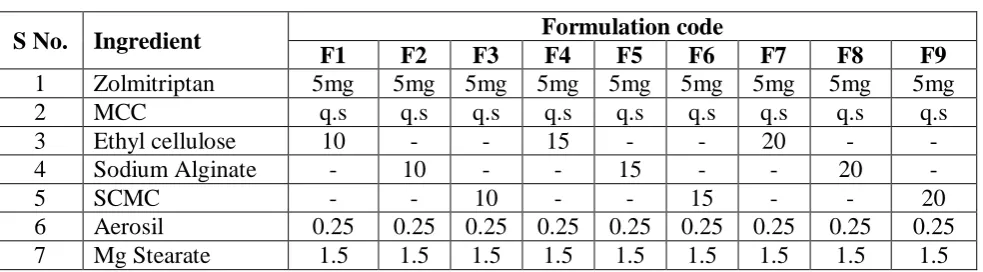
Composition of matrix tablets of Zolmitriptan with 3 polymers in 10%, 15%, 20%. (Total
Table no.1
S No. Ingredient Formulation code
F1 F2 F3 F4 F5 F6 F7 F8 F9
1 Zolmitriptan 5mg 5mg 5mg 5mg 5mg 5mg 5mg 5mg 5mg
2 MCC q.s q.s q.s q.s q.s q.s q.s q.s q.s
3 Ethyl cellulose 10 - - 15 - - 20 - -
4 Sodium Alginate - 10 - - 15 - - 20 -
5 SCMC - - 10 - - 15 - - 20
6 Aerosil 0.25 0.25 0.25 0.25 0.25 0.25 0.25 0.25 0.25
7 Mg Stearate 1.5 1.5 1.5 1.5 1.5 1.5 1.5 1.5 1.5
Post-Compression studies[14,15,16,17,24] 1] Thickness
The thickness of the tablets was determined using Vernier Callipers. Five tablets from each
batch were used and average values were calculated and are shown in table no.3.
2] Hardness
For each formulation, the hardness of 5 tablets was determined using the Monsanto hardness
tester (Cadmach, Ahmedabad, India) and average of values was found out in Table no.3.
3) Friability
Previously weighed 10 tablets were taken in a friabilator (Remi Electronics, Mumbai, India)
and the friability was checked at 25 rpm for 4 minutes. The friability of formulations are
given in table no.3
4). Weight variation test
Twenty tablets were selected randomly and weighed and average weight was determined and
given in table no.3
5] Drug content uniformity estimation
Drug content uniformity was done by taking 100 mg of pure drug with simulated gastric and
In vitro EVALUATION OF TABLETS[18,19,20]
In vitro dissolution of Zolmitriptan tablets was studied in USP XXII dissolution apparatus
(Labindia) employing a paddle stirrer at 75 rpm. 900 ml of 1.2 PH buffer was used as
dissolution medium for the first 2 hours later 900 ml of 7.4 PH phosphate buffer was used for
5 hours. The temperature of the dissolution medium was maintained at 37±0.5ºC throughout
the experiment. One tablet was used in each test. 5 ml of the sample of pre filtered dissolution
medium was withdrawn known intervals of time (1 hour) and maintained sink conditions.
The sample was analyzed for drug release by measuring the absorbance at 289 nm using
UV-visible spectrophotometer after suitable dilutions. The study was conducted in triplicate and
the result were given in the table no.4.
ANALYSIS OF RELEASE DATA[21,22,23,24]
In order to elucidate the model and mechanism of drug release, the in vitro drug release data
was transformed and interpreted at graphical interface constructed using various kinetic
models. The in vitro release data obtained from microspheres formulation in 7.2 pH
phosphate buffer was fitted to various kinetic models. The results were shown in table no.5
and fig.1. The kinetic and the release mechanisms were estimated by Regression plots for
Zero order, First order, Higuchi model and Koresmeyer Peppas model When the R2 values of
regression plots for First order and Zero order were considered, it is evident that the drug
release from all formulations, follow Zero order release kinetics. By incorporating release
data in Higuchi and Kores Meyer Peppas model, the R2 value of F4 and F6 is greater. To
further confirm the exact mechanism of drug release, the data was incorporated in to Kores
Meyer Peppas model and the mechanism of drug release was indicated according to value of
release exponent „n‟.
RESULTS AND DISCUSSION PRECOMPRESSION RESULTS Table no.2
Formulation Code
Angle of repose
Bulk
density Bulkiness
Tapped density
Compressi bility index
Hausner’s
ratio %yield
F1 26.38±0.32 0.31±0.52 3.15±0.53 0.43±0.7 19.23±0.12 1.18±0.14 97.82±0.12
F2 27.14±0.41 0.21±0.39 3.43±0.43 0.33±0.21 22.64±0.72 1.19±0.41 99.64±0.13
F3 26.85±0.82 0.37±0.64 3.25±0.80 0.44±0.68 20.34±0.43 1.13±0.78 98.45±0.25
F4 29.12±0.56 0.32±0.92 3.06±0.45 0,38±0.63 19.23±0.98 1.17±0.73 99.22±0.31
F5 28.47±0.91 0.28±0.23 3.49±0.68 0.35±0.12 17.30±0.45 1.19±0.89 97.84±0.11
F6 26.96±0.39 0.30±0.65 3.25±0.45 0.34±0.45 22.00±0.44 1.16±0.71 98.30±0.23
F8 26.38±0.52 0.44±0.22 2.27±0.39 0.38±0.99 16.98±0.81 1.15±0.45 99.19±0.11
F9 26.54±0.76 0.31±0.89 3.16±0.54 0.35±0.11 19.6±0.19 1.14±0.51 98.89±0.45
All values represent mean standard deviation (SD) n=3.
[image:6.595.143.459.373.555.2]POST-COMPRESSION RESULTS Table no.3
All values represent mean standard deviation (SD) n=3.
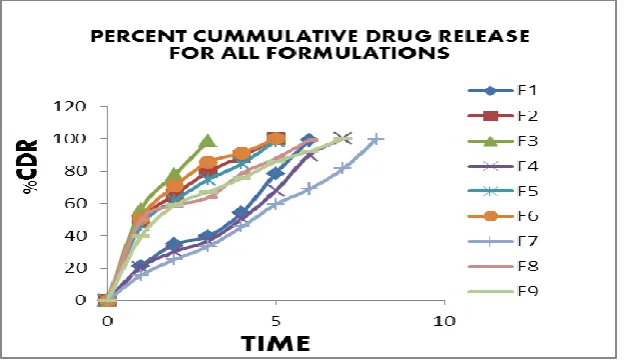
Fig no.1 Formulation
code
Weight variation
Hardness
(Kg/cm2) Friability Thickness
Content uniformity
F1 100±0.61 5.4±0.30 0.72±0.12 3.8±0.02 99.28±0.21
F2 98±0.54 5.3±0.20 0.68±0.08 3.6±0.08 97.16±0.17
F3 99±0.91 5.7±0.25 0.69±0.09 3.7±0.06 101.18±0.14
F4 102±0.58 5.6±0.10 0.66±0.15 3.8±0.04 97.68±0.23
F5 101±0.46 5.7±0.40 0.68±0.14 3.8±0.01 99.41±0.10
F6 98±0.23 5.9±0.25 0.65±0.06 3.6±0.02 98.19±0.17
F7 101±0.53 4.2±0.30 0.67±0.08 3.8±0.04 102.6±0.12
F8 99±0.42 4.1±0.10 0.68±0.16 3.8±0.06 99.31±0.21
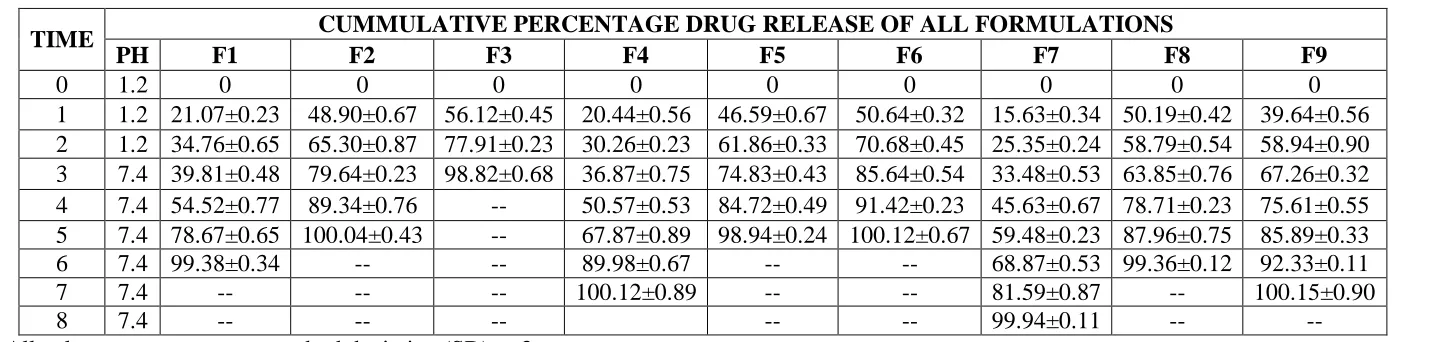
IN VITRO DRUG RELEASE PROFILE OF ALL FORMULATIONS
Table no.4.
All values represent mean standard deviation (SD) n=3.
RELEASE KINETICS STUDIES OF ALL THE FORMULATION Table no.5
MODEL NAME
FORMULATION CODE
F1 F2 F3 F4 F5 F6 F7 F8 F9
Zero Order(R2) 0.972 0.887 0.928 0.989 0.904 0.854 0.993 0.873 0.886
First Order(R2) 0.701 0.567 0.698 0.695 0.575 0.556 0.708 0.519 0.511
Higuchi (R2) 0.873 0.999 0.998 0.885 0.996 0.990 0.902 0.980 0.996
Kores Meyer
Peppas (n) 0.636 0.459 0.401 0.669 0.465 0.452 0.724 0.456 0.502
TIME CUMMULATIVE PERCENTAGE DRUG RELEASE OF ALL FORMULATIONS
PH F1 F2 F3 F4 F5 F6 F7 F8 F9
0 1.2 0 0 0 0 0 0 0 0 0
1 1.2 21.07±0.23 48.90±0.67 56.12±0.45 20.44±0.56 46.59±0.67 50.64±0.32 15.63±0.34 50.19±0.42 39.64±0.56 2 1.2 34.76±0.65 65.30±0.87 77.91±0.23 30.26±0.23 61.86±0.33 70.68±0.45 25.35±0.24 58.79±0.54 58.94±0.90 3 7.4 39.81±0.48 79.64±0.23 98.82±0.68 36.87±0.75 74.83±0.43 85.64±0.54 33.48±0.53 63.85±0.76 67.26±0.32
4 7.4 54.52±0.77 89.34±0.76 -- 50.57±0.53 84.72±0.49 91.42±0.23 45.63±0.67 78.71±0.23 75.61±0.55
5 7.4 78.67±0.65 100.04±0.43 -- 67.87±0.89 98.94±0.24 100.12±0.67 59.48±0.23 87.96±0.75 85.89±0.33
6 7.4 99.38±0.34 -- -- 89.98±0.67 -- -- 68.87±0.53 99.36±0.12 92.33±0.11
7 7.4 -- -- -- 100.12±0.89 -- -- 81.59±0.87 -- 100.15±0.90
Sustained release matrix tablets were prepared by using various natural polymers like ethyl
cellulose, sodium alginate, sodium carboxy methyl cellulose. All the prepared tablets were
subjected to various pre-compression parameters like Angle of repose, Bulkdensity, Tapped
density, Carr‟s index, Hausner‟s ratio, Bulkiness and percentage yield. The values of Angle
of repose ranged from 26-29°.The values of bulk density ranged from 0.21-0.44g/c.c and the
values of tapped density ranged from 0.33-0.44g/c.c (Table no.2).The flow properties of the
powdered blend were further confirmed by determining Carr‟s index, bulkiness and Hausner‟s ratio. The Carr‟s index values bulkiness and Hausner‟s ratio values ranged
from16-23, 3.06-3.49 and 1.14-1.19 respectively. The percentage yields of all tablets were
within the range of 97-98%. (Table no.2)Thus the tablets indicating all the values were within
the limits as per U.S.P.
Further the tablets were subjected to evaluation of various compression parameters like
weight variation, hardness, thickness, content uniformity and friability. The values of weight
variation, hardness and thickness ranges from 98-102, 4.1-5.9 kg/cm2,3.6-3.8 respectively.
Further the tablets were subjected to content uniformity and friability whose values ranges
from 97-102% and 0.66-0.72 respectively.
The in vitro release studies of sustain release tablets were carried out at 37±0.5°C and 75
rpm using 0.1N HCL (900 ml) for 2 hrs and followed by phosphate buffer pH 7.4 (900 ml) in
a USP dissolution apparatus type Π (Lab India) under sink conditions. The cumulative
percentage drug release for formulations containing different polymers were shown in (Table
no.4) and (Fig.1). The formulations(F1-F9) released 99.38±0.334 in 6hrs, 100.04±0.43 in 5
hrs, 98.82±0.63 in 3hrs, 100.12± 0.89 in 7 hrs,98.94±0.24 in 5 hrs, 100.12±0.67 in 5hrs
99.94±0.11 in 8 hrs, 99.36.12±0.12 in 6hrs100.15±0.15 in 7 hrs respectively.
The in vitro release data obtained from microspheres formulation in 6.8 pH phosphate buffer
was fitted to various kinetic models. The kinetic and the release mechanisms were estimated
by Regression plots for Zero order. First order, Higuchi model and Kores Meyer Peppas
model. When the R2 values of regression plots for First order and Zero order were considered,
it is evident that the drug release from all formulations, follow Zero order release kinetics.
The Higuchi square root model shows hi R2 values for batch F7 (R2 = 0.902). The Higuchi
square root model shows indicates that the drug released by diffusion and slope of Korse
does not change over time and the release is characterized by zero order. According to above
results, it was concluded that, the best formulation, i.e., F7 formulation.
CONCLUSION
Zolmitriptan is an anti migraine drug and has a short half life of 3hr,therefore the present
investigation was concerned with the development of the sustained release matrix tablets,
which after oral administration were designed to prolong the duration of action. Various
formulations were develop by using release rate controlling polymers like EC, SA,
SCMC(10%15%20%) in single by direct compression method. All the prepared formulations
were evaluated for thickness, hardness, friability, weight variation and drug and in-vitro
release. Thus we conclude that from among all the developed formulations F7 formulation
controls the drug release for longer period of time over 8hr when compare to other
formulations. The physicochemical evaluation of the prepared tablets was found within the
standards Pharmacopoeia limits.
REFERENCES
1. Enayatifard R, Saudi M, Akban J and Haeri tabatabaee Y. Effect of hydroxyl propyl
methyl cellulose content on release profile and kinetics of diltiazem hydrochloride from
matrices. Tropical journal of pharmaceutical research, October 2009; 8(5): 425-32.
2. Colombo P., "Swelling controlled release in hydrogel matrices for oral route", Advanced
Drug Delivery Review, 1993; 37: 30.
3. Lachmman L, Liberman HA, Kanig JL. The theory and practice of Industrial Pharmacy,
3rd Edition, Vargheese Publishing House, Bombay, 1991: page 430. Ganesh S,
Radhakrishna M, Ravi M, Prasanna Kumar B, and Kalyani J, “In vitro Evaluation of the
Effect of Combination of Hydrophilic and Hydrophobic Polymers on Controlled Release
Zidovudine Matrix Tablets”, Indian J Pharm Sci, 2008 Jul–Aug; 70(4): 461–65. Ibrahim
M. Bagory, Nahla Brakat, Mahmoud Badry, Mohamed A, Ibrahim and Fouza
El-Enazi, “Effect of polymer blend on diltiazem hydrochloride matrix tablets prepared by direct compression”, Journal of Pharmaceutical Science and Technology, 2010; 2(7):
252-268.
4. Rakesh patel and Ashok Baria, “Formulation development and process optimization of theophylline sustained release matrix tablet”, International Journal of Pharmacy and
5. Khemariya P, Jain A K, Bhargava M, Singhai S K, Goswami S, Goswami R, “Preparation
and In-Vitro Evaluation of Sustained-Release Matrix Tablets of Diltiazem”, International
Journal of advances in Pharmaceutical Sciences, 2010; 1: 267-273.
6. Robinson JR, Lee HL (Ed.). Controlled Drug Delivery: Fundamentals and Applications,
2nd Edition, Marcel Dekker Inc., New York, 1987; 373.
7. Welling P. G. and Dobrinska M. R., .Dosing consideration and bioavailability assessment
of controlled drug delivery system., Chapter 7, Controlled drug delivery; fundamentals
and applications, 2nd edition, Robinson J.R. and Lee V. H. L.(Eds.), Marcel Dekker Inc.,
New York, 1978; 29: 254, 373.
8. Umaunisha A M, Stephen Rathunaraj B, Arunachalam A, Ganesh Shesharao Bangale, Gajanan shande V, Deepak Umalkar G, “Design and evaluation of Famotidine controlled release tablets”, International Journal of Pharmaceutical Sciences, 2010-May-Aug; 2(2):
574-582.
9. Lee T. W. Y. and Robinson J. R., “ Controlled release drug delivery system”, Chapter 47,
Remington: The science and practice of pharmacy, 20th edition, Gennaro A. R. (Ed.),
Mack publishing house, Easton, Pannsylvania, 2000; 903.
10. Ansel C.H., Pharmaceutical Dosage Forms and Drug Delivery Systems., 6th edition, B.I.
Waverly Pvt. Ltd., New Delhi, 1995; 213.
11. Vyas S.P. and Khare R. K., .Controlled Drug Delivery Concept and Advances. 1st edition,
Vallabh Prakashan, New Delhi, 2000; 54: 155.
12. Jain, N. K., (Ed.); Controlled And Novel Drug Delivery, 1st Edition, CBS Publisher and
Distributor, New Delhi, Reprint, 2004; 256.
13. Gudsoorkar V.R. and Rambhau D., "Sustained release of drugs: Part II". The Eastern
Pharmacist, 1993; 36(431): 27.
14. LeeVHL, Robinson JR. Sustained and controlled release drug delivery systems 1978; 6. 15. Gupta P.K., Robinson J.R. “Treatise on Controlled Drug Delivery, Fundamentals,
Optimization Applications” (Agis Kydonieus ed.), Marcel Dekker Inc., 1992; 255-302.
16. Brahmankar D. M. and Jaishwal S. B., Biopharmaceutics and Pharmacokinetics A Trease,
1st edition, Vallabh Prakashan, Delhi, 1995; 335.
17. Kumar R.V. "Scope of biodegradable polymers for controlled drug delivery", Drug. Dev.
Ind. Pharm., 2001; 27(1): 1.
18. Parmar N. S. and Shivprakash, .Biopharmaceutical and pharmacokinetic consideration in
Delivery, 1st edition, Jain N. K. (Ed.), CBS Publisher and Distributor, New Delhi,
1997; 1.
19. Controlled Drug Publication. Indian Pharmacopoeia. 2007; 1: 256-57.
20. Raymond Row C, Paul Sheskey J and Marrian Quinn E, Hand book of pharmaceutical
excipients, The Pharmaceutical Press and American Pharmaceutical Association,
Washington, 2009; 262-266.
21. Raymond Row C, Paul Sheskey J and Marrian Quinn E, Hand book of pharmaceutical
excipients, The Pharmaceutical Press and American Pharmaceutical Association,
Washington, 2009; 364-369.
22. Raymond Row C, Paul Sheskey J and Marrian Quinn E, Hand book of pharmaceutical
excipients, The Pharmaceutical Press and American Pharmaceutical Association,
Washington, 2009; 404-407.
23. Indian Pharmacopoeia (IP), vol II, Published by the controller of publication, Delhi, 470.
24. www.pubmed.com.