ACETOPHENONE BASED MANNICH BASES: SYNTHESIS,
CHARACTERIZATION AND THEIR ANTI-BACTERIAL ACTIVITY
K. Chithra, K. Jayanthi and D. Satheesh*
Department of Chemistry, Loganatha Narayanaswamy Government College, Ponneri –
601204. Tamilnadu, India.
ABSTRACT
Five new Mannich bases, phenyl)-hydrazino]-3-(4-methoxy-phenyl)-1-phenyl-propane-1-one (4a), Dinitro-phenyl)-hydrazino]-1,5-diphenyl-pent-4-en-1-one (4b), (2,4-Dinitro-phenyl)-hydrazino]-1,5-diphenyl-pent-4-en-1-one (4c), 3-[N’-
(2,4-Dinitro-phenyl)-hydrazino]-3-(4-nitro-phenyl)-1-phenyl-propane-1-one (4d), 3-[N’-(2,4-Dinitro-phenyl)-hydrazino]-3-(2-hydroxy-phenyl)-1-phenyl-1-propane-1-one (4e) have been synthesized and characterized by chemical and spectral analyses such as UV-Visible, FT-IR, 1H NMR and 13C NMR. All the synthesized compounds 4a-4e was screened for their antibacterial activities against the Gram-positive bacteria (Staphylococcus aureus and Bacillus species), Gram-negative bacteria (Escherichia coli and Salmonella typhi). Compounds 4c and 4d of the series showed good activities against Bacillus species.
KEYWORDS: Mannich base, Acetophenone, Benzaldehyde derivatives, Cinnamaldehyde.
INTRODUCTION Mannich reaction
The first observation of a condensation of the Mannich reaction was made by Tollens.[1], who
isolated the tertiary amine from ammonium chloride, formaldehyde and acetophenone. The first “Mannich reaction’’ was serendipity in 1912, when Carl Mannich.[2]
, a young professor in the pharmaceutical laboratory at Gottingen University, was treating an acid solution of salicylantipyrine with hexamethylene tetramine (urotropine) for pharmaceutical preparation. He obtained a crystalline precipitate.
Volume 6, Issue 2, 1439-1449. Research Article ISSN 2277– 7105
*Corresponding Author
D. Satheesh
Department of Chemistry,
Loganatha Narayanaswamy
Government College,
Ponneri – 601204.
Tamilnadu, India. Article Received on 20 Dec. 2016,
Revised on 10 Jan. 2017, Accepted on 30 Jan. 2017
Having observed that the same condensation product was also formed by mixing antipyrine, formaldehyde and ammonium chloride, regardless of the order of addition, Mannich realized the great synthesis relevance of the reaction of which only a few examples were then known in literature. Mannich and Kather.[3] treated equivalent amounts of dimethylamine hydrochloride, formaldehyde and antipyrine and the base produced was 4-dimethylaminoantipyrine. Mannich observed that it allowed the linkage of two different chemical moieties in one step by means of a methylenic bridge. He then studies the reaction in considerable depth, assisted by a number of collaborators, and demonstrated products. Mannich bases have been the topic of growing interest as evidenced by the appearance of a reviews.[4-6], books.[7-8] and research papers.[9-12]
Mannich base
The Mannich reaction is the prototype of carbon-carbon bond forming reactions that involves the addition of resonance stabilized carbon nucleophiles to iminium salts and imines. In its original and most widely recognized form, Mannich reaction is a three component condensation of i) ammonia or primary amine or secondary amine.[13] of with amides.[14]; ii) a non-enolisable aldehyde, usually formaldehyde; and iii) a compound containing an active hydrogen.[15] atom (substrate). These three compounds condense with concomitant release of
water to produce a new base known as a Mannich base, in which the active hydrogen is replaced by an aminomethyl group.
The formation of both carbon-carbon and carbon-nitrogen bond in this aminomethylation process makes the Mannich reaction an extremely useful synthetic transformation and it can be illustrated in the following scheme.
Scheme 1: Synthesis of Mannich bases
The Mannich reaction is an important biosynthetic route to natural products, mainly alkaloids. Che et-al.[16] has reported the aminoalkylation of aromatic substrates by the Mannich reaction which is considerable importance for the synthesis and modification of biologically active compounds. It also provides a convenient access to many useful synthetic building blocks because the amino group can be easily converted into a variety of other functionalities.[17]
Mannich bases were found to possess potent activities such as antibacterial.[18], antifungal.[19], anti-HIV.[20], antiviral.[21,22] anticancer.[23], antimicrobial.[24,25] They are also used in polymer industry as paints and surface active agents. Mannich bases demonstrated anticonvulsant activities and have been reported as potential biological agents. They also find application as antitubercular.[26], antimalarial.[27], vasorelaxing.[28], analgesic.[29], anti-convulsant.[30,31] drugs, biological.[32,33] and pharmacological.[34,35] activity.
In the context to the above principle, the present research work was aimed at to synthesize and characterize a series of five new Mannich bases, 3-(4-methoxy-phenyl)-1-phenyl-propane-1-one (4a), 4-en-1-one (4b), 3-[N’-(2,4-Dinitro-phenyl)-hydrazino]-1,5-diphenyl-pent-4-en-1-one (4c), 3-[N’-(2,4-Dinitro-phenyl)-hydrazino]-3-(4-nitro-phenyl)-1-phenyl-propane-1-one (4d), 3-[N’-(2,4-Dinitro-phenyl)-hydrazino]-3-(2-hydroxy-phenyl)-1-phenyl-1-propane-1-one (4e) have been synthesized from acetophenone, 2,4-dinitrophenylhydrazine
and substituted benzaldehydes / cinnamaldehyde. All synthesized Mannich bases have been characterized by chemical and spectral analyses such as UV-Visible, FT-IR, 1H NMR and 13C NMR. All the compounds 4a-4e was screened for their antibacterial activities against the Gram-positive bacteria (Staphylococcus aureus and Bacillus species), Gram-negative bacteria
(Escherichia coli and Salmonella typhi).
MATERIALS AND METHODS
Chemicals: All chemicals and solvents were of reagent grade and were used as commercially purchased without further purification.
Infrared spectra of the compounds were recorded on KBr pellets using a Perkin Elmer RX1-FTIR Spectrophotometer. 1H NMR spectra were recorded on a Bruker Avance spectrometer (500 MHz) at 298 K in CDCl3. Chemical shifts δ in ppm were referenced to the solvent
residual peak as an internal standard. 13C NMR was recorded on a Bruker Avance spectrometer (500 MHz) at 298K in CDCl3 and spectra was referenced to the solvent residual
peak.
Synthesis of 3-[N’-(2,4-Dinitro-phenyl)-hydrazino]-3-(4-methoxy-phenyl)-1-phenyl-propane-1-one (4a)
Ethanolic solution of 2,4-dinitrophenyl hydrazine (1.98 g, 0.01 mole) was added to hydrochloric acid (2.0 ml) in a round bottom flask, stirred for 10 minutes and then added minimum amount of ethanolic solution of acetophenone (1.2 ml, 0.01 mole). 0.01 mole of ethnolic solution of 4-methoxy benzaldehyde (1.10 ml, 0.01 mole) was added slowly to the reaction mixture with constant stirring. The reaction mixture was stirred at room temperature for two hours (Scheme 2). The obtained precipitate was washed with diethyl ether and dried
in vacuo. The product was recrystallized from DMSO. Thin layer chromatography was used
to check the purity of the compounds. Brown crystal, yield 84.78% (3.7006g), Rf = 0.65.
(2,4-Dinitro-phenyl)-hydrazine
NO2
NO2 NH H2N O
NH HN
R
NO2 O2N
O
Acetophenone
O=CH-RHCl -H2O
RT
R= p-CH3O-C6H4-, C6H5-, C6H5-CH=CH, p-NO2-C6H4-, o-OH-C6H4
-Aldehyde(s)
Scheme 2: Synthesis of some new acetophenone based Mannich bases
Synthesis of 3-[N’-(2,4-Dinitro-phenyl)-hydrazino]-1,5-diphenyl-pent-4-en-1-one (4c)
E-3-[N’-(2,4-Dinitro-phenyl)-hydrazino]-1,5-diphenyl-pent-4-en-1-one were synthesized from 1:1:1 ratio of 2,4-dinitrophenylhydrazine (1.98g, 0.01 mole), acetophenone (1.2 ml, 0.01 mole) and cinnamaldehyde (1.05 ml, 0.01 mole) by above mentioned similar manner. Reddish orange crystal, yield 83.47% (3.6099g), Rf = 0.69.
Synthesis of 3-[N’-(2,4-Dinitro-phenyl)-hydrazino]-3-(4-nitro-phenyl)-1-phenyl-propane-1-one (4d)
3-[N’-(2,4-Dinitro-phenyl)-hydrazino]-3-(4-nitro-phenyl)-1-phenyl-propane-1-one were synthesized from 1:1:1 ratio of 2,4-dinitrophenylhydrazine (1.98g, 0.01 mole), acetophenone (1.2 ml, 0.01 mole) and 4-nitrobenzaldehyde (1.51g, 0.01 mole) by above mentioned similar manner. Orange crystal, yield 96.56% (4.3583g), Rf = 0.76.
Synthesis of 3-[N’-(2,4-Dinitro-phenyl)-hydrazino]-3-(2-hydroxy-phenyl)-1-phenyl-1-propane-1-one (4e)
3-[N’-(2,4-Dinitro-phenyl)-hydrazino]-3-(2-hydroxy-phenyl)-1-phenyl-1-propane-1-one were synthesized from 1:1:1 ratio of 2,4-dinitrophenylhydrazine (1.98g, 0.01 mole), acetophenone (1.2 ml, 0.01 mole) and salicylaldehyde (1.15 ml, 0.01 mole) by above mentioned similar manner. Yellow crystal, yield 80.39% (3.3959g), Rf = 0.62.
RESULTS AND DISCUSSION
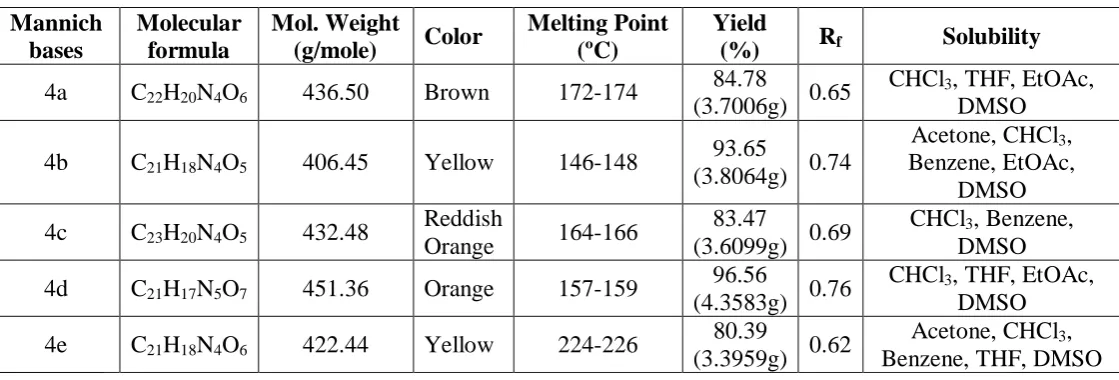
The synthesized Mannich bases were checked by comparing the TLC with the starting materials, which resulted in a single spot different from the starting materials. The synthesis achieved in high yields. The structure of synthesized compounds was confirmed on the basis of analytical studies, UV-Vis., FT-IR, 1H NMR and 13C NMR spectral data. The physical properties, yield, Rf value and solubility are summarized in the Table 1.
UV – Visible and FT-IR spectral data
UV-Visible and FT-IR spectrum of synthesized 4a-e are presented in the Table 2. The UV – Visible spectrum of newly synthesized compounds showed at 282-292 nm. This may be due to π-π * and n-π* transitions of C=C bond and C=O bond in aromatic keto group. A band
shown in the range of 2932-2837 cm-1. The carbonyl stretching frequency is ν(C=O) appeared in the region of 1714-1647cm-1. All the compounds exhibit nitro group within the range of expected values at 1592-1514 cm-1.
Table 1: The physical properties, yield, Rf value and solubility of Mannich bases
Mannich bases
Molecular formula
Mol. Weight
(g/mole) Color
Melting Point (ºC)
Yield
(%) Rf Solubility
4a C22H20N4O6 436.50 Brown 172-174 84.78
(3.7006g) 0.65
CHCl3, THF, EtOAc,
DMSO
4b C21H18N4O5 406.45 Yellow 146-148
93.65
(3.8064g) 0.74
Acetone, CHCl3,
Benzene, EtOAc, DMSO
4c C23H20N4O5 432.48 Reddish
Orange 164-166
83.47
(3.6099g) 0.69
CHCl3, Benzene,
DMSO 4d C21H17N5O7 451.36 Orange 157-159
96.56
(4.3583g) 0.76
CHCl3, THF, EtOAc,
DMSO 4e C21H18N4O6 422.44 Yellow 224-226
80.39
(3.3959g) 0.62
Acetone, CHCl3,
Benzene, THF, DMSO
1
H NMR and 13C NMR spectroscopy
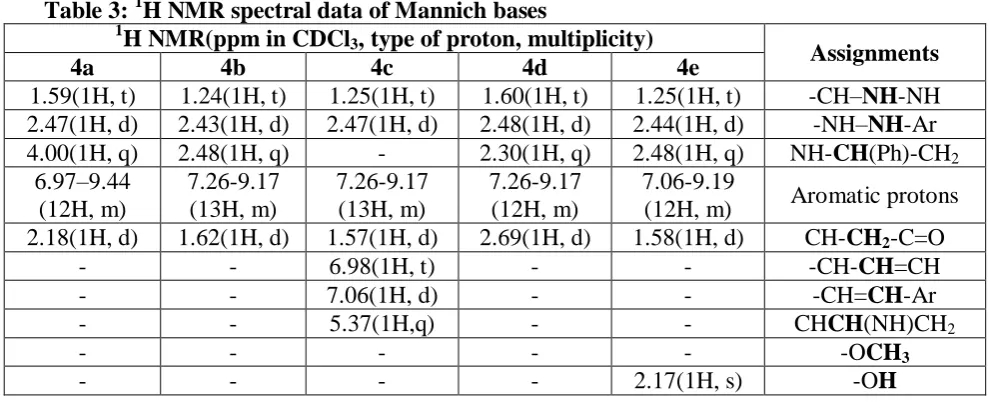
The 1H NMR data of Mannich bases 4a-e are summarized in Table 3 and 13C NMR data in the Table 4.
Table 2: UV-Visible and FT-IR Spectral data of Mannich bases
Mannich bases λmax (nm) λmax (cm) νOH νNH νAr-CH νAli-CH νC=O νNO2
4a 284 35211 - 3328 2941 2838 1714 1590
4b 292 34200 - 3228 2982 2932 1709 1592
4c 284 35211 - 3360 2970 2932 1701 1514
4d 282 35461 - 3330 2942 2837 1708 1591
4e 291 34364 3426 3311 3060 2851 1647 1543
1
H NMR and 13C NMR spectrum of 4a
The Mannich base showed a multiplet at δ 9.44-6.97 (12 H), which is due to phenyl protons. The quartet at δ 4.00 (1H) which is assigned to N-CH-CH2 proton. A singlet at δ 3.89 (3H) is
assigned to O-CH3 protons. The doublet at δ 2.47 (1H), is assigned to NH-NH-Ph proton.
The doublet at δ 2.18 (2H), is assigned CH-CH2-CO protons. The triplet at δ 1.59 (1H), is
assigned to CH-NH-NH proton. The 13C NMR spectrum showed the peak at δ 201.5 was assigned to carbonyl group (C=O). The peak obtained in the region δ 155.22 showed the
presence of –C-O-CH3 group. The phenyl ring carbons show its range δ 114.5 – 152.35. The
obtained in the region δ 55.51 showed the presence of aliphatic –CH2group. The peak
obtained in the region δ 77.28 shows the presence of aliphatic O–CH3 group.
1
H NMR and 13C NMR spectrum of 4b
The Mannich base observed a multiplet at δ 7.26-9.17 (13H). This may be due to phenyl protons. The quartet at δ 2.48 (1H), which is assigned to N-CH-CH2 proton. The doublet at δ
2.43 (1H), is assigned to NH-NH-Ph proton. The doublet at δ 1.62 (2 H), is assigned CH-CH2-CO protons. The triplet at δ 1.24 (1H), is assigned to CH-NH-NH proton. The 13C NMR
spectrum showed the peak at δ 207.22 was assigned to carbonyl group (C=O). The phenyl ring carbons show its range δ 108.00 – 147.89. The peak obtained in the region δ 91.54
showed the presence of aliphatic –CH group. The peak obtained in the region δ 77.02 shows the presence of aliphatic –CH2 group.
1
H NMR and 13C NMR spectrum of 4c
The peak observed a multiplet at δ 7.26-9.17 (13H), which is due to phenyl protons. The doublet at δ 7.06 (1H), is assigned to CH-CH=CH proton. The doublet at δ 6.98 (1H), is
assigned to CH-CH=CH proton. The multiplet at δ 5.37 (1H), is assigned to N-CH-CH2
proton. The doublet at δ 2.47 (1H), is assigned to NH-NH-Ph proton. The doublet atδ 1.57
(2H), is assigned CH-CH2-CO protons. The triplet atδ 1.25 (1H), is assigned to CH-NH-NH
[image:7.595.50.545.571.777.2]proton. The 13C NMR spectrum showed the peak at δ 166.46 was assigned to carbonyl group (C=O). The phenyl ring carbons showed its range δ 116.72 – 152.34. The peak obtained in the region δ 123.49 and 126.52 are shows the presence of aliphatic alkene protons (CH=CH). The peak obtained in the region δ 77.27 showed the presence of aliphatic –CH group. The peak obtained in the region δ 66.70 showed the presence of aliphatic –CH2 group.
Table 3: 1H NMR spectral data of Mannich bases
1
H NMR(ppm in CDCl3, type of proton, multiplicity)
Assignments
4a 4b 4c 4d 4e
1.59(1H, t) 1.24(1H, t) 1.25(1H, t) 1.60(1H, t) 1.25(1H, t) -CH–NH-NH 2.47(1H, d) 2.43(1H, d) 2.47(1H, d) 2.48(1H, d) 2.44(1H, d) -NH–NH-Ar 4.00(1H, q) 2.48(1H, q) - 2.30(1H, q) 2.48(1H, q) NH-CH(Ph)-CH2
6.97–9.44 (12H, m)
7.26-9.17 (13H, m)
7.26-9.17 (13H, m)
7.26-9.17 (12H, m)
7.06-9.19
(12H, m) Aromatic protons 2.18(1H, d) 1.62(1H, d) 1.57(1H, d) 2.69(1H, d) 1.58(1H, d) CH-CH2-C=O
- - 6.98(1H, t) - - -CH-CH=CH
- - 7.06(1H, d) - - -CH=CH-Ar
- - 5.37(1H,q) - - CHCH(NH)CH2
- - - -OCH3
1
H NMR and 13C NMR spectrum of 4d
The peak observed a multiplet at δ 7.26-9.17 (12H). This may be due to phenyl protons. The quartet at δ 2.30 (1H), is assigned to N-CH-CH2 proton. The doublet at δ 2.48 (1H), is
assigned to NH-NH-Ph proton. The doublet atδ 2.69 (2H), is assigned CH-CH2-CO protons.
The triplet atδ 1.60 (1H), is assigned to CH-NH-NH proton. The spectrum observed the peak at δ 190.26 was assigned to carbonyl group (C=O). The phenyl ring carbons show its range δ
116.78 – 140.05. The peak obtained in the region δ 77.25 showed the presence of aliphatic – CH group. The peak obtained in the region δ 76.75 showed the presence of aliphatic –CH2
group.
Table 4: 13C NMR spectral data of Mannich bases
13
C NMR(ppm in CDCl3, multiplicity)
Assignments
4a 4b 4c 4d 4e
201.5 (s) 207.2 (s) 166.4 (s) 190.2 (s) 181.4 (s) -C=O
114.5-152.35(d)
108.0- 147.8 (d)
116.7-152.3(d)
116.7-140.0(d)
113.9-133.0(d)
Aromatic Carbons 76.77 (d) 91.5 (d) 77.27 (d) 77.25 (d) 75.81 (d) HNCH(Ph)CH2
55.51 (t) 77.02 (t) 66.70 (t) 76.75 (t) 57.95 (t) CHCH2CO
77.28 (q) - - - - Ph-OCH3
- - 123.49 (d) - - HNCH=CH
- - 126.52 (d) - - CH=CH-Ph
- - - - 154.4 (s) -C-OH
155.22 (s) - - - - -C-O-CH3
1
H NMR and 13C NMR spectrum of 4e
The peak observed a multiplet at δ 7.06-9.19 (12H), which is due to phenyl protons. The quartet at δ 2.48 (1H), is assigned to N-CH-CH2 proton. The doublet at δ 2.44 (1H), is
assigned to NH-NH-Ph proton. The doublet atδ 1.58 (2H), is assigned CH-CH2-CO protons.
The triplet atδ 1.25 (1H), is assigned to CH-NH-NH proton. A singlet at δ 2.17 (1H), is
assigned to Ph-OH proton. The 13C NMR spectrum observed the peak at δ 181.40 was assigned to carbonyl group (C=O). The peak obtained in the region δ 154.42 shows the presence of –C-OH group. The phenyl ring carbons showed its range δ 113.97 – 133.01. The peak obtained in the region δ 75.81 shows the presence of aliphatic –CH group. The peak obtained in the region δ 57.95 shows the presence of aliphatic –CH2 group.
Anti – bacterial screening
lawn culture. Prepare the disc and impregnate with the compounds with desired quantity. For well diffusion method, cut the well with 6mm and add the compound solution of desired quantity (50µg). For disc diffusion method, add the compound solution to the sterile disc and make them to dry. After swabbing, place the disc and also add the compound solution in well. Incubate it at 37°C for 24 hours. After incubation, observe the plates for zone of inhibition (Table 5).
Table 5: Anti-bacterial activity of Mannich bases 4a-e
Mannich
basea Method
Inhibition zone (mm)
B. species E. coli S. aureus S. typhi
4a Disc
Well
4b Disc
Well
4c Disc 15 11 11 8
Well 23 11 11 9
4d Disc 20 13
Well 25 18
4e Disc
Well
Vancomycinb Well 21 16 18 20
a -50 µg/ml, b – 30 mg/ml
B. species - Bacillus species, E. coli - Escherichia coli, S. aureus - Staphylococcus aureus
and S. typhi – Salmonella typhi.
CONCLUSION
Five new acetophenone based Mannich bases were synthesized in very good yields. All compounds were characterized by analytical and spectroscopic methods. The compounds 4c and 4d were found to possess very good anti-bacterial activity against Bacillus species
comparedthan vancomycin as standard drug. Compound 4d were found to possess very good anti-bacterial activity against Escherichia coli.
ACKNOWLEDGMENTS
The authors thank the Bharathidasan University, Trichy for their help in carrying out UV-Visible, FT-IR and anti-bacterial studies. The authors also thank the IITM, Madras, for help with NMR spectroscopy.
REFERENCES
2. C. Mannich and N. Krosche, Arch. Pharm., 1912;250: 647. 3. C. Mannich and B. Kather, Arch. Pharm., 1919;18: 257. 4. F.F. Bilke, Org. React., 1942;1: 303.
5. H. Hellmann and G. Optitz, Angew. Chem., 1956;68: 265. 6. M. Tramontini, Synthesis, 1973;703.
7. B. Reichert, ‘Mannich Reaction’, springer-Verlag, Berlin (1959).
8. M. Tramontini and L. Angiolini, ‘Mannich Bases: Chemistry and Uses’. CRC Press London (1994).
9. P. Devi and A. J. Boulton, Synth. Commun. 1995;25: 1839.
10.I. Sougandi, R. Mahalakshmi, R. Kannappan, T. M. Rajendran, R. Venkatesan and P. S. Rao, Transition Met. Chem., 2002;27: 512.
11.S. N. Pandeya, D. Sriram, G. Nath and E. D. Clerq, European J. Med. Chem., 2000;35: 249.
12.M. Abdul Rahiman, B. Kalluraya, H. Balakrishna and C. Jyothi, Indian J. Heterocycl. Chem. 2003;12: 241.
13.R. S. Varma, N. Rastogi and A. P. Singh, Indian J. Heterocycl. Chem., 2002;12: 159. 14.H. Hellmann, Angew. Chem., 1957;69: 463.
15.Jerry March, ‘Advanced Organic Chemistry-Reactions, Mechanisms and Structure’, 4th Edn., Wiley, Interscience, 2001; 900.
16.K. W. Chi, Y. S. Ahn, K. T. Shim. Bull. Korean Chem Soc., 1999;20: 973. 17.A. Pochini, G. Pugila and R. Ungaro, Synthesis, 1983;906.
18.Gabriela Laura Almajan, Stefania-Felicia Barbuceanu, Eva-Ruxandra Almajan, Constantin Draghici, Gabriel Saramet, European J. Med. Chem., 2009; 44: 3083–3089. 19.Seshaiah Krishnan Sridhara, Muniyandy Saravanana, Atmakuru Ramesh, Eur. J. Med.
Chem., 2001; 36: 615–625.
20.Alagarsamy V, Meena S and Revathi R, Indian Pharm. Sci., 2004; 4: 459-462.
21.Pandeya S N, Srirama D, Nath G, DeClercqc E, Eur. J. Pharma. Sci., 1999; 9: 25–31.
22.Verma R S and Nobles W L, J. Pharm. Sci.,1975; 69: 881-882.
23.Shivarama Holla B, Veerendra B, Shivananda M K, Boja Poojary, Eur. J. Med. Chem.,
2003; 38: 759-767.
24.Vijayraghavan S, Somani R R, Shirodhar P Y, V. J, Indian J. Heterocycl. Chem., 2008; 18(2): 137-40.
26.Sheela Joshi, Navita Khosla and Prapti Tiwari, Bioorg. Med. Chem., 2004; 12: 571–6. 27.Ying Li, Zhong-Shun Yang, Hong Zhang, Ben-Jun Cao,Fang-Dao Wang,Yu Zhang, et
al, Bioorg. Med. Chem., 2003; 11: 4363–4368.
28.Maria GraziaFerlin, Gianfranco Chiarelotto, Francesca Antonucci, Laura Caparrotta, Guglielmina Froldi, Eur. J. Med. Chem., 2002; 37: 427–434.
29.Malinka W, P.S Wittek, Filipek B, J. Sapa .A, Jezierska A. Koll, IIFarmaco., 2005; 60: 961–968.
30.Pandeya S N, Sowmyalakshmi V, Panda S S, Pandeya A, Stables J P, Indian J. Chem.,
2003, Oct.; 42B(10): 2657-2661.
31.Kalluraya B, Ramesh M, Chimbalkar M, Hedge J C, Indian J. Heterocycl. Chem., 2005; 15(1): 15-18.
32.Holla B S, Shivananda M K, Veerendra B, Poojary B, Indian J. Heterocycl. Chem., 2005; 15(1): 75-76.
33.Sujith K V, Jyothi N Rao, Prashanth Shetty, Balakrishna Kalluraya, Eur J Med Chem., 2009; 44: 3697–3702.
34.Arun M Isloor, Balakrishna Kalluraya, Prashanth Shetty, Eur. J. Med. Chem., 2009; 4: 3784–3787.